2015年12月英语四级考试真题试卷(第三套)
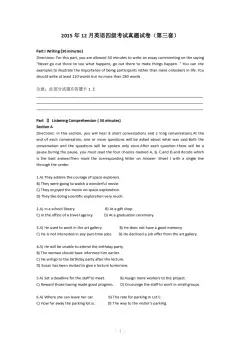
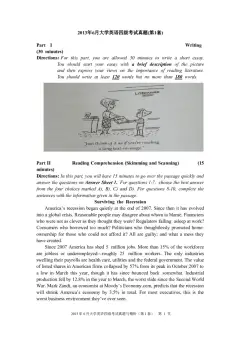
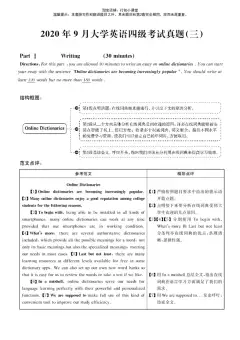
Part I Writing (30 minutes)
Directions: For this part, you are allowed 30 minutes to write an essay commenting on
the saying "Never go out there to see what happens, go out there to make things
happen. " You can cite examples to illustrate the importance of being participants rather
than mere onlookers in life. You should write at least 120 words but no more than 180
words.
注意:此部分试题在答题卡1上
_______________________________________________________________________________
_______________________________________________________________________________
_______________________________________________________________________________
Part Ⅱ Listening Comprehension ( 30 minutes)
Section A
Directions: In this section, you will hear 8 short conversations and 2 long
conversations.At the end of each conversation, one or more questions will be asked
about what was said.Both the conversation and the questions will be spoken only
once.After each question there will be a pause.During the pause, you must read the
four choices marked A, B, C,and D.and decide which is the best answer.Then mark the
corresponding letter on Answer .Sheet I with a single line through the center.
1.A) They admire the courage of space explorers.
B) They were going to watch a wonderful movie.
C) They enjoyed the movie on space exploration.
D) They like doing scientific exploration very much.
2.A) In a school library. B) At a gift shop.
C) In the office of a travel agency. D) At a graduation ceremony.
3.A) He used to work in the art gallery. B) He does not have a good memory.
C) He is not interested in any part-time jobs. D) He declined a job offer from the art
gallery.
4.A) He will be unable to attend the birthday party.
B) The woman should have informed him earlier.
C) He will go to the birthday party after the lecture.
D) Susan has been invited to give a lecture tomorrow.
5.A) Set a deadline for the staff to meet. B) Assign more workers to the project.
C) Reward those having made good progress. D) Encourage the staff to work in small
groups.6.A) Where she can leave her car. B) The rate for parking in Lot C.
C) How far away the parking lot is. D) The way to the visitor's parking.
7.A) He regrets missing the classes. B) He has benefited from exercise.
C) He plans to take the fitness classes. D) He is looking forward to a better life.
8. A) How to select secretaries. B) How to raise work efficiency.
C) The responsibilities of secretaries. D) The secretaries in the man's company.
Questions 9 to 11 are based on the conversation you have just heard.
9.A) It is used by more people than English. B) It is more difficult to learn than
English.
C) It will be as commonly used as English. D) It will eventually become a world
language.
10.A) Its popularity with the common people. B) The effect of the Industrial
Revolution.
C) The influence of the British Empire. D) Its loan words from many languages.
11.A) It has a growing number of newly coined words.
B) It includes a lot of words from other languages.
C) It is the largest among all languages in the world.
D) It can be easily picked up by overseas travellers.
Questions 12 to 15 are based on the conversation you have just heard.
12.A) To place an order. B) To apply for a job.
C) To return some goods. D) To make a complaint.
13.A) He works on a part-time basis for the company.
B) He has not worked in the sales department for long.
C) He is not familiar with the exact details of the goods.
D) He has become somewhat impatient with the woman.
14.A) It is not his responsibility. B) It win be free for large orders.
C) It depends on a number of factors. D) It costs £15 more for express delivery.
15.A) Make inquiries with some other companies.
B) Report the information to her superior.
C) Pay a visit to the saleswoman in charge.
D) Ring back when she comes to a decision.Section B
Directions:In this section, you will hear 3 short passages.At the end of each passage,
you will hear some questions.Both the passage and the questions will be spoken only
once.After you hear a question, you must choose the best answer from the four choices
marked A, B,C.and D .Then mark the corresponding letter on Answer Sheet 1 with a
single line through the center.
Passage One
Questions 16 to 18 are based on the conversation you have just heard.
16.A) No one knows for sure when they came into being.
B) No one knows exactly where they were first made.
C) No one knows for what purpose they were invented.
D) No one knows what they will look like in the future.
17.A) Measure the speed of wind. B) Give warnings of danger.
C) Pass on secret messages. D) Carry ropes across rivers.
18.A) To find out the strength of silk for kites. B) To test the effects of the lightning
rod.
C) To prove that lightning is electricity. D) To protect houses against lightning.
Passage Two
Questions 19 to 22 are based on the passage you have just heard.
19.A) She was born with a talent for languages. B) She was trained to be an
interpreter.
C) She can speak several languages. D) She enjoys teaching languages.
20.A) They want to learn as many foreign languages as possible.
B) They have an intense interest in cross-cultural interactions.
C) They acquire an immunity to culture shock.
D) They would like to live abroad permanently.
21.A) She became an expert in horse racing.
B) She learned to appreciate classical music.
C) She was able to translate for a German sports judge.
D) She got a chance to visit several European countries.
22.A) Take part in a cooking competition. B) Taste the beef and give her comment.
C) Teach vocabulary for food in English. D) Give cooking lessons on Western food.
Passage Three
Questions 23 to 25 are based on the passage you have just heard.23.A) He had only a third-grade education. B) He once threatened to kill his
teacher.
C) He often helped his mother do housework. D) He grew up in a poor single-parent
family.
24.A) Stupid. B) Active. C) Brave. D) Careless.
25.A) Watch educational TV programs only. B) Write two book reports a week.
C) Help with housework. D) Keep a diary.
Section C
Directions: In this section, you will hear a passage three times.When the passage is read
for the first time, you should listen carefully for its general idea.When the passage is
read for the second time, you are required to fill in the blanks with the exact words
you have just heard.Finally, when the passage is read for the third time, you should
check what you have written.
When you look up at the night sky, what do you see? There are other __26__ bodies
out there besides the moon and stars. One of the most __27__ of these is a comet (彗
星).
Comets were formed around the same time the Earth was formed. They are __28__ ice
and other frozen liquids and gases. __29__ these "dirty snowballs" begin to orbit the
sun, just as the planets do.
As a comet gets closer to the sun, some gases in it begin to unfreeze. They __30__
dust particles from the comet to form a huge cloud. As the comet gets even nearer to
the sun, a solar wind blows the cloud behind the comet, thus forming its tail. The tail
and the __31__ fuzzy (模糊的) atmosphere around a comet are __32__ that can help
identify this __33__ in the night sky.
In any given year, about a dozen known comets come close to the sun in their orbits.
The average person can't see them all, of course. Usually there is only one or two a
year bright enough to be seen with the __34__ eye. Comet Hale-Bopp, discovered in
1995, was an unusually bright comet. Its orbit brought it __35__ close to the Earth,
within 122 million miles of it. But Hale-Bopp came a long way on its earthly visit. It
won't be back for another four thousand years or so.
Part Ⅲ Reading Comprehension(40 minutes)
Section A
Directions : In this section, there is a passage with ten blanks.You are required to select
one word for each blank from a list of choices given in a word bank following the
passage.Read the passage through carefully before making your choices.Each choice inthe bank is identified by a letter.Please mark the corresponding letter for each item on
Answer Sheet 2with a single line through the center. You may not use any of the words
in the bank more than once .
Questions 36 to 45 are based on the following passage.
Children do not think the way adults do. For most of the first year of life, if something
is out of sight, it's out of mind. If you cover a baby's __36__ toy with a piece of cloth,
the baby thinks the toy has disappeared and stops looking for it. A 4-year-old may
__37__ that a sister has more fruit juice when it is only the shapes of the glasses that
differ, not the __38__ of juice.
Yet children are smart in their own way. Like good little scientists, children are always
testing their child-sized __39__ about how things work. When your child throws her
spoon on the floor for the sixth time as you try to feed her, and you say, "That's
enough! I will not pick up your spoon again!" the child will __40__ test your claim. Are
you serious? Are you angiy? What will happen if she throws the spoon again? She is
not doing this to drive you __41__ ; rather, she is learning that her desires and yours
can differ, and that sometimes those __42__ are important and sometimes they are not.
How and why does children's thinking change? In the 1920s, Swiss psychologist Jean
Piaget proposed that children's cognitive(认知的) abilities unfold __43__ , like the
blooming of a flower, almost independent of what else is __44__ in their lives. Although
many of his specific conclusions have been __45__ or modified over the years, his ideas
inspired thousands of studies by investigators all over the world.
A) advocate B) amount C) confirmed D) crazy E) definite
F) differences G) favorite H) happening I) immediately J) naturally
K) obtaining L) primarily M) protest N) rejected O) theories
Section B
Directions: In this section, you are going to read a passage with ten statements attached
to it.Each statement contains information given in one of the paragraphs.Identify the
paragraph from which the information is derived.You may choose a paragraph more than
once. Each paragraph is marked with a letter.Answer the questions by marking the
corresponding letter on Answer Sheet 2.
The Perfect Essay
A) Looking back on too many years of education, I can identify one truly impossible
teacher. She cared about me, and my intellectual life, even when I didn't. Her
expectations were high-impossibly so. She was an English teacher. She was also my
mother.
B) When good students turn in an essay, they dream of their instructor returning it tothem in exactly the same condition, save for a single word added in the margin of the
final page: " Flawless. " This dream came true for me one afternoon in the ninth grade.
Of course, I had heard that genius could show itself at an early age, so I was only
slightly taken aback that I had achieved perfection at the tender age of 14. Obviously, I
did what any professional writer would do; I hurried off to spread the good news. I
didn't get very far. The first person I told was my mother.
C) My mother, who is just shy of five feet tall, is normally incredibly soft-spoken, but on
the rare occasion when she got angry, she was terrifying. I am not sure if she was
more upset by my hubris(得意忘形) or by the fact that my English teacher had let my
ego get so out of hand. In any event, my mother and her red pen showed me how
deeply flawed a flawless essay could be. At the time, I am sure she thought she was
teaching me about mechanics, transitions (过渡), structure, style and voice. But what I
learned, and what stuck with me through my time teaching writing at Harvard, was a
deeper lesson about the nature of creative criticism.
D) First off, it hurts. Genuine criticism, the type that leaves a lasting mark on you as a
writer, also leaves an existential imprint (印记) on you as a person. I have heard people
say that a writer should never take criticism personally. I say that we should never listen
to these people.
E) Criticism, at its best, is deeply personal, and gets to the heart of why we write the
way we do. The intimate nature of genuine criticism implies something about who is
able to give it, namely, someone who knows you well enough to show you how your
mental life is getting in the way of good writing. Conveniently, they are also the people
who care enough to see you through this painful realization. For me it took the form of
my first, and I hope only, encounter with writer's block-I was not able to produce
anything for three years.
F) Franz Kafka once said:" Writing is utter solitude (独处), the descent into the cold
abyss (深渊) of oneself. " My mother's criticism had shown me that Kafka is right about
the cold abyss, and when you make the introspective (内省的) descent that writing
requires you are not always pleased by what you find. But, in the years that followed,
her sustained tutoring suggested that Kafka might be wrong about the solitude. I was
lucky enough to find a critic and teacher who was willing to make the journey of
writing with me. "It is a thing of no great difficulty," according to Plutarch, "to raise
objections against another man's speech, it is a very easy matter; but to produce a
better in its place is a work extremely troublesome. " I am sure I wrote essays in the
later years of high school without my mother's guidance, but I can't recall them. What I
remember, however, is how she took up the "extremely troublesome" work of ongoing
criticism.
G) There are two ways to interpret Plutarch when he suggests that a critic should be
able to produce " a better in its place. " In a straightforward sense, he could meanthat a critic must be more talented than the artist she critiques (评论). My mother was
well covered on this count. But perhaps Plutarch is suggesting something slightly
different, something a bit closer to Marcus Cicero's claim that one should " criticize by
creation, not by finding fault. " Genuine criticism creates a precious opening for an
author to become better on his own terms-a process that is often extremely painful, but
also almost always meaningful.
H) My mother said she would help me with my writing, but first I had to help myself.
For each assignment, I was to write the best essay I could. Real criticism is not meant
to find obvious mistakes, so if she found any-the type I could have found on my own-I
had to start from scratch. From scratch. Once the essay was " flawless," she would take
an evening to walk me through my errors. That was when true criticism, the type that
changed me as a person, began.
I) She criticized me when I included little-known references and professional jargon (行
话) ?She had no patience for brilliant but irrelevant figures of speech. "Writers can't
bluff (虚张声势) their way through ignorance. " That was news to me-I would need to
find another way to structure my daily existence.
J) She trimmed back my flowery language, drew lines through my exclamation marks and
argued for the value of restraint in expression. " John," she almost whispered. I leaned
in to hear her: "I can't hear you when you shout at me. " So I stopped shouting and
bluffing, and slowly my writing improved.
K) Somewhere along the way I set aside my hopes of writing that flawless essay. But
perhaps I missed something important in my mother's lessons about creativity and
perfection. Perhaps the point of writing the flawless essay was not to give up, but to
never willingly finish. Whitman repeatedly reworked "Song of Myself' between 1855 and
1891. Repeatedly. We do our absolute best with a piece of writing, and come as close
as we can to the ideal. And, for the time being, we settle. In critique, however, we are
forced to depart, to give up the perfection we thought we had achieved for the chance
of being even a little bit better. This is the lesson I took from my mother.. If perfection
were possible, it would not be motivating.
46. The author was advised against the improper use of figures of speech.
47. The author's mother taught him a valuable lesson by pointing out lots of flaws in
his seemingly perfect essay.
48. A writer should polish his writing repeatedly so as to get closer to perfection.
49. Writers may experience periods of time in their life when they just can't produce
anything.
50. The author was not much surprised when his school teacher marked his essay as
"flawless".
51. Criticizing someone's speech is said to be easier than coming up with a better one.
52. The author looks upon his mother as his most demanding and caring instructor.53. The criticism the author received from his mother changed him as a person.
54. The author gradually improved his writing by avoiding fancy language.
55. Constructive criticism gives an author a good start to improve his writing.
Section C
Directions: There are 2 passages in this section.Each passage is followed by some
questions or unfinished statements.For each of them there are four choices marked A, B,
C. And D .You should decide on the best choice and mark the corresponding letter on
Answer. Sheet 2 with a single line through the center.
Passage One
Questions 56 to 60 are based on the following passage.
Could you reproduce Silicon Valley elsewhere, or is there something unique about it?
It wouldn't be surprising if it were hard to reproduce in other countries, because you
couldn't reproduce it in most of the US either. What does it take to make a Silicon
Valley?
It's the right people. If you could get the right ten thousand people to move from
Silicon Valley to Buffalo, Buffalo would become Silicon Valley.
You only need two kinds of people to create a technology hub (中心): rich people and
nerds (痴迷科研的人)
Observation bears this out. Within the US, towns have become startup hubs if and only
if they have both rich people and nerds. Few startups happen in Miami, for example,
because although it's full of rich people, it has few nerds. It's not the kind of place
nerds like.
Whereas Pittsburgh has the opposite problem: plenty of nerds, but no rich people. The
top US Computer Science departments are said to be MIT, Stanford, Berkeley, and
Carnegie-Mellon. MIT yielded Route 128. Stanford and Berkeley yielded Silicon Valley. But
what did Cainegie-Mellon yield in Pittsburgh? And what happened in Ithaca, home of
Cornell University, which is also high on the list?
I grew up in Pittsburgh and went to college at Cornell, so I can answer for both. The
weather is terrible, particularly in winter, and there's no interesting old city to make up
for it, as there is in Boston. Rich people don't want to live in Pittsburgh or Ithaca. So
while there're plenty of hackers (电脑迷) who could start startups, there's no one to
invest in them.
Do you really need the rich people? Wouldn't it work to have the government invest in
the nerds? No, it would not. Startup investors are a distinct type of rich people. Theytend to have a lot of experience themselves in the technology business. This helps them
pick the right startups, and means they can supply advice and connections as well as
money. And the fact that they have a personal stake in the outcome makes them really
pay attention.
注意:此部分试题请在答题卡2上作答。
56. What do we learn about Silicon Valley from the passage?
A) Its success is hard to copy anywhere else.
B) It is the biggest technology hub in the US.
C) Its fame in high technology is incomparable.
D) It leads the world in information technology.
57. What makes Miami unfit to produce a Silicon Valley?
A) Lack of incentive for investment. B) Lack of the right kind of talents.
C) Lack of government support. D) Lack of famous universities.
58. In what way is Carnegie-Mellon different from Stanford, Berkeley and MIT?
A) Its location is not as attractive to rich people.
B) Its science departments are not nearly as good.
C) It does not produce computer hackers and nerds.
D) It does not pay much attention to business startups.
59. What does the author imply about Boston?
A) It has pleasant weather all year round.
B) It produces wealth as well as high-tech.
C) It is not likely to attract lots of investors and nerds.
D) It is an old city with many sites of historical interest.
60. What does the author say about startup investors?
A) They are especially wise in making investments.
B) They have good connections in the government.
C) They can do more than providing money.
D) They are rich enough to invest in nerds.
Passage Two
Questions 61 to 65 are based on the following passage.
It's nice to have people of like mind around. Agreeable people boost your confidence
and allow you to relax and feel comfortable. Unfortunately, that comfort can hinder the
very learning that can expand your company and your career.
It's nice to have people agree, but you need conflicting perspectives to dig out the
truth. If everyone around you has similar views, your work will suffer from confirmationbias(偏颇).
Take a look at your own network. Do your contacts share your point of view on most
subjects? If yes, it's time to shake things up. As a leader, it can be challenging to
create an environment in which people will freely disagree and argue, but as the saying
goes: From confrontation comes brilliance.
It's not easy for most people to actively seek conflict. Many spend their lives trying to
avoid arguments. There's no need to go out and find people you hate, but you need to
do some self-assessment to determine where you have become stale in your thinking.
You may need to start by encouraging your current network to help you identify your
blind spots.
Passionate, energetic debate does not require anger and hard feelings to be effective.
But it does require moral strength. Once you have worthy opponents, set some ground
rules so everyone understands responsibilities and boundaries. The objective of this
debating game is not to win but to get to the truth that will allow you to move faster,
farther, and better.
Fierce debating can hurt feelings, particularly when strong personalities are involved.
Make sure you check in with your opponents so that they are not carrying the emotion
of the battles beyond the battlefield. Break the tension with smiles and humor to
reinforce the idea that this is friendly discourse and that all are working toward a
common goal.
Reward all those involved in the debate sufficiently when the goals are reached. Let
your sparring partners (拳击陪练) know how much you appreciate their contribution. The
more they feel appreciated, the more they'll be willing to get into the ring next time.
注意:此部分试题请在答题卡2上作答。
61. What happens when you have like-minded people around you all the while?
A) It will help your company expand more rapidly.
B) It will create a harmonious working atmosphere.
C) It may prevent your business and career from advancing.
D) It may make you feel uncertain about your own decisions.
62. What does the author suggest leaders do?
A) Avoid arguments with business partners. B) Encourage people to disagree and
argue.
C) Build a wide and strong business network. D) Seek advice from their worthy
competitors.
63. What is the purpose of holding a debate?A) To find out the truth about an issue. B) To build up people's moral strength.
C) To remove misunderstandings. D) To look for worthy opponents.
64. What advice does the author give to people engaged in a fierce debate?
A) They listen carefully to their opponents' views.
B ) They show due respect for each other's beliefs.
C) They present their views clearly and explicitly.
D) They take care not to hurt each other's feelings.
65. How should we treat our rivals after a successful debate?
A) Try to make peace with them. B) Try to make up the differences.
C) Invite them to the ring next time. D) Acknowledge their contribution.
Part Ⅳ Translation( 30 minutes )
Directions: For this part, you are allowed 30 minutes to translate a passage from
Chinese into English.You should, write your answer on Answer Sheet 2.
今年在长沙举行了一年一度的外国人汉语演讲比赛。这项比赛证明是促进中国和世界其他
地区文化交流的好方法。它为世界各地的年轻人提供了更好地了解中国的机会。
来自87个国家共计126位选手聚集在湖南省省会参加了从7月6日到8月5日进行的半决
赛和决赛。
比赛并不是唯一的活动,选手们还有机会参观了中国其他地区的著名景点和历史名胜。
注意:此部分试题请在答题卡2上作答。
2015年12月全国大学英语四级考试(第三套)参考答案
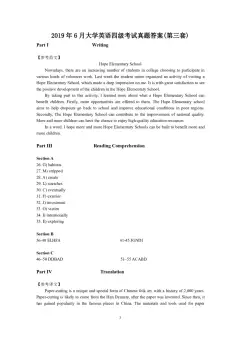
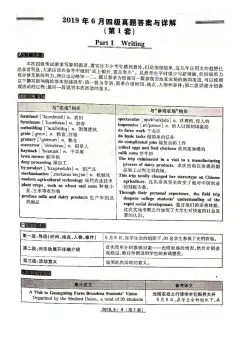
【作文范文】
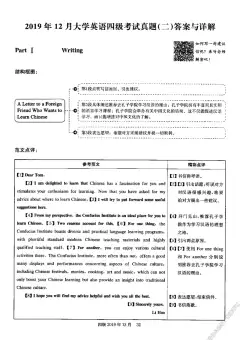
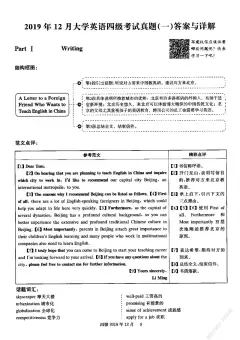
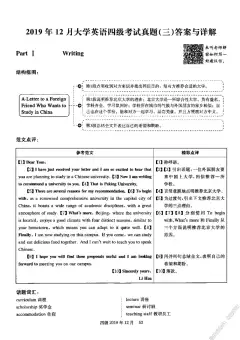
Be Participants Rather than OnlookersJust as the saying goes, never go out there to see what happens, go out there to make
things happen. It obviously emphasizes the importance of being participants instead of
mere onlookers in life.
There are several reasons accounting for it. To start with, you will never learn the
essence of life unless you try something on your own. Whether it's a success or a
failure, it will make your life more colorful. Furthermore, chances are only for those who
are brave enough to challenge themselves. They tend to have more choices and
opportunities than others. Last but not least, Rome is not built in one day. Only if you
are a doer rather than a watcher can you get life-long valuable experience.
It is no exaggeration to say that many of the young generations prefer to be onlookers,
which seems to be easier and less stressful. But this kind of attitude is devastating. We
should start making a change by applying what we have learned into practice, and play
our part in bettering our world, which will finally benefit not only ourselves but also the
future generations.
Part II
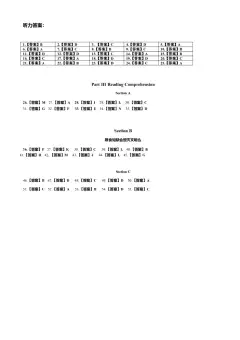
CBDAA DBDAC BACCD ADCCB CBDAB
26. Heavenly 27. Fascinating 28. made up of 29. Now and then 30. combine with
31. Generally 32. Characteristics 33. Phenomenon 34. Naked 35. relatively
Part III
GMBOI DFJHN ICKEB FAHJG ABADC CBADD
Part IV
参考答案:
An annual Chinese speech contest for foreigners was held in Changsha this year, which
proved to be a good way of promoting the cultural communication between China and
other areas of the world. It offered young people all over the world a good opportunity
to learn better about China.
A total of 126 contestants from 87 countries gathered in the capital of Hunan Province
and took pan in both the semifinal and the final from July 6 to August 5.
The competition was not the only activity. The contestants also got chances to visit the
famous scenic spots and historical resorts in other parts of China.