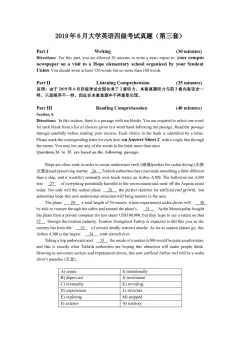
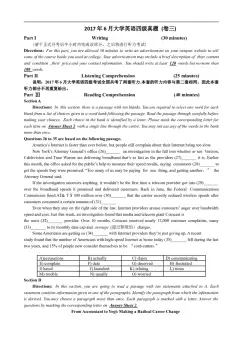
Part I Writing ( 30 minutes)
Directions : For this part , you are allowed 30 minutes to write an advertisement on your campus
website to sell a computer you used at college. Your advertisement may include its
brand, specifications/features, condition and price, and your contact information. You
should write at least 120 words but no more than 180 words.
Part II Listening Comprehension ( 25 minutes)
i.~JJ.I: EBT 2017 .$ 6 ~ lm~~i.i\:~00~~7 2 ~PJr11,*~~~PJr1J~wi 2 ~pg~~~-t-$,JH~:1119i
Ff~-t,$, lts!Jl:t1£*~~~~~~:m~lfi!J\!o
Part ID Reading Comprehension ( 40 minutes)
Section A
Directions: In this section, there is a passage with ten blanks. You are required to select one word
for each blank from a list of choices given in a word bank following the passage. Read the
passage through carefully before making your choices. Each choice in the bank is
identified by a letter. Please mark the corresponding letter for each item on Answer
Sheet 2 with a single line through the centre. You may not use any of the words in the
bank more than once.
Questions 26 to 35 are based on the following passage.
America's Internet is faster than ever before, but people still complain about their Internet being
too slow.
New York's Attorney General's office 26 an investigation in the fall into whether or not
Verizon, Cablevision and Time Warner are delivering broadband that's as fast as the providers 27 it
is. Earlier this month, the office asked for the public's help to measure their speed results, saying
consumers 28 to get the speeds they were promised. " Too many of us may be paying for one
thing , and getting another, " the Attorney General said.
If the investigation uncovers anything , it wouldn't be the first time a telecom provider got into
29 over the broadband speeds it promised and delivered customers. Back in June, the Federal
Communications Commission fined AT&T $100 million over 30 that the carrier secretly reduced
wireless speeds after customers consumed a certain amount of 31
Even when they stay on the right side of the law, Internet providers arouse customers' anger over
bandwidth speed and cost. Just this week, an investigation found that media and telecom giant
Comcast is the most 32 provider. Over 10 months, Comcast received nearly 12 , 000 customer
complaints, many 33 to its monthly data cap and overage Um:i:1Wfl3ti¥J) charges.
Some Americans are getting so 34 with Internet providers they're just giving up. A recent study
found that the number of Americans with high-speed Internet at home today 35 fell during the last
two years, and 15% of people now consider themselves to be "cord-cutters. "
A) accusations I) hated
B) actually J) launched
C) claim K) relating
D) communicating L) times
E) complain M) trouble
F) data N) usually
G) deserved 0) worried
H) frustrated
2017.6/ 1 (ffi3 ~)Section B
Directions : In this section, you are going to read a passage with ten statements attached to it. Each
statement contains information given in one of the paragraphs. Identify the paragraph
from which the information is derived. You may choose a paragraph more than once.
Each paragraph is marked with a letter. Answer the questions by marking the
corresponding letter on Answer Sheet 2.
From Accountant to Yogi: Making a Radical Career Change
A) At some point, almost all of us will experience a period of radical professional change. Some of us
will seek it out; for others it will feel like an unwelcome intrusion into otherwise stable careers.
Either way, we have choices about how we respond to it when it comes.
B) We recently caught up with yoga entrepreneur Leah Zaccaria, who put herself through the fire of
change to completely reinvent herself. In her search to live a life of purpose , Leah left her high
paying accounting job, her husband, and her home. In the process, she built a radically new life
and career. Since then, she has founded two yoga studios, met a new life partner, and formed a
new community of people. Even if your personal reinvention is less drastic, we think there are
lessons from her experience that apply.
C) Where do the seeds of change come from? The Native American Indians have a saying: " Pay
attention to the whispers so you won't have to hear the screams. " Often the best ideas for big
changes come from unexpected places-it's just a matter of tuning in. Great leaders recognize the
weak signals or slight signs that point to big changes to come. Leah reflects on a time she listened
to the whispers : "About the time my daughter was five years old, I started having a sense that ' this
isn't right. ' " She then realized that her life no longer matched her vision for it.
D) Up until that point, Leah had followed traditional measures of success. After graduating with a
degree in business and accounting, she joined a public accounting firm, married, bought a house,
put lots of stuff in it, and had a baby. "I did what everybody else thought looked successful," she
says. Leah easily could have fallen into a trap of feeling content; instead, her energy sparked a
period of experimentation and renewal.
E) Feeling the need to change , Leah started playing with future possibilities by exploring her interests
and developing new capabilities. First trying physical exercise and dieting, she lost some weight
and discovered an inner strength. " I felt powerful because I broke through my own limitations , "
she recalls.
F) However, it was another interest that led Leah to radically reinvent herself. "I remember sitting on
a bench with my aunt at a yoga studio , " she said, "and having a moment of clarity right then and
there: Yoga is saving my life. Yoga is waking me up. I'm not happy and I want to change and I'm
done with this. " In that moment of clarity Leah made an important leap , conquering her inner
resistance to change and making a firm commitment to take bigger steps.
G) Creating the future you want is a lot easier if you are ready to exploit the opportunities that come
your way. When Leah made the commitment to change, she primed herself to new opportunities
she may otherwise have overlooked. She recalls :
H) One day a man I worked with, Ryan, who had his office next to mine, said, "Leah, let's go look at
this space on Queen Anne. " He knew my love for yoga and had seen a space close to where he
lived that he thought might be good to serve as a yoga studio. As soon as I saw the location, I knew
this was it. Of course I was scared, yet I had this strong sense of "I have to do this. " Only a few
months later Leah opened her first yoga studio , but success was not instant.
I) Creating the future takes time. That's why leaders continue to manage the present while building
toward the big changes of the future. When it's time to make the leap, they take action and
immediately drop what's no longer serving their purpose. Initially Leah stayed with her accounting
job while starting up the yoga studio to make it all work.
J) Soon after, she knew she had to make a bold move to fully commit to her new future. Within two
2017.6/ 2 (ffi3 ~)years, Leah shed the safety of her accounting job and made the switch complete. Such drastic
change is not easy.
K) Steering through change and facing obstacles brings us face to face with our fears. Leah reflects on
one incident that triggered her fears , when her investors threatened to shut her down : " I was
probably up against the most fear I've ever had, " she says. "I had spent two years cultivating this
community, and it had become successful very fast, but within six months I was facing the prospect
of losing it all. "
L) She connected with her sense of purpose and dug deep , cultivating a tremendous sense of strength.
"I was feeling so intentional and strong that I wasn't going to let fear just take over. I was thinking,
' OK, guys, if you want to try to shut me down, shut me down. ' And I knew it was a negotiation
scheme , so I was able to say to myself, ' This is not real. ' " By naming her fears and facing them
head-on, Leah gained confidence. For most of us, letting go of the safety and security of the past
gives us great fear. Calling out our fears explicitly, as Leah did, can help us act decisively.
M) The cycle of renewal never ends. Leah's growth spurred her to open her second studio-and it
wasn't for the money.
N) I have no desire to make millions of dollars. It's not about that; it's about growth for me. Honestly,
I didn't need to open a second studio. I was making as much money as I was as an accountant. But
I know if you don't grow, you stand still, and that doesn't work for me.
0) Consider the current moment in your own life , your team or your organization. Where are you in
the cycle of renewal : Are you actively preserving the present, or selectively forgetting the past, or
boldly creating the future? What advice would Leah give you to move you ahead on your journey?
Once we're on the path of growth, we can continually move through the seasons of transformation
and renewal.
36. Readiness to take advantage of new opportunities will make it easier to create one's desired future.
37. By conventional standards, Leah was a typical successful woman before she changed her career.
38. Leah gained confidence by laying out her fears and confronting them directly.
39. In search of a meaningful life , Leah gave up what she had and set up her own yoga studios.
40. Leah's interest in yoga prompted her to make a firm decision to reshape her life.
41. Small signs may indicate great changes to come and therefore merit attention.
42. Leah's first yoga studio was by no means an immediate success.
43. Some people regard professional change as an unpleasant experience that disturbs their stable
careers.
44. The worst fear Leah ever had was the prospect of losing her yoga business.
45. As she explored new interests and developed new potentials, Leah felt powerful internally.
Section C
Directions : There are 2 passages in this section. Each passage is followed by some questions or
unfinished statements. For each of them there are four choices marked A), B), C) and
D). You should decide on the best choice and mark the corresponding letter on Answer
Sheet 2 with a single line through the centre.
Passage One
Questions 46 to 50 are based on the following passage.
Urbanization-migration away from the suburbs to the city center-will be the biggest real estate
trend in 2015, according to a new report.
The report says America's urbanization will continue to be the most significant issue affecting the
industry, as cities across the country imitate the walkability and transit-oriented development making
cities like New York and San Francisco so successful.
As smaller cities copy the model of these "24-hour cities," more affordable versions of these
2017.6/ 3 (ffi3 ~)places will be created. The report refers to this as the coming of the "18-hour city," and uses the term
to refer to cities like Houston, Austin, Charlotte, and Nashville, which are "positioning themselves as
highly competitive , in terms of livability, employment offerings, and recreational and cultural
facilities. "
Another trend that looks significant in 2015 is that America's largest population group, Millennials
( -f-*f~{-t) , will continue to put off buying a house. Apartments will retain their appeal for a while for
Millennials, haunted by what happened to home-owning parents.
This trend will continue into the 2020s, the report projects. After that, survey respondents
disagree over whether this generation will follow in their parents' footsteps , moving to the suburbs to
raise families, or will choose to remain in the city center.
Another issue affecting real estate in the coming year will be America's failing infrastructure. Most
roads , bridges , transit, water systems, the electric grid, and communications networks were installed
50 to 100 years ago , and they are largely taken for granted until they fail.
The report's writers state that America's failure to invest in infrastructure impacts not only the
health of the real-estate market, but also our ability to remain globally competitive.
Apart from the specific trends highlighted above , which cause some investors to worry, the report
portrays an overall optimism borne by the recent healthy real-estate " upcycle " and improving
economy. Seventy-four percent of the respondents surveyed report a "good to excellent" expectation of
real-estate profitability in 2015. While excessive optimism can promote bad investment patterns,
resulting in a real-estate "bubble," the report's writers downplay that potential outcome in that it has
not yet occurred.
46. According to the new report, real estate development in 2015 will witness ____
A) an accelerating speed C) a new focus on small cities
B) a shift to city centers D) an ever-increasing demand
47. What characterizes "24-hour cities" like New York?
A) People can live without private cars. C) People can enjoy services around the clock.
B) People are generally more competitive. D) People are in harmony with the environment.
48. Why are Millennials reluctant to buy a house?
A) They can only afford small apartments.
B) The house prices are currently too high.
C) Their parents' bad experience still haunts them.
D) They feel attached to the suburban environment.
49. What might hinder real estate development in the U.S.?
A) The continuing economic recession in the country.
B) The lack of confidence on the part of investors.
C) The fierce global competition.
D) The worsening infrastructure.
50. How do most of the respondents in the survey feel about the U.S. real-estate market in 2015?
A) Pessimistic. B) Hopeful. C) Cautious. D) Uncertain.
Passage Two
Questions 51 to 55 are based on the following passage.
The brain is a seemingly endless library, whose shelves house our most precious memories as well
as our lifetime's knowledge. But is there a point where it reaches capacity?
The answer is no , because brains are more sophisticated than that. Instead of just crowding in,
old information is sometimes pushed out of the brain for new memories to form.
Previous behavioural studies have shown that learning new information can lead to forgetting. But
in a new study, researchers demonstrated for the first time how this effect occurs in the brain.
In daily life, forgetting actually has clear advantages. Imagine, for instance, that you lost your
2017.6/ 4 (ffi3 ~)bank card. The new card you receive will come with a new personal identification number ( PIN ) .
Each time you remember the new PIN, you gradually forget the old one. This process improves access
to relevant information , without old memories interfering.
And most of us may sometimes feel the frustration of having old memories interfere with new,
relevant memories. Consider trying to remember where you parked your car in the same car park you
were at a week earlier. This type of memory ( where you are trying to remember new, but similar
information) is particularly vulnerable to interference.
When we acquire new information, the brain automatically tries to incorporate ( if# ) it within
existing information by forming associations. And when we retrieve ( ~ ~ ) information, both the
desired and associated but irrelevant information is recalled.
The majority of previous research has focused on how we learn and remember new information.
But current studies are beginning to place greater emphasis on the conditions under which we forget, as
its importance begins to be more appreciated.
A very small number of people are able to remember almost every detail of their life. While it may
sound like an advantage to many, people with this rare condition often find their unusual ability
burdensome.
In a sense , forgetting is our brain's way of sorting memories, so the most relevant memories are
ready for retrieval. Normal forgetting may even be a safety mechanism to ensure our brain doesn't
become too full.
51. What have past behavioural studies found about our brain?
A) Its capacity actually knows no limits.
B) It grows sophisticated with practice.
C) It keeps our most precious memories until life's end.
D) New information learned pushes old information out.
52. What is the benefit of forgetting?
A) It frees us from painful memories.
B) It helps slow down our aging process.
C) It facilitates our access to relevant information.
D) It prevents old information from forming associations.
53. What is the emphasis of current studies of memory?
A) When people tend to forget.
B) What contributes to forgetting.
C) How new technology hinders memory capacity.
D) Why learning and forgetting are complementary.
54. What do people find about their rare ability to remember every detail of their life?
A) It adds to the burden of their memory. C) It contributes to their success in life.
B) It makes their life more complicated. D) It constitutes a rare object of envy.
55. What does the passage say about forgetting?
A) It can enlarge our brain capacity. C) It is a way of organising our memories.
B) It helps get rid of negative memories. D) It should not cause any alarm in any way.
Part IV Translation ( 30 minutes)
Directions : For this part, you are allowed 30 minutes to translate a passage from Chinese into
English. You should write your answer on Answer Sheet 2.
~u:IJ~1¥f ~:kfiiJ*, tif:£JfMrn, ¾9" OOffi=-*~fiiJti ,{,:ZiXr*iI:fllwJiiJ o ~u-=:ffi~H (delta)¾
9" 00:li~~l'r{J:1:-tf!IXZ ~, ffilRf:/4; 11 ooo Jf jJ % 1IL 'ttEffifJt:fll)d=I 7Jffii:11¾tltW J::li:k~~rn!IH~ IX.a
~u=-ffi~ft~:li:k~rn~~5roo~~A~ol:tttrero~ft*9"00~¥Ha~*.~u-ffi~B~~
9" 00 :fll tit W ±~ f ::£ m I X~: fll ttl :a!r 9", t:,, Z ~ o
2017.6/ 5 (ffi3~)