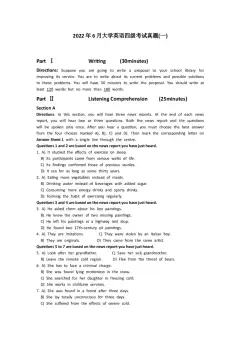
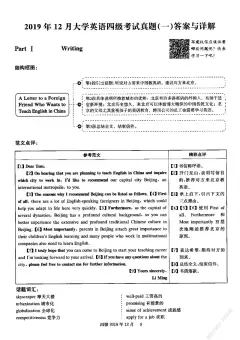
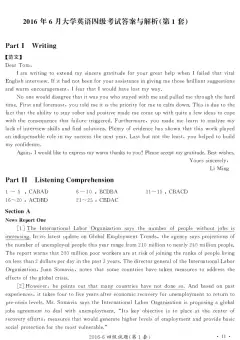
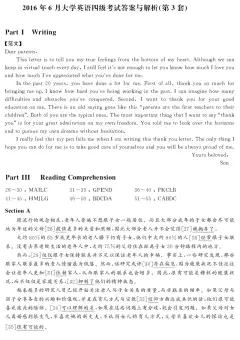
2022年6月大学英语四级考试真题(一)
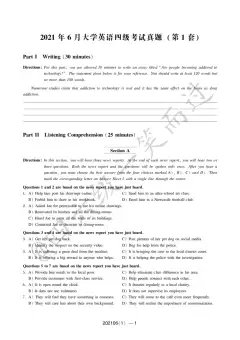
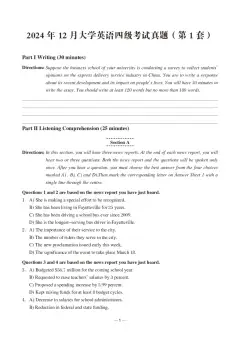
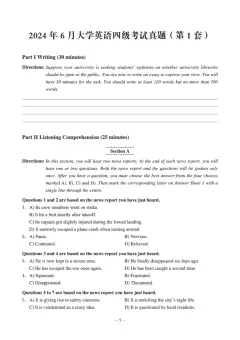
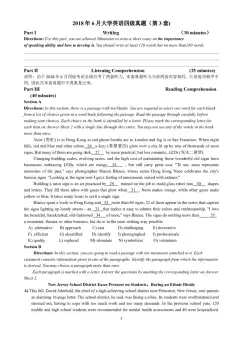
Part Ⅰ Writing (30minutes)
Directions: Suppose you are going to write a proposal to your student union for enriching
students’ extracurricular activities. You are to write about what activities to organize and why.
You will have 3 minutes to write the proposal. You should write at least 120 words but no more
than 180 words.
Part Ⅱ Listening Comprehension (25minutes)
说明:由于2022年6月四级考试全国共考了一套听力,本套真题听力与第一套内容相同,
只是选项顺序不同,因此在本套真题中不再重复出现。
Part Ⅲ Reading Comprehension (40 minutes)
Section A
Directions: In this section, there is a passage with ten blanks. You are required to select one
word for each blank from a list of choices given in a word bank following the passage. Read the
passage through carefully before making your choices. Each choice in the bank is identified by a
letter. Please mark the corresponding letter for each item on Answer Sheet 2 with a single line
through the centre. You may not use any of the words in the bank more than once.
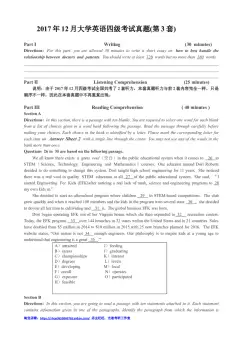
If you’ve ever looked at the ingredients list while grocery shopping, chances are you've seen
the term“natural flavors”. But have you taken a_ 26__to consider what these natural flavors
actually are?
Most of us might think that“natural flavors”are,well naturally good for us. A recent study in the
journal Appetite found that when the word “natural”appears on packaging, people_ 27__ that
the food within is indeed healthier. In truth, natural flavors do not 28 much, at least chemically
speaking, from their flavor-boosting 29 :artificial flavors. Both can be made in a lab by trained
flavorists, but artificial flavors use chemicals to give a product a 30 smell or taste.
Natural flavors come from plant or animal 31 , like fruit, vegetable, meat, fish or milk that is
then processed or refined in some way.In short, natural flavors are 32 from plants and animals to
create specific flavors for processed foods.But that does not 33 make it easier to tell what is really
in your food. Because the Food and Drug Administration(FDA) has not 34 the term ,
companies can use it to refer to pretty much anything derived from a plant or animal.And natural
flavors can also include a variety of chemical additives,such as preservatives.The FDA doesn’t
require companies to reveal what additional chemicals a specific item 35 .
So if you want to know for certain what you’re getting with your groceries,you might want to
stick to the farmer's market.
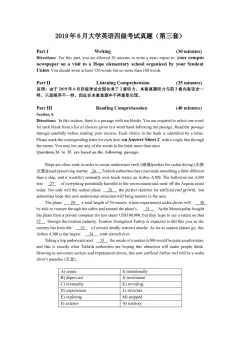
A) acknowledge I) implies
B) chance J)necessarily
C) contains K) particular
D) counterparts L)perceive
E)defined M) secondF) differ N) sources
G) especially O) strange
H) extracted
Section B
Directions: In this section, you are going to read a passage with ten statements attached to it.
Each statement contains information given in one of the paragraphs. Identify the paragraph from
which the information is derived. You may choose a paragraph more than once. Each paragraph
is marked with a letter. Answer the questions by marking the corresponding letter on Answer
Sheet 2.
Fake holiday villa websites prompt warning
A) During the British winter,the thought of two weeks in a coastal villa (别墅) with soul-stirring
views of the sea and a huge pool to enjoy is enough to offset(抵消) the labor until the holidays
start. For a growing number of people, however, their yearly break is turning into a nightmare as
they find that the property they have paid thousands for does not exist and the website through
which they booked it has disappeared.
B) Consumers have been warned to be aware of the potential for deception in this market, which
is far from uncommon. In 2017 there were1,632 cases of reported “villa fraud (诈骗)”,with
victims losing an average of £2,052,according to Action Fraud,the national center for reporting
such frauds.“Millions of pounds are lost each year by defrauded holidaymakers,”says Sean Tipton
of the Association of British Travel Agents (ABTA).
C) The problem has ballooned in the last 10 years, with frauds becoming more and more
sophisticated.The fake websites have authentic-sounding names involving a mix of keywords,
typically including the place name,“summer”,“villas”or “rentals”Details of legitimate(合法的)
villas are often stolen from other sites. “When the fraudsters first started it was unsophisticated
—the websites looked amateur and there wasn’t a lot of effort,”says Tipton.“Now they are
clever.They extensively rip off legitimate websites and use a different website name.They’ll have
pictures of a sales team and it might be a poor actor in New York that is down as their head of
sales.”
D) Fraudsters target popular seaside destinations for British tourists visiting Spain where prices
can soar if demand exceeds supply. Prices are kept within reasonable ranges to avoid arousing
suspicion.“A villa might cost £5,000 elsewhere and they will offer it at say£3,500.But a bit of a
giveaway is that the villa will be cheaper than on other websites and there’s unlimited
availability,”says Tipton. Fraudsters also invest in pay-per-click advertising to feature at the top of
search engines when people type in phrases such as “Spanish seaside villas”.
E) With such a degree of professionalism,how can consumers find out if the website they're
looking to book with is trustworthy?“When people book holiday villas they are doing so through
rose-colored glasses,” says Tony Neate, chief executive of Get Safe Online. “They should be
Googling the property,and looking on websites like Google Maps and StreetView to see if it’s
there. Also, speak t the person you’re booking the villa with on a landline phone, as fraudsters
tend to only use mobiles.” He also suggests asking someone not going on the holiday to have a
look at the website.“They might spot problems you don’t spot.”Another potential red flag is being
asked to pay by bank transfer.“The problem is that when the money leaves your account it’s in
theirs straightaway and it’s very hard to track it,”says Barclays Bank head of digital safety,JodieGilbert.“We generally recommend other forms of payment, like credit card.”
F) Little seems to be known about these fraudsters.“There is no way to definitely know who they
are,” says Neate. “It could be anyone.It could be your next-door neighbor or organized crime in
Russia.”Action Fraud says people should ensure the company renting the villa is a member of a
recognized trade body such as ABTA.
G) “By working with industry partners such as ABTA and Get Safe Online, we are able to issue
alerts about the latest threats they should be aware of.If you believe you have fallen victim to
fraud or cyber- crime,please report it to Action Fraud,”it adds. ABTA says it is trying to combat the
issue by running public awareness campaigns.
“It’s a growing problem and people can’t stop fraudsters being dishonest,” says Tipton.“They’re
still going to do it.It’s not impossible to stop but as it’s internet-based it’s harder to pursue. ”
H) Nick Cooper,the founder and co-owner of villa booking company Villa Plus,estimates his
company has uncovered more than 200 fake villa websites over the past two years,and doesn’t
believe enough is being done.“It is hopeless to report fake villa websites to the internet giants
who host them,”he says.“I found it impossible to speak to anyone.Also,once one bank account
gets reported, they simply use another."
I)For now the only way to stop fraudsters appears ultimately to lie in the hands of the consumer.
“When people book their holidays they get so emotionally involved,and when they find that villa
at a good price with availability in peak season, they are an easy target,”says Cooper.“The public
has to learn to be far more aware they are a target for these sort of frauds.”But it’s not just the
financial cost. “A family will turn up at a villa and find out it doesn’t exist or the owner doesn’t
know who you are,” says Tipton.“The problem then is you have to find accommodation at short
notice.It can be incredibly expensive but it's the emotional cost,too.”
J)Carla O’Shaughnessy from Sydenham was searching last year for a good deal to book a villa in
Majorca for a summer break for the family.“I was comparing prices online and found one that
came in a bit cheaper than others,”says O’Shaughnessy.She emailed the company via its website,
asking how far the villa was from the airport and about local restaurants.“They came back with
believable answers, was all very friendly and professional,”she says.Happy with the
responses,O'Shaughnessy paid the full amount of £3,000 via bank transfer into the travel agent’s
account and then forgot about it until a month before the booking.
K)“I tried logging on to the website and couldn’t,”she recalls.“I Googled the agent's name and
there were lots of complaints about him being a fraudster.If only I’d Googled before but I never
thought of it.”Although she found another villa in time for their holiday,she admits she was much
more cautious. “I paid through a secure third-party site and had phone conversations with the
agent. But I wasn’t able to relax until we turned up and I had the keys.”
36.Fraudsters often steal villa-booking information from authentic holiday websites.
37.Fraudsters keep changing their bank accounts to avoid being tracked.
38. It is suggested that people not going on the holiday might help detect website frauds.
39. More and more British holidaymakers find the seaside villas they booked online actually
nonexistent.
40. By checking an agent’s name online before booking a villa,holidaymakers can avoid falling into
traps.
41. Fraudsters are difficult to identify,according to an online safety expert.
42.Holidaymakers have been alerted to the frequent occurrence of online villa-booking frauds.43.It is holidaymakers that can protect themselves from falling victim to frauds.
44.Holidaymakers are advised not to make payments by bank transfer.
45. Fraudsters advertise their villas at reasonable prices so as not to be suspected.
Section C
Directions: There are 2 passages in this section. Each passage is followed by some questions or
unfinished statements. For each of them there are four choices marked A), B), C) and D). You
should decide on the best choice and mark the corresponding letter on Answer Sheet 2 with a
single line through the centre.
Passage One
Questions 46 to 50 are based on the following passage.
Social media can be a powerful communication tool for employees,helping them to
collaborate, sh ideas and solve problems. Research has shown that 82% of employees think social
media can improve work relationships and 60%believe it can support decision-making processes.
These beliefs contribute to a majority of workers connecting with colleagues on social media,
even during work hours.
Employers typically worry that social media is a productivity killer; more than half of U.S.
employers reportedly block access to social media at work. In my research with 277 employees of
a healthcare organization I found these concerns to be misguided.Social media doesn’t reduce
productivity nearly as much as it kills employee retention.
In the first part of the study I surveyed the employees about why and how they used platforms
like Facebook,Twitter, or LinkedIn.Respondents were then asked about their work behaviors,
including whether they felt motivated in their jobs and showed initiative at work.I found
employees who engage in online social interactions with co-workers through social media blogs
tend to be more motivated and come up with innovative ideas. But when employees interact
with individuals outside the organization, they are less motivated and show less initiative.
In the second part of the study I found 76% of employees using social media for work took an
interest n other organizations they found on social media.When I examined how respondents
expressed openness to new careers and employers,I found that they engaged in some key
activities including researching new organizations and making new work connections.
These findings present a dilemma for managers: employees using social media at work are
more engaged and more productive, but they are also more likely to leave your
company.Managers should implement solutions that neutralize the retention risk caused by
social media.
They can create social media groups in which employees will be more likely to collaborate and l
likely to share withdrawal intentions or discussions about external job opportunities.
Managers can also use social media to directly reduce turnover(跳槽)intentions ,by recognizing
employees’ accomplishments and giving visibility to employees’ success stories.
46. What does previous research about social media reveal?
A) Most employees think positively of it.
B)It improves employees ’work efficiency.
C) It enables employees to form connections.
D) Employees spend much of their work time on it.
47. What did the author’s own research find about social media?A)It influences employees’ work negatively.
B)It does much harm to employee loyalty.
C)It kills employees motivation for work.
D)It affects employers’ decision-making.
48. What did the author find in his study about the effect of online social interactions?
A)It differs from employee to employee.
B) It tends to vary with the platform used.
C) It has much to do with whom employees interact with.
D) It is hard to measure when employees interact with outsiders.
49. What problem was found with employees using social media for work?
A)They seldom expressed their inner thoughts.
B) Most of them explored new job opportunities.
C) They were reluctant to collaborate with others
D) Many of them ended with lower productivity
50.What does the author suggest managers do to neutralize the retention risk?
A) Give promotions to employees for their accomplishments.
B) Create opportunities for employees to share success stories.
C) Acknowledge employees’ achievements through social media.
D) Encourage employees to increase their visibility on social media.
Passage Two
Questions 51 to 55 are based on the following passage.
In the coming era of budget cuts to education,distance learning could become the norm.
The temptation for those in charge of education budgets to trade teachers for technology
could be so strong that they ignore the disadvantages of distance learning.School facilities are
expensive to build and maintain,and teachers are expensive to employ.Online classes do not
require buildings and each class can host hundreds of people simultaneously,resulting in greater
savings,thus increasing the temptation of distance education for those concerned more about
budgets than learning. But moving away from a traditional classroom in which a living,breathing
human being teaches and interacts with students daily would be a disaster. Physically attending
school has hidden benefits: getting up every morning,interacting with peers, and building
relationships with teachers are essential skills to cultivate in young people Moreover,schools
should be more than simple institutions of traditional learning. They are now places that provide
meals. They are places where students receive counseling and other support.
Those policy-makers are often fascinated by the latest technology in education and its
potential to“transform”education overnight. But online education does not allow a teacher to
keep a struggling student after class and offer help.Educational videos may deliver academic
content,but they are unable to make eye contact or assess a student’s level of
engagement.Distance education will never match the personal teaching in a traditional
classroom. In their first 18 years of life, American children spend o9% of their time in school. Yet
teachers are expected to prepare them to be responsible citizens,cultivate their social skills,
encourage successful time management, and enhance their capacity to flourish in increasingly
harsh labor market. Given these expectations, schools should not become permanent“remote”.
The power of the classroom is rooted in the humanity of the people gathered in the sameplace, at the same time. Personal teaching is about teachers showing students a higher path, and
about young people going through the process together.Technology,no matter how advanced
should simply be a tool good teacher.
51.What mainly accounts for the possibility that distance learning could become the norm
A)Advances in education technology
B)Shrinking financial resources.
C) Shortage of school facilities.
D)Lack of qualified teachers.
52. What does the author say is one possible benefit of students attending school physically?
A)Developing the habit of getting up early
B)Eating nutritionally well-balanced meals
C) Growing into living and breathing human beings
D)Cultivating relationships with peers and teachers.
53. What does the author think of the latest technology in education?
A)It may have potential disadvantages.
B)It may render many teachers jobless.
C) It may add to students’ financial burden.
D) It may revolutionize classroom teaching.
54. What does the author say teachers are expected to do?
A)Enhance students’ leadership capacity.
B)Elevate students to managerial positions
C) Enable students to adapt to the changes in life.
D) Prepare students to be competitive in the future.
55. Why couldn’t technology replace a good teacher?
A) It lacks humanity. C)It cannot track students growth.
B) It is still immature. D) It cannot cater to personal needs.
Part Ⅳ Translation (30minutes)
Directions: For this part, you are allowed 30 minutes to translate a passage from Chinese into
English. You should write your answer on Answer Sheet 2
从前有个人养了一群羊。一天早上他准备出去放羊,发现少了一只。他仔细一看,看
到羊栏(sheepfold)上有个窟窿。显然,夜间有狼钻进羊圈叼走了羊。
邻居劝他修羊栏,可是他不听。
第二天,他发现狼又通过窟窿叼走一只羊。他想起邻居的话,就赶快堵上窟窿,把羊栏补
好。此后,他的羊再也没有被狼叼走。
故事告诉我们:出了问题及时补救,可以防止蒙受更大损失。