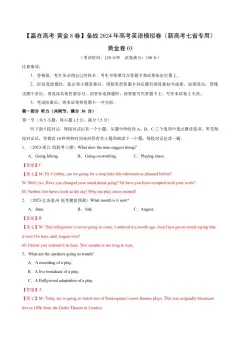
【赢在高考·黄金8卷】备战2024年高考英语模拟卷(上海专用)
黄金卷03
(考试时间:120分钟 试卷满分:140分)
注意事项:
1.答卷前,考生务必将自己的姓名、考生号等填写在答题卡和试卷指定位置上。
2.回答选择题时,选出每小题答案后,用铅笔把答题卡对应题目的答案标号涂黑。如需改动,用橡
皮擦干净后,再选涂其他答案标号。回答非选择题时,将答案写在答题卡上。写在本试卷上无效。
3.考试结束后,将本试卷和答题卡一并交回。
I.Listening Comprehension (第1-10题, 每题1分;第11-20题,每题1.5分;共25分)
Section A
Directions: In Section A, you will hear ten short conversations between two speakers. At the end of each
conversation, a question will be asked about what was said. The conversations and the questions will be spoken
only once. After you hear a conversation and the question about it, read the four possible answers on your paper,
and decide which one is the best answer to the question you have heard.
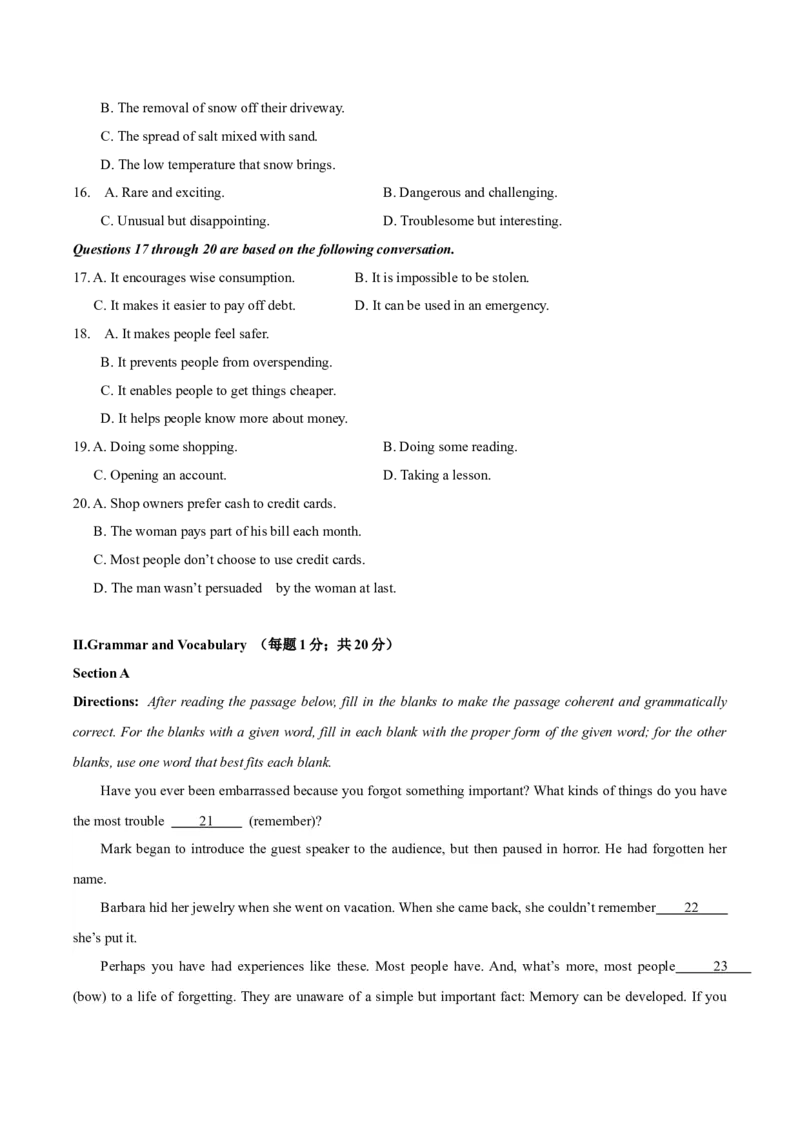
1. A. A postwoman. B. A teacher. C. A journalist. D. A librarian.
2. A. On a plane. B. On a train. C. At a restaurant. D. At a travel agency.
3. A. 5 minutes. B. 10 minutes. C. 15 minutes. D. 20 minutes.
4. A. He spends too much money. B. He should watch more TV.
C. He actually likes watching TV. D. He bought an expensive watch.
5. A. The woman should get a new watch.
B. The woman needs to buy another battery.
C. He knows what is wrong with the watch.
D. The store can probably fix the woman’s watch.
6. A. He should work in the summer school.
B. He shouldn't go to New York in the summer.
C.He may not want to do so.
D. He may have difficulty in doing so.
7. A. Spend more time on the course.
B. Turn to the graduate assistant for help.
C. Drop the course as soon as possible.D. Help the graduate assistant with the course.
8. A. They should buy a lot of coffee.
B. The supermarket isn’t going to be closed.
C. Coffee is out of stock in the supermarket.
D. They should wait for a better deal on coffee.
9. A. The final exam. B. A law school.
C. A reference letter. D. The department policy.
10. A. He wasn't able to find a seat there.
B. He had to wait a long time for a seat there.
C. The seats there are uncomfortable.
D. It provides reading materials for customers.
Section B
Directions: In Section B, you will hear two short passages and one longer conversation, and you will be asked
several questions on each of the short passages and the longer conversation. The short passages and the longer
conversation will be read twice, but the questions will be spoken only once. When you hear a question, read the
four possible answers on your paper and decide which one is the best answer to the question you have heard.
Questions 11 through 13 are based on the following news.
11. A. 2. B. 18. C. About 125. D. Over 1,300.
12. A. Helping good universities to enroll more students.
B. Getting more financial support from foreign students.
C. Encouraging more foreign students to travel around the UK.
D. Attracting more excellent foreign students to work in Britain.
13. A. He voted for Donald Trump.
B. He did not vote in the presidential election.
C. He made a political speech in the concert.
D. He sang for only 40 minutes in the concert.
Questions 14 through 16 are based on the following passage.
14. A. They can play many kinds of games with snow.
B. They can see the beautiful scenery of falling snow.
C. They can have several days off from school if it snows.
D. They can enjoy steaming hot chocolate on a snowy day.
15. A.The building of snowmen for children.B. The removal of snow off their driveway.
C. The spread of salt mixed with sand.
D. The low temperature that snow brings.
16. A. Rare and exciting. B. Dangerous and challenging.
C. Unusual but disappointing. D. Troublesome but interesting.
Questions 17 through 20 are based on the following conversation.
17. A. It encourages wise consumption. B. It is impossible to be stolen.
C. It makes it easier to pay off debt. D. It can be used in an emergency.
18. A. It makes people feel safer.
B. It prevents people from overspending.
C. It enables people to get things cheaper.
D. It helps people know more about money.
19. A. Doing some shopping. B. Doing some reading.
C. Opening an account. D. Taking a lesson.
20. A. Shop owners prefer cash to credit cards.
B. The woman pays part of his bill each month.
C. Most people don’t choose to use credit cards.
D. The man wasn’t persuaded by the woman at last.
II.Grammar and Vocabulary (每题1分;共20分)
Section A
Directions: After reading the passage below, fill in the blanks to make the passage coherent and grammatically
correct. For the blanks with a given word, fill in each blank with the proper form of the given word; for the other
blanks, use one word that best fits each blank.
Have you ever been embarrassed because you forgot something important? What kinds of things do you have
the most trouble 21 (remember)?
Mark began to introduce the guest speaker to the audience, but then paused in horror. He had forgotten her
name.
Barbara hid her jewelry when she went on vacation. When she came back, she couldn’t remember 22
she’s put it.
Perhaps you have had experiences like these. Most people have. And, what’s more, most people 23
(bow) to a life of forgetting. They are unaware of a simple but important fact: Memory can be developed. If youwill just accept that fact, this book will show you 24 it can be improved.
First, relax. If you are overanxious about remembering something, you will forget it. Relaxing will enhance
your awareness and ability to concentrate. You can’t remember anything 25 you can concentrate.
Second, avoid being negative. If you keep telling 26 that your memory is bad, your mind will come
to believe it and you won’t remembers things. When you forget something, don’t say," Gee, I need to have my brain
27 (rewire).” Instead, you need to take an active role.
28 your body, your memory can be strengthened strong exercised. Look for opportunities to exercise
your memory. For example, if you are learning a language, try to actively remember irregular verbs.
You may also want to make associations, or links, between 29 you are trying to remember and things
you already know. For example, if you need to catch a plane at 2:00 p.m., you can imagine a plane in your mind
and notice that it has two wings. Two wings = 2:00. You are now ten times 30 (likely) to remember the
rake-off time.
Section B
Directions: Fill in each blank with a proper word chosen from the box. Each word can be used only once.
Note that there is one word more than you need.
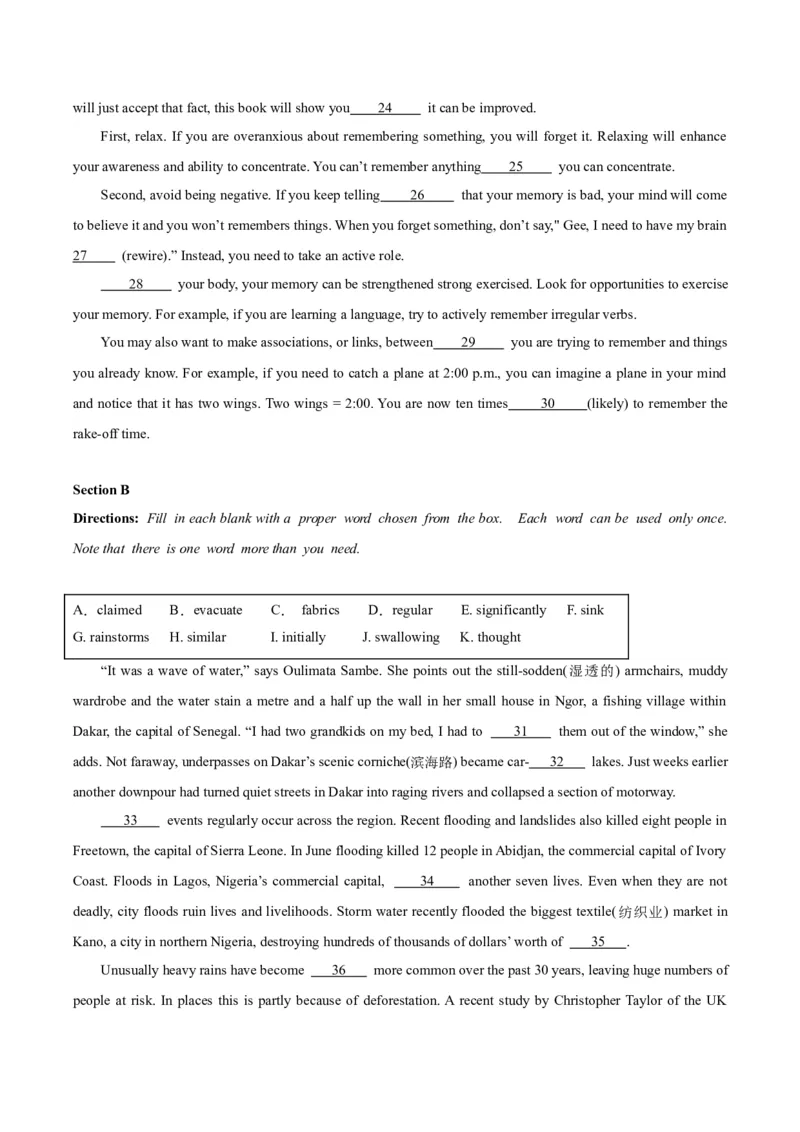
A.claimed B.evacuate C. fabrics D.regular E. significantly F. sink
G. rainstorms H. similar I. initially J. swallowing K. thought
“It was a wave of water,” says Oulimata Sambe. She points out the still-sodden(湿透的) armchairs, muddy
wardrobe and the water stain a metre and a half up the wall in her small house in Ngor, a fishing village within
Dakar, the capital of Senegal. “I had two grandkids on my bed, I had to 31 them out of the window,” she
adds. Not faraway, underpasses on Dakar’s scenic corniche(滨海路) became car- 32 lakes. Just weeks earlier
another downpour had turned quiet streets in Dakar into raging rivers and collapsed a section of motorway.
33 events regularly occur across the region. Recent flooding and landslides also killed eight people in
Freetown, the capital of Sierra Leone. In June flooding killed 12 people in Abidjan, the commercial capital of Ivory
Coast. Floods in Lagos, Nigeria’s commercial capital, 34 another seven lives. Even when they are not
deadly, city floods ruin lives and livelihoods. Storm water recently flooded the biggest textile(纺织业) market in
Kano, a city in northern Nigeria, destroying hundreds of thousands of dollars’ worth of 35 .
Unusually heavy rains have become 36 more common over the past 30 years, leaving huge numbers of
people at risk. In places this is partly because of deforestation. A recent study by Christopher Taylor of the UKCentre for Ecology and Hydrology, a research institute, and his coauthors found that afternoon 37 in
deforested parts of coastal west Africa happen twice as often compared with 30 years ago. Their frequency went up
by only about a third in places that kept their forests.
Yet 38 flooding of cities in west Africa is not only caused by heavier rain. Unplanned urbanization is
also to blame. As cities have grown, builders have thrown up concrete walls with little 39 about providing
drainage, making it harder for water to find a clear path to the sea. As ever larger areas have been paved over, there
has been less exposed soil into which water can gently 40 away. And as cites get more packed with new
arrivals, their few functioning drains get overwhelmed or clogged.
III.Reading Comprehension (共45分。 41-45每题1分;56-70每题2分)
Section A
Directions: For each blank in the following passage there are four words or phrases marked A. B.C and D.
Fill in each blank with the word or phrase that best fits the context
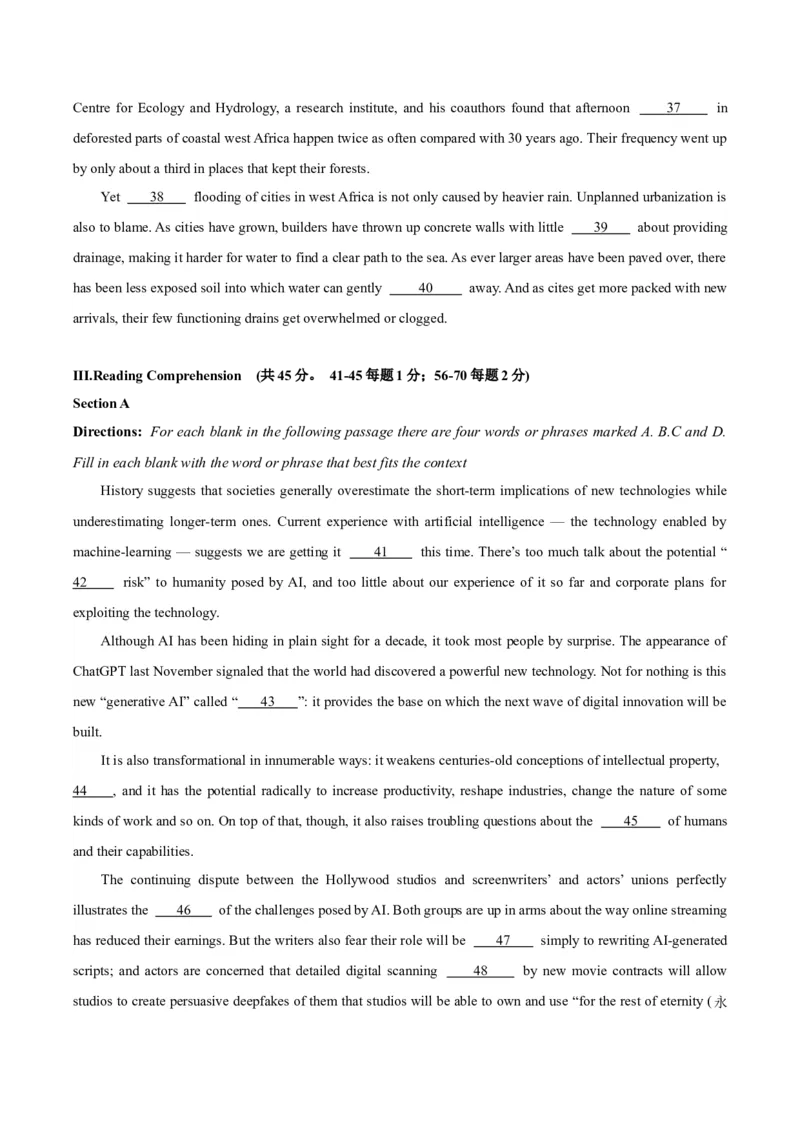
History suggests that societies generally overestimate the short-term implications of new technologies while
underestimating longer-term ones. Current experience with artificial intelligence — the technology enabled by
machine-learning — suggests we are getting it 41 this time. There’s too much talk about the potential “
42 risk” to humanity posed by AI, and too little about our experience of it so far and corporate plans for
exploiting the technology.
Although AI has been hiding in plain sight for a decade, it took most people by surprise. The appearance of
ChatGPT last November signaled that the world had discovered a powerful new technology. Not for nothing is this
new “generative AI” called “ 43 ”: it provides the base on which the next wave of digital innovation will be
built.
It is also transformational in innumerable ways: it weakens centuries-old conceptions of intellectual property,
44 , and it has the potential radically to increase productivity, reshape industries, change the nature of some
kinds of work and so on. On top of that, though, it also raises troubling questions about the 45 of humans
and their capabilities.
The continuing dispute between the Hollywood studios and screenwriters’ and actors’ unions perfectly
illustrates the 46 of the challenges posed by AI. Both groups are up in arms about the way online streaming
has reduced their earnings. But the writers also fear their role will be 47 simply to rewriting AI-generated
scripts; and actors are concerned that detailed digital scanning 48 by new movie contracts will allow
studios to create persuasive deepfakes of them that studios will be able to own and use “for the rest of eternity (永久), in any project they want, with no permission and no compensation”.
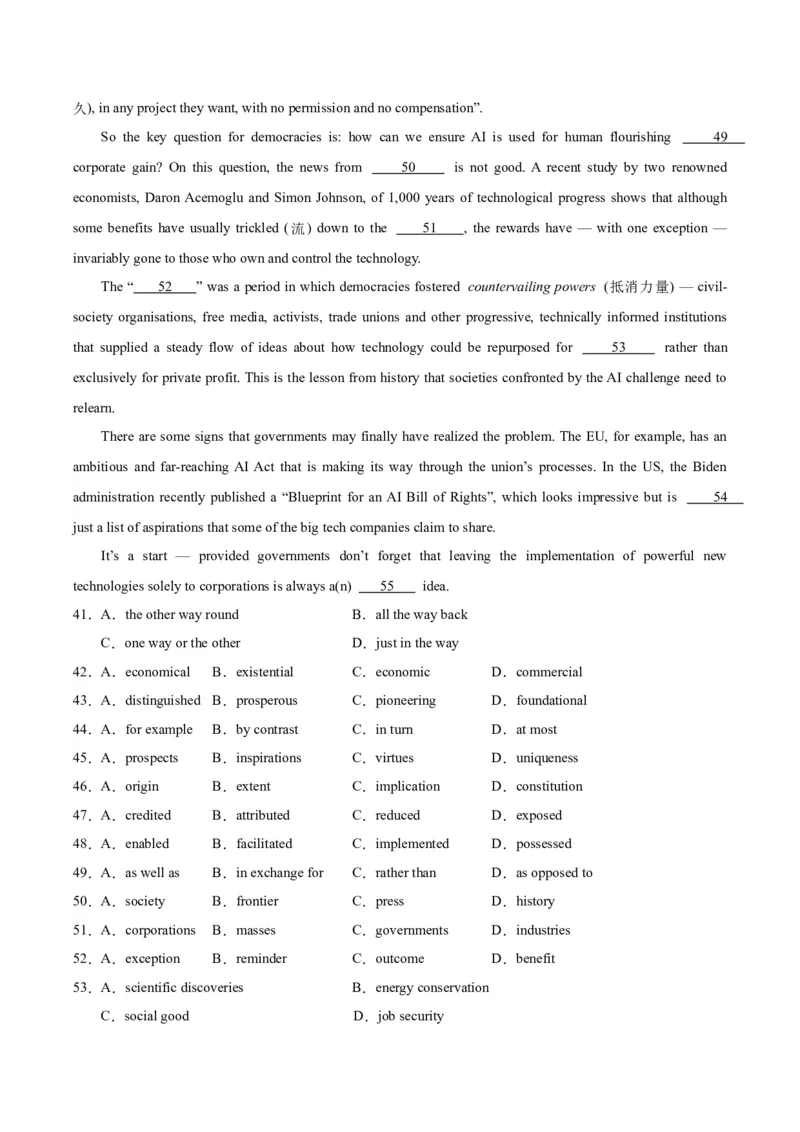
So the key question for democracies is: how can we ensure AI is used for human flourishing 49
corporate gain? On this question, the news from 50 is not good. A recent study by two renowned
economists, Daron Acemoglu and Simon Johnson, of 1,000 years of technological progress shows that although
some benefits have usually trickled (流) down to the 51 , the rewards have — with one exception —
invariably gone to those who own and control the technology.
The “ 52 ” was a period in which democracies fostered countervailing powers (抵消力量) — civil-
society organisations, free media, activists, trade unions and other progressive, technically informed institutions
that supplied a steady flow of ideas about how technology could be repurposed for 53 rather than
exclusively for private profit. This is the lesson from history that societies confronted by the AI challenge need to
relearn.
There are some signs that governments may finally have realized the problem. The EU, for example, has an
ambitious and far-reaching AI Act that is making its way through the union’s processes. In the US, the Biden
administration recently published a “Blueprint for an AI Bill of Rights”, which looks impressive but is 54
just a list of aspirations that some of the big tech companies claim to share.
It’s a start — provided governments don’t forget that leaving the implementation of powerful new
technologies solely to corporations is always a(n) 55 idea.
41.A.the other way round B.all the way back
C.one way or the other D.just in the way
42.A.economical B.existential C.economic D.commercial
43.A.distinguished B.prosperous C.pioneering D.foundational
44.A.for example B.by contrast C.in turn D.at most
45.A.prospects B.inspirations C.virtues D.uniqueness
46.A.origin B.extent C.implication D.constitution
47.A.credited B.attributed C.reduced D.exposed
48.A.enabled B.facilitated C.implemented D.possessed
49.A.as well as B.in exchange for C.rather than D.as opposed to
50.A.society B.frontier C.press D.history
51.A.corporations B.masses C.governments D.industries
52.A.exception B.reminder C.outcome D.benefit
53.A.scientific discoveries B.energy conservation
C.social good D.job security54.A.supposedly B.essentially C.necessarily D.commonly
55.A.impressive B.sensible C.outdated D.bad
Section B
Directions: Read the following three passages. Each passage is followed by several questions or unfinished
statements. For each of them there are four choices marked A, B, C and D. Choose the one that fits best according
to the information given in the passage you have just read.
(A)
Chinese Teapot Escaping from British Museum Goes Viral
Chinese state media has praised a viral video series telling the story of a jade teapot coming to life and fleeing
the British Museum to make its way back home.
The set of three short episodes, entitled Escape from the British Museum, shows the teapot turning into a
young woman in a green dress, who then engages a London-based Chinese journalist to help her reunite with her
family.
It appears to have struck a chord in China after first being released by independent vloggers on Douyin,
China’s equivalent to TikTok. By Monday evening, it had reportedly racked up more than 310 million views.
The plot line taps into growing Chinese criticism of the British Museum after reports last month that more
than 1,500 priceless objects, including gold jewelry, semi-precious stones and glass, were missing, stolen or
damaged.
In August the state media tabloid Global Times called for the return of Chinese artefacts from the museum
“free of charge” in the wake of the controversy.
“The huge loopholes in the management and security of cultural objects in the British Museum exposed by
this scandal have led to the collapse of a long-standing and widely circulated claim that ‘foreign cultural objects are
better protected in the British Museum’,” it said.
⑦It strongly supported the video series for touching on a “powerful message” about the importance of cultural
heritage and reflecting “Chinese people’s yearning for the repatriation of the Chinese cultural relics”.
In a further jibe at the museum, it interpreted the jade teapot’s surprise at the size of the journalist’s residenceas depicting the “casual attitude of the British Museum toward Chinese cultural relics, as many of them are
crammed into one cabinet for exhibition”.
State broadcaster CCTV also gave the short films a glowing review saying: “We are very pleased to see
Chinese young people are passionate about history and tradition… We are also looking forward to the early return
of Chinese artefacts that have been displaced overseas.”
The museum scandal made headlines around the world and revived earlier demands by the Chinese media to
restore the country’s relics.
The new three-part show has unleashed a wave of nationalism among viewers, with many praising the creative
plot that reduced them to tears by showing how the teapot experienced the happiness of returning to China to see
pandas and watch a flag-raising ceremony on Tiananmen Square.
56.What excuse does Britain give for keeping other nations’ cultural objects in its museum?
A.It has taken possession of these objects by all lawful means.
B.These objects may come to life, flee their countries and go viral.
C.These objects are safer and taken better care of in its museum.
D.It is requested by other nations to protect their cultural objects.
57.What does the underlined word “repatriation” (Para. 7) probably mean?
A.Repair. B.Reflection. C.Return. D.Reserve.
58.Which can we infer from the passage?
A.A London-based Chinese journalist has contributed a lot to the viral three-part video series.
B.The museum’s flawed management and security systems are involved in the scandal.
C.The Britain Museum is under pressure to return the cultural relics to China sooner or later.
D.China had already demanded the restoration of its cultural relics before the scandal.
59.What’s the purpose of the passage?
A.To appeal to Britain to return China’s cultural objects.
B.To introduce a viral video series about a fleeing jade teapot.
C.To arouse readers’ concern about Chinese cultural objects abroad.
D.To praise Chinese young people’s passion for history and tradition.
(B)
Superb Spring Gardens
Sunshine on your face, the scent of blossom in the air, the dreamy song of a blackbird.What better way to
while away a spring day than in a country garden filled with flowers like magnolia, rhododendron, primula, iris,
daffodils or bluebells? Here are a four of the best.YORKSHIRE The Hirnalayan Garden
LONDON The Savili Garden Grewelthorpe, North Yorkshire. Open daily from 12
Egham, Surrey. Open daily. April.
Part of the Windsor Great Park estate, with one of Set in a valley between Harrogate and Ripon, this
the country’s finest plant collections. Aptly named garden features hundreds of native Himalayan plants in
Spring Wood is planted with magnolia and a setting that is perhaps as close as you can get to being
rhododendron, including many Loderi hybrids, the in an actual Himalayan valley - especially on a misty
flowers of which are deliciously scented, while the morning. Many of the rhododendrons are wild species,
Azalea Walk is at its peak in mid to late May. Brilliant collected and grown from seed and now in their mature
for families with a great cafe, too. prime.
windsorgreatpark.co.uk/en 01765 658009,
himalayangarden.com
WALES Bodnant Garden
SCOTLAND Arduaine Garden
Near Colwyn Bay, Clwyd. Open daily.
Near Oban, Argyll. Open daily from 1 April.
Rightly considered one of the UK’s finest gardens,
Set on Scotland’s west coast amid stunning
Bodnant springs to life with pools of daffodils in Old
scenery, this beautiful garden benefits from the
Park Meadow, along with national collections of
influence of the Gulf Stream. Now in the care of the
magnolia and rhododendron.Extensive plantings of
National Trust for Scotland, the historic garden featured
cherry fill the garden with sweet scent in mid-spring,
over 200 rhododendrons by the 1920s, which are still
alongside plentiful bluebells. For these weeks from mid-
spring highlights, as are stands of primula and iris. But
May, thefamous Laburnum Arch, a long walkway with
the real stars are the stretches of colourful and jaw-
golden-yellow flowers, alone is worth a visit to
droppingly beautiful Himalayan plants.
experience it.
01852 200366,
01492 650460,
nationaltrust.org.uk/arduain-garden
nationaltrust.org.uk/bodnant-garden
60.The purpose of this page is to _________.
A.introduce the beauty of the superb spring gardens in the UK
B.urge garden lovers to visit the websites of the four gardens
C.promote different regions in the UK by introducing their gardens
D.advertise four spring gardens and encourage visits to them
61.Born in London and a rhododendron lover, Sally has always been longing to visit Himalaya in person
someday. She’s also fascinated by Himalayan plants. Which garden will she most probably visit during April?
A.The Savill Garden B.The Himalayan Garden
C.Arduaine Garden D.Bodnant Garden
62.Which of the following statements is true?
A.All four gardens boast magnolia and rhododendron.
B.Two gardens are open to the public only during April.
C.The National Trust takes care of two of the four gardens.
D.Tourists can call to know more about the four gardens.
(C)Scientific publishing has long been a license to print money. Scientists need journals in which to publish their
research, so they will supply the articles without monetary reward. Other scientists perform the specialized work of
peer review also for free, because it is a central element in the acquisition of status and the production of scientific
knowledge.
With the content of papers secured for free, the publisher needs only find a market for its journal. Until this
century, university libraries were not very price sensitive. Scientific publishers routinely report profit margins
approaching 40% on their operations, at a time when the rest of the publishing industry is in an existential crisis.
The Dutch giant Elsevier, which claims to publish 25% of the scientific papers produced in the world , made
profits of more than £900m last year, while UK universities alone spent more than £210m in 2016 to enable
researchers to access their own publicly funded research; both figures seem to rise unstoppably despite increasingly
desperate efforts to change them.
The most drastic, and thoroughly illegal, reaction has been the emergence of Sci-Hub, a kind of global
photocopier for scientific papers, set up in 2012, which now claims to offer access to every paywalled article
published since 2015. The success of Sci-Hub, which relies on researchers passing on copies they have themselves
legally accessed, shows the legal ecosystem has lost legitimacy among its users and must be transformed so that it
works for all participants.
In Britain the move towards open access publishing has been driven by funding bodies. In some ways it has
been very successful. More than half of all British scientific research is now published under open access terms:
either freely available from the moment of publication, or paywalled for a year or more so that the publishers can
make a profit before being placed on general release.
Yet the new system has not worked out any cheaper for the universities. Publishers have responded to the
demand that they make their product free to readers by charging their writers fees to cover the costs of preparing an
article. These range from around £500 to $5,000. A report last year pointed out that the costs both of subscriptions
and of these “article preparation costs” had been steadily rising at a rate above inflation. In some ways the scientific
publishing model resembles the economy of the social internet: labour is provided free in exchange for the hope of
status, while huge profits are made by a few big firms who run the market places. In both cases, we need a
rebalancing of power.
63.Scientific publishing is seen as “a license to print money” partly because________
A.its funding has enjoyed a steady increase. B.its marketing strategy has been successful.
C.its payment for peer review is reduced. D.its content acquisition costs nothing.
64.Which statement is true from Paragraphs 2 to 4?A.Scientific publisher Elsevier have thrived mainly on university libraries.
B.Most scientific publishers gone through an existential crisis until this century.
C.Sci-Hub offers free access to paywalled articles published since 2015.
D.The researchers’ legally-accessed copies deny the legal ecosystem legitimacy.
65.It can be learned from Paragraphs 5 and 6 that open access terms________
A.allow publishers some room to make money. B.render publishing much easier for scientists.
C.reduce the cost of publication substantially. D.free universities from financial burdens.
66.Which of the following characteristics the scientific publishing model?
A.Trial subscription is offered. B.Labour triumphs over status.
C.Costs are well controlled. D.The few feed on the many.
Section C
Directions: Complete the following passage by using the sentences in the box Each sentence can only be used
once. Note that there are two sentences more than you need.
A.Whether she was blessed with a good sense of language, the practice would motivate her.
B.By now she is redoing problems — how do I get characters into a room — dozens and dozens of times.
C.But it underlines a fact that is often neglected: public discussion is affected by genetics and what we’re
“hard-wired” to do.
D.It’s not I.Q., a generally bad predictor of success, even in realms like chess.
E.This contact would give the girl a vision of her future self.
F.Researchers can safely draw the conclusion that she has internalized the skill of writing stories.
The latest research suggests a more prosaic, democratic, even puritanical view of the world. The key factor
separating geniuses from the merely accomplished is not a divine spark. 67 Instead, it’s deliberate
practice. Top performers spend more hours rigorously practicing their craft.
If you wanted to picture how a typical genius might develop, you’d take a girl who possessed a slightly above
average verbal ability, a talent just enough so that she might gain some sense of distinction. Then you would want
her to meet, say, a novelist, who coincidentally shared some similar biographical traits. Maybe the writer was from
the same town, had the same ethnic background, or, shared the same birthday.
68 It would give her some idea of a fascinating circle she might someday join and fuel a need for
success. Armed with this ambition, she would read novels and life stories of writers without end. This would give
her a primary knowledge of her field. She’d be able to see new writing in deeper ways and quickly perceive its
inner workings.Then she would practice writing. Her practice would be slow, painstaking and error-focused. By practicing in
this way, she delays the automatizing process. Her mind wants to turn conscious, newly learned skills into
unconscious, automatically performed skills. Then she would find an adviser who would provide a constant stream
of feedback, viewing her performance from the outside, correcting the smallest errors, pushing her to take on
tougher challenges. 69 She is establishing habits of thought she can call upon in order to understand or
solve future problems.
The primary trait she possesses is not some mysterious genius. It’s the ability to develop a purposeful,
laborious and boring practice routine. The latest research takes some of the magic out of great achievement. 70
And it’s true that genes play a role in our capabilities. But the brain is also very plastic. We construct ourselves
through behavior.
IV.Summary Writing (共10分)
Directions: Read the following passage. Summarize the main idea and the main point( s)of the passage in no more
than 60 words. Use your own words as far as possible.
Obstacles to the correct decision
Life is full of choices, some inconsequential, some really significant. But sometimes it can be hard to make the
correct one. What are the obstacles that stand between us and a good outcome?
Some of us just find it hard to decide. Alice Boyes, writing for Harvard Business Review, tells us this can be
connected to perfectionism, where people attempt to find a perfect solution to any problem and are unable to move
forward when they can’t find one. It might seem that being indecisive would stop us making the right decision, but
in fact it could actually help us make the correct ones.
Susan Krauss in Psychology Today reminds us that people often make bad decisions because they base them
on preconceptions rather than the context in which things happen. She highlights a paper by researcher Iris
Schneider which finds that indecisive people are more likely to look at different perspectives and use them to come
to a better decision. So, it could be that a more significant barrier to making the best choice is our cognitive biases.
David Robson tells us that intelligence can sometimes stop people making the right decision. People
sometimes use intelligence to invent justifications for irrational beliefs. He believes that humility is key to making a
good decision. People who can accept that they might be wrong are more likely to consider different viewpoints.
He is backed up on this by Jeff Bezos. Tech CEO Jason Fried recalls the Amazon founder saying how the people
who were right a lot of the time were the people who often changed their minds.So, maybe rather than indecision, it might be intelligence and decisiveness, backed up by our biases that
actually stop us making good choices while humility and indecisiveness could help us pick the best option.
71.__________________________________________________________________________________________
____________________________________________________________________________________________
____________________________________________________________________________________________
____________________________________________________________________________________________
__________________________
V.Translation (共15分。第1小题和第2小题,每题3分;第3题4分;第4题5分。)
Directions:Translate the following sentences into English, using the words given in the brackets
72.(书展的门票只能提前一天在网上购买。(available)
73.为了达到一箭双雕的目的,设计师采取了既实用又实惠的方案。(adopt)
74.在人生旅程中,虽然谁是最后的赢家还有待见分晓,但我们坚信付出的努力终不会白费。(pay)
75.饺子是中国的文化符号之一,其特点是皮薄馅嫩,味道鲜美,形状独特。(characterize)
VI.Guided Writing (共25分)
Directions: Write an English composition in 120-150 words according to the instructions given below in Chinese
你是明启中学李华,打算向学校申请创立一个社团。请你给校长写一封申请信,信中必须包括:
1. 这个社团的名字、创建主旨以及打算举办的活动;
2. 这个社团的建立会给学生带来的益处。
____________________________________________________________________________________________
____________________________________________________________________________________________
____________________________________________________________________________________________
____________________________________________________________________________________________
______________________________________________________________________________________