2024 年中考第三次模拟考试(重庆卷)
英语
(全卷共九个大题,满分150分,考试时间为120分钟)
注意事项:
1.试题的答案书写在答题卡上,不得在试卷上直接作答。
2.作答前认真阅读答题卡上的注意事项。
3.考试结束,由监考人将试题卷和答题卡一并收回。
第Ⅰ卷
Ⅰ. 听力测试。(每小题1.5分,共30分)
第一节(每小题1.5分, 共9分)
听一遍。根据你所听到的句子,从 A、B、C三个选项中选出最恰当的答语,并把答题卡
上对应题目的答案标号涂黑。
1. A. Not bad. B. It’s time to go. C. Good morning, sir.
2. A. Not at all. B. Don’t mention it. C. Sorry. I’ll put it away.
3. A. Me, too. B. It doesn’t matter. C. You’re welcome.
4. A. Sounds great. B. Wait a moment. C. Enjoy yourself.
5. A. Don’t worry. B. You’d better not. C. I agree with you.
6. A. Be careful. B. Keep going. C. The same to you.
第二节(每小题1.5分, 共9分)
听一遍。根据你所听到的对话和问题,从 A、B、C三个选项中选出正确答案,并把答题
卡上对应题目的答案标号涂黑。
7. A. A painter. B. A teacher. C. A doctor.
8. A. /kæt/. B. /keɪk/. C. /hæt/.
9. A. The storybook. B. The science book. C. The history book.
10. A. In April. B. In June. C. In October.
11. A. Because they had a trip. B. Because they had a meeting.
C. Because they were on business.
12. A. B. C.
第三节(每小题1.5分, 共6分)
听两遍。根据你所听到的长对话,从 A、B、C三个选项中选出正确答案,并把答题卡上
对应题目的答案标号涂黑。
听第一段材料,回答第13和14小题。
13. Who will go with Daisy?A. Her sister. B. Her friends. C. Her parents.
14. What has Daisy prepared for the students?
A. Books and food. B. Books and clothes.C. Food and clothes.
听第二段材料,回答第15和16小题。
15. When was the lunch break before?
A. From 12:00 to 2:00 p.m. B. From 11:30 a.m. to 1:30 p.m.
C. From 11:30 a.m. to 2:00 p.m.
16. What does the girl think of the new schedule?
A. It is bad. B. It is necessary. C. It is wonderful.
第四节 (每小题1.5分, 共6分)
听两遍。根据你所听到的短文内容,从 A、B、C三个选项中选出正确答案,并把答题卡
上对应题目的答案标号涂黑。
17. How many small meals should we eat a day according to doctors?
A.Two. B. Three. C. Five.
18. What can we eat instead of fried food?
A. Some bread. B. Some rice. C. Junk food.
19. What can we drink if we want to have something sweet?
A. Fruit juice. B. Some water. C. Coffee with milk.
20. What does the passage mainly talk about?
A. How to get a good diet. B. How to exercise properly.
C. How to keep healthy.
Ⅱ. 语法选择。(每小题1分,共10分)
阅读短文,从A、B、C三个选项中选出可以填入空白处的最佳选项,并把答题卡上对应
题目的答案标号涂黑。
Dear Jim,
How is it going?
Last Friday, our school held 21 activity—working on the farm. I’d like to share this
special and meaningful experience 22 you.
Every eight students prepared farming tools together. Then, each group 23 by one
teacher. We 24 a process including lining, turning, stepping and leveling the land.
Although there were challenges like the hard soil and heavy tools, we created an excellent
environment for the growth of vegetables. After that, the teacher taught us 25 cucumber
frames (黄瓜架). “It seemed easy, but in fact, it was quite difficult to make 26 stand
upright.” said Liu Li, one of my classmates.
You can’t imagine 27 happy we were at the end of the day! More amazingly, we now
have a 28 understanding of valuing food than before. “He began to make sure of the zero-
waste dinner, and loved planting in his bedroom,” said a student’s mother when talking about her29 progress. Our headmaster said,“Since everyone loves farming, we 30 a small
garden in the empty school land next year. In this way, you can enjoy the simple joy of farming at
school.” What good news!
Yours,
Bob
21.A.a B.an C.the
22.A.with B.to C.for
23.A.guided B.was guiding C.was guided
24.A.follow B.follows C.followed
25.A.built B.to build C.building
26.A.they B.them C.their
27.A.how B.what C.when
28.A.good B.better C.best
29.A.son B.sons C.son’s
30.A.make B.makes C.will make
Ⅲ. 完形填空。(每小题1分,共10分)
根据短文内容,从A、B、C、D四个选项中选出一个能填入相应空格内的最佳答案,并
把答题卡上对应题目的答案标号涂黑。
I recently gave my class a task. It was to go to someone and say “I love you”. It could be
someone you felt sorry to or had never 31 those words to before. Hearing this, my students
were silent, because they were too 32 to express love, especially the boys who considered
speaking out love not macho (男子汉的).
When I checked the task, Tan Qiang was the first to share his story. “Since my sister was born,
she has become the focus and 33 the attention of the whole family. I felt left out and
unhappy.” Tan Qiang said. “They were not angry with me. Instead, they comforted me. When I said
‘I love you’ they were 34 and moved.”
The time Tan Qiang sat down, many students 35 their hands actively. Wang Tao got
the chance. “My father and I had an argument one month ago. After that, we 36 spoke to
each other. When I went back home with the task, I took 37 , stepped forward and said,
‘Dad, I just want to tell you that I love you.’ My father’s face softened and his eyes watered. He
reached out, hugged me and said, ‘I love you too, but I have never been able to say it.’ The next day,
my father volunteered to fight COVID-19. Several days later, he called and thanked me for those
words. He added that 38 could be stronger than the power of love and support from
family. I believe that my father will have a safe return.” 39 tears in his eyes, Wang Tao sat
down.
Hands were waving when the bell rang. No doubt all my students had expressed love. 40
there was still a person in the classroom who didn’t. It was me. It was my turn to do that.31.A.said B.talked C.communicated D.explained
32.A.outgoing B.warm-hearted C.shy D.considerate
33.A.lost B.rose C.reduced D.caught
34.A.bored B.tired C.surprised D.relaxed
35.A.put up B.put down C.put on D.put off
36.A.frequently B.hardly C.greatly D.nearly
37.A.praise B.courage C.wealth D.promise
38.A.nothing B.anything C.everything D.something
39.A.For B.Of C.On D.With
40.A.After all B.At least C.Besides D.However
IV.阅读理解(41-43小题,每小题1分,44-59小题,每小题2分,共35分)
阅读下列材料,从A、B、C、D四个选项中选出最佳答案,并把答题卡上对应题目的答
案标号涂黑。
A
How to tell bad eggs from good eggs?
We can use eggs to cook lots of delicious dishes. They can be cooked in many ways. However, it
would be dangerous to eat bad eggs. They can make you sick. It’s important for us to learn how to
find bad eggs. Here are two ways.
Smell. Bad eggs have a terrible smell. If you beat the egg into the bowl and find it’s smelly, just
throw it away.
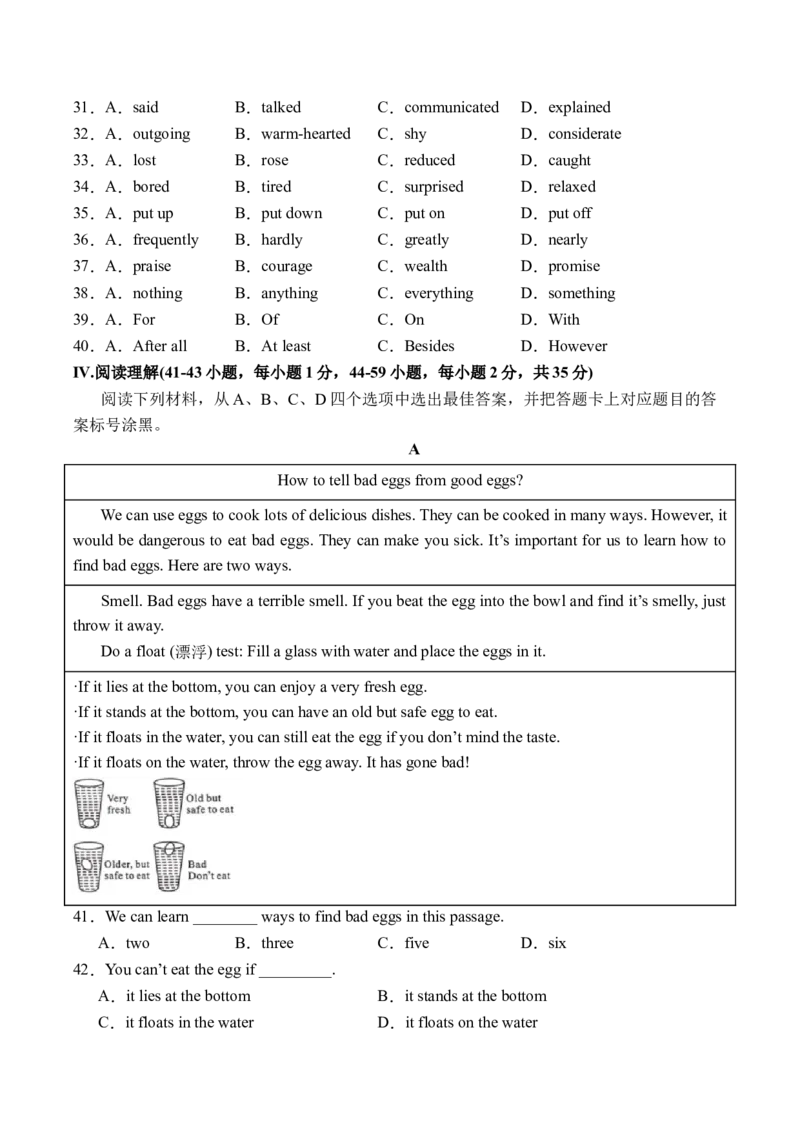
Do a float (漂浮) test: Fill a glass with water and place the eggs in it.
·If it lies at the bottom, you can enjoy a very fresh egg.
·If it stands at the bottom, you can have an old but safe egg to eat.
·If it floats in the water, you can still eat the egg if you don’t mind the taste.
·If it floats on the water, throw the egg away. It has gone bad!
41.We can learn ________ ways to find bad eggs in this passage.
A.two B.three C.five D.six
42.You can’t eat the egg if _________.
A.it lies at the bottom B.it stands at the bottom
C.it floats in the water D.it floats on the water43.This passage is probably from a _________.
A.dictionary B.magazine C.notice D.menu
B
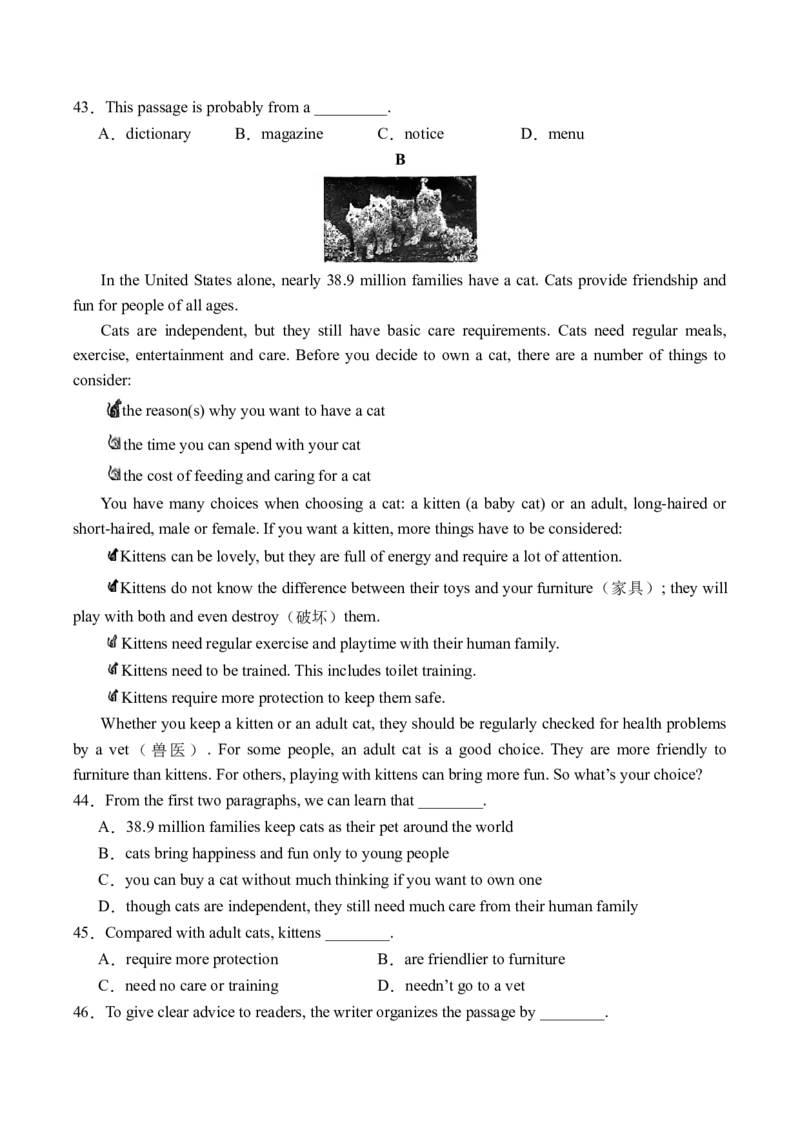
In the United States alone, nearly 38.9 million families have a cat. Cats provide friendship and
fun for people of all ages.
Cats are independent, but they still have basic care requirements. Cats need regular meals,
exercise, entertainment and care. Before you decide to own a cat, there are a number of things to
consider:
the reason(s) why you want to have a cat
the time you can spend with your cat
the cost of feeding and caring for a cat
You have many choices when choosing a cat: a kitten (a baby cat) or an adult, long-haired or
short-haired, male or female. If you want a kitten, more things have to be considered:
Kittens can be lovely, but they are full of energy and require a lot of attention.
Kittens do not know the difference between their toys and your furniture(家具); they will
play with both and even destroy(破坏)them.
Kittens need regular exercise and playtime with their human family.
Kittens need to be trained. This includes toilet training.
Kittens require more protection to keep them safe.
Whether you keep a kitten or an adult cat, they should be regularly checked for health problems
by a vet(兽医). For some people, an adult cat is a good choice. They are more friendly to
furniture than kittens. For others, playing with kittens can bring more fun. So what’s your choice?
44.From the first two paragraphs, we can learn that ________.
A.38.9 million families keep cats as their pet around the world
B.cats bring happiness and fun only to young people
C.you can buy a cat without much thinking if you want to own one
D.though cats are independent, they still need much care from their human family
45.Compared with adult cats, kittens ________.
A.require more protection B.are friendlier to furniture
C.need no care or training D.needn’t go to a vet
46.To give clear advice to readers, the writer organizes the passage by ________.A.listing facts B.telling a story C.using famous sayings D.listing numbers
47.Which would be the best title for the passage?
A.How Can We Train Our Cats? B.How Can We Choose Cats?
C.Why Can Cats Be Our Friends? D.Why Do We Keep Cats?
C
The Buckets, of course, were able to find something to eat, but every one of them—the two old
grandfathers, the two old grandmothers, Charlie’s father, Charlie’s mother, and especially little
Charlie himself—went about from morning till night with an awful empty feeling in their stomachs.
Charlie felt it worst of all. And although his father and mother often went without their own
share of lunch or supper so that they could give it to him, it still wasn’t nearly enough for a growing
boy. He really wanted something more satisfying than cabbage and cabbage soup. The one thing he
wanted more than anything else was... CHOCOLATE
Walking to school in the mornings, Charlie could see lots of chocolate in the shop windows,
and he would stop and stare and press his nose against the glass, his mouth watering like mad. Many
times a day, he would see other children taking creamy chocolate out of their pockets and eating
them like a hungry tiger, and that, of course, was pure torture (折磨).
Only once a year, on his birthday, could Charlie Bucket ever get to taste a bit of chocolate.
The whole family saved up their money for that special day, and when the great day arrived,
Charlie was always given one small chocolate bar (棒) to eat all by himself. And each time he
received it, on those wonderful birthday mornings, he would place it carefully in a small wooden
box, and treasure it as if it were a bar of gold. And for the next few days, he would allow himself
only to look at it, but never to touch it. Then at last, when he couldn’t stand it any longer, he would
uncover a tiny bit of the paper covering at one corner to expose (暴露) a tiny bit of chocolate, and
then he would take a tiny bite—just enough to allow the lovely sweet taste to spread out slowly over
his tongue. The next day, he would take another tiny bite, and so on, and so on. And in this way,
Charlie would eat his cheap bar of birthday chocolate for more than a month.
—adapted from Charlie and the Chocolate Factory
48.How many people are there in the Buckets?
A.5. B.6. C.7. D.8.
49.According to the second paragraph, what is the Bucket family like?
A.Honest but poor.B.Happy and rich. C.Warm but poor. D.Serious and rich.
50.What can we learn about the chocolate that Charlie got on his birthday?
A.It was a large chocolate bar. B.It could be kept for more than a month.
C.It was in a plastic box. D.It was quite expensive.
51.Which is not true according to the passage?
A.Besides cabbage and cabbage soup, Charlie wanted to eat other more satisfying food.B.On the way to school, Charlie could see plenty of chocolate in the shop windows.
C.Charlie’s birthday was one of the most special days in a year for him.
D.Charlie was often asked by his family to share the chocolate bar with others.
D
“No building comes without carvings (雕刻), and carvings make buildings more valuable,” goes
an old saying in Minnan, an area in southern Fujian Province. The saying refers to brick (砖)
carvings, which were an important part of the old red brick buildings in the area.
Wu Jiandong, a young master brick carver from Fujian’s Quanzhou City, became worried when
he discovered that this tradition was disappearing. The carvings were once commonly found on
either side of the door of Minnan’s buildings, but with development, the number of ancient red brick
buildings has fallen, causing Minnan’s brick carvings have gradually been out of sight.
The 42-year-old has learned the traditional skill and decided to conflate it with modern tastes to
develop his own style of brick carving. Wu said that he hoped to be able to help the traditional art
form continue through innovation (创新).
People in Minnan love tea, so Wu created many carved brick tea decorations (装饰), including
tea plates, tea cups and other things. They have been warmly received by local people and foreign
visitors. Earlier this year, an art piece with a swallow tail ridge (燕尾形屋脊) and a bright moon was
bought by an overseas Chinese man from the Philippines. The customer told Wu that he would hang
the art piece in his office as a reminder of the buildings and the moon of his hometown.
Wu’s works are now more popular among people, and this helps him to pass down the tradition
and further develop his pieces, and the popularity of short videos has also given him new hopes of
promoting (推广) Minnan brick carvings.
Recently, he has designed a DIY brick carving experience box called Wei Yu Huan Xi (or “Only
You are Happy”). “I wish that more young people will make their own pieces with the knife and red
brick in the box, and enjoy a sense of achievement through my video,” Wu said.
52.The writer mentioned the saying at the beginning to _________.
A.attract more people to visit Minnan
B.introduce the valuable buildings with carvings
C.show the importance of brick carvings in Minnan
D.give advice on developing brick carvings
53.From the passage, we can know that _________.
A.most of Wu’s customers come from abroad
B.Wu has combined the Chinese traditional skill with the foreign culture
C.Wu’s pieces are warmly received, but few of them can be seen on the Internet
D.brick carvings could be a comfort to homesick (思乡的) Chinese abroad
54.We can put the word conflate (in Para. 3) in the sentence _________.A.The artist _________(s) different skills in the same painting.
B.The traditional Chinese culture _________(s) the writers so much.
C.We should take action to _________ the situation.
D.He will never _________ the art since it’s important to people’s daily life.
55.How did Wu feel about his brick art pieces?
A.Hopeful. B.Worried. C.Disappointed. D.Surprised.
E
①Since the pre-Qin period, Chengdu has been an important cultural town in China. But what
really makes the city special, culturally, is its opera. An important part of Sichuan Opera is face
changing where colored masks are changed within the blink of an eye (眨眼).
② It is widely believed that face changing could be traced back (追溯) to ancient times. In
order to scare away the dangerous animals and protect themselves, people painted their faces in
different colors. Later this technique was taken into the art of Sichuan Opera and brought onto stage.
③ Face-changing skills are mainly divided into three types: wiping the face, blowing the face
and pulling the face. Before performing the skill of wiping the face, the performer will first paint on
some parts of his face. While on the stage, he could change the color of his face by wiping it. To
perform the skill of blowing the face, the performer needs to do a movement of kissing the ground
and blowing the box full of cosmetic powders (化妆粉). And then the powders are blown to his face,
changing the color into another.
④ The skill of pulling the face is more difficult than the other two. Under the cover of fast
movements, the performer pulls each piece of the facial masks which is tied with a thin thread (线)
and stuck to his face to change the color of his face. ________ For this, the performer must work
very well and have great skill. And face changing techniques are a secret handed down from
generation to generation of performers.
⑤ Face changing is not only an acrobatic skill (杂技), but it also has rich cultural meaning.
The different kinds of characters and personalities that Sichuan Opera brings alive can be found
among common people. This is why it continues to be popular for a long time.
56.Which type of face changing skills do the following pictures show?
A.Washing the face. B.Wiping the face.
C.Blowing the face. D.Pulling the face.
57.Which sentence can be put in the ________?
A.However, one can easily know what the facial masks are made of.B.However, only men performers can have the chance to learn this skill.
C.Surprisingly, no matter how close one is to the stage, he can’t tell how the masks change.
D.Surprisingly, no matter how many masks the performer wears, the color remains the same.
58.What can we infer from the passage?
A.Pulling the face is the most difficult type of face changing.
B.People used to paint their faces to make themselves look funny.
C.Face changing is very special because it can only be watched in Chengdu.
D.Good traditional art can’t be lasting unless it is connected with people’s daily life.
59.Which of the following shows the structure of this passage?
A. B.
C. D.
V.口语应用(每小题1分,共5分)
阅读下面对话,从方框内7个选项中选择5个恰当的句子完成此对话,并把答题卡上对应
题目的答案标号涂黑。
A.What do you think is the biggest worry for our future?
B.Are you always busy?
C.Yes, there are lots of things we can do.
D.What other things can we do to protect the
environment?
E.I went to an environmental meeting.
F.How about recycling?
G.I’m sorry about that.
A: What did you do over the weekend?
B: 60 It was fantastic to be around so many people who care about the environment.
A: Do you think there’s anything we can do to protect the environment?
B: 61
A: Like what?
B: Well, we can use public transport instead of taking our cars.
A: 62
B: We should plant more trees.
A: 63 Does that actually help?
B: Yes. We should take glass, paper, plastic to a recycling bin.
A: 64B: I’m worried that there’s not enough clean water for everyone.
第II卷
VI.任务型阅读(第65-67题每题2分,第68题3分,共9分)
阅读下面短文,根据短文内容,完成下列各题。
Reading is an extremely important and necessary skill, which you need throughout your life;
without it, you could fail achieving many things, such as education and, in the future, jobs.
There is plenty of evidence (证据) to suggest that children who read for enjoyment not only
perform better in reading tests but also develop a wider vocabulary and have greater general
knowledge and understanding of other cultures. Reading for pleasure also makes it possible for
young people to develop better problem-solving skills and greater empathy (同情), giving them
better relationships with others. All of these things come together to give children improved feelings
of happiness and well-being (健康幸福). In fact, reading for pleasure has a greater influence on
children’s achievement at school than their social or economic background.
The positive effects of reading are there for all ages. If children are too young to read
themselves, then it is important to read to them, talk to them and surround (围绕) them with books.
Reading should be a part of our everyday lives but the benefits (益处) are stronger when reading for
pleasure rather than because we “have to”. It should be happening at home as well as in school.
World Book Day, created by UNESCO (an organization responsible for making sure that
everyone in the world gets a chance to learn) in 1995 to celebrate reading, is a one-day festival.
During World Book Day, children are given a chance to talk about their favorite books, learn more
about their favorite writers and explore new stories. They are encouraged to take part in different fun
activities, encouraging a love of reading and books in all.
“If you are going to get anywhere in life, you have to read a lot of books.” Roald Dahl.
65.Is reading only important for children at school?
66.When was World Book Day created by UNESCO?
67.Give two benefits (益处) of reading for pleasure from your own reading experience. (You can’t
copy the sentences from the passage.)
68.“If you are going to get anywhere in life, you have to read a lot of books.” What do you think
Roald Dahl meant when he said this?
VII.完成句子(每空1分,共10分)根据所给提示,完成句子。每空一词,含缩略词。
69.I will talk to you on the phone tonight. (改为否定句)
I to you on the phone tonight.
70.The population of China is 1.413 billion now. (对划线部分提问)
the population of China now?
71.Jack spends one hour reading books every day.(改为同义句)
It Jack one hour to books every day.
72.丽莎学习非常努力,她的父母以她为骄傲。(完成译句)
Lisa studies very hard and her parents are her.
73.昨天我们一直等到雨停才离开。(完成译句)
We leave the rain stopped yesterday.
VIII.短文填空(每空2分,共16分)
根据下面短文内容及部分首字母提示,在短文的空格处填上一个最恰当的词,使短文完
整、通顺。请将完整的单词填写在答题卡上对应的位置。
It’s easy to see the fun in buying a huge ice cream or going shopping with friends, but saving
money can be even more e 74 . That’s because saving creates opportunities and opens the
door to all kinds of adventures (冒险).
The key to successful saving is setting a goal. Get a pen and paper, and write down how much
you need to spend. Then work out how much you can 75 each week and how long it will
take you to reach your goal. It’s important to be realistic because you’ll soon get bored if you plan to
save every single penny (便士). Some weeks you might decide to save a little more than planned so
that you can reach your goals even faster.
To avoid accidentally spending the money you’ve saved, it’s a good idea to keep 76
separate from the rest of your money. You could do this by using a savings account (账户). Then,
you have the opportunity to earn interest (利息). This is the money that a bank p 77 you for
leaving the money there, and the longer you leave money in a savings account, the more interest you
will earn. Some savings accounts allow you to take out money whenever you like, 78
some will keep your money locked away for a certain time. Some parents set up a savings account
because they want to put some money away for their kids’ future.
Once you get to know how to save, you can set some bigger 79 . Perhaps you want to
start saving for university, for a trip or for helping the poor. Remember, you can save 80
more than one purpose at a time, as some of your goals might take months or even years to achieve.
If you’re new to saving, start off by thinking of some fun goals, like taking a vacation or going
to a concert. Every penny you save brings you one step 81 to reaching your goal and what
could be more exciting than that?IX.书面表达(满分20分)
近日来,校园霸凌问题备受社会关注,它严重影响着学生的身心健康和学习氛围,甚至
造成了一些不可挽回的伤害。学校公众号正在开展《停止校园霸凌》英文征文活动,请根据
以下提示,以“Stop Campus Bullying”为题投稿。
提示:1. What should we do when we see campus bullying?
2. What should we do to keep away from campus bullying?
要求:1.短文须包括提示的主要信息,可适当发挥;
2.要求80~120词,开头已给出,不记入总词数;
3.文中不能出现自己的姓名和班级名称。
Stop Campus Bullying
Nowadays campus bullying happens in many schools. What should we do about campus
bullying?
_________________________________________________________________________________