2025 学年第一学期高二期末质量评价题库
英语(B 类)
本题库分选择题和非选择题两部分,共 12 页,选择题部分 1 至 9 页,非择
题部分 10 至 12 页。建议做题时间 120 分钟。
答题须知
1.答题前,务必将自己的姓名、题库答题卡号码填写在答题卡上。
2.回答选择题时,选出每小题答案后,用铅笔把答题卡上对应题目的答案标号涂黑。
如需改动,用橡皮擦干净后,再选涂其他答案标号。回答非选择题时,将答案写在
答题卡上,写在本题库上无效。
第一部分 听力(共两节,满分 30 分)
做题时,先将答案标在本题库上,录音内容结束后,你将有两分钟的时间将题
库上的答案涂到答题卡上。
第一节(共 5 小题;每小题 1.5 分,满分 7.5 分)
听下面 5 段对话。每段对话后有一个小题,从题中所给的 A、B、C 三个选项
中选出最佳选项。听完每段对话后,你都有 10 秒钟的时间来回答有关小题和
阅读下一小题。每段对话读两遍。
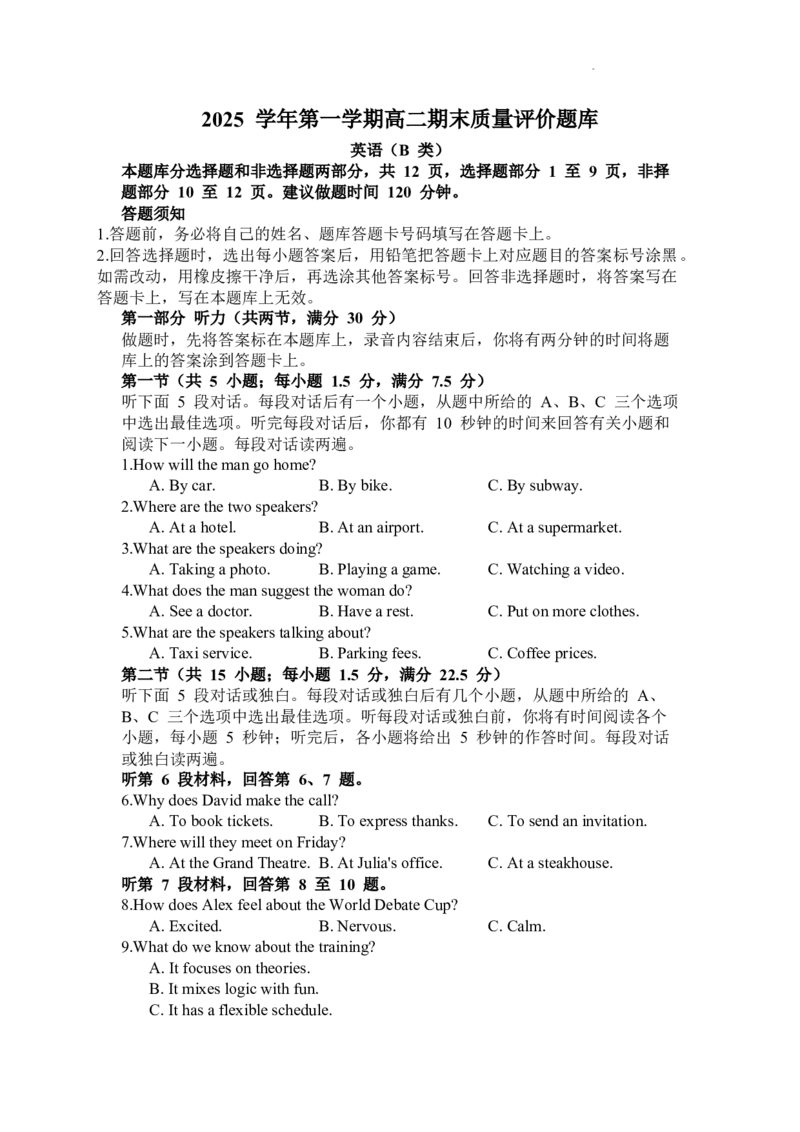
1.How will the man go home?
A. By car. B. By bike. C. By subway.
2.Where are the two speakers?
A. At a hotel. B. At an airport. C. At a supermarket.
3.What are the speakers doing?
A. Taking a photo. B. Playing a game. C. Watching a video.
4.What does the man suggest the woman do?
A. See a doctor. B. Have a rest. C. Put on more clothes.
5.What are the speakers talking about?
A. Taxi service. B. Parking fees. C. Coffee prices.
第二节(共 15 小题;每小题 1.5 分,满分 22.5 分)
听下面 5 段对话或独白。每段对话或独白后有几个小题,从题中所给的 A、
B、C 三个选项中选出最佳选项。听每段对话或独白前,你将有时间阅读各个
小题,每小题 5 秒钟;听完后,各小题将给出 5 秒钟的作答时间。每段对话
或独白读两遍。
听第 6 段材料,回答第 6、7 题。
6.Why does David make the call?
A. To book tickets. B. To express thanks. C. To send an invitation.
7.Where will they meet on Friday?
A. At the Grand Theatre. B. At Julia's office. C. At a steakhouse.
听第 7 段材料,回答第 8 至 10 题。
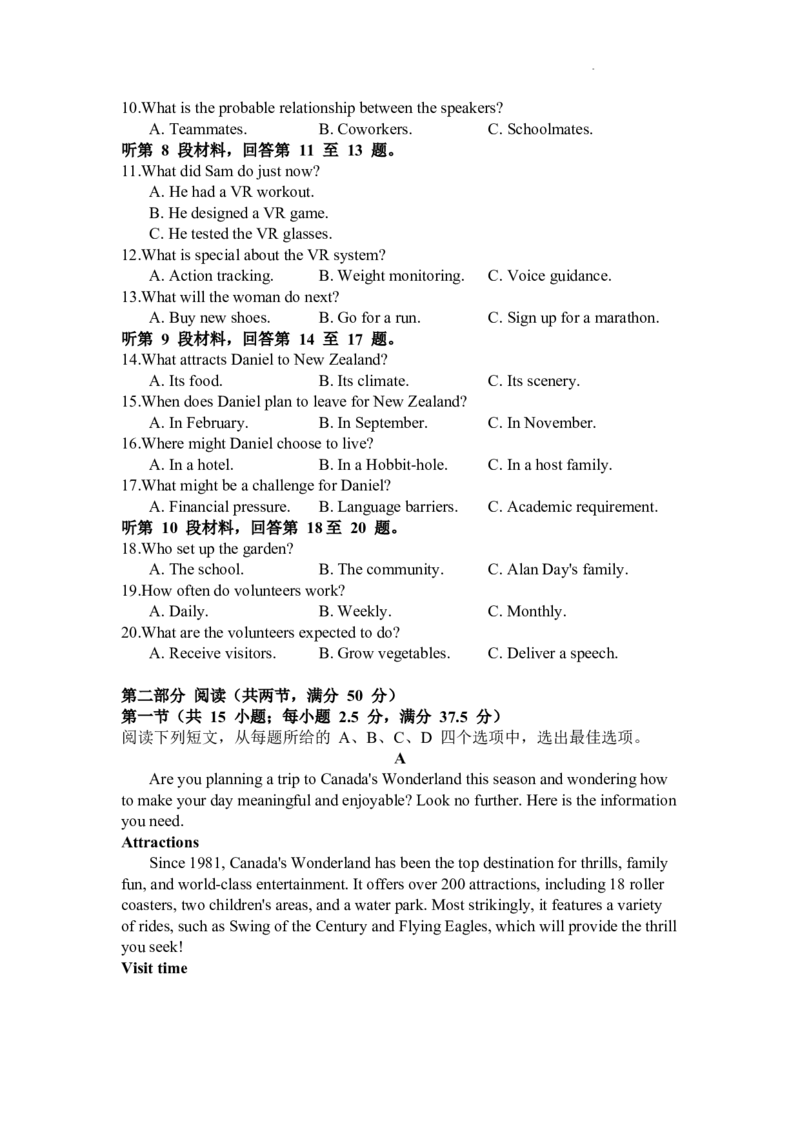
8.How does Alex feel about the World Debate Cup?
A. Excited. B. Nervous. C. Calm.
9.What do we know about the training?
A. It focuses on theories.
B. It mixes logic with fun.
C. It has a flexible schedule.
学科网(北京)股份有限公司10.What is the probable relationship between the speakers?
A. Teammates. B. Coworkers. C. Schoolmates.
听第 8 段材料,回答第 11 至 13 题。
11.What did Sam do just now?
A. He had a VR workout.
B. He designed a VR game.
C. He tested the VR glasses.
12.What is special about the VR system?
A. Action tracking. B. Weight monitoring. C. Voice guidance.
13.What will the woman do next?
A. Buy new shoes. B. Go for a run. C. Sign up for a marathon.
听第 9 段材料,回答第 14 至 17 题。
14.What attracts Daniel to New Zealand?
A. Its food. B. Its climate. C. Its scenery.
15.When does Daniel plan to leave for New Zealand?
A. In February. B. In September. C. In November.
16.Where might Daniel choose to live?
A. In a hotel. B. In a Hobbit-hole. C. In a host family.
17.What might be a challenge for Daniel?
A. Financial pressure. B. Language barriers. C. Academic requirement.
听第 10 段材料,回答第 18至 20 题。
18.Who set up the garden?
A. The school. B. The community. C. Alan Day's family.
19.How often do volunteers work?
A. Daily. B. Weekly. C. Monthly.
20.What are the volunteers expected to do?
A. Receive visitors. B. Grow vegetables. C. Deliver a speech.
第二部分 阅读(共两节,满分 50 分)
第一节(共 15 小题;每小题 2.5 分,满分 37.5 分)
阅读下列短文,从每题所给的 A、B、C、D 四个选项中,选出最佳选项。
A
Are you planning a trip to Canada's Wonderland this season and wondering how
to make your day meaningful and enjoyable? Look no further. Here is the information
you need.
Attractions
Since 1981, Canada's Wonderland has been the top destination for thrills, family
fun, and world-class entertainment. It offers over 200 attractions, including 18 roller
coasters, two children's areas, and a water park. Most strikingly, it features a variety
of rides, such as Swing of the Century and Flying Eagles, which will provide the thrill
you seek!
Visit time
学科网(北京)股份有限公司The park normally operates from late April or early May to Labour Day, and then
on select dates until early January. You can visit it when the clock strikes 3 p.m. and
leave before it closes at 9 p.m.
The best way to beat the waiting lines
To reduce your wait times, arriving right at opening or saving popular rides until
the evening when the waiting lines begin to thin out is usually the best time to hit up
those rides. Download the mobile app so that you can get up-to-date information on
wait times.
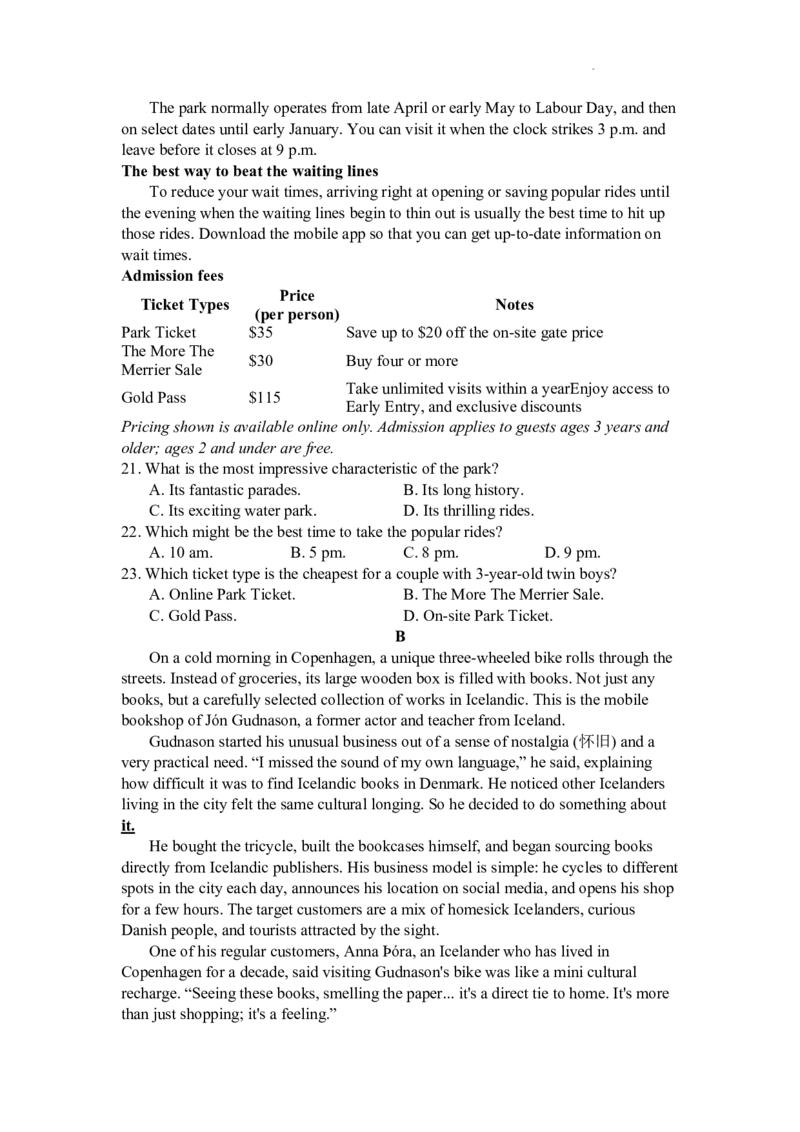
Admission fees
Price
Ticket Types Notes
(per person)
Park Ticket $35 Save up to $20 off the on-site gate price
The More The
$30 Buy four or more
Merrier Sale
Take unlimited visits within a yearEnjoy access to
Gold Pass $115
Early Entry, and exclusive discounts
Pricing shown is available online only. Admission applies to guests ages 3 years and
older; ages 2 and under are free.
21. What is the most impressive characteristic of the park?
A. Its fantastic parades. B. Its long history.
C. Its exciting water park. D. Its thrilling rides.
22. Which might be the best time to take the popular rides?
A. 10 am. B. 5 pm. C. 8 pm. D. 9 pm.
23. Which ticket type is the cheapest for a couple with 3-year-old twin boys?
A. Online Park Ticket. B. The More The Merrier Sale.
C. Gold Pass. D. On-site Park Ticket.
B
On a cold morning in Copenhagen, a unique three-wheeled bike rolls through the
streets. Instead of groceries, its large wooden box is filled with books. Not just any
books, but a carefully selected collection of works in Icelandic. This is the mobile
bookshop of Jón Gudnason, a former actor and teacher from Iceland.
Gudnason started his unusual business out of a sense of nostalgia (怀旧) and a
very practical need. “I missed the sound of my own language,” he said, explaining
how difficult it was to find Icelandic books in Denmark. He noticed other Icelanders
living in the city felt the same cultural longing. So he decided to do something about
it.
He bought the tricycle, built the bookcases himself, and began sourcing books
directly from Icelandic publishers. His business model is simple: he cycles to different
spots in the city each day, announces his location on social media, and opens his shop
for a few hours. The target customers are a mix of homesick Icelanders, curious
Danish people, and tourists attracted by the sight.
One of his regular customers, Anna Þóra, an Icelander who has lived in
Copenhagen for a decade, said visiting Gudnason's bike was like a mini cultural
recharge. “Seeing these books, smelling the paper... it's a direct tie to home. It's more
than just shopping; it's a feeling.”
学科网(北京)股份有限公司But is it a workable business? Gudnason admits the profits are slim. The books
are expensive to import, and his customer base is small. “This will never make me
rich,” he laughed. “But that is never the goal. For me, success is seeing a child get
excited about an Icelandic children's book, or helping a student find a novel for their
studies.”
His effort has turned him into a local celebrity and a preserver of culture. He's not
just selling books; he's selling a piece of Iceland. He offers recommendations,
discusses literature, and has become a walking, talking cultural ambassador.
24.What does the underlined word “it” in paragraph 2 refer to?
A. The unusual business. B. The Danish language.
C. The shared homesickness. D. The Icelandic lifestyle.
25.What is paragraph 3 mainly about?
A. How the bookshop runs. B. Who funds the bookshop.
C. What inspires the business. D. Where the books come from.
26.What did Anna Þóra think of visiting the bookshop?
A. It helped her fit in with the locals. B. It connected her to her cultural roots.
C. It brought book buyers convenience.D. It offered an escape from the city life.
27.Which of the following best describes Gudnason?
A. A cultural messenger. B. A patriotic publisher.
C. A knowledgeable teacher. D. A conventional businessman.
C
“I want that one—no, that one, over there.” This intention can be said with words,
but it’s just as easily communicated through gestures such as pointing and raising
your eyebrows. Humans, however, aren’t the only ones who move our bodies to
express meaning. Now, research published in Royal Society Open Science has added
another animal to the list—elephants. They are also capable of making specific
gestures to communicate their desire.
To understand the research, think of how humans get others to do what they want.
Lead researcher Dr. Vesta Eleuteri, a behavioral biologist at the University of Vienna,
described the essential steps—checking for an audience, signaling, continuing to
signal in different ways if the first signal doesn’t get through, and stopping the
signaling once the goal is achieved. These are all signs of intentionally using gesture
to make others act.
With this understanding, the researchers designed an experiment to see if
elephants show similar intentionality. The animals were shown two trays (托盘) just
out of reach—one empty, the other full of apples—and interacted with a human
experimenter. The scientists ended up observing 38 different gesture types, which the
elephants performed only when an experimenter was present and looking at them,
often using their trunks (象鼻) to gesture in the direction of the full tray. “It was clear
that they wanted the apples,” Eleuteri said. “They’re very expressive.”
However, when the apples on the tray were eaten up, the elephants in the study
didn’t keep gesturing. This is because the animals got used to being fed during the
training and interpreted being given the empty tray as the “end” of the feeding.
学科网(北京)股份有限公司“Further work with wild animals will be required,” Dr. Eleuteri said. Scientists
are still trying to figure out how wild elephants influence each other through gestures
in the wild. Observing these natural interactions offers crucial clues to the
understanding of this gestural language.
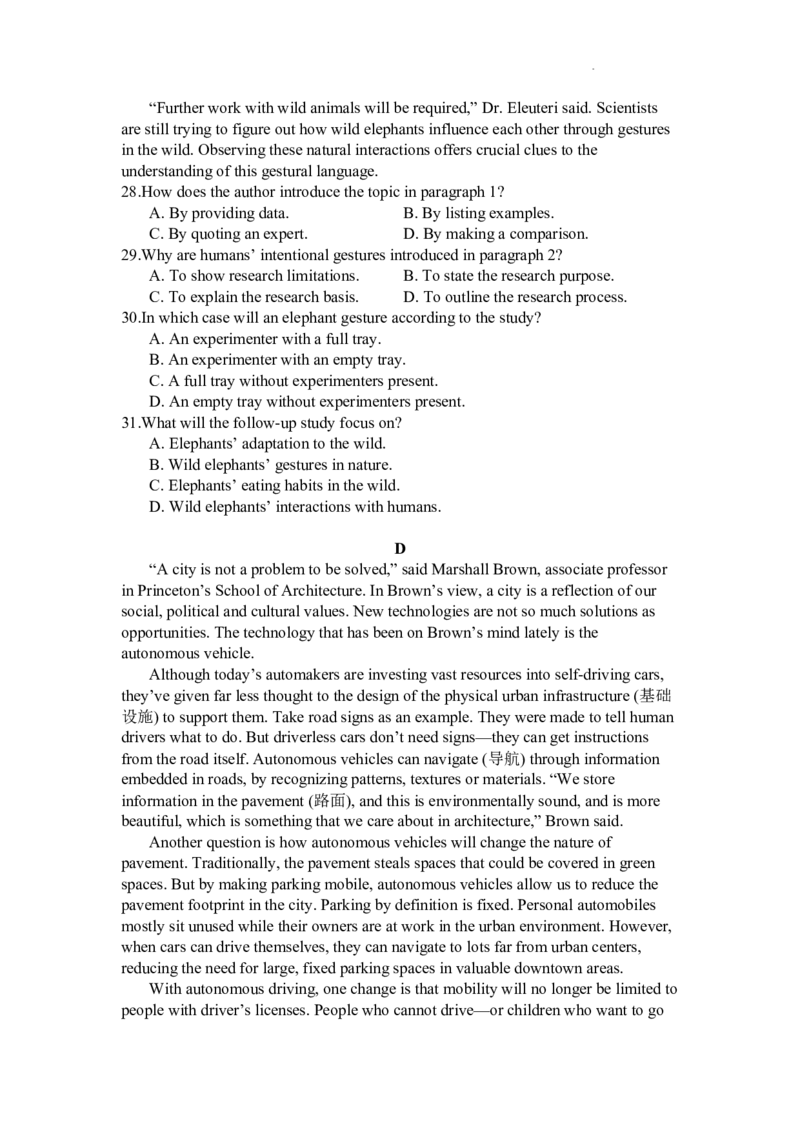
28.How does the author introduce the topic in paragraph 1?
A. By providing data. B. By listing examples.
C. By quoting an expert. D. By making a comparison.
29.Why are humans’ intentional gestures introduced in paragraph 2?
A. To show research limitations. B. To state the research purpose.
C. To explain the research basis. D. To outline the research process.
30.In which case will an elephant gesture according to the study?
A. An experimenter with a full tray.
B. An experimenter with an empty tray.
C. A full tray without experimenters present.
D. An empty tray without experimenters present.
31.What will the follow-up study focus on?
A. Elephants’ adaptation to the wild.
B. Wild elephants’ gestures in nature.
C. Elephants’ eating habits in the wild.
D. Wild elephants’ interactions with humans.
D
“A city is not a problem to be solved,” said Marshall Brown, associate professor
in Princeton’s School of Architecture. In Brown’s view, a city is a reflection of our
social, political and cultural values. New technologies are not so much solutions as
opportunities. The technology that has been on Brown’s mind lately is the
autonomous vehicle.
Although today’s automakers are investing vast resources into self-driving cars,
they’ve given far less thought to the design of the physical urban infrastructure (基础
设施) to support them. Take road signs as an example. They were made to tell human
drivers what to do. But driverless cars don’t need signs—they can get instructions
from the road itself. Autonomous vehicles can navigate (导航) through information
embedded in roads, by recognizing patterns, textures or materials. “We store
information in the pavement (路面), and this is environmentally sound, and is more
beautiful, which is something that we care about in architecture,” Brown said.
Another question is how autonomous vehicles will change the nature of
pavement. Traditionally, the pavement steals spaces that could be covered in green
spaces. But by making parking mobile, autonomous vehicles allow us to reduce the
pavement footprint in the city. Parking by definition is fixed. Personal automobiles
mostly sit unused while their owners are at work in the urban environment. However,
when cars can drive themselves, they can navigate to lots far from urban centers,
reducing the need for large, fixed parking spaces in valuable downtown areas.
With autonomous driving, one change is that mobility will no longer be limited to
people with driver’s licenses. People who cannot drive—or children who want to go
学科网(北京)股份有限公司to a friend’s house—can just hire driverless vehicles that will take them to their
destinations. “Once you start thinking even a little bit about the impact of these
technologies,” Brown said, “it explodes into thinking about everything at once.”
32.What is Marshall Brown’s view on new technologies?
A. A problem to be solved. B. An opportunity for change.
C. A threat to urban design. D. A sign of social development.
33.How do autonomous vehicles navigate according to the text?
A. By using digital maps. B. By following road signs.
C. By obeying drivers’ instructions. D. By reading the road itself.
34.What might be a consequence of mobile parking?
A. Reduced traffic jams. B. Less travel time.
C. Increased green coverage. D. More parking lots.
35.Which can be a suitable title for the text?
A. What Problems New Technology Might Bring
B. Why Cities Should Welcome More Future Cars
C. What Driverless Cars Could Mean for Environment
D. How Autonomous Vehicles Could Reshape Our Cities
第二节(共 5 小题;每小题 2.5 分,满分 12.5 分)
阅读下面短文,从短文后的选项中选出可以填入空白处的最佳选项。选项中有
两项为多余选项。
I grew up in Sichuan, but I only learned to cook surprisingly late in life, after
moving to Germany when I began missing the taste of home. My first adult kitchen
was in a small shared flat in Berlin-Mitte. Out of necessity, I turned to Xiachufang, a
Chinese user-generated recipe (菜谱) app, and taught myself a handful of dishes.
36._____ And over the next decade, I must have made it at least fifty, if not a
hundred times.
I know I’m not alone. For many Chinese immigrants, tomato and egg is the first
dish we master once we leave home. 37._____ It only began appearing in Chinese
kitchens in the 1940s, yet it somehow became the most “default (默认的)” of home-
cooked meals.
38._____ Some will claim no version (版本) tops their mother’s. Others chase
down hidden menu at high-end restaurants or drive across Chengdu just for the plate
everyone says is “the best”.
For all its simplicity, with just tomatoes, eggs, oil, and salt, some versions do
taste better than others. 39._____ This summer, though, with late-season tomatoes at
their peak, I decided to test what actually makes a difference. I cooked plate after
plate, sometimes five or six times within two weeks. At one point, I threw a batch (一
批) into the fridge, determined never to see tomato and egg again. 40._____
A. They were an absolute treat.
B. Tomato and egg stir-fry was one of them.
C. The dish often pulled me back to my childhood.
D. The surprising fact is that the dish itself is relatively young.
E. Today, tomato and egg are both universal and deeply personal.
学科网(北京)股份有限公司F. Yet the next day, I reheated it, paired it with steamed rice, and ate up the whole
thing.
G. For years, I made mine with the cheapest supermarket tomatoes I could find in
Germany.
第三部分 语言运用(共两节,满分 30 分)
第一节(共 15 小题;每小题 1 分,满分 15 分)
阅读下面短文,从每题所给的 A、B、C、D 四个选项中,选出可以填入空白
处的最佳选项。
In the heart of the city’s rush, a different kind of hunter is at work. They move
with microphones and headphones, their prey (猎物) not an animal, but a (n)
41_____.
Antonio is one of them. He describes the city not as a map of places, but as a map
of 42_____. “Most people hear only noise—a loud, 43_____ mass,” he says, “I’ve
learned to listen for peace in it. The birdsong after a fading siren (警笛). The gentle
raindrops after a storm. These are the 44_____.”
His 45_____ began when he suffered from burnout. The endless noise of his life
had become 46_____. A therapist (治疗师) suggested he try listening, truly listening,
to just one sound at a time. It then turned into a passion. He now 47_____ small
groups on “soundwalks,” guiding people to hear the city anew.
On a recent 48_____, he asked participants to stand still under a tree. “Close
your eyes,” he 49_____. “What do you hear?” 50_____, there was just the dull noise
of the city. But slowly, other sounds 51_____: the whisper of leaves, the faint
laughter of a kid two blocks away. A sense of collective calm 52_____ the group.
One participant later said, “For ten minutes, I wasn’t 53_____ about my emails. I
was just…here.”
Antonio explained, “Every small, quiet sound we discover is a(n) 54_____ that
peace is hidden in plain 55_____, waiting for us to listen.”
41.A. story B. fashion C. experience D. object
42.A. sounds B. smells C. sights D. tastes
43.A. surprising B. annoying C. pleasant D. scary
44.A. distractions B. memories C. warnings D. treasures
45.A. journey B. job C. ambition D. experiment
46.A. unbearable B. incredible C. impossible D. unnecessary
47..A. joins B. interviews C. leads D. studies
48.A. show B. adventure C. walk D. drive
49.A. explained B. commented C. recalled D. instructed
50.A. Strangely B. Initially C. Secretly D. Instantly
51.A. ceased B. faded C. traveled D. appeared
52.A. broke into B. took apart C. settled over D. ruled out
53.A. confused B. stressed C. curious D. excited
54.A. reminder B. impression C. promise D. assumption
55.A. living B. hearing C. understanding D. thinking
学科网(北京)股份有限公司非选择题部分
注意:将答案写在答题卡上。写在本题库上无效。
第三部分 语言运用(共两节,满分 30 分)
第二节(共 10 小题;每小题 1.5 分,满分 15 分)
阅读下面短文,在空白处填入 1 个适当的单词或括号内单词的正确形式。
Along the southern edge of the Maowusu Desert, an apple harvest is in full
swing. Farmers move through trees, their baskets filling with fruit that shines in the
warm autumn light. It’s 56._____________ scene of abundance (丰盛) that would
have been unthinkable just twenty years ago. The transformation is part of a quiet
agricultural revolution—the northward march of Shaanxi’s apple belt, extending
hundreds of kilometers into 57._____________ was once an unyielding desert.
Shaanxi’s traditional apple-growing areas were concentrated in the area north of
the Weihe River. In recent years, the planting zone 58._____________ (expand)
northward all the way to the Maowusu Desert, which means one in every four apples
59._____________ (harvest) in China now comes from Shaanxi.
The story of this expansion is written in the weathered face of 85-year-old Zhang
Binggui. In 2003, after retiring, he 60._____________ (rent) sandy land in Yulin,
determined to make something grow. His early 61._____________ (experiment)
with grapes and date trees ended in failure, drawing laughter from neighbors.
However, Zhang’s perseverance (毅力) led him 62._____________ (shift) his focus
to apples. Through years of trial and error, today, he 63._____________ (eventual)
pioneered techniques for sandy soil, increased sales through e-commerce
64._____________ brought their sandy land apples to the national market.
This northward march is also a story written by the changing climate. Between
2010 and 2024, the city’s average yearly rainfall rose. Once known
65._____________ its vast stretches of shifting dunes (沙丘), the Maowusu Desert is
now turning green.
第四部分 写作(共两节,满分 40 分)
第一节(满分 15 分)
假定你是校英文杂志主编李华,杂志近期将发行题为《校园无名英雄》的专刊。
请为其写一篇寄语,内容包括:
1.发行目的;
2.专刊内容。
注意:
1.写作词数应为 80 左右;
2.适当增加细节,以使行文连贯。
Dear Readers,
It is my great pleasure to announce the release of our special issue, “Unsung
Heroes on Campus.”
学科网(北京)股份有限公司Best regards,
Li Hua
Editor-in-chief
第二节(满分 25 分)
阅读下面材料,根据其内容和所给段落开头语续写两段,使之构成一篇完整的
短文。
It was a fresh spring morning. Johnny stood on the top of Broomstick Hill and
took great, happy gulps (大口吸) of the sunny air and the cool smell of new things
growing. It was not a day for sitting around. No sir. Johnny was off for a hike and a
day of adventure! He threw over his shoulders his backpack, dug his hands in his
pockets and started down Broomstick Hill.
When passing by the Professor’s house, he stopped short. There, on the water of
the Professor’s pond were two wild ducks. They were black, with touches of brownish
yellow, and they swam like anything.
“Hi, Johnny!” smiled the Professor, “I’ve tidied up the pond for these two
newcomers. The fat one is Stuffer and the one standing on his head in the water is
Diver.” Johnny smiled back. He liked seeing the Professor’s pond—it was always
clear and bright. And he liked the Professor. Winter or summer, spring or fall, he was
always doing something interesting, something to do with birds, or bugs or animals.
After saying goodbye to the Professor, Johnny started down the hill again. He
walked on and on and then came a loud, unusual sound! Johnny looked up. There,
high above his head, was a long line of ducks. They quacked (嘎嘎叫), beat the air
with their wings and flew high and proud right through the blue spring sky. One
lonely duck was left, though, for it could not fly.
Walking closer, Johnny saw its shiny brown feathers, a yellowish bill and a
twisted (变形的) wing—that was why it could only swim slowly. But seeing it slide
lazily on the water, Johnny knew it was the most beautiful duck he had ever seen. He
took some biscuits from his backpack and dropped in the water. Next second, the
duck stretched down and up and the biscuits were all gone! Then a Fourth-of-July-
sort-of-idea exploded inside Johnny’s head. He would catch that duck and bring it
home! It would be his own duck to keep!
注意:(1)续写词数应为 150 个左右;(2)请按如下格式在答题卡的相应位
置作答。
Johnny dropped his last piece of biscuit into the water.
_____________________________________________________________________
_____________________________________________________________________
_____________________________________________________________________
With the poor duck in his hands, Johnny sighed and headed to the Professor’s.
_____________________________________________________________________
_____________________________________________________________________
_____________________________________________________________________
学科网(北京)股份有限公司学科网(北京)股份有限公司