2013年全国硕士研究生招生考试
英语(二)试题
Section I Use of English
Directions:
Read the following text. Choose the best word(s) for each numbered blank and mark A, B, C or D
on the ANSWER SHEET. (10 points)
①Given the advantages of electronic money, you might think that we would move quickly to
the cashless society in which all payments are made electronically. ② 1 , a true cashless society
is probably not around the corner. ③Indeed, predictions have been 2 for two decades but have
not yet come to fruition. ④For example, Business Week predicted in 1975 that electronic means of
payment would soon “revolutionize the very 3 of money itself,” only to 4 itself several
years later. ⑤Why has the movement to a cashless society been so 5 in coming?
①Although electronic means of payment may be more efficient than a payments system
based on paper, several factors work 6 the disappearance of the paper system. ②First, it is
very 7 to set up the computer, card reader, and telecommunications networks necessary to
make electronic money the 8 form of payment. ③Second, paper checks have the advantage
that they 9 receipts, something that many consumers are unwilling to 10 . ④Third, the use
of paper checks gives consumers several days of “float”—it takes several days 11 a check is
cashed and funds are 12 from the issuer’s account, which means that the writer of the check
can earn interest on the funds in the meantime. ⑤ 13 electronic payments are immediate, they
eliminate the float for the consumer.
①Fourth, electronic means of payment may 14 security and privacy concerns. ②We
often hear media reports that an unauthorized hacker has been able to access a computer database
and to alter information 15 there. ③The fact that this is not an 16 occurrence means that
dishonest persons might be able to access bank accounts in electronic payments systems and 17
from someone else’s accounts. ④The 18 of this type of fraud is no easy task, and a new field
of computer science is developing to 19 security issues. ⑤A further concern is that the use of
electronic means of payment leaves an electronic 20 that contains a large amount of personal
data. ⑥ There are concerns that government, employers, and marketers might be able to access
these data, thereby violating our privacy.
1. [A] Moreover [B] However [C] Therefore [D] Otherwise
2. [A] off [B] back [C] over [D] around
3. [A] power [B] concept [C] history [D] role
4. [A] reverse [B] resist [C] resume [D] reward
5. [A] silent [B] sudden [C] slow [D] steady
6. [A] for [B] against [C] with [D] on
7. [A] expensive [B] imaginative [C] sensitive [D] productive
8. [A] similar [B] original [C] temporary [D] dominant
9. [A] collect [B] copy [C] provide [D] print
10. [A] give up [B] take over [C] bring back [D] pass down11. [A] before [B] after [C] since [D] when
12. [A] kept [B] borrowed [C] withdrawn [D] released
13. [A] Unless [B] Because [C] Until [D] Though
14. [A] hide [B] express [C] ease [D] raise
15. [A] analyzed [B] shared [C] stored [D] displayed
16. [A] unsafe [B] unnatural [C] unclear [D] uncommon
17. [A] steal [B] choose [C] benefit [D] return
18. [A] consideration [B] prevention [C] manipulation [D] justification
19. [A] call for [B] fight against [C] adapt to [D] cope with
20. [A] chunk [B] chip [C] trail [D] path
Section II Reading Comprehension
Part A
Directions:
Read the following four texts. Answer the questions after each text by choosing A, B, C or [D]
Mark your answers on the ANSWER SHEET. (40 points)
Text 1
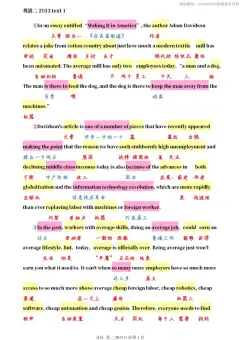
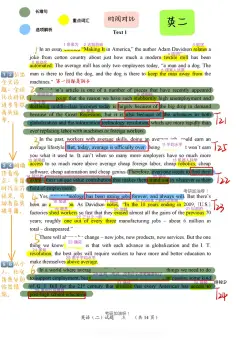
① In an essay entitled “Making It in America,” the author Adam Davidson relates a joke
from cotton country about just how much a modern textile mill has been automated: The average
mill has only two employees today, “a man and a dog. ②The man is there to feed the dog, and the
dog is there to keep the man away from the machines.”
① Davidson’s article is one of a number of pieces that have recently appeared making the
point that the reason we have such stubbornly high unemployment and declining middle-class
incomes today is largely because of the big drop in demand because of the Great Recession, but it
is also because of the advances in both globalization and the information technology revolution,
which are more rapidly than ever replacing labor with machines or foreign workers.
① In the past, workers with average skills, doing an average job, could earn an average
lifestyle. ② But, today, average is officially over. ③ Being average just won’t earn you what it
used to. ④It can’t when so many more employers have so much more access to so much
more above average cheap foreign labor, cheap robotics, cheap software, cheap automation
and cheap genius. ⑤ Therefore, everyone needs to find their extra—their unique value
contribution that makes them stand out in whatever is their field of employment.
① Yes, new technology has been eating jobs forever, and always will. ② But there’s been
an acceleration. ③As Davidson notes, “In the 10 years ending in 2009, [U.S.] factories shed
workers so fast that they erased almost all the gains of the previous 70 years; roughly one out of
every three manufacturing jobs—about 6 million in total—disappeared.”
①There will always be change—new jobs, new products, new services. ②But the one thing
we know for sure is that with each advance in globalization and the I. T. revolution, the best jobs
will require workers to have more and better education to make themselves above average.
①In a world where average is officially over, there are many things we need to do to support
employment, but nothing would be more important than passing some kind of G. I. Bill for the
21st century that ensures that every American has access to post-high school education.21. The joke in Paragraph 1 is used to illustrate .
[A] the impact of technological advances
[B] the alleviation of job pressure
[C] the shrinkage of textile mills
[D] the decline of middle-class incomes
22. According to Paragraph 3, to be a successful employee, one has to .
[A] adopt an average lifestyle
[B] work on cheap software
[C] ask for a moderate salary
[D] contribute something unique
23. The quotation in Paragraph 4 explains that .
[A] gains of technology have been erased
[B] job opportunities are disappearing at a high speed
[C] factories are making much less money than before
[D] new jobs and services have been offered
24. According to the author, to reduce unemployment, the most important is .
[A] to accelerate the I. T. revolution
[B] to advance economic globalization
[C] to ensure more education for people
[D] to pass more bills in the 21st century
25. Which of the following would be the most appropriate title for the text?
[A] Technology Goes Cheap.
[B] New Law Takes Effect.
[C] Recession Is Bad.
[D] Average Is Over.
Text 2
① A century ago, the immigrants from across the Atlantic included settlers and
sojourners. ② Along with the many folks looking to make a permanent home in the
United States came those who had no intention to stay, and who would make some
money and then go home. ③ Between 1908 and 1915, about 7 million people arrived
while about 2 million departed. ④About a quarter of all Italian immigrants, for example,
eventually returned to Italy for good. ⑤They even had an affectionate nickname, “uccelli
di passaggio,” birds of passage.
① Today, we are much more rigid about immigrants. ② We divide newcomers into
two categories: legal or illegal, good or bad. ③ We hail them as Americans in the
making, or brand them as aliens to be kicked out. ④ That framework has contributed
mightily to our broken immigration system and the long political paralysis over how to
fix it. ⑤We don’t need more categories, but we need to change the way we think about
categories. ⑥ We need to look beyond strict definitions of legal and illegal. ⑦ To start,
we can recognize the new birds of passage, those living and thriving in the gray areas.
⑧We might then begin to solve our immigration challenges.
①Crop pickers, violinists, construction workers, entrepreneurs, engineers, home health-
care aides and physicists are among today’s birds of passage. ② They are energetic
participants in a global economy driven by the flow of work, money and ideas. ③Theyprefer to come and go as opportunity calls them. ④They can manage to have a job in
one place and a family in another.
① With or without permission, they straddle laws, jurisdictions and identities with
ease. ② We need them to imagine the United States as a place where they can be
productive for a while without committing themselves to staying forever. ③We need them
to feel that home can be both here and there and that they can belong to two nations honorably.
①Accommodating this new world of people in motion will require new attitudes on
both sides of the immigration battle. ②Looking beyond the culture war logic of right or
wrong means opening up the middle ground and understanding that managing immigration
today requires multiple paths and multiple outcomes, including some that are not easy to
accomplish legally in the existing system.
26. “Birds of passage” refers to those who .
[A] stay in a foreign country temporarily
[B] leave their home countries for good
[C] immigrate across the Atlantic
[D] find permanent jobs overseas
27. It is implied in Paragraph 2 that the current immigration system in the US .
[A] needs new immigrant categories
[B] has loosened control over immigrants
[C] should be adapted to meet challenges
[D] has been fixed via political means
28. According to the author, today’s birds of passage want .
[A] financial incentives
[B] a global recognition
[C] the freedom to stay and leave
[D] opportunities to get regular jobs
29. The author suggests that the birds of passage today should be treated .
[A] as faithful partners
[B] with legal tolerance
[C] with economic favors
[D] as mighty rivals
30. The most appropriate title for this text would be .
[A] Come and Go: Big Mistake
[B] Living and Thriving: Great Risk
[C] With or Without: Great Risk
[D] Legal or Illegal: Big mistake
Text 3
①Scientists have found that although we are prone to snap overreactions, if we take
a moment and think about how we are likely to react, we can reduce or even eliminate
the negative effects of our quick, hard-wired responses.
① Snap decisions can be important defense mechanisms; if we are judging whether
someone is dangerous, our brains and bodies are hard-wired to react very quickly, within
milliseconds. ② But we need more time to assess other factors. ③ To accurately tell
whether someone is sociable, studies show, we need at least a minute, preferably five.④ It takes a while to judge complex aspects of personality, like neuroticism or open-
mindedness.
①But snap decisions in reaction to rapid stimuli aren’t exclusive to the interpersonal
realm. ② Psychologists at the University of Toronto found that viewing a fast-food logo
for just a few milliseconds primes us to read 20 percent faster, even though reading has
little to do with eating. ③ We unconsciously associate fast food with speed and
impatience and carry those impulses into whatever else we’re doing. ④ Subjects exposed
to fast-food flashes also tend to think a musical piece lasts too long.
①Yet we can reverse such influences. ②If we know we will overreact to consumer
products or housing options when we see a happy face (one reason good sales
representatives and real estate agents are always smiling), we can take a moment before
buying. ③If we know female job screeners are more likely to reject attractive female applicants,
we can help screeners understand their biases—or hire outside screeners.
① John Gottman, the marriage expert, explains that we quickly “ thin slice”
information reliably only after we ground such snap reactions in “thick sliced” long-term
study. ②When Dr. Gottman really wants to assess whether a couple will stay together, he
invites them to his island retreat for a much longer evaluation: two days, not two seconds.
① Our ability to mute our hard-wired reactions by pausing is what differentiates us
from animals: dogs can think about the future only intermittently or for a few minutes. ②
But historically we have spent about 12 percent of our days contemplating the longer
term. ③ Although technology might change the way we react, it hasn’t changed our
nature. ④We still have the imaginative capacity to rise above temptation and reverse the
high-speed trend.
31. The time needed in making decisions may .
[A] predetermine the accuracy of our judgment
[B] prove the complexity of our brain reaction
[C] depend on the importance of the assessment
[D] vary according to the urgency of the situation
32. Our reaction to a fast-food logo shows that snap decisions .
[A] can be associative
[B] are not unconscious
[C] can be dangerous
[D] are not impulsive
33. To reverse the negative influences of snap decisions, we should .
[A] trust our first impression
[B] think before we act
[C] do as people usually do
[D] ask for expert advice
34. John Gottman says that reliable snap reactions are based on .
[A] critical assessment
[B] “thin sliced” study
[C] adequate information
[D] sensible explanation
35. The author’s attitude toward reversing the high-speed trend is .[A] tolerant
[B] optimistic
[C] uncertain
[D] doubtful
Text 4
① Europe is not a gender-equality heaven. ② In particular, the corporate workplace
will never be completely family-friendly until women are part of senior management
decisions, and Europe’s top corporate-governance positions remain overwhelmingly male.
③Indeed, women hold only 14 per cent of positions on European corporate boards.
①The European Union is now considering legislation to compel corporate boards to
maintain a certain proportion of women—up to 60 per cent. ②This proposed mandate was
born of frustration. ③ Last year, European Commission Vice President Viviane Reding
issued a call to voluntary action. ④ Reding invited corporations to sign up for gender
balance goals of 40 per cent female board membership. ⑤But her appeal was considered
a failure: only 24 companies took it up.
① Do we need quotas to ensure that women can continue to climb the corporate
ladder fairly as they balance work and family?
①“Personally, I don’t like quotas,” Reding said recently. ②“But I like what the
quotas do.” ③Quotas get action: they “open the way to equality and they break through
the glass ceiling,” according to Reding, a result seen in France and other countries with
legally binding provisions on placing women in top business positions.
①I understand Reding’s reluctance—and her frustration. ②I don’t like quotas either;
they run counter to my belief in meritocracy, governance by the capable. ③ But, when
one considers the obstacles to achieving the meritocratic ideal, it does look as if a fairer
world must be temporarily ordered.
①After all, four decades of evidence has now shown that corporations in Europe as
well as the US are evading the meritocratic hiring and promotion of women to top
positions—no matter how much “soft pressure” is put upon them. ② When women do
break through to the summit of corporate power—as, for example, Sheryl Sandberg recently did
at Facebook—they attract massive attention precisely because they remain the exception to the
rule.
①If appropriate pubic policies were in place to help all women—whether CEOs or
their children’s caregivers—and all families, Sandberg would be no more newsworthy than
any other highly capable person living in a more just society.
36. In the European corporate workplace, generally .
[A] women take the lead
[B] men have the final say
[C] corporate governance is overwhelmed
[D] senior management is family-friendly
37. The European Union’s intended legislation is .
[A] a reflection of gender balance
[B] a response to Reding’s call
[C] a reluctant choice
[D] a voluntary action38. According to Reding, quotas may help women .
[A] get top business positions
[B] see through the glass ceiling
[C] balance work and family
[D] anticipate legal results
39. The author’s attitude toward Reding’s appeal is one of .
[A] skepticism
[B] objectiveness
[C] indifference
[D] approval
40. Women entering top management become headlines due to the lack of .
[A] more social justice
[B] massive media attention
[C] suitable public policies
[D] greater “soft pressure”
Part B
Directions:
Read the following text and answer the questions by choosing the most suitable subtitle from
the list A-G for each numbered paragraph (41-45). There are two extra subtitles which you do
not need to use. Mark your answers on the ANSWER SHEET. (10 points)
[A] Shopkeepers are your friends
[B] Remember to treat yourself
[C] Stick to what you need
[D] Live like a peasant
[E] Balance your diet
[F] Planning is everything
[G] Waste not, want not
The hugely popular blog the Skint Foodie chronicles how Tony balances his love of good
food with living on benefits. After bills, Tony has £60 a week to spend, £40 of which goes on
food, but 10 years ago he was earning £130, 000 a year working in corporate communications and
eating at London’s best restaurants at least twice a week. Then his marriage failed, his career
burned out and his drinking became serious. “The community mental health team saved my life.
And I felt like that again, to a certain degree, when people responded to the blog so well. It gave
me the validation and confidence that I’d lost. But it’s still a day-by-day thing.” Now he’s living in
a council flat and fielding offers from literary agents. He’s feeling positive, but he’ll carry on
blogging—not about eating as cheaply as you can—“there are so many people in a much worse
state, with barely any money to spend on food”—but eating well on a budget. Here’s his advice
for economical foodies.
41.
Impulsive spending isn’t an option, so plan your week’s menu in advance, making shopping
lists for your ingredients in their exact quantities. I have an Excel template for a week of breakfast,
lunch and dinner. Stop laughing: it’s not just cost effective but helps you balance your diet. It’s
also a good idea to shop daily instead of weekly, because, being human, you’ll sometimes changeyour mind about what you fancy.
42.
This is where supermarkets and their anonymity come in handy. With them, there’s not the
same embarrassment as when buying one carrot in a little greengrocer. And if you plan properly,
you’ll know that you only need, say, 350g of shin of beef and six rashers of bacon, not whatever
weight is pre-packed in the supermarket chiller.
43.
You may proudly claim to only have frozen peas in the freezer—that’s not good enough.
Mine is filled with leftovers, bread, stock, meat and fish. Planning ahead should eliminate
wastage, but if you have surplus vegetables you’ll do a vegetable soup, and all fruits threatening to
“go off” will be cooked or juiced.
44.
Everyone says this, but it really is a top tip for frugal eaters. Shop at butchers, delis and fish-
sellers regularly, even for small things, and be super friendly. Soon you’ll feel comfortable asking
if they’ve any knuckles of ham for soups and stews, or beef bones, chicken carcasses and fish
heads for stock which, more often than not, they’ll let you have for free.
45.
You won’t be eating out a lot, but save your pennies and once every few months treat
yourself to a set lunch at a good restaurant—£1.75 a week for three months gives you £21—more
than enough for a three-course lunch at Michelin-starred Arbutus. It’s £16.95 there—or £12.99 for
a large pizza from Domino’s: I know which I’d rather eat.
Section III Translation
46. Directions:
Translate the following text into Chinese. Write your translation on the ANSWER SHEET. (15
points)
I can pick a date from the past 53 years and know instantly where I was, what happened in
the news and even the day of the week. I’ve been able to do this since I was four.
I never feel overwhelmed with the amount of information my brain absorbs. My mind seems
to be able to cope and the information is stored away neatly. When I think of a sad memory, I do
what everybody does—try to put it to one side. I don’t think it’s harder for me just because my
memory is clearer. Powerful memory doesn’t make my emotions any more acute or vivid. I can
recall the day my grandfather died and the sadness I felt when we went to the hospital the day
before. I also remember that the musical play Hair opened on Broadway on the same day—they
both just pop into my mind in the same way.
Section IV Writing
Part A
47. Directions:
Suppose your class is to hold a charity sale for kids in need of help. Write your classmates an
email to1) inform them about the details, and
2) encourage them to participate.
You should write about 100 words on the ANSWER SHEET.
Do not use your own name. Use “Li Ming” instead.
Do not write your address. (10 points)
Part B
48. Directions:
Write an essay based on the following chart. In your writing, you should
1) interpret the chart, and
2) give your comments.
You should write about 150 words on the ANSWER SHEET. (15 points)