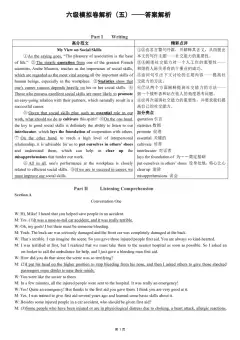
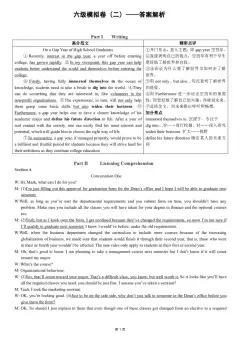
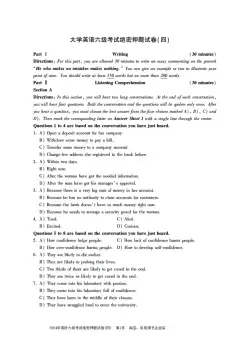
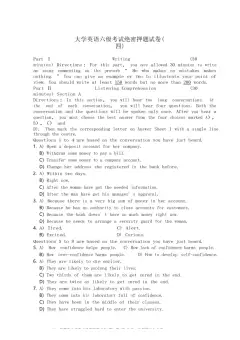
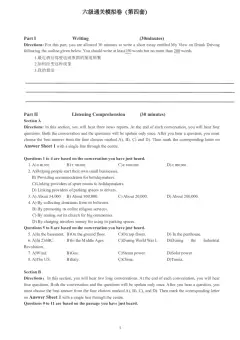
六级模拟卷(四)
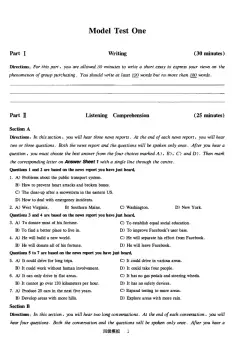
Part I Writing (30 minutes)
Directions: For this part, you are allowed 30 minutes to write a short essay on cohesion. Your essay should
include the importance of cohesion and measures to be taken to enhance cohesion. You should write at least150
words but no more than 200 words.
PartII ListeningComprehension (30minutes)
SectionA
Directions: In this section, you will hear three news reports.At the end of each news report, you will hear two or
three questions. Both the news report and the questions will be spoken only once.After you hear a question, you
must choose the bestanswer from the four choices markedA), B), C) and D).Then mark the corresponding letter
onAnswerSheet1withasinglelinethroughthecentre.
Questions1to4arebasedontheconversationyouhavejustheard.
1.A)Howtoactatajobinterview.
B)Howtorunone’sownbusiness.
C)Howtodressduringajobinterview.
D)Howtocommunicatewithyourboss.
2.A)Whetherheshouldboastabouthisadvantages.
B)Whetherheshoulddressformallyfortheinterview.
C)Whetherheshouldmentionhispersonalproblems.
D)Whetherheshouldbehonestabouthisbadhabit.
3.A)Asksomethought-provokingquestions.
B)Offerafirmhandshakewhengreetingtheinterviewer.
C)Arriveontimeattheinterview.
D)Dressgorgeousclothes.
4.A)Becauseitisthebestwaytolettheconversationgosmoothly.
B)Becauseitisthebestwaytoleaveagoodfirstimpression.
C)Becauseitcanshowthatyouareanintelligentinterviewee.
D)Becauseitcanshowthatyouaregenuinelyinterestedintheposition.
Questions5to8arebasedontheconversationyouhavejustheard.
5.A)Heprefersvotingforaqualifiedleader.
B)Heprefersbecomingabusinessman.
C)Heprefersjoininganon-governmentalorganization.
D)Heprefersjoiningapoliticalparty.
6.A)Fromstates. B)Fromtheirownmembers.
C)Fromtheirownbusinesses. D)Fromdonations.
7.A)Thosewhocanoffergoodconcepts. C)Thosewhodeliverenlighteningspeeches.
B)Thosewhocanofferlotsofmoney. D)Thosewhoaregoodatmanagingeconomy.
8.A)Intelligent. B)Humorous. C)Confident. D)Brave.
第 1 页SectionB
Directions:In this section, you will hear two long conversations.At the end of each conversation, you will hear
four questions. Both the conversation and the questions will be spoken only once.After you hear a question, you
must choosethe bestanswer fromthe four choices markedA), B), C), andD).Then mark thecorresponding letter
onAnswerSheet 1withasinglelinethroughthecentre.
Questions9to11arebasedonthepassageyouhavejustheard.
9.A)Becauseitisatonallanguage.
B)Becauseitsgrammarisirregular.
C)Becauseitscharactersaredifficulttoremember.
D)Becauseithasmanydialects.
10.A)TotalktoasmanyChineseaspossible.
B)TogetabilingualteacherwhocanspeakChineseandEnglish.
C)TowatchasmanyChinesemoviesaspossible.
D)TolistentoasmanyChineserecordingsaspossible.
11.A)Findlocalstotalkto. B)Embraceitanduseiteverywhere.
C)Memorizeitscharacters. D)ReadalotofChinesebooks.
Questions12to15arebasedonthepassageyouhavejustheard.
12.A)Becausetheygetmorepraisefromtheirparents.
B)Becausetheygetmorementalstimulationfromtheirparents.
C)Becausetheygetmoreemotionalsupportfromtheirparents.
D)Becausetheygetmorehelpfromtheirparentswiththeirtasks.
13.A)First-bornchildrenhavebetterbusinessachievements.
B)First-bornchildrenhavebetterthinkingskills.
C)First-bornchildrenhavebettersenseofindependence.
D)First-bornchildrenhavebetterlogicalthinking.
14.A)Writing. B)Reciting. C)Matchingletters. D)Calculating.
15.A)Theyareareasonableexplanationfortheobservedbirth-orderdifferences.
B)Theyareincompleteinexplainingtheobservedbirth-orderdifferences.
C)Theyaredoubtfulinexplainingtheobservedbirth-orderdifferences.
D)Theyareanunconvincingexplanationfortheobservedbirth-orderdifferences.
SectionC
Directions: In this section, you will hear three recordings of lectures or followed by three or four questions. The
recordings will be played only once. After you hear a question, you must choose the best answer from the four
choices marked A), B), C), D). Then mark the corresponding letter on Answer Sheet 1 with a single line
throughthecentre.
Questions16to18arebasedontherecordingyouhavejustheard.
16.A)Usingminivanstocollectdata. B)Usingdronestocollectdata.
C)Releasinganewoperatingsystem. D)Releasinganewversionofapp.
17.A)Becauseitcouldnotnavigate. B)Becauseitofferedwronginformation.
C)Becauseitalwaysbrokedown. D)Becauseitsoperatingsystemwastoocomplex.
18.A)Ithassimplifieditsoperatingsystem. C)Ithasimproveditsappearance.
B)Ithasreleasedanewversion. D)Ithasaddedmoreinformation.
Questions20to22arebasedontherecordingyouhavejustheard.
19.A)Usefullanguageknowledgeislaiddownintheveryearlymonthsoflife.
B)Languageabilitycanberetainedwithoutfurtherinputofthelanguage.
C)Languageknowledgecannotberetainedwithoutfurtherinputofthelanguage.
D)Theprocessofacquiringlanguagestartswhenthebabyis2yearsold.
第 2 页20.A)Itisabstractinnature. C)Itfadeswithtime.
B)Itreliesonexperience. D)Itcanbeerased.
21.A)Whenthechildisborn. C)Whenthechildis6mothsold.
B)Whenthechildisstillinthewomb. D)Whenthechildis17monthsold.
22.A)Itisaconcreteprocess. C)Itisanabstractprocess.
B)Itdependsontraining. D)Itdependsonfetaleducation.
Questions23to25arebasedontherecordingyouhavejustheard.
23.A)Pretendingtocarethepatientsmayimproveyourjob.
B)Professionalismdoesnotnecessarilyaccommodateempathy.
C)Whetherdoctorsshouldempathizewithpatients.
D)Whatisthebestforpatients.
24.A)Itimprovesthehealthofpatients. C)Itfacilitatescommunication.
B)Itimprovesthemoodofdoctors. D)Itdecreasesthemedicalrisk.
25.A)Leaningbackinthechairwhenlistening. C)Repeatingtheirstatementscontinuously.
B)Seeingthemeye-to-eyewhenlistening. D)Sittingnexttothemwhenlistening.
PartⅢ Reading Comprehension (40minutes )
SectionA
Directions: In this section, there is a passage with ten blanks.You are required to select one word for each blank
from a list of choices given in a word bank following the passage. Read the passage through carefully before
making your choices. Each choice in the bank is identified by a letter. Please mark the corresponding letter for
each item on Answer Sheet 2 with a single line through the centre. You may not use any of the words in the
bankmorethanonce.
Questions26to35arebasedonthefollowingpassage.
As the recent courgette(密生西葫芦)crisis and shortages of lettuce, eggplants and broccoli(绿花椰菜)have
shown, Spain’s fame as the vegetable garden of Europe is well deserved. The country’s huge agricultural
sector—courgettes,lettuces,tomatoesandstrawberries—__26__ahugedemand.
Therehasbeena major__27__towardsmechanization since the1950s, butjustasin theUK, many cropsstill
need to be harvested by hand, and many farmers rely on migrant labour. Even where mechanisation can be used,
pickingmachinestendtobetooexpensiveand__28__forsmall-scalefarmers.
The tension between locals and migrant workers,__29__from North and Sub-Saharan Africa and eastern
Europe—is not a big problem, as many of the foreign workers have proper__30__and return to the same farms
yearafteryear.They’reknownandthat’simportant.
Alfrut—a company in the south-western province of Huelva that exports strawberries, raspberries, and other
fruits around the EU—shill harvests by hand. “There is a machine that gathers strawberries, but you have
to__31__the crop to the machine,” says Agustin Muriel, a technical and quality control expert at Alfrut. “If we
weretousemachines, wewouldhaveto__32__ourentire infrastructureanditwouldrequirealotofinvestmentin
machinery,whichisdesignedmainlyforlargeareasandreallybigcompanies.”
Headdsthatthe__33__,manualapproachislikelytocontinueforthe__34__future,asfruitpricesaren’thigh
enough to allow farmers to make big__35__in machinery or spend money reconfiguring( 重新配置)their
operations.
第 3 页A)adapt I)investments
B)attach J)modify
C)contracts K)predominantly
D)feeds L)preference
E)foreseeable M)shift
F)heralds N)traditional
G)impractical O)unexpectedly
H)inaccessible
SectionB
Directions: In this section, you are going to read a passage with ten statements attached to it. Each statement
containsinformationgiveninoneoftheparagraphs.Identifytheparagraphfromwhichtheinformationisderived.
You may choose a paragraph more than once. Each paragraph is marked with a letter. Answer the questions by
markingthecorrespondingletteronAnswerSheet2.
NowWe’reTalking:HowVoiceTechnologyIsTransformingComputing
[A]Like casting a magic spell, it lets people control the world through words alone. Any sufficiently
advancedtechnology,notedArthurC.Clarke,aBritishscience-fictionwriter,isindistinguishablefrommagic.The
fast-emergingtechnologyofvoicecomputingproveshispoint.Usingitisjustlikecastingaspell:sayafewwords
intotheair,andanearbydevicecangrantyourwish.
[B]TheAmazon Echo, a voice-driven cylindrical(圆柱体的)computer that sits on a table top and answers to
the name Alexa, can all up music tracks and radio stations, tell jokes, answer trivia questions and control smart
appliances; even before Christmas it was already resident in about 4% of American households. Voice assistants
are proliferating in smartphones, too: Apple’s Siri handles over 2bn commands a week, and 20% of Google
searches on Android-powered handsets in America are input by voice. Dictating emails and text messages now
worksreliablyenoughtobeuseful.Whytypewhenyoucantalk?
[C]This is a huge shift. Simple though it may seem, voice has the power to transform computing, by
providing a natural means of interaction. Windows, icons and menus, and then touchscreens, were welcomed as
more intuitive ways to deal with computers than entering complex keyboard commands. But being able to talk to
computers abolishesthe needfor the abstractionofa “userinterface” atall. Justas mobile phoneswere more than
existing phones without wires, and cars were more than carriages without horses, so computers without screens
andkeyboardshavethepotentialtobemoreuseful,powerfulandubiquitousthanpeoplecanimaginetoday.
[D]Voice will notwholly replace other forms of inputand output. Sometimes it will remain more convenient
to converse with a machine by typing rather than talking(Amazon is said to be working on an Echo device with a
built-in screen). But voice is destined to account for a growing share of people’s interactions with the technology
around them, from washing machines that tell you how much of the cycle they have left to virtual assistants in
corporate call-centers. However, to reach its full potential, the technology requires further breakthroughs—and a
resolutionofthetrickyquestionsitraisesaroundthetrade-offbetweenconvenienceandprivacy.
[E]Alexa, what is deep learning? Computer-dictation systems have been around for years. But they were
unreliable and required lengthy training to learn a specific user’s voice. Computers’ new ability to recognize
almost anyone’s speech dependably without training is the latest latest manifestation of the power of “deep
learning”, an artificial-intelligence technique in which a software system is trained using millions of examples,
usually culled( 挑 选 )from the internet. Thanks to deep learning, machines now nearly equal humans in
transcription accuracy, computerized translation systems are improving rapidly and text-to-speech systems are
becomingless roboticandmorenatural-sounding. Computers are,inshort, getting muchbetter athandlingnatural
languageinallitsforms.
第 4 页[F]Although deep learning means that machines can recognize speech more reliably and talk in a less
stilted(不自然的)manner,they still don’t understand the meaning of language. That is the most difficult aspectof
the problem and, if voice-driven computing is truly to flourish, one that must be overcome. Computers must be
able to understand context in order to maintain a coherent conversation about something, rather than just
responding to simple, one-off voice commands, as they mostly do today(“Hey, Siri, set a timer for ten
minutes”).Researchersinuniversitiesandatcompanieslargeandsmallareworkingonthisveryproblem, building
“bots” that can hold more elaborate conversations about more complex tasks, from retrieving information to
advisingonmortgagestomakingtravelarrangements.(Amazonisofferinga$1mprizeforabotthatcanconverse
“coherentlyandengagingly”for20minutes.)
[G]Whenspellsreplacespelling. Consumersandregulators alsohavearoletoplayindetermininghowvoice
computing develops. Even in its current, relatively primitive form, the technology poses a dilemma: voice-driven
systems are most useful when they are personalized, and are granted wide access to sources of data such as
calendars,emailsandothersensitiveinformation.Thatraisesprivacyandsecurityconcerns.
[H]To further complicate matters, many voice-driven devices are always listening, waiting to be activated.
Some people are already concerned about the implications of internet-connected microphones listening in every
room and from every smartphone. Not all audio is sent to the cloud—devices wait for a trigger phrase(“Alexa”,
“OK, Google”, “Hey, Cortana”, or “Hey, Siri”) before they start relaying the user’s voice to the servers that
actuallyhandletherequests—butwhenitcomestostoringaudio,itisunclearwhokeepswhatandwhen.
[I]Police investigating a murder in Arkansas, which may have been overheard by an Amazon Echo, have
asked the company for access to any audio that might have been captured. Amazon has refused to co-operate,
arguing(with the backing of privacy advocates)that the legal status of such requests is unclear. The situation is
analogous(相似)to Apple’s refusal in 2016 to help FBI investigators unlock a terrorist’s iPhone; both cases
highlighttheneedforrulesthatspecifywhenandwhatintrusionsintopersonalprivacyarejustifiedintheinterests
ofsecurity.
[J]Consumers will adopt voice computing even if such issues remain unresolved. In many situations voice is
far more convenient and natural than any other means of communication. Uniquely, it can also be used while
doing something else(driving, working out or walking down the street). It can extend the power of computing to
people unable, for one reason or another, to use screens and keyboards.And it could have a dramatic impact not
juston computing, buton the use of language itself. Computerized simultaneous translation could renderthe need
to speak a foreign language irrelevant for many people;and in a world where machines can talk, minor languages
maybemorelikelytosurvive.Thearrivalofthetouchscreenwasthelastbigshiftinthewayhumansinteractwith
computers.Theleaptospeechmattersmore.
36. Despite the issue of invasion of privacy, voice-computing’s irresistible convenience is already receiving
wideadoption.
37.Conventionalformsofinputandoutputwillnotbeentirelyreplacedbyvoicecommand.
38.Deeplearningrevolutionizesspeechtechnologies,enablingcomputerstoprocessanynaturallanguage.
39.Screens and keyboards of computers are not necessarily indispensable because of the invention of voice
computing.
40.Deeplearninghasrealsuccesses,butisnotenoughtounderstandthemeaningoflanguage.
41.Theconveniencebroughtbyvoicecomputingcancomeatariskofprivacyorsecurity.
42.Laws that apply to privacy and security issues for voice technology are needed in light of the two cases in
America.
43.Despiteitssimpleappearance,voiceiscapableofchangingcomputing,bybypassingthephysicalrealm.
44.Thanks to voice computing, several devices such as smartphones have already done some tasks by voice
orders.
45.To fully explore the potential of voice technology, more things need to be done to tackle the gaps between
convenienceandprivacy.
第 5 页SectionC
Directions: There are 2 passages in this section. Each passage is followed by some questions or unfinished
statements. For each of them there are four choices marked A), B), C) and D). You should decide on the best
choiceandmarkthecorrespondingletteronAnswerSheet 2withasinglelinethroughthecentre.
PassageOne
Questions46to50arebasedonthefollowingpassage.
Policeofficersmayhopethattheirpresenceinschoolswillhelpthembuildstrongrelationshipswithstudents,
improving police-community relations over the long term. But achieving that goal may require rethinking law
enforcement’sroleineducation,anewreportsuggests.
Lookingatfederaldatafromthe2012-2014schoolyear,researchersatEducationWeekfoundthatstudentsin
schools with at least one school resource officer(STO)were1.5 times likely to be arrested than their peers in
schools that did nothave a police presence.The disparity is particularly stark for black students, possibly because
police presence is concentrated in districts with a higher proportion of minority students. Black buys were three
timesmorelikelytobearrestedatschoolthanwhiteboys,thereportfound.
Rather than building relationships and improving outcomes, students who are arrested or referred to law
enforcementcan see a drop in schoolperformance and are disproportionately more likely to get involved with the
law again as adults, researchers say. Racial bias means that outcomes are particularly poor in communities of
color.
Spurred byrising fears of violentcrime during the 1980s and 1990s, some schools began turning to police to
increase safety on campus. With federal funding, their presence only grew. Following tragedies like the school
shootingatColumbineHighSchoolinColorado,anincreasingnumberofparentscalledforsecuritymeasureslike
metal detectors and armed officers. By 2013-2014, 44,000 “school resource officers” worked in schools on a
full-orpart-timebasis.
In some cases,hiringthese officershasresulted inanimpressive dropinincidents. Butthenationalpicture is
less positive. Particularly in schools with a high proportion of minorities, the SROs are overused, taking on
disciplinaryfunctionsthatclassroomteachershavetraditionallyperformed,expertssay.
Arresting students, rather than having a classroom teacher discipline them, brings financial and emotional
costs. An American Civil Liberties Union report found that arrested students were twice as likely to drop out of
highschool—andforthosewhoappearedincourt,thatfiguredoubled.
Compoundingtheproblem, thecostofemploying schoolresourceofficersmeans many schools with apolice
presence are less likely to have school counselors who can keep an eye on the psychological and developmental
effects of arrests on children, Education Week reported. Detaining students also drains the budget of money that
couldbeusedtoeducatethem.
So how can police officers help ensure safety without becoming disciplinarians(纪律严明者)who grease the
school-to-prison pipeline? Training is key, National Association of School Resource Officers executive director
Mo Canady told EducationWeek. SROs should see themselves notonly as members of law enforcement, butalso
embracetheirroleaseducatorsonissueslikedrugpreventionandasinformalcounselorsforstudents,Mr.Canady
said.
46.ThefederaldataquotedinParagraphTwoindicatethat_____.
A)schoolsinminoritydistrictareinneedofSROs
B)policeofficerstendtoarrestminoritystudents
C)theexistenceofSROsintensifiedcampusviolence
D)theSROsmayhavefailedtofunctionasexpected
第 6 页47.WhatmaybethenegativeeffectofdeployingSROs?
A)Itexertedmorelawenforcementthannecessary.
B)Itdisturbedthenormalteachingpractices.
C)Itposedriskstostudents’psychologicalhealth.
D)Itfrustratedtheenthusiasmoffacultymembers.
48.WhatdoestheauthorthinkofthemeasureofemployingSRO?
A)Itsrealeffectremainstobeseen. B)Itshouldbevigorouslypromoted.
C)There’sstillroomforimprovement. D)Itcausesmoreharmthangood.
49.Whatdoes“greasetheschool-to-prisonpipeline”(Line2,Para.8)mostprobablymean?
A)Toeffectivelypreventjuvenilecrime. B)Toleadmorestudentstobearrested.
C)Tohelpensurethesafetyoncampus. D)Totightentheschool-to-prisonlink.
50.Inthelastparagraph,theauthoradvisestheSROsto______.
A)workhardertoensureschoolsafety B)reinforcetheirrolesasdisciplinarians
C)adjusttheirfunctionineducation D)caremoreaboutstudents’mentalhealth
PassageTwo
Questions51to55arebasedonthefollowingpassage.
Clear Macro CEO Mike Simcock, who has 25 years of professional asset management experience, says he
startedthecompanytohelpinvestmentmanagersthatweredrowninginadelugeofdata.
There has been a massive explosion in data sources, many offering the prospect of more timely information
andmoreimpactfulsignals. Butthebigdatarevolutionis actuallycompoundingaproblemthatwasalreadythere,
saysSimcock.Advancementsin technologyaremakinganalyticalprocessesaccessiblebeyondtheworld ofhedge
funds(对冲基金)andCTAs(交易顾问);thingslikebacktestingtoolsandwaysofaggregatinginformationand
visualizinginformationinareallyefficientway.
ClearMacro is buildinga “Wikipedia ofinvestmentstrategies”.Itapplies strategic, tacticalandsystematic
assetallocationstrategies,alongsideacombinationofselectdatasetsprovidingrealtimemacroinsights,fromtext
mediaandnow-castingtocrossbordercentralbankliquiditystatistics.
Simcock suggests a less is more approach to data. “We are not scraping the internet for data. We are doing
aggregation in the sense that we are sourcing what we call best quality data sets for the categories of information
that we think decision makers care about holistically, as well as tools to back test and gain conviction over what
works and what doesn’t. “He said big data sets within the hedge fund space tend to be really focused on tactical,
higher frequency, shorter term decision making, such as trying to gain an edge on payrolls or the next move in
inflation,orcompanyresults.
The industry is very quickly going to move much further toward data driven automated research and
investible strategies. “Funds or products that are essentially driven more and more by rules, and can be delivered
indifferentways,whetherit’sanETFstructureorsimplyconnectingtointeractivebrokers.”
Suddenlyallsortsofownersofdataarerealizingthepoweroftheirdatasets.“Wearecompletelyunawareof
whetherweusetraditional dataornewdata. Ifwe candemonstrate itaddssome valuethen thatcanjustify paying
forit.”
Data does not come cheap: all sorts of entities are offering to sell their data, from anywhere between£25K
and£250K, and upward. “The value of data is in the eyes of the beholder,” said Simcock. “Typically I think the
way that data sales work is that everything is up for negotiation,” he said. “Some ofthe things we are finding is a
lot of the classic data sets are delivering better performance when you build them into strategies. The message I
would give to someone asking how should I deal with this landscape—embrace technologies that can make your
jobeasierandtakeyourtime.”
第 7 页51.Itisindicatedinthefirsttwoparagraphsthat_____.
A)Simcockhimselfisaninvestmentconsultant
B)Simcock’scompanyofferstimelymessage
C)it’shardtomakeaselectionindataexplosion
D)high-techprovidesneanalytictoolsforCTAs
52.Whatcanwelearnaboutthe“Wikipediaofinvestmentstrategies”?
A)Itmakesinvestmentsuggestions. B)Itsortsandanalyzestimelydata.
C)Itprovidesmacrodatareports. D)Itpredictsthestatisticsofbanks.
53.AccordingtoSimcock,thekeytoanefficientprocesswiththedatais_____.
A)aggregation B)allocation C)combination D)simplification
54.WhatopiniondoesSimcockexpressinthelastparagraph?
A)Thepriceofdatamaysoarupinthefuture.
B)Anykindofdatacanbesoldoutnowadays.
C)Classicdatacanprovidebetterinformation.
D)It’sworthtimetogetadaptedtonewtech.
55.Whatcanbethebesttitleofthispassage?
A)HowtoAvoidDrowninginData C)HowtoApplyInvestmentStrategies
B)HowtoRespondtoDataExplosion D)HowtoaSystematicDataSet
PartⅣ Translation (30 minutes)
Directions:Forthispart,youareallowed30minutestotranslateapassagefromChineseinto
English.YoushouldwriteyouransweronAnswerSheet2.
春联(SpringFestivalcouplets)是中国独特文化的一部分,有着悠久的历史。贴春联是中国民间庆祝
春节的第一件事情。每当春节将近的时候,无论城市还是农村,家家户户都要精心挑选一副红春联贴于门
上,辞旧迎新,增加喜庆的节日气氛。对联由富有诗意而又押韵的两句话组成。上联(thefirstlineofacouplet)
贴在前门的右侧,下联贴在前门的左侧,横批(thehorizontalscroll)横着贴在门框上。人们常用春联来描
述美好形象,抒发美好愿望。传统春联是用毛笔书写,但现在通常是用机器制作。
第 8 页