2017 年北京市中考英语试卷及答案解析和听力原文
2017 年北京市中考英语试卷
听力理解(共30 分)
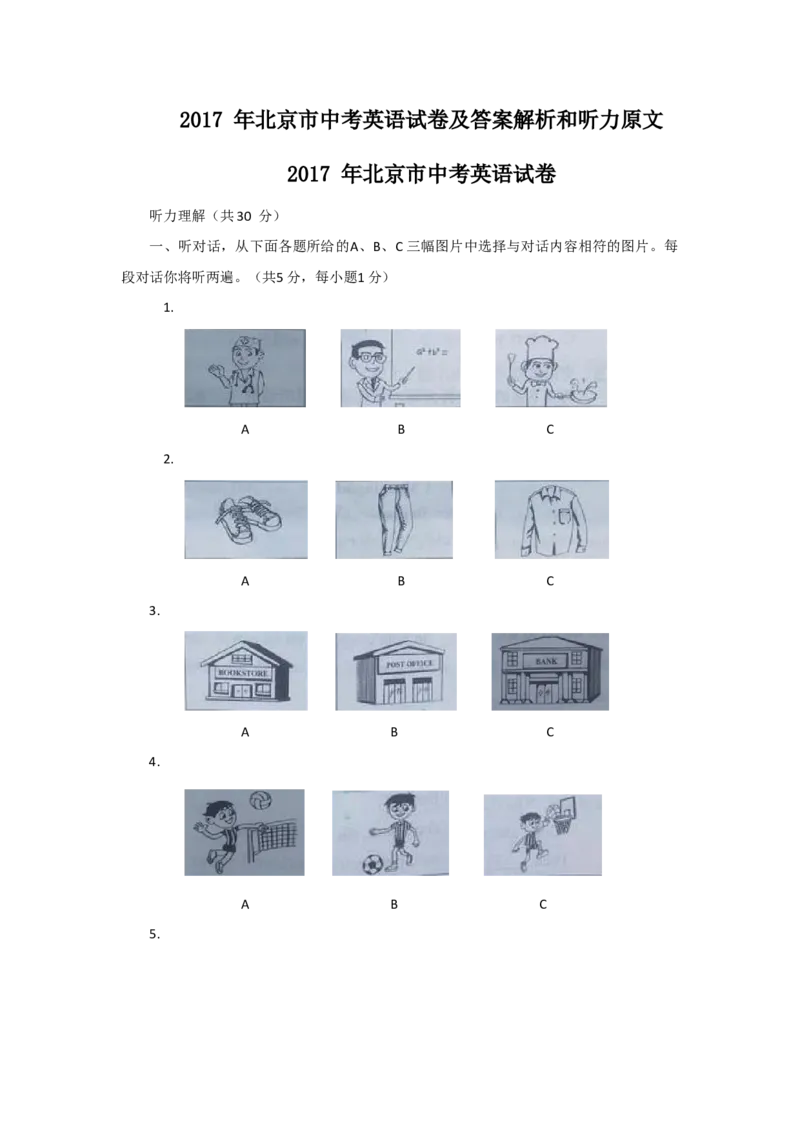
一、听对话,从下面各题所给的A、B、C 三幅图片中选择与对话内容相符的图片。每
段对话你将听两遍。(共5 分,每小题1 分)
1.
A B C
2.
A B C
3.
A B C
4.
A B C
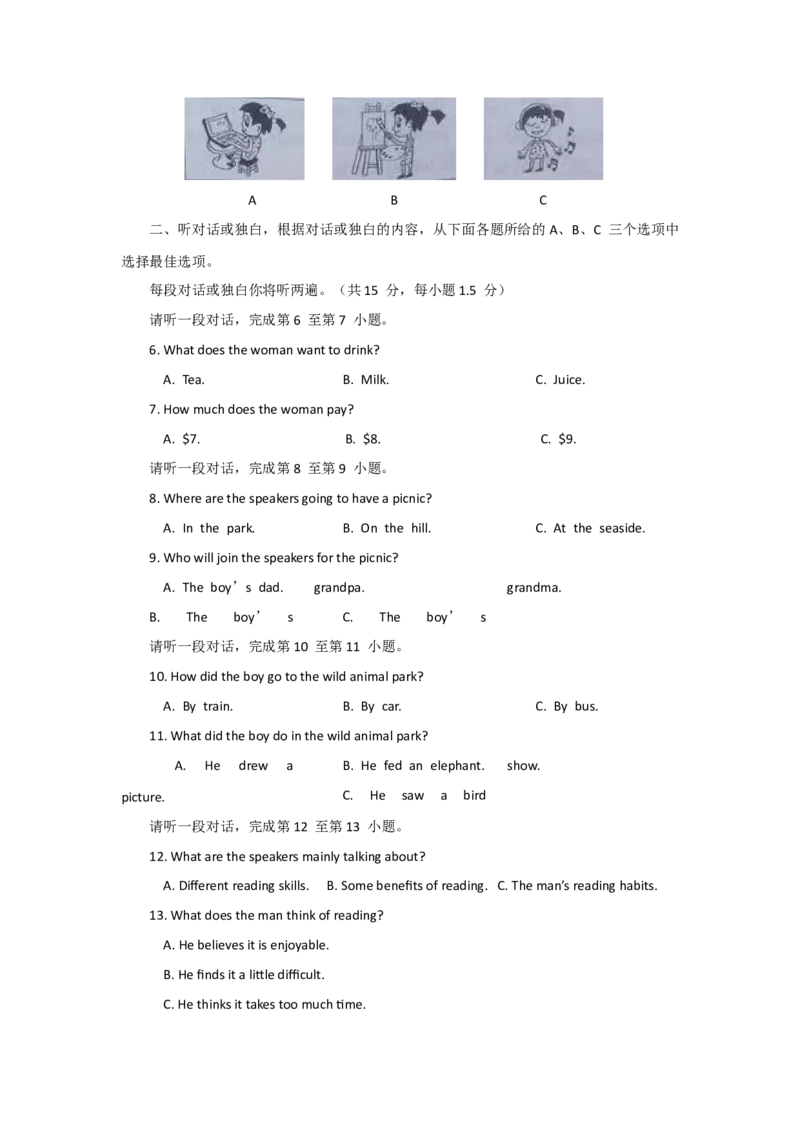
5.A B C
二、听对话或独白,根据对话或独白的内容,从下面各题所给的A、B、C 三个选项中
选择最佳选项。
每段对话或独白你将听两遍。(共15 分,每小题1.5 分)
请听一段对话,完成第6 至第7 小题。
6. What does the woman want to drink?
A. Tea. B. Milk. C. Juice.
7. How much does the woman pay?
A. $7. B. $8. C. $9.
请听一段对话,完成第8 至第9 小题。
8. Where are the speakers going to have a picnic?
A. In the park. B. On the hill. C. At the seaside.
9. Who will join the speakers for the picnic?
A. The boy’s dad. grandpa. grandma.
B. The boy’ s C. The boy’ s
请听一段对话,完成第10 至第11 小题。
10. How did the boy go to the wild animal park?
A. By train. B. By car. C. By bus.
11. What did the boy do in the wild animal park?
A. He drew a B. He fed an elephant. show.
picture. C. He saw a bird
请听一段对话,完成第12 至第13 小题。
12. What are the speakers mainly talking about?
A. Different reading skills. B. Some benefits of reading. C. The man’s reading habits.
13. What does the man think of reading?
A. He believes it is enjoyable.
B. He finds it a little difficult.
C. He thinks it takes too much time.请听一段独白,完成第14 至第15 小题。
14. What can we know about the speaker?
A. She lives near her school.
B. She likes traveling abroad.
C. She wants to improve her English.
15. Why does the speaker send this message?
A. To describe her trip in London.
B. To tell the way to her house.
C. To introduce her hometown.
三、听对话,记录关键信息。本段对话你将听两遍。(共10 分,每小题2 分)请根据
所听到的对话内容和提示词语,将所缺的关键信息填写在答题卡的相应位置上。
Service Request Form
Name 1 6 White
Phone 1 7
Address 56 1 8 Road
Service Moving a double 1 9
Time On 2 0 ,July 31
知识运用(共25 分)
四、单项选择(共10 分,每小题1 分)
从下面各题所给的A、B、C、D 四个选项中,选择可以填入空白处的最佳选项。
21. My father is a worker. is very kind.
A. He B. She C. His D. It
22. More and more young people go skating winter.
A. at B. in C. on D. to
23. --- did you stop playing?
--- Because I was tired.
A. How B. Why C. When D. Where
24. The hotel is very old. It’s one of buildings in the city.
A. old B. older C. oldest D. the oldest
25. --- I hand in the report today?--- No, you needn’t.
A. Can B. Must C. Shall D. Could
26. --- How do you usually go to school?
--- I to school on foot.
A. go B. went C. was going D. will go
27. My mother some washing when the telephone rang.
A. does B. did C. is doing D. was doing
28. Lily is my classmate. We each other since she came to our school.
A. know B. knew C. have known D. will know
29. The mobile phone in 1973.
A. invents B. is invented C. invented D. was invented
30. --- Judy, could you tell me _______ the schoolbag?
--- Oh, yes. I bought it in a store on the Internet.
A. where did you buy C. where you bought
B. where will you buy D. where you will buy
五、完形填空(共15 分,每小题1.5 分)
阅读下面的短文,掌握其大意,然后从短文后各题所给的A、B、C、D 四个选项中,选
择最佳选项。
A Meaningful Gift
Emily was an eighth grader. To pass her Civics course(公民课程), she had to do some
volunteer service in a nursing home for a week.
One Monday, Emily went to the nursing home after school. When she arrived, she was told
she would ___31 an hour every weekday with an elderly lady, Mrs. Blair. She was then led into
a room, where an old lady in a flowery dress was sitting on a sofa.
Emily 32 awkwardly(别扭地)in front of the lady. She cleared her throat and said,
“Good afternoon. I’m Emily.”
“Good afternoon, Emily. Take a seat, please.” Mrs. Blair replied. Then, 33 filled the
space between them. Emily wondered what to say.
“Tell me about yourself, Emily,” Mrs. Blair said suddenly.
“Well,” Emily started, “I don’t have any grandparents, so I can’t relate to elderly people
much. I love the performing arts. I’m here mainly because I have to 34 here to get a goodgrade for my Civics class.”
Mrs. Blair didn’t seem to 35 . “Many people, especially teens, don’t seem to care about
old people like me. Now you are here, and I’m going to change that about you. Ask me
anything.”
Emily thought for a moment, and finally decided, “What was your job?”
“I was a Broadway star in the 1950s.” Mrs. Blair answered.
“Cool! Can you tell me about it?” Emily asked, amazed.
Mrs. Blair smiled. “Back then, only the lead actress had the honor to wear
a 36 bracelet. I was the lead in almost all of the plays, so I always wore the bracelet. Till this
day, I still have it.”
Emily smiled along with Mrs. Blair and listened to the other stories, attentively. She had
become so interested in Mrs. Blair’s 37 that she decided to come earlier the next day.
Tuesday, Wednesday, and Thursday passed by quickly. Then came Friday. As she was leaving,
Emily was really 38 to say goodbye.
“Don’t be sad. You can still visit me,” Mrs. Blair comforted her. She then handed a small box
to Emily, “It’s my gift to you.”
Emily 39 opened the box and was surprised to see what was inside. “It’s the bracelet
that you wore. Thank you!” Emily said, with tears in her eyes. “I’m sure to visit you whenever I’m
free.”
On her way home, Emily thought of her own love for the performing arts. She touched the
bracelet and made a 40 t hat she would keep her word to Mrs. Blair.
31.A. waste B. spend C. plan D. exercise
32. A. asked B. sat C. stood D. danced
33. A. warmth B. sadness C. happiness D. silence
34.A. study B. live C. volunteer D. play
35. A. mind B. fear C. insist D. regret
36. A. strange B. special C. common D. private37. A. dreams B. hobbies C. stories D. jokes
38. A. upset B. confused C. surprised D. nervous
39. A. proudly B. secretly C. worriedly D. carefully
40. A. promise B. change C. judgment D. choice
阅读理解(共50 分)
六、阅读下列短文,根据短文内容,从短文后各题所给的 A、B、C、D 四个选项中,
选择最佳选项。(共30 分,每小题2 分)
A
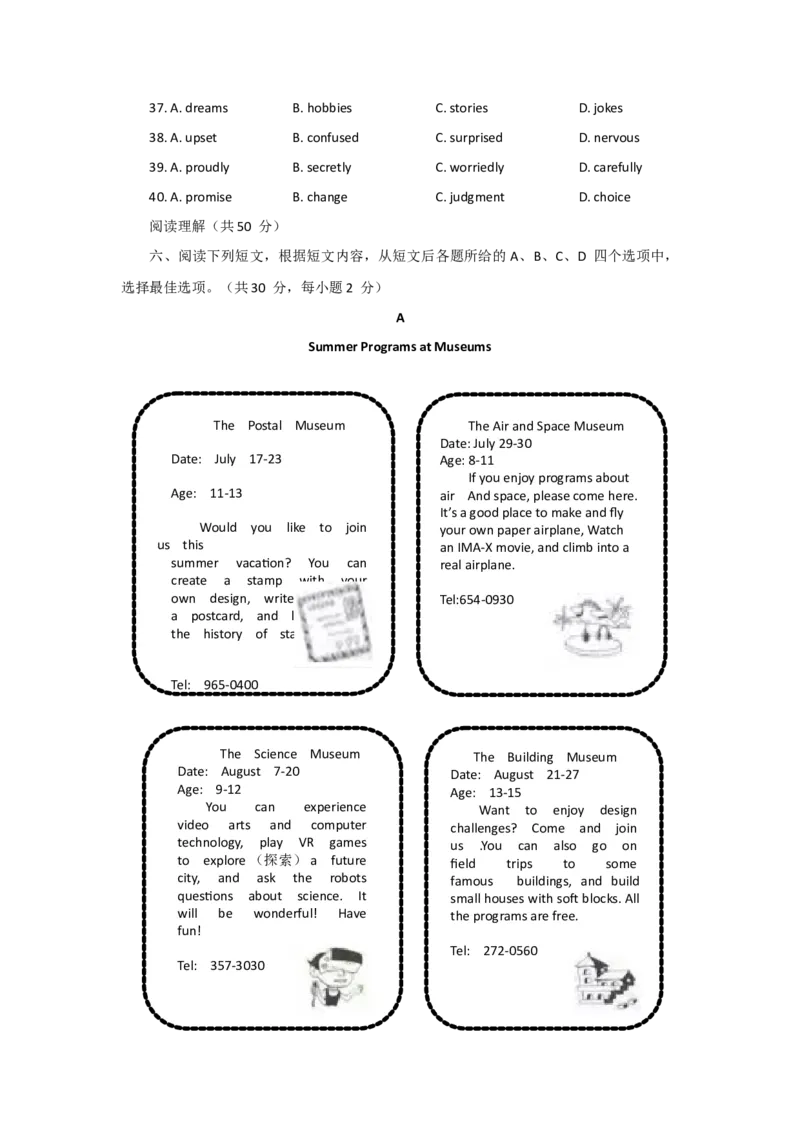
Summer Programs at Museums
The Postal Museum The Air and Space Museum
Date: July 29-30
Date: July 17-23 Age: 8-11
If you enjoy programs about
Age: 11-13 air And space, please come here.
It’s a good place to make and fly
Would you like to join your own paper airplane, Watch
us this an IMA-X movie, and climb into a
summer vacation? You can real airplane.
create a stamp with your
own design, write and mail Tel:654-0930
a postcard, and learn about
the history of stamps.
Tel: 965-0400
The Science Museum The Building Museum
Date: August 7-20 Date: August 21-27
Age: 9-12 Age: 13-15
You can experience Want to enjoy design
video arts and computer challenges? Come and join
technology, play VR games us .You can also go on
to explore(探索)a future field trips to some
city, and ask the robots famous buildings, and build
questions about science. It small houses with soft blocks. All
will be wonderful! Have the programs are free.
fun!
Tel: 272-0560
Tel: 357-303041. You can join in the programs at the Postal Museum any day _______.
A. from July 17 to 23 C. from August 7-20
B. from July 29-30 D. from August 21 to 27
42. If you are interested in the program about video arts, you can phone _______.
A. 965-0400 B. 654-0930 C. 357-3030 D. 272-0560
43. A 15-year-old student can take part in the programs at _______.
A. the Building Museum C. the Air and Space Museum
B. the Postal Museum D. the Science Museum
44. In the Air and Space Museum, you can _______.
A. create a stamp C. make a paper airplane
B. build a house D. explore a future city
B
The Sixth Time I Went to the Principal’s Office
When I was in the seventh grade, I had problems behaving. My heart was in the right place,
but I couldn’t always follow the rules. I played many tricks on my schoolmates. Once, I even
pulled a girl’s hair on the school bus to get her attention. As a result, I was repeatedly
sent to the office of the principal(校长). Although I hated going there, I did not hate the
principal, Mr. Ratcliff.
Mr. Ratcliff was a kind, elderly man. When he spanked( 打屁股) me for putting
some ants into a classmate’s pencil box, it didn’t hurt at all, but it did hurt my feelings. I
thought so much of him and moments like that seemed to prove I was hopelessly bad.
When I got called to Mr. Ratcliff’s office for the sixth time, I had no idea what I had done. I
felt disappointed as I walked down there. I went into his office, sat down, and looked at the floor.
Then he said the last thing I expected to hear:” Kevin, I’ve heard you’ve been behaving really well
lately. I want you to know how proud I am of you, and I just called you down to my office to give
you a peppermint.”
“Really?” I was surprised.
“Yes. Now you can take that peppermint and go back to class.”
I carried the peppermint with me as if it was a gold coin. When I got into my
classroom, I bragged ( 吹嘘) to my classmates about my turnaround, excitedly. Iwasn’t so bad after all.
Mr. Ratcliff was really kind. He made me realize that I was just a kid who had problems with
behavior. He bought some peppermints and took the time to notice me when I got something-
anything-right. Mr. Ratcliff gave me some hope by giving me some love. I will just remember him
for the rest of my life.
45. In his seventh grade, the writer __________.
A. hated the principal C. always followed the rules
B. had problems behaving D. often helped his classmates
46. How did the writer feel when he went to the principal’s office for the sixth time?
A. Lonely. B. Excited. C. Confident. D. Disappointed.
47. The sixth time the writer went to the principal’s office, he got __________.
A. a peppermint B. a model bus C. a pencil box D. a coin
48. The writer will always remember Mr. Ratcliff, because the principal __________.
A. talked with him in the office C. expected him to be a teacher
B. played games with him D. gave him some hope and love
C
Buying Is Doing?
How important is shopping to you? How much time do you spend buying things? And how
much time do you spend organizing these things in your home? In the future, how much time
will you spend in movie theaters, at amusement parks, at shopping malls, or at convenience
stores? When you add it all up, you will probably see you spend a lot of your life
consuming(消费)things. Consuming products is not necessarily bad. However, if we spend
too much time doing it, we should look at it carefully.
Imagine that you have a week off from school. You don’t have to go to class. However, in this
week, you cannot spend any money ----- no shopping, no movies, no eating out. How would you
spend your time? What things would bring you happiness? Perhaps you would take a walk withyour best friend. Perhaps you would help a child read. Or you might spend time with your family.
When we look back, it is likely that non-consuming experiences like these will be our most
important memories. Why? Non-consuming activities are active, not passive. They don’t
come in a package. You make the experience yourself. For example, each person who
reads to a child will have a different experience. The experience changes with the
reader, the child, and the book. Similarly, when you have a conversation with a friend,
you are actively creating an experience. The conversation that you have with your friend
cannot be experienced or recreated by anyone else. However, if you watch a movie with
a friend, you will each have a package experience. It requires no action and little
interaction between the two of you.
The environment we live in encourages us to have packaged experiences. We feel
that we must consume because we believe that buying is doing. However, we can start
a personal revolution ( 变革) against consumerism. How? By consuming less. We can
ask ourselves what experiences bring us the greatest satisfaction. Then we can organize
our lives so that we have more of those kinds of experiences.
49. If consuming products takes too much time, we should ____________.
A. spend less money C. organize our things
B. think about it carefully D. go to convenience stores
50. According to the passage, the writer believes that _____________.
A. we can say no to consumerism by consuming less
B. buying things can bring us the greatest satisfaction
C. the environment seldom influences our shopping choices
D. consuming experiences will be our most important memories
51. What is the writer’s main purpose in writing this passage?
A. To introduce some ways of enjoying our spare time.
B. To encourage people to have more active experiences.
C. To explain reasons behind people’s shopping behavior.
D. To share his personal experience in consuming products.
D
Say you’re sitting around with some friends playing video games and someone mentions a
game that happens to be one of your favorites. “Oh, that game’s easy. So not worththe time,”one of your friends says. The others agree. Although you enjoy the game quite
a lot, not wanting to argue with them, you go along with the crowd.
You have just experienced what is commonly referred to as peer pressure(同伴压
力), also called peer influence. You will adopt a certain type of behavior, dress, or attitude in
order to be accepted as part of a group of your “peers”. As a teen, you are likely to have
experienced the effect of peer pressure in a number of different areas.
We are all influenced by our peers at any age. For teens, as school and other activities take
you away from home, you may spend more time with your friends than with your family. As you
become more independent, your peers naturally play a greater role in your life.
According to Dr. Casey from Cornell University, teens are very quick and accurate in making
decisions on their own and in situations where they have time to think. However, when they
make decisions in the heat of the moment or in social situations, their decisions are often
influenced by factors like peers. In a recent study, teen volunteers played a video driving game,
either alone or with friends watching. The researchers discovered that the number of risks
teens took more than doubled when their friends were watching, compared with when
they played alone. This shows that teens may find it more difficult to control risky
behavior when their friends are around, or in situations where they are extremely angry.
Just as people can influence us to make unwise choices, they can also influence us
to make good ones. A teen might join in a volunteer project because his or her friends
are doing it, or get good grades because his or her friends think getting good grades is
important. In fact, friends often encourage each other to study, or try out for sports.
While we are always influenced by those around us, the decision to act or not is up to us. So
when it comes to decision making, the choice is up to you.
52. According to the passage, Dr. Casey probably agrees that teens ____________.
A. like to play driving games with their friends
B. prefer situations where they have time to think
C. may take more risks when their friends are around
D. are slow in making decisions when they are on their own
53. The words “in the heat of the moment” in Paragraph 4 probably mean “_________”.
A. when teens avoid possible risks C. when teens lose control over theiranger
B. when teens trust their judgment D. when teens give consideration to
situations
54. What can we learn from the passage?
A. Teens are eager to be different from their peers.
B. Peer pressure has effects on both teens and adults.
C. Peer pressure does more harm than good to teens.
D. Tees think it challenging to get good grades at school.
55. Which of the following would be the best title for the passage?
A. Peer Pressure: Is It Necessary to Deal with It?
B. Peer Pressure: Is It Possible to Get Away from It?
C. Peer Pressure: Its Benefits to Teens and Friend Making.
D. Peer Pressure: Its Influence on Teens and Decision Making.
七、阅读短文,根据短文内容,从短文后的五个选项中选出能填入空白处的最佳选项。
每个选项只能用一次。(共10 分,每小题2 分)
From the Other Side
Lara and Tara are twins. 56 , but they are very different in everything else. For example,
hot food is Lara’s favorite, and Tara has a sweet choice.
However, this isn’t the problem with the twin girls. They always argued that the opposite
one was wrong. 57 , while Tara insisted that mornings were fresh and it was difficult to stay up
till midnight.
58 . To put an end to their fights, their parents decided to create a small
drama. They wanted the girls to understand that they were both correct from their own
point of view. Their parents covered the girls’ eyes with black ribbons, and brought
them to the dining room. 59 . Lara was asked to stand on one side of the
board and Tara on the other. They couldn’t see the other side of it. When the ribbons
were taken away, they were surprised to see a huge board between them.
Now, their father asked Lara, “What’s the color of the board?” She replied, “It’s
black!” 60 . She replied, “It’s white!” The two girls began to argue again. While
Lara was confident it was black, Tara was sure it was white. Then, they were asked to
exchange(交换)their places. They couldn’t believe their eyes. Tara, who insisted it wasa white board, saw a black one. Similarly, Lara, who argued the board was black, was
shocked to see a white one. They understood that each of them was right in her own
view.
Most of us are like Lara and Tara. We are right most times, but insist that others
are wrong!
A. They look like each other
B. For years, their arguments continued
C. Their mother asked Tara the same question
D. In the room, a big board was placed in the middle
E. Lara thought it was terrible to get up early in the morning
八、阅读短文,根据短文内容回答问题。(共10 分,每小题2 分)
What’s in a Name?
Many American names come from England. But where did most English names come from?
Centuries ago, most people in England had only one name-- their first name. In the
11th century, five or six of the 50 people in a village might be named William, and it
was easy to get confused. But in the Middle Ages, people found a way to describe each
person exactly. If there were four Williams in one village, one might be referred to as
William the son of John. A second might be called William from the hill. A third,
William the blacksmith ( 铁 匠 ) . And a fourth, William the brown haired. In
conversation, people might refer to the four Williams as William John’s son, William
hill, William smith, and William brown.
It was 300 or 400 years before the extra ( 附加的) names gradually developed
into last names, or surnames. They were passed on from generation to generation. By the
1300s, Robert, the son of William smith, had the name Robert smith, even if he was not a
blacksmith like his father. As the last name became widely accepted, the first letter wascapitalized, as in Robert Smith. By the 15th century, most people of the upper and middle classes
had surnames.
Many surnames were based on father-son relations. The “son of” part was added to the
father’s first name, like Johnson, meaning John’s son. Sometimes it was shortened to just “s”, as
in Jones or Evans. Surnames like Hill described the place where a person lived. They are
the most common type of surname. A third kind of surname was based on a person’s
job. Forester was someone who looked after the forest. In the Middle Ages, occupation
names such as Baker, Carpenter, and Miller became common. The fourth kind of
surname was nickname(绰号). A man whose surname was Bear might be as fierce as
a bear.
Have you ever wondered why some surnames are so common? The most common surname
in the English language is Smith. Being able to make metals(金属)into tools was an
important skill in the Middle Ages, and many people were trained as blacksmiths. The most
common American surnames are Smith, Johnson, William and Brown.
61. Where do many American names come from?
62. When did people find a way to describe each person exactly?
63. How long did it take for extra names to develop into last names?
64. What is the fourth paragraph mainly about?
65. Why were many people trained blacksmith in the Middle Ages?
书面表达(共15 分)
九、文段表达(15 分)
66. 从下面两个题目中任选一题,根据中文和英文提示,完成一篇不少于50 词的文段
写作。文中已给出内容不计入总词数。所给提示词语仅供选用。请不要写出你的校名和姓
名。
题目①
假如你是李华,正在美国参加一个交换生项目。今天下午你应邀和朋友Jim 一家外出
请用英语给接待家庭的妈妈Mrs. Smith 写一个留言条,告诉她你们要去哪里,去做什么,
以及你回家的时间和方式。
提示词语:park, movie theater, go boating, watch a movie
提示问题:Where are you going?
What are you going to do?When and how will you get home?
Dear Mrs. Smith,
My friend Jim asks me to go out with his family this afternoon.
____________________________________________________________________
____________________________________________________________________
Li Hua
题目②
宽容是一种美德。人与人之间难免会有磕磕绊绊。面对矛盾,多一份包容和谅解,生
活就会多一缕阳光。
某英文网站正在开展以“包容、谅解”为主题的征文活动。假如你是李华,请用英语
写一篇短文投稿,谈谈生活中你原谅他人的一次经历,主要内容包括:你们之间发生了什
么,你为什么原谅对方,以及原谅对方之后的感受。2-1-c-n-j-y
提示词语:hurt, realize, forgive(原谅), happy
提示问题:What happened between you and him/her?
Why did you decide to forgive him/her?
How did you feel after forgiving him/her?
I still remember what happened between_________________________________
______________________________________________________________________
______________________________________________________________________
______________________________________________________________________