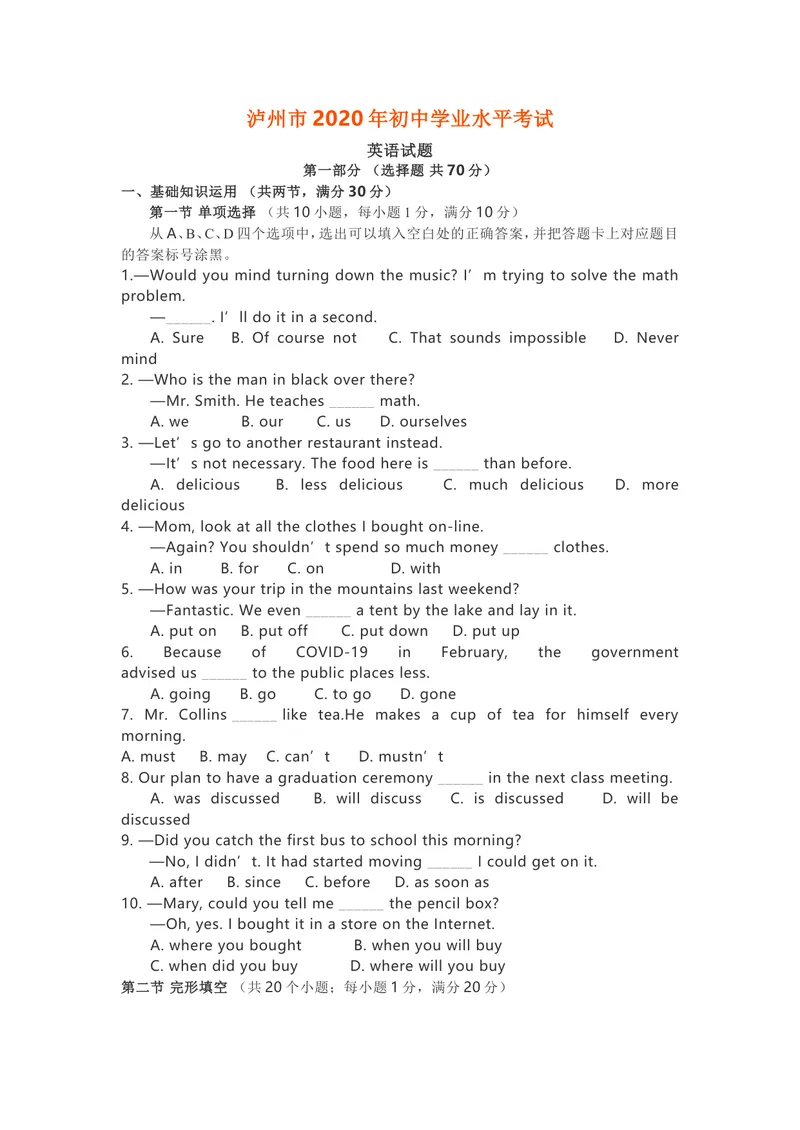
泸州市 2020 年初中学业水平考试
英语试题
第一部分 (选择题 共70分)
一、基础知识运用 (共两节,满分30分)
第一节 单项选择 (共10小题,每小题1分,满分10分)
从A、B、C、D四个选项中,选出可以填入空白处的正确答案,并把答题卡上对应题目
的答案标号涂黑。
1.—Would you mind turning down the music? I’m trying to solve the math
problem.
—______. I’ll do it in a second.
A. Sure B. Of course not C. That sounds impossible D. Never
mind
2. —Who is the man in black over there?
—Mr. Smith. He teaches ______ math.
A. we B. our C. us D. ourselves
3. —Let’s go to another restaurant instead.
—It’s not necessary. The food here is ______ than before.
A. delicious B. less delicious C. much delicious D. more
delicious
4. —Mom, look at all the clothes I bought on-line.
—Again? You shouldn’t spend so much money ______ clothes.
A. in B. for C. on D. with
5. —How was your trip in the mountains last weekend?
—Fantastic. We even ______ a tent by the lake and lay in it.
A. put on B. put off C. put down D. put up
6. Because of COVID-19 in February, the government
advised us ______ to the public places less.
A. going B. go C. to go D. gone
7. Mr. Collins ______ like tea.He makes a cup of tea for himself every
morning.
A. must B. may C. can’t D. mustn’t
8. Our plan to have a graduation ceremony ______ in the next class meeting.
A. was discussed B. will discuss C. is discussed D. will be
discussed
9. —Did you catch the first bus to school this morning?
—No, I didn’t. It had started moving ______ I could get on it.
A. after B. since C. before D. as soon as
10. —Mary, could you tell me ______ the pencil box?
—Oh, yes. I bought it in a store on the Internet.
A. where you bought B. when you will buy
C. when did you buy D. where will you buy
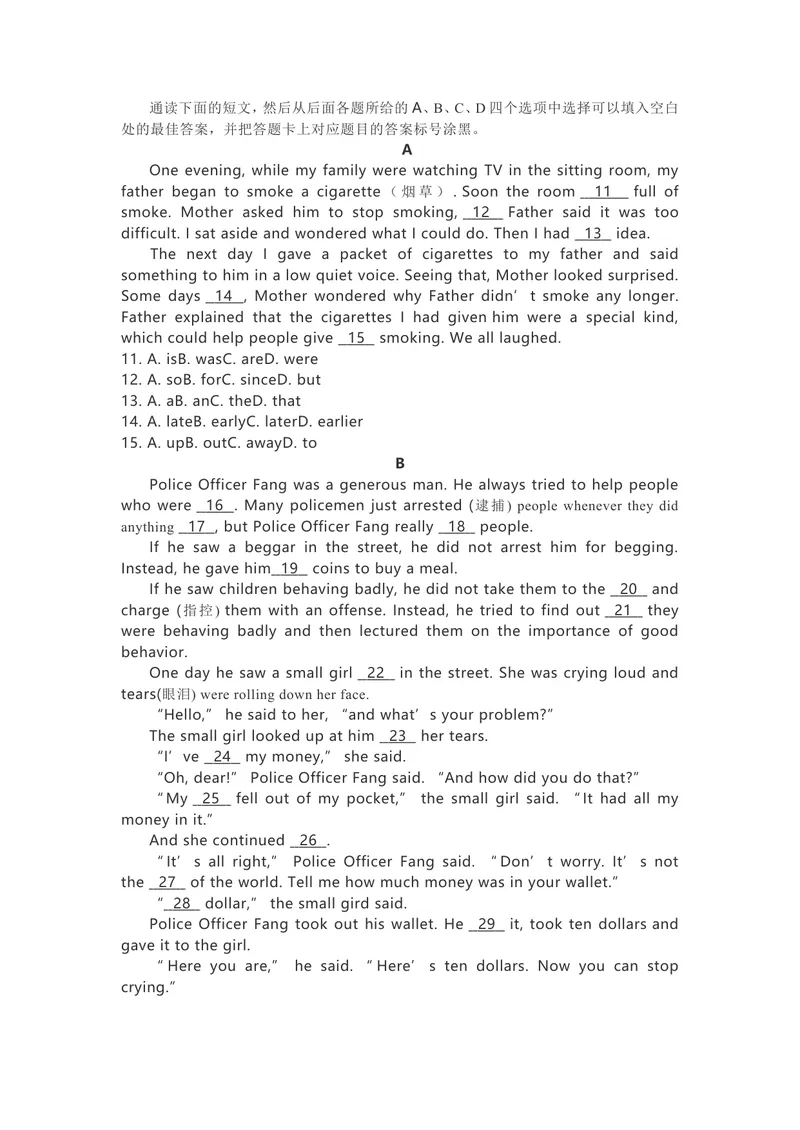
第二节 完形填空 (共20个小题;每小题1分,满分20分)通读下面的短文,然后从后面各题所给的A、B、C、D四个选项中选择可以填入空白
处的最佳答案,并把答题卡上对应题目的答案标号涂黑。
A
One evening, while my family were watching TV in the sitting room, my
father began to smoke a cigarette(烟草). Soon the room 11 full of
smoke. Mother asked him to stop smoking, 12 Father said it was too
difficult. I sat aside and wondered what I could do. Then I had 13 idea.
The next day I gave a packet of cigarettes to my father and said
something to him in a low quiet voice. Seeing that, Mother looked surprised.
Some days 14 , Mother wondered why Father didn’t smoke any longer.
Father explained that the cigarettes I had given him were a special kind,
which could help people give 15 smoking. We all laughed.
11. A. isB. wasC. areD. were
12. A. soB. forC. sinceD. but
13. A. aB. anC. theD. that
14. A. lateB. earlyC. laterD. earlier
15. A. upB. outC. awayD. to
B
Police Officer Fang was a generous man. He always tried to help people
who were 16 . Many policemen just arrested (逮捕) people whenever they did
anything 17 , but Police Officer Fang really 18 people.
If he saw a beggar in the street, he did not arrest him for begging.
Instead, he gave him 19 coins to buy a meal.
If he saw children behaving badly, he did not take them to the 20 and
charge (指控) them with an offense. Instead, he tried to find out 21 they
were behaving badly and then lectured them on the importance of good
behavior.
One day he saw a small girl 22 in the street. She was crying loud and
tears(眼泪) were rolling down her face.
“Hello,” he said to her, “and what’s your problem?”
The small girl looked up at him 23 her tears.
“I’ve 24 my money,” she said.
“Oh, dear!” Police Officer Fang said. “And how did you do that?”
“My 25 fell out of my pocket,” the small girl said. “It had all my
money in it.”
And she continued 26 .
“It’s all right,” Police Officer Fang said. “Don’t worry. It’s not
the 27 of the world. Tell me how much money was in your wallet.”
“ 28 dollar,” the small gird said.
Police Officer Fang took out his wallet. He 29 it, took ten dollars and
gave it to the girl.
“ Here you are,” he said. “ Here’ s ten dollars. Now you can stop
crying.”But instead of stopping crying, the small girl cried even 30 , still
standing there.
“Now what’s the matter?” Police Officer Fang said.
“I wish I’d said I’d lost fifty dollar,” the small girl replied.
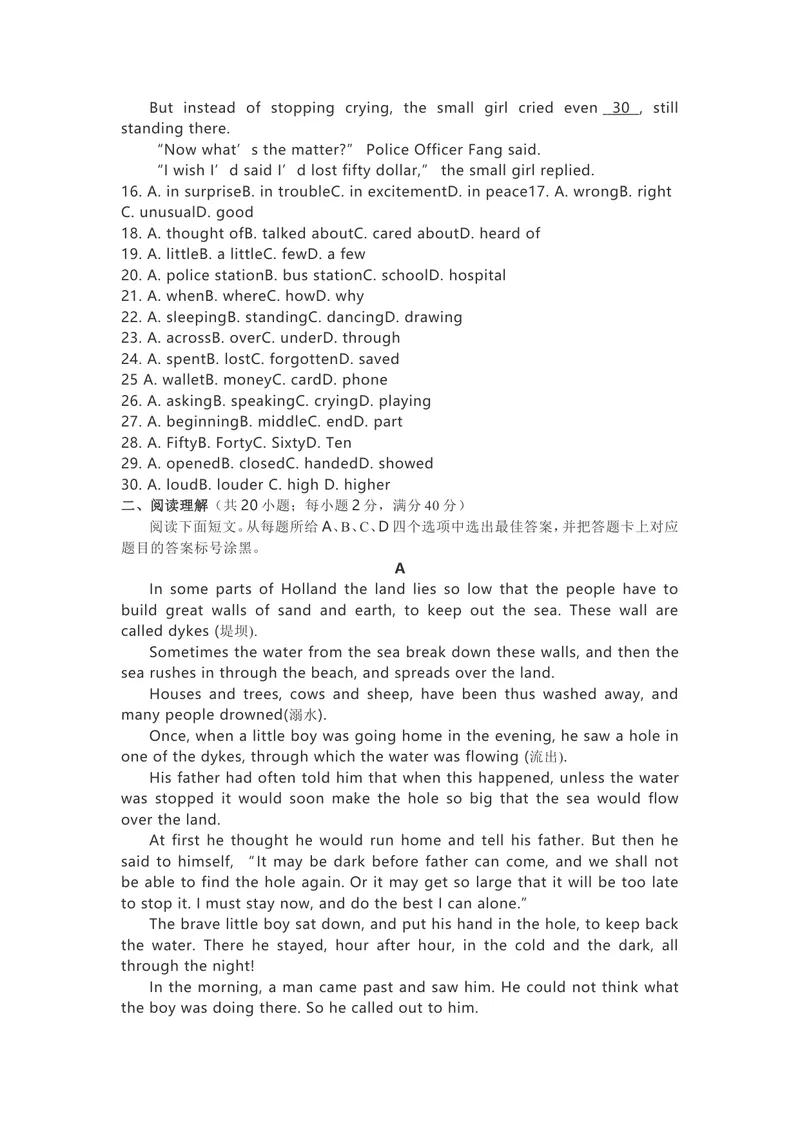
16. A. in surpriseB. in troubleC. in excitementD. in peace17. A. wrongB. right
C. unusualD. good
18. A. thought ofB. talked aboutC. cared aboutD. heard of
19. A. littleB. a littleC. fewD. a few
20. A. police stationB. bus stationC. schoolD. hospital
21. A. whenB. whereC. howD. why
22. A. sleepingB. standingC. dancingD. drawing
23. A. acrossB. overC. underD. through
24. A. spentB. lostC. forgottenD. saved
25 A. walletB. moneyC. cardD. phone
26. A. askingB. speakingC. cryingD. playing
27. A. beginningB. middleC. endD. part
28. A. FiftyB. FortyC. SixtyD. Ten
29. A. openedB. closedC. handedD. showed
30. A. loudB. louder C. high D. higher
二、阅读理解(共20小题;每小题2分,满分40分)
阅读下面短文。从每题所给A、B、C、D四个选项中选出最佳答案,并把答题卡上对应
题目的答案标号涂黑。
A
In some parts of Holland the land lies so low that the people have to
build great walls of sand and earth, to keep out the sea. These wall are
called dykes (堤坝).
Sometimes the water from the sea break down these walls, and then the
sea rushes in through the beach, and spreads over the land.
Houses and trees, cows and sheep, have been thus washed away, and
many people drowned(溺水).
Once, when a little boy was going home in the evening, he saw a hole in
one of the dykes, through which the water was flowing (流出).
His father had often told him that when this happened, unless the water
was stopped it would soon make the hole so big that the sea would flow
over the land.
At first he thought he would run home and tell his father. But then he
said to himself, “It may be dark before father can come, and we shall not
be able to find the hole again. Or it may get so large that it will be too late
to stop it. I must stay now, and do the best I can alone.”
The brave little boy sat down, and put his hand in the hole, to keep back
the water. There he stayed, hour after hour, in the cold and the dark, all
through the night!
In the morning, a man came past and saw him. He could not think what
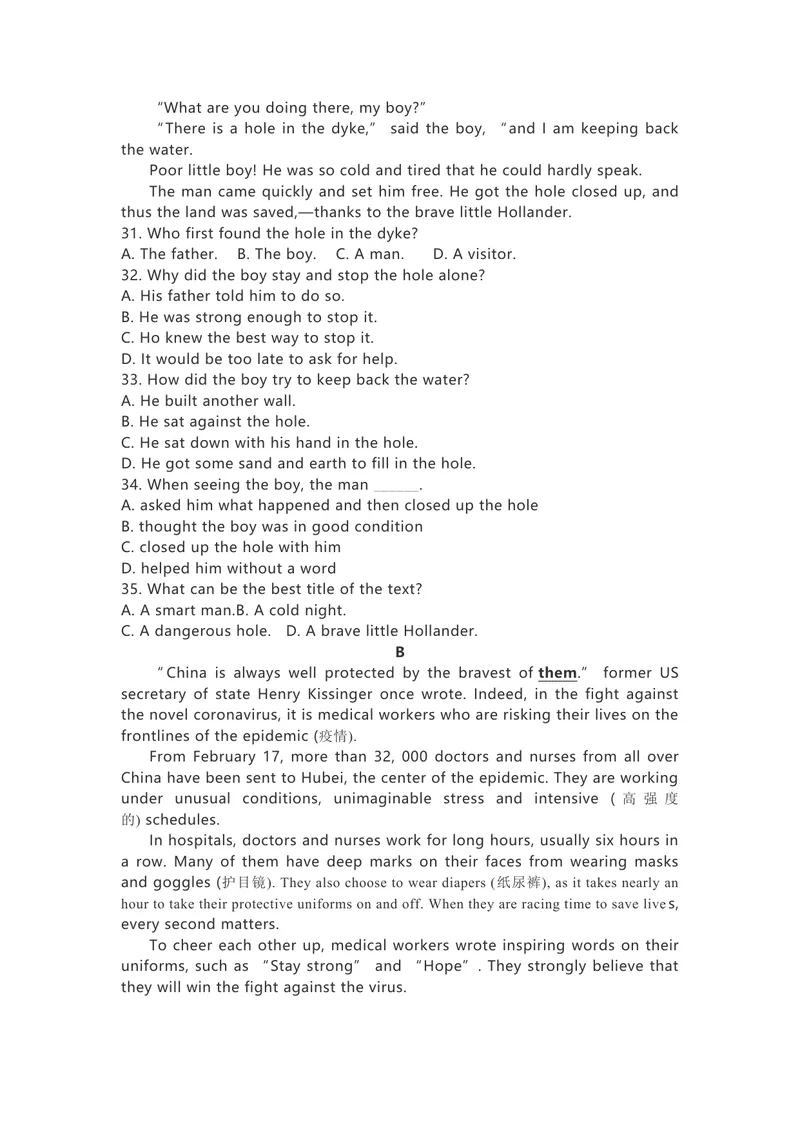
the boy was doing there. So he called out to him.“What are you doing there, my boy?”
“There is a hole in the dyke,” said the boy, “and I am keeping back
the water.
Poor little boy! He was so cold and tired that he could hardly speak.
The man came quickly and set him free. He got the hole closed up, and
thus the land was saved,—thanks to the brave little Hollander.
31. Who first found the hole in the dyke?
A. The father. B. The boy. C. A man. D. A visitor.
32. Why did the boy stay and stop the hole alone?
A. His father told him to do so.
B. He was strong enough to stop it.
C. Ho knew the best way to stop it.
D. It would be too late to ask for help.
33. How did the boy try to keep back the water?
A. He built another wall.
B. He sat against the hole.
C. He sat down with his hand in the hole.
D. He got some sand and earth to fill in the hole.
34. When seeing the boy, the man ______.
A. asked him what happened and then closed up the hole
B. thought the boy was in good condition
C. closed up the hole with him
D. helped him without a word
35. What can be the best title of the text?
A. A smart man.B. A cold night.
C. A dangerous hole. D. A brave little Hollander.
B
“China is always well protected by the bravest of them .” former US
secretary of state Henry Kissinger once wrote. Indeed, in the fight against
the novel coronavirus, it is medical workers who are risking their lives on the
frontlines of the epidemic (疫情).
From February 17, more than 32, 000 doctors and nurses from all over
China have been sent to Hubei, the center of the epidemic. They are working
under unusual conditions, unimaginable stress and intensive ( 高 强 度
的) schedules.
In hospitals, doctors and nurses work for long hours, usually six hours in
a row. Many of them have deep marks on their faces from wearing masks
and goggles (护目镜). They also choose to wear diapers (纸尿裤), as it takes nearly an
hour to take their protective uniforms on and off. When they are racing time to save lives,
every second matters.
To cheer each other up, medical workers wrote inspiring words on their
uniforms, such as “Stay strong” and “Hope”. They strongly believe that
they will win the fight against the virus.These medical worker are just common people. But with their white
coats on, they become the bravest fighters.
36. In the passage, the underlined word “them ” probably refers to ______.
A. Some soldiers. B. Masks and goggles.
C. Medical workers. D. Protective uniforms.
37. Because ________, doctors and nurses choose to wear diapers.
A. they are racing time to save lives
B. they don't take enough underwear
C. they are in poor health conditions
D. they’d like to try something different
38. Why do medical workers write some words on their uniforms?
A. To be cool. B. To protect themselves from the virus.
C. To have a long memory. D. To support and encourage each other.
39. In the passage, the writer mainly tells us that the medical workers ______.
A. are kind and patient
B. are the bravest fighters
C. live a relaxing life every day
D. have good working conditions
40. In which part of a newspaper may this text appear?
A. Travel. B. News. C. Sports. D. Lifestyle.
C
A man was sitting in the park watching the ducks on the pond, when a
woman came near him. She had a white dog with her.
She sat down on a chair, took out of a magazine and began to read
The dog was sitting between her and the man.
After it had been sitting quietly for about ten minutes, the dog turned
and looked up at the man.
“Excuse me,” the dog whispered (低语), “but you look like a kind man.
Please buy me from this awful woman.”
The man could hardly believe his ears. A dog was whispering to him, in
English.
“She is so mean to me,” the dog continued. “She never pets me or
plays with me. She doesn’t feed me properly and she often beats me when
she is unhappy, which is most of the time.”
The man was amazed to hear the dog say all this. He was even more
surprised when the dog added, “And I am really a very good dog. I’m
quite famous, too. I won a medal in the last war and was twice wounded in
action. I’ ve saved three children— two from drowning and one from a
fire.”
The man decided that he would try to buy the dog from the woman. He
would pay a lot of money if necessary. The dog would soon earn tens of
thousands of dollars on television. It would be the world’s first talking dog.
“Excuse me,” he said to the woman, “but I love your little dog.Will
you sell him to me?”“I’ll be pleased to sell him,” the woman said. “You can have him for
ten dollar.”
“Ten dollar!” the man said. “Only ten dollars? Why so little?”
“Because,” the woman said, “he’s a trouble-making liar(说谎者).
41. At the beginning of the story, the dog ______.
A. was leading the woman B. was watching the ducks
C. was reading a magazine D. was sitting close to the man and the woman
42. From what the dog said, the woman ______.
A. didn't feed her dog B. treated her dog badly
C. was always unhappy D. played with her dog sometimes
43. The underlined word “mean” probably means ______.
A.宽容的 B. 有意的 C.刻薄的 D. 宠爱的
44. Why did the man decide to buy the dog? Because the dog ______.
A. was famous B. was poor
C. could behave bravelyD. would earn much money soon
45. How did the woman feel when the man wanted to buy her dog?
A. Glad.B. Proud.C. Sorry.D. Worried.
D
Curiosity ( 好 奇 心 ) is part of human nature. Children are famous for
wanting answers to thousands of questions. Books and TV shows often
depend on curiosity. People keep reading or watching because they want to
find out what happens. But curiosity also provides many advantages.
Leaning the easiest if you have a desire (愿望) for knowledge. Curiosity
can create that desire when you have a question you want an answer to.
Many of history’s greatest discoveries were made by curious people.
Thanks to their curiosity, people now know far more about the world and
have useful technology to help them.
Even if you don’t plan to be an inventor or researcher, curiosity can
still help you in the classroom. If you develop the joy of learning, classes will
become more fun. And you’ll be better because you will fully take part in
the process of learning. Even if you’re no longer a student, curiosity will
make you get more information and then a better worker.
What do you do if you’re not already curious? Luckily, curiosity is a skill
that can be improved. If you act like you’re curious, you’ll quickly start to
actually feel curious. Often, the more you learn about a topic, the more
interesting it becomes.
As you learn about a topic, collect information from as many sources (来
源 ) as possible. Read different kinds of books, listen to talks and ask
questions. Don’ t always get your information from the same source.
Instead, learn to appreciate (欣赏) facts that different people know and the
different opinions that they express. Ask a lot of questions. Remember,
everyone knows something that you don’t. Find out what that is, and ask
about it. This lets you learn something and makes the other person happy
by letting them show off their knowledge.In the classroom or out of it, developing curiosity is sure to be valuable.
46. According to the passage, curiosity ______.
A. is the only part of human nature
B. depends on books and TV shows
C. can’t create the desire for answers
D. may lead to many great discoveries
47. Without curiosity, ______.
A. student may become less interested in classes
B. people will know more about the world
C. people can still become better workers
D. students can’t improve it again
48. When you learn about a topic, you’d better ______.
A. just learn from different people
B. argue with others
C. collect information from different sources
D. only read different kinds of books
49. In the passage, curiosity is a ______.
A. new discovery B. natural ability
C. great invention D. famous creation
50. What does the writer mainly want us to do after reading the passage?
A. To make others happy. B. To show off our knowledge.
C. To develop our curiosity. D. To become an inventor or researcher.
第二部分(非选择题 共50分)
注意事项:
第二部分共2页,用0.5毫米黑色墨水签字笔答在答题卡上,不能答在试卷上。
三、完成对话(共5小题;每小题1分,满分5分)
根据对话内容,在每个空缺处填入一个适当的词,使整段对话意思完整。请把该空
缺处的词填写在答题卡相应的位置上。(每空限填一词)
A: You look tired. What did you do?
B: I had a soccer match just now and I’m really hungry!
A: Let’s make a banana milk shake.
B: 51 do you make a banana milk shake?
A: First, peel 52 bananas.
B: Three bananas?
A: Yes. Then cut up the bananas.
B: OK, I’m finished.
A: Now put the bananas and ice-cream in the blender. Then pour the
53 into the blender.
B: Is this enough milk?
A: I guess so. Next, turn 54
the blender. Finally pour the milk shake into a glass and drink 55 .
B: Yummy.
四、短文填空(共10小题;每小题1分,满分10分)通读下面短文,掌握其大意,然后从短文后面的括号内选出可以填入短文空格处的词,
并将该词的字母代号(不写出该词)填写在答题卡相应的位置上。
Thousands of years ago, people had to hunt (打猎) for food. They lived in
caves (洞穴) and needed fire to keep 56 . Some of them drew pictures on
the walls of their caves.
We don’t know why they drew the pictures. They had to go 57 into
the cave to do it, so they must have had a plan. They probably took a
light 58 them, which was made of animal fat. Maybe they drew the
pictures to 59 good luck when they hunted. Others think the spears (矛) in
the pictures mean that they were 60 other people to hunt.
For paint, they mixed animal fat with some different things like dirt or
berries. They used sticks to brush the paint onto the 61 of their caves.
Some of the drawings are colorful and others are black from the burned end
of a sick.
These people drew what they saw around them— 62 such as tigers,
deer, horses, and sometimes birds and fish. They also drew people, but not
very 63 .
The pictures are 64 good most of the time. The tigers look strong and
powerful. Many of the hoses and deer look graceful.
These drawings have been 65 in more than 130 caves— mostly in
England and France. Maybe there are more that we haven’t found yet. It’s
interesting to look at such old drawings.
( A. withB. teachingC. wallsD. deepE. warm
F. bring G. often H. animals I. quite J. found)
五、阅读短文并回答问题(共5小题;每小题2分,满分10分)根据短文内容,回答文
后所给出的问题,并按要求将答案填写在答题卡相应的位置上。
Marie Curie, a world famous woman scientist, was born into a teacher’s
family in Poland in 1867 and died in 1934.
When she was still a child, she was fond of study very much and had a
dream of becoming a scientist, but that would not be easy. Her family
became very poor, and at the age of 18, Marie began to work in the
government. She helped pay for her sister to study in Paris. Later, her sister
helped Marie with her education. When she was 24, she went to study at
Paris University, where she had a difficult time but still worked very hard.
Together with her husband, Pierre, she discovered two new elements (元素)
and studied the x-rays they emitted. She devoted (奉献) all her life to scientific
research and her efforts were rewarded. In 1901, Marie Curie won the Nobel Prize in
physics and was honored with a second Nobel Prize in chemistry in 1911.
“Of all the famous people in the world, Marie Curie is the only one that
was not spoiled (宠坏) by fame.”Einstein once said. Today, as a famous
female, Marie Curie is still remembered by the whole world. People will
remember her forever for her spirit of courage and devotion.
66. How old was Marie when she died?
________________________________________________67. What was Marie’s dream in her childhood?
________________________________________________
68. Who helped Marie with her education?
________________________________________________
69. When did Marie win her first Nobel Prize?
________________________________________________
70. What will people remember Marie forever for?
________________________________________________
六、书面表达(共1题,满分25分)
泸州是全国文明城市,我们应从身边小事做起,成为文明泸州人。请你根据以下要点
提示,以“To Be a Better Citizen (市民)”为题,用英语写一篇短文。
要点提示:
1.爱护环境,不乱扔垃圾等;
2.注意安全,遵守交通规则,不私自下河、塘游泳等;
3.锻炼身体,养成良好的生活习惯等;
4.对人友善,乐于助人等;
5.其他,……。
要求:1.词数110词左右(文首已给出,不计入总词教);2.要点提示均须涉及,可适当
增加内容;3.字迹工整,卷面整洁,文意连贯,语言流畅;4.不用真实姓名、校名、地名。
参考词语: protect, environment, litter, traffic rules, living habits
To Be a Better Citizen
Luzhou is a national civilized city. As a citizen, ___________________
_______________________________________________
参考答案
1. B 2. C 3. D 4. C 5. D 6. C 7. A 8. D 9. C 10. A
11—15 BDBCA
16—20 BACDA 21—25 DBDBA 26—30 CCDAB
31—35 BDCAD 36—40 CADBB 41—45 DBCDA 46—50 DACBC
51. How 52. three 53. milk 54. on 55. it
56. E 57. D 58. A 59. F 60. B 61. C 62. H 63. G 64. I 65. J
66. 67/She was 67.
67. (Her dream was) To be a scientist.
68. Her sister.
69. In 1901.
70. Her spirit of courage and devotion.
One possible version:
To Be a Better Citizen
Luzhou is a national civilized city. As a citizen, we should take pride of our city. And I
think we have lots of things to do if we want to be a civilized citizen.
Firstly, it’ s our duty to protect the environment. We mustn’ t throw litter
everywhere. Instead we can put it in the dustbins. Secondly, we should keep ourselves
safe all the time. For example, following the traffic rules, not swimming in the river or
the pool by ourselves. Thirdly, try to develop a good living habit. Play sports for at leastone hour a day and don’t stay up too late. Fourthly, we should be friendly to others,
and be ready to help others.
If we follow these,we will be a better citizen.