中考英语阅读理解二轮选编及参考答案
【先睹为快】
第一篇
中考 理解
阅读 训练
下面四篇材料,然后从各 所 的四个 中 出一个最佳答案。
阅读 题 给 选项 选
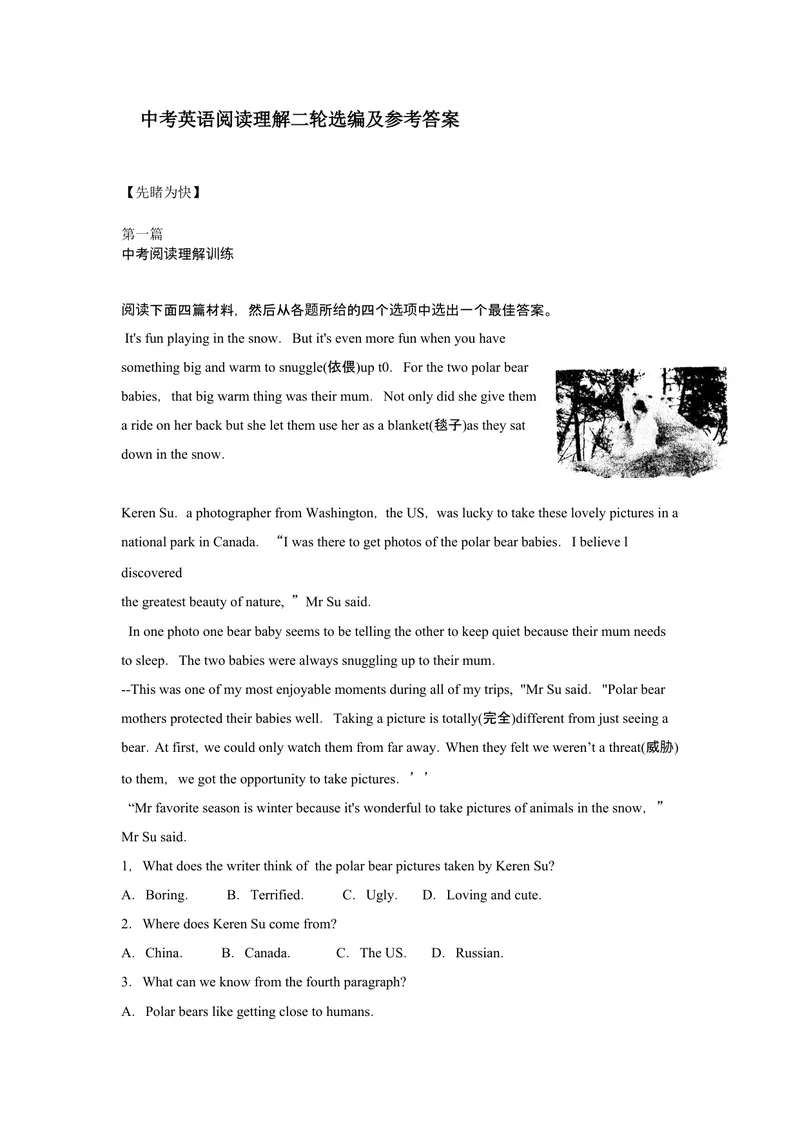
It's fun playing in the snow.But it's even more fun when you have
something big and warm to snuggle(依偎)up t0.For the two polar bear
babies,that big warm thing was their mum.Not only did she give them
a ride on her back but she let them use her as a blanket(毯子)as they sat
down in the snow.
Keren Su.a photographer from Washington,the US,was lucky to take these lovely pictures in a
national park in Canada.“I was there to get photos of the polar bear babies.I believe l
discovered
the greatest beauty of nature, ”Mr Su said.
In one photo one bear baby seems to be telling the other to keep quiet because their mum needs
to sleep.The two babies were always snuggling up to their mum.
--This was one of my most enjoyable moments during all of my trips, "Mr Su said."Polar bear
mothers protected their babies well.Taking a picture is totally(完全)different from just seeing a
bear.At first,we could only watch them from far away.When they felt we weren’t a threat(威 )
胁
to them,we got the opportunity to take pictures.’’
“Mr favorite season is winter because it's wonderful to take pictures of animals in the snow,”
Mr Su said.
1,What does the writer think of the polar bear pictures taken by Keren Su?
A.Boring. B.Terrified. C.Ugly. D.Loving and cute.
2.Where does Keren Su come from?
A.China. B.Canada. C.The US. D.Russian.
3.What can we know from the fourth paragraph?
A.Polar bears like getting close to humans.B.It isn’t easy to take pictures of these polar bears.
C.It’s fun taking pictures of polar bears.
D.Watching polar bears is more difficult than taking pictures of them.
4.What can we know from the passage?
A.Global warming is getting worse.
B.The number of polar bears is dropping quickly·
C.Getting close to nature is wonderful.
D.A polar bear mother doesn’t have many babies·
【参考答案】1—4、DC BC
中考 理解 【18】
阅读 训练
I shook hands with my father in the truck, and for a long time he looked
straight ahead and didn't say a word. But I knew he was going to say a little
to me. "I can't tell anything," he finally said. "I never went to college, and
none of your brothers went to college. I can't say don't do this and do that,
because everything is different and I don't know what is going to come up. I
can't help much with money either, but I think things will work out. "
He gave me a new check-book. "If things get pushing, write a small check. But
when you write one, send me a letter and let me know how much. There are some
things we can always sell." In four years all the checks I wrote were less than
a thousand dollars. My part-time jobs such as reading to the blind student and
sitting with the teachers' kids filled in the financial gaps.
"You know what you want to be, and they'll tell you what to take," my father
went on. "When you get a job, be sure it's honest, and work hard." I knew that
soon I would be alone in the big town, and I would be missing the cool winds
and a life where your thinking was done for you.Then my dad reached down beside his seat and brought the old, broken Bible that
he had read so often, the one he used when he wanted to look something up in a
friendly quarrel with one of the neighbours. I knew he would miss it. I knew,
though, that I must take it.
He didn't say read this every morning. He just said, "This can help you if you
will let it."
Did it help? I got through college without being a burden on the family. I have
been able to make money since.
1. What is the writer's main purpose (目的) in writing this passage?
A. To tell the readers his life story.
B. To tell people what kind of person his father was.
C. To let people know how poor he was.
D. To tell the readers what present he got from his father.
2. Why did the father not ask his son not to do this and do that?
A. Because he felt quite confident of his son.
B. Because he was born from a poor family.
C. Because he was a man of few words.
D. Because he didn't want to be much too strict with his son.
3. What would someone learn from this passage?
A. How to live by oneself. B. How to stand on one's
own feet.
C. What a good father should do. D. What the self-important is
like.
4. What may be the proper Chinese for the underlined part in the passage?
A. 暇 光. B. 学 . C. 不足. D. 精神空虚.
闲 时 费 经济
5. What kind of book did the Bible seem to be to the writer's father?
A. It was a book which told you how you should get on well with others.B. There were many good examples for you to copy in it.
C. It was a book that told you how to get a good job and a good future.
D. It was a good book that could help you when you were in trouble.
理解答案:1. D 2. A 3. B 4. C 5. D
阅读
第二篇
Recently in a class in Tokyo,a robot teacher called Saya called out the names of
students,and smiled at them.Her funny face made the students laugh.However,the inventor
says she is not going to take the place of human teachers.
Unlike other robots without feelings,Saya has six feelings — surprise,fear,dislike,
anger,happiness and sadness.She can also say simple phrases such as "Thank you" and
"Sorry".
"Robots that look like humans have an important influence on children and older
people," Hiroshi Kobayashi,Saya's developer,said.
Saya was first invented as a receptionist(接待 ) robot in 2004.Later,she was tested in
员
a real Tokyo classroom with many fifth and sixth grade students."Although she still can't
do much more than call out names and shout 'Be quiet',the children had great fun,"
Kobayashi says."They were very happy when Saya called out their names."
Ronald C.Arkin,a scientist,says people should do more study on the interaction(互 )
动
between humans and robots before people depend on robots too much.
Kobayashi says,"Saya is just meant to help people,and we should not have too high
hope for her ability.She has no thought and no ability to learn.She is just a tool."
根据短文内容, 最佳答案。
选择
( ) 1.Saya is _______.
A.a Japanese woman teacher
B.a Japanese girl
C.a robot teacher
D.a scientist
( ) 2.Saya's first job is _______.A.a teacher
B.a receptionist
C.a student
D.a robot
( ) 3.Saya can say _______ in lives.
A.Thank you
B.Sorry
C.Be quiet
D.all of the above
( ) 4.Ronald C.Arkin mainly tells us that _______.
A.people will do better than robots on the interaction
B.robots will do better than humans on the interaction
C.robots have an important influence on humans
D.Saya will be the best teacher
( ) 5.Which of the following is NOT right?
A.Saya is not going to take the place of human teachers.
B.Saya has seven feelings.
C.Robots that look like humans have an important influence on children and older
people.
D.Saya is just a tool,and just helps humans.
答案:
1.C 根据短文第一段的内容可以确定,Saya 是一位机器人教 。
师
2.B 根据短文第四段的第一句内容可以确定,Saya 在 2004 年被作 一位接待 而 造。
为 员 创
3.D 根据短文内容可以确定,Saya 可以 的 如“ ”“ 不起”和“安静”等。
说简单 话 谢谢 对
4.A 根据倒数第二段的内容可以推 出人 在 生互 方面将比机器人做得更好。
测 类 师 动
5.B 通 全文可以确定,Saya 只是一个工具,永 也代替不了人 ,她 孩子和老人有重大影
读 远 类 对
响,用排除法即 B。
选
Usually schools and teachers set the class rules for students. But Wuhan school
recently tried a different way. This year, the rules of Class 12, Grade 7 in No. 6 HighSchool have been made by themselves—all 46 class students.
During the first days of this school year, the teacher allowed his student to make their own
classroom rules, and asked each student to give a list of rules to help make their class a
good learning environment. The whole class shared and discussed the lists. Later they added
or took out some of rules. The rule—making activity lasted about a month. Finally the class
had 30 rules.
Then, rule—making were asked to sign up to the rule list—their promise (承 ) to follow the
诺
rules. A poster with all the rules was put up beside the blackboard.
Most of the rules are about the way students should do. “No cell phone calls and text
messages in class” and “No loud noise in the classroom.” are two examples. But there are
also some for teachers, “No lessons should overrun” is one rule. Also some rules are strict
with the students who break the rules. If a person is late for class above a certain number
of times, he or she loses the chance to be an honor student.
Students say the rules work well in the classroom. “We are the rule—makers, so we
have to obey the rules that we agreed to,” said one of the students.
66. The class rules for students are made by as usual.
A. teachers B. students C. parents D. officers
67. There would be about the lists after each student gave a list of rules.
A. a discussion B. a lesson C. a speech D. a party
68. Each student were asked to sign the rule list .
A. to share the class rules
B. to be an honor student
C. to make their promise to follow the rules
D. to help make their class a good learning environment
69. The underlined word “overrun” in paragraph 4 probably means .
A. 跑步 B. 步行 C. 教学 D. 拖延
70. The whole class won’t obey the student making rules until they them.
A. agree to B. share C. discuss D. add
参考答案66. A 67. A 68. C 69. D 70. A第三篇
中考阅读理解
阅读下列短文,选出最佳选项。
I made a pledge(发誓) to myself on the way down to the vacation beach cottage.
For two weeks I would try to be a loving husband and father. Totally loving. No ifs ,
ands or buts .
The idea had come to me as I listened to a talk on my car radio. The speaker was
quoting(引用) a Biblical(圣经的) passage about husbands being thoughtful(体贴的) of their
wives. Then he went on to say, “Love is an act of will. A person can choose to love.”
To myself, I had to admit that I had been a selfish husband. Well, for two weeks that
would change.
And it did. Right from the moment I kissed Evelyn at the door and said, “That
new yellow sweater looks great on you.”
“Oh, Tom, you noticed,” she said, surprised and pleased, maybe a little puzzled.
After the long drive, I wanted to sit and read. Evelyn suggested a walk on the
beach. I started to refuse, but then I thought, “Evelyn’s been alone here with the kids
all the week and now she wants to stay with me.” We walked on the beach while the
children flew their kites.
So it went. Two weeks of not calling the Wall Street firm where I am a director; a
visit to the shell museum though I usually hate museums. Relaxed and happy, that’s how
the whole vacation passed. I made a new pledge to keep on remembering to choose love.
There was one thing that went wrong with my experiment, however. Evelyn and I still laugh
about it today. Last night at our cottage, preparing for bed, Evelyn stared at me with the
saddest expression.
“What’s the matter?” I asked her.
“Tom,” she said in a voice filled with distress, “do you know something I don’t?”
“What do you mean?”
“Well... that checkup(体检) I had several weeks ago... our doctor... did he tell yousomething about me? Tom, you’ve been so good to me... am I dying?”
It took a moment for it all to sink in. Then I burst out laughing.
“No, honey,” I said, wrapping her in my arms. “You’re not dying; I ’ m just starting
to live .”
1. In the first paragraph, “No ifs, ands or buts” probably means ______.
A. unnecessarily B. unexpectedly C. impossibly D. unconditionally
2. From the story we may infer(推断) that Tom went to the beach cottage ______.
A. with his family B. with Evelyn C. alone D. with his
children
3. During the two weeks on the beach, Tom showed more love to his wife because
______.
A. she looked lovely in her new clothes
B. he had made a lot of money in Wall Street
C. he was determined to be a good husband
D. she was seriously ill
4. The underlined words “one thing” in the passage refer to the fact that ______.
A. he praised her sweater, which puzzled her
B. she insisted on visiting a museum, which he hated
C. he knew something about her illness but didn’t tell her
D. he was so good to her that she thought she must be dying
5. By saying “I’m just starting to live”, Tom means that ______.
A. he is just beginning to understand the real meaning of life
B. he is just beginning to enjoy his life as a loving husband
C. he lived an unhappy life before and is now starting to change
D. he is beginning to feel regretful for what he did to his wife
【参考答案】1—5、DACDB