专题 02 数词,介词,连词讲练
数词
语法解析
一.基数词的构成
one eleven twenty-one
two twelve twenty-two
three thirteen thirty
four fourteen forty
five fifteen fifty
six sixteen sixty
seven seventeen seventy
eight eighteen eighty
nine nineteen ninety
ten twenty one hundred
one hundred and one
two hundred
二.基数词的用法
用法 例子
句 主语 It is said that thirteen is an unlucky number.
法 The first day of May is International Labour Day.
功 宾语 It is worth three hundred.
能 He was among the first to arrive.
定语 There are only three boys in the class.
May is the fifth month of a year.
表示事物编号 No. Ten Middle School, Lesson One
表示年代 in the 1890s
表示年、月、日 On May 1st,2008
表示分数 分子是基数词,分母是序数词,当分子大于1时,分母用复数形式。如:
one third, five sixths
表 整点 Tom often gets up at six in the morning.
示 与汉语 4:25four twenty-five
时 顺序相同 6:30six thirty
间 几点过几分 at twenty past six, at a quarter past eleven
差几分到 at five to six, at twenty-nine to ten
几点
注意1.表示某人约几十岁时,在表示整十位的基数词后面加-s。如:
Tom went to New York in his twenties.汤姆在二十多岁时去了纽约。
2.分数作主语时,谓语动词由of后面的名词的数来确定。of 后为可数名词复数时,谓语动词用复数形
式;of后面的名词为 不可数名词时,谓语动词用单数形式。如:
Two thirds of the work is hard to finish.三分之二的工作很难完成。
Two thirds of the students in our class are League members.我们班里三分之二的学生是团员。
三.序数词的构成
first twenty-first
second thirtieth
third thirty-ninth
fourth fortieth
fifth fiftieth
sixth sixtieth
seventh seventieth
eighth eightieth
ninth ninetieth
tenth hundredth
eleventh one hundred
twelfth and first
twentieth
注意
1.序数词在使用时,通常前面要加定冠词 the;但是如果序数词前出现不定冠词 a或an时,则表示“再
一”,“又一”。如:
We’ll go over it a second time.我们得再念第二遍。We’ve tried it three times. Must we try it a fourth time?我们
已经试过三遍了,还必须试一次(第四次)吗?
2.基数词也可以表示顺序。只需将基数词放在它所修饰的名词之后即可,不需要添加定冠词。如:
the first lesson——Lesson One
the fifth page——Page 5(Five)
the twenty-first room——Room 21(Twenty-one)
随堂训练
基础题组
一.单项选择
1.There are ______ students in the school. They are studying hard for their dreams.
A.three thousands B.thousand of C.thousands of D.three thousands of
2.We read the number 78,459 as ________.
A.seventy-eight thousands, four hundred and fifty-nine
B.seventy-eight thousand, four hundred and fifty-nine
C.seventy-eight thousands, four hundreds and fifty-nineD.seventy-eight thousand, four hundreds fifty-nine
3.______ of the land in this area ______ covered with forests.
A.One third; is B.One thirds; is C.One third; are D.One thirds; are
4.About 285 _______ people around the world are _______.
A.million; blindness B.million; blind
C.millions; blindness D.millions; blind
5.—How do you like our city, Jenny?
—It’s wonderful. I would like to stay here for ________.
A.two other days B.two another days C.more two days D.two more days
6.Here is a survey about how to be a good learner among 800 students. According to the form below, ________
students have chosen “Learning from mistakes” as their key words.
A.120 B.260 C.300 D.240
7.The young tree is only ________ tall. It needs special care.
A.one and half foot B.one and a half feet
C.one feet and a half D.one and half a feet
8.—How long does it take to fly to Guangzhou, Nick?
—________.
A.Three hours and a half B.Three and half an hour
C.Three and half hours D.Three and a half hour
9.Last Sunday was Andy’s ________ birthday. We had a birthday party.
A.twelve B.the twelfth C.twelfth D.the twelve
10.In our school, ________ of the students ________ girls.
A.two fifth; is B.two fifth; are C.two fifths; are D.two fifths; is
二.正确形式填空
1.Our town has been famous since the century.(twelve)
2.Every year, (百万) of books are donated to the children in poor areas.
3.Tomorrow they will have a party to celebrate his brother’s (五) birthday.
4.My sister was born on the (九) of June.
5.Seven (十二) of the students took part in the activity last weekend.
6.My aunt became a nurse in her (twenty) and she still loves her job now.
7.Two (nine) of the land in this area is covered with trees and grass. The rest is sandy.
8.I found out about Yumenguan in the famous poem written by Wang Zhihuan for the (one) time.
9.Wang Yaping, China’s (two) female astronaut, has recently recorded a video to send her
greetings to women around the world on Women’s Day.
10.My uncle lives in a town kilometers from Yangzhou. (十五)
提升题组一.语篇填空
This time yesterday, Mr Zhang was celebrating his 1. (ninety) birthday at home.
He said this to his family members: About two 2. (three) of the people change houses during
their lifetimes, but I have lived in this house since I was born. I’ve got 3. (four) children and all of
them were born in this house too. Most of the time it is a happy place. The street is very different from the one
when I was young. In the 4. (1970), there were no cars and all the children played in the road. Some
children still do, but it’s not the same—you’ve got to be very careful nowadays with the traffic. In the street,
few people who live in the street are as old as I am now—many of them have died; 5. (hundred) of
neighbours have moved to another area. I only go out 6. (two) a week now and I’m getting a bit deaf.
But this is unimportant. I’ve got my children and my grandchildren, and they mean everything to me.
二.语法选择
The world's longest cross-sea bridge—the Hong Kong-Zhuhai-Macao Bridge (HZMB)—opened on 1 .
The Guardian described it as one of the “ 2 wonders of the modern world”.
Construction (施工) on the HZMB began 3 and cost about 4 yuan. The bridge links Hong Kong
and Macao to the Chinese mainland city of Zhuhai, CGTN reported.
The HZMB is unique in many ways. It's designed to have a service life of 120 years, 5 than most
bridges.
In one section, the bridge turns into a 6 undersea tunnel that passes through two man-made islands. The
tunnel is the world's longest undersea tunnel for road traffic, allowing large ships to continue passing through the
sea area in the tunnel.
The bridge's engineers had to consider many environmental factors in order to protect the surrounding (周围
的) environment while building the bridge. 7 of Chinese white dolphins, an endangered species that lives in
the area, attracted particular concern.
The HZMB will make it much more convenient to travel between the 8 areas it connects. It will
shorten the travel time from Hong Kong to Zhuhai from four hours to about 9 .
By connecting local cities and regions closer, the bridge will benefit 10 people in this area. It is
expected to drive the economic (经济的) development of Hong Kong, Macao and nine Guangdong cities, South
China Morning Post noted.
1.A.October 24, 2018 B.24nd October, 2018
C.2018, October 24 D.2018, 24th October
2.A.seven B.seventh C.the seventh D.sevens
3.A.in 2009 B.in the 2009 C.in 2009s D.in the 2009s
4.A.120 billions B.120 billion of C.120 billions of D.120 billion
5.A.20-year-long B.20 years longer C.20 years long D.20-year longer
6.A.6.7 kilometer B.6.7 kilometers C.6.7-kilometer D.6.7 kilometer's
7.A.One third B.One three C.One thirds D.One threes
8.A.one B.two C.three D.four
9.A.45 minute B.45 minutes C.45-minute D.45 minutes'
10.A.million B.millions C.million of D.millions of介词
语法解析
一.介词的主要类别
表示时间 at, in, on, before, after, since, until, till, by, during, from...to..., past, to...
at, in, on, round, around, over, under, above, below, down, before, behind, between,
表示地点和方位
among, up, in front of, in the front of, beside, next to, near...
表示空间运动 along, across, through, over, up, down, from, to, into, out of, towards...
表示方式、方法和手段 by, with, in, through, on...
表示原因 for, at, from, with, of, because of...
表示“除……以外” besides, except, except for...
其他常用介词 about, like, without, against, off...
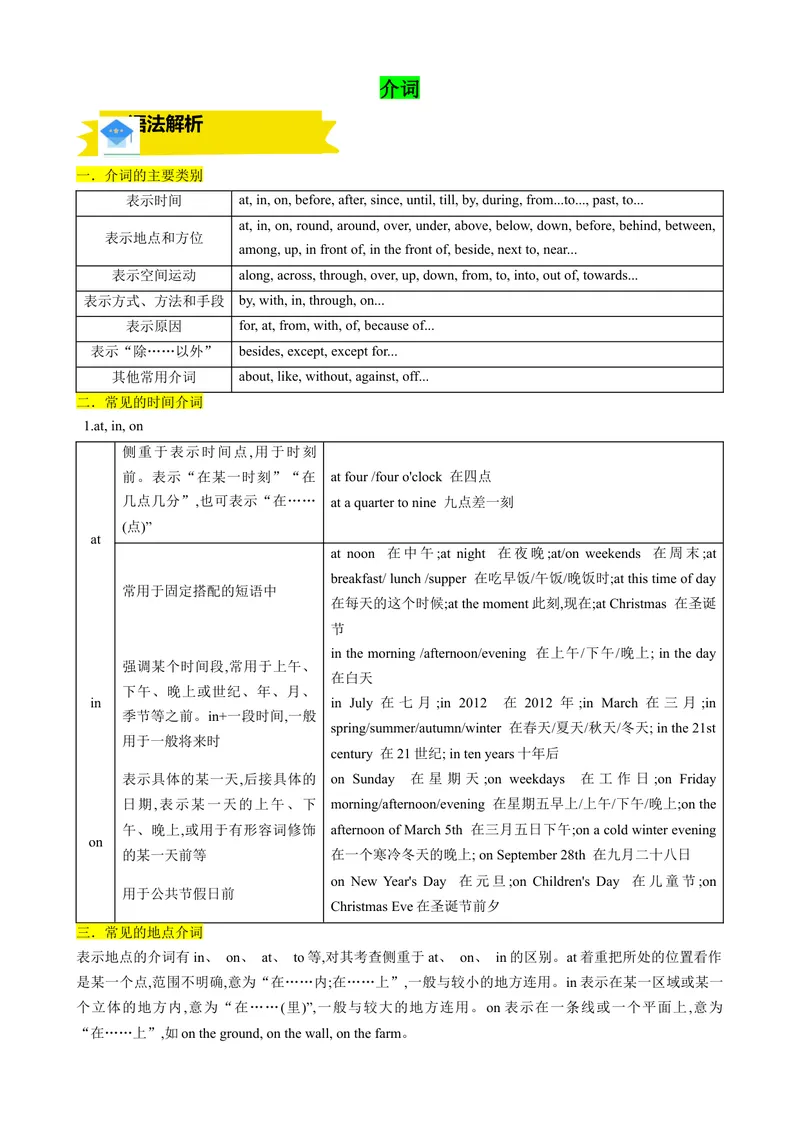
二.常见的时间介词
1.at, in, on
侧重于表示时间点,用于时刻
前。表示“在某一时刻”“在 at four /four o'clock 在四点
几点几分”,也可表示“在…… at a quarter to nine 九点差一刻
(点)”
at
at noon 在中午;at night 在夜晚;at/on weekends 在周末;at
breakfast/ lunch /supper 在吃早饭/午饭/晚饭时;at this time of day
常用于固定搭配的短语中
在每天的这个时候;at the moment此刻,现在;at Christmas 在圣诞
节
in the morning /afternoon/evening 在上午/下午/晚上; in the day
强调某个时间段,常用于上午、
在白天
下午、晚上或世纪、年、月、
in in July 在 七 月 ;in 2012 在 2012 年 ;in March 在 三 月 ;in
季节等之前。in+一段时间,一般
spring/summer/autumn/winter 在春天/夏天/秋天/冬天; in the 21st
用于一般将来时
century 在21世纪; in ten years十年后
表示具体的某一天,后接具体的 on Sunday 在 星 期 天 ;on weekdays 在 工 作 日 ;on Friday
日期,表示某一天的上午、下 morning/afternoon/evening 在星期五早上/上午/下午/晚上;on the
午、晚上,或用于有形容词修饰 afternoon of March 5th 在三月五日下午;on a cold winter evening
on
的某一天前等 在一个寒冷冬天的晚上; on September 28th 在九月二十八日
on New Year's Day 在元旦;on Children's Day 在儿童节;on
用于公共节假日前
Christmas Eve在圣诞节前夕
三.常见的地点介词
表示地点的介词有in、 on、 at、 to等,对其考查侧重于at、 on、 in的区别。at着重把所处的位置看作
是某一个点,范围不明确,意为“在……内;在……上”,一般与较小的地方连用。in表示在某一区域或某一
个立体的地方内,意为“在……(里)”,一般与较大的地方连用。on表示在一条线或一个平面上,意为
“在……上”,如on the ground, on the wall, on the farm。四.常见的方位介词
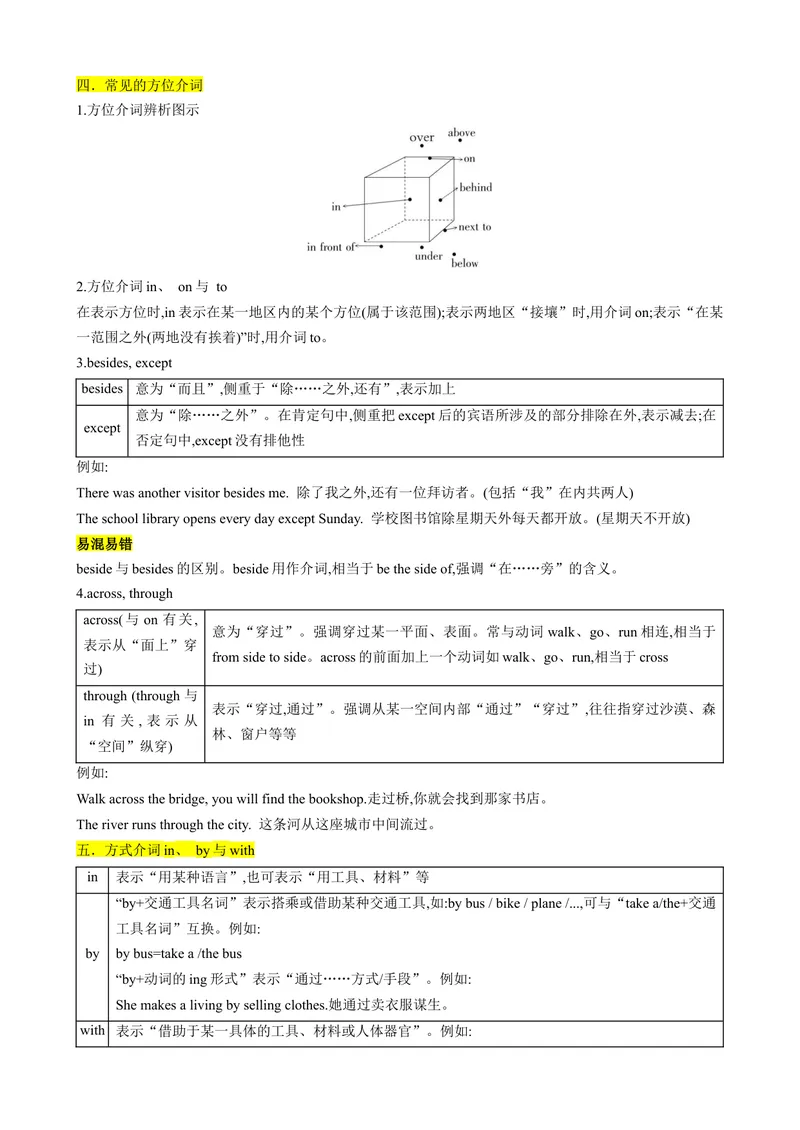
1.方位介词辨析图示
2.方位介词in、 on与 to
在表示方位时,in表示在某一地区内的某个方位(属于该范围);表示两地区“接壤”时,用介词on;表示“在某
一范围之外(两地没有挨着)”时,用介词to。
3.besides, except
besides 意为“而且”,侧重于“除……之外,还有”,表示加上
意为“除……之外”。在肯定句中,侧重把except后的宾语所涉及的部分排除在外,表示减去;在
except
否定句中,except没有排他性
例如:
There was another visitor besides me. 除了我之外,还有一位拜访者。(包括“我”在内共两人)
The school library opens every day except Sunday. 学校图书馆除星期天外每天都开放。(星期天不开放)
易混易错
beside与besides的区别。beside用作介词,相当于be the side of,强调“在……旁”的含义。
4.across, through
across(与 on 有关,
意为“穿过”。强调穿过某一平面、表面。常与动词walk、go、run相连,相当于
表示从“面上”穿
from side to side。across的前面加上一个动词如walk、go、run,相当于cross
过)
through (through与
表示“穿过,通过”。强调从某一空间内部“通过”“穿过”,往往指穿过沙漠、森
in 有 关 , 表 示 从
林、窗户等等
“空间”纵穿)
例如:
Walk across the bridge, you will find the bookshop.走过桥,你就会找到那家书店。
The river runs through the city. 这条河从这座城市中间流过。
五.方式介词in、 by与with
in 表示“用某种语言”,也可表示“用工具、材料”等
“by+交通工具名词”表示搭乘或借助某种交通工具,如:by bus / bike / plane /...,可与“take a/the+交通
工具名词”互换。例如:
by by bus=take a /the bus
“by+动词的ing形式”表示“通过……方式/手段”。例如:
She makes a living by selling clothes.她通过卖衣服谋生。
with 表示“借助于某一具体的工具、材料或人体器官”。例如:I write with a pen. 我用钢笔写字。
易混易错
表示出行的方式也可用“in (on)+冠词(形容词性物主代词等)+交通工具名词”结构;表示“步行”用on
foot。walk to...与go...on foot表示“步行去……”,在同一个句子中,两者不能同时使用。
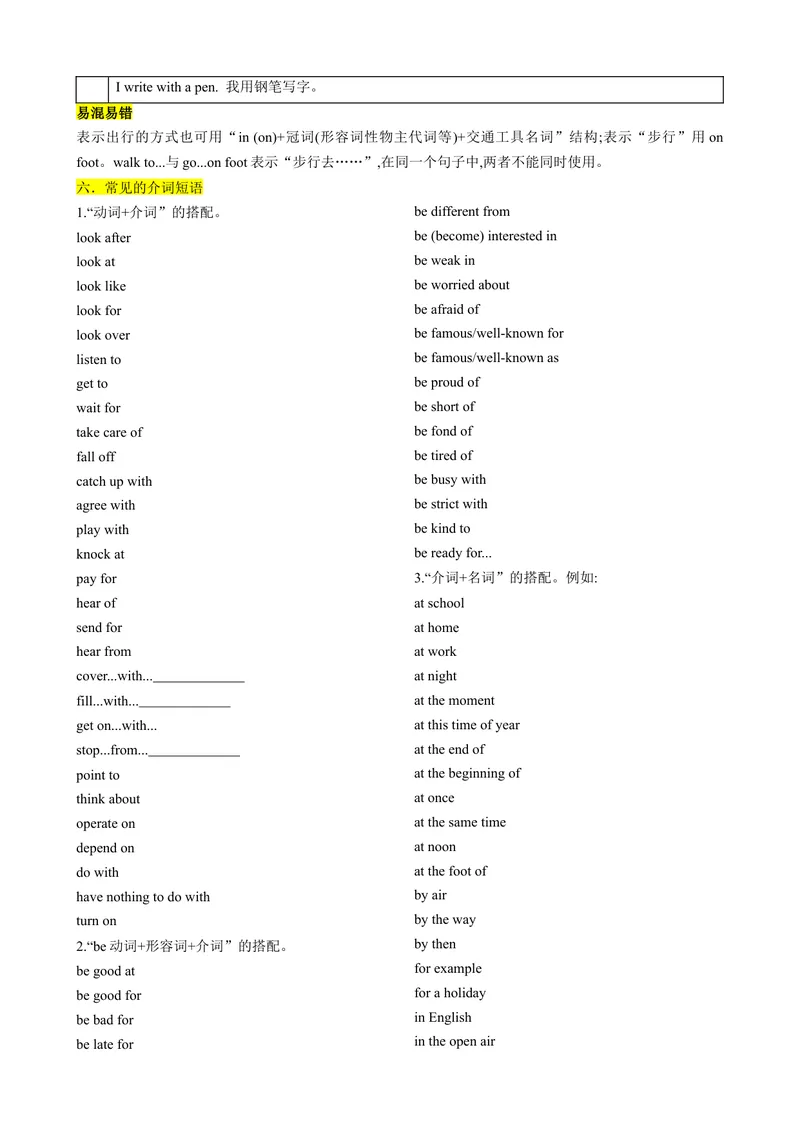
六.常见的介词短语
1.“动词+介词”的搭配。 be different from
look after be (become) interested in
look at be weak in
look like be worried about
look for be afraid of
look over be famous/well-known for
listen to be famous/well-known as
get to be proud of
wait for be short of
take care of be fond of
fall off be tired of
catch up with be busy with
agree with be strict with
play with be kind to
knock at be ready for...
pay for 3.“介词+名词”的搭配。例如:
hear of at school
send for at home
hear from at work
cover...with... at night
fill...with... at the moment
get on...with... at this time of year
stop...from... at the end of
point to at the beginning of
think about at once
operate on at the same time
depend on at noon
do with at the foot of
have nothing to do with by air
turn on by the way
2.“be动词+形容词+介词”的搭配。 by then
be good at for example
be good for for a holiday
be bad for in English
be late for in the open airin front of on duty
in bed on the way/on one's way (home)
in line of course
in trouble on top of
in a minute on show
in surprise
随堂训练
基础题组
一.单项选择
1.The concert will start at 7:00 p. m. ________ June 15th.
2.Tony’s birthday is ________ July 12th, 2010.
A.in B.on C.at D.for
3.The Science and Technology Museum is located ________ the centre of Shanghai.
A.in B.to C.on D.with
4.Yangzhou is ________ the east of China and ________ the west of Japan.
A.in; to B.in; on C.to; in D.to; on
5.In the situation ________ the company is going broke (破产), the employees are trying their best to find
solutions ________ the crisis.
A.when; to B.when; of C.where; of D.where; to
6.Some students in our class will celebrate their birthdays ________ May.
A.at B.on C.in D.for
7.The girl ________ long hair is my classmate.
A.has B.with C.in D.on
8.All of the students went to the Great Wall________ Mary because she had to stay at home and looked after her
sick brother.
A.except B.with C.besides D.beside
9.The building ________ a big garden is my uncle’s. And the garden ________ flowers.
A.has; is full of B.there is; full of C.with; is full of D.with; full of
10.—Do you spend a lot of time ________ computer?
—No, but I spend some time ________ doing my homework.
A.on; in B.in; on C.on; on D.in; in
二.用适当的介词完成下列句子
1.There are many apples the tree in our yard.
2.My grandpa died peacefully a cold winter afternoon.
3.Li Fei improved his spoken English watching English documentaries.
4.There will be a dancing competition the sixteenth day of March.
5.The old man's garden is so beautiful spring that kids like to play there.
6.Lily is only six years old, but she is very good cooking.7.Mr.Lin's flight will arrive half an hour.Let's take a taxi to the airport.
8.Miss Yang helped her neighbor buy two kilos sugar on her way home.
9.Mary has been looking her ruler for 10 minutes. But it is actually in her schoolbag.
10.The students usually have their first class eight o'clock the morning.
11.I like dancing and singing and often spend a lot of time them.
12.Where is the key the front door?
13.After school, I like playing computer games and chatting my friends the Internet.
14.I learned a lot the other students in this class.
15.What do you think my new car?
16.I hurried to school breakfast this morning, so I feel hungry now.
17.The man is a great basketball player.We are all proud him.
18.My mother will come home the morning of August 8.
19.I grew up the foot of the mountain.
20.That naughty boy hid the door and waited for his friends to find him.
三.正确形式填空
1.He didn’t want to go the expectation of his parents.(违反)
2.The app about how to learn Chinese is very popular the foreigners.(在……当中)
3.Walk (穿过) the bridge, and you’ll see the Panda House.
4.The temperature in our hometown usually drops (在……以下) zero in winter.
5. (在……期间) his stay in Yancheng, he made some good friends.
6.Everyone was tired out because they worked w a break until about eight in the evening.
7.Both jobs were very attractive, but I had to choose b the two jobs.
8.You can use something simple l a magazine or a newspaper.
提升题组
一.介词填空
In the past few years, quite a number of men and women have chosen to do something less challenging.
They are afraid that the stress of work robs them1. joy and happiness and brings them harm both
physically and mentally.
2. fact, however, stress isn’t such a bad thing. Above all, unless it gets out of control,
a certain amount of stress is 3. importance as it provides people 4. motivation(动机),
challenges, and purposes. Besides, people under stress prefer to realize their potential(潜能) and achieve their
own personal worth—the very purpose of a human life. Last but not least, research has showed that proper
stress can strengthen the immune system(免疫系统) and is good 5. health.
Stress is a natural part of everyday life and there is no way to escape. Developing our abilities to deal with
stress can prevent us 6. being defeated(打败) by competitive society.
二.语法选择
When a man was walking 1 some elephants, he suddenly stopped. He was confused that these huge
animals were being held only 2 a small rope tied 3 their front legs. No chains, no cages. It was
obvious that the elephants could break their bonds at any time, but 4 some reasons, they did not.He saw a trainer nearby and asked why the animals just stood there and made no attempt to get away.“Well,”
the trainer said, “when they were very young and much smaller, we used the same rope to keep them 5
running away. 6 that age, it was enough to hold them. As they grow up, they get used 7 believing they
cannot break the rope. They believe it can still hold them, so they never try to break free.”
The man was amazed. These animals could break free whenever they wanted, but because they believed they
couldn't, they were stuck right where they were.
How many of us go 8 life like the elephants—holding 9 the belief that we cannot do something
simply because we failed in it once before?
Failure is a part of learning. If we failed once, it doesn't mean we can never succeed. We should never give
up trying when we encounter failures 1 0 life.
1.A.with B.on C.by D.to
2.A.by B.for C.from D.at
3.A.in B.to C.with D.by
4.A.with B.at C.about D.for
5.A.to B.from C.for D.of
6.A.On B.In C.At D.For
7.A.with B.in C.to D.for
8.A.by B.on C.for D.through
9.A.to B.into C.with D.up
10.A.for B.by C.in D.to
并列连词
语法解析
并列连词是用来连接语法地位相同的单词、短语以及句子的连词。并列连词主要分为表示并列关
系、转折关系、因果关系及选择关系的并列连词。
1. 表并列关系的:and(和;同;与);both…and…(……和……都);neither…nor…(既不……也
不……);not only…but also…(不但……而且……);as well as(而且;还;又)。
(1)and“和,并且”连接并列关系的项。
(2)both …and...“既……又……”。
(3)neither…nor…“既不……也不……”,连接并列主语时,谓语动词用就近原则,即谓语动词跟第二
个主语一致。
(4)not only…but also…“不但……而且……”,连接并列主语时,谓语动词用就近原则,即谓语动词跟
第二个主语一致
(5)as well as“而且;还;又”,它连接含有并列主语的句子中,谓语动词应与它前面的主语一致。
1.Both rice and cotton are grown in south China.
2.My sister studies both English and Japanese.
3.My father can speak neither English nor Chinese.
4.Neither you nor he is right.
5.He can play not only basketball but also football.6.Not only Peter but also Bob comes here every day.
7.The students as well as the teacher were present at the meeting. 学生们以及老师都出席了会议。
2、表示转折关系的: but(但;但是;可是);while(然而);yet(然而);however(然而)。
(1)but“但;但是;可是”。
(2)yet“然而”。
(3)however“然而”。
(4)while“然而”。
1.She was very tired, but she kept working till midnight. 她虽然很累了,但还是一直工作到深夜。
2.The woman is old, but she looks very young.
3.My little sister is young, yet she is very clever.
4.Li Lei wanted to Seven Star Park, however ,he didn’t know the way.
5.He’s a worker while his wife is a doctor. 他是一名工人而他妻子是一名医生。
3、表示选择关系的:or(或;或者;还是;否则;不然);either…or…(或者……或者……;不是……
就是……);not…but…(不是……而是……)。
(1)or“或;或者;还是;否则;不然”,连接并列主语时,谓语动词用就近原则,即谓语动词跟第二个
主语一致。
(2)either…or…“或者……或者……;不是……就是……”,连接并列主语时,谓语动词用就近原则,
即谓语动词跟第二个主语一致。如:Nick is either in London or in Paris. 尼克不是在伦敦就是在巴
黎。
(3)not…but…(不是……而是……)。
1.You or he is wrong.
2.You can watch TV or play games at home.
3.Hurry up, or you’ll be late for school.
4.Either you or he is going to do some shopping this afternoon. 今天下午或者你或者他去购物。
5.Ma Lin is not a student but a teacher. 马林不是学生而是老师。
4. 表示因果关系的:so(所以);therefore(因此);for(因为)。
(1)so“因此,所以”。
(2)therefore“因此,所以”。
(3)for“因为”。
1.I got up late, so I was late for class.
2.It’s snowing heavily, so I have to stay at home.
3.Mr. Wang can’t come here today; therefore you needn’t wait for him.
4.It must be snowing, for it is bright outside.
随堂训练
基础训练
一.单项选择
1.The kitchen was messy after cooking, ______ I cleaned it at once.A.or B.so C.but D.because
2.—Let’s play football now!
—Good idea, _______ I’ve forgotten to bring the ball.
A.so B.or C.and D.but
3.Many young people have realized the importance of health, ________ they still go to work without breakfast.
A.so B.or C.but D.and
4.I am interested in European history ________ I will visit Britain this summer.
A.so B.or C.for D.but
5.She didn’t go to the park ________ it rained heavily.
A.because B.so C.but D.or
6.Although he is very old, ________ he works very hard.
A.so B.but C.and D./
7.Amy and Sandy are quite different. Sandy likes joining in different activities, ________ Amy mostly does
reading at home alone.
A.when B.while C.if D.because
8.—Can you come to my party?
—I’d love to, ________ I have to visit my grandparents.
A.until B.but C.because D.unless
9.In autumn, the weather gets cooler ________ the green leaves start to turn gold.
A.because B.but C.and D.or
10.Exercise improves our bone health, ________ we should make it a habit.
A.but B.although C.so D.because
能力提升
一.语法选择
She used to sleep on the sidewalk (人行道) of the Fifth Street Post Office. I could smell her 1 I came
close. She wore dirty clothes and her mouth was nearly toothless. I rarely saw her talk with others. 2 she
was not asleep, she talked to herself. I always had sympathy for her. What a poor old lady! She must be desperate
(绝望的) 3 hungry.
One Thanksgiving, we had lots of food left over. I thought about the old lady. She might be still hungry. 4
I packed the food up and drove over to the post office.
It was a cold night. There was hardly anyone out. 5 I knew she would stay at the same place and I
would find her easily.
There she was, sitting against a fence near the post office. She was dressed 6 she always was.
I drove my car over to her, rolled down the window and said, “I've brought you some food. Would you like
some turkey (火鸡) and apple pie?”
7 , the old woman didn't seem to be very excited about this. She looked at me and said quite clearly, “Oh,
thank you very much, but someone has given me food earlier and I'm quite full now. Why don't you take it to
someone else 8 needs it?”
Her words were so clear and her manners were so gracious (亲切的) 9 no one would consider her as ahomeless woman. Soon her head sank into her arms again. I was the only person who didn't know 10 to
say.
1.A.before B.unless C.until D.since
2.A.Because B.Before C.If D.Although
3.A.but B.and C.or D.so
4.A.So B.Because C.Though D.And
5.A.Though B.But C.So D.Or
6.A.as B.so C.because D.and
7.A.Instead B.However C.But D.Therefore
8.A.whom B.who C.which D.whose
9.A.that B.what C.which D.when
10.A.how B.whether C.what D.that
二.短文填空
A popular one-armed teenager in China
Despite losing one arm, Zhang Jiacheng never loses his love for basketball or willingness to improve his
skills on the court.
Zhang is 15 now and he likes playing basketball very much. 1 a video of him was posted online, he
became very popular in China. In the video, he showed his dribbing abilities(运球能力) in front of the defense
made up of some professional(专业的) basketball players, 2 received a loud cheer from people watching on
site.
Born in southern China's Guangdong Province, Zhang lost his right arm in an accident when he was just five.
However, Zhang decides to face up to the hardship, 3 to be a basketball player is his dream.
Zhang works very hard. 4 it is rainy or windy, he never stops practicing playing basketball, and has
made much progress in his skills.
“Give it a try, 5 give it up,” Zhang said in a video. Of course, he chose the former.
1. 2. 3. 4. 5.