专题 03 Unit 2 Home Sweet Home
Section A What can you do for your home?
单词学习
1.pack /pæk/v. 打包;收拾 17.plan /plæn/v. 策划;打算 n. 计划;方案
2.pack up 打包 18.treasure /ˈtreʒə(r)/n. 宝物;财富 v. 珍视
3.bathroom /ˈbɑːθruːm/n. 浴室;洗手间 19.hunt /hʌnt/n. 搜寻;狩猎 v. 搜寻;打猎
4.sort /sɔːt/v. 把…… 分类;整理 20.treasure hunt 寻宝游戏
5.bedroom /ˈbedruːm/n. 卧室 21.lift /lɪft/n. 搭便车;电梯 v. 举起;抬起
6.balcony /ˈbælkəni/n. 阳台 22.give sb a lift 开车顺便送某人
7.hang up 挂起;挂断电话 23.until /ənˈtɪl/prep. 到…… 时;直到…… 为止
8.invite /ɪnˈvaɪt/v. 邀请 24.be careful with 注意;当心
9.living room 客厅 25.movie /ˈmuːvi/n. 电影
10.arrival /əˈraɪvl/n. 到达 26.the movies 电影院;电影产业
11.yet /jet/adv.(用于否定句和疑问句)还 conj. 27.dead /ded/adj. 不运行的;死的
但是 28.note /nəʊt/n. 笔记;记录;便条 v. 注意;指出
12.add /æd/v. 添加;加 29.take notes 做笔记
13.add sth to sth 把…… 加入…… 30.clean up 清扫
14.go shopping 去购物 31.community /kəˈmjuːnəti/n. 社区;社团
15.biscuit /ˈbɪskɪt/n. 饼干 32.rubbish /ˈrʌbɪʃ/n. 垃圾
16.borrow /ˈbɒrəʊ/v. 借
课文解析
Section A, 1b and 1c 吉姆:爸爸,午饭后我可以和我的朋友出
去玩吗?
Conversation 1
爸爸:对不起,吉姆,你得先收拾东西。
Jim: Dad, can I hang out with my friends after lunch? 吉姆:但是我想在我们搬家之前和他们呆
在一起。
Dad: Sorry, Jim, you have to pack up your things first.
爸爸:我知道,但是搬家的人来之前我们
Jim: But I want to spend time with them before we move. 需要做好准备。你能把你的东西整理到那
些箱子里吗?
Dad: I know, but we need to get ready before the movers come. Can
吉姆:好吧。那之后,我可以出去吗?
you sort your things into those boxes? 爸爸:对,记得在每个盒子里都写上“吉
姆的卧室”!
Jim: OK. After that, could I go out?
吉姆:没问题,爸爸。
Dad: Yes. Remember to write “Jim’s bedroom” on each box!
Jim: No problem, Dad.
Conversation 2 吉姆:我喜欢我们的新房子。客厅好大
1
学科网(北京)股份有限公司Jim: I love our new house. The living room is so big! Could we keep 啊!我们能养些鱼吗?
爸爸:嗯,吉姆,这可真是一项艰巨的任
some fish here?
务。你能每天照顾他们吗?
Dad: Well, Jim, that’s a lot of work. Can you take care of them every 吉姆:是的!
爸爸:好的,现在,请你帮我把照片挂
day?
好。
Jim: Yes! 吉姆:当然!
海伦:我们的阳台很大,阳光充足。我可
Dad: OK. Now, could you please help me hang up the photos?
以在那里种些花吗?
Jim: Sure! 妈妈:是的,你可以。这是个好主意,海
伦!
Helen: Our balcony is so big and gets a lot of sunshine. Can I grow
彼得:妈妈,我可以邀请我的朋友来我们
some flowers there? 新家吗?
妈妈:是的,彼得,但是先帮着打扫一
Mum: Yes, you can. That’s a great idea, Helen!
下。你能扫一下地板吗?我来打扫
Peter: Mum, can I invite my friends to our new house? 浴室。
彼得:好吧,妈妈。
Mum: Yes, Peter, but help clean up first. Could you please sweep the
floor? I’ll clean the bathroom.
Peter: OK, Mum.
Section A, 2a and 2d 爸爸:猜猜看!爷爷奶奶这周末要来看
我们!
Dad: Guess what! Grandpa and Grandma are visiting us this
吉姆:哦,太好了!
weekend! 彼得:我迫不及待地想给他们看我们的
新房子!
Jim: Oh, great!
妈妈:是的,但是现在我们需要为他们
Peter: I can’t wait to show them our new house! 的到来做好准备。你能帮我打扫一下他
们的房间吗?
Mum: Yes, but now we need to get ready for their arrival. Can you
彼得:但是他们的房间已经很干净了!
help me clean up their room? 妈妈:嗯,还没到“奶奶干净”的时
候!
Peter: But their room is already clean!
彼得:哦,好吧!
Mum: Well, it’s not "grandma clean" yet! 爸爸:吉姆,你能帮我把新钟表挂到墙
上吗?我买它给爷爷看时间的。
Peter: Oh, OK!
吉姆:当然,爸爸。
Dad: Jim, can you help me put the new clock on the wall? I bought it 爸爸:海伦,你能把这把椅子搬到他们
的房间吗?爷爷喜欢在窗前看书。
for Grandpa to see the time.
海伦:没问题,爸爸。我可以把一些花
Jim: Sure, Dad. 放在窗边吗?
爸爸:好主意!奶奶喜欢花。
Dad: Helen, can you move this chair to their room? Grandpa like
妈妈,你能不能带我到花店去?
reading books in front of the window. 妈妈:没问题,午饭后我们去!
Helen: No problem, Dad. Can I put some flowers by the window?
Dad: Yes, good idea! Grandma loves flowers.
Helen: Mum, could you take me to the flower shop later?
Mum: No problem. Let’s go after lunch!
知识解析
1 . What chores do you do?
do chores 做家务(固定搭配)
2
学科网(北京)股份有限公司My mom asks me to do chores every weekend. 我妈妈每周末要求我做家务。
注意:chores是复数名词,不能加a/an
2. sweep the floor 扫地
I sweep the floor before mopping.拖地前我先扫地。
同类词:mop the floor 拖地
3. feed the fish 喂鱼
Don't forget to feed the fish today. 今天别忘记喂鱼。
搭配:feed sb. sth. = feed sth. to sb.
4. pack up 打包(强调动作过程)
I need to pack up my suitcase for the trip. 为了这次旅行,我需要打包行李箱。
5. hang up the clothes 挂衣服
Hang up your wet towel in the bathroom. 把你的湿毛巾挂在浴室。
6. water the plants 浇花
Water the flowers twice a week.一周浇花两次。
注意:water可作动词(浇水)或名词(水)
7.sort things into boxes 把东西分类到盒子里
Let's sort these books into different categories. 让我们把这些书分成不同种类吧。
拓展:sort out 整理
8. grow flowers 种花
I grow roses in my garden. 我在花园里中玫瑰。
同类词:plant trees 种树
9. invite friends to the new house 邀请朋友到新房子
用法:invite sb. to do sth. 邀请某人做某事;invite sb to sp邀请某人到某地
I want to invite Tom to my party. 我想邀请Tom到我的派对。
10. Good job! 做得好!
Teacher said "Good job!" when I finished the work. 当我写完作业后,老师说“做得好!”
同义表达:Well done!
3
学科网(北京)股份有限公司11. look like 看起来像(外貌特征)
The cloud looks like a rabbit. 云看起来像一个兔子。
12. clean up 彻底打扫(强调结果)
We cleaned up the park after the picnic. 野餐后我们把公园打扫干净了。
比较:clean the room 打扫房间(动作)
13. But I want to spend time with them before we move.
move动词:移动;搬家
Move your chair closer to the table. 把你的椅子移到桌子附近。
We moved to a new house last month. 上个月我们搬到了新房子
14 . Guess what? 猜猜看?
用法:口语中引起注意,后接惊喜消息
Guess what? I won the first prize in the competition! 你猜怎么着?我比赛得一等奖了!
15 . I can’t wait to show them our new house.
can’t wait to do sth迫不及待做某事
I can’t wait to visit the new museum this weekend. 这周末我迫不及待要去参观博物馆。
16 . Can I put some flowers by the window?
by用法:作为介词,有多种含义。
①“通过……方式”,例如“I go to school by bus.”(我坐公交车去上学。);
②“在……旁边”,如“sit by the window”(坐在窗户旁边);
③ 还能用于被动语态中,引出动作的执行者,如“The book was written by him.”(这本书是他写的。)
常见搭配:by the way(顺便说一下);by oneself(独自);by the time(到……时候)。
17 . But their room is already clean! Well, it’s not “grandma clean” yet.
Yet & Already
Yet(尚未):用于否定句和疑问句
I haven’t finished my homework yet. 我还没完成作业。
Already(已经):用于肯定句
She has already read this book. 她已经读过这本书了。
18 . Yes, but now we need to get ready for their arrival .
arrival名词,到达 搭配:on arrival(到达时)
Please call me on your arrival at the airport. 你到达机场时请给我打电话。
4
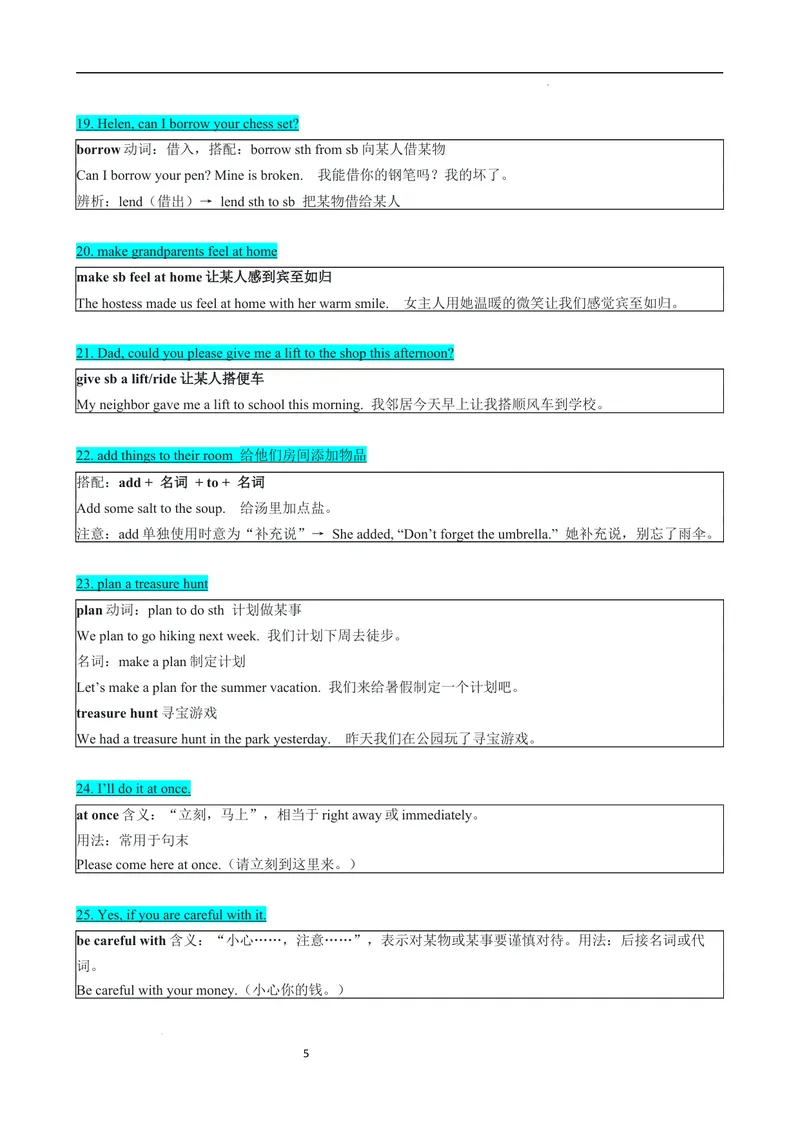
学科网(北京)股份有限公司19 . Helen, can I borrow your chess set?
borrow动词:借入,搭配:borrow sth from sb向某人借某物
Can I borrow your pen? Mine is broken. 我能借你的钢笔吗?我的坏了。
辨析:lend(借出)→ lend sth to sb 把某物借给某人
20 . make grandparents feel at home
make sb feel at home让某人感到宾至如归
The hostess made us feel at home with her warm smile. 女主人用她温暖的微笑让我们感觉宾至如归。
21 . Dad, could you please give me a lift to the shop this afternoon?
give sb a lift/ride让某人搭便车
My neighbor gave me a lift to school this morning. 我邻居今天早上让我搭顺风车到学校。
22 . add things to their room 给他们房间添加物品
搭配:add + 名词 + to + 名词
Add some salt to the soup. 给汤里加点盐。
注意:add单独使用时意为“补充说”→ She added, “Don’t forget the umbrella.” 她补充说,别忘了雨伞。
23 . plan a treasure hunt
plan动词:plan to do sth 计划做某事
We plan to go hiking next week. 我们计划下周去徒步。
名词:make a plan制定计划
Let’s make a plan for the summer vacation. 我们来给暑假制定一个计划吧。
treasure hunt寻宝游戏
We had a treasure hunt in the park yesterday. 昨天我们在公园玩了寻宝游戏。
24 . I’ll do it at once .
at once含义:“立刻,马上”,相当于right away或immediately。
用法:常用于句末
Please come here at once.(请立刻到这里来。)
25 . Yes, if you are careful with it.
be careful with含义:“小心……,注意……”,表示对某物或某事要谨慎对待。用法:后接名词或代
词。
Be careful with your money.(小心你的钱。)
5
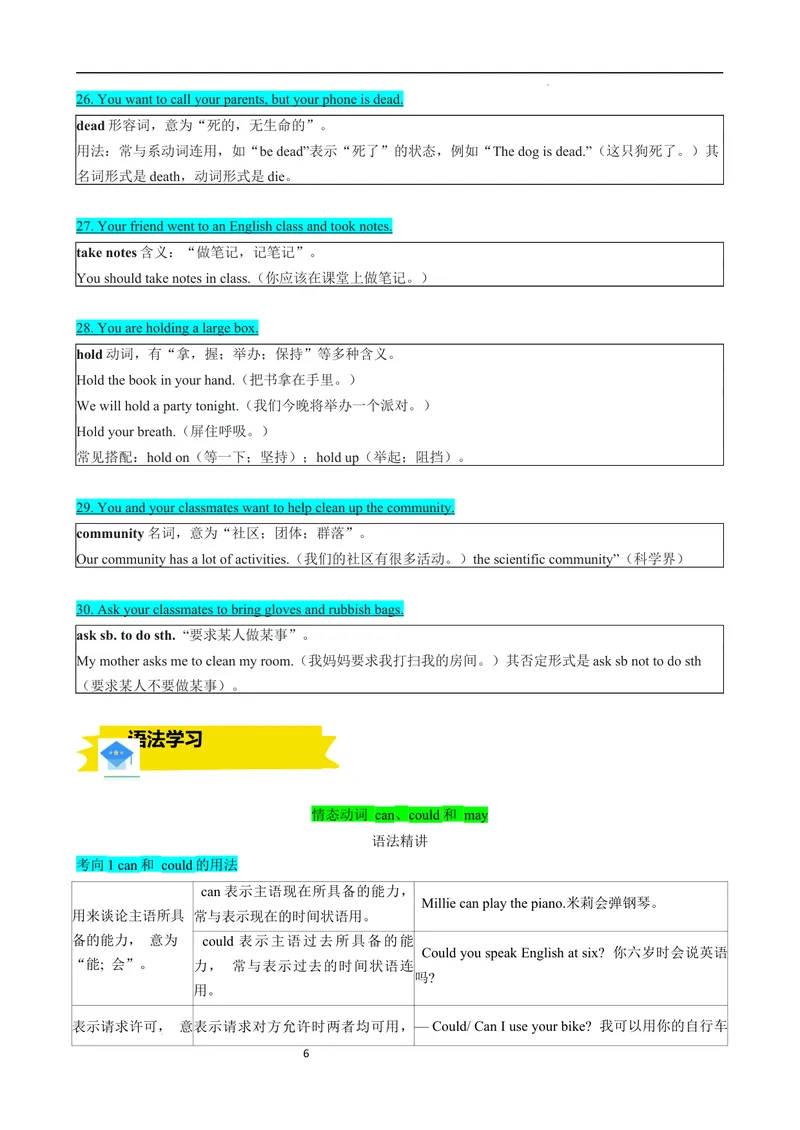
学科网(北京)股份有限公司26 . You want to call your parents, but your phone is dead.
dead形容词,意为“死的,无生命的”。
用法:常与系动词连用,如“be dead”表示“死了”的状态,例如“The dog is dead.”(这只狗死了。)其
名词形式是death,动词形式是die。
27 . Your friend went to an English class and took notes.
take notes含义:“做笔记,记笔记”。
You should take notes in class.(你应该在课堂上做笔记。)
28 . You are holding a large box .
hold动词,有“拿,握;举办;保持”等多种含义。
Hold the book in your hand.(把书拿在手里。)
We will hold a party tonight.(我们今晚将举办一个派对。)
Hold your breath.(屏住呼吸。)
常见搭配:hold on(等一下;坚持);hold up(举起;阻挡)。
29 . You and your classmates want to help clean up the community.
community名词,意为“社区;团体;群落”。
Our community has a lot of activities.(我们的社区有很多活动。)the scientific community”(科学界)
30 . Ask your classmates to bring gloves and rubbish bags.
ask sb. to do sth. “要求某人做某事”。
My mother asks me to clean my room.(我妈妈要求我打扫我的房间。)其否定形式是ask sb not to do sth
(要求某人不要做某事)。
语法学习
情态动词 can、could和 may
语法精讲
考向1 can和 could的用法
can表示主语现在所具备的能力,
Millie can play the piano.米莉会弹钢琴。
用来谈论主语所具 常与表示现在的时间状语用。
备的能力, 意为 could 表示主语过去所具备的能
Could you speak English at six? 你六岁时会说英语
“能; 会”。 力, 常与表示过去的时间状语连
吗?
用。
表示请求许可, 意表示请求对方允许时两者均可用, — Could/ Can I use your bike? 我可以用你的自行车
6
学科网(北京)股份有限公司此时 could并不表示过去,而是表示
吗?— Yes, of course you can./
一种更委婉的语气。 could只用于
为“可以”。 Sorry, you can't. 好的, 当然可以。/对不起, 你不
一般疑问句, 回答应用 can, 不用
可以。
could。
表示对现在 can常用于否定句中, cannot (can't) The jacket can't be Tom’ s. 这件夹克衫不可能是汤
或将来的推 表示“不可能”。 姆的。
测, 意为 You could be right, but I don't think you are. 你可能
could可用于肯定句和否定句中。
“可能; 会”。 是对的,但我认为你是错的。
考向2 may的用法
①may是情态动词,可表示请求许可或征求同意,比较正式。②对含 may的一般疑问句作答时,肯定回
答常用“Yes,主语+ can.”或“Yes, please/ of course.”; 否定回答常用“No, 主语+ can't.”
或“Sorry, I'm afraid you can't.”
— Yes, you can./ No, you can't. 好的, 你可以。/不, 你不可以。
— Yes, you can./ No, you can't. 好的, 你可以。/不, 你不可以。
①may也可表示推测, 其过去式为
might。 He said that he might be free that afternoon.他说他那天下午可能有
②might也可用作情态动词, 表示推测, 空。
但 might 表示的可能性比 may 小一 He may/ might be ill today. 他今天或许是病了。
些。
①常强调客观需要,多译为“不得不”;
②有时态、人称和数的变化, 其一般现在时的第
have to
三人称单数形式为 has to, 过去式为 had to。 Have to的否定形式
为 don't have to, 表示“不必”。
①常表示说话人的主观看法, 多译为“必须”;
must ②没有时态、人称和数的变化。 must的否定形式为 mustn't, 表示
“禁止, 不准”。
语法训练
一、用 can’t/could/must/have to 填空
1. — _______ I have an ice cream, Mom? — You’d better not. You have a cold now.
2. —_______ you please clean the living room?
— Sorry, I _______ . I ____________ do my homework now.
3. Mom, _______ you buy me a new watch? The old one just stopped working.
4. — I can’t stop eating junk food. — For your health, I’m afraid you _______ .
5. — What about seeing a new film this evening?
— I am afraid I _______ . I ____________ finish my math exercises this evening.
二、根据汉语意思补全句子
7
学科网(北京)股份有限公司6. ——你能告诉我 WiFi 密码吗? ——当然, WiFi 密码是 88888888。
— _______ _______ _______ _______ the WiFi password?
— Sure, the WiFi password is 88888888.
7. 我可以用你的笔记本电脑几个小时来完成我的项目吗?
_______ _______ _______ your laptop for a few hours to finish my project?
8. ——明天请你来参加我的聚会,好吗? ——可以,我很乐意。
—_______ _______ _______ _______ to my party tomorrow?
— Yes, I’d love to.
9.——苏西,你能教我怎么拉小提琴吗 ? ——没问题。
—_______ you show me how to play the violin, Suzy?
— _______ _______ .
10. ——杨小姐,我可以从图书馆借书吗? ——对不起,你不能。
— _______ _______ _______ the books from the library, Miss Yang?
— Sorry, _______ _______ .
三、 家不只是地方的代名词,它更是一个充满爱的地方,让我们一起帮助作者打造属于他的爱的港湾
吧。
Home
can must could have to may
Last weekend, my family decided to decorate (装饰) our living room. We wanted to change the old
wallpaper (墙纸), but we 11. ______ clean the room first. My dad said, “We 12. ______ remove all the furniture
before painting the walls.”
I 13. ______ paint well, so I offered to help. My mom asked, “Who 14. ______ pass me the brushes?”
“Me,” I answered.
While working, we 15. ______ wear gloves to protect our hands. My younger sister also wanted to help,
but Dad said, “You 16. ______ help with small tasks, but you 17. ______ stay away from the ladder—it’s
dangerous!”
After painting, we 18. ______ choose new curtains. Mom insisted, “We 19. ______ pick a color that
matches the walls.” Then, we reached agreement. At last, we 20. ______ move everything back. It was tiring, but
now our home looks bright and nice!
As we sat together and enjoyed our work, I realized something: home isn’t just a place with painted walls
or pretty curtains. It’s where we laugh, help each other, and share love.
一、Could;Could; can’t; have to/must ;could;have to;can’t; have to/must
二、Can you tell me;Could I use;Could you please come;Can; No problem;Could I borrow;
you can’t
三、had to;must;can;can;had to;may;must;could;must;had to
综合训练
一.完成句子
8
学科网(北京)股份有限公司1. I like having a cup of tea with ____________ (biscuit) in the afternoon. It’s a relaxing moment.
2. We often go to the ____________ (movie) on weekends to enjoy the latest blockbusters.
二、词形转换
1. invite (v.) →(现在分词) ____________→(n.) ____________
2. arrive (v.) → (动词过去式) ____________→(n.) ____________
3. hunt (v.) →(过去式) ____________→(现在分词) ____________ →(n. 猎人 ) ____________
4. die (v.) →(adj.) ____________→(n.) ____________
5. She ____________me to her birthday party and sent me an ____________card last week. (invite)
6. The____________ of the train was a bit late. When it finally ____________at the station, all the passengers
were ready to get off. (arrival)
7. The ____________went on a ____________trip in the forest. He hoped to ____________some wild animals
for food. (hunt)
8. Lily’s flowers are ____________. Their ____________made her a bit sad. She thought it was a big mistake not
to water them regularly. (dead)
三、完成句子
Yesterday, I planned to go 1. ____________ (shop) in the downtown area. As I was walking to the bus stop, my
neighbor saw me and gave me 2. ____________ lift. It was really kind of him. I accepted and chatted with him all
the way. When I got home, I 3. ____________ (hang) up my coat, still feeling happy.
四、翻译
1.请你给植物浇水,好吗?
__________________________________
2.对不起,我现在必须打扫浴室。
_____________________________________________
3.我迫不及待地想带他们看看我们的新房子!
_____________________________________________
一.biscuits;movies
二、词形转换
inviting;invitation ;arrived;arrival;hunted;hunting;hunter ;dead;death;
invited;invitation;arrival;arrived;hunter;hunting;hunt;dead;death;
三、shopping;a;hung;
四、Could you please water the plants?
Sorry, I have to clean the bathroom now.
I can’t wait to show them our new house!
五、单项选择
1.We planted ______ 50,000 trees last year.
A. at last B. at least C. at once
答案:B 句意:我们去年种植了至少50,000棵树。A项“最后”;B项“至少”;C项“立刻;马
上”。根据句意可知选B。
9
学科网(北京)股份有限公司2.—______ does your school organize an English Reading Festival?—Once a term.
A. How often B. How old C. How long D. How soon
答案:A 考查特殊疑问词组辨析。句意:——你们学校多久组织一次英语阅读节?——一学期一次。
根据答语可知上句询问频率,故用How often“多久一次”提问。故选A。
3. —I lost my bicycle in the city park last Sunday. —______
A. How come? B. Sounds cool!
C. Not at all. D. I’m not sure.
答案:A A项“怎么会?”;B项“听起来很酷”;C项“没关系”;D项“我不确信”。根据语境可知
选A。
4.Life is ______ surprises. No matter what you do, try your best.
A. proud of B. full of
C. because of D. afraid of
答案:B 句意:生活充满了惊喜。无论你做什么,要竭尽全力。be full of意为“充满;装满”,故答案
选B。
5.—Do you often play football?—No, ______. I don’t like it at all.
A. never B. always C. sometimes D. usually
答案:A 根据答语中后一句“我一点也不喜欢它” 可知是从不踢足球。故答案选A。
6. Now people can stay at home for as long as they like because of the ______.
They can order food, buy clothes, have classes, etc.
A. world B. Internet C. supermarket D. restaurant
答案:B 句意:由于网络现在人们可以在家里喜欢待多久就待多久。他们可以订食物、买衣服、上课
等。A项“世界”;B项“互联网”;C项“超市”;D项“餐馆”。由句意可知选B。
六、补全对话
A: Hi, Jim. What do you often do in your free time?
B: 1.
A: It’s a relaxing hobby! I like music, too.
B: 2.
A: I like pop music. What about you?
B: I also like it. 3. I like folk music best.
A: I know little about folk music.
B: 4.
A: Yes. My favorite English song is Yesterday Once More.
B: 5. Can you sing it?
A: Of course.
答案:
1. I often listen to music.
2. What kind of music do you like?
3. But it’s not my favorite.
4. Do you like English songs?
10
学科网(北京)股份有限公司5. It must be a good song.
七、短文填空
根据短文内容和所给中文提示,在空白处写出单词的正确形式。
We went to Hong Kong last month. It was a 1 (精彩的) trip, so 2
(每人) had great fun. We went there by train. On the train, I read a 3 (杂志) about Hong Kong and I
learned a lot about it. In Hong Kong, we visited lots of tall 4
(建筑物) and beautiful parks. I also bought some clothes for 5 (我自己). When we were 6 (饥饿
的), we went to eat some delicious food. I ate at 7
(最少) four hamburgers. I was really full. 8 (然而), my mother told me that eating junk food 9
(这样的) as hamburgers was bad for my health. 1 0 (或许)next time I should eat less.
答案:
1. wonderful 2. everyone 3. magazine 4. buildings 5. myself
6. hungry 7. least 8. However 9. such 10. Maybe
八、英译汉,翻译下面短文中画线的句子
1. Everyone knows exercise can keep us healthy. Without exercise, we can’t live healthily or happily. But
how to exercise is really very important. Here’s some advice for you. 2.There are many ways to exercise. You
can take a walk, run or play ball games. These sports can take away your worry. 3. You will feel very happy and
strong. But when you take exercise, you must make sure that you are safe. Because you are still young, don’t go
fishing or go hunting by yourself. 4. When you exercise in the morning, you can first drink some water. If you
have sports in the afternoon or evening, you’d better not exercise right after meals. 5. You can exercise in the
sports field or in a park. But don’t play ball games on the road or in the street because it’s not safe.
1.
2.
3.
4.
5.
答案:
1.人人都知道锻炼能使我们保持健康。
2.有许多锻炼的方式。
3.你会感到快乐和强壮。
4.你早晨锻炼时,你可以先喝些水。
5.你可以在运动场或者在公园里锻炼。
九、任务型阅读
根据短文内容,从短文后的选项中选出能填入空白处的最佳选项。选项中有两项为多余选项。
Everybody knows that healthy eating habits are very important. 1 I’m sure you will live a healthy
and happy life if you follow them.
2
Drink about 8 cups of water every day. You may need even more water when you do exercise.
11
学科网(北京)股份有限公司Don’t forget breakfast.
Breakfast is the most important meal of the day. 3
Try to eat light (清淡的) lunch.
Don’t eat junk food or food that has too much fat for lunch. They are bad for your health. If you don’t have
enough time to have a healthy lunch, you can bring some bread with you for a quick lunch.
4
Fruit and vegetables should be a necessary part of your food. You can have a vegetable salad for your lunch.
If you don’t like eating vegetables, you can eat some fruit.
Don’t have dinner too late.
5 Your body needs time to digest (消化) most of the food.
A. Drink enough water.
B. The results are as follows.
C. Eat fruit and vegetables every day.
D. Here are five good eating habits.
E. So we’d better exercise more in our free time.
F. Try to have dinner at least 3 hours ago before you go to bed.
G. You will have more energy (精力) after you eat breakfast.
答案:
[语篇解读] 本文主要介绍了健康的饮食习惯。
1. D 根据后句“I’m sure you will live a healthy and happy life if you follow them.”及下文介绍的饮食习惯可
知此处应引出下文的好的饮食习惯,因此选项D符合语境。
2. A 根据下文中的“Drink about 8 cups of water every day.”可知此处内容应和喝水有关,因此选项A符合
语境。
3. G 根据前句“Breakfast is the most important meal of the day.”可知此处内容应和吃早餐有关,因此选项
G符合语境。
4. C 根据下面的“Fruit and vegetables should be a necessary part of your food.”可知此处内容应和蔬菜水果
有关,因此选项C符合语境。
5. F 根据标题“Don’t have dinner too late.”及后句“Your body needs time to digest most of the food.”可知
此处内容应和吃晚餐的时间有关,因此选项F符合语境。
12
学科网(北京)股份有限公司