专题 03 简单句,句型转换,there be 句型,祈使句讲练
一.简单句
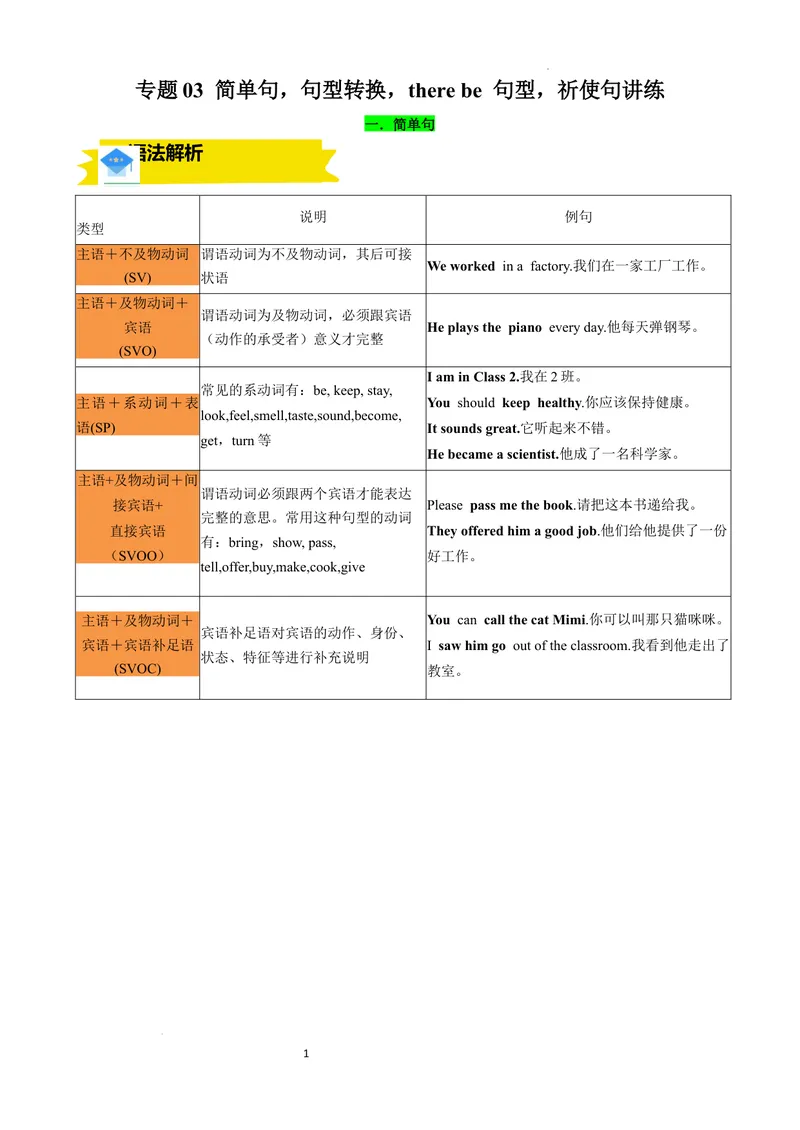
语法解析
说明 例句
类型
主语+不及物动词 谓语动词为不及物动词,其后可接
We worked in a factory.我们在一家工厂工作。
(SV) 状语
主语+及物动词+
谓语动词为及物动词,必须跟宾语
宾语 He plays the piano every day.他每天弹钢琴。
(动作的承受者)意义才完整
(SVO)
I am in Class 2.我在2班。
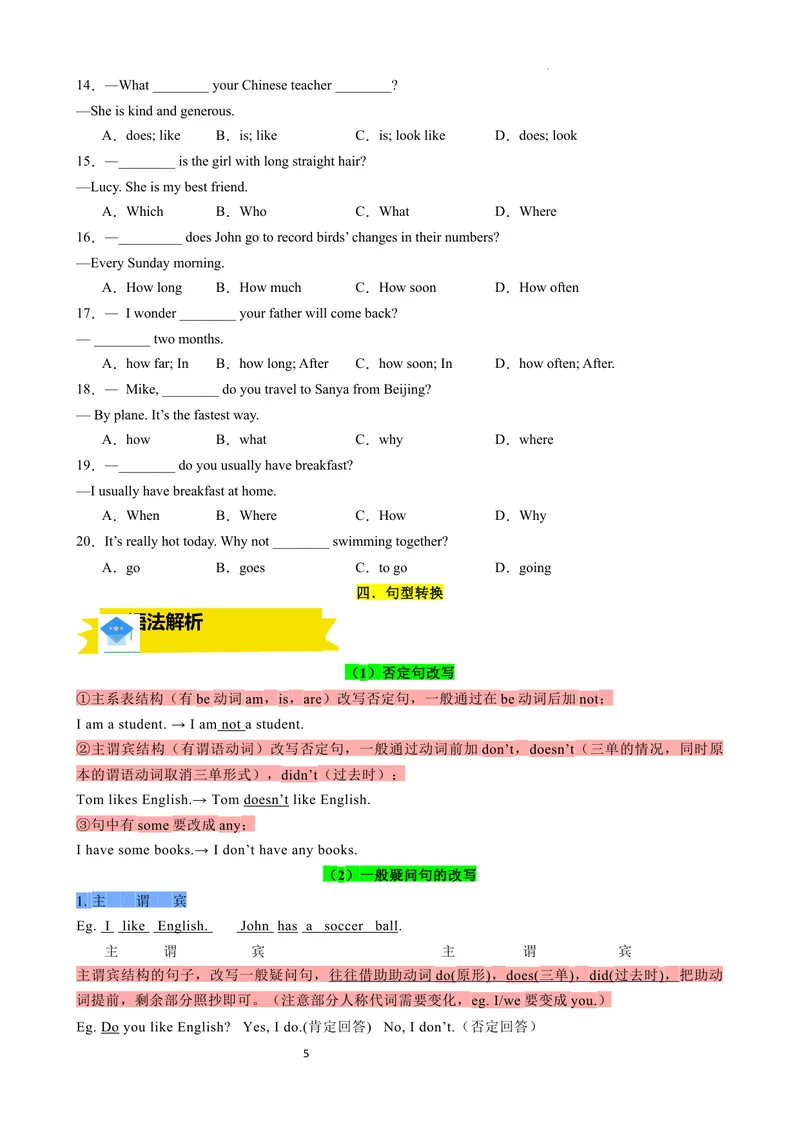
常见的系动词有:be, keep, stay,
主语+系动词+表 You should keep healthy.你应该保持健康。
look,feel,smell,taste,sound,become,
语(SP) It sounds great.它听起来不错。
get,turn等
He became a scientist.他成了一名科学家。
主语+及物动词+间
谓语动词必须跟两个宾语才能表达
接宾语+ Please pass me the book.请把这本书递给我。
完整的意思。常用这种句型的动词
直接宾语 They offered him a good job.他们给他提供了一份
有:bring,show, pass,
(SVOO) 好工作。
tell,offer,buy,make,cook,give
主语+及物动词+ You can call the cat Mimi.你可以叫那只猫咪咪。
宾语补足语对宾语的动作、身份、
宾语+宾语补足语 I saw him go out of the classroom.我看到他走出了
状态、特征等进行补充说明
(SVOC) 教室。
1
学科网(北京)股份有限公司随堂训练
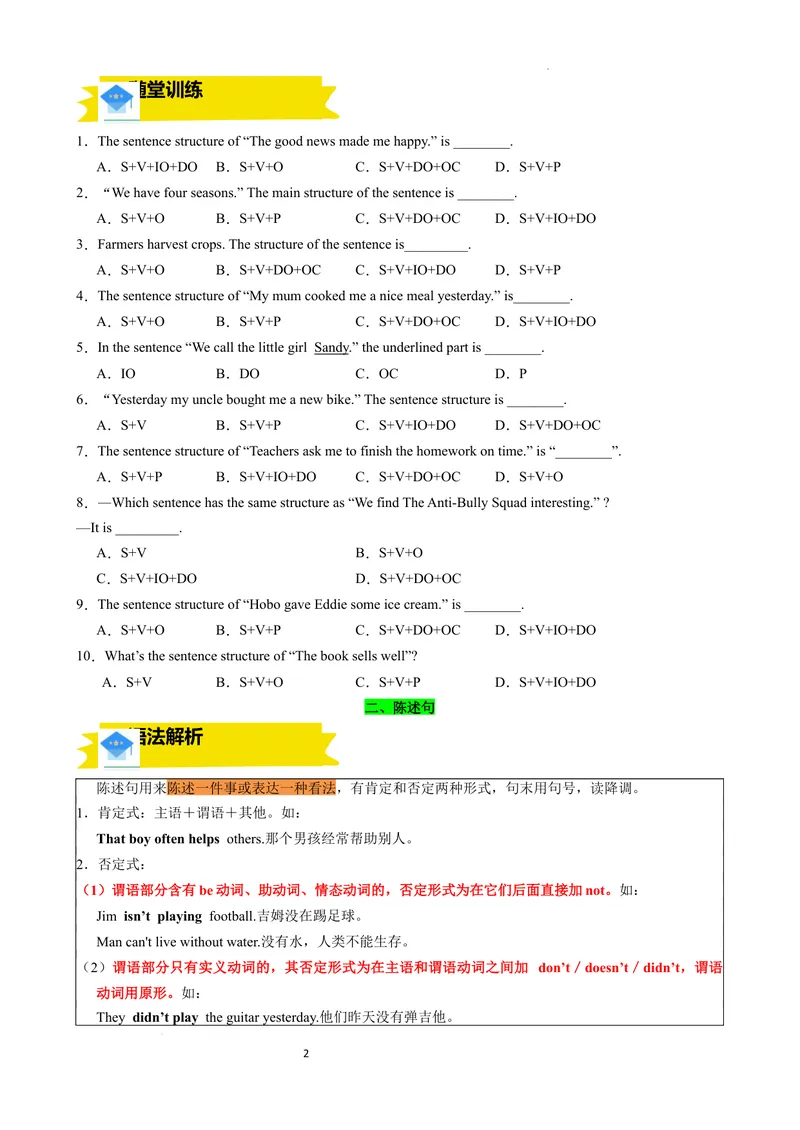
1.The sentence structure of “The good news made me happy.” is ________.
A.S+V+IO+DO B.S+V+O C.S+V+DO+OC D.S+V+P
2.“We have four seasons.” The main structure of the sentence is ________.
A.S+V+O B.S+V+P C.S+V+DO+OC D.S+V+IO+DO
3.Farmers harvest crops. The structure of the sentence is_________.
A.S+V+O B.S+V+DO+OC C.S+V+IO+DO D.S+V+P
4.The sentence structure of “My mum cooked me a nice meal yesterday.” is________.
A.S+V+O B.S+V+P C.S+V+DO+OC D.S+V+IO+DO
5.In the sentence “We call the little girl Sandy.” the underlined part is ________.
A.IO B.DO C.OC D.P
6.“Yesterday my uncle bought me a new bike.” The sentence structure is ________.
A.S+V B.S+V+P C.S+V+IO+DO D.S+V+DO+OC
7.The sentence structure of “Teachers ask me to finish the homework on time.” is “________”.
A.S+V+P B.S+V+IO+DO C.S+V+DO+OC D.S+V+O
8.—Which sentence has the same structure as “We find The Anti-Bully Squad interesting.” ?
—It is _________.
A.S+V B.S+V+O
C.S+V+IO+DO D.S+V+DO+OC
9.The sentence structure of “Hobo gave Eddie some ice cream.” is ________.
A.S+V+O B.S+V+P C.S+V+DO+OC D.S+V+IO+DO
10.What’s the sentence structure of “The book sells well”?
A.S+V B.S+V+O C.S+V+P D.S+V+IO+DO
二、陈述句
语法解析
陈述句用来陈述一件事或表达一种看法,有肯定和否定两种形式,句末用句号,读降调。
1.肯定式:主语+谓语+其他。如:
That boy often helps others.那个男孩经常帮助别人。
2.否定式:
(1)谓语部分含有be动词、助动词、情态动词的,否定形式为在它们后面直接加not。如:
Jim isn’t playing football.吉姆没在踢足球。
Man can't live without water.没有水,人类不能生存。
(2)谓语部分只有实义动词的,其否定形式为在主语和谓语动词之间加 don’t/doesn’t/didn’t,谓语
动词用原形。如:
They didn’t play the guitar yesterday.他们昨天没有弹吉他。
2
学科网(北京)股份有限公司三、疑问句
语法解析
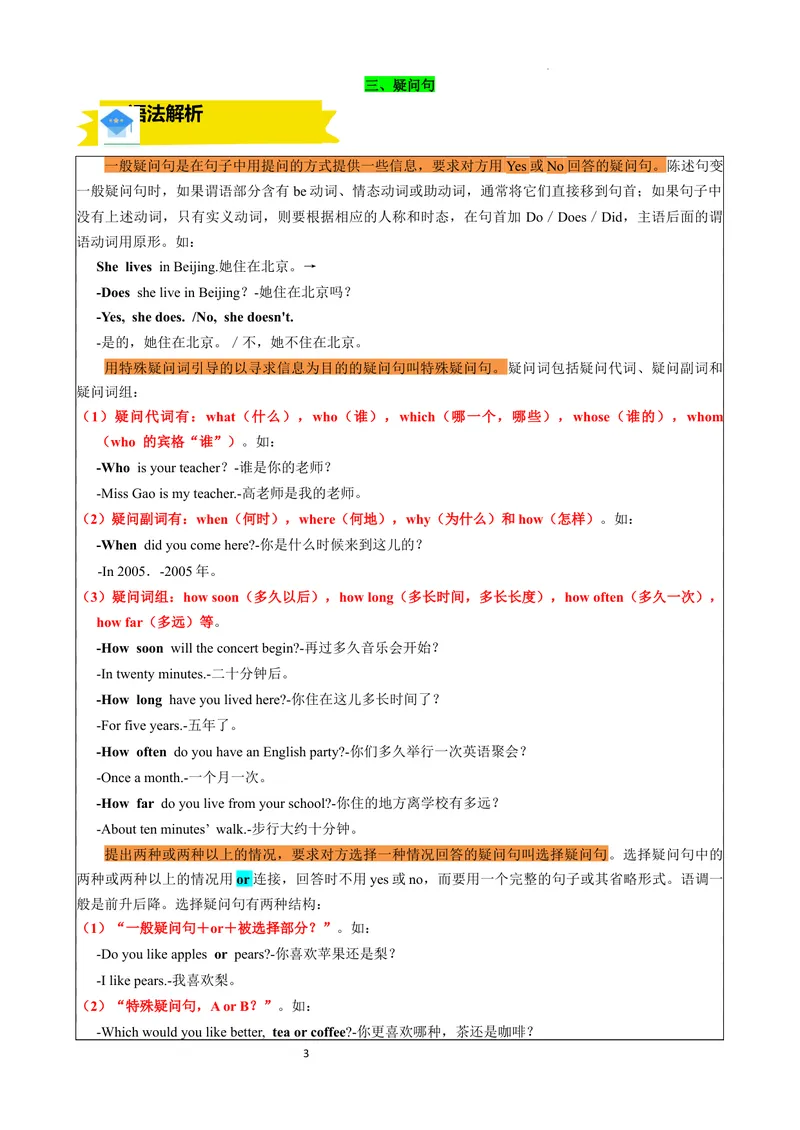
一般疑问句是在句子中用提问的方式提供一些信息,要求对方用Yes或No回答的疑问句。陈述句变
一般疑问句时,如果谓语部分含有be动词、情态动词或助动词,通常将它们直接移到句首;如果句子中
没有上述动词,只有实义动词,则要根据相应的人称和时态,在句首加 Do/Does/Did,主语后面的谓
语动词用原形。如:
She lives in Beijing.她住在北京。→
-Does she live in Beijing?-她住在北京吗?
-Yes, she does. /No, she doesn't.
-是的,她住在北京。/不,她不住在北京。
用特殊疑问词引导的以寻求信息为目的的疑问句叫特殊疑问句。疑问词包括疑问代词、疑问副词和
疑问词组:
(1)疑问代词有:what(什么),who(谁),which(哪一个,哪些),whose(谁的),whom
(who 的宾格“谁”)。如:
-Who is your teacher?-谁是你的老师?
-Miss Gao is my teacher.-高老师是我的老师。
(2)疑问副词有:when(何时),where(何地),why(为什么)和how(怎样)。如:
-When did you come here?-你是什么时候来到这儿的?
-In 2005.-2005年。
(3)疑问词组:how soon(多久以后),how long(多长时间,多长长度),how often(多久一次),
how far(多远)等。
-How soon will the concert begin?-再过多久音乐会开始?
-In twenty minutes.-二十分钟后。
-How long have you lived here?-你住在这儿多长时间了?
-For five years.-五年了。
-How often do you have an English party?-你们多久举行一次英语聚会?
-Once a month.-一个月一次。
-How far do you live from your school?-你住的地方离学校有多远?
-About ten minutes’ walk.-步行大约十分钟。
提出两种或两种以上的情况,要求对方选择一种情况回答的疑问句叫选择疑问句。选择疑问句中的
两种或两种以上的情况用or连接,回答时不用yes或no,而要用一个完整的句子或其省略形式。语调一
般是前升后降。选择疑问句有两种结构:
(1)“一般疑问句+or+被选择部分?”。如:
-Do you like apples or pears?-你喜欢苹果还是梨?
-I like pears.-我喜欢梨。
(2)“特殊疑问句,A or B?”。如:
-Which would you like better, tea or coffee?-你更喜欢哪种,茶还是咖啡?
3
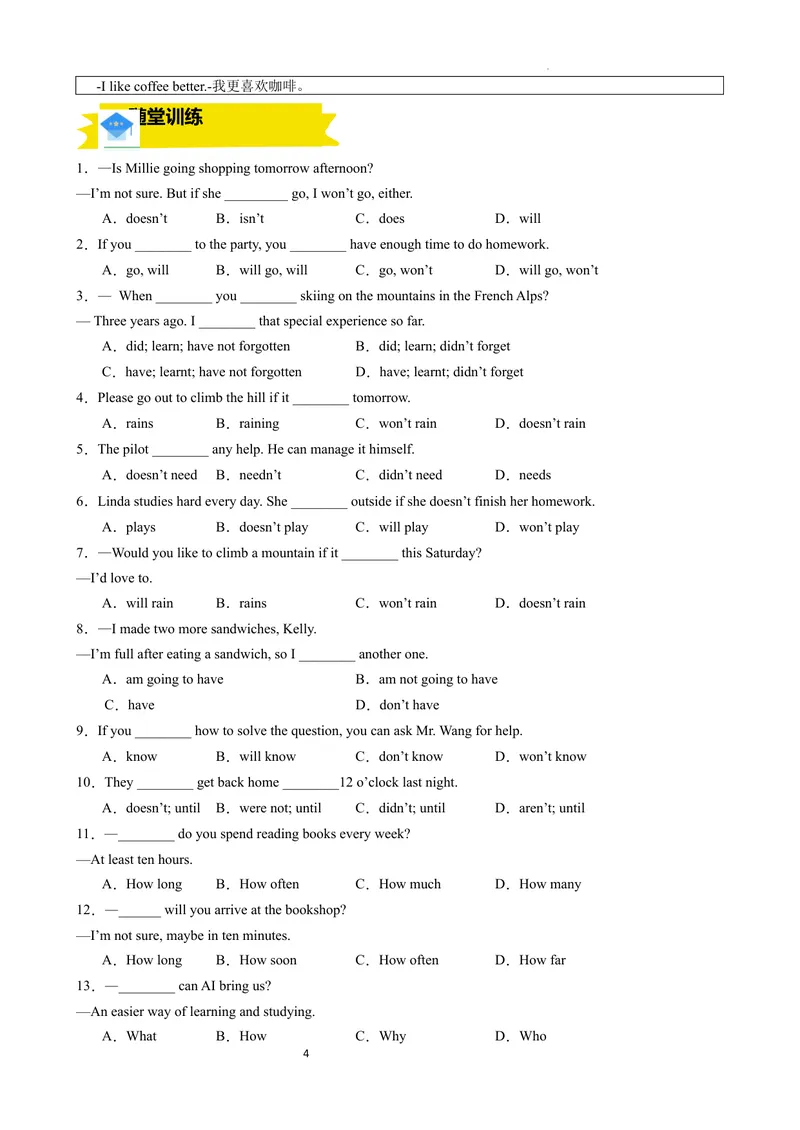
学科网(北京)股份有限公司-I like coffee better.-我更喜欢咖啡。
随堂训练
1.—Is Millie going shopping tomorrow afternoon?
—I’m not sure. But if she _________ go, I won’t go, either.
A.doesn’t B.isn’t C.does D.will
2.If you ________ to the party, you ________ have enough time to do homework.
A.go, will B.will go, will C.go, won’t D.will go, won’t
3.— When ________ you ________ skiing on the mountains in the French Alps?
— Three years ago. I ________ that special experience so far.
A.did; learn; have not forgotten B.did; learn; didn’t forget
C.have; learnt; have not forgotten D.have; learnt; didn’t forget
4.Please go out to climb the hill if it ________ tomorrow.
A.rains B.raining C.won’t rain D.doesn’t rain
5.The pilot ________ any help. He can manage it himself.
A.doesn’t need B.needn’t C.didn’t need D.needs
6.Linda studies hard every day. She ________ outside if she doesn’t finish her homework.
A.plays B.doesn’t play C.will play D.won’t play
7.—Would you like to climb a mountain if it ________ this Saturday?
—I’d love to.
A.will rain B.rains C.won’t rain D.doesn’t rain
8.—I made two more sandwiches, Kelly.
—I’m full after eating a sandwich, so I ________ another one.
A.am going to have B.am not going to have
C.have D.don’t have
9.If you ________ how to solve the question, you can ask Mr. Wang for help.
A.know B.will know C.don’t know D.won’t know
10.They ________ get back home ________12 o’clock last night.
A.doesn’t; until B.were not; until C.didn’t; until D.aren’t; until
11.—________ do you spend reading books every week?
—At least ten hours.
A.How long B.How often C.How much D.How many
12.—______ will you arrive at the bookshop?
—I’m not sure, maybe in ten minutes.
A.How long B.How soon C.How often D.How far
13.—________ can AI bring us?
—An easier way of learning and studying.
A.What B.How C.Why D.Who
4
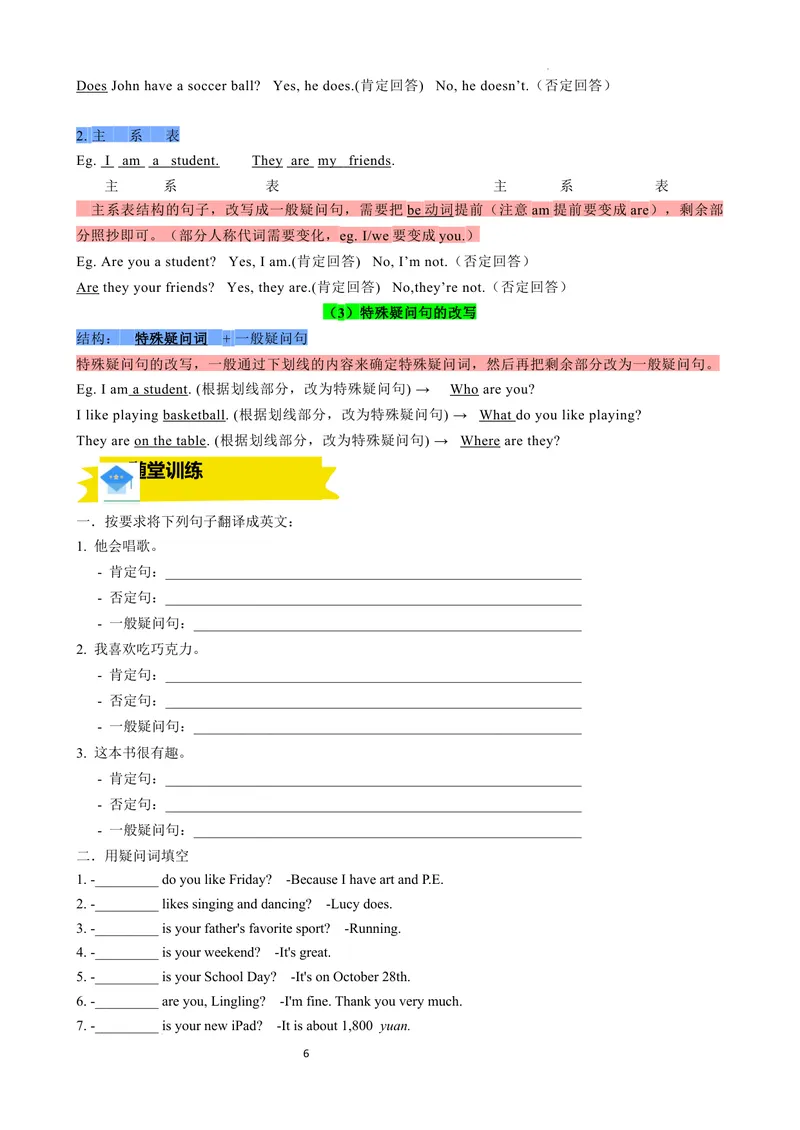
学科网(北京)股份有限公司14.—What ________ your Chinese teacher ________?
—She is kind and generous.
A.does; like B.is; like C.is; look like D.does; look
15.—________ is the girl with long straight hair?
—Lucy. She is my best friend.
A.Which B.Who C.What D.Where
16.—_________ does John go to record birds’ changes in their numbers?
—Every Sunday morning.
A.How long B.How much C.How soon D.How often
17.— I wonder ________ your father will come back?
— ________ two months.
A.how far; In B.how long; After C.how soon; In D.how often; After.
18.— Mike, ________ do you travel to Sanya from Beijing?
— By plane. It’s the fastest way.
A.how B.what C.why D.where
19.—________ do you usually have breakfast?
—I usually have breakfast at home.
A.When B.Where C.How D.Why
20.It’s really hot today. Why not ________ swimming together?
A.go B.goes C.to go D.going
四.句型转换
语法解析
(1)否定句改写
①主系表结构(有be动词am,is,are)改写否定句,一般通过在be动词后加not;
I am a student. → I am not a student.
②主谓宾结构(有谓语动词)改写否定句,一般通过动词前加don’t,doesn’t(三单的情况,同时原
本的谓语动词取消三单形式),didn’t(过去时);
Tom likes English.→ Tom doesn’t like English.
③句中有some要改成any;
I have some books.→ I don’t have any books.
(2)一般疑问句的改写
1. 主 谓 宾
Eg. I like English . John has a soccer ball .
主 谓 宾 主 谓 宾
主谓宾结构的句子,改写一般疑问句, 往往借助助动词 do ( 原形 ) , does ( 三单 ) , did ( 过去时 ) , 把助动
词提前,剩余部分照抄即可。(注意部分人称代词需要变化,eg. I/we要变成you.)
Eg. Do you like English? Yes, I do.(肯定回答) No, I don’t.(否定回答)
5
学科网(北京)股份有限公司Does John have a soccer ball? Yes, he does.(肯定回答) No, he doesn’t.(否定回答)
2. 主 系 表
Eg. I am a student . They are my friends .
主 系 表 主 系 表
主系表结构的句子,改写成一般疑问句,需要把 be 动词 提前(注意am提前要变成are),剩余部
分照抄即可。(部分人称代词需要变化,eg. I/we要变成you.)
Eg. Are you a student? Yes, I am.(肯定回答) No, I’m not.(否定回答)
Are they your friends? Yes, they are.(肯定回答) No,they’re not.(否定回答)
(3)特殊疑问句的改写
结构: 特殊疑问词 + 一般疑问句
特殊疑问句的改写,一般通过下划线的内容来确定特殊疑问词,然后再把剩余部分改为一般疑问句。
Eg. I am a student . (根据划线部分,改为特殊疑问句) → Who are you?
I like playing basketball . (根据划线部分,改为特殊疑问句) → What do you like playing?
They are on the table . (根据划线部分,改为特殊疑问句) → Where are they?
随堂训练
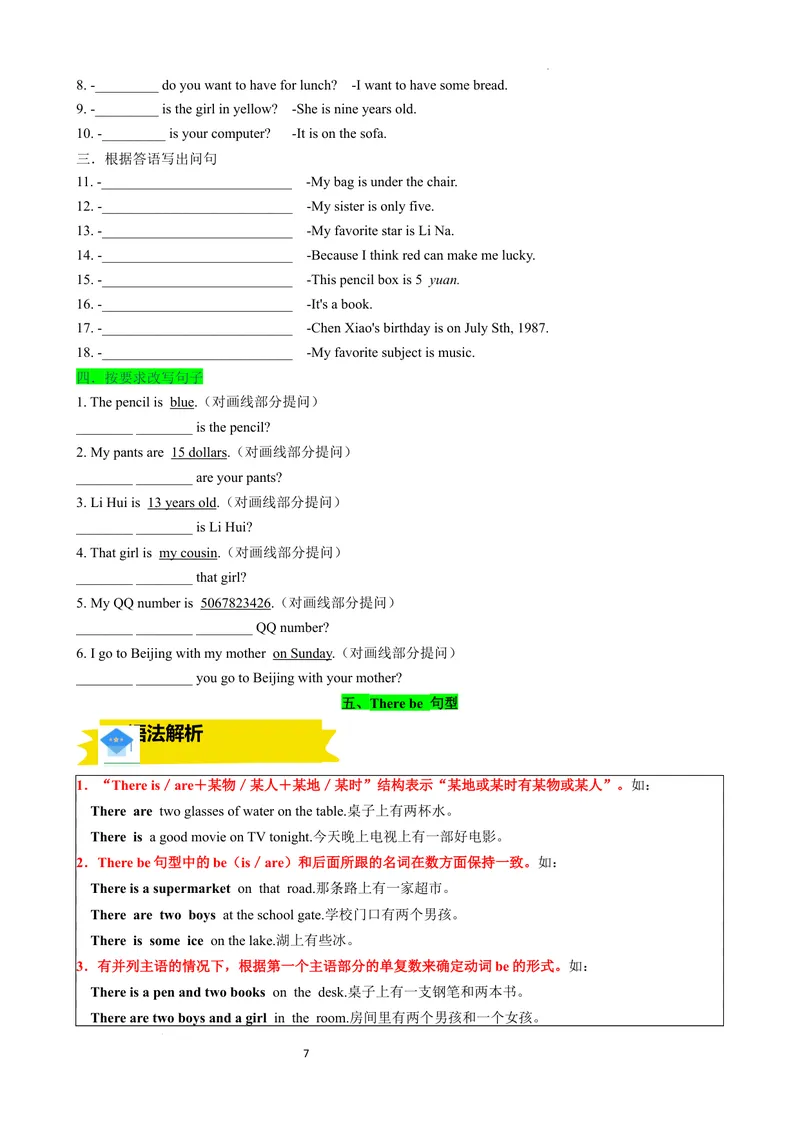
一.按要求将下列句子翻译成英文:
1. 他会唱歌。
- 肯定句:___________________________________________________________
- 否定句:___________________________________________________________
- 一般疑问句:_______________________________________________________
2. 我喜欢吃巧克力。
- 肯定句:___________________________________________________________
- 否定句:___________________________________________________________
- 一般疑问句:_______________________________________________________
3. 这本书很有趣。
- 肯定句:___________________________________________________________
- 否定句:___________________________________________________________
- 一般疑问句:_______________________________________________________
二.用疑问词填空
1. -_________ do you like Friday? -Because I have art and P.E.
2. -_________ likes singing and dancing? -Lucy does.
3. -_________ is your father's favorite sport? -Running.
4. -_________ is your weekend? -It's great.
5. -_________ is your School Day? -It's on October 28th.
6. -_________ are you, Lingling? -I'm fine. Thank you very much.
7. -_________ is your new iPad? -It is about 1,800 yuan.
6
学科网(北京)股份有限公司8. -_________ do you want to have for lunch? -I want to have some bread.
9. -_________ is the girl in yellow? -She is nine years old.
10. -_________ is your computer? -It is on the sofa.
三.根据答语写出问句
11. -___________________________ -My bag is under the chair.
12. -___________________________ -My sister is only five.
13. -___________________________ -My favorite star is Li Na.
14. -___________________________ -Because I think red can make me lucky.
15. -___________________________ -This pencil box is 5 yuan.
16. -___________________________ -It's a book.
17. -___________________________ -Chen Xiao's birthday is on July Sth, 1987.
18. -___________________________ -My favorite subject is music.
四.按要求改写句子
1. The pencil is blue.(对画线部分提问)
________ ________ is the pencil?
2. My pants are 15 dollars.(对画线部分提问)
________ ________ are your pants?
3. Li Hui is 13 years old.(对画线部分提问)
________ ________ is Li Hui?
4. That girl is my cousin.(对画线部分提问)
________ ________ that girl?
5. My QQ number is 5067823426.(对画线部分提问)
________ ________ ________ QQ number?
6. I go to Beijing with my mother on Sunday.(对画线部分提问)
________ ________ you go to Beijing with your mother?
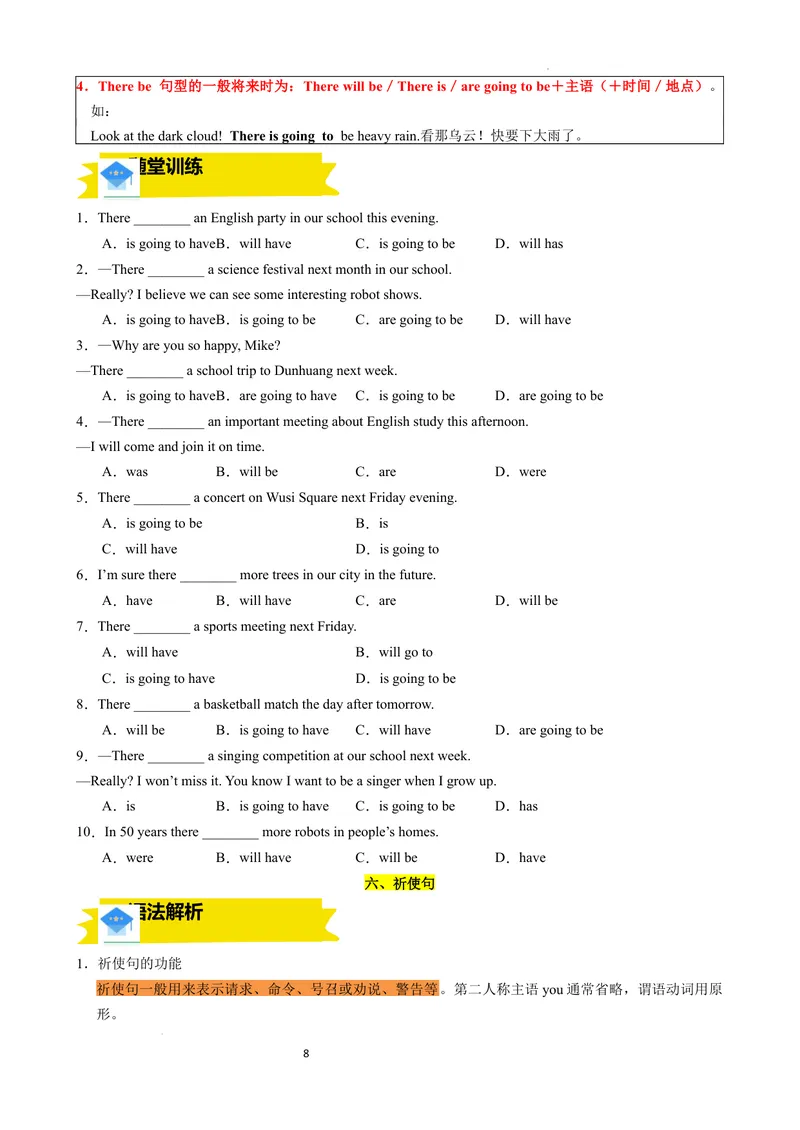
五、There be 句型
语法解析
1.“There is/are+某物/某人+某地/某时”结构表示“某地或某时有某物或某人”。如:
There are two glasses of water on the table.桌子上有两杯水。
There is a good movie on TV tonight.今天晚上电视上有一部好电影。
2.There be句型中的be(is/are)和后面所跟的名词在数方面保持一致。如:
There is a supermarket on that road.那条路上有一家超市。
There are two boys at the school gate.学校门口有两个男孩。
There is some ice on the lake.湖上有些冰。
3.有并列主语的情况下,根据第一个主语部分的单复数来确定动词be的形式。如:
There is a pen and two books on the desk.桌子上有一支钢笔和两本书。
There are two boys and a girl in the room.房间里有两个男孩和一个女孩。
7
学科网(北京)股份有限公司4.There be 句型的一般将来时为:There will be/There is/are going to be+主语(+时间/地点)。
如:
Look at the dark cloud! There is going to be heavy rain.看那乌云!快要下大雨了。
随堂训练
1.There ________ an English party in our school this evening.
A.is going to haveB.will have C.is going to be D.will has
2.—There ________ a science festival next month in our school.
—Really? I believe we can see some interesting robot shows.
A.is going to haveB.is going to be C.are going to be D.will have
3.—Why are you so happy, Mike?
—There ________ a school trip to Dunhuang next week.
A.is going to haveB.are going to have C.is going to be D.are going to be
4.—There ________ an important meeting about English study this afternoon.
—I will come and join it on time.
A.was B.will be C.are D.were
5.There ________ a concert on Wusi Square next Friday evening.
A.is going to be B.is
C.will have D.is going to
6.I’m sure there ________ more trees in our city in the future.
A.have B.will have C.are D.will be
7.There ________ a sports meeting next Friday.
A.will have B.will go to
C.is going to have D.is going to be
8.There ________ a basketball match the day after tomorrow.
A.will be B.is going to have C.will have D.are going to be
9.—There ________ a singing competition at our school next week.
—Really? I won’t miss it. You know I want to be a singer when I grow up.
A.is B.is going to have C.is going to be D.has
10.In 50 years there ________ more robots in people’s homes.
A.were B.will have C.will be D.have
六、祈使句
语法解析
1.祈使句的功能
祈使句一般用来表示请求、命令、号召或劝说、警告等。第二人称主语you通常省略,谓语动词用原
形。
8
学科网(北京)股份有限公司2.祈使句的基本结构
类别 肯定句 否定句
Do(原形)+... Don’t do(原形)+...
Do型
Read English aloud! Don’t talk in class!
Be+adj. Don’t + be +adj.
Be型
Be quiet! Don’t be late again!
Let 型 Let sb.+do... Let sb.+ not do...
Let me help
Let him not talk in class.
you.
No+doing/n.禁止·······
——
Never + do (原形)+...永远不要······
No/Never 型
No smoking. (= Don’t smoke.)
——
Never give up!
1.________ tea with me after work today, please. I have something important to tell you.
A.Drinking B.Drink C.To drink D.Drank
2.—Sandy, ________ photos in the museum. You’ll hurt the paintings!
—I’m sorry. I won’t do it again.
A.not take B.don’t take C.doesn’t take D.not to take
3.________ afraid to make a change in your life. It might be a new start for you.
A.Be B.Be not C.Not to be D.Don’t be
4.Kitty, please be careful, ________ you will make a mistake again.
A.and B.or C.so D.but
5.________ quiet, Peter. Your mother is writing a report.
A.Keep B.To keep C.Keeping D.Keeps
6.Please _________ hard and you’ll get good grades in this exam.
A.study B.to study C.studying D.studied
7._____随_ t堂he b训uil练ding quickly when the ground stops shaking in the earthquake.
A.Leave B.To leave C.Leaving D.Leaves
8.—Tom, it’s time ________ class.
—OK. Let’s ________.
A.for; going B.for; go C.to; go D.to; going
9.— Sandy, ________ others the secret, will you?
— Trust me. I’m your best friend.
A.don’t tell B.not to tell C.not telling D.no telling
9
学科网(北京)股份有限公司10.—Mum, what should I do now?
— ________ the fruit into small pieces, please.
A.Cut B.To cut C.Cutting D.Cuts
语法解析
10
学科网(北京)股份有限公司随堂训练
How time flies!
How+主语+谓语!
时间过得真快啊!
1.________ fighter plane, j-20, made in China, it flies!
A.How a fast B.What fast C.How fast a D.How fast
2.________ the boy is writing!
A.What quickly B.How quick C.How quickly D.What quick
3.—_________ good news it is! The UNESCO added Spring Festival to the Representative List of the
Intangible Cultural Heritage of Humanity (《人类非物质文化遗产代表作名录》).
—Yes, it is. Every Chinese is happy to hear it.
A.What a B.What C.How a D.How
4.________ interesting it is to play with the kid in the kindergarten!
A.What an B.What a C.What D.How
5.—You can buy the ticket through Damai App more cheaply.
—Thanks! ________ useful information!
A.What B.What a C.What an D.How
6.________ bad news it is and the students all look surprised when hearing it.
A.How B.How a C.What D.What a
7.______ great invention the abacus is!
A.How B.What C.What a D.What an
8.________ useful book it is! It can help us learn English better.
A.What B.What a C.What an D.How
9.—Evans had a big fight with his parent. The teacher advised him ________ a letter.
—________ good advice it is!
A.to write; What a B.writing; What a
C.writing; How a D.to write; What
10.—________ fine day today! Why not go hiking?
—Good idea!
A.What an B.How C.What a D.What
语法解析
11
学科网(北京)股份有限公司一、语法一致原则
主语和谓语通常在语法形式上保持一致,即主语是单数形式时,谓语动词也用单数形式;主语是复数
形式时,谓语动词也用复数形式。
1.当and或both... and...连接并列主语时,谓语动词用复数形式。如:
Tom and Mike are good friends.汤姆和迈克是好朋友。
Both Lucy and Lily are students.露西和莉莉都是学生。
2.复合不定代词 anyone,anything,someone,something,everybody,everything,nobody,nothing 等
作主语时,谓语动词用单数形式。如:
Is there anything wrong with your bike?你的自行车出什么故障了吗?
3.动词不定式或动词的-ing形式作主语时,谓语动词用单数形式。如:
Reading is learning.读书就是学习。
4.“A+with/along with/together with/as wellas+B”结构作主语时,谓语动词的数由前面的A的单复数形式决
定。如:
Mr.Green with his wife and two daughters is coming to Beijing.格林先生将和他的夫人及两个女儿一起来北
京。
二、意义一致原则
意义一致又叫概念一致,即谓语动词用单数形式还是复数形式要看主语所表达的概念。
谓语动
类别 例句
词形式
由and连接的两个名词作主语,如 The singer and dancer has been invited to the party.
单数形式
果是指同一人(and 后面无冠词) 那位歌唱家兼舞蹈家被邀请参加聚会了。
表示金钱、价格、时间、长度等的
Three years is a long time. 三年是一段很长的时
复数名词或词组作主语时,一般看 单数形式
间。
作一个整体
集体名
表示整体概念 单数形式 His family is going to move.他家要搬走了。
词,如
family,
team,class 表示各个成员 复数形式 His family are all eating.他全家人都在吃饭。
等作主语
The police are helping a girl look for her mother.警察
police,cattle 等名词作主语时 复数形式
正在帮助一个女孩找她的妈妈。
三、就近一致原则
12
学科网(北京)股份有限公司就近一致原则是指谓语动词的数要与和它紧邻的名词或代词的人称和数保持一致。
1.either...or..., neither...nor..., not only...but (also) ..., not...but...或or连接两个并列主语时,谓语动词与离它较
近的主语在人称和数上保持一致。如:
Not only my parents but also I am looking forward to meeting my uncle.不仅是我父母,我也盼望看到我叔
叔。
2.There be 句型中的be动词常与离它近的主语在数上保持一致。如:
There is a table and three chairs in Tom's room.在汤姆的房间有一张桌子和三把椅子。
随堂训练
1.Everyone in our class ________ her.
A.like B.likes C.to like D.liking
2.It’s surprising that only ________ of news online ________true.
A.twenty percent, is B.twenty percents, are
C.twenty percent, are D.twenty percents, is
3.The boy ________ round glasses ________ my classmate.
A.with; is B.with; are C.in; is D.wears; is
4.The number of the volunteers in our city ________ about 1500.
A.is B.am C.are D.be
5.Not only Tim but also Sue and I ________ interested in DIY. We often make nice things.
A.am B.are C.was D.were
6.Not only my sister but also I ________ good at drawing.
A.is B.am C.are D.were
7.—________ honey do you need in your salad?
—A little. Too much sweet food ________ bad for health.
A.How much; is B.How many; am
C.How much; are D.How many; be
8.________ Bob ________ Jim are going to watch the 9th Asian Winter Games in Harbin next year.
A.Neither; nor B.Not only; but also C.Both; and D.Either; or
9.Forty percent of the students ________ going to have lunch in that restaurant, but there is little food
________.
A.is; left B.is; leaving C.are; left D.are; leaving
10.Two-thirds of the apple ________ bad, so we have to throw it away.
A.is B.are C.has D.have
综合训练
一.语法选择
When it becomes colder and colder and you see people sneezing and getting a runny(流鼻涕的) nose, you
13
学科网(北京)股份有限公司should think about getting vaccinated (接种疫苗) to protect yourself against the flu. Below are some commonly
asked questions about this illness. 1 on and you'll find out how to prevent yourself from getting it.
Q: 2 I need to be vaccinated against the flu?
A:The Centers for Disease Control and Prevention in the US recommends that everyone aged 6 months and older
receive a flu vaccine.
Q: 3 does a flu shot (注射) work?
A:The formula(配方) in the shot helps your immune system(免疫系统) to produce antibodies(抗体). The
antibodies work against the three most common flu viruses.
Q:Do I really need a vaccine every year?
A: 4 . This is because public health officials look at which of the flu viruses will be the most common every
year. Then they set a formula to work against those special viruses. So the formula can change from year to year.
Q: 5 does the flu season start?
A:It usually begins in October and can last through May. But people don't know when the flu will strike, and
seasonal peaks may be different in different areas.
Q:I hate needles (针)!I can take a flu pill instead, 6 I?
A:Unfortunately, you can't! But now, there is a new, less scary method. It uses a new needle, about 90 percent
smaller than the standard one. It goes just under the skin rather than deep into the muscle, causing less pain later.
People aged from 18 to 64 can have this kind of vaccine.
Q: 7 are the risks(风险)?
A:Serious problems from flu vaccines seldom happen. Common mild problems include:soreness or redness where
the shot was given, a fever, a headache, and a cough. Allergic (过敏的) reaction symptoms include:difficult
breathing, a fast heart rate and hives (荨麻疹).
Q: 8 dangerous it seems! What should people do if such problems happen?
A:People with severe allergies, especially to eggs, should talk to their doctors before getting a shot.
1.A.Read B.To read C.Readed D.Reading
2.A.Do B.Does C.Are D.Did
3.A.What B.How C.Why D.When
4.A.Yes, I do B.No, I don't
C.Yes, you do D.No, you don't
5.A.Where B.When C.Which D.Why
6.A.can B.can't C.do D.don't
7.A.What B.How C.When D.Where
8.A.What B.What a C.How D.How a
二.短文填空
One day, I wanted my father to get some fruit for me.So I said to my father, “Dad, 1 here!” When my
dad heard me, he came over right away. However, my mom said to me, “ 2 say it that way. Say it more
politely.”
“I didn't want to.” I replied.“If you don't say it politely, then 3 watching TV from now on!” my mom
said angrily.
14
学科网(北京)股份有限公司4 sad I was when I heard this! Then my mom said,“ 5 you want others to be polite to you? If so,
you should be polite to others too.”
Indeed, we should be polite, or it might make others feel uncomfortable.
1. 2. 3. 4. 5.
15
学科网(北京)股份有限公司