文档文本内容
人教版八上英语 讲义
Unit 7 When Tomorrow Comes
一、语法考点
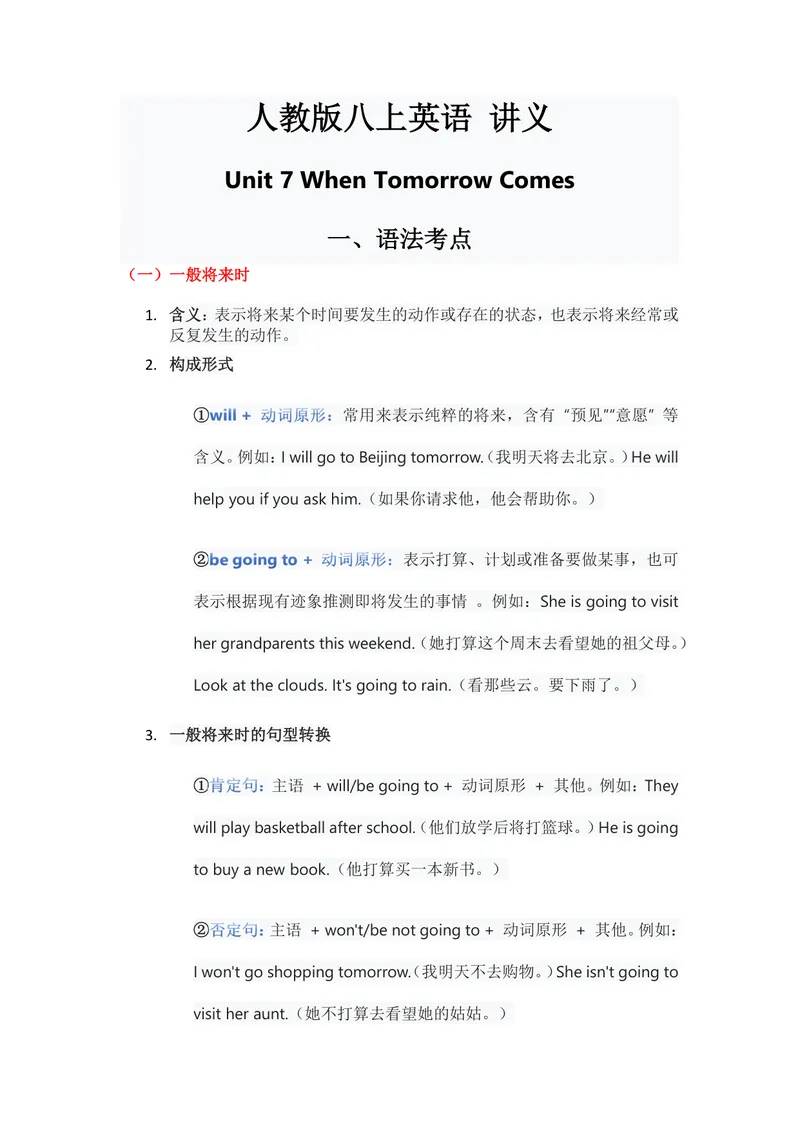
(一)一般将来时
1. 含义:表示将来某个时间要发生的动作或存在的状态,也表示将来经常或
反复发生的动作。
2. 构成形式
① 常用来表示纯粹的将来,含有 预见 意愿 等
“ ”“ ”
含义。例如: (我明天将去北京。)
Iwill go toBeijing tomorrow. He will
(如果你请求他,他会帮助你。)
help you if you ask him.
② 表示打算、计划或准备要做某事,也可
表示根据现有迹象推测即将发生的事情 。例如:
She is going to visit
(她打算这个周末去看望她的祖父母。)
hergrandparentsthisweekend.
(看那些云。要下雨了。)
Look at the clouds. It's going to rain.
3. 一般将来时的句型转换
① 主语 动词原形 其他。例如:
+will/be goingto+ + They
(他们放学后将打篮球。)
will playbasketballafter school. He isgoing
(他打算买一本新书。)
to buy a new book.
② 主语 动词原形 其他。例如:
+ won't/benotgoingto+ +
(我明天不去购物。)
Iwon'tgo shopping tomorrow. Sheisn't going to
(她不打算去看望她的姑姑。)
visit her aunt.③ 主语 动词原形 其他?肯定回答: 主
Will + + + Yes,
语 否定回答: 主语 例如:
+ will. No, + won't. Will you go to the
(你明天会去公园吗?) (是的,我会去。)
parktomorrow? Yes, Iwill.
(不,我不会去。)
No, I won't.
④ 特殊疑问词 主语 动词原形 其他?特
+ will + + +
殊疑问词 主语 动词原形 其他?例如:
+ be + + going to + +
(你明天打算做什么?)
What will you do tomorrow? Where are you
(你打算去哪里参观?)
going to visit?
(二) 句型的一般将来时
There be
1. 结构: There will be... 或 There is/are going to be... ,表示 “ 将会有 ……” 。
2. 区别: Therewillbe 更强调客观上将来会有; Thereis/are goingtobe 表
示根据计划、安排或迹象推测将来会有 。例如:
There willbea meeting
(明天将会有一个会议。)
tomorrow. Therearegoingtobemoretrees in
(我们学校将会有更多的树。)
our school.
3. 句型转换
例如:
There won't be.../ There isn't/aren't going to be...
(今晚不会有派对。)
Therewon't bea party tonight. Therearen'tgoing
(桌子上不会有任何书。)
to be any books on the desk.
例如:
Will there be...? / Is/Are there going to be...?
(下周会有运动会吗?)
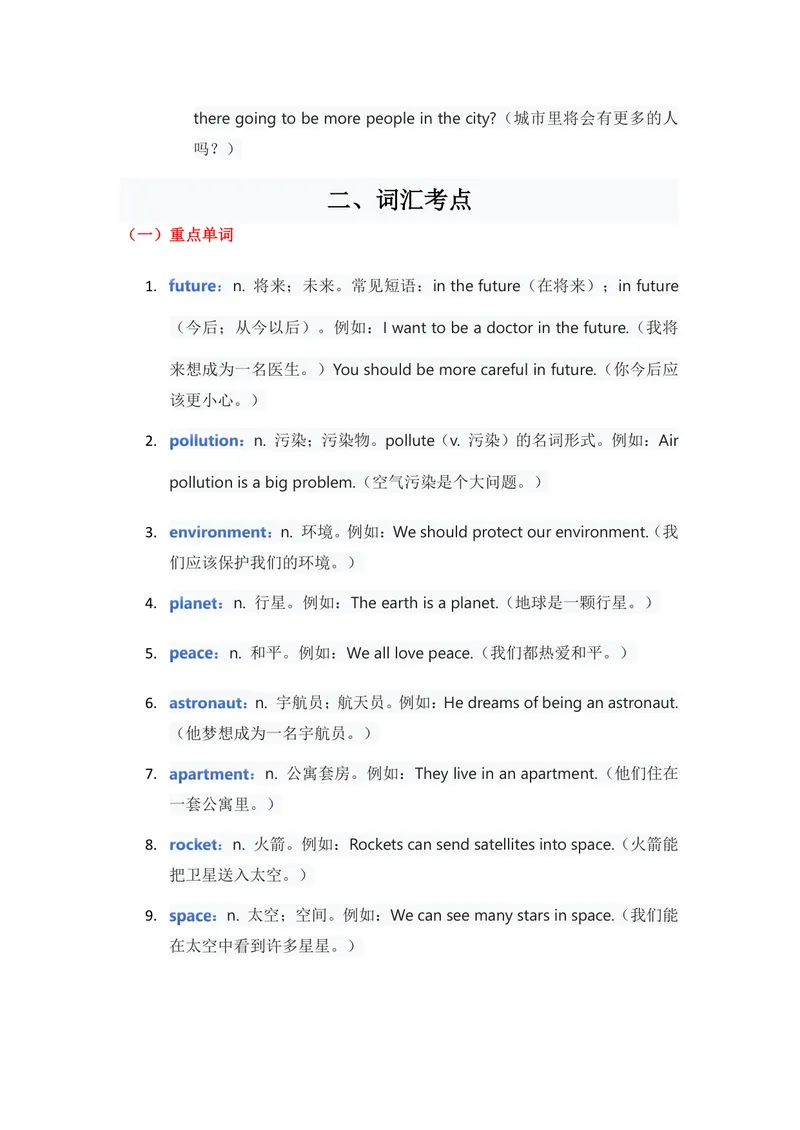
Will therebea sports meeting nextweek? Are(城市里将会有更多的人
there going to be more people in the city?
吗?)
二、词汇考点
(一)重点单词
1. n. 将来;未来。常见短语: in the future (在将来); in future
(今后;从今以后)。例如: (我将
I want to be a doctor in the future.
来想成为一名医生。) (你今后应
You should be more careful in future.
该更小心。)
2. n. 污染;污染物。 pollute ( v. 污染)的名词形式。例如: Air
(空气污染是个大问题。)
pollution is a big problem.
3. n. 环境。例如: Weshould protect ourenvironment. (我
们应该保护我们的环境。)
4. n. 行星。例如: The earth is a planet. (地球是一颗行星。)
5. n. 和平。例如: We all love peace. (我们都热爱和平。)
6. n. 宇航员;航天员。例如: Hedreamsofbeing an astronaut.
(他梦想成为一名宇航员。)
7. n. 公寓套房。例如: They live in an apartment. (他们住在
一套公寓里。)
8. n. 火箭。例如: Rocketscan send satellitesinto space. (火箭能
把卫星送入太空。)
9. n. 太空;空间。例如: Wecan see manystars in space. (我们能
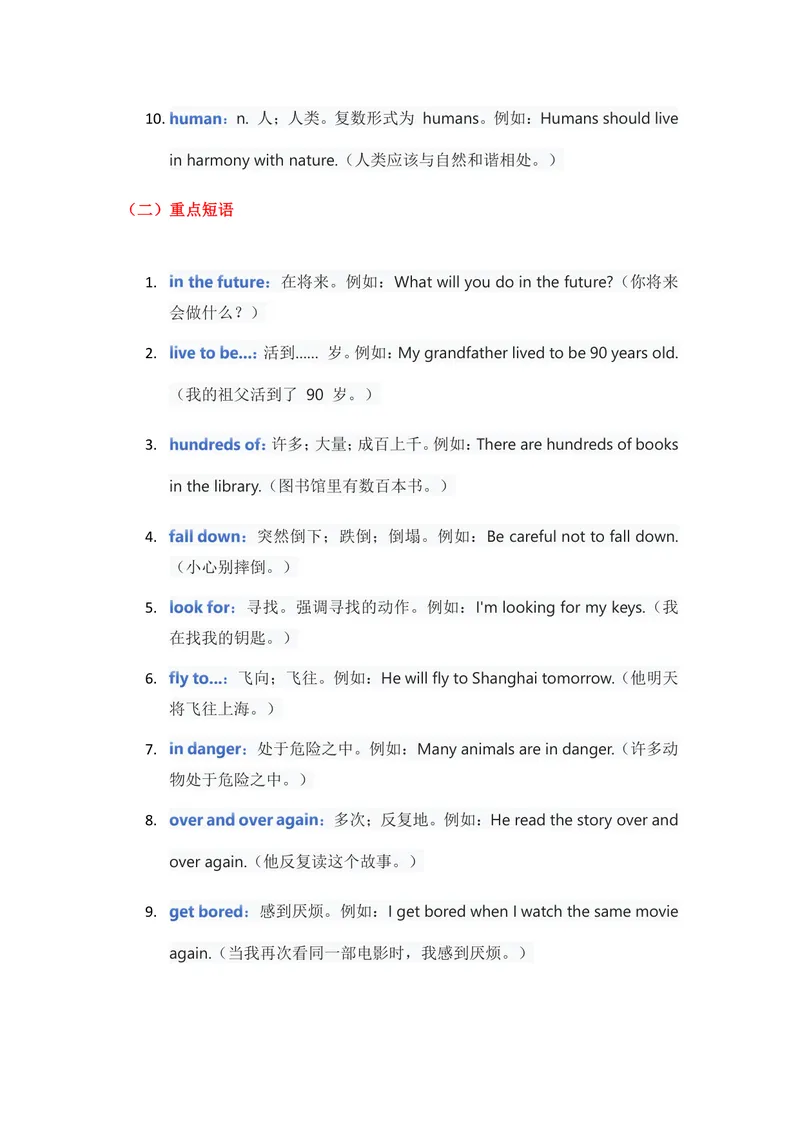
在太空中看到许多星星。)10. n. 人;人类。复数形式为 humans 。例如: Humansshouldlive
(人类应该与自然和谐相处。)
in harmony with nature.
(二)重点短语
1. 在将来。例如: What will you do in the future? (你将来
会做什么?)
2. 活到 …… 岁。例如: Mygrandfather livedto be90 years old.
(我的祖父活到了 岁。)
90
3. 许多;大量;成百上千。例如: Therearehundredsofbooks
(图书馆里有数百本书。)
in the library.
4. 突然倒下;跌倒;倒塌。例如: Be careful not to fall down.
(小心别摔倒。)
5. 寻找。强调寻找的动作。例如: I'm looking for my keys. (我
在找我的钥匙。)
6. 飞向;飞往。例如: Hewill fly toShanghaitomorrow. (他明天
将飞往上海。)
7. 处于危险之中。例如: Manyanimalsareindanger. (许多动
物处于危险之中。)
8. 多次;反复地。例如: He readthestory over and
(他反复读这个故事。)
over again.
9. 感到厌烦。例如: I get bored when I watch thesame movie
(当我再次看同一部电影时,我感到厌烦。)
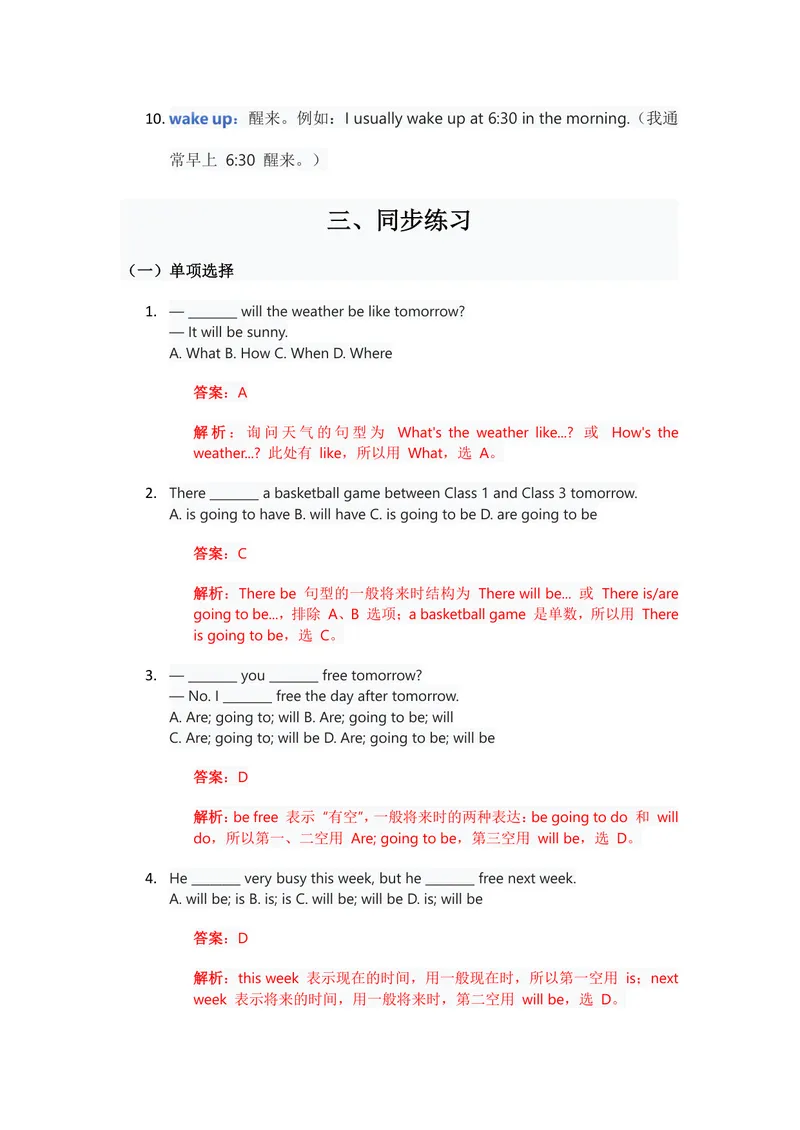
again.10. 醒来。例如: I usually wake up at 6:30 in the morning. (我通
常早上 醒来。)
6:30
三、同步练习
(一)单项选择
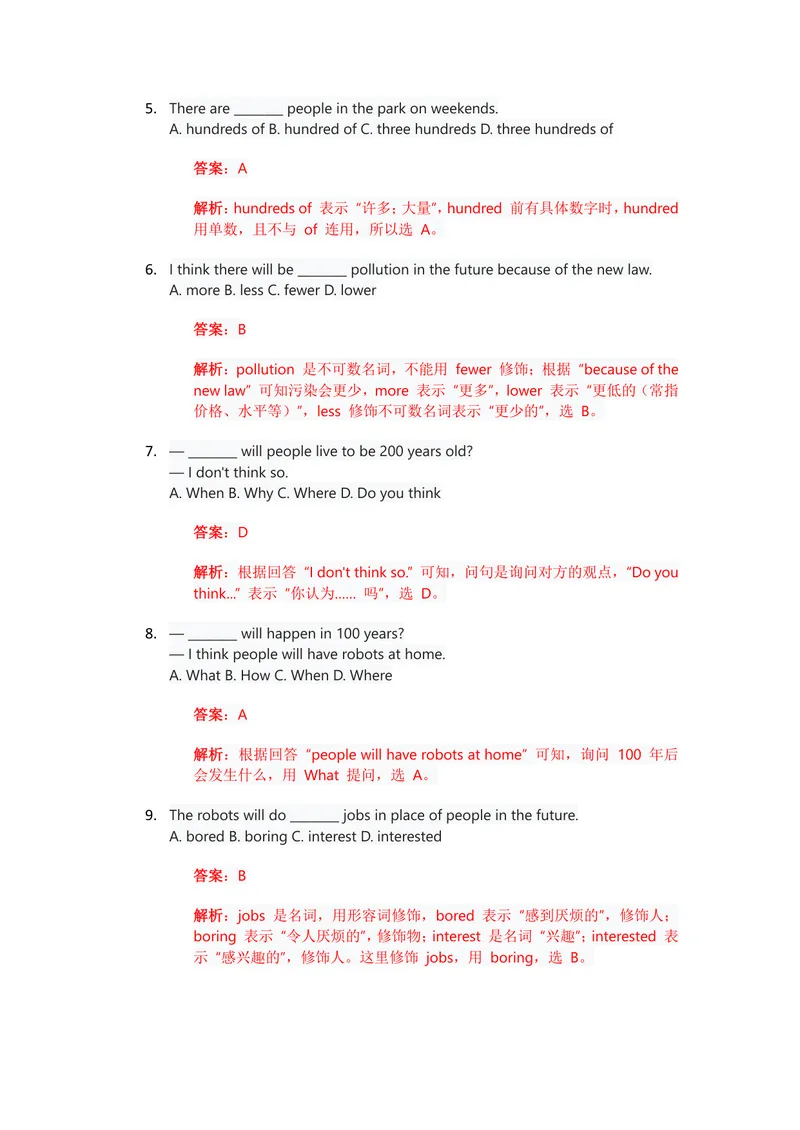
1. —________will theweatherbeliketomorrow?
—Itwill besunny.
A. WhatB. HowC. WhenD.Where
答案:A
解析:询问天气的句型为 What's the weather like...? 或 How's the
weather...? 此处有 like,所以用 What,选 A。
2. There________ abasketballgamebetweenClass1 andClass3 tomorrow.
A. isgoingtohaveB.will haveC. isgoingtobeD.aregoingtobe
答案:C
解析:There be 句型的一般将来时结构为 There will be... 或 There is/are
goingtobe...,排除 A、B 选项;abasketballgame 是单数,所以用 There
isgoingtobe,选 C。
3. —________you________freetomorrow?
—No. I________ freethedayafter tomorrow.
A. Are; goingto; will B.Are; goingto be; will
C. Are;goingto;will beD.Are; goingtobe; will be
答案:D
解析:befree 表示 “有空”,一般将来时的两种表达:begoingtodo 和 will
do,所以第一、二空用 Are; goingtobe,第三空用 will be,选 D。
4. He________very busythisweek, buthe________freenextweek.
A. will be; isB.is; is C.will be;will beD.is; will be
答案:D
解析:this week 表示现在的时间,用一般现在时,所以第一空用 is;next
week 表示将来的时间,用一般将来时,第二空用 will be,选 D。5. Thereare________peopleintheparkonweekends.
A. hundredsofB.hundredofC.threehundredsD.threehundredsof
答案:A
解析:hundredsof 表示 “许多;大量”,hundred 前有具体数字时,hundred
用单数,且不与 of 连用,所以选 A。
6. Ithink therewill be________pollutioninthefuturebecauseofthenew law.
A. moreB. lessC.fewer D.lower
答案:B
解析:pollution 是不可数名词,不能用 fewer 修饰;根据 “becauseofthe
newlaw” 可知污染会更少,more 表示 “更多”,lower 表示 “更低的(常指
价格、水平等)”,less 修饰不可数名词表示 “更少的”,选 B。
7. —________will peopleliveto be200 yearsold?
—Idon'tthink so.
A. WhenB. WhyC.WhereD.Doyouthink
答案:D
解析:根据回答 “Idon'tthinkso.” 可知,问句是询问对方的观点,“Doyou
think...” 表示 “你认为…… 吗”,选 D。
8. —________will happenin 100years?
—Ithink peoplewill haverobotsathome.
A. WhatB. HowC. WhenD.Where
答案:A
解析:根据回答 “people will have robots athome” 可知,询问 100 年后
会发生什么,用 What 提问,选 A。
9. Therobotswill do________ jobsinplaceofpeopleinthefuture.
A. boredB. boringC. interestD.interested
答案:B
解析:jobs 是名词,用形容词修饰,bored 表示 “感到厌烦的”,修饰人;
boring 表示 “令人厌烦的”,修饰物;interest 是名词 “兴趣”;interested 表
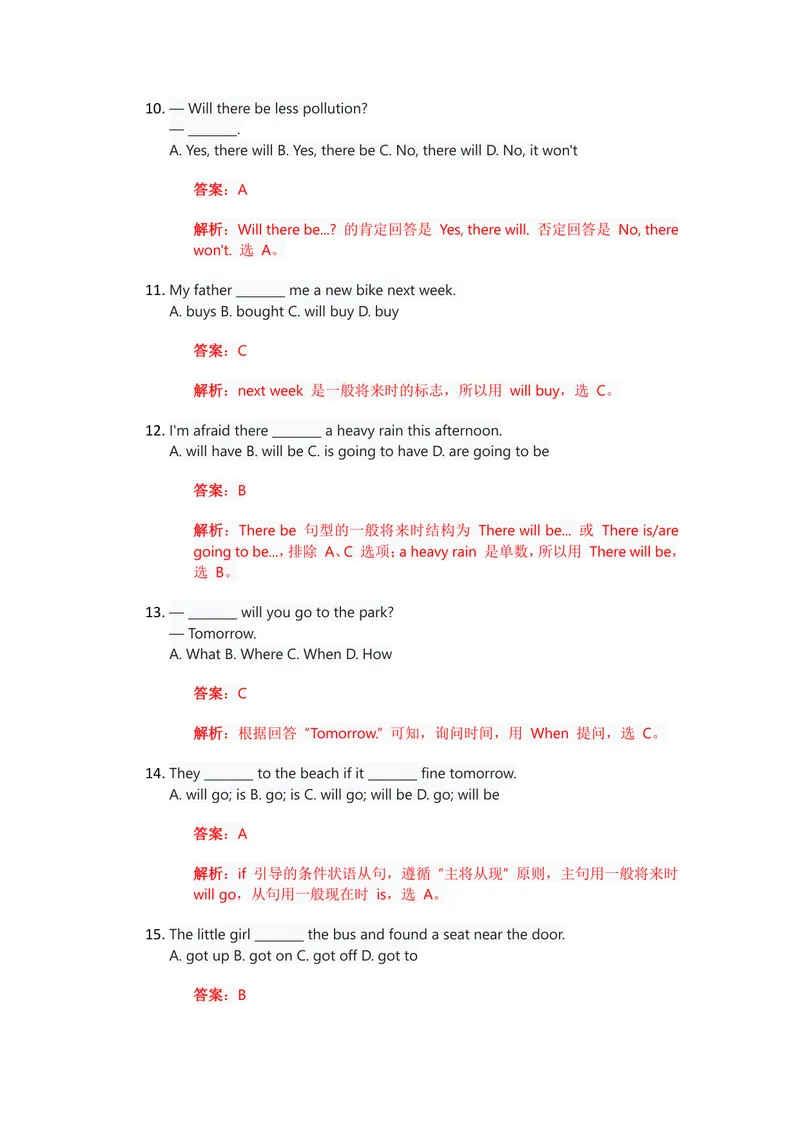
示 “感兴趣的”,修饰人。这里修饰 jobs,用 boring,选 B。10.—Willtherebelesspollution?
—________.
A. Yes,therewill B.Yes, therebeC. No,therewill D.No, itwon't
答案:A
解析:Willtherebe...? 的肯定回答是 Yes,therewill. 否定回答是 No,there
won't. 选 A。
11.Myfather ________mea newbikenextweek.
A. buysB.boughtC. will buyD.buy
答案:C
解析:next week 是一般将来时的标志,所以用 will buy,选 C。
12.I'mafraid there________a heavyrainthisafternoon.
A. will haveB.will beC. isgoingtohaveD.aregoingtobe
答案:B
解析:There be 句型的一般将来时结构为 There will be... 或 There is/are
goingtobe...,排除 A、C 选项;aheavyrain 是单数,所以用 Therewillbe,
选 B。
13.—________will yougotothe park?
—Tomorrow.
A. WhatB. WhereC.WhenD.How
答案:C
解析:根据回答 “Tomorrow.” 可知,询问时间,用 When 提问,选 C。
14.They________ tothebeachifit ________finetomorrow.
A. will go; isB.go; isC. will go; willbe D.go;will be
答案:A
解析:if 引导的条件状语从句,遵循 “主将从现” 原则,主句用一般将来时
will go,从句用一般现在时 is,选 A。
15.Thelittle girl________thebusandfounda seatnear thedoor.
A. gotupB.gotonC.gotoff D.gotto
答案:B解析:getup 意为 “起床”;geton 意为 “上车”;getoff 意为 “下车”;get
to 意为 “到达”。根据 “founda seatnear thedoor” 可知是上车,选 B。
16.—Whatareyougoingto do thisweekend?
—I________yet.
A. haven'tdecided B.won'tdecide C.didn'tdecide D.don'tdecide
答案:A
解析:yet 常与现在完成时连用,现在完成时的结构为 have/has+ 过去分
词,否定形式为 haven't/hasn't+ 过去分词,所以选 A。
17.—________will yourfather comeback?
—Intwo days.
A. HowlongB.How soonC. HowoftenD.Howfar
答案:B
解析:How long 询问时间长度或物体长度;Howsoon 询问 “多久以后”,
常用于一般将来时,回答用 “in+ 一段时间”;Howoften 询问频率;Howfar
询问距离。根据回答 “In twodays.” 可知用 Howsoon,选 B。
18.There________ afootball matchonTV thisevening.
A. will haveB.isgoingtobeC. hasD.isgoingtohave
答案:B
解析:There be 句型的一般将来时结构为 There will be... 或 There is/are
goingtobe...,排除 A、C、D 选项,选 B。
19.Ithink robots________do somejobsbetter thanhumansinthefuture.
A. canB.will canC. will beabletoD.areableto
答案:C
解析:inthefuture 表示将来,用一般将来时,can 没有将来时态,beable
to 有将来时态 will beableto,选 C。
20.—________you________totheparty tomorrow?
—Yes,Iam.
A. Will; go B.Are; goingC. Do; goD.Did;go
答案:B
解析:根据回答 “Yes, I am.” 可知,问句是用 begoingto 结构的一般疑问
句,选 B。(二)用所给单词的正确形式填空
1. There________ (be)a meetingtomorrowafternoon.
答案:will be/isgoingtobe
解析:tomorrow afternoon 是一般将来时的标志,Therebe 句型的一般将
来时结构为 Therewillbe... 或 Thereis/aregoingtobe...,ameeting 是单
数,所以用 will be 或 isgoingtobe。
2. We________ (nothave) anyclassesnextweek.
答案:won't have/aren'tgoingtohave
解析:nextweek 是一般将来时的标志,一般将来时的否定句结构为 willnot
(won't) + 动词原形或 benotgoingto+ 动词原形,主语是 We,所以
用 won'thave 或 aren'tgoingtohave。
3. Lookattheclouds. It________ (rain).
答案:is goingto rain
解析:根据 “Look at the clouds.” 可知,根据迹象推测要下雨了,用 be
goingto 结构,it 是第三人称单数,be 动词用 is,所以填 isgoingtorain。
4. Myfather ________(fly) toBeijingtomorrow.
答案:will fly/is goingtofly
解析:tomorrow 是一般将来时的标志,用 will+ 动词原形或 begoingto
+ 动词原形,主语是 Myfather,所以用 will fly 或 isgoingtofly。
5. Ithink he________(be) afamoussinger inthefuture.
答案:will be
解析:inthefuture 是一般将来时的标志,用 will+ 动词原形,所以填 will
be。
6. Therearemany________(planet)intheuniverse.
答案:planets
解析:many 修饰可数名词复数,planet 的复数形式是 planets。
7. People________ (live)tobe200 yearsoldinthefuture.答案:will live
解析:inthefuture 是一般将来时的标志,用 will+ 动词原形,所以填 will
live。
8. Robotscando many________(danger) jobsforhumans.
答案:dangerous
解析:jobs 是名词,用形容词修饰,danger 的形容词形式是 dangerous。
9. Mymotheroftenmakesme________(clean) myroom.
答案:clean
解析:makesb. dosth. 表示 “让某人做某事”,所以用 clean 的原形。
10.Weshouldtry ourbest to savethe ________(environmentally).
答案:environment
解析:the 后接名词,environmentally 是副词,其名词形式是 environment。
11.There________ (notbe) morepollutioninthefuture.
答案:won't be/isn'tgoingtobe
解析:inthefuture 是一般将来时的标志,Therebe 句型的一般将来时否定
句结构为 There won't be... 或 There isn't/aren't going to be...,pollution
是不可数名词,所以用 won'tbe 或 isn'tgoingtobe。
12.Thechildren________(play) footballintheparktomorrow.
答案:will play/aregoingto play
解析:tomorrow 是一般将来时的标志,所以用 will play 或 are going to
play 表示 “孩子们明天将在公园踢足球” 。
13.I'mlookingforwardto________ (hear) fromyou.
答案:hearing
解析:lookforwardtodoingsth. 是固定短语,意为 “期待做某事”,所以用
hear 的动名词形式 hearing。
14.Mysister wantstobea ________(science) whenshegrowsup.答案:scientist
解析:根据语境,此处表示 “科学家”,science 的表示职业的名词形式是
scientist。
15.It'seasyfor robots________(do)such jobs.
答案:to do
解析:It's+ 形容词 +forsb./sth.+todosth. 是固定句型,意为 “对某人 /
某物来说做某事是…… 的”,所以用 todo。
16.Therearealotof________ (factory) inthiscity.
答案:factories
解析:a lotof 后接可数名词复数,factory 的复数形式是 factories。
17.We________ (build)a newschoolinour townnextyear.
答案:will build/aregoingto build
解析:next year 是一般将来时的标志,所以用 will build 或 are going to
build。
18.Thelittle girlisvery kindandshealways________ (help)others.
答案:helps
解析:根据 always 可知,句子时态是一般现在时,主语 she 是第三人称
单数,动词 help 要用第三人称单数形式 helps。
19.If it________ (notrain)tomorrow,wewillgo to thepark.
答案:doesn't rain
解析:if 引导的条件状语从句,遵循 “主将从现” 原则,主句用一般将来时,
从句用一般现在时,it 是第三人称单数,rain 是实义动词,否定句要借助助
动词 doesn't,后接动词原形 rain。
20.My father ________ (drive) to work every day, but he ________ (take) a bus
tomorrow.
答案:drives; will take/isgoingtotake解析:根据 every day 可知,前半句用一般现在时,主语 My father 是第
三人称单数,动词 drive 要用第三人称单数形式 drives;根据 tomorrow 可
知,后半句用一般将来时,所以用 will take 或 isgoingtotake。
(三)阅读理解
未来的生活
In the future, life will be very different. People will live in houses that can
change colors and shapes according to the weather and their mood. These
houses will be very comfortable and energy - saving. They will use solar energy
to heat and cool the rooms, so there will be less pollution.
Transportation will also change a lot. People won't drive cars as often as
they do now. Instead, they will use flying cars or high - speed trains. Flying cars
垂直地
will be able to take off and land vertically ( ), so they won't need long
runways like airplanes. High - speed trains will be much faster than the trains
we have now, and they will be more comfortable.
In the future, people will work at home more often. They will use
computers and the Internet to communicate with their colleagues. Schools will
also be different. Students won't need to go to school every day. They can
study at home through online courses. They will be able to choose the courses
they like and learn at their own pace.
However, there will also be some problems. For example, with more and
more robots doing jobs, some people may lose their jobs. And if people don't
go out often, they may become less healthy. So, we need to find ways to solve
these problems to make the future life better.1. ( )Whatcanhousesdo inthefutureaccordingtothepassage?
A. Theycanonly changecolors. B.Theycan onlychangeshapes.
C. Theycanchangecolorsandshapes. D.They can'tchangeatall.
答案:C
解析:根据文中 “People will live in houses that can change colors and
shapes according to the weather and their mood.” 可知,未来的房子能根
据天气和人们的心情改变颜色和形状,所以选 C。
2. ( )Whatkindofenergywill housesusein thefuture?
A. Windenergy. B. Solar energy. C. Waterenergy. D.Coalenergy.
答案:B
解析:从文中 “Theywillusesolarenergytoheatandcooltherooms” 可知,
未来房子将使用太阳能,所以选 B。
3. ( )Howwill transportationchangein thefuture?
A. Peoplewill drivecarsmoreoften.
B.Flyingcarswill needlongrunways.
C. High- speedtrainswill beslower.
D.Peoplewill useflyingcarsor high- speedtrains.
答案:D
解析:依据 “Peoplewon'tdrivecarsasoftenastheydo now.Instead,they
will useflying cars or high - speedtrains.” 可知,未来人们会更多使用飞行
汽车或高速列车,所以选 D。
4. ( )Howwill studentsstudyinthefuture?
A. Theywill go toschoolevery day.
B.They willstudy athomethroughonlinecourses.
C. Theywill onlystudyinthe library.
D.Theywill study withrobotsatschool.
答案:B
解析:根据 “Studentswon'tneedtogotoschoolevery day.Theycanstudy
athomethroughonlinecourses.” 可知,未来学生可以在家通过在线课程学
习,所以选 B。
5. ( )Whatproblemsmaytherebeinthefuture?
A. Peoplewill havetoomuch worktodo.B.Robotswill do allthejobsandpeoplewill bevery lazy.
C. Somepeoplemay losetheir jobsandpeoplemaybecomelesshealthy.
D.Therewill betoomany carsandthe trafficwill bevery heavy.
答案:C
解析:由文中 “with more and more robots doing jobs, some people may
lose their jobs. And if people don't go out often, they may become less
healthy.” 可知,未来可能存在一些人失业和人们健康状况变差的问题,所以
选 C。