kmkm 第1/76页 1170
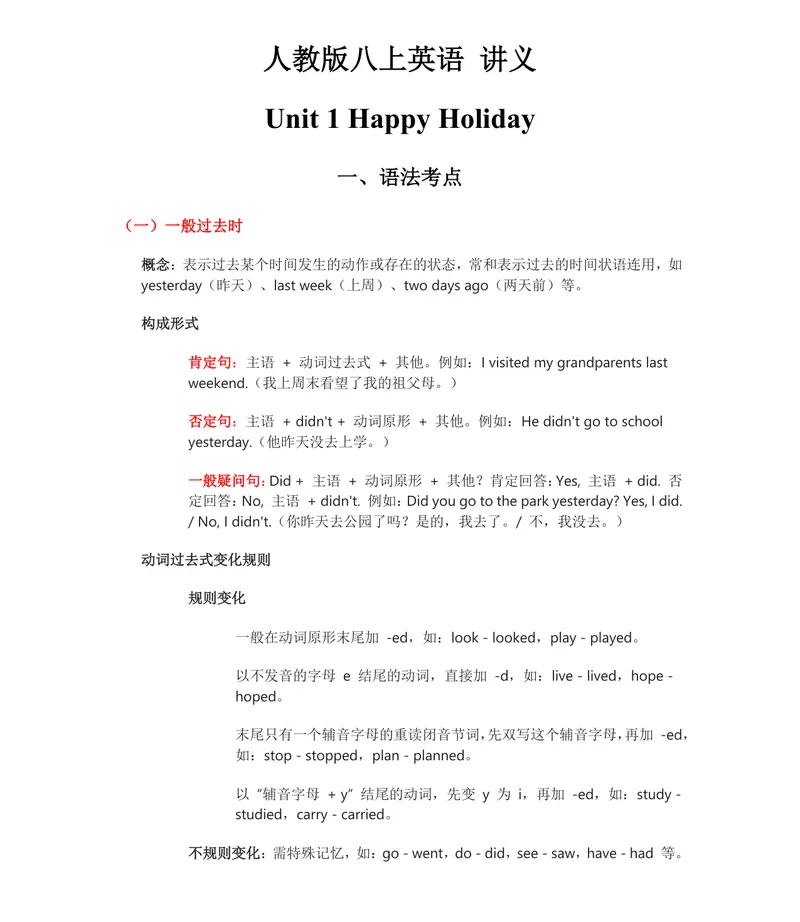
人教版八上英语 讲义
Unit 1 Happy Holiday
一、语法考点
(一)一般过去时
概念:表示过去某个时间发生的动作或存在的状态,常和表示过去的时间状语连用,如
yesterday(昨天)、lastweek(上周)、two daysago(两天前)等。
构成形式
肯定句:主语 + 动词过去式 + 其他。例如:Ivisited mygrandparentslast
weekend.(我上周末看望了我的祖父母。)
否定句:主语 + didn't+ 动词原形 + 其他。例如:He didn'tgo toschool
yesterday.(他昨天没去上学。)
一般疑问句:Did+ 主语 + 动词原形 + 其他?肯定回答:Yes, 主语 +did. 否
定回答:No, 主语 +didn't. 例如:Didyougototheparkyesterday?Yes,Idid.
/No, Ididn't.(你昨天去公园了吗?是的,我去了。/ 不,我没去。)
动词过去式变化规则
规则变化
一般在动词原形末尾加 -ed,如:look- looked,play- played。
以不发音的字母 e 结尾的动词,直接加 -d,如:live - lived,hope-
hoped。
末尾只有一个辅音字母的重读闭音节词,先双写这个辅音字母,再加 -ed,
如:stop-stopped,plan- planned。
以 “辅音字母 + y” 结尾的动词,先变 y 为 i,再加 -ed,如:study -
studied,carry -carried。
不规则变化:需特殊记忆,如:go-went,do-did,see-saw,have-had 等。
暴小雪原创 左右上角是薇kmkm 第2/76页 1170
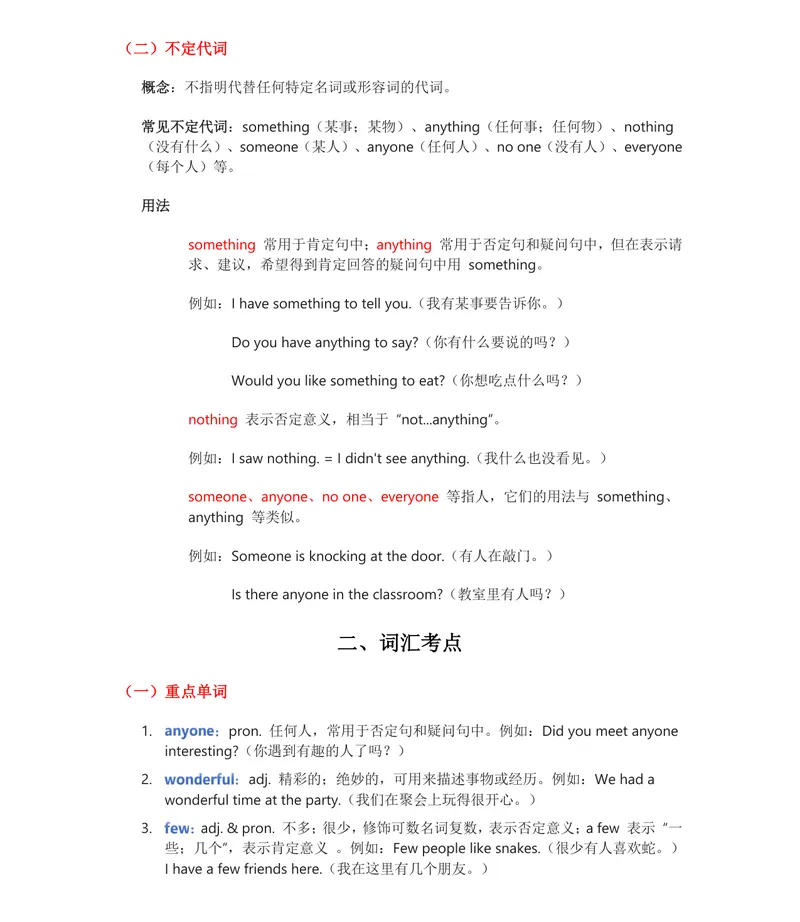
(二)不定代词
概念:不指明代替任何特定名词或形容词的代词。
常见不定代词:something(某事;某物)、anything(任何事;任何物)、nothing
(没有什么)、someone(某人)、anyone(任何人)、noone(没有人)、everyone
(每个人)等。
用法
something 常用于肯定句中;anything 常用于否定句和疑问句中,但在表示请
求、建议,希望得到肯定回答的疑问句中用 something。
例如:Ihavesomethingto tell you.(我有某事要告诉你。)
Doyouhaveanythingto say?(你有什么要说的吗?)
Wouldyoulikesomethingto eat?(你想吃点什么吗?)
nothing 表示否定意义,相当于 “not...anything”。
例如:Isawnothing. =I didn'tseeanything.(我什么也没看见。)
someone、anyone、no one、everyone 等指人,它们的用法与 something、
anything 等类似。
例如:Someoneisknockingatthedoor.(有人在敲门。)
Isthereanyonein theclassroom?(教室里有人吗?)
二、词汇考点
(一)重点单词
1. pron. 任何人,常用于否定句和疑问句中。例如:Didyoumeetanyone
interesting?(你遇到有趣的人了吗?)
2. adj. 精彩的;绝妙的,可用来描述事物或经历。例如:Wehada
wonderfultime attheparty.(我们在聚会上玩得很开心。)
3. adj.&pron. 不多;很少,修饰可数名词复数,表示否定意义;afew 表示 “一
些;几个”,表示肯定意义 。例如:Fewpeoplelikesnakes.(很少有人喜欢蛇。)
Ihavea fewfriendshere.(我在这里有几个朋友。)
暴小雪原创 左右上角是薇kmkm 第3/76页 1170
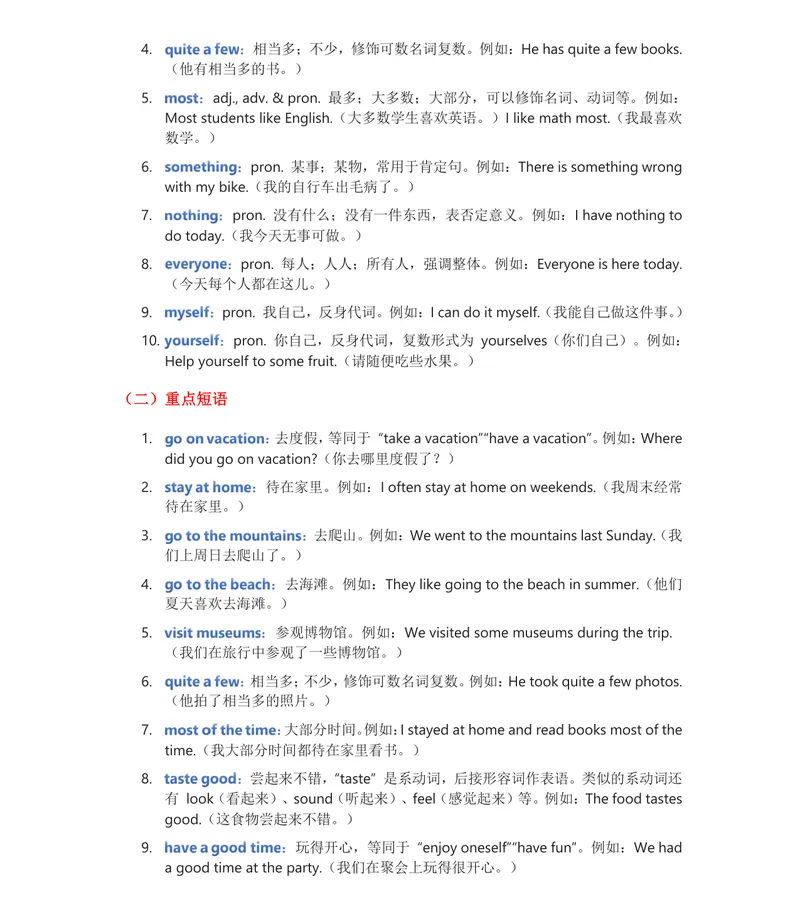
4. 相当多;不少,修饰可数名词复数。例如:Hehasquiteafewbooks.
(他有相当多的书。)
5. adj., adv. &pron. 最多;大多数;大部分,可以修饰名词、动词等。例如:
MoststudentslikeEnglish.(大多数学生喜欢英语。)Ilike mathmost.(我最喜欢
数学。)
6. pron. 某事;某物,常用于肯定句。例如:Thereissomethingwrong
withmy bike.(我的自行车出毛病了。)
7. pron. 没有什么;没有一件东西,表否定意义。例如:Ihavenothingto
dotoday.(我今天无事可做。)
8. pron. 每人;人人;所有人,强调整体。例如:Everyoneisheretoday.
(今天每个人都在这儿。)
9. pron. 我自己,反身代词。例如:Icandoitmyself.(我能自己做这件事。)
10. pron. 你自己,反身代词,复数形式为 yourselves(你们自己)。例如:
Helpyourself tosomefruit.(请随便吃些水果。)
(二)重点短语
1. 去度假,等同于 “takeavacation”“haveavacation”。例如:Where
didyougo onvacation?(你去哪里度假了?)
2. 待在家里。例如:Ioftenstayathomeonweekends.(我周末经常
待在家里。)
3. 去爬山。例如:WewenttothemountainslastSunday.(我
们上周日去爬山了。)
4. 去海滩。例如:Theylikegoingtothebeachinsummer.(他们
夏天喜欢去海滩。)
5. 参观博物馆。例如:Wevisitedsomemuseumsduringthe trip.
(我们在旅行中参观了一些博物馆。)
6. 相当多;不少,修饰可数名词复数。例如:Hetookquiteafewphotos.
(他拍了相当多的照片。)
7. 大部分时间。例如:Istayedathomeandreadbooksmostofthe
time.(我大部分时间都待在家里看书。)
8. 尝起来不错,“taste” 是系动词,后接形容词作表语。类似的系动词还
有 look(看起来)、sound(听起来)、feel(感觉起来)等。例如:Thefoodtastes
good.(这食物尝起来不错。)
9. 玩得开心,等同于 “enjoyoneself”“havefun”。例如:Wehad
a goodtimeattheparty.(我们在聚会上玩得很开心。)
暴小雪原创 左右上角是薇kmkm 第4/76页 1170
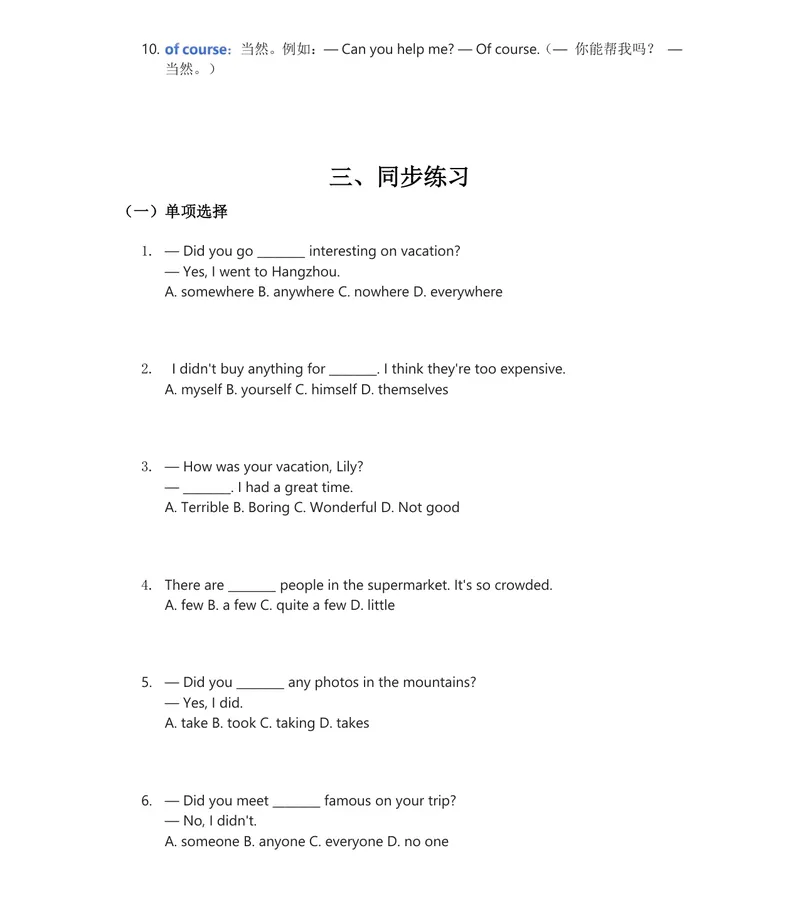
10. 当然。例如:—Canyouhelpme?—Ofcourse.(— 你能帮我吗? —
当然。)
三、同步练习
(一)单项选择
1. —Didyougo ________ interestingonvacation?
—Yes,I wentto Hangzhou.
A. somewhereB. anywhereC.nowhereD.everywhere
2. Ididn't buyanythingfor________. I think they'retooexpensive.
A. myself B.yourself C. himself D.themselves
3. —Howwasyourvacation, Lily?
—________. Ihada greattime.
A. TerribleB.BoringC.WonderfulD.Notgood
4. Thereare________ peopleinthesupermarket. It'sso crowded.
A. fewB. afewC. quitea fewD.little
5. —Didyou________ anyphotosinthemountains?
—Yes,I did.
A. takeB. tookC. takingD.takes
6. —Didyoumeet________famous onyour trip?
—No, Ididn't.
A. someoneB. anyoneC. everyoneD. noone
暴小雪原创 左右上角是薇kmkm 第5/76页 1170
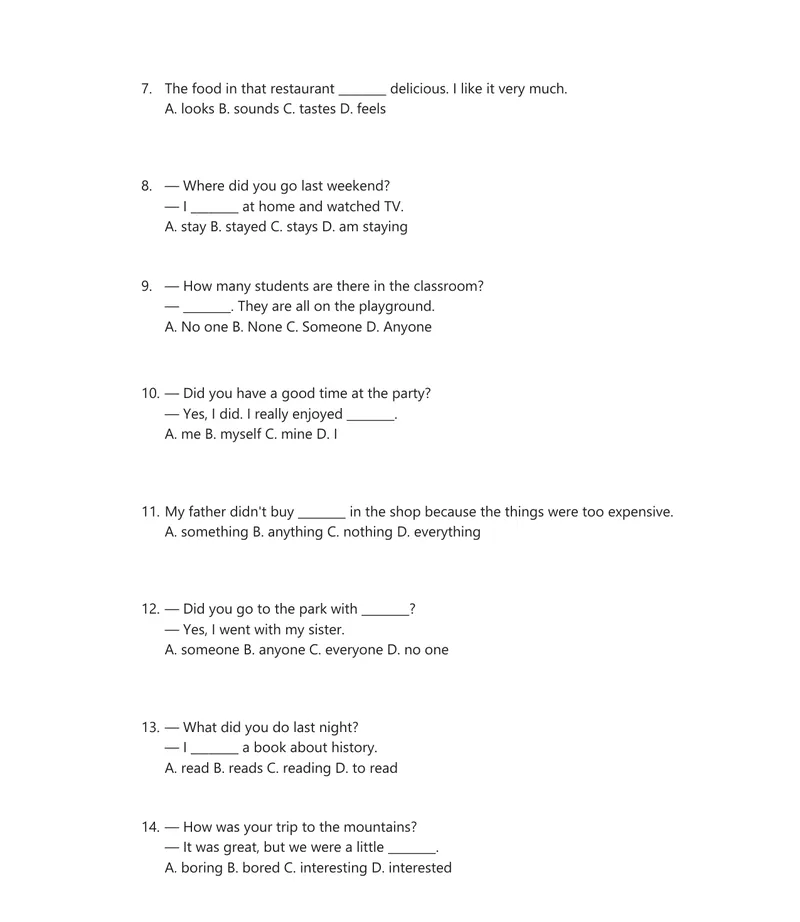
7. Thefoodinthatrestaurant________delicious. I likeitvery much.
A. looksB.soundsC. tastesD.feels
8. —Wheredidyougo lastweekend?
—I________athomeandwatchedTV.
A. stayB.stayedC. staysD.amstaying
9. —Howmanystudentsarethereintheclassroom?
—________. Theyareallontheplayground.
A. NooneB.NoneC.SomeoneD. Anyone
10. —Didyouhavea goodtimeattheparty?
—Yes,I did. Ireallyenjoyed________.
A. meB.myself C.mineD. I
11. Myfather didn'tbuy________ intheshopbecausethethingsweretoo expensive.
A. somethingB.anythingC. nothingD. everything
12. —Didyougo to theparkwith________?
—Yes,I wentwithmy sister.
A. someoneB. anyoneC. everyoneD. noone
13. —Whatdidyoudo lastnight?
—I________a bookabouthistory.
A. readB.readsC. readingD. to read
14. —Howwasyourtrip to themountains?
—Itwasgreat,butwe werealittle ________.
A. boringB.boredC. interestingD.interested
暴小雪原创 左右上角是薇kmkm 第6/76页 1170
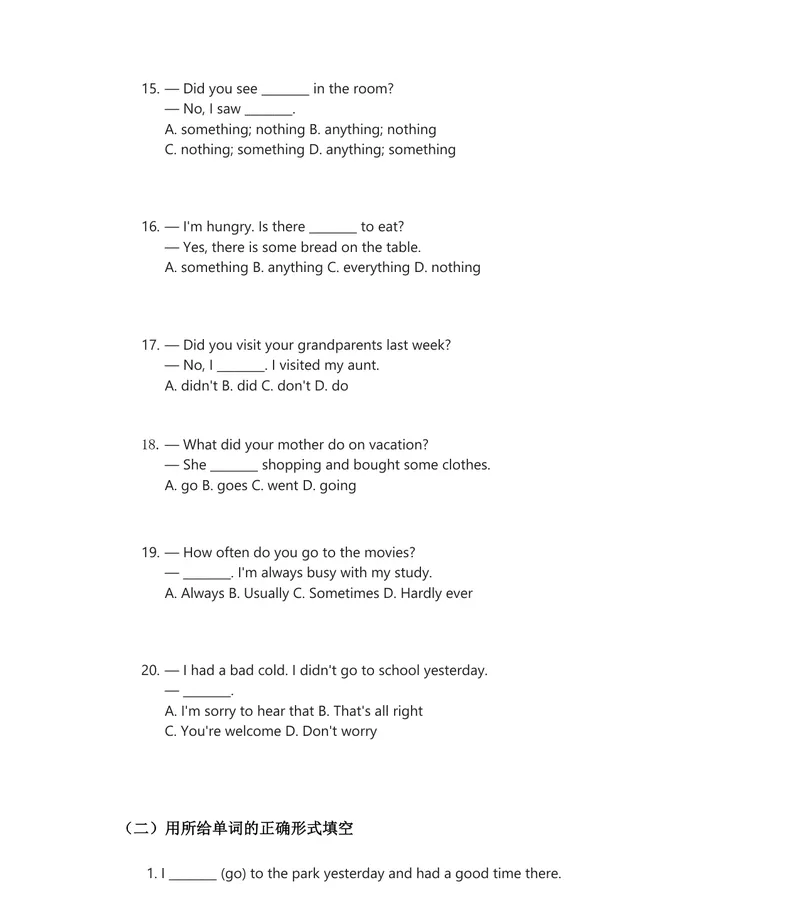
15. —Didyousee________ intheroom?
—No, Isaw________.
A. something; nothingB. anything;nothing
C. nothing;somethingD.anything; something
16. —I'mhungry. Isthere________to eat?
—Yes,thereissomebreadonthetable.
A. somethingB.anythingC. everythingD.nothing
17. —Didyouvisityour grandparentslastweek?
—No, I________. I visitedmy aunt.
A. didn'tB. didC. don'tD. do
18.—Whatdidyour mother doonvacation?
—She________ shoppingandboughtsomeclothes.
A. go B.goesC.went D.going
19. —Howoftendo yougo to themovies?
—________. I'malwaysbusy withmy study.
A. AlwaysB.UsuallyC. SometimesD. Hardlyever
20. —Ihadabadcold. I didn'tgo to schoolyesterday.
—________.
A. I'msorryto hearthatB. That'sall right
C. You'rewelcomeD.Don't worry
(二)用所给单词的正确形式填空
1.I ________ (go)to thepark yesterdayandhadagoodtimethere.
暴小雪原创 左右上角是薇kmkm 第7/76页 1170
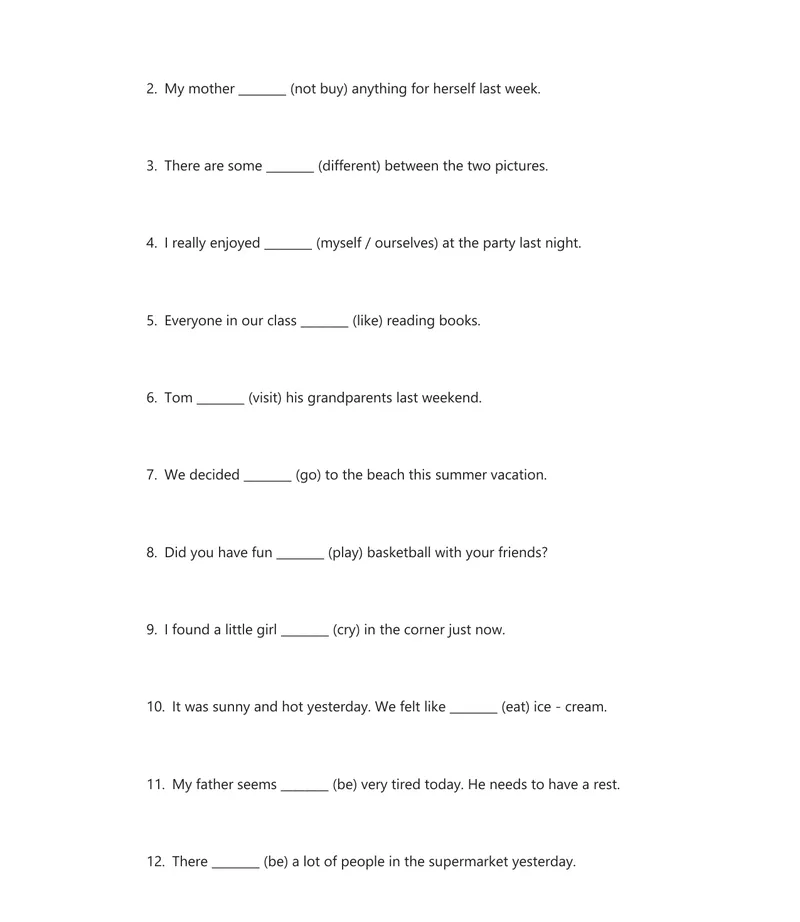
2. Mymother________ (notbuy)anythingforherself lastweek.
3. Therearesome________ (different)betweenthetwo pictures.
4. Ireally enjoyed________ (myself/ ourselves)atthepartylastnight.
5. Everyoneinour class________ (like)readingbooks.
6. Tom________(visit) hisgrandparentslastweekend.
7. Wedecided________ (go)to thebeachthis summervacation.
8. Didyouhavefun________(play) basketballwithyour friends?
9. Ifounda littlegirl ________(cry)in thecorner justnow.
10. It wassunnyandhotyesterday. Wefeltlike________(eat)ice - cream.
11. Myfatherseems________ (be)verytiredtoday. Heneedstohavea rest.
12. There________ (be)alotof peopleinthesupermarketyesterday.
暴小雪原创 左右上角是薇kmkm 第8/76页 1170
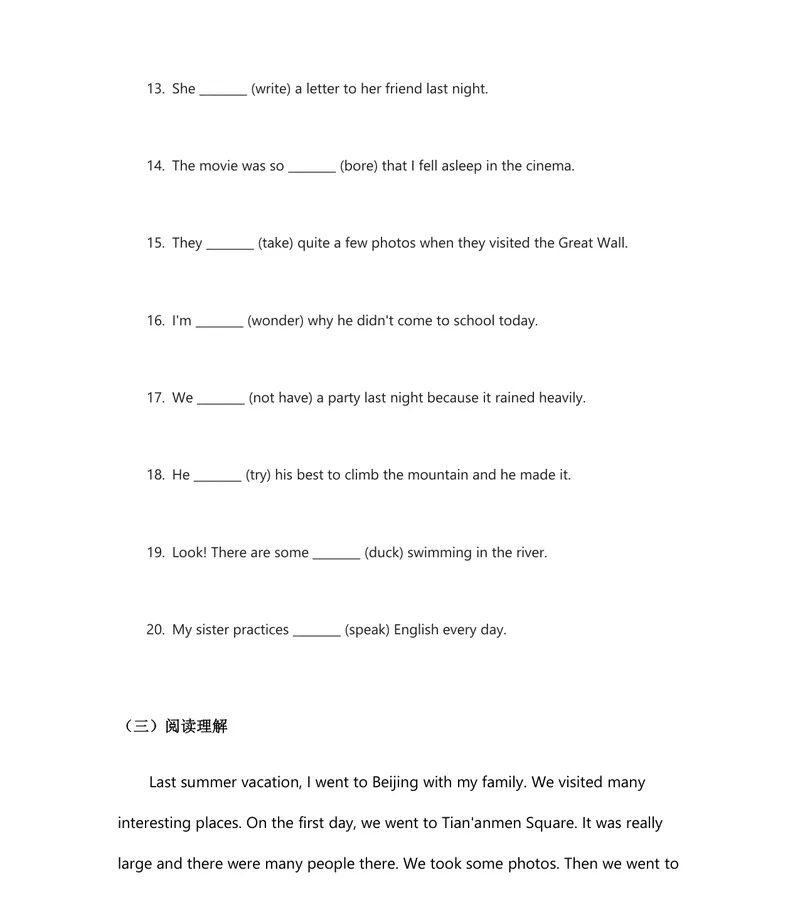
13. She________(write) a letter to her friendlastnight.
14. Themoviewasso ________(bore)thatIfellasleepinthecinema.
15. They ________(take) quitea fewphotoswhentheyvisited theGreatWall.
16. I'm ________(wonder)why hedidn'tcometo schooltoday.
17. We________(nothave)a partylast nightbecauseit rainedheavily.
18. He________ (try)his bestto climb themountainandhemadeit.
19. Look!Therearesome________ (duck)swimmingin theriver.
20. Mysister practices________ (speak)Englishevery day.
(三)阅读理解
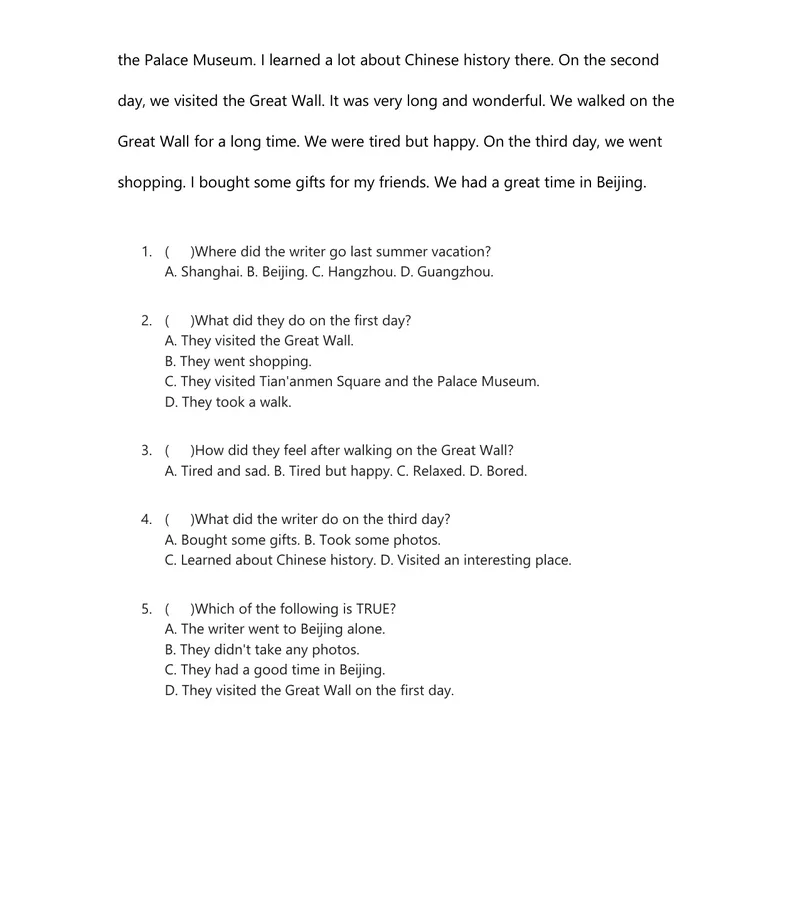
Last summer vacation, I went to Beijing with my family. We visited many
interesting places. On the first day, we went to Tian'anmen Square. It was really
large and there were many people there. We took some photos. Then we went to
暴小雪原创 左右上角是薇kmkm 第9/76页 1170
the Palace Museum. I learned a lot about Chinese history there. On the second
day, we visited the Great Wall. It was very long and wonderful. We walked on the
Great Wall for a long time. We were tired but happy. On the third day, we went
shopping. I bought some gifts for my friends. We had a great time in Beijing.
1. ( )Wheredidthewriter go lastsummer vacation?
A. Shanghai.B. Beijing. C. Hangzhou.D.Guangzhou.
2. ( )Whatdidtheydo onthefirstday?
A. Theyvisited theGreatWall.
B.They wentshopping.
C. TheyvisitedTian'anmenSquareandthePalaceMuseum.
D.Theytooka walk.
3. ( )How didtheyfeelafter walkingontheGreatWall?
A. Tiredandsad.B.Tired buthappy.C. Relaxed. D. Bored.
4. ( )Whatdidthewriter do onthethirdday?
A. Boughtsomegifts.B. Tooksomephotos.
C. LearnedaboutChinesehistory. D.Visitedaninterestingplace.
5. ( )Which ofthefollowingisTRUE?
A. Thewriter wentto Beijingalone.
B.They didn'ttakeanyphotos.
C. Theyhada goodtimeinBeijing.
D.Theyvisited theGreatWallonthe firstday.
暴小雪原创 左右上角是薇kmkm 第10/76页 1170
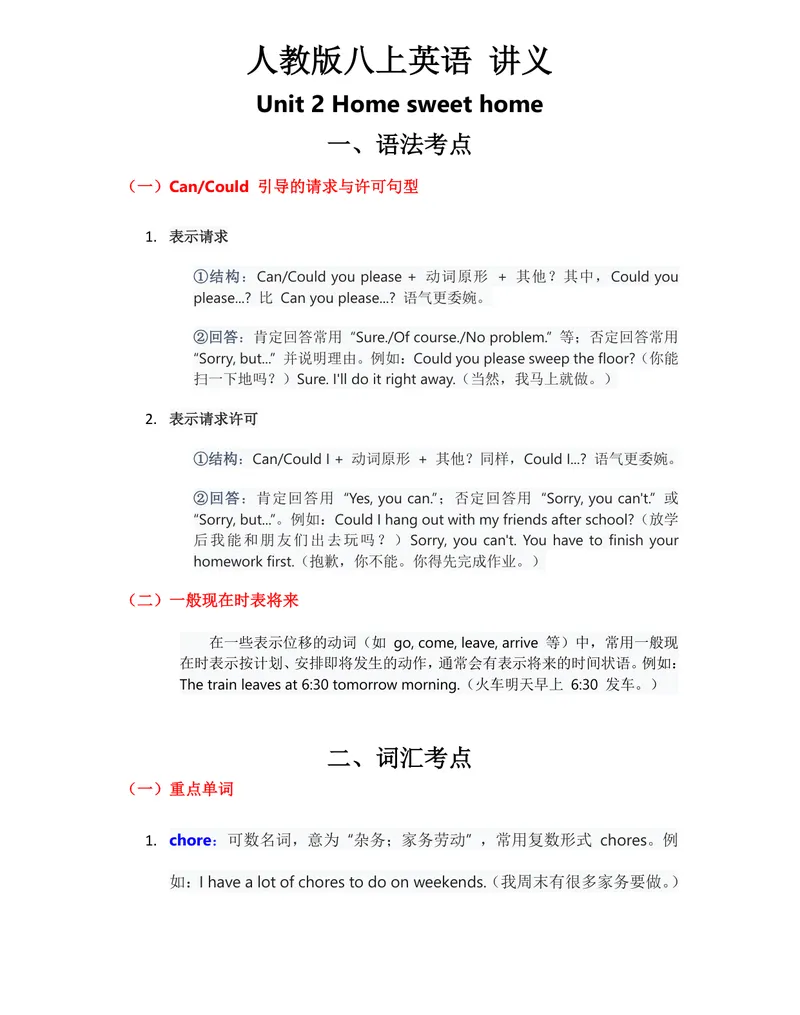
人教版八上英语 讲义
Unit 2 Home sweet home
一、语法考点
(一) 引导的请求与许可句型
Can/Could
1. 表示请求
①结构:Can/Could you please + 动词原形 + 其他?其中,Could you
please...? 比 Canyouplease...? 语气更委婉。
②回答:肯定回答常用 “Sure./Of course./No problem.” 等;否定回答常用
“Sorry,but...” 并说明理由。例如:Couldyoupleasesweepthefloor?(你能
扫一下地吗?)Sure.I'll do it rightaway.(当然,我马上就做。)
2. 表示请求许可
①结构:Can/CouldI + 动词原形 + 其他?同样,CouldI...? 语气更委婉。
②回答:肯定回答用 “Yes, you can.”;否定回答用 “Sorry, you can't.” 或
“Sorry,but...”。例如:CouldIhangoutwithmyfriendsafter school?(放学
后我能和朋友们出去玩吗?)Sorry, you can't. You have to finish your
homeworkfirst.(抱歉,你不能。你得先完成作业。)
(二)一般现在时表将来
在一些表示位移的动词(如 go,come,leave,arrive 等)中,常用一般现
在时表示按计划、安排即将发生的动作,通常会有表示将来的时间状语。例如:
Thetrainleavesat6:30tomorrowmorning.(火车明天早上 6:30 发车。)
二、词汇考点
(一)重点单词
1. chore :可数名词,意为 “ 杂务;家务劳动 ” ,常用复数形式 chores 。例
如: (我周末有很多家务要做。)
I havea lotofchorestodoon weekends.
暴小雪原创 左右上角是薇kmkm 第11/76页 1170
2. sweep :动词,意为 “ 打扫;清扫 ” ,过去式为 swept 。常见短语 sweep the
(扫地)。例如:
floor My mother asks me to sweep the floor every day.
(妈妈让我每天扫地。)
3. floor :名词,意为 “ 地板;地面 ” 。也可表示 “ 楼层 ” ,英式英语中与序
数词连用时, 常置于序数词前;美式英语中 常省略。例如:
the the There
(地板上有一本书。)
is a book on the floor. The library is on the second
(图书馆在二楼。)
floor.
4. borrow :动词,意为 “ 借;借用 ” ,常用结构 borrow sth. from sb. (从
某人那里借某物) 。例如: (我经
I often borrowbooksfromthelibrary.
常从图书馆借书。)
5. lend :动词,意为 “ 借给;借出 ” ,常用结构 lend sth.tosb. =lend sb. sth.
(把某物借给某人) 。例如:
Can you lend your pen to me? = Can you
(你能把你的钢笔借给我吗?)
lend me your pen?
6. invite :动词,意为 “ 邀请 ” ,名词形式为 invitation 。常见短语 invitesb.
(邀请某人做某事); 地点(邀请某人去某地)。
todosth. invitesb. to+
例如: (我想邀请我的朋
I want toinvitemyfriends tomy birthdayparty.
友们参加我的生日派对。)
7. prepare :动词,意为 “ 使做好准备;把 …… 准备好 ” ,常见短语 prepare
(为 做准备); (准备某物)。例如:
for …… preparesth. Wearepreparing
(我们正在为考试做准备。)
for the exam.
8. reason :可数名词,意为 “ 原因;理由 ” 。例如: Thereason for hisbeing
(他迟到的原因是错过了公交车。)
late is that he missed the bus.
暴小雪原创 左右上角是薇kmkm 第12/76页 1170
9. neighbor :可数名词,意为 “ 邻居 ” 。例如: My neighbor is very kind.
(我的邻居非常友善。)
10.care :动词,意为 “ 在意;担忧;关心 ” ,常见短语 care about (关心;
在意); (照顾;照料) 。例如:
care for We should care about the
(我们应该关心环境。)
environment.
(二)重点短语
1. help out :意为 “ 帮助分担工作、解决难题等 ” 。例如: I oftenhelp out with
(我在家经常帮忙做家务。)
housework at home.
2. in orderto :意为 “ 目的是;为了 ” ,后接动词原形,引导目的状语。例
如: (他早起是为了赶上
Hegets upearly in order tocatch theearly bus.
早班车。)
3. depend on :意为 “ 依靠;信赖 ” 。例如: Childrenshouldnotdepend too
(孩子们不应该过于依赖他们的父母。)
much on their parents.
4. takecareof :意为 “ 照顾;照料 ” ,等同于 lookafter 。例如: Weshould
(我们应该照顾老人。)
take care of the old.
5. as a result :意为 “ 结果;因此 ” ,常位于句首,并用逗号与句子其他部
分隔开。例如: (他
Hedidn't study hard.Asa result, hefailed theexam.
学习不努力。结果,他考试不及格。)
三、同步练习
(一)单项选择
暴小雪原创 左右上角是薇kmkm 第13/76页 1170
1. —Couldyouplease________ thefloor?It'sdirty.
—Sure.
A. sweepingB.sweepC.to sweepD.swept
2. —CanI________ yourbike?
—Sorry,I'velentit to Tom.
A. borrowB. lendC. keepD.buy
3. —________Iinvitemyfriendstotheparty?
—Sure. Butyoushouldcleantheroomfirst.
A. MustB. NeedC. CanD.Should
4. Mymotheroftenasksme________thedishesafter dinner.
A. do B.todo C. doingD.does
5. —Couldyouhelpme________thebookstotheclassroom?
—Noproblem.
A. takeB. takingC. takesD.took
6. —Whatareyoudoing,Li Ming?
—I'm________my pen.I can'tfindit.
A. lookingatB.lookingforC. lookingafter D.lookinglike
7. —Whydidn'tyougoto theparty lastnight?
—BecauseIhadto________my sick mother athome.
A. lookatB. lookupC.look forD.look after
8. —Couldyoupleasenot________ noisehere?Thebabyissleeping.
—Sorry,wewon't.
A. makeB. makingC. tomakeD.made
暴小雪原创 左右上角是薇kmkm 第14/76页 1170
9. Myfather ________homeat6:00p.m.every day.
A. arriveB.arrivesC. arrivedD.will arrive
10.—CanIuseyour dictionary?
—________. Hereyouare.
A. Of coursenotB.I'm sorry C. Of course D.No,youcan't
11.—________do youclean yourroom?
—Oncea week.
A. HowlongB.How oftenC. HowsoonD.Howfar
12.Weshould________our parents. Theyworkhardfor us.
A. careaboutB.hear aboutC. talk aboutD.learnabout
13.—Couldyoutellme howtogettothelibrary?
—________. I'mnew here,too.
A. SureB. I'msorry C. NoproblemD.Of course
14.Mysister oftenhelpsme________ myEnglish.
A. withB. forC. inD.at
15.—CanIhavesomemorebread?
—________. There'sstill alotleft.
A. No,youcan'tB. Of coursenotC.Yes, youcanD.That'sallright
16.—Couldyoupleasepassmethebook?
—________.
A. Yes,I couldB. No, Icouldn'tC. Sure. HereyouareD.Ican't
暴小雪原创 左右上角是薇kmkm 第15/76页 1170
17.Hegotupearly ________catchthe earlybus.
A. inordertoB. so thatC.becauseD.becauseof
18.—Do youoftendo choresathome?
—Yes.Ioften________the clothes.
A. do B.makeC.foldD.take
19.—________Ileavenow?
—No, youcan't. Youhavetofinishyour workfirst.
A. MustB. MayC. NeedD.Can
20.Myneighborisa kindwoman. Sheoften________ mewith myproblems.
A. helpsB.helpC. helpingD.tohelp
(二)用所给单词的正确形式填空
1. Couldyouplease________(clean) yourroom?It'samess.
2. Mymotheroftenasksme________(help)her withhousework.
3. I need ________ (borrow) some money from my friend because I left my wallet
athome.
4. He________(sweep)thefloor anhour ago.
5. Weshouldlearn________ (take) careofourselves.
暴小雪原创 左右上角是薇kmkm 第16/76页 1170
6. Mysister isgoodat________ (fold) theclothes.
7. Couldyoupleasenot________ (play) computergames?It'stime togo tobed.
8. Sheoftenhelpsher mother________ (do)thedishesafter dinner.
9. Myfather ________(notarrive)homeuntil8:00p.m. yesterday.
10.Wearelookingforwardto ________(invite)our friendstoour newhouse.
11.It'simportantfor us________(learn)Englishwell.
12.Heisbusy________ (prepare) fortheexamthesedays.
13.She________ (lend)her booktomelastweek.
14.Mymotheraskedme________ (notmake)noiseinthelibrary.
15.Weshouldcaremoreabout________ (other).
16.I'msorry for________(be) latefor classagain.
17.Myneighbor'ssonalwayshelpsme________ (carry) heavythings.
暴小雪原创 左右上角是薇kmkm 第17/76页 1170
18.Sheneeds________ (buy)somenewclothesfortheparty.
19.Myfather oftentellsme________(clean) myroomby myself.
20.They________ (go)to theparktomorrowif itdoesn't rain.
(三)阅读理解
When we talk about home, we often think of its warmth and comfort. A
home is not just a building where we live; it's a place full of love and care.
In my family, we all do our part to make our home a better place. My
mother always keeps the house clean. She sweeps the floor and cleans the
rooms every day. She also cooks delicious meals for us. My father often helps
with the heavier chores. He takes out the rubbish and fixes things around the
house when they are broken.
As for me, I usually help with some small chores. I feed the fish and water
the plants. Sometimes, I also help my mother set the table before dinner. On
weekends, my parents and I often clean up the house together. We work as a
team, and it makes our home look tidy and beautiful.
We also like to decorate our home. We hang up photos of our family on
the walls. These photos show our happy moments together. We also put some
flowers in the living room. They make the house smell nice and feel more
comfortable.
暴小雪原创 左右上角是薇kmkm 第18/76页 1170
Home is where we feel safe and loved. We should all do something to
make our homes better.
1. ( )Whatdoesthe writerthinkofhome?
A. It'sjusta building.
B. It'sa placefullofloveandcomfort.
C. It'sonly aplace to live.
D.It'sa placewithmanychores.
2. ( )Whatdoesthe writer'smotherdo athome?
A. Shetakesouttherubbish.
B. Shefixesthingsaroundthehouse.
C. Shekeepsthehousecleanandcooksmeals.
D.Shefeedsthefishandwaterstheplants.
3. ( )Whatsmallchoresdoesthewriter usuallydo?
A. He helpshismother cleantherooms.
B. Hetakesouttherubbish.
C. Hefeedsthefishandwaterstheplants.
D.Hehelpshisfatherfixthings.
4. ( )How dothey maketheir homelooktidy andbeautiful?
A. They buya lotofnewfurniture.
B. Theycleanupthehousetogetheronweekends.
C. Theyinvitefriendsto help.
D.Theyonlylet themother cleanthehouse.
5. ( )Why do they hang up photos on the walls?
A. Because the photos show their happy moments together.
B. Because the photos are very expensive.
C. Because they want to make the house look bigger.
D. Because they like taking photos.
暴小雪原创 左右上角是薇kmkm 第19/76页 1170
人教版八上英语 讲义
Unit 3 Same or Different
一、语法考点
(一)形容词和副词的比较级
1. 构成规则
①一般在词尾加 -er。例如:tall- taller,fast- faster。
②以字母 e 结尾的词,加 -r。例如:nice -nicer,fine- finer。
③重读闭音节词词尾只有一个辅音字母时,先双写这个辅音字母,再加 -er。
例如:big- bigger,hot- hotter。
④以 “辅音字母 + y” 结尾的双音节词,先把 y 改为 i,再加 -er。例如:
happy- happier,early- earlier。
⑤多音节词和部分双音节词在前面加 more。例如:interesting - more
interesting,outgoing- moreoutgoing。
2. 用法:表示两者之间的比较,常用 “比较级 +than” 结构。例如:Mysisteristaller
thanme.(我姐姐比我高。)
3. 特殊句型
①“as+ 形容词 / 副词原级 +as” 表示 “和…… 一样”。例如:Tomisastall
asJack.(汤姆和杰克一样高。)
②“notas/so+ 形容词 / 副词原级 +as” 表示 “不如……”。例如:Thisbook
isnotasinterestingasthatone.(这本书不如那本书有趣。)
③“比较级 + and + 比较级” 表示 “越来越……”。例如:It's getting colder
andcolder.(天气越来越冷了。)
④“the+ 比较级,the+ 比较级” 表示 “越……,越……”。例如:Themoreyou
read,themoreyouknow.(你读得越多,知道得就越多。)
(二)选择疑问句
1. 结构:一般疑问句 +or+ 选择部分?例如:Doyoulikeapplesorbananas?(你
喜欢苹果还是香蕉?)
暴小雪原创 左右上角是薇kmkm 第20/76页 1170
2. 回答:不能用 yes 或 no 回答,需从提供的选项中选择其一进行回答。例如:
Ilikeapples.(我喜欢苹果。)
二、词汇考点
(一)重点单词
1. outgoing :adj. 爱交际的;友好的;外向的。比较级为 moreoutgoing。例如:
Sheis moreoutgoingthanher sister.(她比她姐姐更外向。)
2. better :adj. &adv. 较好的(地);更好的(地),是 good/well 的比较级。
例如:Thisideaisbetter.(这个主意更好。)Heplaysbasketballbetterthanme.
(他篮球打得比我好。)
3. loudly :adv. 喧闹地;大声地;响亮地。比较级为 moreloudly。例如:Please
don'tspeakso loudly.(请不要这么大声说话。)
4. quietly :adv. 轻声地;轻柔地;安静地。比较级为 morequietly。例如:Thebaby
issleeping. Pleasetalkquietly.(宝宝在睡觉,请轻声说话。)
5. hard- working :adj. 工作努力的;辛勤的。比较级为 morehard- working。
例如:Myclassmatesareallhard- working.(我的同学们都很勤奋。)
6. competition :n. 比赛;竞赛;竞争。例如:Wewillhaveasingingcompetition
nextweek.(下周我们将举行一场歌唱比赛。)
7. fantastic :adj. 极好的;了不起的。例如:Wehadafantastictimeattheparty.
(我们在聚会上玩得很开心。)
8. which :pron.&adj. 哪一个;哪一些。例如:Whichbookdoyoulikebest?(你
最喜欢哪本书?)
9. clearly :adv. 清楚地;清晰地;明白地。比较级为 moreclearly。例如:Speak
clearlyso thateveryonecanhearyou.(说清楚点,以便每个人都能听到你。)
10.win :v. 获胜;赢;赢得。过去式为 won。例如:Ourteamwonthegame.(我
们队赢了这场比赛。)
(二)重点短语
1. careabout :关心;在意。例如:Weshouldcareaboutourfriends.(我们应该
关心我们的朋友。)
2. bedifferentfrom :与…… 不同。例如:Mylifestyleisdifferentfromyours.(我
的生活方式和你的不同。)
3. aslongas :只要;既然。例如:Youcangetgoodgradesaslongasyoustudy
hard.(只要你努力学习,你就能取得好成绩。)
暴小雪原创 左右上角是薇kmkm 第21/76页 1170
4. bringout :使显现;使表现出。例如:Thiskindofmusiccanbringoutthebest
inher.(这种音乐能激发出她最好的一面。)
5. the same as :和…… 相同;与…… 一致。例如:His bike is the same as mine.
(他的自行车和我的一样。)
三、同步练习
(一)单项选择
1. Mybrotheris ________thanme. Helikestalkingwithothers.
A. outgoingB.moreoutgoingC. mostoutgoingD.themostoutgoing
2. —Whosings________inyour class?
—LiMingdoes.
A. better B. bestC.goodD.well
3. Mysister isas________asherclassmate Mary.
A. tallB. taller C.tallestD.thetallest
4. —Whichis ________, thesun, themoonor theearth?
—Themoon.
A. smallB.smaller C. smallestD.thesmallest
5. —Whoruns________ inyourschool?
—Tomdoes.
A. fastB. fasterC. fastestD.morefast
6. —Isyourfriend________thanyou?
—No, heisas________ asme.
A. thin; thinB.thinner; thinner C.thin; thinner D.thinner; thin
暴小雪原创 左右上角是薇kmkm 第22/76页 1170
7. Mymotheris________ thanmy father.
A. funnyB. funnier C.funniestD.thefunniest
8. —Whichsubject do youlike________, mathor English?
—English.
A. wellB. better C. bestD.thebest
9. —Whatdo youthink ofthemovie?
—It's________ thanthelastone.
A. interestingB.moreinterestingC.mostinteresting D.themostinteresting
10.Myfriendis goodat________.
A. singB.tosing C. singingD.sings
11.—IsTom________ thanSam?
—No, heisn't.Samistaller.
A. tallB. taller C.tallestD.thetallest
12.—Wholistens________, Tom, Jack or Bill?
—Jack does.
A. carefully B.morecarefullyC. mostcarefullyD.themostcarefully
13.Myfather is________thanmymother.
A. busyB.busier C. busiestD.thebusiest
14.—Whichcity is________, Beijingor Shanghai?
—It'shardto say.
A. beautifulB. morebeautifulC.mostbeautifulD.themostbeautiful
暴小雪原创 左右上角是薇kmkm 第23/76页 1170
15.—Whowrites________ inyourclass?
—Lily does.
A. carefully B.morecarefullyC. mostcarefullyD.themostcarefully
16.Mysister is________thanmeatsports.
A. goodB.wellC. betterD.best
17.—Whichis ________, a bike, abusor a car?
—Abike.
A. cheapB.cheaper C. cheapestD.thecheapest
18.Myfriendis ________thanme. Healwaysmakesmelaugh.
A. funnyB. funnier C.funniestD.thefunniest
19.—Whoplaysthepiano________, Lucy orLily?
—Lily does.
A. wellB. better C. bestD.thebest
20.Mybrotheris ________atmaththanme.
A. goodB.wellC. betterD.best
(二)用所给单词的正确形式填空
1. Mysister is________(outgoing) thanme.
2. Whois________ (tall),Tomor Jack?
3. Mymotheris________ (busy)thanmyfather.
暴小雪原创 左右上角是薇kmkm 第24/76页 1170
4. Thisbookis________ (interesting)thanthatone.
5. Heruns________ (fast) thanhisbrother.
6. Myfriendis as________ (good)atEnglishasme.
7. Whosings________ (loudly),Lucy orLily?
8. Mysister dances________(well) thanme.
9. Whichsubjectdo youlike________(well), mathor English?
10.Myfather is________(funny) thanmy mother.
11.Theweathertodayis________ (hot)thanyesterday.
12.Mybrotheris ________(thin) thanme.
13.Whois________ (quiet),Tomor Sam?
14.Thismovieis________(boring)thanthatone.
15.Mymotheris________ (hard-working)thanmyfather.
暴小雪原创 左右上角是薇kmkm 第25/76页 1170
16.Heis________ (tall)ofthethreeboys.
17.Whichis________ (big), thesun,the moonorthe earth?
18.Mysister is________(good)atmathinher class.
19.Whoruns________(fast) inyour school?
20.Thisbookis________ (interesting)ofthethree.
(三)阅读理解
In modern society, people are becoming more and more concerned about
their health. There are different ways to maintain a healthy lifestyle, and each
person may choose the one that suits them best.
Tom is a 15 - year - old middle school student. He likes playing basketball
very much. He plays basketball with his classmates after school three times a
week. He believes that playing basketball not only helps him keep fit but also
improves his teamwork skills. He also eats a balanced diet. He always has a
glass of milk and an egg for breakfast. He eats plenty of fruits and vegetables
every day. He hardly ever eats junk food like hamburgers and chips.
On the other hand, Lily has a different way to stay healthy. She is very
interested in yoga. She goes to a yoga class twice a week. Yoga makes her
body more flexible and helps her relax. She also pays attention to her sleep.
She goes to bed before 10 o'clock every night and sleeps for about 8 hours.
She thinks a good sleep is very important for her health.
暴小雪原创 左右上角是薇kmkm 第26/76页 1170
Another student, Jack, likes running. He runs for half an hour every
morning. Running makes him energetic throughout the day. He also tries to
reduce his stress. He listens to music when he is tired, which helps him calm
down.
In conclusion, there are various ways to live a healthy life. Whether it's
through sports, a balanced diet, good sleep, or stress - reduction methods,
everyone can find their own path to health.
1. ( )HowoftendoesTomplaybasketball?
A. Once aweek. B. Twicea week.
C. Threetimesa week. D.Four timesa week.
2. ( )WhatdoesTomhaveforbreakfast?
A. A glassofjuice andanegg. B. Aglassofmilk andanegg.
C. Ahamburger andaglassofmilk. D.An appleandaglassofjuice.
3. ( )HowoftendoesLily go totheyogaclass?
A. Once aweek. B. Twicea week.
C. Threetimesa week. D.Every day.
4. ( )WhattimedoesLily go tobed?
A. Before9o'clock. B. Before10 o'clock.
C. After 10o'clock. D.After 11 o'clock.
5. ( )HowlongdoesJackrunevery morning?
A. For15 minutes. B. For20minutes.
C. For30minutes. D.For45minutes.
暴小雪原创 左右上角是薇kmkm 第27/76页 1170
人教版八上英语 讲义
Unit 4 Amazing Plants and Animals
一、语法考点
(一)形容词和副词的最高级
1. 构成规则
①一般在词尾加 -est。例如:tall -tallest,short - shortest。
②以字母 e 结尾的词,加 -st。例如:nice -nicest,fine- finest。
③重读闭音节词词尾只有一个辅音字母时,先双写这个辅音字母,再加 -est。
例如:big- biggest,hot- hottest。
④以 “辅音字母 + y” 结尾的双音节词,先把 y 改为 i,再加 -est。例如:
happy- happiest,early- earliest。
⑤多音节词和部分双音节词在前面加 most。例如:interesting - most
interesting,outgoing- mostoutgoing。
2. 用法:用于三者或三者以上的比较,表示 “最……”。常与表示范围的短语或从句
连用,如 in...(在…… 范围内)、of...(在…… 之中)等。
①形容词最高级前通常要加定冠词 the,副词最高级前 the 可省略。例如:
Heisthetallestboyin ourclass.(他是我们班最高的男孩。)
Sheruns(the)fastestinher school.(她在学校里跑得最快。)
②常见句型:
“oneofthe+ 形容词最高级 + 可数名词复数” 表示 “最…… 之一”。
例如:TheGreatWallisoneofthemostfamousplacesintheworld.
(长城是世界上最著名的地方之一。)
“Which/Who...+ 最高级,A, BorC?” 用于在三者或三者以上中进行
选择。例如:Whichis the biggest, the sun, the moonor theearth?
(太阳、月亮和地球,哪一个最大?)
(二)倍数表达法
暴小雪原创 左右上角是薇kmkm 第28/76页 1170
1. “A+ be+ 倍数 + as+ 形容词原级 + as+ B” 表示 “A 是 B 的几倍”。例如:
Thisroomisthreetimesasbigasthatone.(这个房间是那个房间的三倍大。)
2. “A + be + 倍数 + 形容词比较级 + than + B” 表示 “A 比 B 大 / 长 / 高等
几倍”。例如:TheYangtzeRiverisabouttwicelongerthanthePearlRiver.(长
江大约比珠江长两倍。)
二、词汇考点
(一)重点单词
1. adj. 令人大为惊奇的;令人惊喜(或惊羡、惊叹)的。常用来修饰
物。例如:The movie hasanamazing ending.(这部电影有一个令人惊叹的结
局。)
2. old 的最高级,意为 “最古老的;年纪最大的”。例如:Thisistheoldest
buildinginthecity.(这是这座城市里最古老的建筑。)
3. heavy 的最高级,意为 “最重的”。例如:Theelephantistheheaviest
animalonland.(大象是陆地上最重的动物。)
4. fast 的最高级,意为 “最快的”。例如:Thecheetahisthefastestanimal
onland.(猎豹是陆地上跑得最快的动物。)
5. beautiful 的最高级,意为 “最美丽的”。例如:Sheisthemost
beautifulgirl inourschool.(她是我们学校最漂亮的女孩。)
6. adj. 受欢迎的;普遍的;流行的。比较级为 more popular,最高级
为 most popular。例如:Football is a very popular sport.(足球是一项非常受
欢迎的运动。)
7. adj. 有用的;有益的。比较级为 moreuseful,最高级为 mostuseful。
例如:Adictionary isa usefultool forlearning languages.(字典是学习语言的
有用工具。)
8. v. 创造;创作;创建。例如:The artist created a beautiful painting.
(这位艺术家创作了一幅美丽的画作。)
9. v. 交流;沟通。名词形式为 communication。例如:We
communicatewith eachother byemail.(我们通过电子邮件相互交流。)
10. v. 保护;防护。例如:Weshouldprotecttheenvironment.(我们应
该保护环境。)
(二)重点短语
1. 表示 “最…… 之一”。例如:China
isoneofthe largestcountriesintheworld.(中国是世界上最大的国家之一。)
暴小雪原创 左右上角是薇kmkm 第29/76页 1170
2. 在世界上。例如:What'sthe biggest animal in the world?(世
界上最大的动物是什么?)
3. 在…… 中起重要作用。例如:Trees play an
important part in keeping the air clean.(树木在保持空气清洁方面起着重要作
用。)
4. 因为;由于。后接名词、代词或动名词。例如:Hedidn'tgotoschool
becauseofhisillness.(他因为生病没去上学。)
5. 照顾;照料。等同于 takecareof。例如:Weshouldlookafterour
parentswhenthey areold.(父母年老时我们应该照顾他们。)
三、同步练习
(一)单项选择
1. Thebluewhaleis________ animalintheworld.
A. thelargestB. largestC. largerD.large
2. Whichis________, thesun, themoonor theearth?
A. bigB. biggerC. thebiggestD.biggest
3. Thisisoneof________booksinour library.
A. themostpopular B.mostpopularC. morepopular D.popular
4. Mysister runs________ inher class.
A. fastB. fasterC. thefastestD.fastest
5. Whichcity is________, Beijing,Shanghaior Guangzhou?
A. beautifulB. morebeautifulC.themostbeautifulD.mostbeautiful
6. Thecheetahruns________ amongalllandanimals.
A. fastB. fasterC. thefastestD.fastest
暴小雪原创 左右上角是薇kmkm 第30/76页 1170
7. Thisis________ interestingstory Ihaveeverheard.
A. themoreB. moreC. themostD.most
8. Heis________ studentin ourclass.
A. goodB.betterC. bestD.thebest
9. Whichis________ seasonin yourhometown?
A. goodB.betterC. thebestD.best
10.TheYellowRiverisoneof________riversinChina.
A. longB.longer C. thelongestD.longest
11.Themovieis________thanthatone.
A. interestingB.moreinterestingC.mostinteresting D.themostinteresting
12.Sheis ________girl inourschool.
A. tallB. taller C.tallestD.thetallest
13.Whichsubjectdo youlike________, math, Englishor Chinese?
A. wellB. better C. bestD.thebest
14.Thebookis________ofall.
A. interestingB.moreinterestingC.mostinteresting D.themostinteresting
15.Thisis________ expensiveshirt intheshop.
A. anB. a C. themostD.most
暴小雪原创 左右上角是薇kmkm 第31/76页 1170
16.Mymotheris________ inmyfamily.
A. busyB.busier C. thebusiestD.busiest
17.Whichis________, a bike, acar ora plane?
A. fastB. fasterC. thefastestD.fastest
18.TheweatherinBeijingis ________thanthatinGuangzhouinwinter.
A. coldB. colder C.coldest D.thecoldest
19.Heis________ boyinourclass.
A. strongB. stronger C. strongestD.thestrongest
20.Whichis________ mountainintheworld?
A. highB. higherC. thehighestD.highest
(二)用所给单词的正确形式填空
1. Theredwoodtreeis oneofthe________ (tall)treesintheworld.
2. Amongall theanimals, thebluewhaleisthe________ (heavy).
3. Whichisthe________(large), thesun, themoonor theearth?
4. Ithink pandasarethe________ (cute) animalsintheworld.
5. Thecheetahrunsthe________(fast) amongalllandanimals.
暴小雪原创 左右上角是薇kmkm 第32/76页 1170
6. Which do you think is the ________ (beautiful), the rose, the peony, or the lotus
flower?
7. Lookatthatbutterfly!Ithasthe________(colorful) wings.
8. Whichanimaljumpsthe________ (far),therabbit, thefrogor thekangaroo?
9. The elephant birds were the ________ (large) and ________ (heavy) birds ever on
earth.
10.Theginkgotreeisoneofthe________(ancient)living treesonearth.
11.Many Chinese believe that the old ginkgo tree in the Zhongnan Mountains in
ShaanxiProvinceisthe________ (old).
12.The ginkgo tree is one of the ________ (popular) trees in streets, parks, and
gardensacrossChina.
13.Beesareoneofthe________(important) animalsonthisplanet.
14.Beesarealso oneofthe________(interesting)animalsintheworld.
15.Ifelt________ (disappointed) whenmyfavouriteflowersdied.
暴小雪原创 左右上角是薇kmkm 第33/76页 1170
16.After therain, somemushrooms________ (appear)inthegarden.
17.Inmy hometown,peopleoftenusebamboo basketsto________ (store) food.
18.Whatdidyouputinyourluggage?It ________ (weigh) aton.
19.Ican't________(imagine)my lifewithoutmypets. They meana lottome.
20.Manypeopleknowthatfrogshelpto________(protect)farmsbyeatinginsects.
(三)阅读理解
Dolphins are one of the most amazing animals in the ocean. They are very
smart and friendly. Dolphins have a special way of communicating with each
other. They use sounds like clicks and whistles to talk. Scientists believe that
these sounds can carry different messages, such as warnings, greetings, or
information about food.
Dolphins are also excellent swimmers. They can swim at high speeds and
jump out of the water in a very beautiful way. Their bodies are designed for
swimming, with a streamlined shapethat helps them movequickly through the
water.
In addition, dolphins are social animals. They live in groups called pods. In
a pod, dolphins help each other. For example, when a dolphin is sick or injured,
other dolphins will support it and help it to the surface to breathe.
Dolphins are very important to the ocean ecosystem. They eat fish and
squid, which helps to keep the populations of these animals in balance. Also,
they are a popular attraction for tourists. Many people go to the sea to watch
dolphins play and swim.
暴小雪原创 左右上角是薇kmkm 第34/76页 1170
However, dolphins are facing some problems. Pollution in the ocean is
making their living environment worse. Some dolphins are caught in fishing
nets and get hurt. We should take action to protect these lovely animals and
keep the ocean clean.
1. ( )Howdo dolphinscommunicatewitheachother?
A. Byusingbodylanguage.
B. Bymakingsoundslikeclicksandwhistles.
C. Bysendingsignalswiththeir tails.
D.Bychangingthe coloroftheir bodies.
2. ( )Whyaredolphinsgoodatswimming?
A. Becausetheyhavelongtails.
B. Becausetheylikeswimmingvery much.
C. Becausetheir bodiesareina streamlinedshape.
D.Becausethey livein theocean.
3. ( )Whatdoesthe underlinedword“pods” meaninChinese?
A. 洞穴 B. 家族 C. 群体 D. 部落
4. ( )Whyaredolphinsimportant totheoceanecosystem?
A. Becausetheycanmaketheoceanmorebeautiful.
B. Becausetheycan helpfishermencatch fish.
C. Becausetheycan keepthepopulationsofsomeanimalsinbalance.
D.Becausethey canclean theocean.
5. ( )Whatproblemsaredolphinsfacing?
A. Thereisnotenoughfoodfor themintheocean.
B. Pollution is making their living environment worse and some are caught
infishingnets.
C. Theyhaveno friendsin theocean.
D.Peopledon'tlikethemanymore.
暴小雪原创 左右上角是薇kmkm 第35/76页 1170
人教版八上英语 讲义
Unit 5 What a Delicious Meal!
一、语法考点
(一)感叹句
1. What 引导的感叹句
①结构: 形容词 可数名词单数 主语 谓语
What +(a/an)+ + (+ + )!
例如: (她是个多么漂亮的女孩啊!)
What a beautiful girl (she is)!
② 形容词 可数名词复数 不可数名词 主语 谓
What + + / (+ +
语 例如: (它们是多么美味的蛋糕
)! What delicious cakes (they are)!
啊!) (多好的天气啊!)
What fine weather (it is)!
2. How 引导的感叹句
结构: 形容词 副词 主语 谓语 例如:
How+ / (+ + )! Howbeautiful
(这个女孩多漂亮啊!) (他跑得真快啊!)
thegirl is! Howfast heruns!
3. What 和 How 引导感叹句的转换: What 引导的感叹句和 How 引导
的感叹句在一定情况下可以相互转换。例如:
What a clever boy he is! =
(他是个多么聪明的男孩啊!)
How clever the boy is!
(二)祈使句
1. 肯定祈使句:以动词原形开头,表示请求、命令、建议等。例如: Open the
(请打开门。)
door, please.
暴小雪原创 左右上角是薇kmkm 第36/76页 1170
2. 否定祈使句:在动词原形前加 Don't ,表示禁止、劝阻等。例如: Don't be
(上学不要迟到。)
late for school.
3. Let 型祈使句: Let + 宾语 + 动词原形 + 其他成分。 Let's 表示 “ 让我
们 ,包括说话者和听话者; 表示 让我们 ,不包括听话者。例如:
” Let us “ ”
(我们去公园吧。) (让我们休息
Let's go to the park. Let us have a rest.
一下吧。)
二、词汇考点
(一)重点单词
1. n. 胡椒粉;辣椒。例如: Addsome peppertothesoup. (往汤
里加些胡椒粉。)
2. cut : v. 切;割;砍。过去式和过去分词均为 cut 。常见短语 cutup (切
碎)。例如: (把西红柿切碎。)
Cut up the tomatoes.
3. mix : v. 混合;融合。常见短语 mix...with... (把 …… 和 …… 混合)。例如:
(把面粉和水混合。)
Mix the flour with the water.
4. bake : v. 烤;烘焙。例如: Bakethecakein theoven. (把蛋糕放进烤箱
里烤。)
5. pour : v. 倒;倾倒。常见短语 pour...into... (把 …… 倒入 …… )。例如:
(把牛奶倒入玻璃杯里。)
Pour the milk into the glass.
6. boil : v. 煮沸;烧开。例如: Boil the water before you drink it. (喝水之
前把水烧开。)
7. ingredient : n. 材料;原料;成分。例如: What aretheingredientsofthis
(这道菜的原料是什么?)
dish?
暴小雪原创 左右上角是薇kmkm 第37/76页 1170
8. finally : adv. 最后;最终。相当于 at last 或 in theend 。例如: Finally,
(最后,我们到达了山顶。)
we got to the top of the mountain.
9. smell : v. 闻起来;发出 …… 气味; n. 气味。例如: Theflowers smellsweet.
(这些花闻起来很香。) (食物的气味
The smell of thefood is delicious.
很香。)
10.memory : n. 记忆;回忆。复数形式为 memories 。例如: I havemanygood
(我有很多童年的美好回忆。)
memories of my childhood.
(二)重点短语
1. cut up :切碎。例如: Cutup theonionsandput themin thepan. (把洋
葱切碎,放到锅里。)
2. pour...into... :把 …… 倒入 …… 。例如: Pourthejuiceinto thebottle. (把
果汁倒入瓶子里。)
3. mix...with... :把 …… 和 …… 混合。例如: Mix theeggs with theflour. (把
鸡蛋和面粉混合在一起。)
4. add...to... :把 …… 加到 …… 上 / 里。例如: Addsome sugartothecoffee.
(往咖啡里加些糖。)
5. a pieceof :一片 / 块 / 张等。例如: a piece ofbread (一片面包), a
(一张纸)。
piece of paper
6. a cup of :一杯。例如: a cup of tea (一杯茶), a cup of coffee (一杯
咖啡)。
7. a bowlof :一碗。例如: abowlofrice (一碗米饭), a bowlofnoodles
(一碗面条)。
暴小雪原创 左右上角是薇kmkm 第38/76页 1170
8. in theend :最后;终于。相当于 finally 或 atlast 。例如: In theend, he
(最后,他通过了考试。)
passed the exam.
9. first of all :首先。例如: First of all, let's listen to the song. (首先,让
我们听这首歌。)
10.thanks to :多亏;由于。例如: Thanks toyour help, I finished thework
(多亏了你的帮助,我按时完成了工作。)
on time.
三、同步练习
(一)单项选择
1. —________beautifulgirl sheis!
—Yes,youareright.
A. Whata B.WhatC.How aD.How
2. —________delicious thesoupis!
—Really?I'm gladyoulikeit.
A. WhatB. Whata C.How D.Howa
3. —________interestingstory itis!
—Iagreewith you.
A. WhatB. WhatanC.HowD.Howan
4. —________fasttheboy runs!
—Hewillbe agoodrunner.
A. WhatB. Whata C.How D.Howa
5. —________badweatherit is!
—Wecan'tgohiking.
A. WhatB. Whata C.How D.Howa
暴小雪原创 左右上角是薇kmkm 第39/76页 1170
6. —________lovelyday!Let'sgo fora walk.
—Goodidea.
A. WhatB. Whata C.How D.Howa
7. —________wonderful newsit is!
—Weareall excited.
A. WhatB. Whata C.How D.Howa
8. —________niceflowers!Wheredid youbuy them?
—Intheflowermarket.
A. WhatB. Whata C.How D.Howa
9. —________clever theboyis!
—Hecansolvetheproblemeasily.
A. WhatB. Whata C.How D.Howa
10.—________usefulbook itis!
—Iwanttobuyonetoo.
A. WhatB. Whata C.How D.Howa
11.—________careful whenyoucrosstheroad.
—OK, I will.
A. BeB.BeingC.TobeD.Is
12.—________lateforschoolagain.
—Sorry,I won't.
A. Don'tB. Don'tbeC. NotD.Notbe
暴小雪原创 左右上角是薇kmkm 第40/76页 1170
13.—Let's________to theparkthis weekend.
—Goodidea.
A. go B.goesC.going D.togo
14.—Please________theTV.It'stime togotobed.
—OK, Dad.
A. turnonB. turnoff C. turnupD.turndown
15.—________somesaltto thesoup, please.
—OK.
A. AddB. PutC. PourD.Mix
16.—Youshould________ thetomatoesbeforeyoucook them.
A. cutdownB. cutupC. cutoff D.cut out
17.—Canyouteachmehowto ________a cake?
—Sure. It'seasy.
A. do B.makeC.cook D.bake
18.—Don'tforgetto________ themilk intotheblender.
—OK, I won't.
A. pourB. putC. takeD.bring
19.—Weneedto________the vegetablesbeforeweeatthem.
A. washB. buyC. cutD.cook
20.—________do weneed to makethesoup?
—Weneedsometomatoes,onionsandsalt.
A. WhatB. HowC. WhereD.When
暴小雪原创 左右上角是薇kmkm 第41/76页 1170
(二)用所给单词的正确形式填空
1. ________(notbe)latefor classagain.
2. ________(mix) theflourwith thewater,andthenyoucanmakenoodles.
3. How________ (beauty)the flowersare!
4. Whata ________(love) girlsheis!
5. ________(pour)themilk intotheglass, please.
6. First, cut thetomatoesinto ________(piece).
7. Let's________ (go)shoppingthisafternoon.
8. Thefoodsmells________ (good).
9. Finally,addsome________(salt)to thesoup.
10.Weneedtwo ________(tomato)to makethesalad.
11.How________ (excite)thenewsis!
暴小雪原创 左右上角是薇kmkm 第42/76页 1170
12.Whatan________(interest) book itis!
13.________(bake) thecakein theovenfor 30minutes.
14.Cutupthepotatoesandthen________(boil) them.
15.Thesouptastes________ (well).
16.Weshouldwashthe vegetables________ (one)beforecooking.
17.Mymotheroften________(cook) deliciousfoodforus.
18.Let________ (we)makea bananamilk shake.
19.What________ (a) deliciousmealitis!
20.How________ (quick)heruns!
(三)阅读理解
Food is an important part of our lives. It not only gives us energy but also
brings people together. Different countries have different food cultures.
In Italy, pizza is one of the most popular foods. It has a long history. The
first pizza was made in Naples, a city in Italy. Pizzas are usually round, and they
暴小雪原创 左右上角是薇kmkm 第43/76页 1170
come in different flavors. Some have tomatoes, cheese, and herbs, while others
may have meat, vegetables, or fruits on them. People all over the world love
Italian pizza.
China has a rich food culture too. Dumplings are a traditional Chinese
food, especially popular during the Spring Festival. They are made of flour,
meat, and vegetables. People usually make dumplings together with their
families. It's a great way to show love and share happiness. There are also
many other delicious Chinese foods like noodles, Peking duck, and hot pot.
Each region in China has its own special dishes.
In Thailand, thefood is known for its strong and spicy flavors. Tom Yum Goong
is a famous Thai soup. It has shrimp, lemongrass, lime juice, and chili peppers.
The combination of these ingredients makes the soup taste really special. Thai
food often uses fresh herbs and spices, which gives it a unique flavor.
Food can also tell us about a country's history, traditions, and values. It's a
way to experience different cultures without traveling too far. We can learn a
lot from the food we eat.
1. ( )Whatisoneofthemostpopular foodsinItaly?
A. Dumplings. B. Pizza.
C. TomYumGoong. D.Pekingduck.
2. ( )Whenaredumplingsespecially popularinChina?
A. DuringtheMid-AutumnFestival. B.DuringtheDragonBoatFestival.
C. DuringtheSpringFestival. D.DuringChristmas.
暴小雪原创 左右上角是薇kmkm 第44/76页 1170
3. ( )WhatisTomYumGoong?
A. Akindofpizza. B.AtraditionalChinesefood.
C. AfamousThaisoup. D.A kindofdumpling.
4. ( )WhatmakesThaifoodtastespecial?
A. It usesa lotofmeat. B. It usesfreshherbsandspices.
C. Itisvery sweet. D.Itismadewith flour.
5. ( )Whatcanfoodtellus?
A. Only aboutacountry'shistory.
B.A country'shistory,traditions, andvalues.
C. Onlyaboutacountry'straditions.
D.Only abouta country'svalues.
暴小雪原创 左右上角是薇kmkm 第45/76页 1170
人教版八上英语 讲义
Unit 6 Plan for Yourself
一、语法考点
(一) 结构
be going to
1. 含义:表示打算、计划或准备要做某事,也可表示根据现有迹象推测即将
发生的事情。
2. 构成: be ( am/is/are ) +goingto+ 动词原形。例如: I amgoingtovisit
(我打算这个周末去看望我的祖父母。)
my grandparents this weekend.
(要下雨了。看那些乌云。)
It's going to rain. Look at the dark clouds.
3. 一般疑问句:将 be 动词提到主语前。肯定回答: Yes, 主语 + be. 否定
回答: 主语 例如:
No, + be not. Are you going to play basketball after
(你放学后打算打篮球吗?) (是的,我打算打。)
school? Yes, I am. No,
(不,我不打算打。)
I'm not.
4. 特殊疑问句:特殊疑问词 + be + 主语 + going to + 动词原形 + 其
他?例如: (你明天打算做什么?)
What areyougoingtodotomorrow?
(二) 结构
want to do sth.
1. 含义:表示 “ 想要做某事 ” ,表达主语的意愿或想法。
2. 用法: want 后接动词不定式作宾语。例如: I wanttobea teacher when
(我长大后想成为一名教师。)
I grow up. She wants to buy a new dress.
(她想买一条新裙子。)
暴小雪原创 左右上角是薇kmkm 第46/76页 1170
二、词汇考点
(一)重点单词
1. n. 工程师。常见短语: computer engineer (计算机工程师),
(机械工程师)。例如:
mechanical engineer My brother is an engineer.
(我哥哥是一名工程师。他设计建筑物。)
He designs buildings.
2. n. 飞行员。例如: Healways dreamsofbeing a pilot andflying in
(他一直梦想成为一名飞行员,在天空中翱翔。)
the sky.
3. n. 小提琴手。由 violin (小提琴) + -ist (表示 “ 人 ” 的后缀)
构成。例如: (这位小提
The violinist played a beautiful piece of music.
琴手演奏了一首美妙的乐曲。)
4. n. 驾驶员;司机。 drive (驾驶)的名词形式。例如: Myfather is
(我父亲是一名司机。他开公交车。)
a driver. He drives a bus.
5. n. 钢琴家。由 piano (钢琴) +-ist (表示 “ 人 ” 的后缀)构成。
例如: (郎朗是一位著名的钢琴家。)
Lang Lang is a famous pianist.
6. n. 科学家。 science (科学)的名词形式, -ist 表示 “ 人 ” 。例
如: (爱迪生是一位伟大的科学家。)
Edison was a great scientist.
7. n. 学院;大学;高等专科学校。例如: He isgoing tocollege next
(他明年要上大学。)
year.
8. n. 教育。 educate (教育)的名词形式。例如: Education is
(教育对一个国家非常重要。)
very important for a country.
暴小雪原创 左右上角是薇kmkm 第47/76页 1170
9. n. 药;医学。常见短语: takemedicine (吃药)。例如: You
(你应该一天吃三次药。)
should take the medicine three times a day.
10. n. 综合性大学。例如: He studies in Peking University. (他
在北京大学学习。)
(二)重点短语
1. 长大;成熟;成长。例如: What doyouwant tobewhenyou
(你长大后想成为什么?)
grow up?
2. 打算;计划。后接动词原形,表示将来的计划或意图。例
如: (我打算这个周末去看望我
I'm going to visit my aunt this weekend.
的姑姑。)
3. 计算机程序设计员;编程人员。例如: Mycousin
(我的表弟想成为一名计算机程序
wants to be a computer programmer.
设计员。)
4. 上表演课。例如: Sheisgoing totakeacting lessons
(她打算上表演课,以便成为一名女演员。)
to become an actress.
5. 学医。例如: He is going to study medicine at a
(他打算在大学里学医。)
university.
6. 确保;查明。后常接从句或 of 短语。例如: Makesureyou
(离开前确保你关掉了灯。)
turn off the lights before you leave.
7. 擅长;在 …… 方面做得好。后接名词、代词或动词 -ing 形
式。例如: (她擅长跳舞。)
She is good at dancing.
暴小雪原创 左右上角是薇kmkm 第48/76页 1170
8. 继续做某事。例如: Keep onstudying hard,andyou
(继续努力学习,你会取得好成绩的。)
will get good grades.
9. 开始从事;占用(时间、空间等)。例如: I want totakeup a
(我想培养一项新爱好。)
new hobby.
10. 写下;记录下。例如: Please write down your name and
(请写下你的姓名和地址。)
address.
三、同步练习
(一)单项选择
1. —Whatdoesyourbrotherwanttobewhenhe________?
—Hewantsto beadoctor.
A. wakesupB. growsupC. standsup D.hurriesup
2. —________areyougoingtobea goodteacher?
—I'mgoingtostudyeducation.
A. HowB. WhatC. WhenD.Where
3. Mysister wantstobe________engineer whenshegrowsup.
A. a B.anC. theD./
4. —Areyougoingto________football thisafternoon?
—Yes,Iam.
A. playB. playsC.playingD.played
5. Heisgoingto________ anew hobbylikepainting.
A. takeoff B.takeupC.takeoutD.takeaway
暴小雪原创 左右上角是薇kmkm 第49/76页 1170
6. —What'syourdreamjob?
—Iwanttobea ________andplaythepianoin concerts.
A. pianistB.violinist C.singer D.scientist
7. —Isshegoingto study________?
—Yes.Shewantsto bea doctor.
A. medicineB. educationC.science D.math
8. —________ishegoingtomove?
—He'sgoingtomovetoShanghai.
A. HowB. WhatC. WhenD.Where
9. Mymotherisgoodat________cakes.They tastedelicious.
A. makeB. makesC. makingD.to make
10.—________do youwant to beanactor?
—BecauseIlikeacting.
A. WhyB.WhatC.HowD.When
11.Sheis goingto ________a famoussinger.
A. isB.be C.areD.am
12.Myfriendwants________a teacher.
A. beB.tobe C.beingD.is
13.—Whatareyougoingto do tomorrow?
—I'mgoingto________my grandparents.
A. visitB. visitsC. visitingD.visited
暴小雪原创 左右上角是薇kmkm 第50/76页 1170
14.Theyaregoingto________ a party nextweek.
A. haveB.hasC.havingD.had
15.—________ishegoingtostart?
—Nextmonth.
A. HowB. WhatC. WhenD.Where
16.I'mgoingtokeepon________Englishevery day.
A. practiceB. practicesC. practicingD.topractice
17.Myfather isa ________. Hedrivesataxi.
A. driverB. teacher C. doctor D.worker
18.Shewantstobea ________. Shelikestodrawpictures.
A. singer B.dancer C. painterD.writer
19.—Areyougoingtoplaybasketball________?
—Yes,Iam.
A. nowB.yesterdayC. tomorrowD.last week
20.Heisgoingtostudy hard________ getgoodgrades.
A. so B.inorder toC.becauseD.but
(二)用所给单词的正确形式填空
1. Mysister wants________(be)a singer whenshegrowsup.
2. Heisgoingto________ (study)hardfor thetest.
暴小雪原创 左右上角是薇kmkm 第51/76页 1170
3. Theyaregoodat________(play) basketball.
4. Mymotheroftenmakesme________(clean) myroom.
5. Sheis goingto take________ (act)lessonstobeanactress.
6. Mybrotherwantsto bea________ (science) whenhegrowsup.
7. I'mgoingtokeepon________(write)stories.
8. Heisgoingto________ (move)toBeijingnextyear.
9. Shewantstobea ________(piano). Shelikesplayingthepiano.
10.Myfather isa ________(drive). Hedrivesa car.
11.Theyaregoingto________ (have)a party tomorrow.
12.I'mgoingtostudy ________(educate)in thefuture.
13.Sheis goingto workhard________ (make)her dreamcometrue.
14.Myfriendwantstobea ________(violin). Helikesplayingtheviolin.
暴小雪原创 左右上角是薇kmkm 第52/76页 1170
15.Wearegoingto ________(visit) themuseumnextweek.
16.Heisgoingtotakeupanewhobbylike________ (swim).
17.Mymotherasksme________ (help)her withhousework.
18.Sheis goingto studymath________(well) thanbefore.
19.Myfather isgoingto________(find)a newjob.
20.I'mgoingto________ (start) a newstudy plannextweek.
(三)阅读理解
梦想职业与计划
In our class, everyone has a dream job. Li Ming wants to be a computer
programmer. He is good at math and enjoys writing computer programs. He is
going to study computer science at a university. He plans to get a part - time
job to make some money and buy a good computer. He believes that with a
good computer, he can practice writing programs better.
Wang Mei dreams of being a teacher. She loves children and is patient
with them. She is going to study education at college. She also wants to get
暴小雪原创 左右上角是薇kmkm 第53/76页 1170
some teaching experience by working as a volunteer in a primary school
during her holidays. She hopes to be a popular teacher in the future.
Zhang Hua wants to be a doctor. He thinks doctors can help sick people.
He is going to study medicine at a medical university. After graduating, he
plans to work in a big hospital to gain more experience. He also wants to learn
some foreign languages so that he can read medical books from other
countries.
1. ( )WhatdoesLi Mingwantto be?
A. Ateacher. B. Adoctor.
C. Acomputer programmer. D.Avolunteer.
2. ( )HowisLiMinggoingtoachievehisdream?
A. Bystudyingeducationatcollege.
B.Bystudyingcomputer scienceata universityandbuyinga goodcomputer.
C. Byworkingina bighospital.
D.Byworkingasa volunteerina primary school.
3. ( )WhydoesWangMeiwantto beateacher?
A. Becausesheisgoodatmath.
B.Becauseshe likeshelpingsickpeople.
C. Becausesheloveschildrenandispatientwith them.
D.Becauseshewantstomakealotofmoney.
4. ( )WheredoesZhangHua planto workafter graduating?
A. Ina bighospital. B. Ina primary school.
C. Ina computer company. D.Ina foreigncountry.
暴小雪原创 左右上角是薇kmkm 第54/76页 1170
5. ( )Whatdo LiMing, WangMeiandZhangHua haveincommon?
A. Theyallwanttomakea lotofmoney.
B.They areallgoingtostudyata university.
C. Theyalllikehelpingothers.
D.Theyall wantto befamous.
暴小雪原创 左右上角是薇kmkm 第55/76页 1170
人教版八上英语 讲义
Unit 7 When Tomorrow Comes
一、语法考点
(一)一般将来时
1. 含义:表示将来某个时间要发生的动作或存在的状态,也表示将来经常或
反复发生的动作。
2. 构成形式
① 常用来表示纯粹的将来,含有 预见 意愿 等
“ ”“ ”
含义。例如: (我明天将去北京。)
Iwill go toBeijing tomorrow. He will
(如果你请求他,他会帮助你。)
help you if you ask him.
② 表示打算、计划或准备要做某事,也可
表示根据现有迹象推测即将发生的事情 。例如:
She is going to visit
(她打算这个周末去看望她的祖父母。)
hergrandparentsthisweekend.
(看那些云。要下雨了。)
Look at the clouds. It's going to rain.
3. 一般将来时的句型转换
① 主语 动词原形 其他。例如:
+will/be goingto+ + They
(他们放学后将打篮球。)
will playbasketballafter school. He isgoing
(他打算买一本新书。)
to buy a new book.
② 主语 动词原形 其他。例如:
+ won't/benotgoingto+ +
(我明天不去购物。)
Iwon'tgo shopping tomorrow. Sheisn't going to
(她不打算去看望她的姑姑。)
visit her aunt.
暴小雪原创 左右上角是薇kmkm 第56/76页 1170
③ 主语 动词原形 其他?肯定回答: 主
Will + + + Yes,
语 否定回答: 主语 例如:
+ will. No, + won't. Will you go to the
(你明天会去公园吗?) (是的,我会去。)
parktomorrow? Yes, Iwill.
(不,我不会去。)
No, I won't.
④ 特殊疑问词 主语 动词原形 其他?特
+ will + + +
殊疑问词 主语 动词原形 其他?例如:
+ be + + going to + +
(你明天打算做什么?)
What will you do tomorrow? Where are you
(你打算去哪里参观?)
going to visit?
(二) 句型的一般将来时
There be
1. 结构: There will be... 或 There is/are going to be... ,表示 “ 将会有 ……” 。
2. 区别: Therewillbe 更强调客观上将来会有; Thereis/are goingtobe 表
示根据计划、安排或迹象推测将来会有 。例如:
There willbea meeting
(明天将会有一个会议。)
tomorrow. Therearegoingtobemoretrees in
(我们学校将会有更多的树。)
our school.
3. 句型转换
例如:
There won't be.../ There isn't/aren't going to be...
(今晚不会有派对。)
Therewon't bea party tonight. Therearen'tgoing
(桌子上不会有任何书。)
to be any books on the desk.
例如:
Will there be...? / Is/Are there going to be...?
(下周会有运动会吗?)
Will therebea sports meeting nextweek? Are
暴小雪原创 左右上角是薇kmkm 第57/76页 1170
(城市里将会有更多的人
there going to be more people in the city?
吗?)
二、词汇考点
(一)重点单词
1. n. 将来;未来。常见短语: in the future (在将来); in future
(今后;从今以后)。例如: (我将
I want to be a doctor in the future.
来想成为一名医生。) (你今后应
You should be more careful in future.
该更小心。)
2. n. 污染;污染物。 pollute ( v. 污染)的名词形式。例如: Air
(空气污染是个大问题。)
pollution is a big problem.
3. n. 环境。例如: Weshould protect ourenvironment. (我
们应该保护我们的环境。)
4. n. 行星。例如: The earth is a planet. (地球是一颗行星。)
5. n. 和平。例如: We all love peace. (我们都热爱和平。)
6. n. 宇航员;航天员。例如: Hedreamsofbeing an astronaut.
(他梦想成为一名宇航员。)
7. n. 公寓套房。例如: They live in an apartment. (他们住在
一套公寓里。)
8. n. 火箭。例如: Rocketscan send satellitesinto space. (火箭能
把卫星送入太空。)
9. n. 太空;空间。例如: Wecan see manystars in space. (我们能
在太空中看到许多星星。)
暴小雪原创 左右上角是薇kmkm 第58/76页 1170
10. n. 人;人类。复数形式为 humans 。例如: Humansshouldlive
(人类应该与自然和谐相处。)
in harmony with nature.
(二)重点短语
1. 在将来。例如: What will you do in the future? (你将来
会做什么?)
2. 活到 …… 岁。例如: Mygrandfather livedto be90 years old.
(我的祖父活到了 岁。)
90
3. 许多;大量;成百上千。例如: Therearehundredsofbooks
(图书馆里有数百本书。)
in the library.
4. 突然倒下;跌倒;倒塌。例如: Be careful not to fall down.
(小心别摔倒。)
5. 寻找。强调寻找的动作。例如: I'm looking for my keys. (我
在找我的钥匙。)
6. 飞向;飞往。例如: Hewill fly toShanghaitomorrow. (他明天
将飞往上海。)
7. 处于危险之中。例如: Manyanimalsareindanger. (许多动
物处于危险之中。)
8. 多次;反复地。例如: He readthestory over and
(他反复读这个故事。)
over again.
9. 感到厌烦。例如: I get bored when I watch thesame movie
(当我再次看同一部电影时,我感到厌烦。)
again.
暴小雪原创 左右上角是薇kmkm 第59/76页 1170
10. 醒来。例如: I usually wake up at 6:30 in the morning. (我通
常早上 醒来。)
6:30
三、同步练习
(一)单项选择
1. —________will theweatherbeliketomorrow?
—Itwill besunny.
A. WhatB. HowC. WhenD.Where
2. There________ abasketballgamebetweenClass1 andClass3 tomorrow.
A. isgoingtohaveB.will haveC. isgoingtobeD.aregoingtobe
3. —________you________freetomorrow?
—No. I________ freethedayafter tomorrow.
A. Are; goingto; will B.Are; goingto be; will
C. Are;goingto;will beD.Are; goingtobe; will be
4. He________very busythisweek, buthe________freenextweek.
A. will be; isB.is; is C.will be;will beD.is; will be
5. Thereare________peopleintheparkonweekends.
A. hundredsofB.hundredofC.threehundredsD.threehundredsof
6. Ithink therewill be________pollutioninthefuturebecauseofthenew law.
A. moreB. lessC.fewer D.lower
暴小雪原创 左右上角是薇kmkm 第60/76页 1170
7. —________will peopleliveto be200 yearsold?
—Idon'tthink so.
A. WhenB. WhyC.WhereD.Doyouthink
8. —________will happenin 100years?
—Ithink peoplewill haverobotsathome.
A. WhatB. HowC. WhenD.Where
9. Therobotswill do________ jobsinplaceofpeopleinthefuture.
A. boredB. boringC. interestD.interested
10.—Willtherebelesspollution?
—________.
A. Yes,therewill B.Yes, therebeC. No,therewill D.No, itwon't
11.Myfather ________mea newbikenextweek.
A. buysB.boughtC. will buyD.buy
12.I'mafraid there________a heavyrainthisafternoon.
A. will haveB.will beC. isgoingtohaveD.aregoingtobe
13.—________will yougotothe park?
—Tomorrow.
A. WhatB. WhereC.WhenD.How
14.They________ tothebeachifit ________finetomorrow.
A. will go; isB.go; isC. will go; willbe D.go;will be
15.Thelittle girl________thebusandfounda seatnear thedoor.
A. gotupB.gotonC.gotoff D.gotto
暴小雪原创 左右上角是薇kmkm 第61/76页 1170
16.—Whatareyougoingto do thisweekend?
—I________yet.
A. haven'tdecided B.won'tdecide C.didn'tdecide D.don'tdecide
17.—________will yourfather comeback?
—Intwo days.
A. HowlongB.How soonC. HowoftenD.Howfar
18.There________ afootball matchonTV thisevening.
A. will haveB.isgoingtobeC. hasD.isgoingtohave
19.Ithink robots________do somejobsbetter thanhumansinthefuture.
A. canB.will canC. will beabletoD.areableto
20.—________you________totheparty tomorrow?
—Yes,Iam.
A. Will; go B.Are; goingC. Do; goD.Did;go
(二)用所给单词的正确形式填空
1. There________ (be)a meetingtomorrowafternoon.
2. We________ (nothave) anyclassesnextweek.
3. Lookattheclouds. It________ (rain).
4. Myfather ________(fly) toBeijingtomorrow.
暴小雪原创 左右上角是薇kmkm 第62/76页 1170
5. Ithink he________(be) afamoussinger inthefuture.
6. Therearemany________(planet)intheuniverse.
7. People________ (live)tobe200 yearsoldinthefuture.
8. Robotscando many________(danger) jobsforhumans.
9. Mymotheroftenmakesme________(clean) myroom.
10.Weshouldtry ourbest to savethe ________(environmentally).
11.There________ (notbe) morepollutioninthefuture.
12.Thechildren________(play) footballintheparktomorrow.
13.I'mlookingforwardto________ (hear) fromyou.
14.Mysister wantstobea ________(science) whenshegrowsup.
15.It'seasyfor robots________(do)such jobs.
16.Therearealotof________ (factory) inthiscity.
暴小雪原创 左右上角是薇kmkm 第63/76页 1170
17.We________ (build)a newschoolinour townnextyear.
18.Thelittle girlisvery kindandshealways________ (help)others.
19.If it________ (notrain)tomorrow,wewillgo to thepark.
20.My father ________ (drive) to work every day, but he ________ (take) a bus
tomorrow.
(三)阅读理解
未来的生活
In the future, life will be very different. People will live in houses that can
change colors and shapes according to the weather and their mood. These
houses will be very comfortable and energy - saving. They will use solar energy
to heat and cool the rooms, so there will be less pollution.
Transportation will also change a lot. People won't drive cars as often as
they do now. Instead, they will use flying cars or high - speed trains. Flying cars
垂直地
will be able to take off and land vertically ( ), so they won't need long
runways like airplanes. High - speed trains will be much faster than the trains
we have now, and they will be more comfortable.
In the future, people will work at home more often. They will use
computers and the Internet to communicate with their colleagues. Schools will
暴小雪原创 左右上角是薇kmkm 第64/76页 1170
also be different. Students won't need to go to school every day. They can
study at home through online courses. They will be able to choose the courses
they like and learn at their own pace.
However, there will also be some problems. For example, with more and
more robots doing jobs, some people may lose their jobs. And if people don't
go out often, they may become less healthy. So, we need to find ways to solve
these problems to make the future life better.
1. ( )Whatcanhousesdo inthefutureaccordingtothepassage?
A. Theycanonly changecolors. B.Theycan onlychangeshapes.
C. Theycanchangecolorsandshapes. D.They can'tchangeatall.
2. ( )Whatkindofenergywill housesusein thefuture?
A. Windenergy. B. Solar energy. C. Water energy. D.Coalenergy.
3. ( )Howwill transportationchangein thefuture?
A. Peoplewill drivecarsmoreoften.
B.Flyingcarswill needlongrunways.
C. High- speedtrainswill beslower.
D.Peoplewill useflyingcarsor high- speedtrains.
4. ( )Howwill studentsstudyinthefuture?
A. Theywill go toschoolevery day.
B.They willstudy athomethroughonlinecourses.
C. Theywill onlystudyinthe library.
D.Theywill study withrobotsatschool.
5. ( )Whatproblemsmaytherebeinthefuture?
A. Peoplewill havetoomuch worktodo.
暴小雪原创 左右上角是薇kmkm 第65/76页 1170
B.Robotswill do allthejobsandpeoplewill bevery lazy.
C. Somepeoplemay losetheir jobsandpeoplemaybecomelesshealthy.
D.Therewill betoomany carsandthe trafficwill bevery heavy.
暴小雪原创 左右上角是薇kmkm 第66/76页 1170
人教版八上英语 讲义
Unit 8 Let's Communicate!
一、语法考点
(一) 引导的条件状语从句
if
1. if 引导的条件状语从句表示在某种条件下,某事可能会发生。
结构为 主句 从句 或 从句 主句 。例如:
“ + if ” “if + ” Ifit rainstomorrow,
(如果明天下雨,我们就待在家里。)
wewill stayat home. Wewill stay at
(如果明天下雨,我们就待在家里。)
home if it rains tomorrow.
2. 遵循 “ 主将从现 ” 原则,即主句用一般将来时,从句用一般现
在时表示将来。例如: (如果他来,
If he comes, I will tell him the news.
我会告诉他这个消息。)但在表示客观真理、自然现象等情况时,主句和
从句都用一般现在时。例如: (如果你
If you heat ice, it turns into water.
加热冰,它会变成水。)
3. if 从句可位于主句前或主句后。当 if 从句在主句前时,从
句后要用逗号与主句隔开;当 从句在主句后时,不用逗号。例如:
if Ifyou
(从句在前,有逗号)
study hard, you will get good grades. You will get
(从句在后,无逗号)
good grades if you study hard.
(二)现在进行时表将来
1. 现在进行时( be + 动词的现在分词形式)有时可用来表示
按计划、安排即将发生的动作,常与表示将来的时间状语连用,如
(明天)、 (下周)等。这种用法常涉及位置移动的
tomorrow next week
暴小雪原创 左右上角是薇kmkm 第67/76页 1170
动词,如 (去)、 (来)、 (离开)、 (到达)等 。
go come leave arrive
例如: (我明天要去北京。)
I'mleaving for Beijing tomorrow. Sheis coming
(她下周要来看我。)
to see me next week.
2. 现在进行时表将来更强调计划或安排的确定性和近
期性;一般将来时( 动词原形)则更侧重于表达意愿、预测或临时
will +
决定 。例如: (已经有计划今晚去看电
I'mgoing tothe movies tonight.
影) (可以是临时决定今晚去看电影)
I will go to the movies tonight.
二、词汇考点
(一)重点单词
1. v. 交流;沟通。名词形式为 communication 。常见短语:
(与某人交流)。例如:
communicatewith sb. Weshould communicatewith
(我们应该多和父母交流。)
our parents more.
2. n. 信息;消息。常见短语: send a message (发送消息);
(捎口信)。例如:
takeamessage Please send me a message whenyou
(你到了请给我发个消息。)
arrive.
3. v. 争吵;争论。名词形式为 argument 。常见短语: arguewith sb.
(与某人争吵); (争论某事)。例如:
argueabout sth. Don't arguewith
(不要和你的同学争吵。)
your classmates.
4. adv. 代替;反而;却。常位于句首或句末。例如: Hedidn'tgo
(他没去上学,反而待在家里。)
to school. Instead, he stayed at home.
暴小雪原创 左右上角是薇kmkm 第68/76页 1170
5. v. 持续;继续存在;继续做。常见短语: continuedoingsth.
(继续做某事); (继续做另一件事)。例如:
continue to do sth. He
(晚饭后他继续看书。)
continued reading the book after dinner.
6. v. 理解;领会;明白。过去式和过去分词均为 understood 。
例如: (我不明白你说的话。)
I can't understand what you said.
7. adj. 诚实的;老实的。反义词为 dishonest (不诚实的)。例如:
(他是个诚实的男孩。)
He is an honest boy.
8. adj. 真诚的;诚恳的。副词形式为 sincerely 。例如: Weshould
(我们应该对朋友真诚。)
be sincere with our friends.
9. v. 假装;装作。常见短语: pretend todo sth. (假装做某事)。
例如: (他妈妈进
He pretended to be asleep when his mother came in.
来时他假装睡着了。)
10. v. 主动提出;自愿给予。常见短语: offertodo sth. (主动提出做
某事); (给某人提供某物)。例如:
offer sb. sth. = offer sth. to sb. He
(他主动提出帮我学英语。)
offered to help me with my English.
(二)重点短语
1. 面对面地。例如: We had a face - to - face talk. (我们进
行了一次面对面的谈话。)
2. 和解;和好;编造;组成等。例如: They made up after the
(争吵之后他们和好了。) (不要编造
argument. Don't make up stories.
故事。)
暴小雪原创 左右上角是薇kmkm 第69/76页 1170
3. 谈论;讨论。例如: We often talk about our hobbies. (我
们经常谈论我们的爱好。)
4. 亲自;亲身。例如: Youshould gotosee himinperson. (你
应该亲自去看他。)
5. 短信。例如: I received a text message from my friend.
(我收到了朋友的一条短信。)
6. 视频通话。例如: Wecan makea video calltokeep in touch.
(我们可以打视频电话保持联系。)
7. 注意;关注。例如: Payattentiontoyour pronunciation.
(注意你的发音。)
8. 肢体语言。例如: Body language is very important in
(肢体语言在交流中非常重要。)
communication.
9. 起立;站起来。例如: Please stand upwhen theteacher comes
(老师进来时请站起来。)
in.
10. 给某人写短信;给某人打电话。例如: Drop me a line
(你到那儿后给我写个短信。)
when you get there.
三、同步练习
(一)单项选择
1. —________do youusually communicatewithyour friends?
—Bysendingtextmessages.
A. WhatB. HowC. WhyD.When
暴小雪原创 左右上角是薇kmkm 第70/76页 1170
2. If it________ tomorrow,we________tothe park.
A. doesn'train;will go B. won'train;will go
C. doesn'train; go D.won'train; go
3. Myparentsoftenargue________ me________my study.
A. with; aboutB. with; for C.about; withD.for; about
4. Hedidn'tgo to school.________, hestayedathome.
A. InsteadB.InsteadofC.BecauseD.Becauseof
5. Shecontinued________ after shefinishedherhomework.
A. readB. readingC. toreadD.reads
6. Ican'tunderstand________ yousaid.
A. whatB.thatC. which D.where
7. Heis________ boy.Everyonelikeshim.
A. a honestB. anhonestC. thehonestD.honest
8. Shepretended________ whenhermother camein.
A. sleepB.sleepingC. tosleepD.slept
9. —Whatareyoudoingtomorrow?
—I'm________my grandparents.
A. visitB. visitsC. visitingD.visited
10.Heoffered________me withmyEnglish.
A. helpB.helping C.tohelpD.helped
暴小雪原创 左右上角是薇kmkm 第71/76页 1170
11.Wehada________ talk andsolvedthe problem.
A. face-to- faceB.facetofaceC. faces- to- facesD.facestofaces
12.Pleasesendme a________ whenyouget there.
A. newsB. informationC. messageD.advice
13.If youwanttosolvetheproblem,youshouldhavea talk withhim________.
A. inpersonB. inthepersonC.in personsD.ina person
14.Weshouldpayattention________ourbodylanguagewhenwetalkwith others.
A. atB.toC. inD.for
15.—Canyouhelpme withmy math?
—Sure. ________.
A. NoproblemB. I'm sorry C. ThankyouD.You'rewelcome
16.Whenyoumeetsomeoneforthefirst time, it'spoliteto________.
A. askhisageB. talkabouttheweather
C. askhisweightD.talk abouthispersonalinformation
17.Sheis ________toothers. Everyonelikestomakefriendswith her.
A. sincereB.angry C.strict D.nervous
18.If youstay calmandsaysorry,it will________.
A. helpB.helpsC. helpingD.tohelp
19.Theymadeupafter they________.
A. argueB.arguedC. arguingD.toargue
暴小雪原创 左右上角是薇kmkm 第72/76页 1170
20.Wecanuse________to communicatewithothers.
A. bodylanguageB. bodylanguagesC. languagesbodyD.languagesbodies
(二)用所给单词的正确形式填空
1. If it________ (notrain)tomorrow,wewillgo to thezoo.
2. Weshouldlearnhow________ (communicate)with others.
3. Myparentsoftenhavean________ (argue) aboutme.
4. Hecontinued________(write)after ashort break.
5. I'mlookingforwardto________ (hear) fromyou.
6. It'simportant________ (be)honestwithothers.
7. Shepretended________ (notknow) mewhenshesawme.
8. Wehadagreattime________ (play)basketballyesterday.
9. Myfather offered________(buy) mea newbike.
10.Theyaregoodat________(use)bodylanguage.
暴小雪原创 左右上角是薇kmkm 第73/76页 1170
11.If youwanttomakefriends,youshouldbe________(friend)toothers.
12.Weshouldpayattention to ________(listen)whenothersaretalking.
13.Hedidn'tgo to school.Instead,he________ (stay)athome.
14.Sheis ________(make) avideo call toher friendnow.
15.Whenwe meetsomeonefor thefirst time, weshould choosethe right________
(topic).
16.If you want to improve your communication skills, you need to practice
________(talk)with others.
17.Wehadaface- to- face________(talk)andunderstoodeachother better.
18.Mymotheroftenasksme________ (send)messagesto my grandparents.
19.Theyarearguingabouthow________(solve) theproblem.
20.It'simpolite________(ask) someone'sweight.
(三)阅读理解
暴小雪原创 左右上角是薇kmkm 第74/76页 1170
有效沟通的重要性
Communication is an important part of our lives. It helps us build
relationships, share ideas, and understand others. Good communication skills
can make our lives easier and more successful.
There are many ways to communicate with others. Face - to - face
communication is one of the most common and effective ways. When we talk
face to face, we can see the expressions on the other person's face and hear
the tone of their voice. This helps us understand their feelings better. For
example, if someone is smiling and speaking in a friendly tone, we can tell that
they are happy. On the other hand, if someone has a serious expression and
speaks in a loud voice, we may think they are angry.
However, in modern society, we also rely a lot on electronic
communication, such as text messages, emails, and video calls. These forms of
communication are convenient, especially when we can't meet in person. But
they also have some disadvantages. For example, it's easy to misunderstand
the meaning of a text message because we can't see the person's face or hear
their tone of voice.
To communicate effectively, we need to be good listeners. We should pay
attention to what the other person is saying and try to understand their point
of view. We should also be clear and honest when we express our own ideas.
Using simple and direct language can help avoid misunderstandings.
暴小雪原创 左右上角是薇kmkm 第75/76页 1170
In addition, body language plays an important role in communication. Our
posture,facial expressions, and gestures can all convey messages. Forexample,
standing up straight and making eye contact shows that we are confident and
interested in the conversation.
1. ( )Whatisanimportantpart ofourlivesaccordingtothepassage?
A. Exercise. B.Communication. C. Study. D.Travel.
2. ( )Whyis face-to- facecommunication effective?
A. Becausewecanonlyseetheexpressionsontheotherperson'sface.
B.Becausewe canonlyhear thetoneoftheother person'svoice.
C. Because we can see the expressions and hear the tone, which helps
understandfeelings.
D.Becauseitistheonly waytocommunicate.
3. ( )Whatarethedisadvantagesofelectroniccommunication?
A. It istoo expensive.
B.It takestoomuchtime.
C. It'seasytomisunderstandthemeaning.
D.It can'tbeusedwhenwecan'tmeetinperson.
4. ( )Howcanwecommunicateeffectively?
A. Bynotlisteningtoothers.
B.Byusingcomplex language.
C. Bybeinggoodlistenersandbeingclearandhonest.
D.Bynotexpressingour ownideas.
5. ( )Whatcanshowthatweareconfidentandinterestedintheconversation?
A. Standingupstraightandmakingeyecontact.
B.Slouchingandavoidingeyecontact.
C. Usingalotofgestures.
D.Speakingina lowvoice.
暴小雪原创 左右上角是薇kmkm 第76/76页 1170
暴小雪原创 左右上角是薇