人教版八上英语 讲义
Unit 1 Happy Holiday
一、语法考点
(一)一般过去时
概念:表示过去某个时间发生的动作或存在的状态,常和表示过去的时间状语连用,如
yesterday(昨天)、last week(上周)、two days ago(两天前)等。
构成形式
肯定句:主语 + 动词过去式 + 其他。例如:I visited my grandparents last
weekend.(我上周末看望了我的祖父母。)
否定句:主语 + didn't + 动词原形 + 其他。例如:He didn't go to school
yesterday.(他昨天没去上学。)
一般疑问句:Did + 主语 + 动词原形 + 其他?肯定回答:Yes, 主语 + did. 否
定回答:No, 主语 + didn't. 例如:Did you go to the park yesterday? Yes, I did.
/ No, I didn't.(你昨天去公园了吗?是的,我去了。/ 不,我没去。)
动词过去式变化规则
规则变化
一般在动词原形末尾加 -ed,如:look - looked,play - played。
以不发音的字母 e 结尾的动词,直接加 -d,如:live - lived,hope -
hoped。
末尾只有一个辅音字母的重读闭音节词,先双写这个辅音字母,再加 -ed,
如:stop - stopped,plan - planned。
以 “辅音字母 + y” 结尾的动词,先变 y 为 i,再加 -ed,如:study -
studied,carry - carried。
不规则变化:需特殊记忆,如:go - went,do - did,see - saw,have - had 等。(二)不定代词
概念:不指明代替任何特定名词或形容词的代词。
常见不定代词:something(某事;某物)、anything(任何事;任何物)、nothing
(没有什么)、someone(某人)、anyone(任何人)、no one(没有人)、everyone
(每个人)等。
用法
something 常用于肯定句中;anything 常用于否定句和疑问句中,但在表示请
求、建议,希望得到肯定回答的疑问句中用 something。
例如:I have something to tell you.(我有某事要告诉你。)
Do you have anything to say?(你有什么要说的吗?)
Would you like something to eat?(你想吃点什么吗?)
nothing 表示否定意义,相当于 “not...anything”。
例如:I saw nothing. = I didn't see anything.(我什么也没看见。)
someone、anyone、no one、everyone 等指人,它们的用法与 something、
anything 等类似。
例如:Someone is knocking at the door.(有人在敲门。)
Is there anyone in the classroom?(教室里有人吗?)
二、词汇考点
(一)重点单词
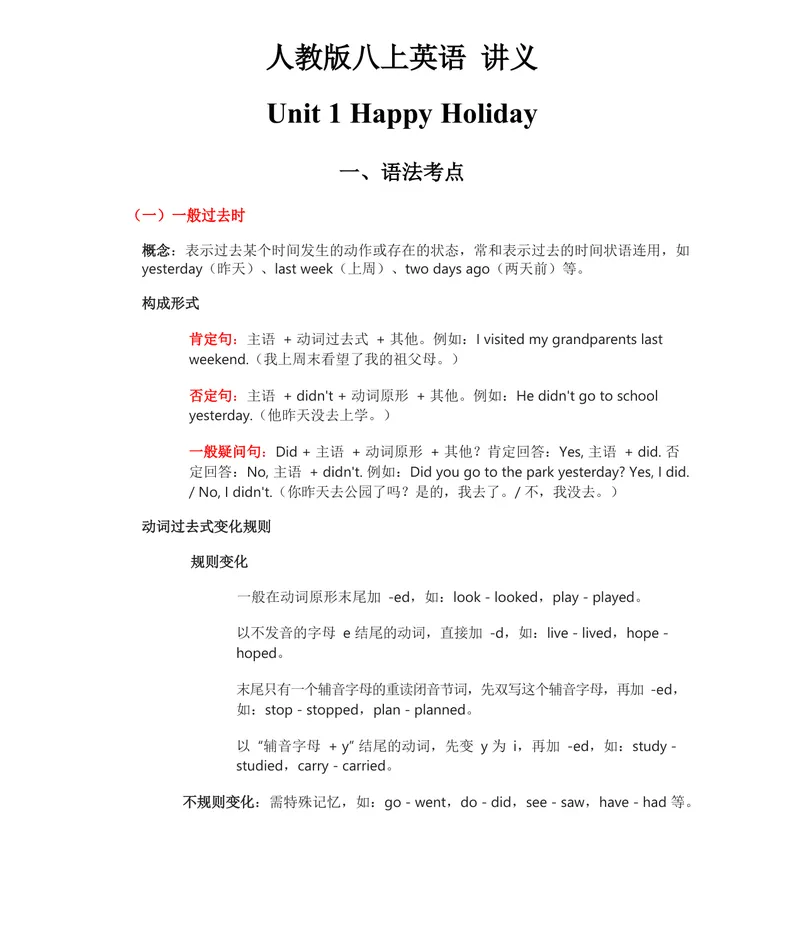
1. pron. 任何人,常用于否定句和疑问句中。例如:Did you meet anyone
interesting?(你遇到有趣的人了吗?)
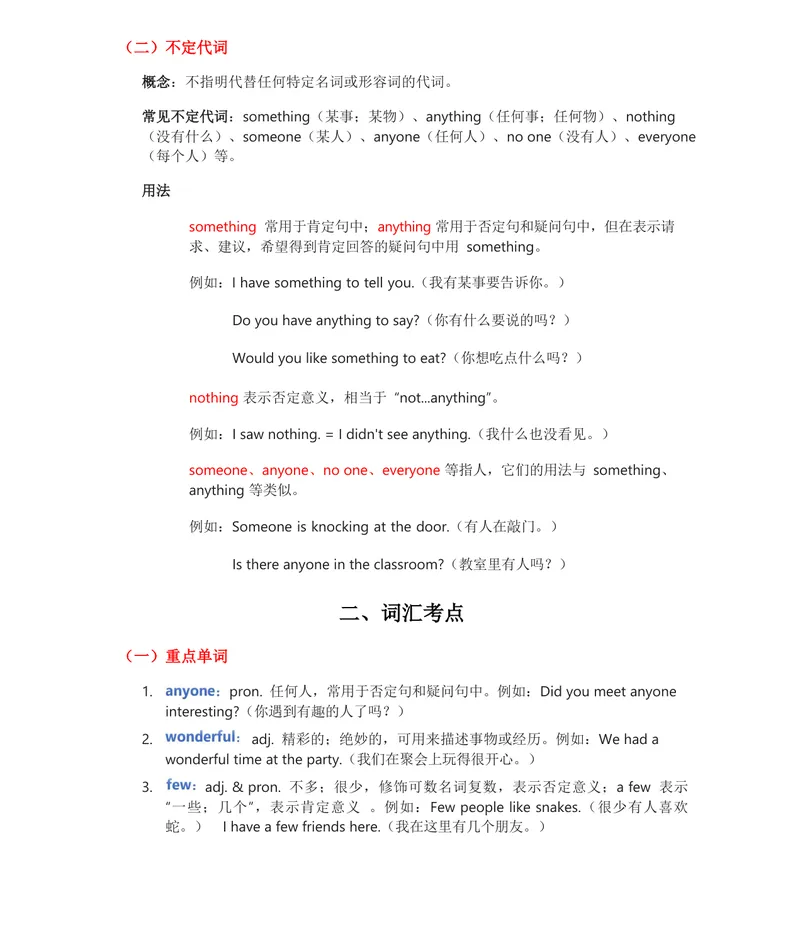
2. adj. 精彩的;绝妙的,可用来描述事物或经历。例如:We had a
wonderful time at the party.(我们在聚会上玩得很开心。)
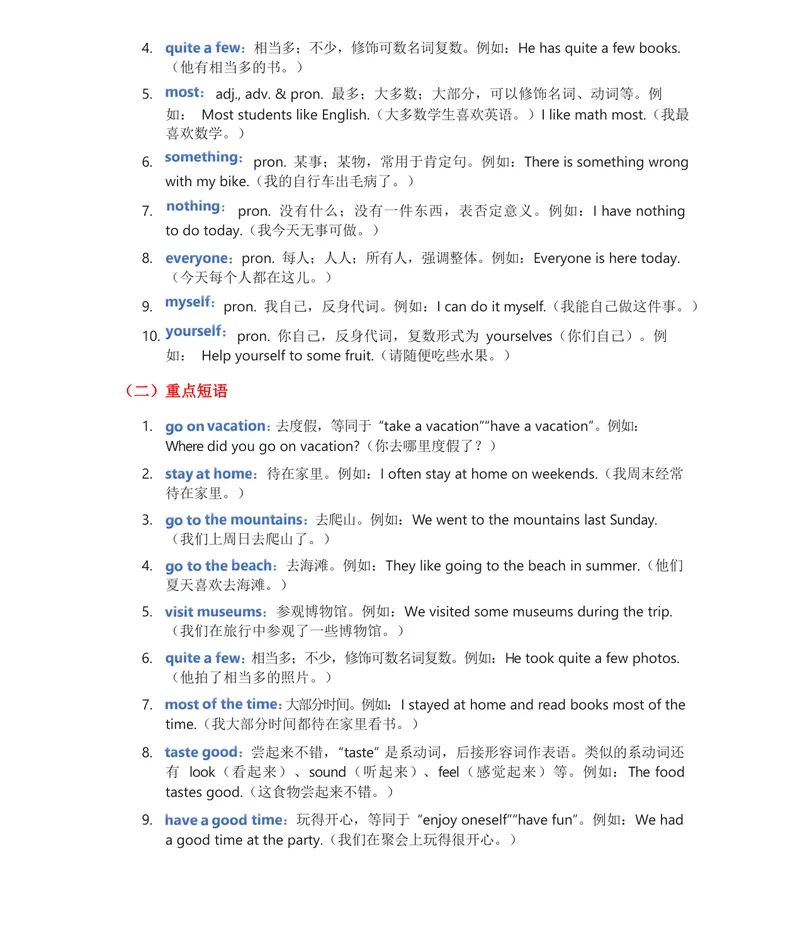
3. adj. & pron. 不多;很少,修饰可数名词复数,表示否定意义;a few 表示
“一些;几个”,表示肯定意义 。例如:Few people like snakes.(很少有人喜欢
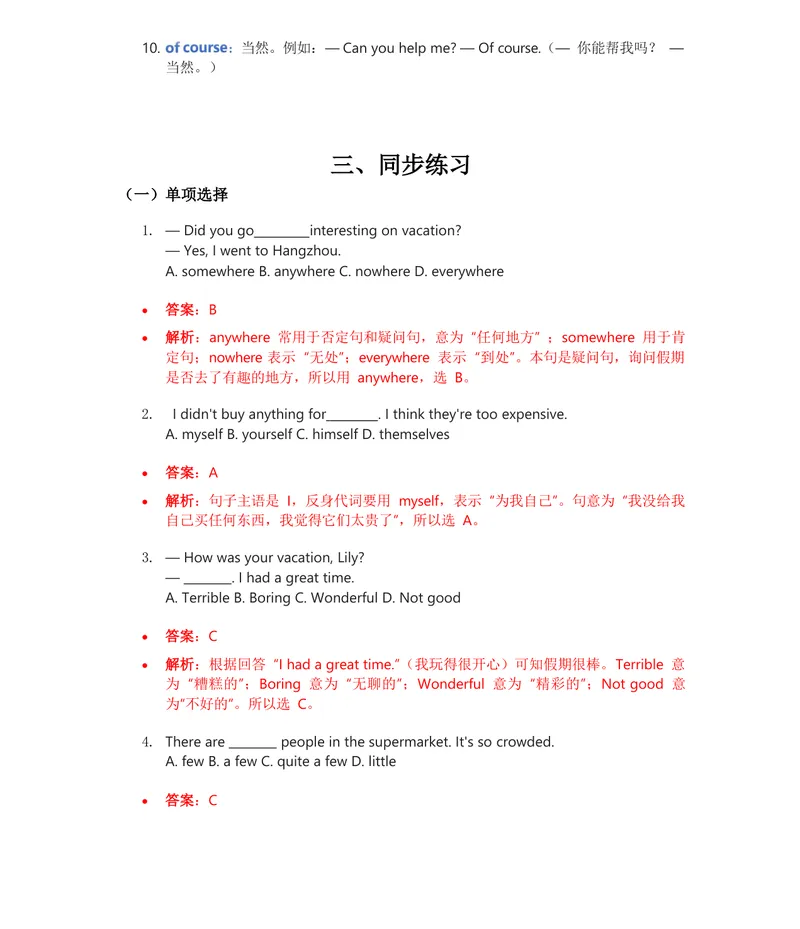
蛇。) I have a few friends here.(我在这里有几个朋友。)4. 相当多;不少,修饰可数名词复数。例如:He has quite a few books.
(他有相当多的书。)
5. adj., adv. & pron. 最多;大多数;大部分,可以修饰名词、动词等。例
如: Most students like English.(大多数学生喜欢英语。)I like math most.(我最
喜欢数学。)
6. pron. 某事;某物,常用于肯定句。例如:There is something wrong
with my bike.(我的自行车出毛病了。)
7. pron. 没有什么;没有一件东西,表否定意义。例如:I have nothing
to do today.(我今天无事可做。)
8. pron. 每人;人人;所有人,强调整体。例如:Everyone is here today.
(今天每个人都在这儿。)
9. pron. 我自己,反身代词。例如:I can do it myself.(我能自己做这件事。)
10. pron. 你自己,反身代词,复数形式为 yourselves(你们自己)。例
如: Help yourself to some fruit.(请随便吃些水果。)
(二)重点短语
1. 去度假,等同于 “take a vacation”“have a vacation”。例如:
Where did you go on vacation?(你去哪里度假了?)
2. 待在家里。例如:I often stay at home on weekends.(我周末经常
待在家里。)
3. 去爬山。例如:We went to the mountains last Sunday.
(我们上周日去爬山了。)
4. 去海滩。例如:They like going to the beach in summer.(他们
夏天喜欢去海滩。)
5. 参观博物馆。例如:We visited some museums during the trip.
(我们在旅行中参观了一些博物馆。)
6. 相当多;不少,修饰可数名词复数。例如:He took quite a few photos.
(他拍了相当多的照片。)
7. 大部分时间。例如:I stayed at home and read books most of the
time.(我大部分时间都待在家里看书。)
8. 尝起来不错,“taste” 是系动词,后接形容词作表语。类似的系动词还
有 look(看起来)、sound(听起来)、feel(感觉起来)等。例如:The food
tastes good.(这食物尝起来不错。)
9. 玩得开心,等同于 “enjoy oneself”“have fun”。例如:We had
a good time at the party.(我们在聚会上玩得很开心。)10. 当然。例如:— Can you help me? — Of course.(— 你能帮我吗? —
当然。)
三、同步练习
(一)单项选择
1. — Did you go interesting on vacation?
— Yes, I went to Hangzhou.
A. somewhere B. anywhere C. nowhere D. everywhere
答案:B
解析:anywhere 常用于否定句和疑问句,意为 “任何地方” ;somewhere 用于肯
定句;nowhere 表示 “无处”;everywhere 表示 “到处”。本句是疑问句,询问假期
是否去了有趣的地方,所以用 anywhere,选 B。
2. I didn't buy anything for . I think they're too expensive.
A. myself B. yourself C. himself D. themselves
答案:A
解析:句子主语是 I,反身代词要用 myself,表示 “为我自己”。句意为 “我没给我
自己买任何东西,我觉得它们太贵了”,所以选 A。
3. — How was your vacation, Lily?
— . I had a great time.
A. Terrible B. Boring C. Wonderful D. Not good
答案:C
解析:根据回答 “I had a great time.”(我玩得很开心)可知假期很棒。Terrible 意
为 “糟糕的”;Boring 意为 “无聊的”;Wonderful 意为 “精彩的”;Not good 意
为“不好的”。所以选 C。
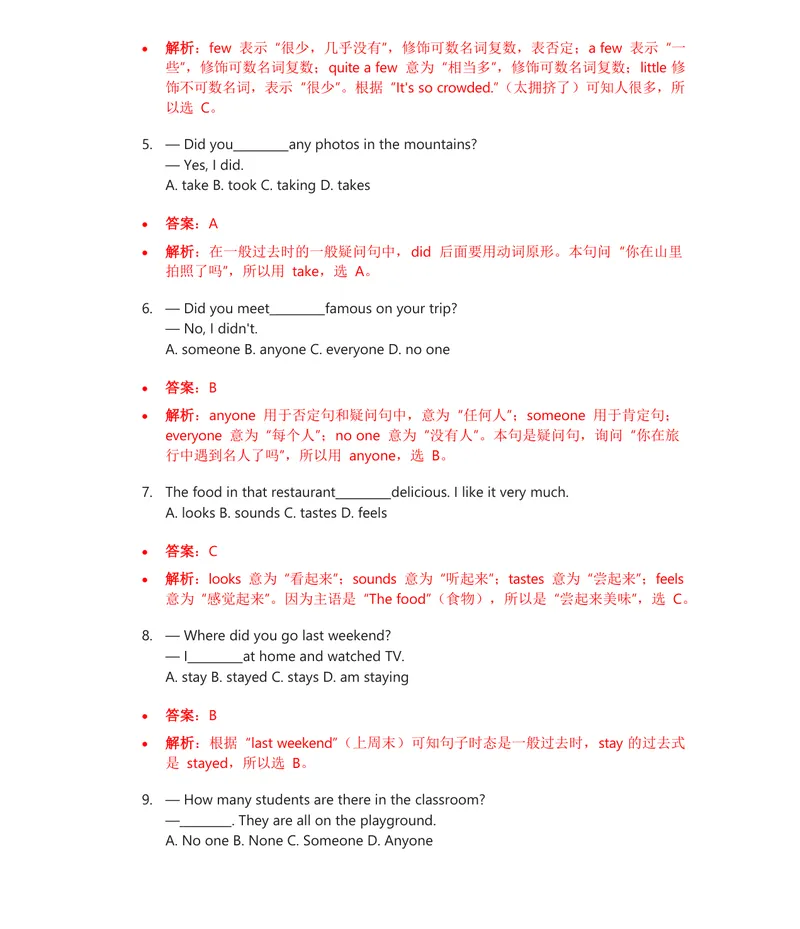
4. There are people in the supermarket. It's so crowded.
A. few B. a few C. quite a few D. little
答案:C 解析:few 表示 “很少,几乎没有”,修饰可数名词复数,表否定;a few 表示 “一
些”,修饰可数名词复数;quite a few 意为 “相当多”,修饰可数名词复数;little 修
饰不可数名词,表示 “很少”。根据 “It's so crowded.”(太拥挤了)可知人很多,所
以选 C。
5. — Did you any photos in the mountains?
— Yes, I did.
A. take B. took C. taking D. takes
答案:A
解析:在一般过去时的一般疑问句中,did 后面要用动词原形。本句问 “你在山里
拍照了吗”,所以用 take,选 A。
6. — Did you meet famous on your trip?
— No, I didn't.
A. someone B. anyone C. everyone D. no one
答案:B
解析:anyone 用于否定句和疑问句中,意为 “任何人”;someone 用于肯定句;
everyone 意为 “每个人”;no one 意为 “没有人”。本句是疑问句,询问 “你在旅
行中遇到名人了吗”,所以用 anyone,选 B。
7. The food in that restaurant delicious. I like it very much.
A. looks B. sounds C. tastes D. feels
答案:C
解析:looks 意为 “看起来”;sounds 意为 “听起来”;tastes 意为 “尝起来”;feels
意为 “感觉起来”。因为主语是 “The food”(食物),所以是 “尝起来美味”,选 C。
8. — Where did you go last weekend?
— I at home and watched TV.
A. stay B. stayed C. stays D. am staying
答案:B
解析:根据 “last weekend”(上周末)可知句子时态是一般过去时,stay 的过去式
是 stayed,所以选 B。
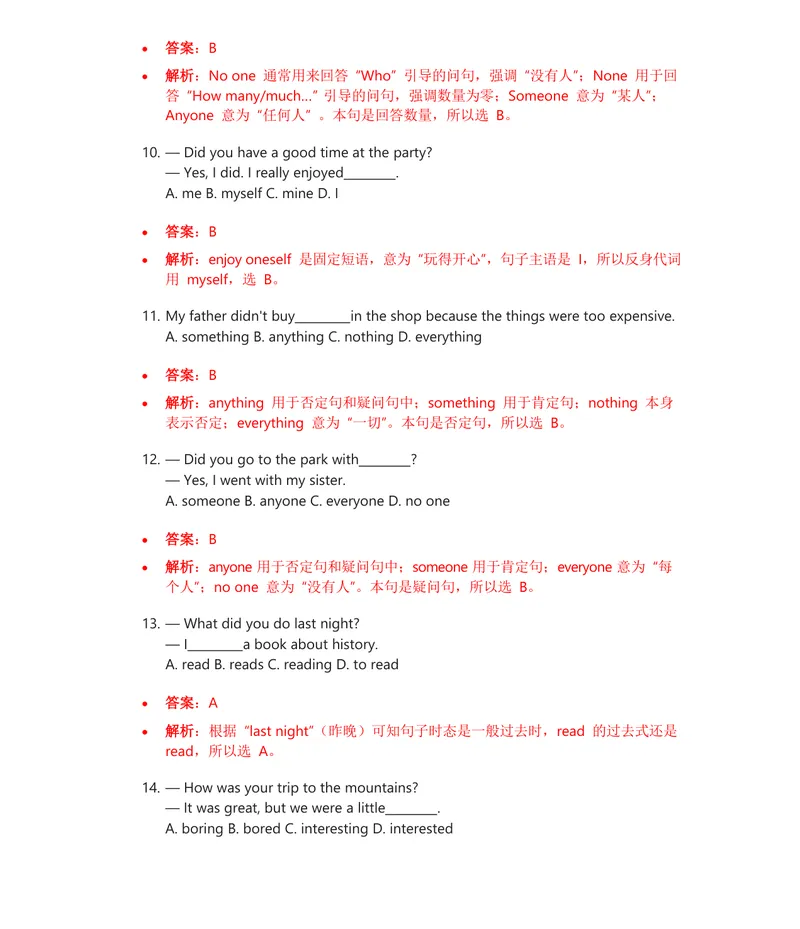
9. — How many students are there in the classroom?
— . They are all on the playground.
A. No one B. None C. Someone D. Anyone 答案:B
解析:No one 通常用来回答 “Who” 引导的问句,强调 “没有人”;None 用于回
答 “How many/much...” 引导的问句,强调数量为零;Someone 意为 “某人”;
Anyone 意为 “任何人” 。本句是回答数量,所以选 B。
10. — Did you have a good time at the party?
— Yes, I did. I really enjoyed .
A. me B. myself C. mine D. I
答案:B
解析:enjoy oneself 是固定短语,意为 “玩得开心”,句子主语是 I,所以反身代词
用 myself,选 B。
11. My father didn't buy in the shop because the things were too expensive.
A. something B. anything C. nothing D. everything
答案:B
解析:anything 用于否定句和疑问句中;something 用于肯定句;nothing 本身
表示否定;everything 意为 “一切”。本句是否定句,所以选 B。
12. — Did you go to the park with ?
— Yes, I went with my sister.
A. someone B. anyone C. everyone D. no one
答案:B
解析:anyone 用于否定句和疑问句中;someone 用于肯定句;everyone 意为 “每
个人”;no one 意为 “没有人”。本句是疑问句,所以选 B。
13. — What did you do last night?
— I a book about history.
A. read B. reads C. reading D. to read
答案:A
解析:根据 “last night”(昨晚)可知句子时态是一般过去时,read 的过去式还是
read,所以选 A。
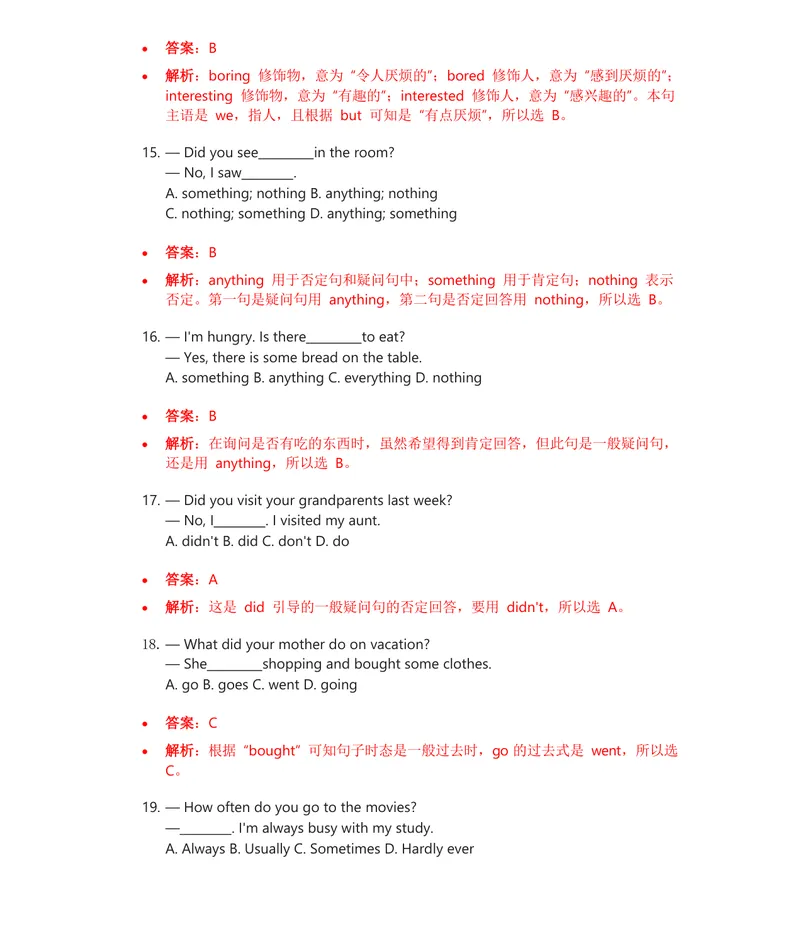
14. — How was your trip to the mountains?
— It was great, but we were a little .
A. boring B. bored C. interesting D. interested 答案:B
解析:boring 修饰物,意为 “令人厌烦的”;bored 修饰人,意为 “感到厌烦的”;
interesting 修饰物,意为 “有趣的”;interested 修饰人,意为 “感兴趣的”。本句
主语是 we,指人,且根据 but 可知是 “有点厌烦”,所以选 B。
15. — Did you see in the room?
— No, I saw .
A. something; nothing B. anything; nothing
C. nothing; something D. anything; something
答案:B
解析:anything 用于否定句和疑问句中;something 用于肯定句;nothing 表示
否定。第一句是疑问句用 anything,第二句是否定回答用 nothing,所以选 B。
16. — I'm hungry. Is there to eat?
— Yes, there is some bread on the table.
A. something B. anything C. everything D. nothing
答案:B
解析:在询问是否有吃的东西时,虽然希望得到肯定回答,但此句是一般疑问句,
还是用 anything,所以选 B。
17. — Did you visit your grandparents last week?
— No, I . I visited my aunt.
A. didn't B. did C. don't D. do
答案:A
解析:这是 did 引导的一般疑问句的否定回答,要用 didn't,所以选 A。
18.— What did your mother do on vacation?
— She shopping and bought some clothes.
A. go B. goes C. went D. going
答案:C
解析:根据 “bought” 可知句子时态是一般过去时,go 的过去式是 went,所以选
C。
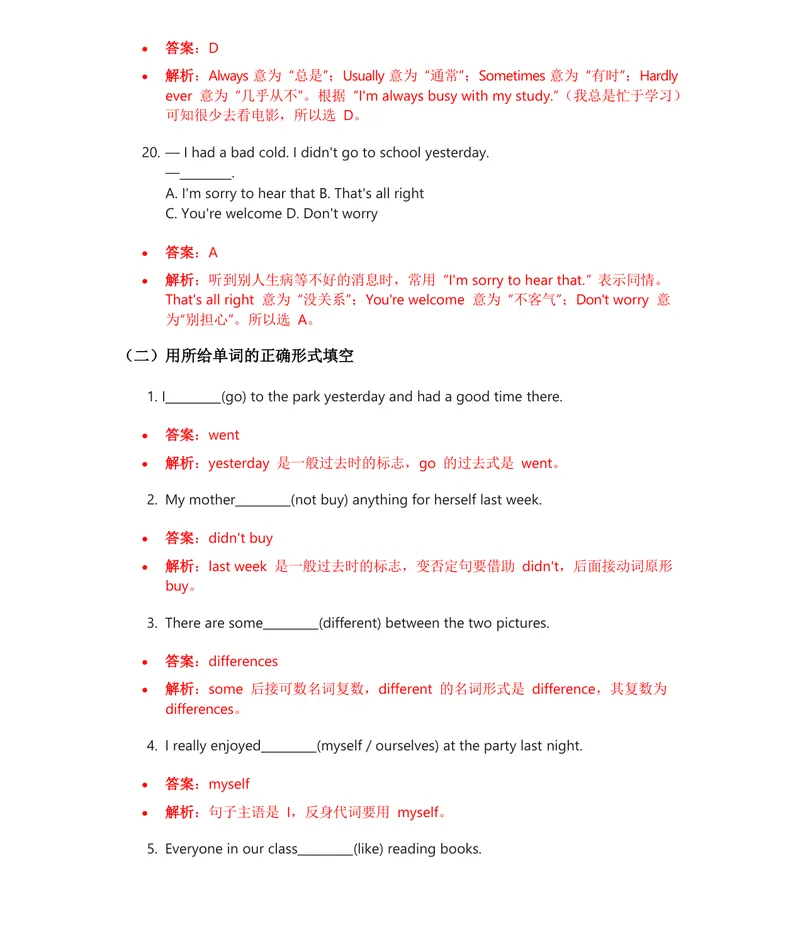
19. — How often do you go to the movies?
— . I'm always busy with my study.
A. Always B. Usually C. Sometimes D. Hardly ever 答案:D
解析:Always 意为 “总是”;Usually 意为 “通常”;Sometimes 意为 “有时”;Hardly
ever 意为 “几乎从不”。根据 “I'm always busy with my study.”(我总是忙于学习)
可知很少去看电影,所以选 D。
20. — I had a bad cold. I didn't go to school yesterday.
— .
A. I'm sorry to hear that B. That's all right
C. You're welcome D. Don't worry
答案:A
解析:听到别人生病等不好的消息时,常用 “I'm sorry to hear that.” 表示同情。
That's all right 意为 “没关系”;You're welcome 意为 “不客气”;Don't worry 意
为“别担心”。所以选 A。
(二)用所给单词的正确形式填空
1. I (go) to the park yesterday and had a good time there.
答案:went
解析:yesterday 是一般过去时的标志,go 的过去式是 went。
2. My mother (not buy) anything for herself last week.
答案:didn't buy
解析:last week 是一般过去时的标志,变否定句要借助 didn't,后面接动词原形
buy。
3. There are some (different) between the two pictures.
答案:differences
解析:some 后接可数名词复数,different 的名词形式是 difference,其复数为
differences。
4. I really enjoyed (myself / ourselves) at the party last night.
答案:myself
解析:句子主语是 I,反身代词要用 myself。
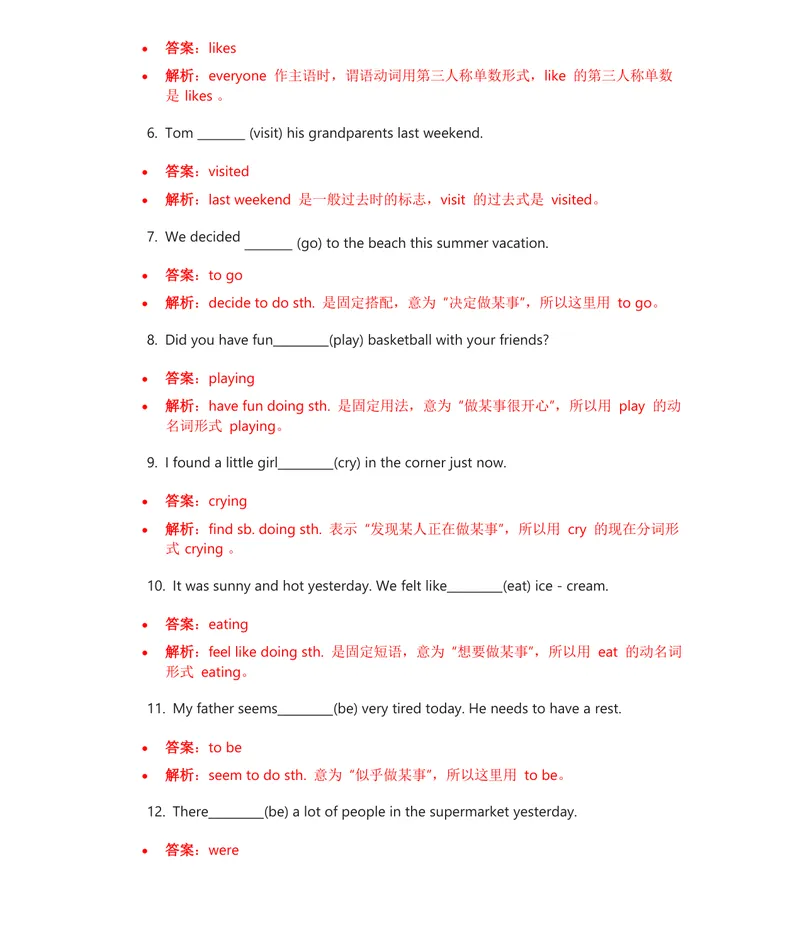
5. Everyone in our class (like) reading books. 答案:likes
解析:everyone 作主语时,谓语动词用第三人称单数形式,like 的第三人称单数
是 likes 。
6. Tom (visit) his grandparents last weekend.
答案:visited
解析:last weekend 是一般过去时的标志,visit 的过去式是 visited。
7. We decided
(go) to the beach this summer vacation.
答案:to go
解析:decide to do sth. 是固定搭配,意为 “决定做某事”,所以这里用 to go。
8. Did you have fun (play) basketball with your friends?
答案:playing
解析:have fun doing sth. 是固定用法,意为 “做某事很开心”,所以用 play 的动
名词形式 playing。
9. I found a little girl (cry) in the corner just now.
答案:crying
解析:find sb. doing sth. 表示 “发现某人正在做某事”,所以用 cry 的现在分词形
式 crying 。
10. It was sunny and hot yesterday. We felt like (eat) ice - cream.
答案:eating
解析:feel like doing sth. 是固定短语,意为 “想要做某事”,所以用 eat 的动名词
形式 eating。
11. My father seems (be) very tired today. He needs to have a rest.
答案:to be
解析:seem to do sth. 意为 “似乎做某事”,所以这里用 to be。
12. There (be) a lot of people in the supermarket yesterday.
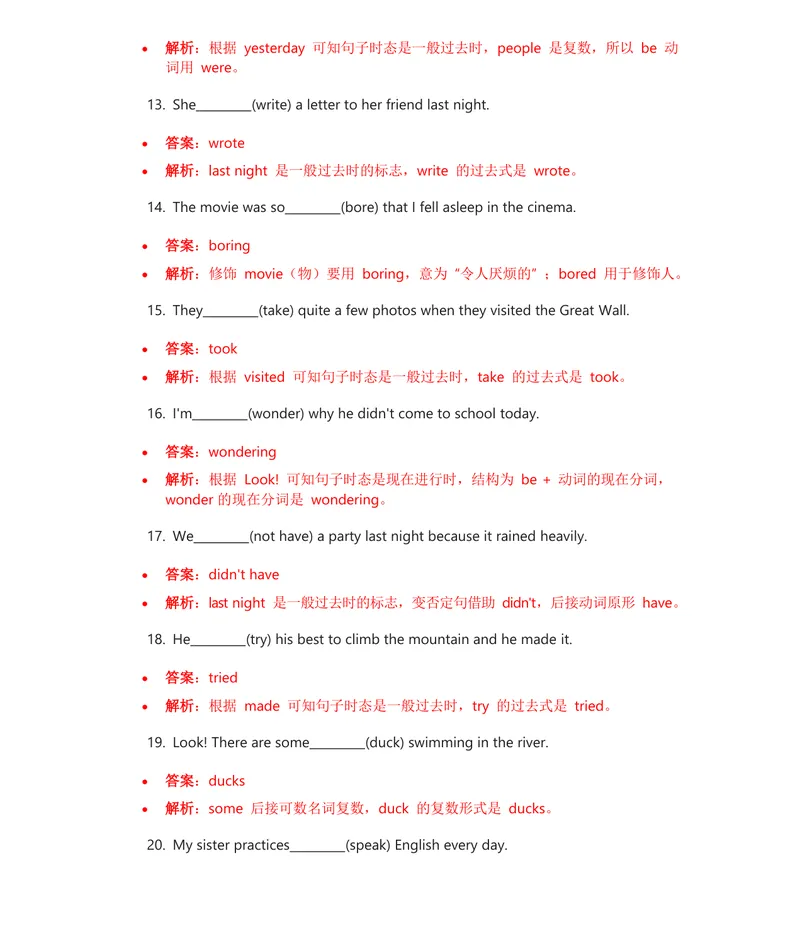
答案:were 解析:根据 yesterday 可知句子时态是一般过去时,people 是复数,所以 be 动
词用 were。
13. She (write) a letter to her friend last night.
答案:wrote
解析:last night 是一般过去时的标志,write 的过去式是 wrote。
14. The movie was so (bore) that I fell asleep in the cinema.
答案:boring
解析:修饰 movie(物)要用 boring,意为 “令人厌烦的” ;bored 用于修饰人。
15. They (take) quite a few photos when they visited the Great Wall.
答案:took
解析:根据 visited 可知句子时态是一般过去时,take 的过去式是 took。
16. I'm (wonder) why he didn't come to school today.
答案:wondering
解析:根据 Look! 可知句子时态是现在进行时,结构为 be + 动词的现在分词,
wonder 的现在分词是 wondering。
17. We (not have) a party last night because it rained heavily.
答案:didn't have
解析:last night 是一般过去时的标志,变否定句借助 didn't,后接动词原形 have。
18. He (try) his best to climb the mountain and he made it.
答案:tried
解析:根据 made 可知句子时态是一般过去时,try 的过去式是 tried。
19. Look! There are some (duck) swimming in the river.
答案:ducks
解析:some 后接可数名词复数,duck 的复数形式是 ducks。
20. My sister practices (speak) English every day. 答案:speaking
解析:practice doing sth. 是固定用法,意为 “练习做某事”,所以用 speak 的动名
词形式 speaking。
(三)阅读理解
Last summer vacation, I went to Beijing with my family. We visited many
interesting places. On the first day, we went to Tian'anmen Square. It was really
large and there were many people there. We took some photos. Then we went to
the Palace Museum. I learned a lot about Chinese history there. On the second
day, we visited the Great Wall. It was very long and wonderful. We walked on the
Great Wall for a long time. We were tired but happy. On the third day, we went
shopping. I bought some gifts for my friends. We had a great time in Beijing.
1. ( )Where did the writer go last summer vacation?
A. Shanghai. B. Beijing. C. Hangzhou. D. Guangzhou.
答案:B。解析:根据 “Last summer vacation, I went to Beijing with my family.” 可
知作者去了北京。
2. ( )What did they do on the first day?
A. They visited the Great Wall.
B. They went shopping.
C. They visited Tian'anmen Square and the Palace Museum.
D. They took a walk.
答案:C。解析:根据 “On the first day, we went to Tian'an men Square...Then we
went to the Palace Museum.” 可知第一天他们去了天安门广场和故宫博物院。
3. ( )How did they feel after walking on the Great Wall?
A. Tired and sad. B. Tired but happy. C. Relaxed. D. Bored.
答案:B。解析:根据 “We walked on the Great Wall for a long time. We were tired
but happy.” 可知他们很累但很开心。
4. ( )What did the writer do on the third day?
A. Bought some gifts. B. Took some photos.
C. Learned about Chinese history. D. Visited an interesting place.答案:A。解析:根据 “On the third day, we went shopping. I bought some gifts
for my friends.” 可知第三天作者买了一些礼物。
5. ( )Which of the following is TRUE?
A. The writer went to Beijing alone.
B. They didn't take any photos.
C. They had a good time in Beijing.
D. They visited the Great Wall on the first day.
答案:C。解析:根据 “We had a great time in Beijing.” 可知他们在北京玩得很开
心。人教版八上英语 讲义
Unit 2 Home sweet home
一、语法考点
(一)Can/Could 引导的请求与许可句型
1. 表示请求
①结构:Can/Could you please + 动词原形 + 其他?其中,Could you
please...? 比 Can you please...? 语气更委婉。
②回答:肯定回答常用 “Sure./Of course./No problem.” 等;否定回答常用
“Sorry, but...” 并说明理由。例如:Could you please sweep the floor?(你能
扫一下地吗?)Sure. I'll do it right away.(当然,我马上就
做。)
2. 表示请求许可
①结构:Can/Could I + 动词原形 + 其他?同样,Could I...? 语气更委婉。
②回答:肯定回答用 “Yes, you can.”;否定回答用 “Sorry, you can't.”
或“Sorry, but...”。例如:Could I hang out with my friends after school?(放
学后我能和朋友们出去玩吗?) Sorry, you can't. You have to finish
your homework first.(抱歉,你不能。你得先完成作业。)
(二)一般现在时表将来
在一些表示位移的动词(如 go, come, leave, arrive 等)中,常用一般现在时
表示按计划、安排即将发生的动作,通常会有表示将来的时间状语。例如: The
train leaves at 6:30 tomorrow morning.(火车明天早上 6:30 发车。)
二、词汇考点
(一)重点单词
1. chore:可数名词,意为 “杂务;家务劳动” ,常用复数形式 chores。例
如:I have a lot of chores to do on weekends.(我周末有很多家务要
做。)2. sweep:动词,意为 “打扫;清扫”,过去式为 swept。常见短语 sweep
the
floor(扫地)。例如:My mother asks me to sweep the floor every day.
(妈妈让我每天扫地。)
3. floor:名词,意为 “地板;地面” 。也可表示 “楼层” ,英式英语中与序
数词连用时,the 常置于序数词前;美式英语中 the 常省略。例如:There
is a book on the floor.(地板上有一本书。)The library is on the
second
floor.(图书馆在二楼。)
4. borrow:动词,意为 “借;借用” ,常用结构 borrow sth. from sb.(从
某人那里借某物) 。例如:I often borrow books from the library.(我
经
常从图书馆借书。)
5. lend:动词,意为 “借给;借出” ,常用结构 lend sth. to sb. = lend sb.
sth.
(把某物借给某人) 。例如:Can you lend your pen to me? = Can you
lend me your pen?(你能把你的钢笔借给我吗?)
6. invite:动词,意为 “邀请” ,名词形式为 invitation。常见短语 invite
sb.
to do sth. (邀请某人做某事);invite sb. to + 地点(邀请某人去某地) 。
例如:I want to invite my friends to my birthday party.(我想邀请我的
朋
友们参加我的生日派对。)
7. prepare:动词,意为 “使做好准备;把…… 准备好” ,常见短语 prepare
for(为…… 做准备);prepare sth(. 准备某物) 。例如:We are
preparing
for the exam.(我们正在为考试做准备。)
8. reason:可数名词,意为 “原因;理由” 。例如:The reason for his
being
late is that he missed the bus.(他迟到的原因是错过了公交车。)9. neighbor:可数名词,意为 “邻居” 。例如:My neighbor is very kind.
(我的邻居非常友善。)
10. care:动词,意为 “在意;担忧;关心” ,常见短语 care about(关心;
在意);care for(照顾;照料) 。例如:We should care about the
environment.(我们应该关心环境。)
(二)重点短语
1. help out:意为 “帮助分担工作、解决难题等” 。例如:I often help out
with housework at home.(我在家经常帮忙做家务。)
2. in order to:意为 “目的是;为了” ,后接动词原形,引导目的状语。例
如:He gets up early in order to catch the early bus.(他早起是为了赶上
早班车。)
3. depend on:意为 “依靠;信赖” 。例如:Children should not depend
too much on their parents.(孩子们不应该过于依赖他们的父母。)
4. take care of:意为 “照顾;照料” ,等同于 look after。例如:We
should take care of the old.(我们应该照顾老人。)
5. as a result:意为 “结果;因此” ,常位于句首,并用逗号与句子其他部
分隔开。例如:He didn't study hard. As a result, he failed the exam.(他
学习不努力。结果,他考试不及格。)
三、同步练习
(一)单项选择1. — Could you please the floor? It's dirty.
— Sure.
A. sweeping B. sweep C. to sweep D. swept
答案:B
解析:Could you please 后接动词原形,所以选 B。
2. — Can I your bike?
— Sorry, I've lent it to Tom.
A. borrow B. lend C. keep D. buy
答案:A
解析:根据回答可知是询问能否借对方的自行车,borrow 表示 “借入”,lend
表示 “借出”,所以选 A。
3. — I invite my friends to the party?
— Sure. But you should clean the room first.
A. Must B. Need C. Can D. Should
答案:C
解析:此处是请求许可,询问是否能邀请朋友参加派对,用 Can I...? 句型,
所以选 C。
4. My mother often asks me the dishes after dinner.
A. do B. to do C. doing D. does
答案:B
解析:ask sb. to do sth. 是固定搭配,意为 “让某人做某事”,所以选 B。
5. — Could you help me the books to the classroom?
— No problem.
A. take B. taking C. takes D. took
答案:A
解析:help sb. (to) do sth. 表示 “帮助某人做某事”,所以用动词原形 take,
选A。
6. — What are you doing, Li Ming?
— I'm my pen. I can't find it.
A. looking at B. looking for C. looking after D. looking like答案:B
解析:根据 “I can't find it.” 可知是在找钢笔,look for 意为 “寻找”,所以
选B。
7. — Why didn't you go to the party last night?
— Because I had to my sick mother at home.
A. look at B. look up C. look for D. look after
答案:D
解析:根据 “my sick mother” 可知是要照顾生病的妈妈,look after 意
为“照顾”,所以选 D。
8. — Could you please not noise here? The baby is sleeping.
— Sorry, we won't.
A. make B. making C. to make D. made
答案:A
解析:Could you please not 后接动词原形,make noise 意为 “制造噪音”,
所以选 A。
9. My father home at 6:00 p.m. every day.
A. arrive B. arrives C. arrived D. will arrive
答案:B
解析:由 every day 可知用一般现在时,主语 My father 是第三人称单数,
动词用第三人称单数形式 arrives,所以选 B。
10. — Can I use your dictionary?
— . Here you are.
A. Of course not B. I'm sorry C. Of course D. No, you can't
答案:C
解析:根据 “Here you are.” 可知同意对方使用字典,Of course 意为 “当然
可以”,所以选 C。
11. — do you clean your room?
— Once a week.
A. How long B. How often C. How soon D. How far
答案:B解析:根据 “Once a week.” 可知询问频率,用 How often,所以选 B。
12.1W2.e should our parents. They work hard for us.
A. care about B. hear about C. talk about D. learn about
答案:A
解析:care about 意为 “关心”,hear about 意为 “听说”,talk about 意为
“谈论”,learn about 意为 “了解”,此处表示应该关心父母,所以选
A。
13. — Could you tell me how to get to the library?
— . I'm new here, too.
A. Sure B. I'm sorry C. No problem D. Of course
答案:B
解析:因为回答者也是新来的,无法提供帮助,所以用 I'm sorry 表示歉意,
选 B 。
14. My sister often helps me my English.
A. with B. for C. in D. at
答案:A
解析:help sb. with sth. 是固定搭配,意为 “在某方面帮助某人”,所以选 A。
15. — Can I have some more bread?
— . There's still a lot left.
A. No, you can't B. Of course not C. Yes, you can D. That's all right
答案:C
解析:根据 “There's still a lot left.” 可知还有很多面包,同意对方再吃一些,
所以选 C。
16. — Could you please pass me the book?
— .
A. Yes, I could B. No, I couldn't C. Sure. Here you are D. I can't
答案:C
解析:对于 Could you please...? 的肯定回答常用 Sure. Here you are 等,
所以选 C。A、B 选项回答方式错误;D 选项没有 C 选项礼貌。
17. He got up early catch the early bus.
A. in order to B. so that C. because D. because of答案:A
解析:in order to 后接动词原形,表示目的;so that 后接从句;because 后
接从句;because of 后接名词、代词或动名词。此处 catch 是动词原形,
所以选 A。
18. — Do you often do chores at home?
— Yes. I often the clothes.
A. do B. make C. fold D. take
答案:C
解析:fold the clothes 意为 “叠衣服”,是做家务的一种,所以选 C。
19. — I leave now?
— No, you can't. You have to finish your work first.
A. Must B. May C. Need D. Can
答案:D
解析:根据回答可知是请求许可,用 Can I...? 句型,所以选 D。
20. My neighbor is a kind woman. She often me with my problems.
A. helps B. help C. helping D. to help
答案:A
解析:由 often 可知用一般现在时,主语 She 是第三人称单数,动词用第
三人称单数形式 helps,所以选 A。
(二)用所给单词的正确形式填空
1. Could you please (clean) your room? It's a
mess.
答案:clean
解析:Could you please 后接动词原形,所以填 clean。
2. My mother often asks me (help) her with housework.
答案:to help
解析:ask sb. to do sth. 是固定搭配,所以填 to help。3. I need (borrow) some money from my friend because I left my wallet
at home.
答案:to borrow
解析:need 作实义动词时,常用结构为 need to do sth.,所以填 to borrow。
4. He (sweep) the floor an hour ago.
答案:swept
解析:由 an hour ago 可知用一般过去时,sweep 的过去式是 swept,所
以填 swept。
5. We should learn (take) care of ourselves.
答案:to take
解析:learn to do sth. 意为 “学习做某事”,所以填 to take。
6. My sister is good at (fold) the clothes.
答案:folding
解析:be good at 后接动词的动名词形式,所以填 folding。
7. Could you please not (play) computer games? It's time to go to bed.
答案:play
解析:Could you please not 后接动词原形,所以填 play。
8. She often helps her mother (do) the dishes after dinner.
答案:(to) do
解析:help sb. (to) do sth. 表示 “帮助某人做某事”,所以填 (to) do。
9. My father (not arrive) home until 8:00 p.m. yesterday.
答案:didn't arrive
解析:由 yesterday 可知用一般过去时,否定句借助 didn't,后接动词原形
arrive,所以填 didn't arrive。
10.We are looking forward to (invite) our friends to our new house.答案:inviting
解析:look forward to 后接动词的动名词形式,所以填 inviting。
11.It's important for us (learn) English well.
答案:to learn
解析:It's + 形容词 + for sb. + to do sth. 是固定句型,意为 “对某人来说
做某事是…… 的”,所以填 to learn。
12.He is busy (prepare) for the exam these
答案:preparing
解析:be busy doing sth. 意为 “忙于做某事”,所以填 preparing。
13.She (lend) her book to me last week.
答案:lent
解析:由 last week 可知用一般过去时,lend 的过去式是 lent,所以填 lent。
14.My mother asked me (not make) noise in the library.
答案:not to make
解析:ask sb. not to do sth. 意为 “让某人不要做某事”,所以填 not to make。
15.We should care more about (other).
答案:others
解析:others 意为 “其他人”,此处表示应该多关心他人,所以填 others。
16.I'm sorry for (be) late for class again.
答案:being
解析:for 是介词,后接动词的动名词形式,所以填 being。
17.My neighbor's son always helps me (carry) heavy things.
答案:(to) carry
解析:help sb. (to) do sth. 表示 “帮助某人做某事”,所以填 (to) carry。18.She needs (buy) some new clothes for the party.
答案:to buy
解析:need 作实义动词时,常用结构为 need to do sth.,所以填 to buy。
19.My father often tells me (clean) my room by myself.
答案:to clean
解析:tell sb. to do sth. 意为 “告诉某人做某事”,所以填 to clean。
20.They (go) to the park tomorrow if it doesn't rain.
答案:will go
解析:由 tomorrow 可知用一般将来时,if 引导的条件状语从句遵循 “主将
从现” 原则,从句用一般现在时,主句用一般将来时,所以填 will go。
(三)阅读理解
When we talk about home, we often think of its warmth and comfort. A
home is not just a building where we live; it's a place full of love and care.
In my family, we all do our part to make our home a better place. My
mother always keeps the house clean. She sweeps the floor and cleans the
rooms every day. She also cooks delicious meals for us. My father often helps
with the heavier chores. He takes out the rubbish and fixes things around the
house when they are broken.
As for me, I usually help with some small chores. I feed the fish and water
the plants. Sometimes, I also help my mother set the table before dinner. On
weekends, my parents and I often clean up the house together. We work as a
team, and it makes our home look tidy and beautiful.We also like to decorate our home. We hang up photos of our family on the
walls. These photos show our happy moments together. We also put some
flowers in the living room. They make the house smell nice and feel more
comfortable.
Home is where we feel safe and loved. We should all do something to
make our homes better.
1. ( )What does the writer think of home?
A. It's just a building.
B. It's a place full of love and comfort.
C. It's only a place to live.
D. It's a place with many chores.
答案:B
解析:根据文章第一段 “A home is not just a building where we live; it's a
place full of love and care.” 可知,作者认为家是充满爱和关怀的地方,B 选
项正确。A 选项 “只是一座建筑” 和 C 选项 “只是居住的地方” 与原文不符;
D 选项 “有很多家务的地方” 不是作者对家的主要看法,所以选 B。
2. ( )What does the writer's mother do at home?
A. She takes out the rubbish.
B. She fixes things around the house.
C. She keeps the house clean and cooks meals.
D. She feeds the fish and waters the plants.
答案:C
解析: 从文章第二段 “My mother always keeps the house clean. She
sweeps the floor and cleans the rooms every day. She also cooks delicious
meals for us.” 可知,作者的妈妈保持房子干净并且做饭,C 选项正确。A 选项
“倒垃圾” 和 B 选项 “修理房子周围的东西” 是作者爸爸做的;D 选项 “喂
鱼和浇花” 是作者做的,所以选 C。
3. ( )What small chores does the writer usually do?
A. He helps his mother clean the rooms.
B. He takes out the rubbish.C. He feeds the fish and waters the plants.
D. He helps his father fix things.
答案:C
解析:根据文章第三段 “As for me, I usually help with some small chores. I
feed the fish and water the plants.” 可知,作者通常做的小家务是喂鱼和浇
花,C 选项正确。A 选项 “帮妈妈打扫房间”、B 选项 “倒垃圾” 和 D 选项
“帮爸爸修理东西” 在文中均未提及是作者做的,所以选 C。
4. ( )How do they make their home look tidy and beautiful?
A. They buy a lot of new furniture.
B. They clean up the house together on weekends.
C. They invite friends to help.
D. They only let the mother clean the house.
答案:B
解析:由文章第三段 “On weekends, my parents and I often clean up the
house together. We work as a team, and it makes our home look tidy and
beautiful.” 可知,他们周末一起打扫房子让家看起来整洁漂亮,B 选项正确。A
选项 “买很多新家具”、C 选项 “邀请朋友帮忙” 和 D 选项 “只让妈妈打扫房
子” 在文中均未提及,所以选 B。
5. ( )Why do they hang up photos on the walls?
A. Because the photos show their happy moments together.
B. Because the photos are very expensive.
C. Because they want to make the house look bigger.
D. Because they like taking photos.
答案:A
解析:从文章第四段 “We hang up photos of our family on the walls.
These photos show our happy moments together.” 可知,他们在墙上挂照
片是因为照片展示了他们在一起的快乐时光,A 选项正确。B 选项 “照片很
贵”、C选项“让房子看起来更大” 和 D 选项 “他们喜欢拍照” 在文中均未提
及,所以选A。人教版八上英语 讲义
Unit 3 Same or Different
一、语法考点
(一)形容词和副词的比较级
1. 构成规则
①一般在词尾加 -er。例如:tall - taller,fast - faster。
②以字母 e 结尾的词,加 -r。例如:nice - nicer,fine - finer。
③重读闭音节词词尾只有一个辅音字母时,先双写这个辅音字母,再加 -er。
例如:big - bigger,hot - hotter。
④以 “辅音字母 + y” 结尾的双音节词,先把 y 改为 i,再加 -er。例如:
happy - happier,early - earlier。
⑤多音节词和部分双音节词在前面加 more。例如:interesting - more
interesting,outgoing - more outgoing。
2. 用法:表示两者之间的比较,常用 “比较级 + than” 结构。例如:My sister is taller
than me.(我姐姐比我高。)
3. 特殊句型
①“as + 形容词 / 副词原级 + as” 表示 “和…… 一样”。例如:Tom is as tall
as Jack.(汤姆和杰克一样高。)
②“not as/so + 形容词 / 副词原级 + as” 表示 “不如……”。例如:This book
is not as interesting as that one.(这本书不如那本书有趣。)
③“比较级 + and + 比较级” 表示 “越来越……”。例如:It's getting colder
and colder.(天气越来越冷了。)
④“the + 比较级,the + 比较级” 表示 “越……,越……”。例如:The more
you read, the more you know.(你读得越多,知道得就越多。)
(二)选择疑问句
1. 结构:一般疑问句 + or + 选择部分?例如:Do you like apples or bananas?
(你喜欢苹果还是香蕉?)2. 回答:不能用 yes 或 no 回答,需从提供的选项中选择其一进行回答。例如:
I like apples.(我喜欢苹果。)
二、词汇考点
(一)重点单词
1. outgoing:adj. 爱交际的;友好的;外向的。比较级为 more outgoing。例如:
She is more outgoing than her sister.(她比她姐姐更外向。)
2. better:adj. & adv. 较好的(地);更好的(地),是 good/well 的比较级。
例如:This idea is better.(这个主意更好。)He plays basketball better than
me.
(他篮球打得比我好。)
3. loudly:adv. 喧闹地;大声地;响亮地。比较级为 more loudly。例如:Please
don't speak so loudly.(请不要这么大声说话。)
4. quietly:adv. 轻声地;轻柔地;安静地。比较级为 more quietly。例如:The baby
is sleeping. Please talk quietly.(宝宝在睡觉,请轻声说话。)
5. hard - working:adj. 工作努力的;辛勤的。比较级为 more hard - working。
例如:My classmates are all hard - working.(我的同学们都很勤奋。)
6. competition:n. 比赛;竞赛;竞争。例如:We will have a singing competition
next week.(下周我们将举行一场歌唱比赛。)
7. fantastic:adj. 极好的;了不起的。例如:We had a fantastic time at the party.
(我们在聚会上玩得很开心。)
8. which:pron. & adj. 哪一个;哪一些。例如:Which book do you like best?
(你最 喜欢哪本书?)
9. clearly:adv. 清楚地;清晰地;明白地。比较级为 more clearly。例如:Speak
clearly so that everyone can hear you.(说清楚点,以便每个人都能听到你。)
10. win:v. 获胜;赢;赢得。过去式为 won。例如:Our team won the game.(我
们队赢了这场比赛。)
(二)重点短语
1. care about:关心;在意。例如:We should care about our friends.(我们应该
关心我们的朋友。)
2. be different from:与…… 不同。例如:My lifestyle is different from yours.
(我的生活方式和你的不同。)3. as long as:只要;既然。例如:You can get good grades as long as you
study hard.(只要你努力学习,你就能取得好成绩。)
4. bring out:使显现;使表现出。例如:This kind of music can bring out the
best in her.(这种音乐能激发出她最好的一面。)
5. the same as:和…… 相同;与…… 一致。例如:His bike is the same as mine.
(他的自行车和我的一样。)
三、同步练习
(一)单项选择
1. My brother is than me. He likes talking with others.
A. outgoing B. more outgoing C. most outgoing D. the most outgoing
答案:B
解析:由 than 可知用比较级,outgoing 是多音节词,其比较级是 more
outgoing,所以选 B。
2. — Who sings in your class?
— Li Ming does.
A. better B. best C. good D. well
答案:B
解析:in your class 表示范围,在班级里比较唱歌情况,用最高级,sing 是
动词,用副词 well 的最高级 best 修饰,所以选 B。
3. My sister is as as her classmate Mary.
A. tall B. taller C. tallest D. the tallest
答案:A
解析:“as + 形容词原级 + as” 表示 “和…… 一样”,所以用 tall 的原级,
选 A 。
4. — Which is , the sun, the moon or the earth?
— The moon.
A. small B. smaller C. smallest D. the smallest
答案:D解析:the sun, the moon or the earth 三者比较,用最高级,最高级前要加
the,所以选 D。
5. — Who runs in your school?
— Tom does.
A. fast B. faster C. fastest D. more fast
答案:C
解析:in your school 表示范围,在学校里比较跑步速度,用最高级,fast 的
最高级是 fastest,所以选 C。
6. — Is your friend than you?
— No, he is as as me.
A. thin; thin B. thinner; thinner C. thin; thinner D. thinner; thin
答案:D
解析:第一空由 than 可知用比较级 thinner;第二空 “as + 形容词原级 +
as”,用 thin 的原级,所以选 D。
7. My mother is than my father.
A. funny B. funnier C. funniest D. the funniest
答案:B
解析:由 than 可知用比较级,funny 的比较级是 funnier,所以选 B。
8. — Which subject do you like , math or English?
— English.
A. well B. better C. best D. the best
答案:B
解析:math or English 两者比较,用比较级,like 是动词,用 well 的比较
级better 修饰,所以选 B。
9. — What do you think of the movie?
— It's than the last one.
A. interesting B. more interesting C. most interesting D. the most interesting
答案:B
解析:由 than 可知用比较级,interesting 是多音节词,其比较级是 more
interesting,所以选 B。10. My friend is good at .
A. sing B. to sing C. singing D. sings
答案:C
解析:be good at doing sth. 表示 “擅长做某事”,所以用 sing 的动名词形
式singing,选 C。
11. — Is Tom than Sam?
— No, he isn't. Sam is taller.
A. tall B. taller C. tallest D. the tallest
答案:B
解析:由 than 可知用比较级,所以选 B。
12. — Who listens , Tom, Jack or Bill?
— Jack does.
A. carefully B. more carefully C. most carefully D. the most carefully
答案:D
解析:Tom, Jack or Bill 三者比较,用最高级,listen 是动词,用副词 carefully
的最高级 the most carefully 修饰,所以选 D。最高级前要加
the。
13. My father is than my mother.
A. busy B. busier C. busiest D. the busiest
答案:B
解析:由 than 可知用比较级,busy 的比较级是 busier,所以选 B。
14. — Which city is , Beijing or Shanghai?
— It's hard to say.
A. beautiful B. more beautiful C. most beautiful D. the most beautiful
答案:B
解析:Beijing or Shanghai 两者比较,用比较级,beautiful 是多音节词,
其比较级是 more beautiful,所以选 B。
15. — Who writes in your class?
— Lily does.
A. carefully B. more carefully C. most carefully D. the most carefully
答案:D解析:in your class 表示范围,在班级里比较书写情况,用最高级,write 是
动词,用副词 carefully 的最高级 the most carefully 修饰,所以选 D。最
高级前要加 the。
16. My sister is than me at sports.
A. good B. well C. better D. best
答案:C
解析:由 than 可知用比较级,good/well 的比较级是 better,所以选 C。
17. — Which is , a bike, a bus or a car?
— A bike.
A. cheap B. cheaper C. cheapest D. the cheapest
答案:D
解析:a bike, a bus or a car 三者比较,用最高级,cheap 的最高级是 the
cheapest,所以选 D。最高级前要加 the。
18. My friend is than me. He always makes me laugh.
A. funny B. funnier C. funniest D. the funniest
答案:B
解析:由 than 可知用比较级,funny 的比较级是 funnier,所以选 B。
19. — Who plays the piano , Lucy or Lily?
— Lily does.
A. well B. better C. best D. the best
答案:B
解析:Lucy or Lily 两者比较,用比较级,play 是动词,用 well 的比较级
better 修饰,所以选 B。
20. My brother is at math than me.
A. good B. well C. better D. best
答案:C
解析:由 than 可知用比较级,good/well 的比较级是 better,所以选 C。
(二)用所给单词的正确形式填空1. My sister is (outgoing) than me.
答案:more outgoing
解析:由 than 可知用比较级,outgoing 是多音节词,其比较级是 more
outgoing。
2. Who is (tall), Tom or Jack?
答案:taller
解析:Tom or Jack 两者比较,用比较级,tall 的比较级是 taller。
3. My mother is (busy) than my father.
答案:busier
解析:由 than 可知用比较级,busy 的比较级是变 y 为 i 再加 -er,即
busier。
4. This book is (interesting) than that one.
答案:more interesting
解析:由 than 可知用比较级,interesting 是多音节词,其比较级是 more
interesting。
5. He runs (fast) than his brother.
答案:faster
解析:由 than 可知用比较级,fast 的比较级是 faster。
6. My friend is as (good) at English as me.
答案:good
解析:“as + 形容词原级 + as” 表示 “和…… 一样”,所以用 good 的原级。
7. Who sings (loudly), Lucy or Lily?
答案:more loudly
解析:Lucy or Lily 两者比较,用比较级,loudly 是多音节词,其比较级是
more loudly。8. My sister dances (well) than me.
答案:better
解析:由 than 可知用比较级,well 的比较级是 better。
9. Which subject do you like (well), math or English?
答案:better
解析:math or English 两者比较,用比较级,well 的比较级是 better。
10.My father is (funny) than my mother.
答案:funnier
解析:由 than 可知用比较级,funny 的比较级是变 y 为 i 再加 -er,即
funnier。
11.The weather today is (hot) than yesterday.
答案:hotter
解析:由 than 可知用比较级,hot 是重读闭音节词,双写 t 再加 -er,即
hotter。
12.My brother is (thin) than me.
答案:thinner
解析:由 than 可知用比较级,thin 是重读闭音节词,双写 n 再加 -er,
即thinner。
13.Who is (quiet), Tom or Sam?
答案:quieter
解析:Tom or Sam 两者比较,用比较级,quiet 的比较级是 quieter。
14.This movie is (boring) than that one.
答案:more boring
解析:由 than 可知用比较级,boring 是多音节词,其比较级是 more
boring。15.My mother is (hard - working) than my father.
答案:more hard - working
解析:由 than 可知用比较级,hard - working 是多音节词,其比较级是
more hard - working。
16.He is (tall) of the three boys.
答案:the tallest
解析:of the three boys 表示范围,三者比较用最高级,tall 的最高级是 the
tallest,最高级前要加 the。
17.Which is (big), the sun, the moon or the earth?
答案:the biggest
解析:the sun, the moon or the earth 三者比较,用最高级,big 是重读闭
音节词,双写 g 再加 -est,即 the biggest,最高级前要加 the。
18.My sister is (good) at math in her class.
答案:the best
解析:in her class 表示范围,在班级里比较数学能力,用最高级,good 的
最高级是 the best,最高级前要加 the。
19.Who runs (fast) in your school?
答案:the fastest
解析:in your school 表示范围,在学校里比较跑步速度,用最高级,fast 的
最高级是 the fastest,最高级前要加 the。
20.This book is (interesting) of the three.
答案:the most interesting
解析:of the three 表示范围,三者比较用最高级,interesting 是多音节词,
其最高级是 the most interesting,最高级前要加 the。
(三)阅读理解In modern society, people are becoming more and more concerned about
their health. There are different ways to maintain a healthy lifestyle, and each
person may choose the one that suits them best.
Tom is a 15 - year - old middle school student. He likes playing basketball
very much. He plays basketball with his classmates after school three times a
week. He believes that playing basketball not only helps him keep fit but also
improves his teamwork skills. He also eats a balanced diet. He always has a
glass of milk and an egg for breakfast. He eats plenty of fruits and vegetables
every day. He hardly ever eats junk food like hamburgers and chips.
On the other hand, Lily has a different way to stay healthy. She is very
interested in yoga. She goes to a yoga class twice a week. Yoga makes her
body more flexible and helps her relax. She also pays attention to her sleep.
She goes to bed before 10 o'clock every night and sleeps for about 8 hours.
She thinks a good sleep is very important for her health.
Another student, Jack, likes running. He runs for half an hour every
morning. Running makes him energetic throughout the day. He also tries to
reduce his stress. He listens to music when he is tired, which helps him calm
down.In conclusion, there are various ways to live a healthy life. Whether it's
through sports, a balanced diet, good sleep, or stress - reduction methods,
everyone can find their own path to health.
1. ( )How often does Tom play basketball?
A. Once a week. B. Twice a week.
C. Three times a week. D. Four times a week.
答案:C
解析:根据文中 “He plays basketball with his classmates after school
times a week.” 可知,Tom 每周和同学一起打篮球三次,所以选
C。
2. ( )What does Tom have for breakfast?
A. A glass of juice and an egg. B. A glass of milk and an egg.
C. A hamburger and a glass of milk. D. An apple and a glass of juice.
答案:B
解析:从 “He always has a glass of milk and an egg for breakfast.” 可知,
Tom 早餐总是喝一杯牛奶,吃一个鸡蛋,所以选 B。
3. ()How often does Lily go to the yoga class?
A. Once a week. B. Twice a week.
C. Three times a week. D. Every day.
答案:B
解析:由 “She goes to a yoga class twice a week.” 可知,Lily 每周去两次
瑜伽课,所以选 B。
4. ( )What time does Lily go to bed?
A. Before 9 o'clock. B. Before 10 o'clock.
C. After 10 o'clock. D. After 11 o'clock.
答案:B
解析:根据 “She goes to bed before 10 o'clock every night” 可知,Lily 每
晚10 点前上床睡觉,所以选 B。5. ( )How long does Jack run every morning?
A. For 15 minutes. B. For 20 minutes.
C. For 30 minutes. D. For 45 minutes.
答案:C
解析:从 “He runs for half an hour every morning.” 可知,Jack 每天早上
跑步半小时,即 30 分钟,所以选 C。人教版八上英语 讲义
Unit 4 Amazing Plants and Animals
一、语法考点
(一)形容词和副词的最高级
1. 构成规则
①一般在词尾加 -est。例如:tall - tallest,short - shortest。
②以字母 e 结尾的词,加 -st。例如:nice - nicest,fine - finest。
③重读闭音节词词尾只有一个辅音字母时,先双写这个辅音字母,再加 -est。
例如:big - biggest,hot - hottest。
④以 “辅音字母 + y” 结尾的双音节词,先把 y 改为 i,再加 -est。例如:
happy - happiest,early - earliest。
⑤多音节词和部分双音节词在前面加 most。例如: interesting -
most interesting,outgoing - most outgoing。
2. 用法:用于三者或三者以上的比较,表示 “最……”。常与表示范围的短语或从句
连用,如 in...(在…… 范围内)、of...(在…… 之中)等。
①形容词最高级前通常要加定冠词 the,副词最高级前 the 可省略。例如:
He is the tallest boy in our class.(他是我们班最高的男孩。)
She runs (the) fastest in her school.(她在学校里跑得最快。)
②常见句型:
“one of the + 形容词最高级 + 可数名词复数” 表示 “最…… 之一”。
例如:The Great Wall is one of the most famous places in the world.
(长城是世界上最著名的地方之一。)
“Which/Who... + 最高级,A, B or C?” 用于在三者或三者以上中进行
选择。例如:Which is the biggest, the sun, the moon or the earth?
(太阳、月亮和地球,哪一个最大?)
(二)倍数表达法1. “A + be + 倍数 + as + 形容词原级 + as + B” 表示 “A 是 B 的几倍”。例如:
This room is three times as big as that one.(这个房间是那个房间的三倍大。)
2. “A + be + 倍数 + 形容词比较级 + than + B” 表示 “A 比 B 大 / 长 / 高等
几倍”。例如:The Yangtze River is about twice longer than the Pearl River.(长
江大约比珠江长两倍。)
二、词汇考点
(一)重点单词
1. adj. 令人大为惊奇的;令人惊喜(或惊羡、惊叹)的。常用来修饰
物。例如:The movie has an amazing ending.(这部电影有一个令人惊叹的结
局。)
2. old 的最高级,意为 “最古老的;年纪最大的”。例如:This is the oldest
building in the city.(这是这座城市里最古老的建筑。)
3. heavy 的最高级,意为 “最重的”。例如:The elephant is the
heaviest animal on land.(大象是陆地上最重的动物。)
4. fast 的最高级,意为 “最快的”。例如:The cheetah is the fastest
animal on land.(猎豹是陆地上跑得最快的动物。)
5. beautiful 的最高级,意为 “最美丽的”。例如:She is the most
beautiful girl in our school.(她是我们学校最漂亮的女孩。)
6. adj. 受欢迎的;普遍的;流行的。比较级为 more popular,最高级
为 most popular。例如:Football is a very popular sport.(足球是一项非常受
欢迎的运动。)
7. adj. 有用的;有益的。比较级为 more useful,最高级为 most useful。
例如:A dictionary is a useful tool for learning languages.(字典是学习语言的
有用工具。)
8. v. 创造;创作;创建。例如:The artist created a beautiful painting.
(这位艺术家创作了一幅美丽的画作。)
9. v. 交流; 沟通。名词形式为 communication。例如: We
communicate with each other by email.(我们通过电子邮件相互交流。)
10. v. 保护;防护。例如:We should protect the environment.(我们应
该保护环境。)
(二)重点短语
1. 表示 “最…… 之一”。例如:China
is one of the largest countries in the world.(中国是世界上最大的国家之一。)2.
在世界上。例如:What's the biggest animal in the world?(世
界上最大的动物是什么?)
3.
在…… 中起重要作用。例如:Trees play an
important part in keeping the air clean.(树木在保持空气清洁方面起着重要作
用。)
4. 因为;由于。后接名词、代词或动名词。例如:He didn't go to school
because of his illness.(他因为生病没去上学。)
5. 照顾;照料。等同于 take care of。例如:We should look after
our parents when they are old.(父母年老时我们应该照顾他们。)
三、同步练习
(一)单项选择
1. The blue whale is animal in the world.
A. the largest B. largest C. larger D. large
答案:A
解析:在世界范围内进行比较,且表示 “最大的”,要用形容词最高级,最高
级前要加 the,所以选 A。
2. Which is , the sun, the moon or the earth?
A. big B. bigger C. the biggest D. biggest
答案:C
解析:在太阳、月亮和地球三者之间进行比较,要用最高级,最高级前要加
the,所以选 C。
3. This is one of books in our library.
A. the most popular B. most popular C. more popular D. popular
答案:A
解析:“one of the + 形容词最高级 + 可数名词复数” 表示 “最…… 之一”,
popular 的最高级是 most popular,前面要加 the,所以选 A。
4. My sister runs in her class.
A. fast B. faster C. the fastest D. fastest答案:C
解析:in her class 表示范围,在班级里比较跑步速度,用最高级,副词最
高级前 the 可省略,但此处加上 the 也正确,所以选 C。
5. Which city is , Beijing, Shanghai or Guangzhou?
A. beautiful B. more beautiful C. the most beautiful D. most beautiful
答案:C
解析:在三个城市之间比较,用最高级,最高级前要加 the,所以选 C。
6. The cheetah runs among all land animals.
A. fast B. faster C. the fastest D. fastest
答案:C
解析:among all land animals 表示范围,在所有陆地动物中比较速度,用
最高级,副词最高级前 the 可省略,但加上 the 更规范,所以选
C。
7. This is interesting story I have ever heard.
A. the more B. more C. the most D. most
答案:C
解析:根据 “I have ever heard”(我曾经听过的)可知,是在众多听过的故
事中进行比较,用最高级,最高级前要加 the,所以选 C。
8. He is student in our class.
A. good B. better C. best D. the best
答案:D
解析:in our class 表示范围,在班级里比较,用最高级,最高级前要加 the,
所以选 D。
9. Which is season in your hometown?
A. good B. better C. the best D. best
答案:C
解析:一年有四季,在多个季节中进行比较,用最高级,最高级前要加 the,所
以选 C。
10. The Yellow River is one of rivers in China.
A. long B. longer C. the longest D. longest答案:C
解析:“one of the + 形容词最高级 + 可数名词复数” 表示 “最…… 之
一”,
long 的最高级是 the longest,所以选 C。
11. The movie is than that one.
A. interesting B. more interesting C. most interesting D. the most interesting
答案:B
解析:由 than 可知,两者比较用比较级,interesting 是多音节词,其比较
级是 more interesting,所以选 B。
12. She is girl in our school.
A. tall B. taller C. tallest D. the tallest
答案:D
解析:in our school 表示范围,在学校里比较,用最高级,最高级前要加 the,
所以选 D。
13. Which subject do you like , math, English or Chinese?
A. well B. better C. best D. the best
答案:C
解析:在数学、英语和语文三者之间比较喜欢的程度,用最高级,副词最高
级前 the 可省略,所以选 C。
14. The book is of all.
A. interesting B. more interesting C. most interesting D. the most interesting
答案:D
解析:of all 表示范围,在所有的书当中比较,用最高级,最高级前要加 the,
所以选 D。
15. This is expensive shirt in the shop.
A. an B. a C. the most D. most
答案:C
解析:in the shop 表示范围,在商店里比较,用最高级,最高级前要加 the,
expensive 的最高级是 the most expensive,所以选 C。16. My mother is in my family.
A. busy B. busier C. the busiest D. busiest
答案:C
解析:in my family 表示范围,在家庭中比较,用最高级,最高级前要加
the,
busy 的最高级是 the busiest,所以选 C。
17. Which is , a bike, a car or a plane?
A. fast B. faster C. the fastest D. fastest
答案:C
解析:在自行车、汽车和飞机三者之间比较速度,用最高级,最高级前要加
the,所以选 C。
18. The weather in Beijing is than that in Guangzhou in winter.
A. cold B. colder C. coldest D. the coldest
答案:B
解析:由 than 可知,两者比较用比较级,cold 的比较级是 colder,所以
选 B 。
19. He is boy in our class.
A. strong B. stronger C. strongest D. the strongest
答案:D
解析:in our class 表示范围,在班级里比较,用最高级,最高级前要加 the,
所以选 D。
20.2W0.hich is mountain in the world?
A. high B. higher C. the highest D.
答案:C
解析:在世界范围内比较山的高度,用最高级,最高级前要加 the,所以选
C。
(二)用所给单词的正确形式填空
1. The redwood tree is one of the (tall) trees in the world.答案:tallest
解析:“one of the + 形容词最高级 + 可数名词复数” 表示 “最…… 之
一”,
tall 的最高级是 tallest。
2. Among all the animals, the blue whale is the (heavy).
答案:heaviest
解析:Among all the animals 表示在所有动物中进行比较,用最高级,heavy
的最高级是 heaviest。
3. Which is the (large), the sun, the moon or the earth?
答案:largest
解析:在太阳、月亮和地球三者之间比较大小,用最高级,large 的最高级
是 largest 。
4. I think pandas are the (cute) animals in the world.
答案:cutest
解析:in the world 表示范围,在世界范围内比较,用最高级,cute 的最高
级是 cutest。
5. The cheetah runs the (fast) among all land animals.
答案:fastest
解析:among all land animals 表示范围,在所有陆地动物中比较速度,用
最高级,fast 的最高级是 fastest。
6. Which do you think is the (beautiful), the rose, the peony, or the lotus
flower?
答案:most beautiful
解析:在玫瑰、牡丹和莲花三者之间比较美丽程度,用最高级,beautiful 的
最高级是 most beautiful。
7. Look at that butterfly! It has the (colorful) wings.
答案:most colorful解析:这里表示 “最色彩斑斓的”,用最高级,colorful 的最高级是 most
colorful。
8. Which animal jumps the (far), the rabbit, the frog or the kangaroo?
答案:farthest
解析:在兔子、青蛙和袋鼠三者之间比较跳的距离,用最高级,far 的最高
级是 farthest 。
9. The elephant birds were the (large) and (heavy) birds ever on
earth.
答案:largest; heaviest
解析:ever on earth 表示在地球上一直以来,在这种范围下比较,用最高
级,large 的最高级是 largest,heavy 的最高级是 heaviest。
10.The ginkgo tree is one of the (ancient) living trees on earth.
答案:most ancient
解析:“one of the + 形容词最高级 + 可数名词复数” 表示 “最…… 之一”,
ancient 的最高级是 most ancient。
11. Many Chinese believe that the old g inkgo tree in the Zhongnan Mountains in
Shaanxi Province is the (old).
答案:oldest
解析:这里是说在众多银杏树中,这棵是最古老的,用最高级,old 的最高
级是 oldest。
12. The ginkgo tree is one of the (popular) trees in streets, parks, and
gardens across China.
答案:most popular
解析:“one of the + 形容词最高级 + 可数名词复数” 表示 “最…… 之一”,
popular 的最高级是 most popular。
13.1B3e.es are one of the (important) animals on this planet.
答案:most important解析:“one of the + 形容词最高级 + 可数名词复数” 表示 “最…… 之
一 im”p , ortant 的最高级是 most important。
14.1B4e.es are also one of the (interesting) animals in the world.
答案:most interesting
解析:“one of the + 形容词最高级 + 可数名词复数” 表示 “最…… 之
一”,
interesting 的最高级是 most interesting。
15.1I 5fe.lt (disappointed) when my favourite flowers died.
答案:disappointed
解析:feel 是系动词,后接形容词作表语,disappointed 表示 “失望的”,
用来描述人的感受。
16.1A6f.ter the rain, some mushrooms (appear) in the garden.
答案:appeared
解析:根据语境,雨后蘑菇出现了,事情发生在过去,用一般过去时,appear
的过去式是 appeared。
17.1In7 .my hometown, people often use bamboo baskets to (store) food.
答案:store
解析:use sth. to do sth. 表示 “用某物做某事”,to 后接动词原形,所以用
store。
18.1W8.hat did you put in your luggage? It (weigh) a ton.
答案:weighs
解析:根据语境,这里描述的是当前的情况,用一般现在时,主语 it 是第
三人称单数,weigh 要用第三人称单数形式 weighs。
19.1I 9c.an't (imagine) my life without my pets. They mean a lot to me.
答案:imagine
解析:can't 是情态动词,后接动词原形,所以用 imagine。
20.2M0.any people know that frogs help to (protect) farms by eating
insects.答案:protect
解析:help to do sth. 表示 “帮助做某事”,to 后接动词原形,所以用
protect。
(三)阅读理解
Dolphins are one of the most amazing animals in the ocean. They are very
smart and friendly. Dolphins have a special way of communicating with each
other. They use sounds like clicks and whistles to talk. Scientists believe that
these sounds can carry different messages, such as warnings, greetings, or
information about food.
Dolphins are also excellent swimmers. They can swim at high speeds and
jump out of the water in a very beautiful way. Their bodies are designed for
swimming, with a streamlined shape that helps them move quickly through
the
In addition, dolphins are social animals. They live in groups called pods. In
a pod, dolphins help each other. For example, when a dolphin is sick or
injured,
Dolphins are very important to the ocean ecosystem. They eat fish and
squid, which helps to keep the populations of these animals in balance. Also,
they are a popular attraction for tourists. Many people go to the sea to watch
dolphins play and swim.However, dolphins are facing some problems. Pollution in the ocean is
making their living environment worse. Some dolphins are caught in fishing
nets and get hurt. We should take action to protect these lovely animals and
keep the ocean clean.
1. ( )How do dolphins communicate with each other?
A. By using body language.
B. By making sounds like clicks and whistles.
C. By sending signals with their tails.
D. By changing the color of their bodies.
答案:B
解析:根据文中 “They use sounds like clicks and whistles to talk.” 可知,
海豚通过发出咔哒声和哨声进行交流,所以选 B。
2. ( )Why are dolphins good at swimming?
A. Because they have long tails.
B. Because they like swimming very much.
C. Because their bodies are in a streamlined shape.
D. Because they live in the ocean.
答案:C
解 析 : 从 文 中 “ Their bodies are designed for swimming, with a
streamlined shape that helps them move quickly through the water.” 可
知,海豚擅长游泳是因为它们流线型的身体,所以选 C。
3. ()What does the underlined word “pods” mean in Chinese?
A. 洞穴B. 家族C. 群体D. 部落
答案:C
解析:根据文中 “In a pod, dolphins help each other.” 以及 “dolphins are
social animals. They live in groups...” 可推测,pods 意思是 “群体”,海豚群
居生活,在群体中相互帮助,所以选 C。
4. ( )Why are dolphins important to the ocean ecosystem?
A. Because they can make the ocean more beautiful.
B. Because they can help fishermen catch fish.C. Because they can keep the populations of some animals in balance.
D. Because they can clean the ocean.
答案:C
解 析 :由文中 “ They eat fish and squid, which helps to keep the
populations of these animals in balance.” 可知,海豚对海洋生态系统重要
是因为它们能保持一些动物的数量平衡,所以选 C。
5. ( )What problems are dolphins facing?
A. There is not enough food for them in the ocean.
B. Pollution is making their living environment worse and some are caught
in fishing nets.
C. They have no friends in the ocean.
D. People don't like them anymore.
答案:B
解析:根据文中 “Pollution in the ocean is making their living environment
worse. Some dolphins are caught in fishing nets and get hurt.” 可知,海豚
面临的问题是海洋污染和被渔网捕获,所以选 B 。人教版八上英语 讲义
Unit 5 What a Delicious Meal!
一、语法考点
(一)感叹句
1. What 引导的感叹句
①结构:What + (a/an) + 形容词 + 可数名词单数 (+ 主语 + 谓语)!
例如:What a beautiful girl (she is)!(她是个多么漂亮的女孩啊!)
②What + 形容词 + 可数名词复数 / 不可数名词 (+ 主语 + 谓
语)! 例如:What delicious cakes (they are)!(它们是多么美味的蛋糕
啊!) What fine weather (it is)!(多好的天气啊!)
2. How 引导的感叹句
结构:How + 形容词 / 副词 (+ 主语 + 谓语)! 例如:How beautiful
the girl is!(这个女孩多漂亮啊!)How fast he runs!(他跑得真快
啊!)
3. What 和 How 引导感叹句的转换:What 引导的感叹句和 How 引导
的感叹句在一定情况下可以相互转换。例如:What a clever boy he is! =
How clever the boy is!(他是个多么聪明的男孩啊!)
(二)祈使句
1. 肯定祈使句:以动词原形开头,表示请求、命令、建议等。例如:Open the
door, please.(请打开门。)2. 否定祈使句:在动词原形前加 Don't,表示禁止、劝阻等。例如:Don't
be
late for school.(上学不要迟到。)
3. Let 型祈使句:Let + 宾语 + 动词原形 + 其他成分。Let's 表示 “让我
们”,包括说话者和听话者;Let us 表示 “让我们”,不包括听话者。例如:
Let's go to the park.(我们去公园吧。)Let us have a rest.(让我们休息
一下吧。)
二、词汇考点
(一)重点单词
1. n. 胡椒粉;辣椒。例如:Add some pepper to the soup. (往汤
里加些胡椒粉。)
2. cut:v. 切;割;砍。过去式和过去分词均为 cut。常见短语 cut up(切
碎)。例如:Cut up the tomatoes.(把西红柿切碎。)
3. mix :v. 混合;融合。常见短语 mix...with... (把…… 和…… 混合)。例如:
Mix the flour with the water.(把面粉和水混合。)
4. bake:v. 烤;烘焙。例如:Bake the cake in the oven.(把蛋糕放进烤
箱
里烤。)
5. pour:v. 倒;倾倒。常见短语 pour...into...(把…… 倒入……)。例如:
Pour the milk into the glass.(把牛奶倒入玻璃杯里。)
6. boil:v. 煮沸;烧开。例如:Boil the water before you drink it.(喝水之
前把水烧开。)
7. ingredient:n. 材料;原料;成分。例如:What are the ingredients of
this
dish?(这道菜的原料是什么?)8. finally:adv. 最后;最终。相当于 at last 或 in the end。例如:Finally,
we got to the top of the mountain.(最后,我们到达了山顶。)
9. smell:v. 闻起来;发出…… 气味;n. 气味。例如:The flowers smell sweet.
(这些花闻起来很香。)The smell of the food is delicious.(食物的气味
很香。)
10. memory:n. 记忆;回忆。复数形式为 memories。例如:I have many
good memories of my childhood.(我有很多童年的美好回忆。)
(二)重点短语
1. cut up:切碎。例如:Cut up the onions and put them in the pan.(把
洋葱切碎,放到锅里。)
2. pour...into...:把…… 倒入……。例如:Pour the juice into the bottle.
(把果汁倒入瓶子里。)
3. mix...with...:把…… 和…… 混合。例如:Mix the eggs with the flour.
(把鸡蛋和面粉混合在一起。)
4. add...to...:把…… 加到…… 上 / 里。例如:Add some sugar to the coffee.
(往咖啡里加些糖。)
5. a piece of:一片 / 块 / 张等。例如:a piece of bread(一片面包),
a piece of paper(一张纸)。
6. a cup of:一杯。例如:a cup of tea(一杯茶),a cup of coffee(一杯
咖啡)。
7. a bowl of:一碗。例如:a bowl of rice(一碗米饭),a bowl of noodles
(一碗面条)。8. in the end:最后;终于。相当于 finally 或 at last。例如:In the end,
he passed the exam.(最后,他通过了考试。)
9. first of all:首先。例如:First of all, let's listen to the song.(首先,让
我们听这首歌。)
10. thanks to:多亏;由于。例如:Thanks to your help, I finished the
work on time.(多亏了你的帮助,我按时完成了工作。)
三、同步练习
(一)单项选择
1. — beautiful girl she is!
— Yes, you are right.
A. What a B. What C. How a D. How
答案:A
解析:此句感叹的中心词是可数名词单数 girl,用 What 引导感叹句,且 girl
前需加不定冠词 a,结构为 What + a + 形容词 + 可数名词单数 + 主语
+ 谓语,所以选 A。
2. — delicious the soup is!
— Really? I'm glad you like it.
A. What B. What a C. How D. How a
答案:C
解析:该句感叹的中心词是形容词 delicious,用 How 引导感叹句,结构
为 How + 形容词 + 主语 + 谓语,所以选 C。
3. — interesting story it is!
— I agree with you.
A. What B. What an C. How D. How an
答案:B解析:感叹句的中心词是可数名词单数 story,且 interesting 以元音音素
开头,用 What 引导,前加不定冠词 an,结构为 What + an + 形容词 +
可数名词单数 + 主语 + 谓语,所以选 B。
4. — fast the boy runs!
— He will be a good runner.
A. What B. What a C. How D. How a
答案:C
解析:此句感叹的中心词是副词 fast,用 How 引导感叹句,结构为 How +
副词 + 主语 + 谓语,所以选 C。
5. — bad weather it is!
— We can't go hiking.
A. What B. What a C. How D. How a
答案:A
解析:感叹句的中心词是不可数名词 weather,用 What 引导感叹句,结
构为 What + 形容词 + 不可数名词 + 主语 + 谓语,所以选 A。
6. — lovely day! Let's go for a walk.
— Good idea.
A. What B. What a C. How D. How a
答案:B
解析:感叹的中心词是可数名词单数 day,用 What 引导感叹句,且 day 前
加不定冠词 a,结构为 What + a + 形容词 + 可数名词单数 + 主语 + 谓
语,所以选 B。
7. — wonderful news it is!
— We are all excited.
A. What B. What a C. How D. How a
答案:A
解析:news 是不可数名词,用 What 引导感叹句,结构为 What + 形容
词 + 不可数名词 + 主语 + 谓语,所以选 A。
8. — nice flowers! Where did you buy them?
— In the flower market.
A. What B. What a C. How D. How a
答案:A解析:感叹的中心词是可数名词复数 flowers,用 What 引导感叹句,结构
为 What + 形容词 + 可数名词复数 + 主语 + 谓语,所以选 A。
9. — clever the boy is!
— He can solve the problem easily.
A. What B. What a C. How D. How a
答案:C
解析:感叹句的中心词是形容词 clever,用 How 引导感叹句,结构为 How
+ 形容词 + 主语 + 谓语,所以选 C。
10.— useful book it is!
— I want to buy one too.
A. What B. What a C. How D. How a
答案:B
解析:感叹的中心词是可数名词单数 book,且 useful 以辅音音素开头,
用What 引导,前加不定冠词 a,结构为 What + a + 形容词 + 可数名词
单数 + 主语 + 谓语,所以选 B。
11.— careful when you cross the road.
— OK, I will.
A. Be B. Being C. To be D. Is
答案:A
解析:此句是祈使句,祈使句以动词原形开头,所以选 A。
12.— late for school again.
— Sorry, I won't.
A. Don't B. Don't be C. Not D. Not be
答案:B
解析:这是一个否定祈使句,be late for 是固定短语,意为 “迟到”,否定祈
使句在动词原形前加 Don't,所以选 B。
13.— Let's to the park this weekend.
— Good idea.
A. go B. goes C. going D. to go
答案:A解析:Let's 后接动词原形,构成 Let's do sth. 结构,表示 “让我们做某事”,
所以选 A 。
14.— Please the TV. It's time to go to bed.
— OK, Dad.
A. turn on B. turn off C. turn up D. turn down
答案:B
解析:根据 “It's time to go to bed.” 可知要关掉电视。turn on 意为 “打开”;
turn off 意为 “关掉”;turn up 意为 “调高(音量等)”;turn down 意为 “调
低(音量等)” ,所以选 B。
15.— some salt to the soup, please.
— OK.
A. Add B. Put C. Pour D. Mix
答案:A
解析:add...to... 是固定短语,意为 “把…… 加到…… 上 / 里”,这里是把盐
加到汤里,所以选 A。put 强调 “放置”;pour 常与 into 搭配,表示 “倒
入”;mix 常与 with 搭配,表示 “混合”。
16.— You should the tomatoes before you cook them.
A. cut down B. cut up C. cut off D. cut out
答案:B
解析:cut down 意为 “砍倒”;cut up 意为 “切碎”;cut off 意为 “切断” ;
cut out 意为 “删除”。根据语境,做饭前要切碎西红柿,所以选
B。
17.— Can you teach me how to a cake?
— Sure. It's easy.
A. do B. make C. cook D. bake
答案:D
解析:make 和 cook 都有 “制作,烹饪” 的意思,但 bake 专指 “烤,烘
焙”,制作蛋糕常用 bake,所以选 D。
18.— Don't forget to the milk into the blender.
— OK, I won't.
A. pour B. put C. take D. bring
答案:A解析:pour...into... 是固定短语,意为 “把…… 倒入……”,这里是把牛奶倒入
搅拌机,所以选 A。put 意为 “放”;take 意为 “拿走”;bring 意为 “带来”。
19.— We need to the vegetables before we eat them.
A. wash B. buy C. cut D. cook
答案:A
解析:根据常识,吃蔬菜前要清洗蔬菜。wash 意为 “洗”;buy 意为 “买”;
cut 意为 “切”;cook 意为 “烹饪”,所以选 A。
20.— do we need to make the soup?
— We need some tomatoes, onions and salt.
A. What B. How C. Where D. When
答案:A
解析:根据回答 “We need some tomatoes, onions and salt.” 可知,询问做
汤需要什么材料,用 What 提问,所以选 A。How 询问方式;Where 询
问地点;When 询问时间。
(二)用所给单词的正确形式填空
1. (not be) late for class again.
答案:Don't be
解析:这是一个否定祈使句,在 be 动词原形前加 Don't。
2. (mix) the flour with the water, and then you can make noodles.
答案:Mix
解析:此句是祈使句,以动词原形开头,所以用 Mix。
3. How (beauty) the flowers are!
答案:beautiful
解析:How 引导的感叹句结构为 How + 形容词 + 主语 + 谓语,所以用
beauty 的形容词形式 beautiful。
4. What a (love) girl she is!
答案:lovely解析:What 引导的感叹句,这里需要用形容词修饰名词 girl,love 的形容
词形式是 lovely。
5. (pour) the milk into the glass, please.
答案:Pour
解析:这是祈使句,用动词原形开头,所以填 Pour。
6. First, cut the tomatoes into (piece).
答案:pieces
解析:piece 是可数名词,这里表示把西红柿切成小块,要用复数形式 pieces。
7. Let's (go) shopping this afternoon.
答案:go
解析:Let's 后接动词原形,构成 Let's do sth. 结构,所以填 go。
8. The food smells (good).
答案:good
解析:smell 是系动词,后接形容词作表语,good 的形容词形式还是 good,
所以填 good 。
9. Finally, add some (salt) to the soup.
答案:salt
解析:salt 是不可数名词,没有复数形式,所以直接填 salt。
10.We need two (tomato) to make the salad.
答案:tomatoes
解析:tomato 是可数名词,前面有 two 修饰,要用复数形式 tomatoes。
11.How (excite) the news is!
答案:exciting
解析:修饰 news(物),用 excite 的形容词形式 exciting,表示 “令人兴
奋的”。excited 通常修饰人。12.What an (interest) book it is!
答案:interesting
解析:修饰 book(物),用 interest 的形容词形式 interesting,表示 “有
趣的”。interested 通常修饰人。
13. (bake) the cake in the oven for 30 minutes.
答案:Bake
解析:这是祈使句,用动词原形开头,所以填 Bake。
14.Cut up the potatoes and then (boil) them.
答案:boil
解析:此句是祈使句,and 连接两个并列的动作,前面用动词原形 cut,这
里也用动词原形 boil。
15.The soup tastes (well).
答案:good
解析:taste 是系动词,后接形容词作表语,well 作形容词时,意为 “健康
的”,表示 “尝起来好” 用 good。
16.We should wash the vegetables (one) before cooking.
答案:first
解析:根据语境,做饭前首先要洗菜,用 one 的序数词形式 first,表示 “首
先”。
17.My mother often (cook) delicious food for us.
答案:cooks
解析:由 often 可知,句子时态是一般现在时,主语 My mother 是第三人
称单数,动词 cook 要用第三人称单数形式 cooks。
18.Let (we) make a banana milk shake.
答案:us
解析:Let 是动词,后面接人称代词宾格,we 的宾格是 us。19.What (a) delicious meal it is!
答案:a
解析:meal 是可数名词单数,且 delicious 以辅音音素开头,所以用不定
冠词 a。
20.How (quick) he runs!
答案:quickly
解析:修饰动词 runs
(三)阅读理解
Food is an important part of our lives. It not only gives us energy but also
brings people together. Different countries have different food cultures.
In Italy, pizza is one of the most popular foods. It has a long history. The
first pizza was made in Naples, a city in Italy. Pizzas are usually round, and they
come in different flavors. Some have tomatoes, cheese, and herbs, while others
may have meat, vegetables, or fruits on them. People all over the world love
Italian pizza.
China has a rich food culture too. Dumplings are a traditional Chinese
food, especially popular during the Spring Festival. They are made of flour,
meat, and vegetables. People usually make dumplings together with their
families. It's a great way to show love and share happiness. There are also
many other delicious Chinese foods like noodles, Peking duck, and hot pot.
Each region in China has its own special dishes.In Thailand, the food is known for its strong and spicy flavors. Tom Yum
Goong is a famous Thai soup. It has shrimp, lemongrass, lime juice, and chili
peppers. The combination of these ingredients makes the soup taste really
special. Thai food often uses fresh herbs and spices, which gives it a unique
flavor.
Food can also tell us about a country's history, traditions, and values. It's a
way to experience different cultures without traveling too far. We can learn a
1. ( )What is one of the most popular foods in Italy?
A. Dumplings. B. Pizza.
C. Tom Yum Goong. D. Peking duck.
答案:B
解析:根据文中 “In Italy, pizza is one of the most popular foods.” 可知,在
意大利最受欢迎的食物之一是披萨,所以选 B。
2. ( )When are dumplings especially popular in China?
A. During the Mid - Autumn Festival. B. During the Dragon Boat Festival.
C. During the Spring Festival. D. During Christmas.
答案:C
解析:从文中 “Dumplings are a traditional Chinese food, especially
popular during the Spring Festival.” 可知,饺子在中国春节期间特别受欢迎,
所以选C。
3. ( )What is Tom Yum Goong?
A. A kind of pizza. B. A traditional Chinese food.
C. A famous Thai soup. D. A kind of dumpling.
答案:C
解析: 根据 “Tom Yum Goong is a famous Thai soup.” 可知, Tom Yum
Goong 是一种著名的泰国汤,所以选 C。4. ( )What makes Thai food taste special?
A. It uses a lot of meat. B. It uses fresh herbs and spices.
C. It is very sweet. D. It is made with flour.
答案:B
解析:由文中 “Thai food often uses fresh herbs and spices, which gives it
a unique flavor.” 可知,泰国食物使用新鲜的香草和香料使其味道特别,所
以选 B 。
5. ( )What can food tell us?
A. Only about a country's history.
B. A country's history, traditions, and values.
C. Only about a country's traditions.
D. Only about a country's values.
答案:B
解析:从文中 “Food can also tell us about a country's history, traditions,
and values.” 可知,食物可以告诉我们一个国家的历史、传统和价值观,所
以选 B。人教版八上英语 讲义
Unit 6 Plan for Yourself
一、语法考点
(一)be going to 结构
1. 含义:表示打算、计划或准备要做某事,也可表示根据现有迹象推测即将
发生的事情。
2. 构成:be(am/is/are)+ going to + 动词原形。例如:I am going to
visit my grandparents this weekend.(我打算这个周末去看望我的祖父
母。) It's going to rain. Look at the dark clouds.(要下雨了。看那些乌
云。)
3. 一般疑问句:将 be 动词提到主语前。肯定回答:Yes, 主语 + be. 否定
回答:No, 主 语 + be not. 例 如 :Are you going to play basketball
after school?(你放学后打算打篮球吗?)Yes, I am.(是的,我打算
打。)No, I'm not.(不,我不打算打。)
4. 特殊疑问句:特殊疑问词 + be + 主语 + going to + 动词原形 + 其
他?例如:What are you going to do tomorrow?(你明天打算做什么?)
(二)want to do sth. 结构
1. 含义:表示 “想要做某事”,表达主语的意愿或想法。
2. 用法:want 后接动词不定式作宾语。例如:I want to be a teacher
when I grow up.(我长大后想成为一名教师。)She wants to buy a new
dress.
(她想买一条新裙子。)二、词汇考点
(一)重点单词
1. n. 工程师。常见短语:computer engineer(计算机工程
师), mechanical engineer(机械工程师)。例如:My brother is an
engineer. He designs buildings.(我哥哥是一名工程师。他设计建筑
物。)
2. n. 飞行员。例如:He always dreams of being a pilot and flying
in the sky.(他一直梦想成为一名飞行员,在天空中翱翔。)
3. n. 小提琴手。由 violin(小提琴) + -ist(表示 “人” 的后缀)
构成。例如:The violinist played a beautiful piece of music.(这位小提
琴手演奏了一首美妙的乐曲。)
4. n. 驾驶员;司机。drive(驾驶)的名词形式。例如:My father
is a driver. He drives a bus.(我父亲是一名司机。他开公交车。)
5. n. 钢琴家。由 piano(钢琴) + -ist(表示 “人” 的后缀)构
成。例如:Lang Lang is a famous pianist.(郎朗是一位著名的钢琴家。)
6. n. 科学家。science(科学)的名词形式,-ist 表示 “人”。例
如:Edison was a great scientist.(爱迪生是一位伟大的科学家。)
7. n. 学院;大学;高等专科学校。例如:He is going to college next
year.(他明年要上大学。)
8. n. 教育。educate(教育)的名词形式。例如:Education is
very important for a country.(教育对一个国家非常重要。)9. n. 药;医学。常见短语:take medicine (吃药)。例如:You
should take the medicine three times a day.(你应该一天吃三次药。)
10.n. 综合性大学。例如:He studies in Peking University. (他
在北京大学学习。)
(二)重点短语
1. 长大;成熟;成长。例如:What do you want to be when you
grow up?(你长大后想成为什么?)
2. 打算;计划。后接动词原形,表示将来的计划或意图。例
如:I'm going to visit my aunt this weekend.(我打算这个周末去看望我
的姑姑。)
3. 计算机程序设计员;编程人员。例如:My cousin
wants to be a computer programmer.(我的表弟想成为一名计算机程序
设计员。)
4. 上表演课。例如:She is going to take acting lessons
to become an actress.(她打算上表演课,以便成为一名女演员。)
5. 学医。例如: He is going to study medicine at a
university.(他打算在大学里学医。)
6. 确保;查明。后常接从句或 of 短语。例如:Make sure you
turn off the lights before you leave.(离开前确保你关掉了灯。)
7. 擅长;在…… 方面做得好。后接名词、代词或动词 -ing 形
式。例如:She is good at dancing.(她擅长跳舞。)8. 继续做某事。例如:Keep on studying hard, and
you will get good grades.(继续努力学习,你会取得好成绩的。)
9. 开始从事;占用(时间、空间等)。例如:I want to take up
a new hobby.(我想培养一项新爱好。)
10. 写下;记录下。例如:Please write down your name and
address.(请写下你的姓名和地址。)
三、同步练习
(一)单项选择
1. — What does your brother want to be when he ?
— He wants to be a doctor.
A. wakes up B. grows up C. stands up D. hurries up
答案:B
解析:wake up 意为 “醒来”;grow up 意为 “长大”;stand up 意为 “站起
来”;hurry up 意为 “赶快”。根据语境,询问长大后的职业,所以选
B。
2. — are you going to be a good teacher?
— I'm going to study education.
A. How B. What C. When D. Where
答案:A
解析:how 询问方式、方法;what 询问事物或职业;when 询问时间;where询
问地点。根据回答 “我打算学习教育学” 可知,是询问成为好老师的方式, 所
以选 A。
3. My sister wants to be engineer when she grows up.
A. a B. an C. the D. /
答案:B解析:engineer 以元音音素开头,所以用不定冠词 an,表示 “一名工程师”,
所以选 B。
4. — Are you going to football this afternoon?
— Yes, I am.
A. play B. plays C. playing D. played
答案:A
解析:be going to 后接动词原形,所以选 A。
5. He is going to a new hobby like painting.
A. take off B. take up C. take out D. take away
答案:B
解析:take off 意为 “脱下;起飞”;take up 意为 “开始从事”;take out
意为 “取出”;take away 意为 “拿走”。根据 “a new hobby” 可知,是开始
从事新爱好,所以选 B。
6. — What's your dream job?
— I want to be a and play the piano in concerts.
A. pianist B. violinist C. singer D. scientist
答案:A
解析:根据 “play the piano in concerts” 可知,想成为钢琴家,所以选 A。
7. — Is she going to study ?
— Yes. She wants to be a doctor.
A. medicine B. education C. science D. math
答案:A
解析:根据 “She wants to be a doctor.” 可知,想成为医生需要学习医学,
所以选 A。
8. — is he going to move?
— He's going to move to Shanghai.
A. How B. What C. When D. Where
答案:D
解析:根据回答 “他打算搬到上海” 可知,询问地点,所以选 D。9. My mother is good at cakes. They taste delicious.
A. make B. makes C. making D. to make
答案:C
解析:be good at 后接动词 -ing 形式,所以选 C。
10. — do you want to be an actor?
— Because I like acting.
A. Why B. What C. How D. When
答案:A
解析:根据回答 “因为我喜欢表演” 可知,询问原因,所以选 A。
11. She is going to a famous singer.
A. is B. be C. are D. am
答案:B
解析:be going to 后接动词原形,be 动词的原形是 be,所以选 B。
12. My friend wants a teacher.
A. be B. to be C. being D. is
答案:B
解析:want to do sth. 表示 “想要做某事”,所以选 B。
13. — What are you going to do tomorrow?
— I'm going to my grandparents.
A. visit B. visits C. visiting D. visited
答案:A
解析:be going to 后接动词原形,所以选 A。
14. They are going to a party next week.
A. have B. has C. having D. had
答案:A
解析:be going to 后接动词原形,所以选 A。15. — is he going to start?
— Next month.
A. How B. What C. When D. Where
答案:C
解析:根据回答 “下个月” 可知,询问时间,所以选 C。
16. I'm going to keep on English every day.
A. practice B. practices C. practicing D. to practice
答案:C
解析:keep on doing sth. 表示 “继续做某事”,所以选 C。
17.1M7.y father is a . He drives a taxi.
A. driver B. teacher C. doctor D.
答案:A
解析:根据 “He drives a taxi.” 可知,父亲是出租车司机,所以选 A。
18. She wants to be a . She likes to draw pictures.
A. singer B. dancer C. painter D. writer
答案:C
解析:根据 “She likes to draw pictures.” 可知,她想成为画家,所以选 C。
19. — Are you going to play basketball ?
— Yes, I am.
A. now B. yesterday C. tomorrow D. last week
答案:C
解析:be going to 结构表示将来的计划,now 表示现在;yesterday 和 last
week 表示过去,tomorrow 表示将来,所以选 C。
20. He is going to study hard get good grades.
A. so B. in order to C. because D. but
答案:B
解析:so 表示结果;in order to 表示目的,后接动词原形;because 表示
原因;but 表示转折。根据语境,努力学习的目的是取得好成绩,所以选 B。(二)用所给单词的正确形式填空
1. My sister wants (be) a singer when she grows up.
答案:to be
解析:want to do sth. 表示 “想要做某事”,所以用 to be。
2. He is going to (study) hard for the test.
答案:study
解析:be going to 后接动词原形,所以用 study。
3. They are good at (play) basketball.
答案:playing
解析:be good at 后接动词 -ing 形式,所以用 playing。
4. My mother often makes me (clean) my room.
答案:clean
解析:make sb. do sth. 表示 “让某人做某事”,所以用 clean 的原形。
5. She is going to take (act) lessons to be an actress.
答案:acting
解析:acting lessons 表示 “表演课”,用 act 的动名词形式作定语修饰
lessons。
6. My brother wants to be a (science) when he grows up.
答案:scientist
解析:根据语境, 想成为科学家,science 的表示 “人” 的名词形式是
scientist。
7. I'm going to keep on (write) stories.
答案:writing
解析:keep on doing sth. 表示 “继续做某事”,所以用 writing。8. He is going to (move) to Beijing next year.
答案:move
解析:be going to 后接动词原形,所以用 move。
9. She wants to be a (piano). She likes playing the piano.
答案:pianist
解析:根据 “She likes playing the piano.” 可知,她想成为钢琴家,piano 的
表示 “人” 的名词形式是 pianist。
10.My father is a (drive). He drives a car.
答案:driver
解析:根据 “He drives a car.” 可知,父亲是司机,drive 的名词形式是 driver。
11.They are going to (have) a party tomorrow.
答案:have
解析:be going to 后接动词原形,所以用 have。
12.I'm going to study (educate) in the future.
答案:education
解析:study 是动词,后接名词作宾语,educate 的名词形式是 education。
13.She is going to work hard (make) her dream come true.
答案:to make
解析:此处用动词不定式表示目的,“努力学习是为了实现梦想”,所以用 to
make。
14.My friend wants to be a (violin). He likes playing the violin.
答案:violinist
解析:根据 “He likes playing the violin.” 可知,他想成为小提琴手,violin 的
表示 “人” 的名词形式是 violinist。
15.We are going to (visit) the museum next week.答案:visit
解析:be going to 后接动词原形,所以用 visit。
16.He is going to take up a new hobby like (swim).
答案:swimming
解析:like 在此处是介词,后接动词 -ing 形式,所以用 swimming。
17.My mother asks me (help) her with housework.
答案:to help
解析:ask sb. to do sth. 表示 “让某人做某事”,所以用 to help。
18.She is going to study math (well) than before.
答案:better
解析:根据 than 可知,用 well 的比较级 better,表示 “比以前学得更好”。
19.My father is going to (find) a new job.
答案:find
解析:be going to 后接动词原形,所以用 find。
20.I'm going to (start) a new study plan next week.
答案:start
解析:be going to 后接动词原形,所以用 start。
(三)阅读理解
梦想职业与计划
In our class, everyone has a dream job. Li Ming wants to be a computer
programmer. He is good at math and enjoys writing computer programs. He is
going to study computer science at a university. He plans to get a part - timejob to make some money and buy a good computer. He believes that with a
good computer, he can practice writing programs better.
Wang Mei dreams of being a teacher. She loves children and is patient
with them. She is going to study education at college. She also wants to get
some teaching experience by working as a volunteer in a primary school
during her holidays. She hopes to be a popular teacher in the future.
Zhang Hua wants to be a doctor. He thinks doctors can help sick people.
He is going to study medicine at a medical university. After graduating, he
plans to work in a big hospital to gain more experience. He also wants to learn
some foreign languages so that he can read medical books from other
countries.
1. ( )What does Li Ming want to be?
A. A teacher. B. A doctor.
C. A computer programmer. D. A volunteer.
答案:C
解析:根据文中 “Li Ming wants to be a computer programmer.” 可知,李
明想成为一名计算机程序员,所以选 C。
2. ( )How is Li Ming going to achieve his
dream? A. By studying education at college.
B. By studying computer science at a university and buying a good computer.
C. By working in a big hospital.
D. By working as a volunteer in a primary school.
答案:B
解析:从文中 “He is going to study computer science at a university. He
plans to get a part - time job to make some money and buy a goodcomputer.” 可知,李明打算通过在大学学习计算机科学并买一台好电脑来实现
梦想,所以选 B。
3. ( )Why does Wang Mei want to be a teacher?
A. Because she is good at math.
B.Because she likes helping sick people.
C. Because she loves children and is patient with
them. D. Because she wants to make a lot of money.
答案:C
解析:依据 “Wang Mei dreams of being a teacher. She loves children and
is patient with them.”,王梅想当老师是因为她喜爱孩子且对孩子有耐心,所
以选 C 。
4. ( )Where does Zhang Hua plan to work after graduating?
A. In a big hospital. B. In a primary school.
C. In a computer company. D. In a foreign country.
答案:A
解析:由文中 “After graduating, he plans to work in a big hospital to gain
more experience.” 可知,张华毕业后打算在大医院工作,所以选
A。
5. ( )What do Li Ming, Wang Mei and Zhang Hua have in common?
A. They all want to make a lot of money.
B. They are all going to study at a
university. C. They all like helping others.
D. They all want to be famous.
答案:B
解析:李明要去大学学习计算机科学,王梅要在大学学习教育学,张华要在
医科大学学习医学,他们都打算在大学学习,B 选项正确。A 选项,文中未
提及他们都想赚很多钱;C 选项,只有张华想帮助他人(通过当医生);D 选
项, 文中没有提到他们都想出名 。所以选 B。人教版八上英语 讲义
Unit 7 When Tomorrow Comes
一、语法考点
(一)一般将来时
1. 含义:表示将来某个时间要发生的动作或存在的状态,也表示将来经常或
反复发生的动作。
2. 构成形式
①常用来表示纯粹的将来,含有 “预见”“意愿” 等
含义。例如:I will go to Beijing tomorrow(. 我明天将去北京。)He
will
help you if you ask him.(如果你请求他,他会帮助你。)
②表示打算、计划或准备要做某事,也可
表示根据现有迹象推测即将发生的事情 。例如:She is going to visit
her grandparents this weekend. (她打算这个周末去看望她的祖父母。)
Look at the clouds. It's going to rain.(看那些云。要下雨了。)
3. 一般将来时的句型转换
①主语 + will/be going to + 动词原形 + 其他。例如:They
will play basketball after school.(他们放学后将打篮球。)He is
going
to buy a new book.(他打算买一本新书。)
② 主语 + won't/be not going to + 动词原形 + 其他。例如:
I won't go shopping tomorrow(. 我明天不去购物。)She isn't
going to
visit her aunt.(她不打算去看望她的姑姑。)③Will + 主语 + 动词原形 + 其他?肯定回答:Yes, 主
语 + will. 否定回答:No, 主语 + won't. 例如:Will you go to the
park tomorrow? (你明天会去公园吗?)Yes, I will. (是的,我会去。)
No, I won't.(不,我不会去。)
④特殊疑问词 + will + 主语 + 动词原形 + 其他?特
殊疑问词 + be + 主语 + going to + 动词原形 + 其他?例如:
What will you do tomorrow?(你明天打算做什么?)Where are you
going to visit?(你打算去哪里参观?)
(二)There be 句型的一般将来时
1. 结构:There will be... 或 There is/are going to be...,表示 “将会有……”。
2. 区别:There will be 更强调客观上将来会有;There is/are going to be
表示根据计划、安排或迹象推测将来会有 。例如:There will be a
meeting tomorrow.(明天将会有一个会议。)There are going to be
more trees in our school.(我们学校将会有更多的树。)
3. 句型转换
There won't be.../ There isn't/aren't going to be... 例如:
There won't be a party tonight(. 今晚不会有派对。)There aren't
going
to be any books on the desk.(桌子上不会有任何书。)
Will there be...? / Is/Are there going to be...? 例如:
Will there be a sports meeting next week?(下周会有运动会吗?)
Arethere going to be more people in the city?(城市里将会有更多的人
吗?)
二、词汇考点
(一)重点单词
1. n. 将来;未来。常见短语:in the future(在将来);in future
(今后;从今以后)。例如:I want to be a doctor in the future.(我将
来想成为一名医生。)You should be more careful in future.(你今后应
该更小心。)
2. n. 污染;污染物。pollute(v. 污染)的名词形式。例如:Air
pollution is a big problem.(空气污染是个大问题。)
3. n. 环境。例如:We should protect our environment.
(我们应该保护我们的环境。)
4. n. 行星。例如:The earth is a planet.(地球是一颗行星。)
5. n. 和平。例如:We all love peace.(我们都热爱和平。)
6. n. 宇航员;航天员。例如:He dreams of being an astronaut.
(他梦想成为一名宇航员。)
7. n. 公寓套房。例如:They live in an apartment.(他们住在
一套公寓里。)
8. n. 火箭。例如:Rockets can send satellites into space.(火箭
能把卫星送入太空。)
9. n. 太空;空间。例如:We can see many stars in space.(我们
能在太空中看到许多星星。)10.1n0. . 人;人类。复数形式为 humans 。例如:Humans should live
in harmony with nature.(人类应该与自然和谐相处。)
(二)重点短语
1. 在将来。例如:What will you do in the future?(你将来
会做什么?)
2. 活到…… 岁。例如:My grandfather lived to be 90 years old.
(我的祖父活到了 90 岁。)
3. 许多;大量;成百上千。例如:There are hundreds of
books in the library.(图书馆里有数百本书。)
4. 突然倒下;跌倒;倒塌。例如:Be careful not to fall down.
(小心别摔倒。)
5. 寻找。强调寻找的动作。例如:I'm looking for my keys.(我
在找我的钥匙。)
6. 飞向;飞往。例如:He will fly to Shanghai tomorrow.(他明天
将飞往上海。)
7. 处于危险之中。例如:Many animals are in danger.(许多
动物处于危险之中。)
8. 多次;反复地。例如:He read the story over and
over again.(他反复读这个故事。)
9. 感到厌烦。例如:I get bored when I watch the same
movie again.(当我再次看同一部电影时,我感到厌烦。)10. 醒来。例如:I usually wake up at 6:30 in the morning.(我
通常早上 6:30 醒来。)
三、同步练习
(一)单项选择
1. — will the weather be like tomorrow?
— It will be sunny.
A. What B. How C. When D. Where
答案:A
解析 : 询问天气的句型为 What's the weather like...? 或 How's the
weather...? 此处有 like,所以用 What,选 A。
2. There a basketball game between Class 1 and Class 3 tomorrow.
A. is going to have B. will have C. is going to be D. are going to be
答案:C
解析:There be 句型的一般将来时结构为 There will be... 或 There is/are
going to be...,排除 A、B 选项;a basketball game 是单数,所以用 There
is going to be,选 C。
3. — you free tomorrow?
— No. I free the day after tomorrow.
A. Are; going to; will B. Are; going to be; will
C. Are; going to; will be D. Are; going to be; will be
答案:D
解析:be free 表示 “有空”,一般将来时的两种表达:be going to do 和 will
do,所以第一、二空用 Are; going to be,第三空用 will be,选
D。
4. He very busy this week, but he free next week.
A. will be; is B. is; is C. will be; will be D. is; will be
答案:D
解析:this week 表示现在的时间,用一般现在时,所以第一空用 is;next
week 表示将来的时间,用一般将来时,第二空用 will be,选 D。5. There are people in the park on weekends.
A. hundreds of B. hundred of C. three hundreds D. three hundreds of
答案:A
解析:hundreds of 表示 “许多;大量”,hundred 前有具体数字时,hundred
用单数,且不与 of 连用,所以选 A。
6. I think there will be pollution in the future because of the new law.
A. more B. less C. fewer D. lower
答案:B
解析:pollution 是不可数名词,不能用 fewer 修饰;根据 “because of the
new law” 可知污染会更少,more 表示 “更多”,lower 表示 “更低的(常指
价格、水平等)”,less 修饰不可数名词表示 “更少的”,选 B。
7. — will people live to be 200 years old?
— I don't think so.
A. When B. Why C. Where D. Do you think
答案:D
解析:根据回答 “I don't think so.” 可知,问句是询问对方的观点,“Do you
think...” 表示 “你认为…… 吗”,选 D。
8. — will happen in 100 years?
— I think people will have robots at home.
A. What B. How C. When D. Where
答案:A
解析:根据回答 “people will have robots at home” 可知,询问 100 年后
会发生什么,用 What 提问,选 A。
9. The robots will do jobs in place of people in the future.
A. bored B. boring C. interest D. interested
答案:B
解析:jobs 是名词,用形容词修饰,bored 表示 “感到厌烦的”,修饰人;
boring 表示 “令人厌烦的”,修饰物;interest 是名词 “兴趣”;interested 表
示 “感兴趣的”,修饰人。这里修饰 jobs,用 boring,选 B。10.— Will there be less pollution?
— .
A. Yes, there will B. Yes, there be C. No, there will D. No, it won't
答案:A
解析:Will there be...? 的肯定回答是 Yes, there will. 否定回答是 No, there
won't. 选 A 。
11.My father me a new bike next week.
A. buys B. bought C. will buy D. buy
答案:C
解析:next week 是一般将来时的标志,所以用 will buy,选 C。
12.I'm afraid there a heavy rain this afternoon.
A. will have B. will be C. is going to have D. are going to be
答案:B
解析:There be 句型的一般将来时结构为 There will be... 或 There is/are
going to be...,排除 A、C 选项;a heavy rain 是单数,所以用 There will
be,选B。
13.— will you go to the park?
— Tomorrow.
A. What B. Where C. When D. How
答案:C
解析:根据回答 “Tomorrow.” 可知,询问时间,用 When 提问,选 C。
14.They to the beach if it fine tomorrow.
A. will go; is B. go; is C. will go; will be D. go; will be
答案:A
解析:if 引导的条件状语从句,遵循 “主将从现” 原则,主句用一般将来时
will go,从句用一般现在时 is,选 A。
15.The little girl the bus and found a seat near the door.
A. got up B. got on C. got off D. got to
答案:B解析:get up 意为 “起床”;get on 意为 “上车”;get off 意为 “下车”;get
to 意为 “到达”。根据 “found a seat near the door” 可知是上车,选 B。
16.— What are you going to do this weekend?
— I yet.
A. haven't decided B. won't decide C. didn't decide D. don't decide
答案:A
解析:yet 常与现在完成时连用,现在完成时的结构为 have/has + 过去分
词,否定形式为 haven't/hasn't + 过去分词,所以选 A。
17.— will your father come back?
— In two days.
A. How long B. How soon C. How often D. How far
答案:B
解析:How long 询问时间长度或物体长度;How soon 询问 “多久以后”,
常用于一般将来时,回答用 “in + 一段时间”;How often 询问频率;How
far询问距离。根据回答 “In two days.” 可知用 How soon,选 B。
18.There a football match on TV this evening.
A. will have B. is going to be C. has D. is going to have
答案:B
解析:There be 句型的一般将来时结构为 There will be... 或 There is/are
going to be...,排除 A、C、D 选项,选 B。
19.I think robots do some jobs better than humans in the future.
A. can B. will can C. will be able to D. are able to
答案:C
解析:in the future 表示将来,用一般将来时,can 没有将来时态,be able
to 有将来时态 will be able to,选 C。
20.— you to the party tomorrow?
— Yes, I am.
A. Will; go B. Are; going C. Do; go D. Did; go
答案:B
解析:根据回答 “Yes, I am.” 可知,问句是用 be going to 结构的一般疑问
句,选 B 。(二)用所给单词的正确形式填空
1. There (be) a meeting tomorrow afternoon.
答案:will be/is going to be
解析:tomorrow afternoon 是一般将来时的标志,There be 句型的一般将
来时结构为 There will be... 或 There is/are going to be...,a meeting 是单
数, 所以用 will be 或 is going to be。
2. We (not have) any classes next week.
答案:won't have/aren't going to have
解析:next week 是一般将来时的标志,一般将来时的否定句结构为 will not
(won't) + 动词原形或 be not going to + 动词原形,主语是 We,所以
用 won't have 或 aren't going to have 。
3. Look at the clouds. It (rain).
答案:is going to rain
解析:根据 “Look at the clouds.” 可知,根据迹象推测要下雨了,用 be
going to 结构,it 是第三人称单数,be 动词用 is,所以填 is going to rain 。
4. My father (fly) to Beijing tomorrow.
答案:will fly/is going to fly
解析:tomorrow 是一般将来时的标志,用 will + 动词原形或 be going to
+ 动词原形,主语是 My father,所以用 will fly 或 is going to
fly。
5. I think he (be) a famous singer in the future.
答案:will be
解析:in the future 是一般将来时的标志,用 will + 动词原形,所以填 will
be。
6. There are many (planet) in the universe.
答案:planets
解析:many 修饰可数名词复数,planet 的复数形式是 planets。
7. People (live) to be 200 years old in the future.答案:will live
解析:in the future 是一般将来时的标志,用 will + 动词原形,所以填 will
live。
8. Robots can do many (danger) jobs for humans.
答案:dangerous
解析:jobs 是名词,用形容词修饰,danger 的形容词形式是 dangerous。
9. My mother often makes me (clean) my room.
答案:clean
解析:make sb. do sth. 表示 “让某人做某事”,所以用 clean 的原形。
10.We should try our best to save the (environmentally).
答案:environment
解析:the 后接名词,environmentally 是副词,其名词形式是 environment。
11.There (not be) more pollution in the future.
答案:won't be/isn't going to be
解析:in the future 是一般将来时的标志,There be 句型的一般将来时否定
句结构为 There won't be... 或 There isn't/aren't going to be...,pollution
是不可数名词,所以用 won't be 或 isn't going to be。
12.The children (play) football in the park tomorrow.
答案:will play/are going to play
解析:tomorrow 是一般将来时的标志,所以用 will play 或 are going to
play 表示 “孩子们明天将在公园踢足球” 。
13.I'm looking forward to (hear) from you.
答案:hearing
解析:look forward to doing sth. 是固定短语,意为 “期待做某事”,所以用
hear 的动名词形式 hearing。
14.My sister wants to be a (science) when she grows up.答案:scientist
解析:根据语境,此处表示 “科学家”,science 的表示职业的名词形式是
scientist。
15.It's easy for robots (do) such jobs.
答案:to do
解析:It's + 形容词 + for sb./sth. + to do sth. 是固定句型,意为 “对某人
/某物来说做某事是…… 的”,所以用 to do。
16.There are a lot of (factory) in this city.
答案:factories
解析:a lot of 后接可数名词复数,factory 的复数形式是 factories。
17.We (build) a new school in our town next year.
答案:will build/are going to build
解析:next year 是一般将来时的标志,所以用 will build 或 are going to
build。
18.The little girl is very kind and she always (help) others.
答案:helps
解析:根据 always 可知,句子时态是一般现在时,主语 she 是第三人称
单数,动词 help 要用第三人称单数形式 helps。
19.If it (not rain) tomorrow, we will go to the park.
答案:doesn't rain
解析:if 引导的条件状语从句,遵循 “主将从现” 原则,主句用一般将来时,
从句用一般现在时,it 是第三人称单数,rain 是实义动词,否定句要借助助动
词 doesn't,后接动词原形 rain。
20. My father (drive) to work every day, but he (take) a bus
tomorrow.
答案:drives; will take/is going to take解析:根据 every day 可知,前半句用一般现在时,主语 My father 是第
三人称单数,动词 drive 要用第三人称单数形式 drives;根据 tomorrow 可
知,后半句用一般将来时,所以用 will take 或 is going to
take。
(三)阅读理解
未来的生活
In the future, life will be very different. People will live in houses that can
change colors and shapes according to the weather and their mood. These
houses will be very comfortable and energy - saving. They will use solar energy
to heat and cool the rooms, so there will be less pollution.
Transportation will also change a lot. People won't drive cars as often as
they do now. Instead, they will use flying cars or high - speed trains. Flying cars
will be able to take off and land vertically (垂直地), so they won't need long
runways like airplanes. High - speed trains will be much faster than the trains
we have now, and they will be more comfortable.
In the future, people will work at home more often. They will use
computers and the Internet to communicate with their colleagues. Schools will
also be different. Students won't need to go to school every day. They can
study at home through online courses. They will be able to choose the courses
they like and learn at their own pace.
However, there will also be some problems. For example, with more and
more robots doing jobs, some people may lose their jobs. And if people don't
go out often, they may become less healthy. So, we need to find ways to solve
these problems to make the future life better.1. ( )What can houses do in the future according to the passage?
A. They can only change colors. B. They can only change shapes.
C. They can change colors and shapes. D. They can't change at all.
答案:C
解析: 根据文中 “People will live in houses that can change colors and
shapes according to the weather and their mood.” 可知,未来的房子能根
据天气和人们的心情改变颜色和形状,所以选 C。
2. ( )What kind of energy will houses use in the future?
A. Wind energy. B. Solar energy. C. Water energy. D. Coal energy.
答案:B
解析:从文中 “They will use solar energy to heat and cool the rooms” 可知,
未来房子将使用太阳能,所以选 B。
3. ( )How will transportation change in the future?
A. People will drive cars more often.
B. Flying cars will need long runways.
C. High - speed trains will be slower.
D. People will use flying cars or high - speed trains.
答案:D
解析:依据 “People won't drive cars as often as they do now. Instead, they
will use flying cars or high - speed trains.” 可知,未来人们会更多使用飞行
汽车或高速列车,所以选 D。
4. ( )How will students study in the future?
A. They will go to school every day.
B. They will study at home through online courses.
C. They will only study in the library.
D. They will study with robots at school.
答案:B
解析:根据 “Students won't need to go to school every day. They can
study at home through online courses.” 可知,未来学生可以在家通过在线
课程学习,所以选 B。
5. ( )What problems may there be in the
future? A. People will have too much work to do.B.Robots will do all the jobs and people will be very lazy.
C. Some people may lose their jobs and people may become less
healthy. D. There will be too many cars and the traffic will be very heavy.
答案:C
解析:由文中 “with more and more robots doing jobs, some people may
lose their jobs. And if people don't go out often, they may become less
healthy.” 可知,未来可能存在一些人失业和人们健康状况变差的问题,所以选
C。人教版八上英语 讲义
Unit 8 Let's Communicate!
一、语法考点
(一)if 引导的条件状语从句
1. if 引导的条件状语从句表示在某种条件下,某事可能会发生。
结构为 “主句 + if 从句” 或 “if 从句 + 主句”。例如:If it rains ,
tomorrow
we will stay at home.(如果明天下雨,我们就待在家里。)We will stay
at
home if it rains tomorrow.(如果明天下雨,我们就待在家里。)
2. 遵循 “主将从现” 原则,即主句用一般将来时,从句用一般现
在时表示将来。例如:If he comes, I will tell him the news.(如果他来,
我会告诉他这个消息。)但在表示客观真理、自然现象等情况时,主句和
从句都用一般现在时。例如:If you heat ice, it turns into water.(如果
你
加热冰,它会变成水。)
3. if 从句可位于主句前或主句后。当 if 从句在主句前时,从
句后要用逗号与主句隔开;当 if 从句在主句后时,不用逗号。例如:If you
study hard, you will get good grades.(从句在前,有逗号)You will get
good grades if you study hard.(从句在后,无逗号)
(二)现在进行时表将来
1. 现在进行时(be + 动词的现在分词形式)有时可用来表示
按计划、安排即将发生的动作, 常与表示将来的时间状语连用, 如
tomorrow(明天)、next week(下周)等。这种用法常涉及位置移动的动词,如 go (去)、come (来)、leave (离开)、arrive (到达)等 。
例如:I'm leaving for Beijing tomorrow(. 我明天要去北京。)She is
coming
to see me next week.(她下周要来看我。)
2. 现在进行时表将来更强调计划或安排的确定性和近
期性;一般将来时(will + 动词原形)则更侧重于表达意愿、预测或临时
决定 。例如:I'm going to the movies tonight.(已经有计划今晚去看
电
影)I will go to the movies tonight.(可以是临时决定今晚去看电影)
二、词汇考点
(一)重点单词
1. v. 交流;沟通。名词形式为 communication 。常见短语:
communicate with sb(. 与某人交流)。例如:We should communicate
with
our parents more.(我们应该多和父母交流。)
2. n. 信息;消息。常见短语:send a message (发送消息);
take a message(捎口信)。例如:Please send me a message when
you
arrive.(你到了请给我发个消息。)
3. v. 争吵;争论。名词形式为 argument 。常见短语:argue with sb.
(与某人争吵);argue about sth.(争论某事)。例如:Don't argue
with
your classmates.(不要和你的同学争吵。)
4. adv. 代替;反而;却。常位于句首或句末。例如:He didn't go
to school. Instead, he stayed at home.(他没去上学,反而待在家里。)5. v. 持续;继续存在;继续做。常见短语:continue doing sth.
(继续做某事);continue to do sth.(继续做另一件事)。例如:He
continued reading the book after dinner.(晚饭后他继续看书。)
6. v. 理解;领会;明白。过去式和过去分词均为 understood 。
例如:I can't understand what you said.(我不明白你说的话。)
7. adj. 诚实的;老实的。反义词为 dishonest (不诚实的)。例如:
He is an honest boy.(他是个诚实的男孩。)
8. adj. 真诚的;诚恳的。副词形式为 sincerely 。例如:We should
be sincere with our friends.(我们应该对朋友真诚。)
9. v. 假装;装作。常见短语:pretend to do sth. (假装做某事)。
例如:He pretended to be asleep when his mother came in.(他妈妈进
来时他假装睡着了。)
10.v. 主动提出;自愿给予。常见短语:offer to do sth. (主动提出做
某事);offer sb. sth. = offer sth. to sb.(给某人提供某物)。例如:He
offered to help me with my English.(他主动提出帮我学英语。)
(二)重点短语
1. 面对面地。例如:We had a face - to - face talk. (我们进
行了一次面对面的谈话。)
2. 和解;和好;编造;组成等。例如:They made up after the
argument.(争吵之后他们和好了。)Don't make up stories.(不要编造
故事。)3. 谈论;讨论。例如:We often talk about our hobbies. (我
们经常谈论我们的爱好。)
4. 亲自;亲身。例如:You should go to see him in person. (你
应该亲自去看他。)
5. 短信。例如:I received a text message from my friend.
(我收到了朋友的一条短信。)
6. 视频通话。例如:We can make a video call to keep in touch.
(我们可以打视频电话保持联系。)
7. 注意;关注。例如:Pay attention to your pronunciation.
(注意你的发音。)
8. 肢体语言。例如:Body language is very important in
communication.(肢体语言在交流中非常重要。)
9. 起立;站起来。例如:Please stand up when the teacher comes
in.(老师进来时请站起来。)
10.给某人写短信;给某人打电话。例如:Drop me a line
when you get there.(你到那儿后给我写个短信。)
三、同步练习
(一)单项选择
1. — do you usually communicate with your friends?
— By sending text messages.
A. What B. How C. Why D. When
答案:B
解析:根据回答 “By sending text messages.”(通过发送短信)可知,询问
的是与朋友交流的方式,用 How 提问,所以选 B。2. If it tomorrow, we to the park.
A. doesn't rain; will go B. won't rain; will go
C. doesn't rain; go D. won't rain; go
答案:A
解析:if 引导的条件状语从句遵循 “主将从现” 原则,主句用一般将来时
will go,从句用一般现在时 doesn't rain,所以选 A。
3. My parents often argue me my study.
A. with; about B. with; for C. about; with D. for; about
答案:A
解析:argue with sb. about sth. 是固定短语,意为 “与某人争论某事”,所
以选 A 。
4. He didn't go to school. , he stayed at home.
A. Instead B. Instead of C. Because D. Because of
答案:A
解析:instead 意为 “代替;反而”,单独使用,位于句首或句末;instead of
后接名词、代词或动名词;because 后接从句;because of 后接名词、代词
或动名词。这里表示 “反而”,且位于句首,所以选 A。
5. She continued after she finished her homework.
A. read B. reading C. to read D. reads
答案:B
解析:continue doing sth. 表示 “继续做同一件事”,continue to do sth. 表
示 “继续做另一件事”,这里是做完作业后继续读书,是同一件事,所以用
continue reading,选 B。
6. I can't understand you said.
A. what B. that C. which D. where
答案:A
解析:此句是宾语从句,从句中 said 缺少宾语,用 what 引导,what 在
从句中作宾语,意为 “你说的话”,所以选 A。
7. He is boy. Everyone likes him.
A. a honest B. an honest C. the honest D. honest答案:B
解析:honest 以元音音素开头,所以用不定冠词 an,表示 “一个诚实的男
孩”,所以选 B。
8. She pretended when her mother came in.
A. sleep B. sleeping C. to sleep D. slept
答案:C
解析:pretend to do sth. 是固定短语,意为 “假装做某事”,所以选 C。
9. — What are you doing
— I'm my grandparents.
A. visit B. visits C. visiting D. visited
答案:C
解析:根据问句 “What are you doing tomorrow?” 可知,询问明天的计划,
用现在进行时表将来,结构为 be + 动词的现在分词形式,所以选
C。
10. He offered me with my English.
A. help B. helping C. to help D. helped
答案:C
解析:offer to do sth. 是固定短语,意为 “主动提出做某事”,所以选 C。
11. We had a talk and solved the problem.
A. face - to - face B. face to face C. faces - to - faces D. faces to faces
答案:A
解析:face - to - face 是复合形容词,意为 “面对面的”,修饰名词 talk,所
以选 A 。
12. Please send me a when you get there.
A. news B. information C. message D. advice
答案:C
解析:news(新闻)、information(信息)、advice(建议)都是不可数名
词,send a message 是固定短语,意为 “发送消息”,所以选 C。
13. If you want to solve the problem, you should have a talk with him .
A. in person B. in the person C. in persons D. in a person答案:A
解析:in person 是固定短语,意为 “亲自;亲身”,所以选 A。
14. We should pay attention our body language when we talk with others.
A. at B. to C. in D. for
答案:B
解析:pay attention to 是固定短语,意为 “注意;关注”,所以选 B。
15. — Can you help me with my math?
— Sure. .
A. No problem B. I'm sorry C. Thank you D. You're welcome
答案:A
解析:根据 “Sure.” 可知,同意帮忙,No problem 意为 “没问题”,符合语
境;I'm sorry 意为 “对不起”;Thank you 意为 “谢谢你”;You're welcome
意为 “不客气”,所以选 A。
16. When you meet someone for the first time, it's polite to .
A. ask his age B. talk about the weather
C. ask his weight D. talk about his personal information
答案:B
解析:根据常识,初次见面谈论天气是礼貌的,而询问年龄、体重或其他个
人信息是不礼貌的,所以选 B。
17. She is to others. Everyone likes to make friends with her.
A. sincere B. angry C. strict D. nervous
答案:A
解析:sincere 意为 “真诚的”;angry 意为 “生气的”;strict 意为 “严格的”;
nervous 意为 “紧张的”。根据 “Everyone likes to make friends with her.” 可
知,她对人真诚,所以选 A。
18. If you stay calm and say sorry, it will .
A. help B. helps C. helping D. to help
答案:A
解析:will 后接动词原形,所以选 A。19. They made up after they .
A. argue B. argued C. arguing D. to argue
答案:B
解析:根据 made up(和好了)可知,争吵发生在过去,用一般过去时,
argue 的过去式是 argued,所以选 B。
20. We can use to communicate with others.
A. body language B. body languages C. languages body D. languages bodies
答案:A
解析:body language 是固定短语,意为 “肢体语言”,是不可数名词,所
以选 A。
(二)用所给单词的正确形式填空
1. If it (not rain) tomorrow, we will go to the zoo.
答案:doesn't rain
解析:if 引导的条件状语从句遵循 “主将从现” 原则,从句主语 it 是第三
人称单数,rain 是实义动词,否定句借助 doesn't,后接动词原形
rain。
2. We should learn how (communicate) with others.
答案:to communicate
解析:“疑问词 + 动词不定式” 结构作宾语,how to communicate 意为 “如
何交流”。
3. My parents often have an (argue) about me.
答案:argument
解析:an 后接可数名词单数,argue 的名词形式是 argument,意为 “争吵”。
4. He continued (write) after a short break.
答案:writing
解析:continue doing sth. 表示 “继续做同一件事”,这里是休息后继续写
作,所以用 writing。5. I'm looking forward to (hear) from you.
答案:hearing
解析:look forward to doing sth. 是固定短语,意为 “期待做某事”,所以用
hear 的动名词形式 hearing。
6. It's important (be) honest with others.
答案:to be
解析:It's + 形容词 + to do sth. 是固定句型,意为 “做某事是…… 的”,所
以用 to be。
7. She pretended (not know) me when she saw me.
答案:not to know
解析:pretend to do sth. 的否定形式是 pretend not to do sth.,意为 “假
装不做某事”,所以用 not to know。
8. We had a great time (play) basketball yesterday.
答案:playing
解析:have a great time doing sth. 是固定短语,意为 “做某事很开心”,所
以用 play 的动名词形式 playing。
9. My father offered (buy) me a new bike.
答案:to buy
解析:offer to do sth. 是固定短语,意为 “主动提出做某事”,所以用 to
buy。
10.They are good at (use) body language.
答案:using
解析:be good at doing sth. 是固定短语,意为 “擅长做某事”,所以用 use
的动名词形式 using。
11.If you want to make friends, you should be (friend) to others.
答案:friendly解析:be friendly to sb. 是固定短语,意为 “对某人友好”,friend 的形容词
形式是 friendly。
12.We should pay attention to (listen) when others are talking.
答案:listening
解析:pay attention to 中 to 是介词,后接动词的动名词形式,所以用
listening。
13.He didn't go to school. Instead, he (stay) at home.
答案:stayed
解析:根据 didn't 可知,句子时态是一般过去时,stay 的过去式是 stayed。
14.She is (make) a video call to her friend now.
答案:making
解析:根据 now 可知,句子时态是现在进行时,结构为 be + 动词的现在
分词形式,make 的现在分词是 making。
15. When we meet someone for the first time, we should choose the right
(topic).
答案:topic(s)
解析:topic 是可数名词,这里可以用单数形式表示泛指,也可以用复数形
式topics 表示多个话题。
16. If you want to improve your communication skills, you need to practice
(talk) with others.
答案:talking
解析:practice doing sth. 是固定短语,意为 “练习做某事”,所以用 talk 的
动名词形式 talking。
17.1W7.e had a face - to - face (talk) and understood each other better.
答案:talk
解析:a 后接可数名词单数,talk 在这里是名词,意为 “谈话”。
18. My mother often asks me (send) messages to my grandparents.答案:to send
解析:ask sb. to do sth. 为固定搭配,意为 “让某人做某事” ,所以这里用
to send。
19.They are arguing about how (solve) the problem.
答案:to solve
解析:“疑问词 + 动词不定式” 结构作宾语,how to solve 意为 “如何解决”。
20.It's impolite (ask) someone's weight.
答案:to ask
解析:It's + 形容词 + to do sth. 是固定句型,意为 “做某事是…… 的”,所
以用 to ask。
(三)阅读理解
有效沟通的重要性
Communication is an important part of our lives. It helps us build
relationships, share ideas, and understand others. Good communication skills
can make our lives easier and more successful.
There are many ways to communicate with others. Face - to - face
communication is one of the most common and effective ways. When we talk
face to face, we can see the expressions on the other person's face and hear
the tone of their voice. This helps us understand their feelings better. For
example, if someone is smiling and speaking in a friendly tone, we can tell that
they are happy. On the other hand, if someone has a serious expression and
speaks in a loud voice, we may think they are angry.However, in modern society, we also rely a lot on electronic
communication, such as text messages, emails, and video calls. These forms of
communication are convenient, especially when we can't meet in person. But
they also have some disadvantages. For example, it's easy to misunderstand
the meaning of a text message because we can't see the person's face or hear
their tone of voice.
To communicate effectively, we need to be good listeners. We should pay
attention to what the other person is saying and try to understand their point
of view. We should also be clear and honest when we express our own ideas.
Using simple and direct language can help avoid misunderstandings.
In addition, body language plays an important role in communication.
Our posture, facial expressions, and gestures can all convey messages. For
example, standing up straight and making eye contact shows that we are
confident and interested in the conversation.
1. ()What is an important part of our lives according to t he passage?
A. Exercise.B. Communication.C. Study.D. Travel.
答案:B
解析:根据文章第一句 “Communication is an important part of our
lives.” 可知,沟通是我们生活的重要部分,所以选 B。
2. ( )Why is face - to - face communication effective?
A. Because we can only see the expressions on the other person's face.
B. Because we can only hear the tone of the other person's voice.
C. Because we can see the expressions and hear the tone, which helps
understand feelings.
D.Because it is the only way to communicate. 答案:C
解 析 :文中提到 “ When we talk face to face, we can see the
expressions on the other person's face and hear the tone of their voice.
This helps us understand their feelings better.”,说明面对面交流能看到
表情和听到语气,有助于更好理解他人感受,所以选 C。
3. ( )What are the disadvantages of electronic
communication? A. It is too expensive.
B.It takes too much time.
C. It's easy to misunderstand the meaning.
D.It can't be used when we can't meet in person.
答案:C
解析 : 从文中 “it's easy to misunderstand the meaning of a text
message because we can't see the person's face or hear their tone of
voice.” 可知,电子通讯的缺点是容易造成误解,所以选 C。
4. ( )How can we communicate
effectively? A. By not listening to others.
B.By using complex language.
C. By being good listeners and being clear and honest.
D. By not expressing our own ideas.
答案:C
解析:根据 “To communicate effectively, we need to be good
listeners.
We should also be clear and honest when we express our own ideas.”
。
可知,有效沟通需要当好倾听者,清晰诚实地表达自己的想法,所以选 C
5. ( )What can show that we are confident and interested in the
conversation? A. Standing up straight and making eye contact.
B. Slouching and avoiding eye contact.
C. Using a lot of gestures.
D. Speaking in a low voice.
答案:A
解析:文中指出 “standing up straight and making eye contact shows
that we are confident and interested in the conversation”,所以选 A。