文档文本内容
(一)名词
1. holiday:假日,节日 11. peace:和平
2. experience:经历;经验 12. landscape:风景;景色
3. scenery:风景;景色 13. diary:日记
4. station:车站;所;站 14. gift:礼物
5. camp:露营;营地 15. culture:文化
6. square:广场 16. history:历史
7. museum:博物馆 17. countryside:乡村;农村
8. palace:宫殿 18. forest:森林
9. tower:塔;塔楼 19. deer:鹿
10. breath:呼吸;气息 20. activity:活动
(二)动词
10. taste:有…… 的味道;品尝
1. visit:拜访;参观;游览
11. meet:遇见;相逢
2. go:去;走
12. become:变成;成为
3. see:看见;看到
13. explore:探索;探究
4. take:拿;取;花费(时间等);拍摄
14. remind:提醒;使想起
(照片)
5. try:尝试;设法;努力 15. get:得到;到达;变得
6. stay:停留;待 16. relax:放松
7. remember:记得;想起 17. share:分享;共享
8. forget:忘记 18. prepare:准备
9. feel:感觉;觉得 19. decide:决定
20. notice:注意到;察觉到
(三)形容词
5. fantastic:极好的;了不起的
1. interesting:有趣的
6. relaxing:令人放松的
2. boring:无聊的;令人厌烦的
7. amazing:令人大为惊奇的;令人
3. wonderful:精彩的;绝妙的
惊喜(或惊叹)的
4. terrible:糟糕的;可怕的8. excellent:优秀的;杰出的;极好的
15. fresh:新鲜的;清新的
9. great:美妙的;伟大的;很好的
16. comfortable:舒服的;舒适的
10. ancient:古代的;古老的
17. excited:激动的;兴奋的
11. sick:生病的;有病的
18. terrible:可怕的;非常讨厌的
12. peaceful:和平的;安宁的
19. strange:奇怪的;奇特的
13. ready:准备好的;愿意的
20. forgettable:容易忘记的;健忘的
14. local:当地的;本地的
(四)副词
6. especially:尤其;特别;格外
1. anywhere:在任何地方;往任何地方
7. easily:容易地;轻易地
2. somewhere:在某处;到某处
8. almost:几乎;差不多
3. nowhere:无处;哪里都不
9. hardly:几乎不;几乎没有
4. everywhere:处处;到处;各个地方
10. quite:相当;很;非常
5. really:真正地;确实
(五)代词
4. everyone:每人;人人;所有人
1. someone:某人;有人
5. something:某事;某物
2. anyone:任何人
6. anything:任何事物;任何东西
3. no one:没有人
7. nothing:没有什么;没有一件东西
1. visit(动词) - visitor(名词,游客;访问者)
2. different(形容词) - difference(名词,差别;差异)
3. relax(动词) - relaxing(形容词,令人放松的,修饰物) - relaxed(形容词,感
到放松的,修饰人)
4. interest(名词,兴趣;爱好;动词,使感兴趣) - interesting(形容词,有趣的,
修饰物) - interested(形容词,感兴趣的,修饰人)
5. amaze(动词,使惊奇;使惊愕) - amazing(形容词,令人大为惊奇的,修饰物)
- amazed(形容词,感到惊奇的,修饰人)
6. excite(动词,使激动;使兴奋) - exciting(形容词,令人激动的,修饰物) - excited
(形容词,感到激动的,修饰人)
7. terrible(形容词) - terribly(副词,非常;很;糟糕地)
8. wonder(名词,奇迹;惊奇;动词,想知道;琢磨) - wonderful(形容词,精彩的;
绝妙的) - wonderfully(副词,精彩地;绝妙地)9. forget(动词) - forgettable(形容词,容易忘记的;健忘的) - forgetful(形容
词,健忘的;好忘事的) - forgetfulness(名词,健忘;遗忘)
10. decide(动词) - decision(名词,决定;抉择)
11. peace(名词) - peaceful(形容词,和平的;安宁的) - peacefully(副词,和平
地;平静地)
12. prepare(动词) - preparation(名词,准备;预备)
13. true(形容词) - truly(副词,真正地;确实) - truth(名词,事实;真相)
14. friend(名词) - friendly(形容词,友好的) - friendship(名词,友谊;友情)
15. sun(名词) - sunny(形容词,晴朗的)
1. experience
作 名 词 时 , 意 为“ 经 历 ” , 是 可 数 名 词 , 如 : I had some interesting
experiences during my trip.(我在旅行中有一些有趣的经历。)
作名词时,还可意为 “经验”,是不可数名词,如:He has a lot of experience in
teaching.(他在教学方面有很多经验。)
作动词时,意为 “经历;体验”,如:We experienced a lot of difficulties in the
project.(我们在这个项目中经历了很多困难。)
2. visit
1. 作动词时,意为 “拜访;参观;游览” ,如:I want to visit my grandparents
this weekend.(我这个周末想去看望我的祖父母。)
2. 作名词时,意为 “参观;游览;拜访”,如:We had a great visit to the museum.
(我们参观博物馆的经历很棒。)
3. try
作动词时,意为 “尝试;设法;努力”,常见用法有 try to do sth.(努力做某事)
和 try doing sth.(尝试做某事),如:I will try to learn a new language.(我会
努力学习一门新语言。);He tried opening the door, but it was locked.(他试着
开门,但门是锁着的。)
作名词时,意为 “尝试;努力”,如:Let me have a try.(让我试一试。)
4. taste作动词时,意为 “有…… 的味道;品尝”,如:The food tastes delicious.(这食物
尝起来很美味。);Please taste the soup and see if it needs more salt.(请尝尝
这汤,看看是否需要再加些盐。)
)
巧 作 克 名 力 词 的 时 味 , 道 意 。 为 ) “ ; 味S道he; h滋as味 go;o品d t味as ” t,e 如in :clo I t l h ik e e s . t ( he 她 t 在 as 服 te 装 of 方 c 面 ho 有 co 很 la 好 te 的 .( 品 我喜
5. feel
作动词时,常见意为 “感觉;觉得”,如:I feel happy today 我今天感觉很开心。);
(.
还可意为 “摸起来”,如:The silk feels soft.(丝绸摸起来很柔软。)
作名词时,意为 “感觉;手感”,常用于短语 have a fee(l 摸一摸),如:Let me
have a feel of this cloth.(让我摸一摸这块布。)
1. go on vacation:去度假 13. in the past:在过去
2. stay at home:待在家里 14. walk around:四处走走
3. visit my grandparents:看望我的祖父 15. because of:因为(后接名词、代词
母 或动名词)
4. go to the mountains:去爬山 16. one bowl of:一碗……
5. go to a summer camp:去参加夏令营 17. find out:查明;弄清
6. visit some ancient buildings:参观一 18. go on:继续
些古老建筑
19. take a walk:散步
7. take photos:拍照
20. the next day:第二天
8. have a great time:玩得开心
21. come up:出来;升起;发生
9. quite a few:相当多;不少(后接可数
22. bring back:带回;使回忆起;使恢
名词复数)
复
10. of course:当然
23. in the countryside:在乡村;在农村
11. feel like:给…… 的感觉;感受到;想
24. make a difference:有影响;起作用
要(后接动词 -ing 形式)
25. get together:相聚;聚集
12. go shopping:去购物
1. Where did you go on vacation?:你去哪里度假了?
回答:I went to...(我去了……),如:I went to Beijing.(我去了北京。)2. Did you go anywhere interesting?:你去了什么有趣的地方吗?
肯定回答:Yes, I did.(是的,我去了。)
否定回答:No, I didn't.(不,我没去。)
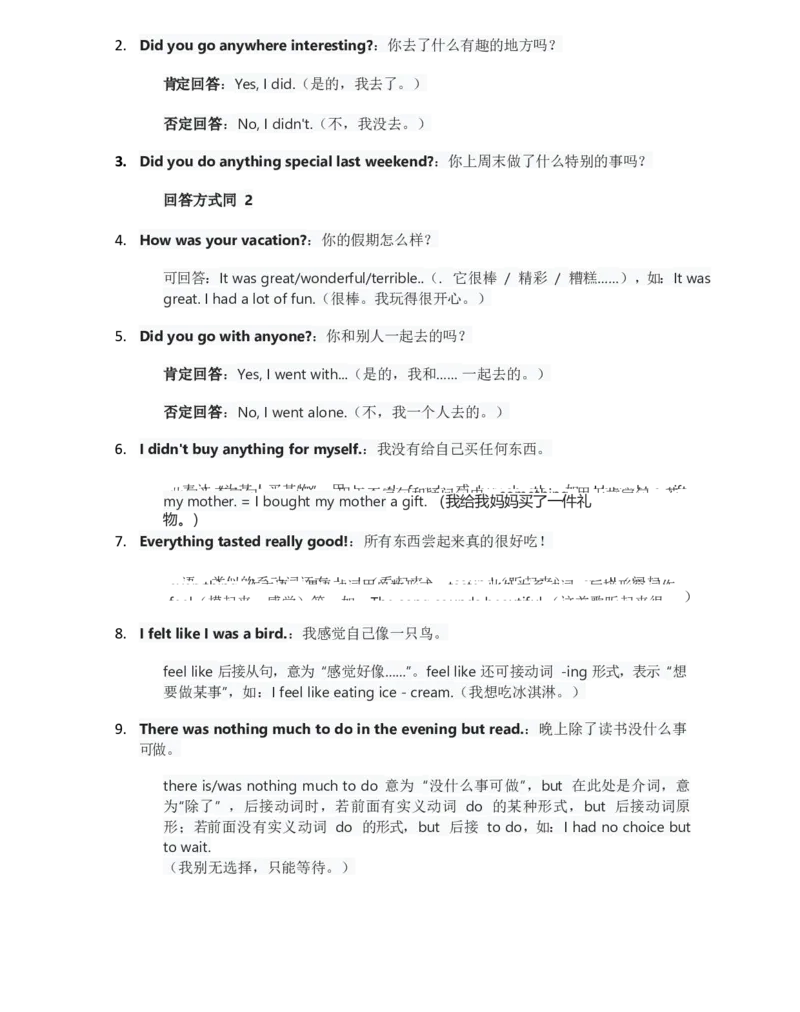
3. Did you do anything special last weekend?:你上周末做了什么特别的事吗?
回答方式同 2
4. How was your vacation?:你的假期怎么样?
可回答:It was great/wonderful/terrible..(. 它很棒 / 精彩 / 糟糕……),如:It was
great. I had a lot of fun.(很棒。我玩得很开心。)
5. Did you go with anyone?:你和别人一起去的吗?
肯定回答:Yes, I went with...(是的,我和…… 一起去的。)
否定回答:No, I went alone.(不,我一个人去的。)
6. I didn't buy anything for myself.:我没有给自己买任何东西。
此表句达为 否“为定某句人,买 an 某 yt 物 hi”n , g 用用 于bu否y 定sth句. f和or疑 sb问. 句或中 b,uys osbm. estthh.i , ng 如 用:于I b肯ou定g句ht 。a 若gift
my mother. = I bought my mother a gift.(我给我妈妈买了一件礼
物。)
7. Everything tasted really good!:所有东西尝起来真的很好吃!
ev 语 er 。 yth 类 in 似 g 的作系主动语词,还谓有语 动lo词ok用(单看数起形来式)。, tasostuen d此(处听为起系来动)词,,s后me接ll(形闻容起词作
)
feel(摸起来;感觉)等,如:The song sounds beautiful.(这首歌听起来很
8. I felt like I was a bird.:我感觉自己像一只鸟。
feel like 后接从句,意为 “感觉好像……”。feel like 还可接动词 -ing 形式,表示 “想
要做某事”,如:I feel like eating ice - cream.(我想吃冰淇淋。)
9. There was nothing much to do in the evening but read.:晚上除了读书没什么事
可做。
there is/was nothing much to do 意为 “没什么事可做”,but 在此处是介词,意
为“除了” ,后接动词时,若前面有实义动词 do 的某种形式,but 后接动词原
形;若前面没有实义动词 do 的形式,but 后接 to do,如:I had no choice but
to wait.
(我别无选择,只能等待。)10. No one seemed to be bored.:没有人看起来很无聊。
seem to do sth. 意为 “似乎做某事”,seem + (to be) + 形容词,表示 “看
起来……”,如:He seems (to be) happy today.(他今天看起来很开心。)(一)名词
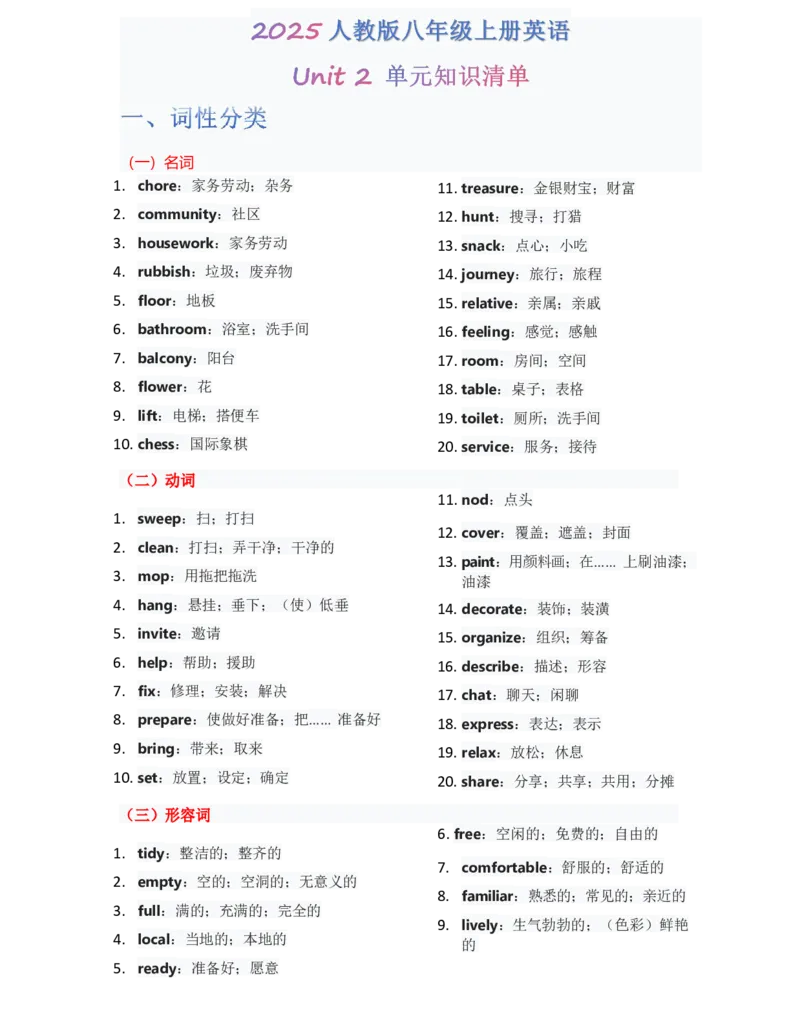
1. chore:家务劳动;杂务 11. treasure:金银财宝;财富
2. community:社区 12. hunt:搜寻;打猎
3. housework:家务劳动 13. snack:点心;小吃
4. rubbish:垃圾;废弃物 14. journey:旅行;旅程
5. floor:地板 15. relative:亲属;亲戚
6. bathroom:浴室;洗手间 16. feeling:感觉;感触
7. balcony:阳台 17. room:房间;空间
8. flower:花 18. table:桌子;表格
9. lift:电梯;搭便车 19. toilet:厕所;洗手间
10. chess:国际象棋 20. service:服务;接待
(二)动词
11. nod:点头
1. sweep:扫;打扫
12. cover:覆盖;遮盖;封面
2. clean:打扫;弄干净;干净的
13. paint:用颜料画;在…… 上刷油漆;
3. mop:用拖把拖洗
油漆
4. hang:悬挂;垂下;(使)低垂 14. decorate:装饰;装潢
5. invite:邀请 15. organize:组织;筹备
6. help:帮助;援助 16. describe:描述;形容
7. fix:修理;安装;解决 17. chat:聊天;闲聊
8. prepare:使做好准备;把…… 准备好 18. express:表达;表示
9. bring:带来;取来 19. relax:放松;休息
10. set:放置;设定;确定 20. share:分享;共享;共用;分摊
(三)形容词
6. free:空闲的;免费的;自由的
1. tidy:整洁的;整齐的
7. comfortable:舒服的;舒适的
2. empty:空的;空洞的;无意义的
8. familiar:熟悉的;常见的;亲近的
3. full:满的;充满的;完全的
9. lively:生气勃勃的;(色彩)鲜艳
4. local:当地的;本地的
的
5. ready:准备好;愿意10. polite:有礼貌的;客气的
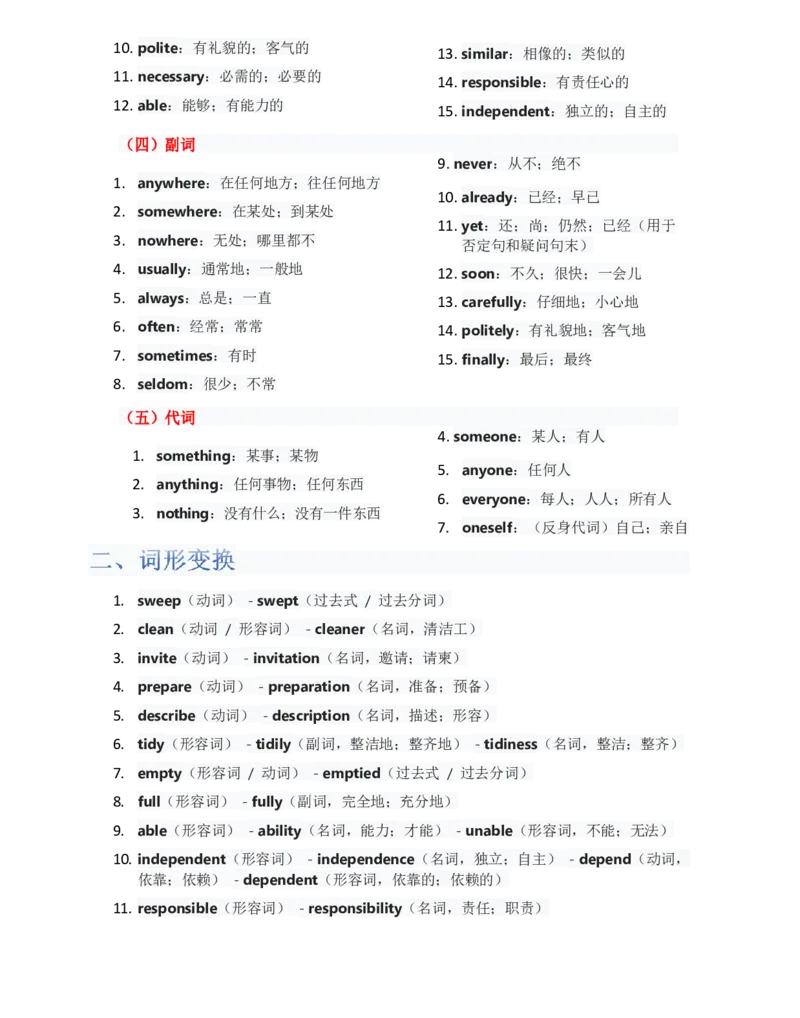
13. similar:相像的;类似的
11. necessary:必需的;必要的
14. responsible:有责任心的
12. able:能够;有能力的
15. independent:独立的;自主的
(四)副词
9. never:从不;绝不
1. anywhere:在任何地方;往任何地方
10. already:已经;早已
2. somewhere:在某处;到某处
11. yet:还;尚;仍然;已经(用于
3. nowhere:无处;哪里都不
否定句和疑问句末)
4. usually:通常地;一般地 12. soon:不久;很快;一会儿
5. always:总是;一直 13. carefully:仔细地;小心地
6. often:经常;常常 14. politely:有礼貌地;客气地
7. sometimes:有时 15. finally:最后;最终
8. seldom:很少;不常
(五)代词
4. someone:某人;有人
1. something:某事;某物
5. anyone:任何人
2. anything:任何事物;任何东西
6. everyone:每人;人人;所有人
3. nothing:没有什么;没有一件东西
7. oneself:(反身代词)自己;亲自
1. sweep(动词) - swept(过去式 / 过去分词)
2. clean(动词 / 形容词) - cleaner(名词,清洁工)
3. invite(动词) - invitation(名词,邀请;请柬)
4. prepare(动词) - preparation(名词,准备;预备)
5. describe(动词) - description(名词,描述;形容)
6. tidy(形容词) - tidily(副词,整洁地;整齐地) - tidiness(名词,整洁;整齐)
7. empty(形容词 / 动词) - emptied(过去式 / 过去分词)
8. full(形容词) - fully(副词,完全地;充分地)
9. able(形容词) - ability(名词,能力;才能) - unable(形容词,不能;无法)
10. independent(形容词) - independence(名词,独立;自主) - depend(动词,
依靠;依赖) - dependent(形容词,依靠的;依赖的)
11. responsible(形容词) - responsibility(名词,责任;职责)12. similar(形容词) - similarly(副词,相似地;类似地) - similarity(名词,相似
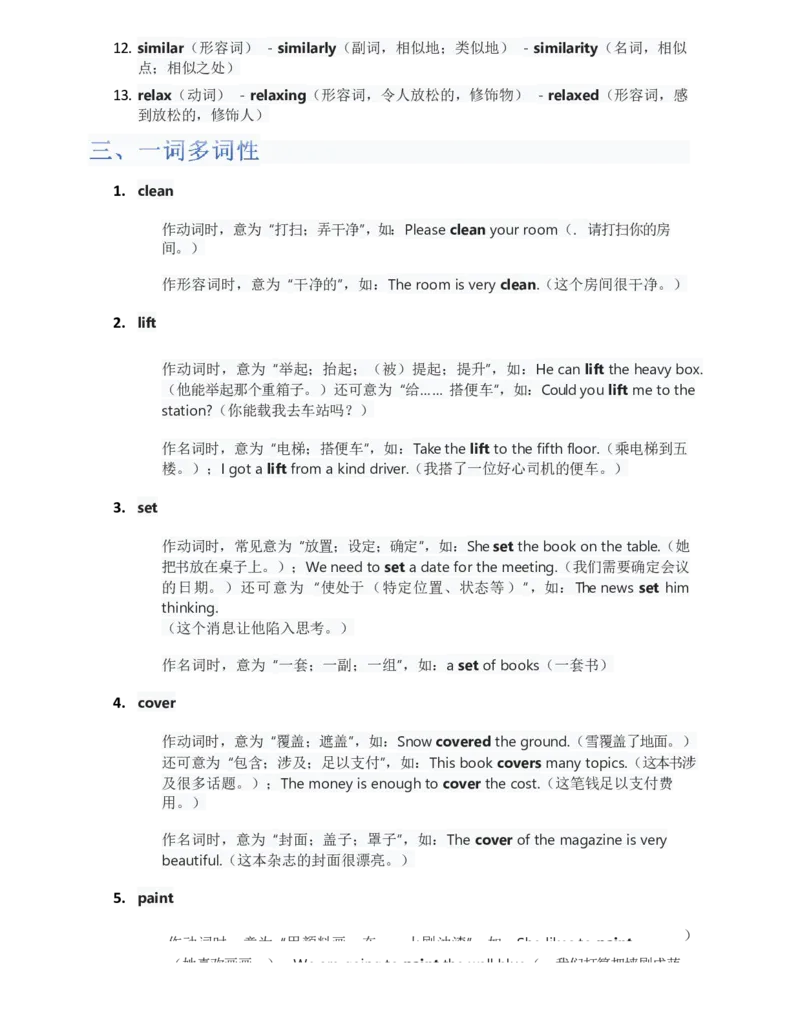
点;相似之处)
13. relax(动词) - relaxing(形容词,令人放松的,修饰物) - relaxed(形容词,感
到放松的,修饰人)
1. clean
作动词时,意为 “打扫;弄干净”,如:Please clean your room(. 请打扫你的房
间。)
作形容词时,意为 “干净的”,如:The room is very clean.(这个房间很干净。)
2. lift
作动词时,意为 “举起;抬起;(被)提起;提升”,如:He can lift the heavy box.
(他能举起那个重箱子。)还可意为 “给…… 搭便车”,如:Could you lift me to the
station?(你能载我去车站吗?)
作名词时,意为 “电梯;搭便车”,如:Take the lift to the fifth floor.(乘电梯到五
楼。);I got a lift from a kind driver.(我搭了一位好心司机的便车。)
3. set
作动词时,常见意为 “放置;设定;确定”,如:She set the book on the table.(她
把书放在桌子上。);We need to set a date for the meeting.(我们需要确定会议
的日期。)还可意为 “使处于(特定位置、状态等)”,如:The news set him
thinking.
(这个消息让他陷入思考。)
作名词时,意为 “一套;一副;一组”,如:a set of books(一套书)
4. cover
作动词时,意为 “覆盖;遮盖”,如:Snow covered the ground.(雪覆盖了地面。)
还可意为 “包含;涉及;足以支付”,如:This book covers many topics.(这本书涉
及很多话题。);The money is enough to cover the cost.(这笔钱足以支付费
用。)
作名词时,意为 “封面;盖子;罩子”,如:The cover of the magazine is very
beautiful.(这本杂志的封面很漂亮。)
5. paint
)
作动词时,意为 “用颜料画;在…… 上刷油漆”,如:She likes to paint
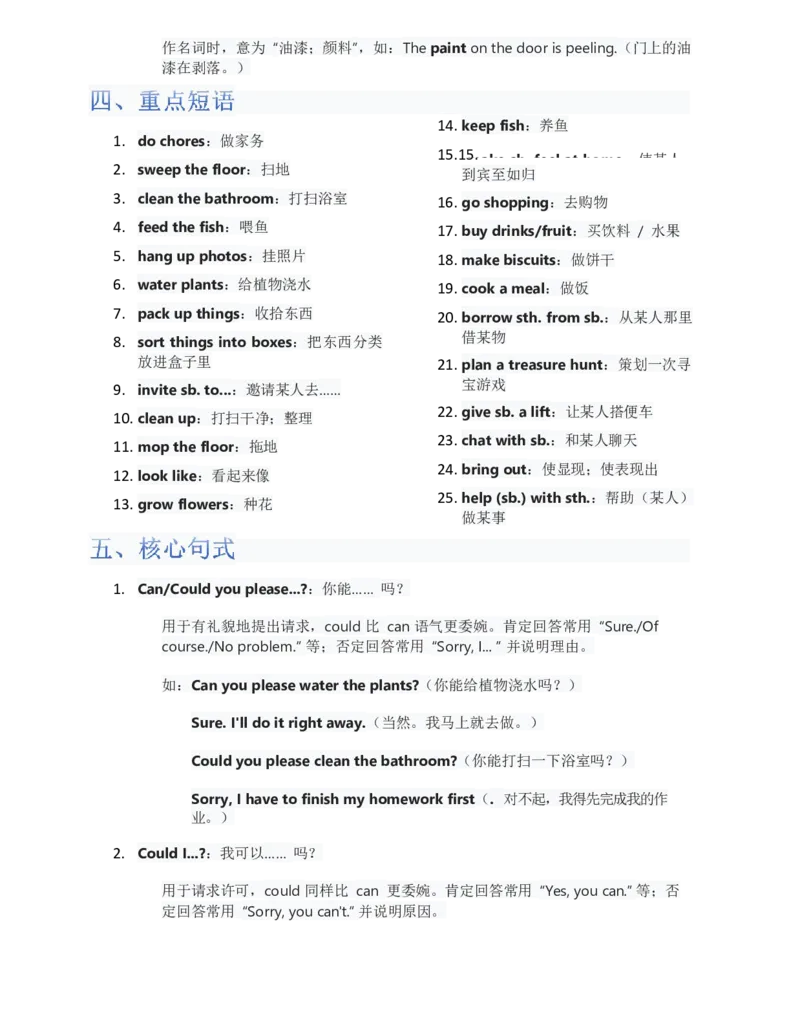
(她喜欢画画。);We are going to paint the wall blue(. 我们打算把墙刷成蓝作名词时,意为 “油漆;颜料”,如:The paint on the door is peeling.(门上的油
漆在剥落。)
14. keep fish:养鱼
1. do chores:做家务
15.15.
make sb. feel at home:使某人
2. sweep the floor:扫地 到宾至如归
3. clean the bathroom:打扫浴室 16. go shopping:去购物
4. feed the fish:喂鱼 17. buy drinks/fruit:买饮料 / 水果
5. hang up photos:挂照片 18. make biscuits:做饼干
6. water plants:给植物浇水 19. cook a meal:做饭
7. pack up things:收拾东西 20. borrow sth. from sb.:从某人那里
借某物
8. sort things into boxes:把东西分类
放进盒子里 21. plan a treasure hunt:策划一次寻
宝游戏
9. invite sb. to...:邀请某人去……
22. give sb. a lift:让某人搭便车
10. clean up:打扫干净;整理
23. chat with sb.:和某人聊天
11. mop the floor:拖地
24. bring out:使显现;使表现出
12. look like:看起来像
25. help (sb.) with sth.:帮助(某人)
13. grow flowers:种花
做某事
1. Can/Could you please...?:你能…… 吗?
用于有礼貌地提出请求,could 比 can 语气更委婉。肯定回答常用 “Sure./Of
course./No problem.” 等;否定回答常用 “Sorry, I... ” 并说明理由。
如:Can you please water the plants?(你能给植物浇水吗?)
Sure. I'll do it right away.(当然。我马上就去做。)
Could you please clean the bathroom?(你能打扫一下浴室吗?)
Sorry, I have to finish my homework first(. 对不起,我得先完成我的作
业。)
2. Could I...?:我可以…… 吗?
用于请求许可,could 同样比 can 更委婉。肯定回答常用 “Yes, you can.” 等;否
定回答常用 “Sorry, you can't.” 并说明原因。如:Could I hang out with my friends after dinner?(晚饭后我可以和朋友们出
去玩吗?)
Yes, you can. But you must be back before 9 o'clock.(可以。但你必须在 9
点前回来。)
3. What chores do you do?:你做什么家务?
用于询问对方所做的家务,回答时用 “I...” 句型列举所做家务,如:I sweep the floor
and clean the table.(我扫地和擦桌子。)
4. How often do you do chores?:你多久做一次家务?
用于询问做某事的频率,回答常用 “once a week(一周一次)”“twice a month(一
个月两次)”“three times a day(一天三次)” 等表示频率的短语。
如:How often do you clean your room?(你多久打扫一次房间?)
I clean my room once a week.(我一周打扫一次房间。)
5. It's time to...:是做…… 的时候了。
后接动词原形,表示该做某事了。如:It's time to have dinner.(是吃晚饭的时候
了。)
6. Let's...:让我们……
用于提出建议,后接动词原形。肯定回答常用 “OK./Good idea.” 等;否定回答常
用“Sorry, I... ” 并说明理由。
如:Let's go shopping this weekend.(这个周末我们去购物吧。)
OK. That sounds great.(好的。听起来不错。)
7. We should...:我们应该……
用于表达建议或陈述观点,should 后接动词原形。如:We should help our parents
with housework.(我们应该帮助父母做家务。)
8. My home is a place of...:我的家是一个…… 的地方。
用于描述家的特点,of 后接名词。如:My home is a place of love and warmth.
(我的家是一个充满爱和温暖的地方。)(一)名词
1. competition:比赛;竞赛;竞争 11. information:信息;消息
2. mirror:镜子 12. difference:差别;差异
3. kid:小孩;年轻人 13. similarity:相似点;相似之处
4. grade:成绩等级;评分等级;年级 14. talent:天资;天赋
5. saying:谚语;格言;警句 15. loud:喧闹声;嘈杂声
6. hand:手;帮助;指针 16. quiet:安静;寂静
7. heart:内心;心脏 17. interest:兴趣;爱好;利息;利益
8. fact:事实;实际情况 18. hobby:业余爱好
9. arm:手臂;上肢 19. joke:笑话;玩笑
10. shoulder:肩膀 20. opinion:意见;想法;看法
(二)动词
8. bring:带来;取来
1. win:获胜;赢;赢得
9. make:使成为;制造;做
2. care:在意;担忧;关心
10. reach:伸手;到达;抵达
3. reach:伸手;到达;抵达
11. touch:感动;触摸;碰
4. touch:感动;触摸;碰
12. compete:竞争;对抗
5. break:(使)破;裂;碎;损坏
13. say:说;讲
6. share:分享;共享;共用;分摊
14. mean:意思是;打算;意欲
7. laugh:笑;发笑;嘲笑
(三)形容词
7. talented:有才能的;有才干的
1. outgoing:爱交际的;友好的;外向
的 8. similar:相像的;类似的
2. better:更好的;较好的;(well 的 9. primary:最初的;最早的;初等教
比较级)更好地 育的;小学教育的
3. quiet:安静的;轻声的;轻柔的 10. necessary:必需的;必要的
4. hard - working:工作努力的;辛勤 11. both:两个;两个都
的
12. loud:喧闹的;大声的;响亮的
5. serious:严肃的;稳重的
13. clear:清楚易懂的;晴朗的;清澈的
6. funny:有趣的;滑稽的
14. fantastic:极好的;了不起的15. true:符合事实的;确实的
18. common:常见的;普遍的;普通的
16. poor:贫穷的;可怜的;贫乏的
19. primary:最初的;最早的;初等教
17. rich:富有的;富裕的;富饶的 育的;小学教育的
20. elder:年纪较长的
(四)副词
6. seriously:严肃地;认真地;严重地
1. better:更好地;(well 的比较级)
7. necessarily:必然地;必定地
2. truly:真正地;确实
8. almost:几乎;差不多
3. clearly:清楚地;清晰地;明白地
9. hardly:几乎不;几乎没有
4. loudly:喧闹地;大声地;响亮地
10. quite:相当;很;非常
5. similarly:相似地;类似地
(五)代词
5. no one:没有人
1. both:两个;两个都
6. something:某事;某物
2. anyone:任何人
7. anything:任何事物;任何东西
3. someone:某人;有人
8. nothing:没有什么;没有一件东西
4. everyone:每人;人人;所有人
1. win(动词) - won(过去式) - won(过去分词) - winner(名词,获胜者)
2. care(动词) - careful(形容词,小心的;仔细的;慎重的) - carefully(副词,小
心地;仔细地) - careless(形容词,粗心的;疏忽的) - carelessness(名词,粗心
大意)
3. reach(动词) - reachable(形容词,可到达的;可获得的)
4. touch(动词) - touching(形容词,动人的;令人同情的) - touched(形容词,
受感动的;触动的)
5. break(动词) - broke(过去式) - broken(过去分词) - breakable(形容词,
易碎的)
6. share(动词) - sharing(现在分词) - shared(过去式 / 过去分词) - shareholder
(名词,股东)
7. laugh(动词) - laughter(名词,笑;笑声)
8. say(动词) - said(过去式 / 过去分词) - saying(名词,谚语;格言;警句)
9. mean(动词) - meant(过去式 / 过去分词) - meaning(名词,意义;意思;含
义) - meaningful(形容词,有意义的) - meaningless(形容词,无意义的;无价
值的)
10. true(形容词) - truly(副词,真正地;确实) - truth(名词,事实;真相)11. serious(形容词) - seriously(副词,严肃地;认真地;严重地)
12. necessary(形容词) - necessarily(副词,必然地;必定地)
13. outgoing(形容词) - more outgoing(比较级,更外向的) - most outgoing(最
高级,最外向的)
14. funny(形容词) - funnier(比较级,更有趣的) - funniest(最高级,最有趣的)
15. good(形容词) - better(比较级,更好的) - best(最高级,最好的) - well(副
词, 好;熟练地;很好地;形容词,健康的)
1. share
作动词时,意为 “分享;共享;共用;分摊”,如:I like to share my toys with my
friends.(我喜欢和朋友们分享我的玩具。)
作名词时,意为 “一份;份额”,如:Each person has an equal share of the cake.
(每个人都有一份相等的蛋糕。)
2. laugh
作动词时,意为 “笑;发笑;嘲笑”,常见搭配有 laugh at(嘲笑),如:Don't
laugh at others.(不要嘲笑别人。)
作名词时,意为 “笑;笑声”,如:We heard his loud laugh from the next room.
(我们从隔壁房间听到他响亮的笑声。)
3. reach
作动词时,常见意为 “伸手;到达;抵达”,如:I can't reach the book on the top
shelf.(我够不着书架顶层的书。);We reached the park at noon.(我们中午到
达了公园。)还可意为 “与…… 取得联系”,如:I tried to reach you on the
phone,
but you were not available.(我试着给你打电话,但你没空接。)
作名词时,意为 “手臂展开的长度;波及范围”,如:The cat is just out of my reach.
(那只猫我够不着。)
4. break
作动词时,意为 “(使)破;裂;碎;损坏”,如:Be careful not to break the glass.
(小心别打破玻璃。);还可意为 “违背;违反”,如:Don't break the rules.(不
要违反规则。);另外还有 “休息” 的意思,如:Let's break for lunch.(我们停下
来吃午饭吧。)
作名词时,意为 “休息;间歇”,如:We had a short break during the meeting.
(我们在会议期间休息了一会儿。)
5. mean
作事动)词,时m,e意an为 d o“in意g思 st是h.(;意打味算着;做意某欲事”,)常,见如用:法I d有id nm'te mane taon dtoo hstuhr.t( y打ou算r 做(我不是故意要伤害你的感情。);Missing this bus means waiting for another
hour.(错过这辆公交车意味着还要再等一个小时。)
作形容词时,意为 “吝啬的;小气的;刻薄的”,如:He is so mean with his money.
(他在钱财方面非常吝啬。)
14. touch one's heart:触动某人的心;
1. more outgoing:更外向
令某人感动
2. as...as:和…… 一样
15. in fact:事实上;实际上
3. the same as:与…… 相同;与……
16. be similar to:与…… 相像的、类似
一致
的
4. be different from:与…… 不同
17. be good with:善于和…… 相处;
5. care about:关心;在意 与…… 相处得好
6. be like:像…… 18. have fun:玩得开心
7. make friends:交朋友 19. talk about:谈论;讨论
8. be good at:擅长…… 20. primary school:小学
9. be talented in:在…… 方面有天赋 21. as long as:只要;既然
10. care for:照顾;照料;喜欢 22. in common:共同;共有
11. bring out:使显现;使表现出 23. be different in:在…… 方面不同
12. get good grades:取得好成绩 24. the other:(两者中的)另一个
13. reach for:伸手去够;伸手拿 25. be ready to:准备好(做某事);
愿意做某事
26.
1. Is...taller than...?:…… 比…… 高吗?
用于比较两者的身高,是一般疑问句。肯定回答用 “Yes, 主语 + is.”,否定回答
用“No, 主语 + isn't.”。如:
Is Tom taller than Sam?(汤姆比山姆高吗?)
Yes, he is.(是的,他比山姆高。)
2. Who...better,...or...?:谁…… 更好,…… 还是……?
用于在两者之间进行比较,询问谁在某方面更具优势。如:
Who dances better, Lucy or Lily?(谁跳舞更好,露西还是莉莉?)
Lucy dances better.(露西跳舞更好。)
3. I'm as...as...:我和…… 一样……表示两者在某方面程度相同,as...as 中间用形容词或副词原级。如:
I'm as tall as my sister.(我和我姐姐一样高。)
4. ...is more...than...:…… 比…… 更……
用于两者比较,more 后接多音节形容词或副词,表示一方在某方面超过另一方。
如:
English is more interesting than math.(英语比数学更有趣。)
5. ...is the + 形容词最高级 +...in/of...:…… 是…… 中最…… 的
用于三者或三者以上的比较,形容词最高级前要加 the。如:
He is the tallest student in our class.(他是我们班最高的学生。)
6. A good friend is like a mirror.:好朋友就像一面镜子。
h用a比nd喻 an的d方 to式uc描he述s 好yo朋ur 友he的art特.”( 质 一 , 个 类 真 似 正 表 的 达 朋 还 友 有 是 在 “A 需 t 要 rue 时 f 给 rie 你 nd 帮 r 助 ea , ch 使 es 你 f 感 or )
7. I think a good friend makes me laugh.:我认为好朋友能让我发笑。
此句包含宾语从句,“I think” 后接宾语从句,表达个人对好朋友的看法。类似的表
达还有 “I believe...”“I hope...” 等。
8. That's why...:那就是为什么……
用于解释原因,后接结果。如:That's why I like reading books.(那就是为什么我
喜欢读书。)
9. It's not necessary to be the same.:没有必要完全一样。
It's + 形容词 + (for sb.) + to do sth. 是常用句型,意为 “(对某人来说)做
某事是…… 的”。
10. My best friend helps to bring out the best in me.:我最好的朋友帮助我展现出最
好的一面。
help to do sth. 意为 “帮助做某事”,bring out the best/worst in sb. 表示 “使某人
展现出最好 / 最坏的一面” 。(一)名词
1. plant:植物 11. symbol:象征;符号;标志
2. animal:动物 12. hope:希望
3. moss:苔藓 13. butterfly:蝴蝶
4. blue whale:蓝鲸 14. bee:蜜蜂
5. redwood tree:红杉树 15. honey:蜂蜜
6. cheetah:猎豹 16. honeycomb:蜂巢
7. bamboo:竹子 17. pollen:花粉
8. fan:扇子;风扇 18. ecosystem:生态系统
9. painting:绘画;油画;画作 19. planet:行星
10. culture:文化 20. fact:事实;真相
(二)动词
1. talk:谈论;讨论;说话 11. communicate:交流;沟通
2. compare:比较;对比 12. drop:落下;掉下;降低
3. use:使用;运用;利用 13. protect:保护;防护
4. build:建造;建筑 14. imagine:想象;设想
5. make:制造;做;使得 15. connect:连接;与…… 有联系
6. eat:吃 16. pollinate:授粉;传粉
7. weigh:有…… 重;重 17. describe:描述;形容
8. appear:出现;显得;似乎 18. collect:收集;采集
9. store:储存;储备;商店 19. choose:选择;挑选
10. create:创造;创建 20. vote:投票;选举;表决
(三)形容词
1. amazing:令人大为惊奇的;令人惊 6. long:长的;长时间的;长久的
喜(或惊叹)的
7. large:大的;大量的;大规模的
2. short:短的;矮的;短暂的
8. heavy:重的;沉的;繁重的
3. tall:高的;高大的
9. fast:快的;迅速的;敏捷的(adj.);
4. small:小的;小号的
迅速地;快地(adv.)
5. old:年老的;旧的;古老的
10. big:大的;巨大的;重要的11. beautiful:美丽的;美好的;出色的
16. important:重要的;有重大影响的
12. popular:受欢迎的;普遍的;流行的
17. tiny:极小的;微小的
13. useful:有用的;有益的
18. lively:生气勃勃的;(色彩)鲜艳的
14. interesting:有趣的;引起兴趣的
19. ancient:古代的;古老的
15. hard - working:工作努力的;辛勤的
20. common:常见的;普遍的;普通的
(四)副词
1. fast:迅速地;快地(adj. 快的;迅 6. together:共同;一起;同时
速的;敏捷的)
7. easily:容易地;轻易地
2. really:真正地;确实;的确
8. however:然而;可是;无论如何
3. especially:尤其;特别;格外
9. then:那么;然后;那时;接着
4. perhaps:或许;可能;大概
10. already:已经;早已
5. almost:几乎;差不多
(五)代词
1. something:某事;某物 4. someone:某人;有人
2. anything:任何事物;任何东西 5. anyone:任何人
3. nothing:没有什么;没有一件东西 6. everyone:每人;人人;所有人
1. plant(动词,种植;名词,植物) - planting(现在分词) - planted(过去式 / 过
去分词)
2. amaze(动词,使惊奇;使惊愕) - amazing(形容词,令人大为惊奇的,修饰物)
- amazed(形容词,感到惊奇的,修饰人)
3. use(动词,使用) - useful(形容词,有用的) - useless(形容词,无用的) - user
(名词,使用者)
4. build(动词,建造) - builder(名词,建筑工人;建造者) - building(名词,建
筑物;大楼)
5. make(动词,制造) - maker(名词,制造者;制造商) - made(过去式 / 过去
分词)
6. appear(动词,出现) - appearance(名词,外貌;外观;出现)
7. store(动词,储存;名词,商店) - storage(名词,储存;仓库)
8. create(动词,创造) - creation(名词,创造;创建;作品) - creative(形容词,
创造性的;有创造力的)
9. communicate(动词,交流;沟通) - communication (名词,交流;沟通;通讯)
10. describe(动词,描述;形容) - description(名词,描述;形容)11.collect(动词,收集;采集) - collection(名词,收藏品;收集物;采集) - collector
(名词,收藏家;收集者)
12. choose(动词,选择) - choice(名词,选择;选择权;抉择) - chose(过去式)
- chosen(过去分词)
13. protect(动词,保护) - protection(名词,保护;防护) - protective(形容词,
保护的;防护的)
14. pollinate(动词,授粉;传粉) - pollination(名词,授粉;传粉)
15. heavy(形容词,重的) - heavily(副词,沉重地;猛烈地)
1. store
作动词时,意为 “储存;储备”,如:We need to store some food for the winter.
(我们需要储存一些食物过冬。)
作名词时,意为 “商店”,如:There is a grocery store near my house.(我家附近
有一家杂货店。)
2. fast
(猎豹是一种速度很快的动物。)
作形容词时,意为 “快的;迅速的;敏捷的”,如:The cheetah is a fast
作副词时,意为 “迅速地;快地”,如:He runs fast.(他跑得很快。)
3. plant
作名词时,意为 “植物”,如:There are many different kinds of plants in the garden.
(花园里有许多不同种类的植物。)
作动词时,意为 “种植”,如:We plant trees every spring(. 我们每年春天都种
树。)
4. appear
作动词时,基本义为 “出现”,如:A rainbow appeared in the sky after the rain.
(雨后天空出现了一道彩虹。);还可意为 “显得;似乎”,常见用法有 appear +
(to be) + 形容词 / 名词,如:He appears (to be) very happy today.(他
今天看起来很高兴。)
5. drop
作天动树词时叶,从意树为上 “落落下下;。掉)下 ;”, 还如可:意Le为av e“s 降dr低op; fr o减m少 th” e, t re如e:s i nT haue tumn.is dropping quickly.(温度正在迅速下降。);另外,还有 “放弃;中断” 的意思,
如:He decided to drop the plan.(他决定放弃这个计划。)
作名词时,意为 “滴;水珠”,如:A drop of water fell on my nose.(一滴水落在
了我的鼻子上。)
1. talk about:谈论;讨论
2. in the world:在世界上
3. one of the + 形容词最高级 + 可数名词复数:最…… 之一
4. look at:看;朝…… 看
5. grow up:长大;成长
6. be good at:擅长;在…… 方面做得好
7. make sth. for sb.:为某人制作某物
8. be used to do sth.:被用来做某事
9. be used for (doing) sth.:用于(做)某事
10. a symbol of:…… 的象征
11. at least:至少;不少于;起码
12. up to:多达;直到;胜任
13. live up to:活到;符合;不辜负
14. play an important part in:在…… 中起重要作用
15. hundreds of:成百上千的;许许多多的
16. thousands of:成千上万的;许许多多的
17. communicate with:与…… 交流;与…… 沟通
18. in fact:事实上;实际上
19. be connected with:与…… 有关;与…… 相联系
20. because of:因为;由于(后接名词、代词或动名词)
1. What's the + 形容词最高级 + 名词 + in the world?:世界上最…… 的…… 是什么?
用于询问在世界范围内某方面最突出的事物,如:What's the largest animal in
the world?(世界上最大的动物是什么?)
回答常用 “It's...” 句型,如:It's the blue whale.(是蓝鲸。)2......is one of the + 形容词最高级 + 可数名词复数 + 范围:…… 是…… 中最…… 之一
useful plants in the world.(竹子是世界上最有用的植物之一。)
用来描述某人或某物在特定范围内具有突出特征,如:Bamboo is one of the
3. How do you think...?:你认为…… 怎么样?
animals?(你认为那部关于动物的电影怎么样?)
用于询问对方对某人或某事的看法,如:How do you think of the movie
4. Why do you...?:你为什么……?
询问原因,回答常用 “Because...” 句型,如:Why do you like pandas?(你为什
么喜欢熊猫?) - Because they are very cute.(因为它们非常可爱。)
5. What can...do?:…… 能做什么?
做什么?) - They can pollinate flowers.(它们能给花授粉。)
询问某人或某物具备的能力或可以从事的活动,如:What can bees do?(蜜蜂
6. It's + 形容词 +(for sb.) + to do sth.:(对某人来说)做某事是…… 的
protect the ecosystem.(对我们来说,保护生态系统很重要。)
这是一个常用的表达观点或描述事物特征的句型,如:It's important for us
7. Without...,...can't...:没有……,…… 就不能……
the world cannot grow.(没有蜜蜂,世界上大约 80% 的植物就无法生
强调前者对后者的重要性,如:Without bees, about 80 per cent of the plants
长。)
8. The + 比较级,the + 比较级:越……,就越……
knowledge you will get.(你读得越多,获得的知识就越多。)(拓展用法,课
表示一方的程度随着另一方的变化而变化,如:The more you read, the
文虽未直接涉及,但可适当延伸)2025 秋人教版英语八
Unit 5 单元知识清单
(一)名词
1. meal:一餐;饭食 17. mushroom:蘑菇
2. pepper:胡椒;辣椒 18. recipe:食谱;烹饪法
3. salt:盐 19. dish:菜肴;盘;碟
4. sugar:糖 20. smell:气味
5. butter:黄油 21. mess:杂乱;不整洁
6. cheese:奶酪 22. luck:幸运;运气
7. onion:洋葱 23. memory:记忆;回忆
8. pumpkin:南瓜 24. host:主人;东道主
9. beef:牛肉 25. culture:文化
10. chicken:鸡肉 26. secret:秘密
11. pork:猪肉 27. pollen:花粉
12. tofu:豆腐 28. honey:蜂蜜
13. noodle:面条 29. honeycomb:蜂巢
14. spaghetti:意大利面 30. ecosystem:生态系统
15. yogurt:酸奶 31. planet:行星
16. oil:油 32. fact:事实;真相
(二)动词
10. cook:烹饪;煮;做饭
1. add:添加;增加
11. create:创造;创建
2. mix:混合;搅拌
12. share:分享;共享
3. bake:烤;烘焙
13. connect:连接;与…… 有联系
4. pour:倒;倾倒
14. pollinate:授粉;传粉
5. boil:煮;煮沸
15. describe:描述;形容
6. stir - fry:炒
16. collect:收集;采集
7. heat:加热;使变热
17. choose:选择;挑选
8. mash:捣成泥;捣碎
18. vote:投票;选举;表决
9. steam:蒸
19. imagine:想象;设想
第 1 页 共 6 页2025 秋人教版英语八
20. protect:保护;防护
24. drop:落下;掉下;降低
21. appear:出现;显得;似乎
25. build:建造;建筑
22. store:储存;储备;商店
26. weigh:有…… 重;重
23. communicate:交流;沟通
(三)形容词
12. large:大的;大量的;大规模的
1. delicious:美味的;可口的
13. heavy:重的;沉的;繁重的
2. amazing:令人大为惊奇的;令人惊
喜(或惊叹)的
14. fast:快的;迅速的;敏捷的
(adj.);迅速地;快地(adv.)
3. terrible:糟糕的;可怕的
15. beautiful:美丽的;美好的;出色的
4. fantastic:极好的;了不起的
16. popular:受欢迎的;普遍的;流行的
5. interesting:有趣的;引起兴趣的
17. useful:有用的;有益的
6. lovely:可爱的;美丽的
18. hard - working:工作努力的;辛勤的
7. great:伟大的;极好的
19. important:重要的;有重大影响的
8. pretty:漂亮的;可爱的
20. tiny:极小的;微小的
9. wonderful:精彩的;绝妙的
21. lively:生气勃勃的;(色彩)鲜艳的
10. kind:友善的;和蔼的
22. ancient:古代的;古老的
11. special:特别的;特殊的
23. common:常见的;普遍的;普通的
(四)副词
7. especially:尤其;特别;格外
1. first:首先;第一
8. perhaps:或许;可能;大概
2. next:接下来;然后
9. almost:几乎;差不多
3. then:那么;然后;那时;接着
10. together:共同;一起;同时
4. after that:在那之后
11. easily:容易地;轻易地
5. finally:最后;最终
12. however:然而;可是;无论如何
6. really:真正地;确实;的确
13. already:已经;早已
(五)代词
5. anyone:任何人
1. something:某事;某物
6. everyone:每人;人人;所有人
2. anything:任何事物;任何东西
7. it:它(在描述烹饪过程、评价食物
3. nothing:没有什么;没有一件东西
等情境中常作形式主语或宾语)
4. someone:某人;有人
第 2 页 共 6 页2025 秋人教版英语八
1. cook(动词,烹饪;名词,厨师) - cooking(现在分词) - cooked(过去式 / 过
去分词)
2. amaze(动词,使惊奇;使惊愕) - amazing(形容词,令人大为惊奇的,修饰物) -
amazed(形容词,感到惊奇的,修饰人)
3. use(动词,使用) - useful(形容词,有用的) - useless(形容词,无用的) - user
(名词,使用者)
4. create(动词,创造) - creation(名词,创造;创建;作品) - creative(形容词,
创造性的;有创造力的)
5. communicate(动词,交流;沟通) - communication (名词,交流;沟通;通讯)
6. describe(动词,描述;形容) - description(名词,描述;形容)
7.
collect(动词,收集;采集) - collection(名词,收藏品;收集物;采集) -
(名词,收藏家;收集者)
8.
choose(动词,选择) - choice(名词,选择;选择权;抉择) - chose(过去
- chosen(过去分词)
9. protect(动词,保护) - protection(名词,保护;防护) - protective(形容
词,
保护的;防护的)
10. pollinate(动词,授粉;传粉) - pollination(名词,授粉;传粉)
11. heavy(形容词,重的) - heavily(副词,沉重地;猛烈地)
1. store
作动词时,意为 “储存;储备”,如:We store some flour in the cupboard.(我们
在橱柜里储存了一些面粉。)
作名词时,意为 “商店”,如:There is a convenience store near the school.(学校
附近有一家便利店。)
2. fast
作形容词时,意为 “快的;迅速的;敏捷的”,如:The fast - food restaurant is popular
among students.(这家快餐店很受学生欢迎。)
作副词时,意为 “迅速地;快地”,如:Cook the steak fast over high heat.(用高
温快速煎牛排。)
第 3 页 共 6 页2025 秋人教版英语八
3. plant
作名词时,意为 “植物”,如:Some plants are used for cooking.(有些植物可用
于烹饪。)
作动词时,意为 “种植”,如:We plant herbs in the garden for cooking.(我们在
花园里种香草用于烹饪。)
4. appear
作动词时,基本义为 “出现”,如:A delicious smell appeared as soon as the
5. dropcake was out of the oven.(蛋糕刚从烤箱里拿出来,一股香味就飘了出来。)
还可意为 “显得;似乎”,常见用法有 appear + (to be) + 形容词 / 名词,
如:
The dish appears (to be) very delicious.(这道菜看起来非常美味。)
作动词时,意为 “落下;掉下”,如:Be careful not to drop the eggs.(小心别把
鸡蛋掉了。)
还可意为 “降低;减少”,如:The price of vegetables dropped recently.(最近蔬
菜价格下降了。)
另外,还有 “放弃;中断” 的意思,如:He dropped the idea of making a new dish.
(他放弃了做一道新菜的想法。)
作名词时,意为 “滴;水珠”,如:A drop of oil fell into the soup.(一滴油掉进了
汤里。)
1. add...to...:把…… 加到……
2. cut up:切碎
3. mix...with...:把…… 和…… 混合
4. pour...into...:把…… 倒入……
5. bake...in the oven:在烤箱里烤……
6. boil...until...:把…… 煮到……
7. stir - fry:炒
8. heat some oil:加热一些油
9. mash the potatoes:把土豆捣成泥
10. make mashed potatoes:做土豆泥
第 4 页 共 6 页2025 秋人教版英语八
11. make a banana milk shake:做香蕉奶昔
12. make steamed fish:做蒸鱼
13. make beef with black pepper:做黑椒牛肉
14. make stir - fried eggs and tomatoes:做西红柿炒鸡蛋
15. make Guoqiao Rice Noodles:做过桥米线
16. make apple pie:做苹果派
17. make spaghetti bolognese:做意大利肉酱面
18. be good at:擅长;在…… 方面做得好
19. be used to do sth.:被用来做某事
20. be used for (doing) sth.:用于(做)某事
21. a symbol of:…… 的象征
22. at least:至少;不少于;起码
23. up to:多达;直到;胜任
24. live up to:活到;符合;不辜负
25. play an important part in:在…… 中起重要作用
26. hundreds of:成百上千的;许许多多的
27. thousands of:成千上万的;许许多多的
28. communicate with:与…… 交流;与…… 沟通
29. in fact:事实上;实际上
30. be connected with:与…… 有关;与…… 相联系
31. because of:因为;由于(后接名词、代词或动名词)
1. How do we make...?:我们怎样做……?
回答:First...Next...Then...After that...Finally...(首先…… 接下来…… 然后…… 在那
之后…… 最后……),例如:How do we make stir - fried eggs and tomatoes?
(我们怎样做西红柿炒鸡蛋?) - First, cut the tomatoes into small pieces. Next,
mix the eggs in a bowl. Then, heat some oil in a pan and add the eggs. After that,
take the eggs out of the pan. Finally, cook the tomatoes in the pan and add the
eggs back.(首先,把西红柿切成小块。接下来,在碗里把鸡蛋打散。然后,在平
底锅里加热一些油,加入鸡蛋。在那之后,把鸡蛋从锅里盛出来。最后,在锅里炒西
红柿,再把鸡蛋倒回去。)
第 5 页 共 6 页2025 秋人教版英语八
2. What's your favourite dish?:你最喜欢的菜是什么?
回答:My favourite dish is...(我最喜欢的菜是……),例如:What's your
favourite dish? - My favourite dish is steamed fish.(你最喜欢的菜是什么? - 我
最喜欢的菜是蒸鱼。)
3. Why do you like it?:你为什么喜欢它?
回答:Because...(因为……),例如:Why do you like steamed fish? - Because
it's healthy and delicious.(你为什么喜欢蒸鱼? - 因为它既健康又美味。)
4. How much...do we need?:我们需要多少……?(用于询问不可数名词的数量)
例如:How much salt do we need?(我们需要多少盐?)
5. How many...do we need?:我们需要多少……?(用于询问可数名词的数量)
例如:How many tomatoes do we need?(我们需要多少西红柿?)
6. What + a/an + 形容词 + 可数名词单数 + (it is)!:多么…… 的一个…… 啊!(What
引导的感叹句,修饰可数名词单数)
例如:What an amazing smell (it is)!(多么令人惊奇的气味啊!)
7. What + 形容词 + 可数名词复数 / 不可数名词 + (they are /it is)!:多么……
的…… 啊!(What 引导的感叹句,修饰可数名词复数或不可数名词)
例如:What delicious cookies (they are)(! 多么美味的饼干啊!);What
beautiful music (it is)!(多么美妙的音乐啊!)
8. How + 形容词 / 副词 + (主语 + 谓语)!:多么…… 啊!(How 引导的感叹句,
修饰形容词或副词)
例如:How delicious the dish looks!(这道菜看起来多么美味啊!);How fast he
cooks!(他做饭多快啊!)
9. It's + 形容词 +(for sb.) + to do sth.:(对某人来说)做某事是…… 的
例如:It's important for us to learn how to cook.(对我们来说,学习烹饪很重要。)
第 6 页 共 6 页2025 秋人教版英语八
Unit 6 单元知识清单
(一)名词
1. plan:计划 11. doctor:医生
2. job:工作;职业 12. painter:画家;油漆匠
3. engineer:工程师 13. businessman:商人
4. designer:设计师 14. farmer:农民
5. director:导演;主管 15. actress:女演员
6. musician:音乐家 16. lawyer:律师
7. fireman:消防员 17. resolution:决议;决心
8. athlete:运动员 18. health:健康
9. photographer:摄影师 19. hobby:爱好
10. worker:工人 20. skill:技能;技巧
(二)动词
1. talk:谈论;讨论 9. decide:决定;选定
2. want:想要;希望 10. explain:解释;说明
3. be:成为;变成 11. fail:失败;未能做到
4. exercise:锻炼;练习 12. promise:承诺;保证
5. keep:保持;保留 13. remind:提醒;使想起
6. achieve:实现;达成 14. encourage:鼓励;激励
7. improve:提高;改善 15. arrange:安排;筹备
8. take:参加;从事 16. solve:解决;解答
(三)形容词
1. interesting:有趣的 6. confident:自信的;有信心的
2. famous:著名的;出名的 7. organized:有组织的;有条理的
3. sure:确定的;确信的 8. common:共同的;普通的
4. difficult:困难的;艰难的 9. healthy:健康的;健壮的
5. possible:可能的;可实现的 10. last:最后的;末尾的
(四)副词
第 1 页 共 4 页2025 秋人教版英语八
1. really:真地;确实
4. together:一起;共同
2. hardly:几乎不;几乎没有
5. later:以后;后来
3. wisely:明智地;聪明地
(五)代词
1. everyone:每个人;所有人 3. anything:任何事;任何东西
2. something:某事;某物
1. decide(动词,决定) - decision(名词,决定;决心)
2. improve(动词,提高;改善) - improvement(名词,改进;改善)
3. succeed(动词,成功) - success(名词,成功) - successful(形容词,成功的) -
successfully(副词,成功地)
4. confidence(名词,自信;信心) - confident(形容词,自信的;有信心的) -
confidently(副词,自信地)
5. explain(动词,解释;说明) - explanation(名词,解释;说明)
1. want
作动词时,意为 “想要;希望”,如:I want to be a teacher.(我想成为一名教师。)
作名词时,意为 “需要;缺乏”,如:The plants died for want of water.(这些植物
因缺水而死。)
2. work
作动词时,意为 “工作;起作用”,如:I work hard every day.(我每天努力工作。)
作名词时,意为 “工作;作品”,如:His works are very famous.(他的作品非常有
名。)
3. study
作动词时,意为 “学习;研究”,如:I study English every day.(我每天学习英语。)
作名词时,意为 “书房”,如:My father is reading in the study.(我父亲正在书房
看书。)
第 2 页 共 4 页2025 秋人教版英语八
4. improve
作动词时,意为 “提高;改善”,如:I want to improve my English.(我想提高我
的英语水平。)
作名词时,意为 “改进;改善”,如:There is a great improvement in your work.
(你的工作有很大的改进。)
5. decide
作动词时,意为 “决定;选定”,如:I decide to go shopping.(我决定去购物。)
作名词时,意为 “决定;决心”,如:My mother's decision surprised me.(我母亲
的决定让我很惊讶。)
1. grow up:长大;成熟 11. develop a hobby:培养一种爱好
2. want to be:想要成为 12. come up with:提出;想出
3. be going to do sth.:打算做某事 13. write down:写下;记下
4. work hard:努力工作;努力学习 14. remind sb. of:提醒;使想起
5. take lessons:上课 15. fail to do sth.:未能做某事
6. try one's best:尽某人最大努力 16. encourage sb. to do sth.:鼓励某
人做某事
7. take up:开始从事;占用
17. prepare for:为…… 做准备
8. stick to:坚持;遵守
18. make a resolution:制定一个决心
9. have to do with:与…… 有关
19. solve problems:解决问题
10. make sure:确保;务必
20. find differences:找出差异
1. What do you want to be when you grow up?:你长大后想成为什么?
1. 回答:I want to be...(我想成为……),如:I want to be a doctor.(我想成为
一名医生。)
2. How are you going to achieve that?:你打算怎样实现它?
1. 回答:I'm going to...(我打算……),如:I'm going to study medicine.(我打
算学习医学。)
第 3 页 共 4 页2025 秋人教版英语八
3. Are you going to...?:你打算…… 吗?
1. 肯定回答:Yes, I am.(是的,我打算。)
2. 否定回答:No, I'm not.(不,我不打算。)
4. What are you going to do...?:你打算在…… 做什么?
1. 回答:I'm going to..(. 我打算……),如:What are you going to do this
weekend?
(你这个周末打算做什么?) - I'm going to visit my grandparents.(我打算
去看望我的祖父母。)
5. I'm going to...because...:我打算…… 因为……
1. 例如:I'm going to join the music club because I like singing.(我打算加入音
乐俱乐部因为我喜欢唱歌。)
第 4 页 共 4 页2025 秋人教版英语八
Unit 7 单元知识清单
(一)名词
1. future:未来;将来 16. author:作者;作家
2. prediction:预言;预测 17. futurist:未来主义者
3. earth:地球;大地 18. disaster:灾难;灾祸
4. space:太空;空间 19. emergency:突发事件;紧急情况
5. climate:气候 20. pilot:飞行员
6. change:变化;改变 21. expert:专家;行家
7. robot:机器人 22. supermarket:超市
8. accident:事故;意外 23. refrigerator:冰箱
9. health:健康;人的身体(或精神) 24. creativity:创造力;创造性
状况
25. intelligence:智力;才智
10. education:教育
26. relationship:关系;联系
11. scientist:科学家
27. artist:艺术家
12. cure:疗法;治疗
28. museum:博物馆
13. cancer:癌症
29. countryside:乡村;农村
14. interview:采访;面试;访谈
30. nature:自然界;大自然
15. guest:客人;宾客
31. environment:环境
(二)动词
1. predict:预言;预测 10. keep:保持;保留;继续
2. meet:遇见;相逢;满足 11. pass:通过;及格;传递
3. start:开始;着手;出发 12. win:获胜;赢;赢得
4. solve:解决;解答 13. find:找到;发现;查明
5. watch:观看;注视;手表 14. mention:提到;说到
6. become:开始变得;变成 15. develop:发展;壮大;开发
7. study:学习;研究;书房 16. influence:影响;作用于
8. invite:邀请;请求 17. accept:接受;收受;同意
9. believe:相信;认为有可能 18. create:创造;创作;创建
第 1 页 共 5 页2025 秋人教版英语八
(三)形容词
1. fewer:更少的(few 的比较级,修 9. positive:积极的;肯定的
饰可数名词复数)
10. challenging:具有挑战性的
2. less:更少的(little 的比较级,修饰
不可数名词)
11. possible:可能存在或发生的;可能
的
3. more:更多的(many 和 much
的比较级,修饰可数或不可数名词)
12. efficient:效率高的;有成效的
13. different:不同的;有差异的
4. better:更好的(good 和 well 的
比较级) 14. smart:聪明的;机敏的
5. worse:更差的;更糟的;更坏的(bad 15. creative:创造性的;有创造力的
和 badly 的比较级)
16. emotional:情感的;情绪的
6. boring:没趣的;令人厌烦的
17. valuable:很有用的;宝贵的
7. exciting:使人兴奋的;令人激动的
18. difficult:困难的;费力的
8. scary:恐怖的;吓人的
19. famous:著名的;出名的
(四)副词
1. really:真正地;确实;的确 4. also:也;而且;此外
2. hardly:几乎不;几乎没有 5. then:那么;然后;那时;接着
3. even:甚至;连;愈加
(五)代词
1. we:我们 4. more:更多;更大的量;更多的数量
2. they:他们;她们;它们 (或数目、程度等)
3. most:大多数;大部分;大多数的
5. any:任何的;任一的;一些(用于
否定句和疑问句)
1. predict(动词) - prediction(名词)
2. different(形容词) - difference(名词,差别;差异)
3. develop(动词) - development(名词,发展;发育;成长)
4. influence(动词 / 名词) - influential(形容词,有很大影响的;有作用的)
5. create(动词) - creation(名词,创造;创建;作品) - creative(形容词,创造性
的;有创造力的)
6. appear(动词,出现) - disappearance(名词,消失) - disappear(动词,消失)
7. win(动词) - winner(名词,获胜者;赢家)
第 2 页 共 5 页2025 秋人教版英语八
8. positive(形容词) - negatively(副词,消极地;否定地) - negative(形容词,
消极的;否定的)
9. possible(形容词) - possibility(名词,可能性;可能的事) - impossible(形容
词,不可能的)
10. friend(名词,朋友) - friendly(形容词,友好的) - friendship(名词,友谊;友
情)
1. work
作动词时,意为 “工作;起作用” 。例如:I work hard every day.(我每天努力工
作。);The medicine worked well.(这药很有效。)
作名词时,意为 “工作;作品” 。例如:I have a lot of work to do.(我有很多工
作要做。);His works are very famous.(他的作品非常有名。)
2. study
作动词时,意为 “学习;研究” 。例如:I study English every day.(我每天学习英
语。)
作名词时,意为 “书房” 。例如:My father is reading in the study.(我父亲正在
书房看书。)
3. watch
作动词时,意为 “观看;注视” 。例如:I like watching TV.(我喜欢看电视。)
作名词时,意为 “手表” 。例如:My watch is lost.(我的手表丢了。)
4. book
作动词时,意为 “预订;预约” 。例如:I booked a ticket for the concert.(我预订
了一张音乐会的门票。)
作名词时,意为 “书” 。例如:I have a lot of books.(我有很多书。)
5. change
作动词时,意为 “改变;变化;更换” 。例如:We can change the world.(我们
可以改变世界。);I want to change my clothes.(我想换衣服。)
第 3 页 共 5 页2025 秋人教版英语八
作名词时,意为 “变化;改变;零钱” 。例如:There are many changes in my
hometown.(我的家乡有很多变化。);I have some change in my pocket.(我口
袋里有一些零钱。)
1. in 100 years:在 100 年后 11. live to be...:活到…… 岁
2. live on earth:住在地球上 12. find a cure for...:找到治疗…的方法
3. outer space:太空 13. shopping mall:购物中心
4. climate change:气候变化 14. smart refrigerator:智能冰箱
5. take over:接管;接收 15. space pilot:太空飞行员
6. traffic accident:交通事故 16. AI expert:人工智能专家
7. health care:医疗保健 17. run away from:逃离;躲避
8. study at home:在家学习 18. public transport:公共交通
9. more people:更多的人 19. art museum:艺术博物馆
10. fewer accidents:更少的事故 20. drop in:顺便拜访
1. What will the future be like?:未来会是什么样的?
回答:There will be.../ People will.../ We'll... 等。例如:There will be more robots.
(将会有更多机器人。);People will live longer.(人们会活得更久。)
2. Will...?:…… 将会…… 吗?
肯定回答:Yes, 主语 + will. 例如:Will people live in space?(人们会住在太空吗?)
- Yes, they will.(是的,他们会。)
否定回答:No, 主语 + won't. 例如:Will there be less pollution?(污染会更少吗?)
- No, there won't.(不,不会。)
3. How long will people live?:人们会活多久?
回答:People will live to be... 例如:People will live to be over 100 years old.(人
们会活到 100 多岁。)
4. I think (that)...:我认为……
例如:I think there will be more trees in the future.(我认为未来会有更多的树。)
第 4 页 共 5 页2025 秋人教版英语八
5. I don't think (that)...:我认为…… 不会……
例如:I don't think robots will replace humans completely.(我认为机器人不会完
全取代人类。)
第 5 页 共 5 页2025 秋人教版英语八
Unit 8 单元知识清单
(一)名词
1. communication:交流;沟通 13. topic:话题;题目
2. form:形式;表格;类型 14. travel:旅行;旅游
3. text:短信;文本 15. information:信息;消息
4. video:视频;录像 16. honesty:诚实;正直
5. sign language:手语 17. sincerity:真诚;诚挚
6. rehearsal:排练;预演 18. body language:身体语言;肢体语言
7. problem:问题;难题 19. speech:演讲;讲话
8. advice:建议;劝告 20. listener:听众;听者
9. situation:情况;状况 21. invitation:邀请;请柬
10. chance:机会;时机 22. event:事件;大事
11. stranger:陌生人 23. opinion:意见;想法;看法
12. hobby:爱好;业余爱好 24. story:故事;小说
(二)动词
1. discover:发现;发觉 13. mention:提及;说起
2. describe:描述;形容 14. pretend:假装;佯装
3. send:发送;寄;派遣 15. notice:注意;留意;关注
4. solve:解决;解答 16. offer:提供;给予;提出
5. invite:邀请;请求 17. build:建造;建筑;创建
6. follow:跟随;跟着;遵守 18. avoid:避免;防止;避开
7. argue:争吵;争论 19. misunderstand:误解;误会
8. make up:弥补;编造;组成;和好 20. invite:邀请;聘请
9. reach:到达;抵达;够得着 21. cover:覆盖;包括;足以支付
10. listen:倾听;听信;听从 22. attend:出席;参加;上(学)
11. choose:选择;挑选 23. benefit:受益;得益于
12. agree:同意;赞成;应允 24. reply:回复;回答;回应
第 1 页 共 4 页2025 秋人教版英语八
(三)形容词
1. different:不同的;有差异的 10. polite:礼貌的;客气的
2. present:当前的;现在的;出席的 11. impolite:不礼貌的;粗鲁的
3. future:未来的;将来的 12. true:真实的;正确的;真正的
4. best:最好的(good 的最高级) 13. friendly:友好的;友善的
5. personal:个人的;私人的 14. valuable:重要的;有价值的
6. honest:诚实的;老实的 15. possible:可能的;可实现的
7. sincere:真诚的;诚挚的 16. interesting:有趣的;引起兴趣的
8. nervous:紧张的;焦虑的 17. difficult:困难的;费力的
9. important:重要的;有重大影响的 18. excellent:优秀的;杰出的;极好的
(四)副词
1. face to face:面对面地 5. right away:立即;马上
2. on time:准时;按时 6. in person:亲自;本人;就个人而言
3. everywhere:到处;处处;各个地方 7. however:然而;可是;无论如何
4. seriously:认真地;严肃地;严重地 8. sincerely:真诚地;诚恳地;由衷地
(五)代词
1. they:他们;她们;它们 3. anyone:任何人;无论谁
2. someone:某人;有人 4. nothing:没有什么;没有一件东西
1. communicate(动词) - communication(名词,交流;沟通) - communicative
(形容词,爱说话的;健谈的)
2. different(形容词) - difference(名词,差别;差异)
3. invite(动词) - invitation(名词,邀请;请柬)
4. argue(动词) - argument(名词,争吵;争论)
5. true(形容词) - truth(名词,事实;真相) - truly(副词,真正地;确实)
6. visit(动词) - visitor(名词,访问;参观;游客)
7. listen(动词) - listener(名词,听众;听者)
8. friend(名词) - friendly(形容词,友好的) - friendship(名词,友谊;友情)
9. agree(动词) - agreement(名词,同意;一致;协定) - agreeable(形容词,同
意的;赞成的)
第 2 页 共 4 页2025 秋人教版英语八
10.understand(动词) - understanding(名词,理解;领悟;谅解) - understanding
(形容词,善解人意的;富有同情心的)
1. talk
作动词时,意为 “交谈;谈话” 。例如:We often talk about our hobbies.(我
经常谈论我们的爱好。)
作名词时,意为 “谈话;演讲” 。例如:I listened to a talk about history.(我听了
一场关于历史的演讲。)
2. call
作动词时,意为 “打电话;呼叫;称呼” 。例如:I'll call you later.(我稍后给你打
电话。);We call him Tom.(我们叫他汤姆。)
作名词时,意为 “电话;呼叫” 。例如:I got a call from my mother.(我接到了妈
妈的电话。)
3. work
作动词时,意为 “工作;起作用” 。例如:My father works hard.(我父亲工作很
努力。);The plan works well.(这个计划很有效。)
作名词时,意为 “工作;作品” 。例如:I have a lot of work to do.(我有很多工
作要做。);His works are very famous.(他的作品非常有名。)
4. stand
作动词时,意为 “站立;位于;忍受” 。例如:Stand up, please.(请站起来。);
The building stands by the river.(那栋建筑位于河边。);I can't stand the noise.
(我受不了这种噪音。)
作名词时,意为 “看台;摊位” 。例如:There are many stands in the market.(市
场上有很多摊位。)
5. cover
作动词时,意为 “覆盖;包括;足以支付” 。例如:Snow covered the ground.(雪
覆盖了地面。);The book covers many topics.(这本书涵盖了很多话题。);
This money can cover my expenses.(这笔钱够支付我的费用。)
作名词时,意为 “封面;盖子” 。例如:The cover of the book is very beautiful.
(这本书的封面很漂亮。)
第 3 页 共 4 页2025 秋人教版英语八
1. talk face to face:面对面交谈 11. stay calm:保持冷静
2. send text messages:发送短信 12. listen carefully:仔细听
3. make a video call:打视频电话 13. show interest in:对…… 表现出兴趣
4. send emails:发送电子邮件 14. choose the right topic:选择合适
的话题
5. use sign language:使用手语
15. move on:继续前进;更换(话题等)
6. make a phone call:打电话
16. be honest and sincere:诚实且真诚
7. pick... up:接载(某人)
17. pay attention to:注意;留意
8. show... around:带…… 参观;给……
展示 18. body language:身体语言
9. talk about:谈论;讨论 19. keep away from:远离;避开
10. make up:和好;和解;编造;组成 20. in person:亲自;本人
1. If you want to...:如果你想要……
例如:If you want to solve the problem, a face-to-face talk usually works the best.
(如果你想要解决问题,面对面交谈通常是最好的办法。)
2. If...,主语 + will...:如果……,…… 将……(if 引导的条件状语从句,遵循 “主将从现”
原则)
例如:If it doesn't rain tomorrow, we'll go for a picnic.(如果明天不下雨,我们就
去野餐。)
3. What's the best way to...?:做…… 的最佳方法是什么?
例如:What's the best way to communicate with your parents?(和你的父母交流
的最佳方法是什么?)
4. How do you communicate with...?:你如何和…… 交流?
例如:How do you communicate with your classmates?(你如何和你的同学交流?)
5. It's time to...:是时候做…… 了
例如:It's time to learn some more conversation skills.(是时候学习更多的交谈技
巧了。)
第 4 页 共 4 页