八年级下U2 Body language 测试卷
(A卷·夯实基础)
【牛津(广州,深圳,沈阳)版】
学校:__________班级:__________姓名:_________ 考号:___________
温馨提示:
本试卷共分第Ⅰ卷和第Ⅱ卷两部分,第Ⅰ卷为选择题;第Ⅱ卷为非选择题;满分为 90分,考试时间为
100分钟。
第Ⅰ卷 选择题
一、语法选择(共15小题,每小题1分,满分15分)
You are talking with a person who is very important to you. He keeps on talking ____1____ things that bore
you. It makes you 2 like running away from that place. However, you can’t
just get angry 3 him . To hold your anger, you may 4 gestures and smiles
to pretend (假装)that you are listening to the person. ____5_____, it may
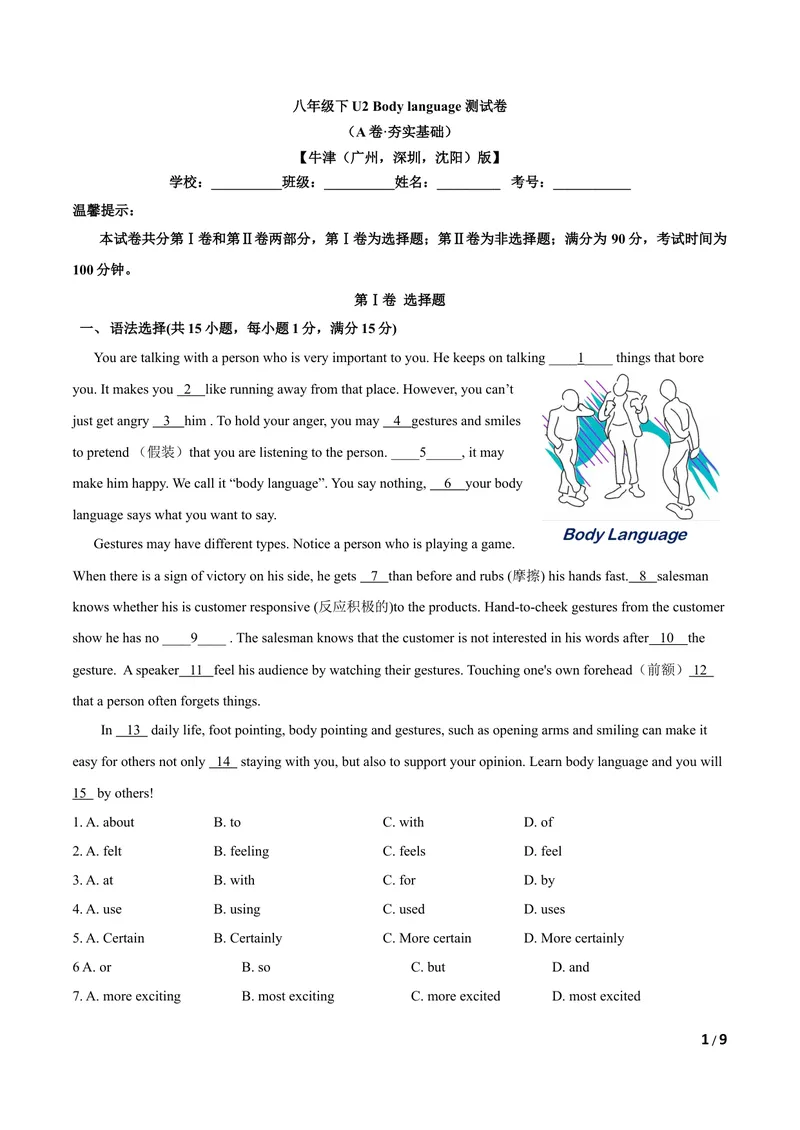
make him happy. We call it “body language”. You say nothing, 6 your body
language says what you want to say.
Gestures may have different types. Notice a person who is playing a game.
When there is a sign of victory on his side, he gets 7 than before and rubs (摩擦) his hands fast. 8 salesman
knows whether his is customer responsive (反应积极的)to the products. Hand-to-cheek gestures from the customer
show he has no ____9____ . The salesman knows that the customer is not interested in his words after 10 the
gesture. A speaker 11 feel his audience by watching their gestures. Touching one's own forehead(前额) 12
that a person often forgets things.
In 13 daily life, foot pointing, body pointing and gestures, such as opening arms and smiling can make it
easy for others not only 14 staying with you, but also to support your opinion. Learn body language and you will
15 by others!
1. A. about B. to C. with D. of
2. A. felt B. feeling C. feels D. feel
3. A. at B. with C. for D. by
4. A. use B. using C. used D. uses
5. A. Certain B. Certainly C. More certain D. More certainly
6 A. or B. so C. but D. and
7. A. more exciting B. most exciting C. more excited D. most excited
1 / 98. A. A B. The C. An D. /
9. A. interesting B. interested C. interest D. interestedly
10. A. watch B. watches C. watching D. watched
11. A. must B. need C. should D. can
12. A. shows B. showed C. has showed D. is showing
13. A. us B. our C. ours D. we
14. A. enjoy B. enjoying C. enjoys D. to enjoy
15. A. be respected B. respects C. respect D. respecting
二、完形填空 阅读短文,掌握大意,选出最佳选项。(共10分,每小题1分)
In my opinion. the best body language may be the smile. A smile can help us
get through difficult times and find friends. A smile can open doors and pull down
walls among strangers. My _____16___can tell it.
I have organized a meeting with the doctor for months. I also called the day
before to make sure all the paperwork would be prepared for the x-rays.
Then I arrived. It wasn't___17_____at all. The lady there even didn't know what I was talking about . I felt my
blood hot at once I was getting so____18____ . Though I didn't_____19_____her. the way I was talking to her was
not nice. The whole time she smiled and was friendly to me.
When everything was____20____done. I felt much better. I sat down and____21_____about the whole
thing. How can I make it better ? How can I make up for my impolite behavior a moment ago ? I could
give her a chocolate bar I had on me. but this_____22____ more than that. I should say sorry to her honestly. And
that is exactly what I did.
I____23_____ for the way I had spoken to her and told her it was wrong of me. She accepted, again with a
_____24____. God helps me be that woman who smiles and forgives(谅)so easily. I don't get it right every
time. I can be impolite and when I am. I almost hate myself for it. I am not that person. not any more. Yet I
continue to grow and continue to learn. It's true that smile________ my anger and opened a door to understanding.
16. A. expression B. experience C. memory D. difficulty
17. A. free B. perfect C. sure D. ready
18. A. angry B. sad C. tired D. scared
19. A. make fun of B. give up C. shout at D. look for
20. A. finally B. suddenly C usually D. probably
2 / 921. A. forgot B. thought C. wrote D. heard
22. A. spent B. found C. used D. needed
23. A. communicated B. replied C. apologized D. fought
24. A. gesture B. smile C. promise D message
25. A .changed B. decided C. punished D raised
三、阅读理解(分2节,共35分)
第一节、阅读选择(30分)
A
Knowing the eye contact
◆If a person doesn’t want to contact, there may be something he doesn’t want you to know.
◆People who are looking for a piece of memory often look up. People who make up (编造) something often look
down.
Knowing the looks on their faces
◆A person with a true smile smiles with his or her mouth and eyes.
◆A person with an untrue smile does not smile with the eyes.
Knowing body language about hands and feet
◆Hands in pockets may mean the person is keeping distance.
◆Feet pointing towards the door of the house may mean the person really wants to leave.
Using body language to help you
If you want someone to like you, do as the following:
◆Keep eye contact to show you are interested (But don’t look at someone for too long!).
◆Do the similar action, postures and gestures as the other person. This will make him more relaxed.
Other body language
◆If the other person’s voice goes up or down, he or she is most likely interested.
◆A bored person looks everywhere, looks at the time often and does the same action such as drumming the table
with finger.
26. When a person doesn’t want to make eye contact with you, what is he doing?
A. He is trying something. B. He is hiding something.
C. He is cheering himself up. D. He is giving up himself.
3 / 927. Which of the following can show your brother doesn’t want to be close to you?
A. Laughing with you. B. Looking down.
C. Putting his hands in pockets. D. Keeping eye contact.
28. Which is NOT mentioned about body language in the passage?
A. Facial expression. B. Eye contact.
C. Feet gesture. D. Shaking hands.
B
A powerful body posture(姿势) may help children to feel more confident in school. These are the findings of a
new study by psychologists(心理学家) from Martin Luther University.
Some body poses don’t need further explanation: When a person sits with their arms crossed behind their
head, resting his feet on a table, he is probably feeling very self-confident. “Body language is not just about
expressing feelings, it can also shape how a person feels,” explains Robert from MLU.
“Power posing is the nonverbal(非语言的) expression. It involves making very confident poses and changes
in body posture,” says Robert. Up to now, most studies have focused on the effects(影响) on adults. Robert and
partners’ study is the first to examine children. “Children from the age of five are able to know and read the body
posture of others,” Robert adds.
The researchers started their experiment with 108 fourth-graders. One group was to perform two open postures
for one minute each. The other group posed with their arms crossed in front of them and their heads down. The
children then completed a series of psychological tests. The children who had performed an open posture before
had better mood and reported higher self-confidence than the children in the other group. The effects were very
clear when it came to questions about school. “Here, power posing had the strongest effect on the children’s self-
respect,” concludes Robert. “Teachers could try and see whether this method helps their students.” However,
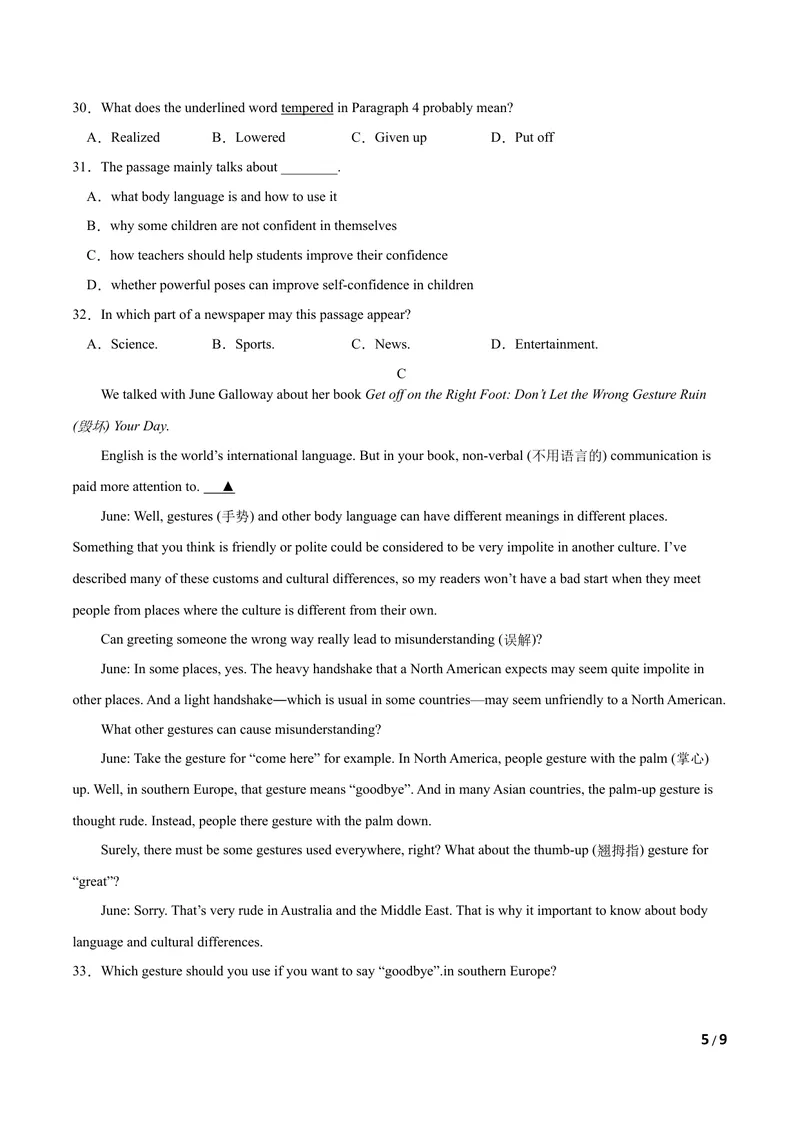
Robert says that the results of the new study should not be blown up and that expectations(期望值) about this skill
should be tempered. The effects could last for a short time. Serious problems must be treated by doctors.
The new study is consistent with earlier findings on power posing. However, more research need to be carried
on.
29.What does the writer want to do in Paragraph 3?
A.Add some background information on the study.
B.Introduce a new topic to children for discussion.
C.Show the methods of the psychological tests.
D.Explain the uselessness of the body language.
4 / 930.What does the underlined word tempered in Paragraph 4 probably mean?
A.Realized B.Lowered C.Given up D.Put off
31.The passage mainly talks about ________.
A.what body language is and how to use it
B.why some children are not confident in themselves
C.how teachers should help students improve their confidence
D.whether powerful poses can improve self-confidence in children
32.In which part of a newspaper may this passage appear?
A.Science. B.Sports. C.News. D.Entertainment.
C
We talked with June Galloway about her book Get off on the Right Foot: Don’t Let the Wrong Gesture Ruin
(毁坏) Your Day.
English is the world’s international language. But in your book, non-verbal (不用语言的) communication is
paid more attention to. ▲
June: Well, gestures (手势) and other body language can have different meanings in different places.
Something that you think is friendly or polite could be considered to be very impolite in another culture. I’ve
described many of these customs and cultural differences, so my readers won’t have a bad start when they meet
people from places where the culture is different from their own.
Can greeting someone the wrong way really lead to misunderstanding (误解)?
June: In some places, yes. The heavy handshake that a North American expects may seem quite impolite in
other places. And a light handshake―which is usual in some countries—may seem unfriendly to a North American.
What other gestures can cause misunderstanding?
June: Take the gesture for “come here” for example. In North America, people gesture with the palm (掌心)
up. Well, in southern Europe, that gesture means “goodbye”. And in many Asian countries, the palm-up gesture is
thought rude. Instead, people there gesture with the palm down.
Surely, there must be some gestures used everywhere, right? What about the thumb-up (翘拇指) gesture for
“great”?
June: Sorry. That’s very rude in Australia and the Middle East. That is why it important to know about body
language and cultural differences.
33.Which gesture should you use if you want to say “goodbye”.in southern Europe?
5 / 9A. B.
C. D.
34.According to the passage, ________ is/are NOT mentioned in June’s book.
A.the importance of body language. B.some common gestures
C.the development of body language D.different meanings of a gesture
35.Which of the following can be put in the ▲ ?
A.How is that possible? B.Could it make readers interested?
C.Can you give us some examples? D.why is that so important?
36.What can we infer (推断) from the passage?
A.June paid more attention to the language of English in her book.
B.A girl from Australia may be angry with you if you praise her by using the thumb-up gesture.
C.Body language is the world’s international language.
D.In many Asian countries, the palm-up gesture is thought rude.
D
Do you use hand gestures when you talk? Do you open your mouth and eyes wide when you are surprised?
These are all examples of body language. How important can it be? Follow Teens and have a look.
Body language does not use words. It uses the movement or position of your body to show certain meanings.
According to American scientist Edward T. Hall, in a conversation between two people, 65 per cent of
communication is body language. In some cases you even express yourself without words. For example, if your
friend asks you to join him in a picnic, you will give him an "OK" gesture to say: "Yes, sounds great!" Sometimes,
your words say one thing, but your body language says another. You may do things unconsciously(无意识地) like
touching your face while telling a lie.
In different cultures, the same body language means different things. In the US, making eye contact(眼神交流)
with someone means you are interested in what the person is saying. While in some Asian countries, it is rude to
look into a person's eyes during a conversation.
6 / 9Sometimes, different body language expresses the same meaning. Take "hello" for example. French people kiss
cheeks (脸颊) to say hello. Japanese people bow (鞠躬). Maoris in New Zealand, however, touch noses in greeting.
What are you trying to say?
Body language is important to teenagers. Understanding this language helps you to communicate better with
others.
37.What does body language use to show meanings?
A. Words. B. Sentences. C. Letters. D. Movement or position.
38.What does an American mean if he makes eye contact with someone?
A. He is bored with the person.
B. He is interested in the person.
C. He is angry with the person.
D. He doesn't want to say anything.
39.Whom might this passage be written for?
A. Old people. B. The disabled. C. Adults. D. Teenagers.
40.Which of the following is TRUE?
A. The same body language always means the same thing.
B .Different body language can express the same meaning.
C. Asian people like making eye contact.
D. Japanese people kiss to say hello.
第二节、阅读填空(5分)
Many animals use some kinds of “language”. They use signals that have certain meanings. __41_____ It is
difficult for a bee to tell the other bees where the food is but it can do a little dancing. __42_____
Some animals show how they feel by making sounds. It is not difficult to tell if a dog is angry when it barks.
Birds make several different sounds and each has its meaning. __43_____We make sounds like “Oh” show how we
feel about something or when we drop something on our feet.
We humans also have languages. we have words. __44____ We are able to give each other information and to
tell other people what we think or feel. By writing down words, we can remember what has happened or send
messages to people far away.
Languages, like people, live and die. __45____ This language cannot live and grow because no one uses it.
A. Sometimes we humans make sounds in the same way.
7 / 9B. If a language is not used by people, it is called a dead language.
C. For example, when a bee has found some food, it goes back to its home.
D. These words have the meanings of things action feelings or ideas.
E. This tells the other bees where the food is and how far away it is.
第2卷 非选择题(共30分)
第一节、根据首字母填写单词
Body language plays an important role in our daily c___________(1). From our expressions to our body
movements, the things we don’t say can still have a lot of information. A few feelings can be expressed through our
e_________(2), including happiness, sadness, anger, surprise, fear and so on. Gestures are another kind of
body language. A thumb up is used as a g__________(3)of approval (同意) while a thumb d________(4)
is a gesture of disapproval (不同意). The arms and legs are also useful in conveying (传递) information.
Folding one’s arms may show that he protects himself against attack. C________(5)one’s legs away from another
person may show that he doesn’t like or want to stay with the person.
第二节、完成句子(每题2分,共10分)
1.坐直意味着你很自信。
means you are very confident.
2.她动听的声音给我留下了好印象。
Her beautiful voice me.
3.父亲直视着儿子的眼睛,要他讲真话。
The father the son’s eyes and asked him to tell the truth.
4.你可能是对的。我对答案不确定。
You may be right. I about the answer.
5英语是一门多么重要的语言啊!
English is!
第三节、书面表达(15分)
日常生活中,我们在交流时,除了用口头语言以外,还会用一些肢体语言。肢体语言在人们的交流中
十分重要。假如你是李伟,你的笔友Jack将要来中国学习汉语,请你根据下列提示用英语写一封电子邮件,
告诉他中国人常用的一些肢体语言。80词左右,开头和结尾已给出,不计入总词数;
8 / 9提示:
1.见面打招呼时点头并微笑。
2.很少在公共场合拥抱或亲吻。
3.好朋友见面通常短暂地握手。
Dear Jack,
I’m glad that you are going to study Chinese in China.
____________________________________________________________________________________________
____________________________________________________________________________________________
____________________________________________________________________________________________
____________________________________________________________________________________________
____________________________________________________________________________________________
____________________________________________________________________________________________
____________________________________________________________________________________________
____________________________________________________________________________________________
____________________________________________________________________________________________
____________________________________________________________________________________________
____________________________________________________________________________________________
____________________________________________________________________________________________
I’ll tell you more when you come. And I’m looking forward to seeing you soon.
Yours,
Li Wei
9 / 9