八年级下U2
(B卷提升篇)
【牛津(广州,深圳,沈阳)版】
学校:__________班级:__________姓名:_________ 考号:___________
温馨提示:
本试卷共分第Ⅰ卷和第Ⅱ卷两部分,第Ⅰ卷为选择题;第Ⅱ卷为非选择题;满分为110分,考试时间为
120分钟。
第Ⅰ卷 选择题
一、语法选择(共15小题,每小题1分,满分15分。(2019-2020年广州天河区级期末试题)
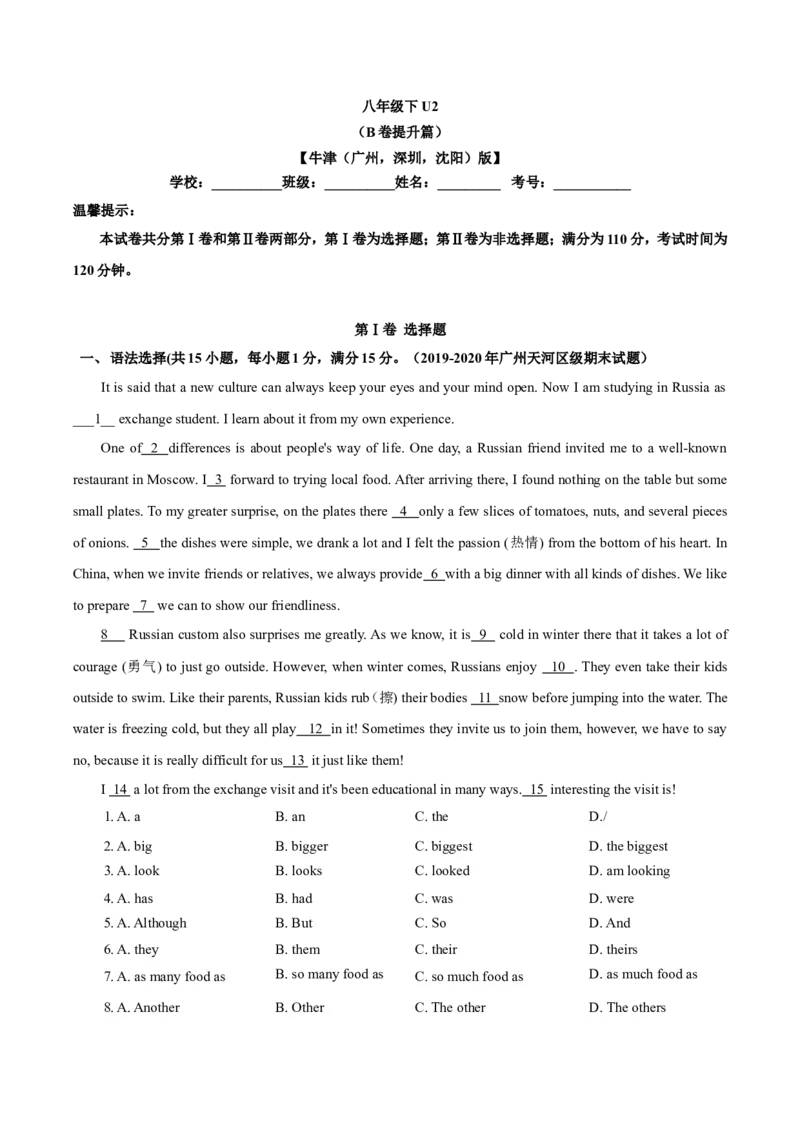
It is said that a new culture can always keep your eyes and your mind open. Now I am studying in Russia as
___1__ exchange student. I learn about it from my own experience.
One of 2 differences is about people's way of life. One day, a Russian friend invited me to a well-known
restaurant in Moscow. I 3 forward to trying local food. After arriving there, I found nothing on the table but some
small plates. To my greater surprise, on the plates there 4 only a few slices of tomatoes, nuts, and several pieces
of onions. 5 the dishes were simple, we drank a lot and I felt the passion (热情) from the bottom of his heart. In
China, when we invite friends or relatives, we always provide 6 with a big dinner with all kinds of dishes. We like
to prepare 7 we can to show our friendliness.
8 Russian custom also surprises me greatly. As we know, it is 9 cold in winter there that it takes a lot of
courage (勇气) to just go outside. However, when winter comes, Russians enjoy 10 . They even take their kids
outside to swim. Like their parents, Russian kids rub(擦) their bodies 11 snow before jumping into the water. The
water is freezing cold, but they all play 12 in it! Sometimes they invite us to join them, however, we have to say
no, because it is really difficult for us 13 it just like them!
I 14 a lot from the exchange visit and it's been educational in many ways. 15 interesting the visit is!
1. A. a B. an C. the D./
2. A. big B. bigger C. biggest D. the biggest
3. A. look B. looks C. looked D. am looking
4. A. has B. had C. was D. were
5. A. Although B. But C. So D. And
6. A. they B. them C. their D. theirs
7. A. as many food as B. so many food as C. so much food as D. as much food as
8. A. Another B. Other C. The other D. The others9. A. very B. quite C. so D. such
10. A. swim B. swam C. to swim D. swimming
11.A. with B. by C. in D. through
12. A. excited B. excitedly C. excite D. excitement
13. A. enjoy B. enjoyed C. to enjoy D. enjoying
14. A. learn B. learnt C. will learn D. have learnt
15. A. How B. How an C. What D. What an
二、完形填空 阅读短文,掌握大意,选出最佳选项。(共15分,每小题1.5分)
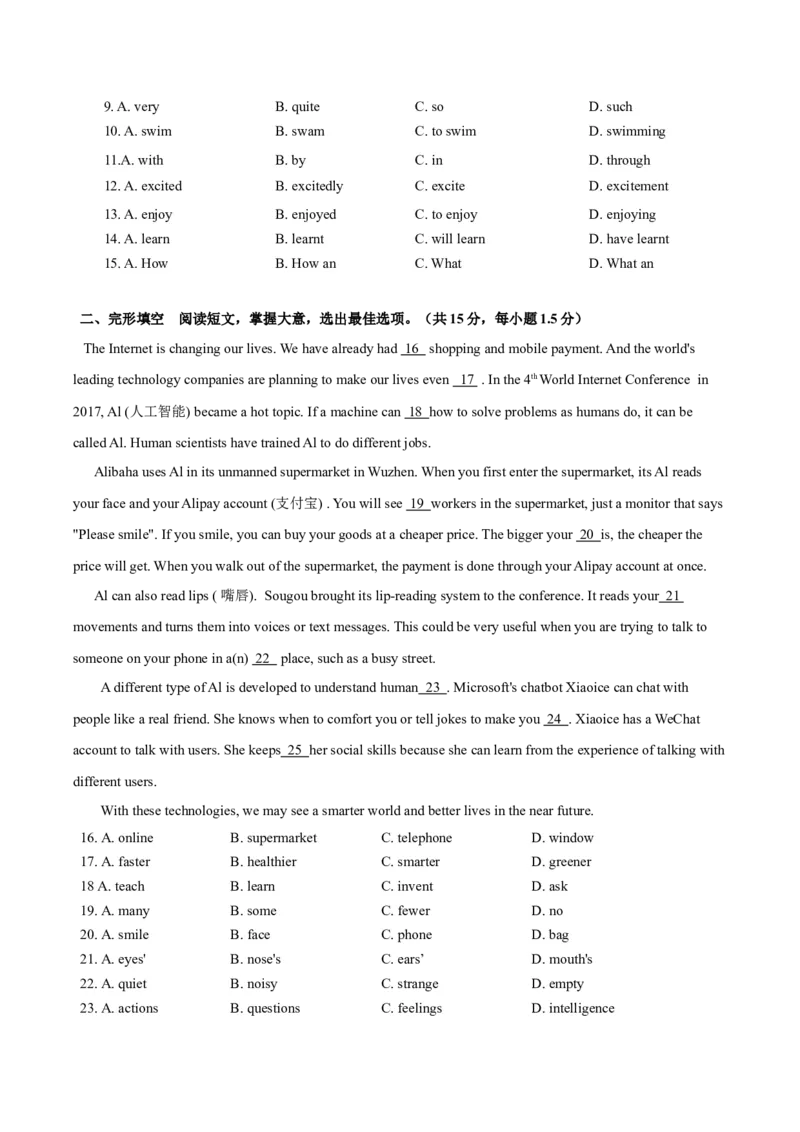
The Internet is changing our lives. We have already had 16 shopping and mobile payment. And the world's
leading technology companies are planning to make our lives even 17 . In the 4th World Internet Conference in
2017, Al (人工智能) became a hot topic. If a machine can 18 how to solve problems as humans do, it can be
called Al. Human scientists have trained Al to do different jobs.
Alibaha uses Al in its unmanned supermarket in Wuzhen. When you first enter the supermarket, its Al reads
your face and your Alipay account (支付宝) . You will see 19 workers in the supermarket, just a monitor that says
"Please smile". If you smile, you can buy your goods at a cheaper price. The bigger your 20 is, the cheaper the
price will get. When you walk out of the supermarket, the payment is done through your Alipay account at once.
Al can also read lips ( 嘴唇). Sougou brought its lip-reading system to the conference. It reads your 21
movements and turns them into voices or text messages. This could be very useful when you are trying to talk to
someone on your phone in a(n) 22 place, such as a busy street.
A different type of Al is developed to understand human 23 . Microsoft's chatbot Xiaoice can chat with
people like a real friend. She knows when to comfort you or tell jokes to make you 24 . Xiaoice has a WeChat
account to talk with users. She keeps 25 her social skills because she can learn from the experience of talking with
different users.
With these technologies, we may see a smarter world and better lives in the near future.
16. A. online B. supermarket C. telephone D. window
17. A. faster B. healthier C. smarter D. greener
18 A. teach B. learn C. invent D. ask
19. A. many B. some C. fewer D. no
20. A. smile B. face C. phone D. bag
21. A. eyes' B. nose's C. ears’ D. mouth's
22. A. quiet B. noisy C. strange D. empty
23. A. actions B. questions C. feelings D. intelligence24. A. happy B. sad C. angry D. clever
25. A. changing B. copying C. improving D. comparing
三、阅读 (共两节,满分45分)
第一节 阅读理解(共20小题;每小题2分,满分40分)
A
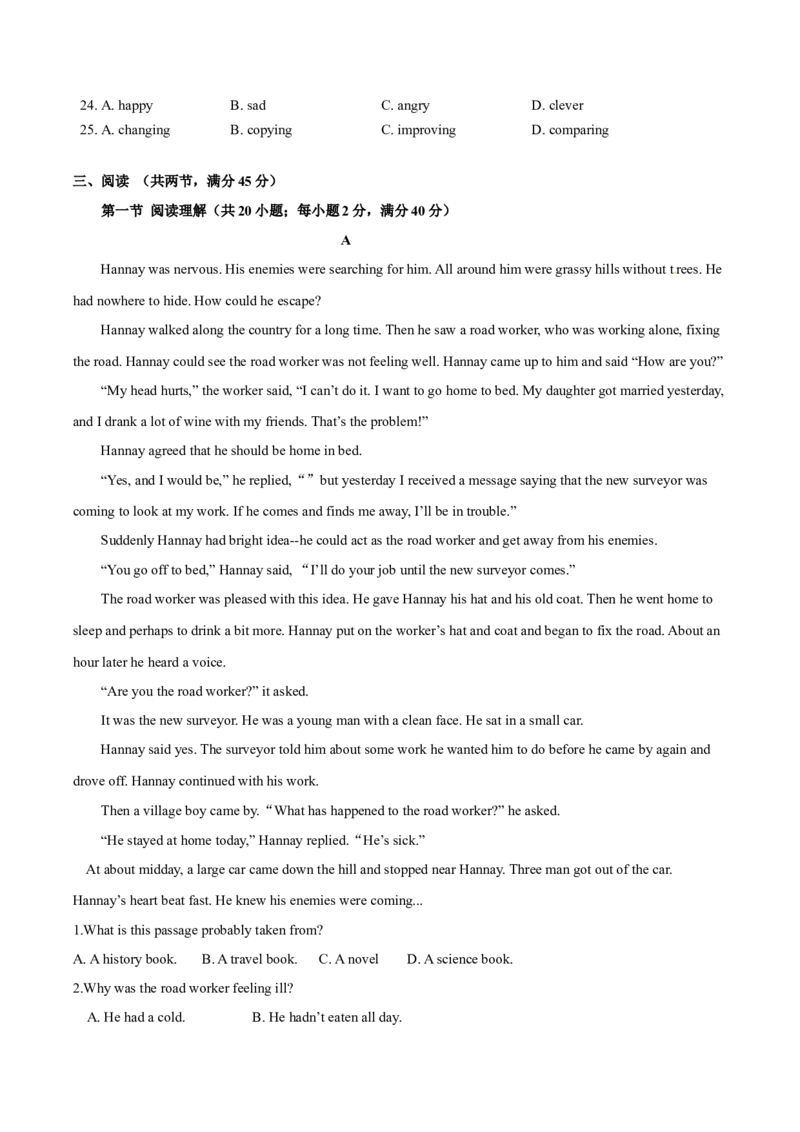
Hannay was nervous. His enemies were searching for him. All around him were grassy hills without trees. He
had nowhere to hide. How could he escape?
Hannay walked along the country for a long time. Then he saw a road worker, who was working alone, fixing
the road. Hannay could see the road worker was not feeling well. Hannay came up to him and said “How are you?”
“My head hurts,” the worker said, “I can’t do it. I want to go home to bed. My daughter got married yesterday,
and I drank a lot of wine with my friends. That’s the problem!”
Hannay agreed that he should be home in bed.
“Yes, and I would be,” he replied,“”but yesterday I received a message saying that the new surveyor was
coming to look at my work. If he comes and finds me away, I’ll be in trouble.”
Suddenly Hannay had bright idea--he could act as the road worker and get away from his enemies.
“You go off to bed,” Hannay said, “I’ll do your job until the new surveyor comes.”
The road worker was pleased with this idea. He gave Hannay his hat and his old coat. Then he went home to
sleep and perhaps to drink a bit more. Hannay put on the worker’s hat and coat and began to fix the road. About an
hour later he heard a voice.
“Are you the road worker?” it asked.
It was the new surveyor. He was a young man with a clean face. He sat in a small car.
Hannay said yes. The surveyor told him about some work he wanted him to do before he came by again and
drove off. Hannay continued with his work.
Then a village boy came by.“What has happened to the road worker?” he asked.
“He stayed at home today,” Hannay replied.“He’s sick.”
At about midday, a large car came down the hill and stopped near Hannay. Three man got out of the car.
Hannay’s heart beat fast. He knew his enemies were coming...
1.What is this passage probably taken from?
A. A history book. B. A travel book. C. A novel D. A science book.
2.Why was the road worker feeling ill?[
A. He had a cold. B. He hadn’t eaten all day.C. He had been working all day. D. He drank too much at his daughter’s wedding.
3.Who did NOT come by while Hannay was working on the road?
A. The surveyor. B. The road worker’s daughter.
C. Hannay’s enemies. D. A village boy.
4.What can we infer (推断)from the story?
A. Hannay helped the road worker because he was warm-hearted.
B. The grassy hills were a perfect hiding place for Hannay.
C. The surveyor had lot of working experience.
D. The village boy knew the road worker.
5.What is the correct order of the story?
①Hannay met a road worker who was not feeling well and offered to take over for him.
②Hannay was worried because his enemies were following him.
③A car stopped near Hannay and three men got out.
④Hannay acted as the road worker when the surveyor came by.
⑤ The village boy wondered what had happened to the road worker.
A.②→①→④→⑤→③ B. ②→①→④→③→⑤
C. ①→④→②→⑤→③ D.①→④→②→③→⑤
B
In 2010, writer Ding Yan made a decision to leave her hometown in west China’s Xinjiang Uygur
Autonomous Region for Dongguan, a manufacturing(制造业) capital in south China’s Guangdong Province. She
wanted to experience and write about the lives of the city’s factory girls who keep the production lines (生产线)
moving.
For almost a year, Ding worked at two electronics factories and a CD packaging factory. It was a difficult
experience for a woman in her forties. Every day, she would put a small notebook and pen into her pocket secretly
before starting her work. Much of the book was written during her short toilet breaks at work. From her experiences
and the stories of the women she met came a book, Factory Girls, which came out at the end of this April.
Factory Girls describes what life is like on the production line. It describes how the women stand all day,
doing the same work. They sometimes chat quietly. One time, Ding was working next to a girl who told her, "I
really wish the production line could just stop a moment for me to take a breath (呼吸). "
Ding said, "When I really thought about it, I came to realize that there was no difference between the factory
girls and me. Although I don’t work physically as hard as they do to make a living, we are all experiencing thesame helpless feeling towards life. The women I met were all very good at their jobs but they didn’t have great
passion (热情) for life. "
6. Writer Ding Yan was born in ______________.
A. Beijing B. Guangdong C. Hainan D. Xinjiang
7. How many factories did Ding work in almost a year?
A. Two. B. Three. C. Four. D. Five.
8. What does her book Factory Girls describe?
A. Her hometown. B. The lives of factory girls.
C. Her special life experience. D. The production lines of the city’s factories.
9. What do we know about the factory girls on the production lines?
A. They are poor.
B. They were born in Dongguan.
C. They can do well in their jobs.
D. They can’t chat with each other at work.
10. Which of the following is NOT true according to the passage?
A. Ding Yan is a writer of 30.
B. Ding Yan lived as a factory girl and wrote the book.
C. Much of Ding’s book was written during short toilet breaks at work.
D. Ding Yan thinks there is no difference between the factory girls and her.
C
BODY language is the quiet, secret and most powerful language of all! It is said that our body movements
communicate about 50 per cent of what we really mean while words themselves only express 7 per cent. So, while
your mouth is closed, just what is your body saying...
Arms. How you hold your arms shows how open and receptive you are to people you meet. If you keep your
arms to the sides of your body or behind your back, this suggests you are not afraid of taking on whatever comes
your way. Outgoing people generally use their arms with big movements, while quieter people keep them close to
their bodies. If someone upsets you, just cross your arms to show you're unhappy!
Head. When you want to appear confident, keep your head level. If you are monitor in class, you can also take
on this position when you want your words to be taken seriously. However, to be friendly in listening or speaking,
you must move your head a little to one side.Legs. Your legs tend to move around a lot more than normal when you are nervous or telling lies. If you are at
interviews, try to keep them still!
Posture (姿势). A good posture makes you feel better about yourself. If you are feeling down, you normally
don't sit straight, with your shoulders inwards. This makes breathing more difficult, which in turn can make you
feel nervous or uncomfortable.
Mouth. When you are thinking, you often purse your lips (噘起嘴). You might also use this position to hold
back an angry comment you don't wish to show. However, it will probably still be noticed, and people will know
you're not pleased.
11.How many kinds of body language are mentioned in this passage?
A. three B. four C. five D. six
12.When may you cross your arms?
A. when someone helps you B. when someone upsets you
C. when someone hits you D. when someone pleases you
13. You should hold your head level if you_______________.
A. want others take your words serious C. want to be friendly in listening
B. want to be polite D. want to make fun of others
14.What does the underlined word mean?
A. arm B. head C. posture D. mouth
15.Which statement is not true?
A. Your legs tend to move around more when you are nervous
B. A good posture may be of help.
C. You may keep your shoulders inwards is you feel down.
D.A good posture may can make you feel uncomfortable.
D
We often use some warning signals to describe how serious a meteorological disaster(气象灾害) is . For
example, let’s see how to describe the level of a snowstorm.
Warning signal Meaning NoticeIt means the amount of snowfall reaches Fight against snowstorm;
4mm or more in 12 hours, or the snowfall
Work of sweeping and melting
continues when it gets to 4 mm. It may
affect (影响) people’s daily life . the snow;
Be careful not to slide (滑倒).
The amount of snowfall reaches 6 mm or
more in 12 hours, or the snow continues to
The same as the first notice.
fall after it gets to 6 mm. It may have
effects on people’s daily life.
The amount of snowfall reaches 10 mm or The same as the first notice and
more in 6 hours, or it continues to fall moreover, avoid unnecessary
after getting to 10 mm. It has a great effect
outdoor activities.
on people’s life.
The amount of snowfall reaches 15 mm or
more in 6 hours, or it continues to fall
The same as the third notice.
after getting to 15 mm. It has a very great
effect on people’s life.
16. Which of the four signals describe the most serious snowstorm?
A. The blue one. B. The yellow one. C. The orange one. D. The red one.
17. If the amount of snowfall gets to 13 mm in 6 hours, the signal should be .
A. blue B. yellow C. orange D. red
18. The meaning of the underlined word “melting” may be “ ”.
A. 凝结 B. 凝固 C. 融化 D. 熔化
19. If the warning signal is red, which of the following things CANNOT Lucy do?
A. She is going to watch CCTV news about snowstorm at home.
B. She is going to take photos of snow in the front of her house.
C. She is going to draw a picture about snow in the field.
D. She is going to sleep in bed.
20. Which of the following places may the signals come from?
A. The travelling department. B. The meteorological department.
C. The traffic department. D. The railway department.
第二节 阅读填空(共5小题;每小题1分,满分5分)
根据短文内容,将下面A---E五个句子分别填入文中空缺处,使得补全后的短文意思通顺,结构完整。
The world is full of great books, just waiting to read. 1 Here are some tips.
What makes you happy?If you have a favorite hobby, look for books about that activity. You're more likely to enjoy reading a book if
you're already interested in its subject.
Fiction or nonfiction?
Some books are totally made up and imagined. 2 Novels, short stories, and fables(寓言)are all
examples of fiction. These books can bring you to another world or help you imagine something beyond(超出)
your own experience.
3 But that doesn't mean they are boring. Nonfiction books can bring to life everything
from the first trip to the moon to what it's like to explore (探索)the deepest oceans.
Try both fiction and nonfiction books to see which you like better.
Find a family favorite.
What was your mother's favorite book when she was at your age? Or your dads? 4 Then
you can ask them why they liked it and share your thoughts. It's a fun way to get to know your family a little
better, and to find a book you ll enjoy!
Ask an expert.
Your local library is a great place to find books that you will love. 5 Tell a librarian about
your interests. Your librarian can help you find books that you're sure to love. Your teacher is another
good person to ask.
A. Ask them and give it a read.
B. Those are called fiction books.
C. How can you pick one you will like?
D. Nonfiction books tell stories using facts.
E. You don' t have to search all by yourself.
第2卷 写作(共35分)
第一节 单词拼写(共6小题,每小题1分,满分6分)
1. We must go a_______ the road carefully. Because there are too many cars.
2. C_______ the street and you can find the hospital.
3. Michael was late for work ,do you know what’s the m___________ ?
4. The e___________ on your face means that there is something wrong with you.5, L________ and gentlemen, welcome to the opening ceremony.
6, He is not at home. You can leave a m _________ for him
第二节 完成句子。(共7小题,每题2分,满分14分)
1.你给老师们留下了很好的印象。
You ______ ________ _________ _________ _________ the teachers.
2. 他想提醒我明天是她的奶奶的生日。
She wanted __________ __________ __________ _________tomorrow is her grandmother’s birthday.
3.你应该尽力多开口说话。
You must __________ __________ ________, I think your Chinese will improve a lot.
4. 交多点朋友对你有好处。
________ _________ __________ is good for you.
5. 你可以四处走以便了解更多中国文化。
You can travel around __________ __________ you will know more about China.
6. 火灾发生在昨天晚上。
The fire _________ _________ on yesterday evening.
7. 他坐直了身体,并尝试对人微笑。
He __________ __________ and tried _________ ________people
第三节:书面表达
在日常交流中, 你喜欢使用肢体语言吗? 使用肢体语言有哪些好处呢? 请根据下面的提示写一篇短文,
70~80词, 可适当发挥。
内容包括: 1. 我喜欢使用肢体语言;
2. 使用肢体语言能够很好地表达自己, 让别人更容易理解我们;
3. 肢体语言很有趣,它能让谈话变得更轻松;
4. 使用正确的肢体语言能给别人留下好印象。
____________________________________________________________________________________________
____________________________________________________________________________________________
_________________________________________________________________________________________
____________________________________________________________________________________________
____________________________________________________________________________________________
_____________________________________________________________________________________________________________________________________________________________________________________
____________________________________________________________________________________________
_________________________________________________________________________________________
____________________________________________________________________________________________
__________________________________________________________________________________________