八年级下U2 Body language 测试卷
(A卷基础篇)
【牛津(广州,深圳,沈阳)版】
学校:__________班级:__________姓名:_________ 考号:___________
温馨提示:
本试卷共分第Ⅰ卷和第Ⅱ卷两部分,第Ⅰ卷为选择题;第Ⅱ卷为非选择题;满分为100分,考试时间为
100分钟。
第Ⅰ卷 选择题
一、选择题(每题1分,共10分)
1、I haven’t had a chance of the movie.
A see B to see C seeing D saw
2、It was the first meeting, so Tom decided a good impression his boss.
A to make, on B make, on C to make, about D make, in
3、Great changes have in my hometown since 1978.
A looked up B talked about C taken place D looked into
4、David is interested in_______
A. sing B. sings C. singing D. sang
5、 Tom up his head to look at the blackboard.
A took B held C hosted D caught
6、It had rained for nearly two weeks by yesterday, it made me _____ out these days, so
I felt very bored.
A. don’t go B. didn’t go C. not to go D. not go
7、We are looking forward to _________ you again.
A see B to see C seeing D saw
8、When I entered the room, I saw Tom a book
A reading B reads C read D to read
9、The old photo reminds me my school days.
A at B on C to D of
10、Finally he _________.the invitation to stay with us
A. locked B. received C. accepted D. created二、完形填空(每题1.5分,共15分 2019年北京海淀区101中学8年级期中试题)
From the time I was a child growing up in New Jersey, I loved spending weekends with my grandparents. I
felt ____ 1 ___ in Granny’s small kitchen. We always had peaceful conversations, and Granny always seemed to
include some wisdom with every dish she prepared.
I remember one Saturday morning. I was about 11 years old. After breakfast I asked Granny, “What kind of
soup are you making today?” “Vegetable beef,” she answered. “And you can help by cutting some carrots.” As I
slowly cut the carrots, I said, “I’ve got to give a report next week and I’m scared (害怕的). I don’t like standing in
front of everybody. What if I forget what I’m going to say? Or what if somebody laughs?” “And what if you do just
fine?” Granny asked. “Have you ___ 2 ___ notes?” “Well, no. That would be a lot of work.” “Hard work never
___ 3 ___ anyone,” Granny said. “You could try practicing in front of a ___ 4 ___ . It’s easy to find how well you are
practicing.”
I pushed the pieces of carrots to the side of the cutting board and went on to complain (抱怨) about
schoolwork, friends and family. Granny took it all in, listening ____ 5 ____ while I talked about so many pieces of
grief (伤心事) in my life. “Nancy, ” she said, “there’s nothing wrong with a little trouble in your life. Well, you
know, a lot of people don’t make homemade soup these days. They say it’s too much trouble. But I don’t ___ 6 ___
such a little trouble. It adds flavor (滋味) to my soup — and to my life. My soup would be pretty bland (平淡)
___ 7 ___ the vegetables, and so would my life if it didn’t have the little ups and downs.” She smiled and then
started washing the dishes. While I helped Granny clean up, I thought about what she had said. I still had a few
days to practice my report.
That Saturday, Granny gave me food for ___ 8 ___ as well as a bowl of her homemade soup. As I __ 9 ___ the
meal with my grandparents, somehow (不知何故) my problems didn’t seem so big any more. Maybe I could turn a
little trouble into something as ___ 10 ____ as Granny’s homemade soup. I would have to work on them. Granny
had said hard work paid off.
1. A. comfortable B. lucky C. excited D. relaxed
2. A. taken B. found C. prepared D. reviewed
3. A. misses B. hurts C. troubles D. stops
4. A. mirror B. wall C. person D. group
5. A. kindly B. quietly C. carefully D. patiently
6. A. mind B. refuse C. hate D. avoid
7. A. out of B. away from C. beyond D. without
8. A. attitude B. ability C. thought D. energy9. A. offered B. enjoyed C. cooked D. shared
10. A. great B. delicious C. special D. healthy
二、阅读理解(共4篇每题2分,共40分)
A
There is one language used in every country in the world. It is everybody’s second language. It is easy to
understand, although you can’t hear it. It is sign language.
For example, when you wave to a friend who is across the street, you are using sign language. When you smile at
someone, you are saying, “I want to be friendly”, but you are not using speech. You are using sign language. When
you raise your hand in class, you are saying, “Please ask me. I think I know the correct answer.” A policeman is
using sign language when he holds up his hands to stop traffic. Even a baby can use sign language when she
points at things that she wants.
Many years ago, a French priest(牧师)called Charles Michel invented a finger alphabet(字母表)for deaf
people. It is still in use. People can make the sign for letters and spell words with their hands, and deaf people
can read and understand them. Soon there were schools for the deaf in many countries. The only university for the
deaf is Gallaudet College in Washington, D.C.
Today, in the US, there are special TV news programs for deaf people. The newsreader tells the news in sign
language. At the same time, the words appear on the TV screen.
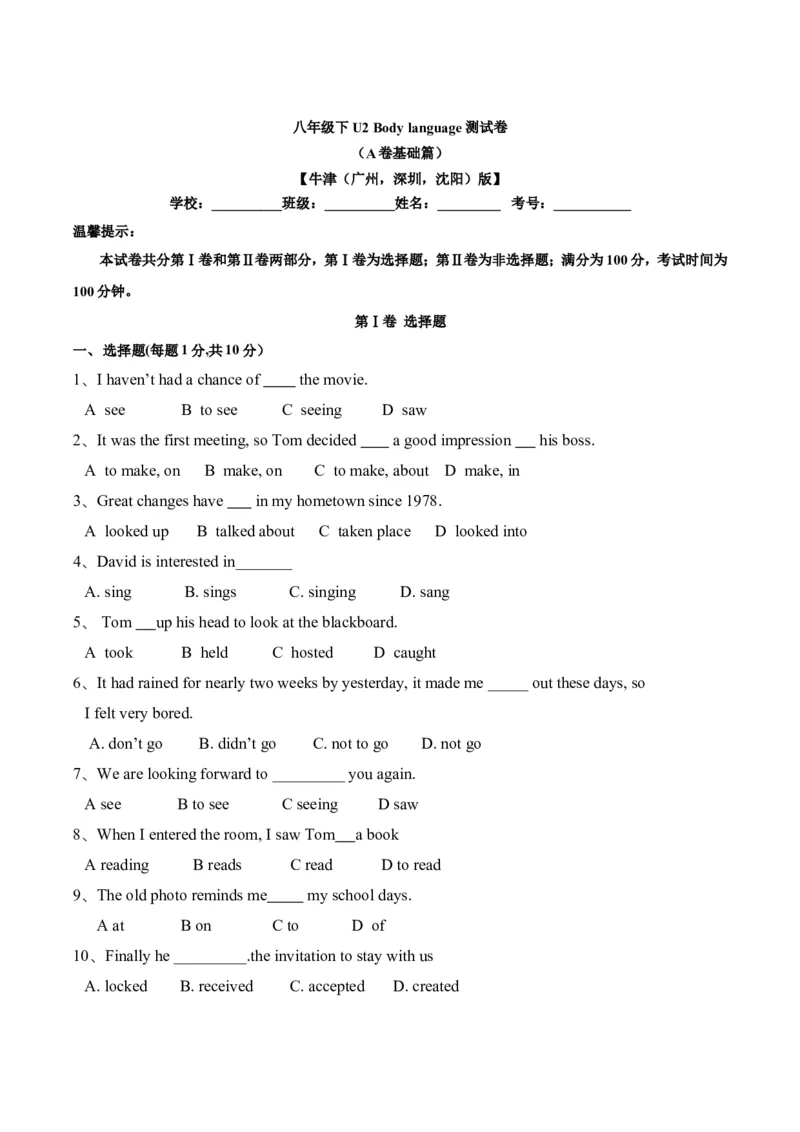
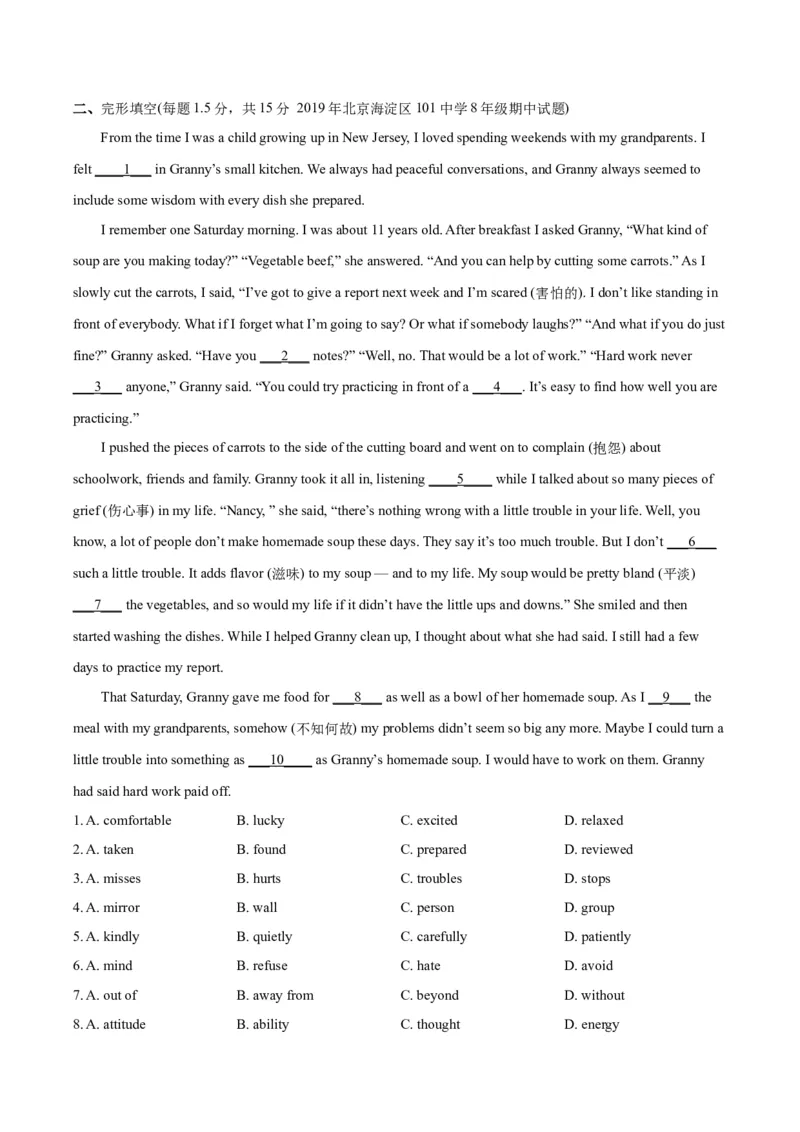
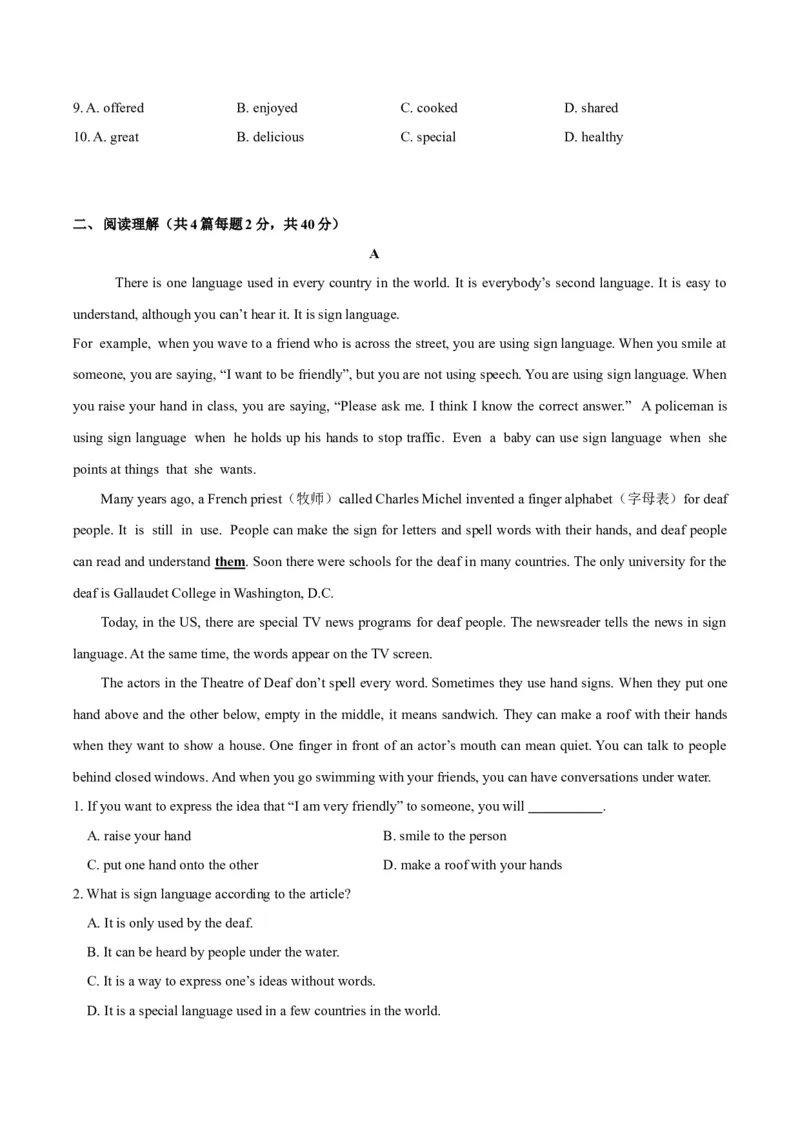
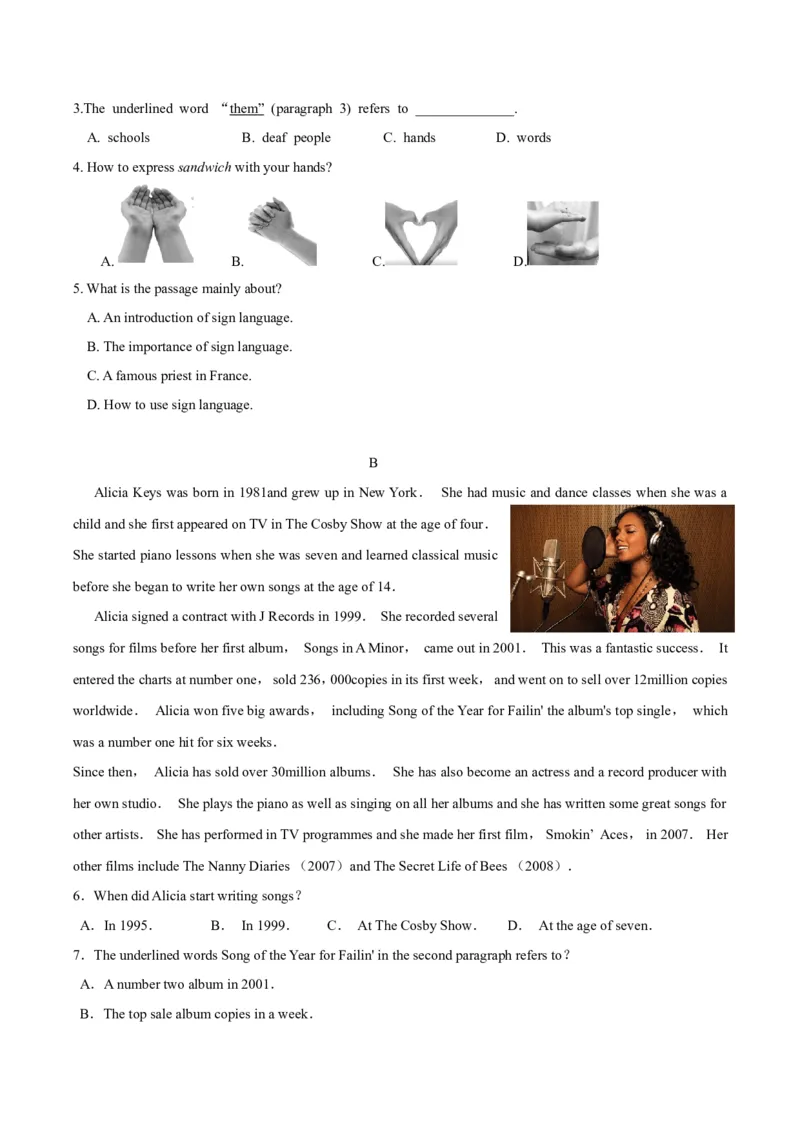
The actors in the Theatre of Deaf don’t spell every word. Sometimes they use hand signs. When they put one
hand above and the other below, empty in the middle, it means sandwich. They can make a roof with their hands
when they want to show a house. One finger in front of an actor’s mouth can mean quiet. You can talk to people
behind closed windows. And when you go swimming with your friends, you can have conversations under water.
1. If you want to express the idea that “I am very friendly” to someone, you will .
A. raise your hand B. smile to the person
C. put one hand onto the other D. make a roof with your hands
2. What is sign language according to the article?
A. It is only used by the deaf.
B. It can be heard by people under the water.
C. It is a way to express one’s ideas without words.
D. It is a special language used in a few countries in the world.3.The underlined word “ them ” (paragraph 3) refers to ______________.
A. schools B. deaf people C. hands D. words
4. How to express sandwich with your hands?
A. B. C. D.
5. What is the passage mainly about?
A. An introduction of sign language.
B. The importance of sign language.
C. A famous priest in France.
D. How to use sign language.
B
Alicia Keys was born in 1981and grew up in New York. She had music and dance classes when she was a
child and she first appeared on TV in The Cosby Show at the age of four.
She started piano lessons when she was seven and learned classical music
before she began to write her own songs at the age of 14.
Alicia signed a contract with J Records in 1999. She recorded several
songs for films before her first album, Songs in A Minor, came out in 2001. This was a fantastic success. It
entered the charts at number one, sold 236,000copies in its first week, and went on to sell over 12million copies
worldwide. Alicia won five big awards, including Song of the Year for Failin' the album's top single, which
was a number one hit for six weeks.
Since then, Alicia has sold over 30million albums. She has also become an actress and a record producer with
her own studio. She plays the piano as well as singing on all her albums and she has written some great songs for
other artists. She has performed in TV programmes and she made her first film, Smokin’ Aces, in 2007. Her
other films include The Nanny Diaries (2007)and The Secret Life of Bees (2008).
6.When did Alicia start writing songs?
A.In 1995. B. In 1999. C. At The Cosby Show. D. At the age of seven.
7.The underlined words Song of the Year for Failin' in the second paragraph refers to?
A.A number two album in 2001.
B.The top sale album copies in a week.C.The name of a hero in Songs in A Minor.
D.The song which was at the top of the charts for weeks.
8.What has Alicia done since 2001?
A.She has started playing the piano.
B. She has recorded all her songs herself.
C.She has opened her own studio.
D. She has first appeared on TV.
9.Which of following statements is NOT true when Alicia Keys was a child?
A. She lived in New York.
B. She took classical music lessons.
C. She learned dancing and singing.
D. She often appeared on television.
10.Which of the following shows the right order of what happened to Alicia?
①made the film Smokin' Aces
②signed a contract with J Records
③appeared on TV in The Cosby Show
④Songs in A Minor sold 236,000copies
⑤become an actress and a record producer
A.③④②⑤① B. ③②④⑤① C. ③①④②⑤ D. ③⑤④②①
C
Most people want to be happy, but few know how to find happiness.Money and success alone do not bring
lasting happiness.Aristotle, a Greek thinker, said, “Happiness depends upon ourselves.”In other words, we make
our own happiness.Here are a few suggestions to help you be happier.
The first secret of happiness is to enjoy the simple things in life.We spend so much time thinking about the
future that we fail to enjoy the present.You should enjoy life’s pleasures, such as reading a good book, listening to
your favorite music, or spending time with close friends.They live happier and healthier lives .
Another secret to living a happy life is to be active, you can dance, or play sports, such as swimming.You can
forget about your problems, and only think about the activity.Finally, many people find happiness in helping
others.People feel good when they spend their time helping others.If you want to feel happier, do good things for
someone.You can help a friend with his or her studies, go shopping to buy food for an elderly person.11.The best title of the passage is ________.
A.Money Makes You Happy
B.The Secrets of Happiness
C.Ideas for Helping Other People to Be Happy
[来源:学&科&网Z&X&X&K]
D.Good Friends Make You Happy
12.The second paragraph tells us that ________.
A.the more friends you have, the happier you will be
[来源:学&科&网]
B.we shouldn’t think about our future
C.happiness is to enjoy the simple things in life.
D.some people fail to live a happy life
13.The passage gives us ________ pieces of advice on happiness.
A.one B.two C.three D.four
14.The writer thinks that ________.
A.everyone knows how to live a happier life
B.it’s wrong to spend time on work
C.hobbies take up too much time
D.doing good things for someone can make you happier
15.Which of the following is NOT mentioned in the passage?
A.Reading a good book. B.Traveling to a foreign country.
C.Playing a sport. D.Spending time with close friends.
D【2019 • 黑龙江省哈尔滨市】
The Volunteers for the Ice and Snow Festival
Name
Item
Age 25 28 31 28
Nationality American Chinese English Chinese
Job Coach Nurse Singer Tour guidePersonality Friendly Quiet Humorous Outgoing
Helping during the Volunteering at an Teaching children Working at an
Volunteering
City Art Festival in animal hospital in music at school in animal care centre
experience(s)
2016 2013 and 2015 the countryside twice
Word Box: item 项目; personality性格
16. Jack helped during the City Art Festival ___________.
A. in 2013 B. in 2015 C. in 2016
17. Mike is ___________ Zhang Na.
A. three years older than B. as old as C. three years younger than
18. Du Yue and Zhang Na ___________.
A. have similar volunteering experiences
B. come from different countries
C. have the same personality
19. If someone is hurt during the Ice and Snow Festival, ___________ may be the most suitable to help.
A. Jack B. Du Yue C. Mike
20. Which of the following is TRUE according to the form(表格)above?
A. Mike who taught children music is humorous.
B. The two girls volunteered at the Olympics.
C. Jack from England is a tour guide.
第2卷 非选择题(共35分)
第一节、根据首字母填写单词
1 She called to r me about the meeting in the afternoon.
2. I get b with my job. I want to find a more interesting one.
3. What’s the m with you? You look sad.
4. Ten students would like to a the plan while the others rejected it.
5. Eric is not here now. Would you like to leave a m ?
6. The beautiful 1 over there is Tom’s mother.
第二节、完成句子(每题2分,共14分)
1.故事发生在1983年。
The story in 1983.2.坐直意味着你很自信。
means you are very confident.
3.她动听的声音给我留下了好印象。
Her beautiful voice me.
4.父亲直视着儿子的眼睛,要他讲真话。
The father the son’s eyes and asked him to tell the truth.
5.你可能是对的。我对答案不确定。
You may be right. I about the answer.
6.别叹气,继续努力。
Just keep on trying.
7.英语是一门多么重要的语言啊!
English is!
第三节、书面表达(15分)
你是Ms. Lee,你的学生John下周将参加英语演讲比赛,请你根据以下提示,写一封邮件告诉他比赛时
肢体语言方面的注意事项。词数不少于80词(开头和结尾已给出,不计入总词数)。
内容包括:
1. 保持微笑;
2. 与听众有目光接触,但需避免直盯着他人;
3. 必要时使用一些手势;
4. 结束时对台下听众表示感谢。
Dear John,
____________________________________________________________________________________________
____________________________________________________________________________________________
__________________________________________________________________________________________
____________________________________________________________________________________________
____________________________________________________________________________________________
_________________________________________________________________________________________
____________________________________________________________________________________________
______________________________________________________________________________________________________________________________________________________________________________________
____________________________________________________________________________________________
____________________________________________________________________________________________
______________________________________________________________________________________
Yours,
Ms. Lee