八年级(下)Unit 2 能力测试题
笔试部分(85分)
第一卷 选择题(60分)
I.词汇测试(15分)
i.根据句意,选择与划线部分意思最接近的选项。(共8小题,每小题1分)
()1. — Have you got the message of having a Chinese exam?
—Yes, I have. I began to study for the exam as soon as I knew it.
A. idea B. information
C. thought
()2. — Let’s take our kids out for a walk. They get bored with staying at home.
—That sounds good.
A. afraid of B. worried about
C. tired of
()3. — How is your new neighbor, Mrs Green?
—She is a kind-hearted lady. She always helps others.
A. baby B. man C. woman
()4. — Lucy always holds her head up in front of others.
—That’s because she is a very confident girl.
A. puts B. sendsC. keeps
()5. — Have they won the football game?
—I don’t know, but seeing their sad expressions, I think they lost the game.
A. looksB. eyes C. bodies
()6. — Are you sure that the girl in blue is not your friend Lily?
—Yes, I am. Lily wears a pink skirt today.
A. happy B. certain C. sad
()7. — Oh, the traffic is very heavy now. Do you know what happened?
—Yes. A traffic accident took place just now.
A. suffered B. happened C. paid
()8. — What is the man doing?
—He is reminding people about the danger of feeding animals in this zoo.
A. making ... help with
B. making... have
C. making ... think of
ii.从下面每小题的A、B、C三个选项中选出最佳答案。(共7小题,每小题1
分)
()9. ____________ is the activity of expressing ideas and feelings or exchanging
information.
A. Training B. Communication
C. Permission
()10. If someone is a ____________ worker, he or she works for only part of each day
or week.A. well-dressed B. part-time
C. full-time
()11. — Why did you ____________, Nancy?
— I failed my exam again. I feel sad.
A. sigh B. laugh C. dance
()12. — What’s the ____________ of that policeman’s gesture?
—Stop.
A. matter B. organization C. meaning
()13. — What do Chinese do when they meet each other for the first time?
—They often ____________ hands.
A. moveB. wash C. shake
()14. — How is your trip?
—Great. We had a good time and ____________ the local people.
A. looked forward to
B. made a good impression on
C. were good at
()15. — ____________ or others will think you are shy or not friendly.
—OK.
A. Sit up B. Set up C. Put up
II.完形填空(15分)
阅读下面短文,掌握其大意,然后从16-25各小题的A、B、C三个选项中选出
最佳答案。(共10小题,每小题1.5分)
That was a bad day for the lion. When he was running after a rabbit, he jumped into a
small bush. After he came out, there was no 16 in his hand, but a large thorn (刺).
He tried his best to pull out the thorn, but didn’t 17. Then he asked other animals for
help. But they were all 18 of the lion, so no animals helped him.
At last the lion came to the 19 fox. The lion asked, “Can you pull out the thorn
please?” The fox said, “I have a little 20 who does well in this, I will surely ask him
to 21 you. But you should allow me to kick you five times on your back!
The lion was 22, but he thought, “I am suffering from the 23 of the thorn. Let him
kick me. After taking out the thorn, I will 24 his little friend.”
The fox kicked the lion and then called his little friend.
A porcupine ( 豪 猪 ) came. He pulled out the thorn 25. The pain of the lion
disappeared. But he was filled with anger and sadness. He couldn’t eat the porcupine
with thousands of thorns.
()16. A. lion B. rabbit C. fox
()17. A. remain B. reply C. succeed
()18. A. afraid B. bored C. tired
()19. A. blind B. cheerful C. clever
()20. A. sister B. friend C. teacher
()21. A. remind B. hold C. help
()22. A. worried B. sad C. angry
()23. A. illness B. pain C. hunger
()24. A. eat up B. take up C. pick up()25. A. difficultly B. easily C. suddenly
III.阅读理解(30分)
阅读下列短文,从下面每题的 A、B、C、D四个选项中选出最佳答案。(共20
小题,每小题1.5分)
A
Once, a man travelled on a train. He felt hungry and got off at a station to look for
food. He bought the food in a short time but the train had gone away. It was getting
dark and he decided to find a place to spend the night. So he went to the nearby hotels
to look for a room but found none.
At last he reached a small house. He asked permission for staying in it for a night.
The host agreed happily. The host served him food and gave him a room to sleep in.
But the host did not ask for anything in return.
When it was seven at night, the man heard a knock at the door. He saw someone well-
dressed enter the house and ask the host to pay his debts (债务). The man came to
know that the host was in need of money. The next morning he put a box in the room
and left.
When the host found the box, he saw a note saying, “You helped me but did not
expect anything from me. Yesterday I heard the talk and knew your problem. This is
what you need.”
()26. Why did the man get off the train?
A. To find some drinks.
B. To find a room to rest in.
C. To find some food.
D. To go back home.
()27. What does the underlined word “it” refer to?
A. The hotel. B. The station.
C. The house. D. The train.
()28. What might the host find in the box?
A. A ticket and a card.
B. A note and some money.
C. Some money and a ticket.
D. A note and a ticket.
()29. Which of the following is TRUE according to the passage?
A. The owner of the house had a rich relative.
B. The owner of the house might be very poor.
C. The man said goodbye when he left.
D. The man was in need of money.
()30. What does the story mainly teach us?
A. Ask something in return when you help others.
B. We must pay our debts as soon as possible.
C. It is important to leave a note after living in a house.
D. When you help others, you get some help too.B
The Language of the Body The Body Language of Liars
Published on October 21, 2013
Published on December 1,2012 Written by Lillian Glass
Written by Alexander Lowen Price: $13.36
Price: $29.93 Being fooled can happen to anyone.
The Language of the Body remains You may be cheated (被欺骗) in
one of the greatest books in business. You may be cheated by a
psychology ( 心 理 学 ). It is an friend or a relative. There are many
important book to psychologists and liars in the world. Now, world-
everyone interested in understanding famous body language expert Dr
psychology. Lillian Glass shares some quick and
easy ways she uses to see throuth
the tricks with you.
The Silent Language of Leaders The Body Language of Horses
Published on April 19,2011 Published on May 1,1980
Written by Carol Kinsey Goman Written by Tom Ainslie and Bonnie
Price: $13.58 Ledbtter
This is a guide for using body Price: $18
language to become better leaders. Horses communicate in a language
Goman is widely considered as an of posture, gesture and sound. They
expert in body language in the express their needs, wishes and
workplace. This book will show feelings to each other and to some
readers how to make use of the skills people who understand them. After
of body language in leading others. reading this fantastic, exciting and
interesting book, you will
understand the horses’ language.
()31. How much should you pay if you want to buy The Language of the Body and
The Body Language of Horses?
A. $29.94. B. $31.58.
C. $31.36. D. $47.93.
()32. What does the underlined word “liars” mean?
A. People who don’t tell the facts.
B. People who are interested in body language.
C. People who like making friends with others.D. People who don’t like playing tricks.
()33. Which of the words is NOT mentioned to describe The Body Language of
Horses?
A. Educational. B. Fantastic.
C. Interesting. D. Exciting.
()34. What can we know from the passage?
A. The Language of the Body is useful for people who like art.
B. Dr Lillian Glass is a body language expert in the workplace.
C. The Silent Language of Leaders is the most expensive of all.
D. Horses can also express their feelings to people who understand them.
()35. What is the passage mainly about?
A. How to choose good books to read.
B. Why body language is important.
C. Four books about the use of body language.
D. Four books about why people use body language.
C
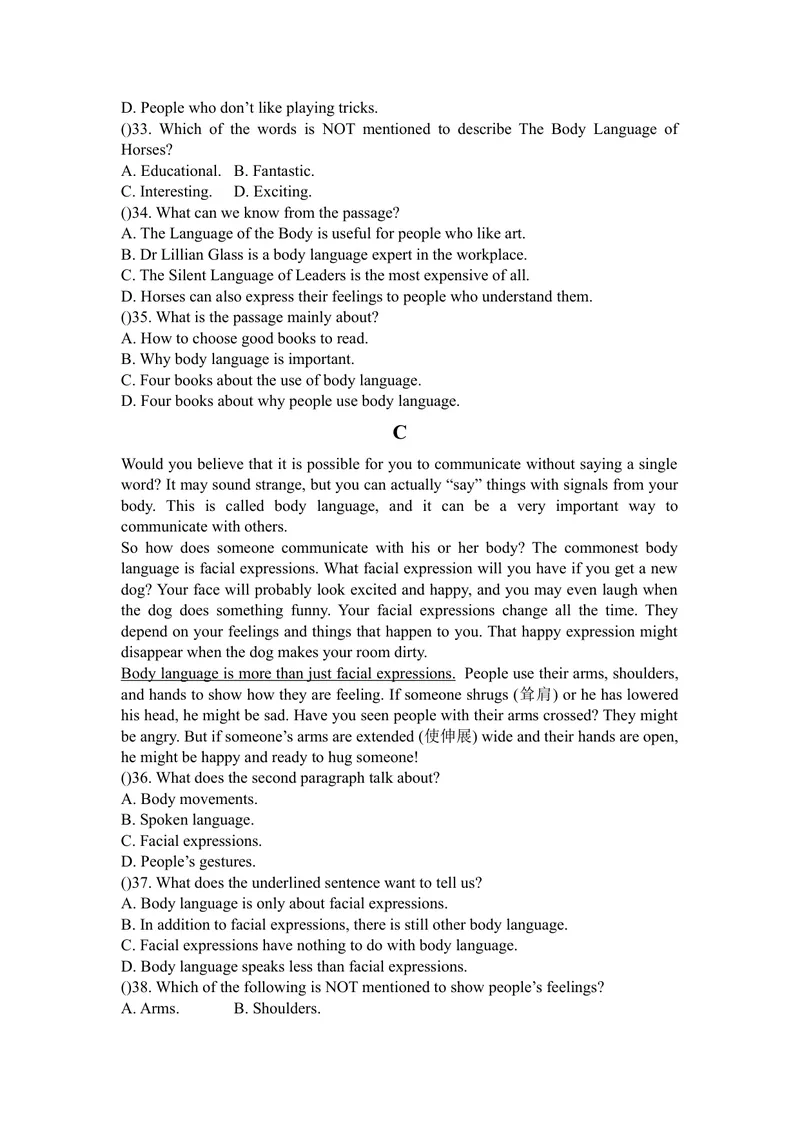
Would you believe that it is possible for you to communicate without saying a single
word? It may sound strange, but you can actually “say” things with signals from your
body. This is called body language, and it can be a very important way to
communicate with others.
So how does someone communicate with his or her body? The commonest body
language is facial expressions. What facial expression will you have if you get a new
dog? Your face will probably look excited and happy, and you may even laugh when
the dog does something funny. Your facial expressions change all the time. They
depend on your feelings and things that happen to you. That happy expression might
disappear when the dog makes your room dirty.
Body language is more than just facial expres sions . People use their arms, shoulders,
and hands to show how they are feeling. If someone shrugs (耸肩) or he has lowered
his head, he might be sad. Have you seen people with their arms crossed? They might
be angry. But if someone’s arms are extended (使伸展) wide and their hands are open,
he might be happy and ready to hug someone!
()36. What does the second paragraph talk about?
A. Body movements.
B. Spoken language.
C. Facial expressions.
D. People’s gestures.
()37. What does the underlined sentence want to tell us?
A. Body language is only about facial expressions.
B. In addition to facial expressions, there is still other body language.
C. Facial expressions have nothing to do with body language.
D. Body language speaks less than facial expressions.
()38. Which of the following is NOT mentioned to show people’s feelings?
A. Arms. B. Shoulders.C. Necks. D. Hands.
()39. How might someone feel when you see him with his arms crossed?
A. Excited. B. Happy.
C. Angry. D. Sad.
()40. What does the passage mainly talk about?
A. It tells us how to use body language.
B. It introduces different kinds of body language.
C. It shows why body language is important.
D. It tells us when to use body language.
D
It is important but difficult for us to decide where to live. You need to think about
many things, such as “if (是否) you want your neighbors to be close to you”, “if you
can stand the noisy city”, “how to get to work” and “how much time it will take you
to get back home from the workplace”. All of them are important when you choose
where to live.
City life and countryside life have some differences.
When you live in the city, you can do lots of things. At night, you can walk around the
roads and watch cars come from all comers and stop at traffic lights. And there are
many nice but expensive shops and lots of good restaurants. You can buy things
easily. In my mind, living in the city gives people a special feeling of superiority (优
越感).
Although city life seems to be great, the countryside is a wonderful place to live in.
The life in the countryside can also give you many good things. You can enjoy the
natural beauty. There are fewer people so it gives you more space than cities. The
countryside may help you become a more outgoing person. You can buy a small piece
of land and grow vegetables on your own.
()41. What does the first paragraph talk about?
A. The noisy city and the traffic in cities.
B. The relationship between you and your neighbors.
C. Your workplace and your driving time.
D. The important factors (因素) about choosing living places.
()42. What will the writer think if he lives in the city according to the passage?
A. I want to improve myself and work better.
B. I need a big house.
C. I live a better life than others in the countryside.
D. I should go back to my parents.
()43. What does the last paragraph mainly tell us?
A. How to find a wonderful place to live in.
B. How to become more active.
C. The best place to live in around the world.
D. The good things about living in the countryside.
()44. What can we infer (推断) from the passage?
A. Countryside life is better than city life.B. Everyone in the countryside plants vegetables.
C. City life is more convenient than countryside life.
D. An outgoing person is from the countryside.
()45. Why did the writer write the passage?
A. To tell us some facts.
B. To teach us how to make a decision.
C. To tell us how to live well.
D. To tell us to live in the countryside.
第二卷 非选择题(25分)
IV.语法填空:用所给单词的适当形式填空,未提供单词的根据上下文填入适当的
词。(共10小题,每小题1分)
Mr Smith is seventy years old. He lives alone (46) _______________ his two children
are both in America. They only come back (47) _______________ China for the
Spring Festival. His neighbor, Sarah, (48) _______________ (be) a kind girl. She’s
always ready to help the people in trouble. One morning, Sarah knocked at Mr
Smith’s door (49) _______________ (give) him some dumplings made by herself.
She knocked and knocked, (50) _______________ nobody answered. “How strange!
Mr Smith always comes (51) _______________ (open) the door for me. Though he’s
old, he hears (52) _______________ (good). There must be something wrong with
him today,” Sarah thought. So she (53) _______________ (ask) several neighbors to
help open the door.
When they went into (54)_______________ room, Mr Smith was lying on the floor.
He had a heart attack (心脏病发作). Sarah and her neighbors took Mr Smith to the
nearest hospital. After three days’ treatment (治疗), Mr Smith got well again. “I can’t
imagine what would happen if nobody found me. (55) _______________ (have) so
many good neighbors really means a lot,” said Mr Smith with tears in his eyes.
V.书面表达(共1题,15分)
日常生活中,我们在交流时,除了用口头语言以外,还会用一些肢体语言。肢
体语言在人们的交流中十分重要。假如你是李伟,你的笔友 Jack将要来中国学
习汉语,请你根据下列提示用英语写一封电子邮件,告诉他中国人常用的一些
肢体语言。80词左右,开头和结尾已给出,不计入总词数;
提示:
1.见面打招呼时点头并微笑。
2.很少在公共场合拥抱或亲吻。
3.好朋友见面通常短暂地握手。
Dear Jack,
I’m glad that you are going to study Chinese in China.
_____________________________________________________________________
_____________________________________________________________________
_____________________________________________________________________
_____________________________________________________________________
_____________________________________________________________________
__________________________________________________________________________________________________________________________________________
I’ll tell you more when you come. And I’m looking forward to seeing you soon.
Yours,
Li Wei
八年级(下)Unit 2 能力测试题
笔试部分
第一卷
I.
1-5 BCCCA 6-10 BBCBB
11-15 ACCBA
II.
16-20 BCACB 21-25 CCBAB
III.
26-30 CCBBD 31-35 DAADC
36-40 CBCCB 41-45 DCDCA
第二卷 (One possible version)
IV.
46. because 47. to
48. is 49. to give
50. but 51. to open
52. well 53. asked
54. the 55. Having
V.
Dear Jack,I’m glad that you are going to study Chinese in China. Before you come,
I’d like to tell you what body language Chinese people often use.
Just like in America, in China, people greet each other with head
nodding, smiling and so on. We often smile when we meet people. Also
in China nodding the head means agreement. But we hardly ever hug or
kiss each other in public. Even good friends just shake hands for a short
time when they meet.
And remember that in China, students must sit in their seats in class —
it’s our tradition.
I’ll tell you more when you come. And I’m looking forward to seeing you
soon.
Yours,
Li Wei