八年级(下)Unit 1 能力测试题
笔试部分(85分)
第一卷 选择题(60分)
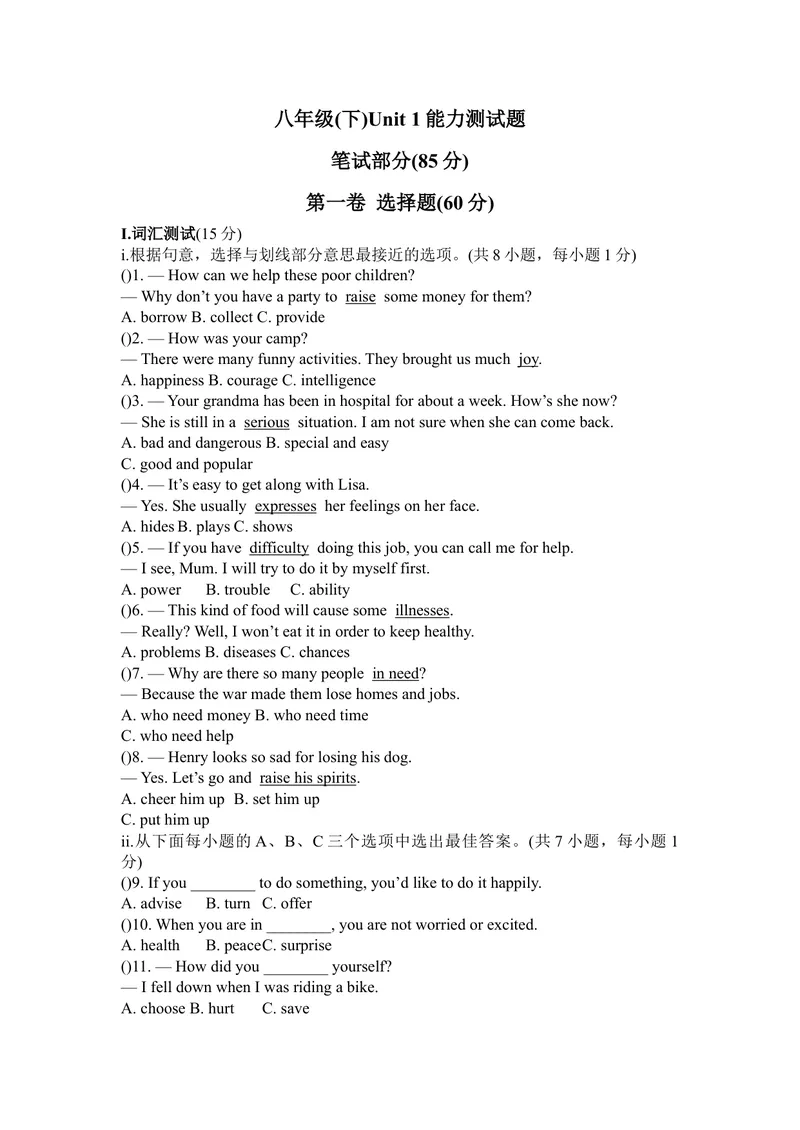
I.词汇测试(15分)
i.根据句意,选择与划线部分意思最接近的选项。(共8小题,每小题1分)
()1. — How can we help these poor children?
— Why don’t you have a party to raise some money for them?
A. borrow B. collect C. provide
()2. — How was your camp?
— There were many funny activities. They brought us much joy.
A. happiness B. courage C. intelligence
()3. — Your grandma has been in hospital for about a week. How’s she now?
— She is still in a serious situation. I am not sure when she can come back.
A. bad and dangerous B. special and easy
C. good and popular
()4. — It’s easy to get along with Lisa.
— Yes. She usually expresses her feelings on her face.
A. hidesB. playsC. shows
()5. — If you have difficulty doing this job, you can call me for help.
— I see, Mum. I will try to do it by myself first.
A. power B. trouble C. ability
()6. — This kind of food will cause some illnesses.
— Really? Well, I won’t eat it in order to keep healthy.
A. problems B. diseases C. chances
()7. — Why are there so many people in need?
— Because the war made them lose homes and jobs.
A. who need money B. who need time
C. who need help
()8. — Henry looks so sad for losing his dog.
— Yes. Let’s go and raise his spirits.
A. cheer him up B. set him up
C. put him up
ii.从下面每小题的A、B、C三个选项中选出最佳答案。(共7小题,每小题1
分)
()9. If you ________ to do something, you’d like to do it happily.
A. advise B. turn C. offer
()10. When you are in ________, you are not worried or excited.
A. health B. peaceC. surprise
()11. — How did you ________ yourself?
— I fell down when I was riding a bike.
A. choose B. hurt C. save()12. — How is your grandpa in the countryside?
— He lives alone. Most of the time, he is happy, but he feels ________ sometimes.
A. lonely B. relaxed C. satisfied
()13. — He often looks unhappy. Why?
— Since that accident, he has ________ a serious headache.
A. come from B. learnt from
C. suffered from
()14. — We can have a book fair to get books for the children in the mountain areas.
—Good idea! However, we need to ________ first.
A. ask permission B. keep in touch
C. give up
()15. — Do you want to do some ________?
—Sure. I like helping others.
A. great changes B. voluntary work
C. difficult work
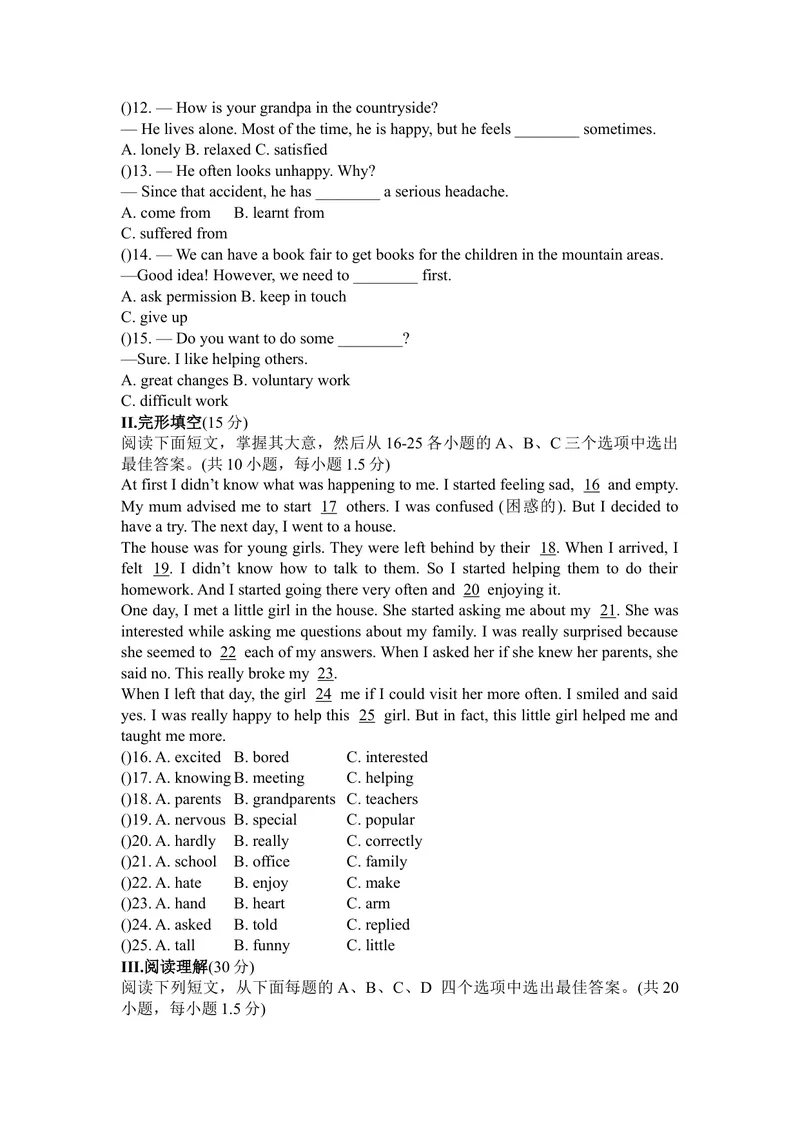
II.完形填空(15分)
阅读下面短文,掌握其大意,然后从16-25各小题的A、B、C三个选项中选出
最佳答案。(共10小题,每小题1.5分)
At first I didn’t know what was happening to me. I started feeling sad, 16 and empty.
My mum advised me to start 17 others. I was confused (困惑的). But I decided to
have a try. The next day, I went to a house.
The house was for young girls. They were left behind by their 18. When I arrived, I
felt 19. I didn’t know how to talk to them. So I started helping them to do their
homework. And I started going there very often and 20 enjoying it.
One day, I met a little girl in the house. She started asking me about my 21. She was
interested while asking me questions about my family. I was really surprised because
she seemed to 22 each of my answers. When I asked her if she knew her parents, she
said no. This really broke my 23.
When I left that day, the girl 24 me if I could visit her more often. I smiled and said
yes. I was really happy to help this 25 girl. But in fact, this little girl helped me and
taught me more.
()16. A. excited B. bored C. interested
()17. A. knowingB. meeting C. helping
()18. A. parents B. grandparents C. teachers
()19. A. nervous B. special C. popular
()20. A. hardly B. really C. correctly
()21. A. school B. office C. family
()22. A. hate B. enjoy C. make
()23. A. hand B. heart C. arm
()24. A. asked B. told C. replied
()25. A. tall B. funny C. little
III.阅读理解(30分)
阅读下列短文,从下面每题的A、B、C、D 四个选项中选出最佳答案。(共20
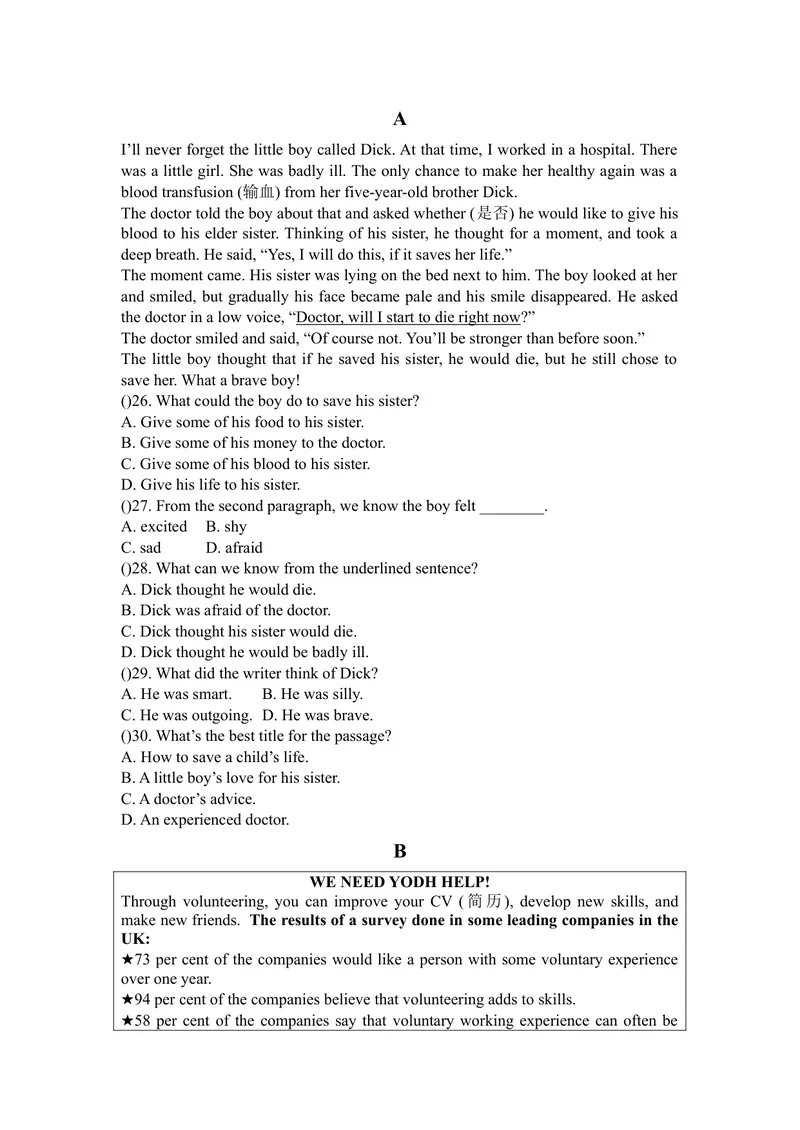
小题,每小题1.5分)A
I’ll never forget the little boy called Dick. At that time, I worked in a hospital. There
was a little girl. She was badly ill. The only chance to make her healthy again was a
blood transfusion (输血) from her five-year-old brother Dick.
The doctor told the boy about that and asked whether (是否) he would like to give his
blood to his elder sister. Thinking of his sister, he thought for a moment, and took a
deep breath. He said, “Yes, I will do this, if it saves her life.”
The moment came. His sister was lying on the bed next to him. The boy looked at her
and smiled, but gradually his face became pale and his smile disappeared. He asked
the doctor in a low voice, “Doctor, will I start to die right now?”
The doctor smiled and said, “Of course not. You’ll be stronger than before soon.”
The little boy thought that if he saved his sister, he would die, but he still chose to
save her. What a brave boy!
()26. What could the boy do to save his sister?
A. Give some of his food to his sister.
B. Give some of his money to the doctor.
C. Give some of his blood to his sister.
D. Give his life to his sister.
()27. From the second paragraph, we know the boy felt ________.
A. excited B. shy
C. sad D. afraid
()28. What can we know from the underlined sentence?
A. Dick thought he would die.
B. Dick was afraid of the doctor.
C. Dick thought his sister would die.
D. Dick thought he would be badly ill.
()29. What did the writer think of Dick?
A. He was smart. B. He was silly.
C. He was outgoing. D. He was brave.
()30. What’s the best title for the passage?
A. How to save a child’s life.
B. A little boy’s love for his sister.
C. A doctor’s advice.
D. An experienced doctor.
B
WE NEED YODH HELP!
Through volunteering, you can improve your CV (简历), develop new skills, and
make new friends. The results of a survey done in some leading companies in the
UK:
★73 per cent of the companies would like a person with some voluntary experience
over one year.
★94 per cent of the companies believe that volunteering adds to skills.
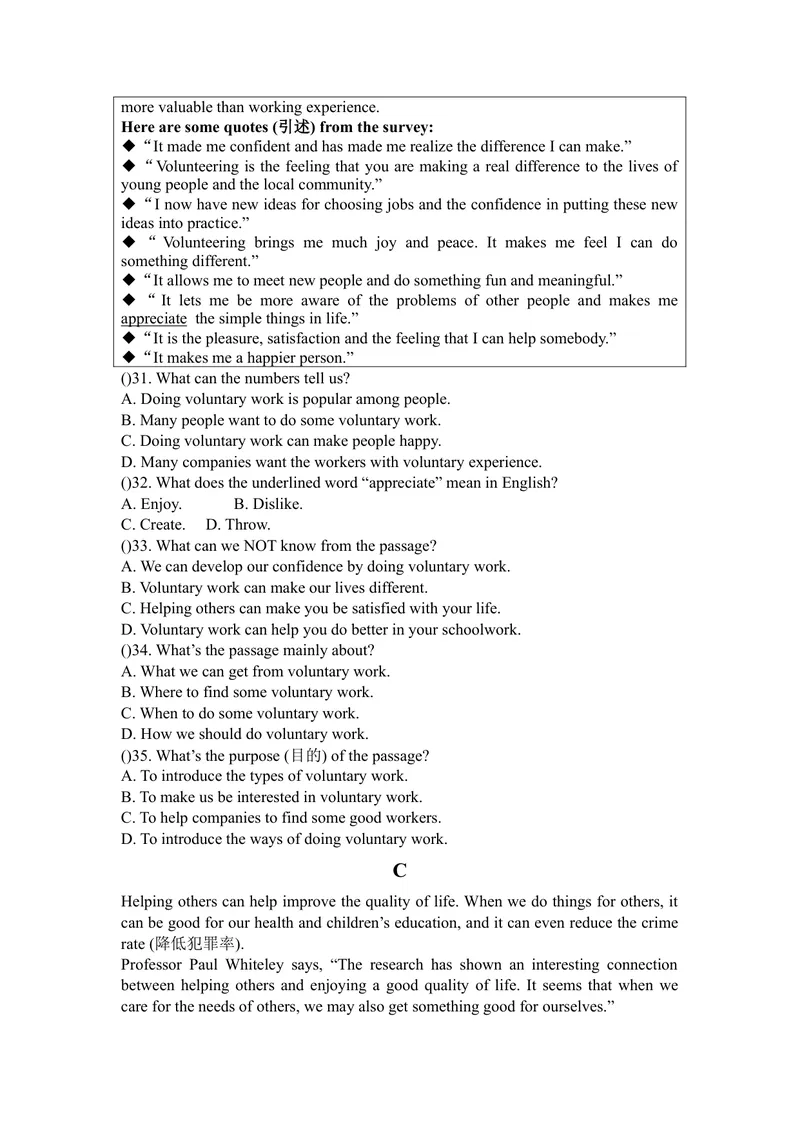
★58 per cent of the companies say that voluntary working experience can often bemore valuable than working experience.
Here are some quotes (引述) from the survey:
◆“It made me confident and has made me realize the difference I can make.”
◆“Volunteering is the feeling that you are making a real difference to the lives of
young people and the local community.”
◆“I now have new ideas for choosing jobs and the confidence in putting these new
ideas into practice.”
◆ “ Volunteering brings me much joy and peace. It makes me feel I can do
something different.”
◆“It allows me to meet new people and do something fun and meaningful.”
◆“It lets me be more aware of the problems of other people and makes me
appreciate the simple things in life.”
◆“It is the pleasure, satisfaction and the feeling that I can help somebody.”
◆“It makes me a happier person.”
()31. What can the numbers tell us?
A. Doing voluntary work is popular among people.
B. Many people want to do some voluntary work.
C. Doing voluntary work can make people happy.
D. Many companies want the workers with voluntary experience.
()32. What does the underlined word “appreciate” mean in English?
A. Enjoy. B. Dislike.
C. Create. D. Throw.
()33. What can we NOT know from the passage?
A. We can develop our confidence by doing voluntary work.
B. Voluntary work can make our lives different.
C. Helping others can make you be satisfied with your life.
D. Voluntary work can help you do better in your schoolwork.
()34. What’s the passage mainly about?
A. What we can get from voluntary work.
B. Where to find some voluntary work.
C. When to do some voluntary work.
D. How we should do voluntary work.
()35. What’s the purpose (目的) of the passage?
A. To introduce the types of voluntary work.
B. To make us be interested in voluntary work.
C. To help companies to find some good workers.
D. To introduce the ways of doing voluntary work.
C
Helping others can help improve the quality of life. When we do things for others, it
can be good for our health and children’s education, and it can even reduce the crime
rate (降低犯罪率).
Professor Paul Whiteley says, “The research has shown an interesting connection
between helping others and enjoying a good quality of life. It seems that when we
care for the needs of others, we may also get something good for ourselves.”Whether a community is rich or poor, volunteering has a good influence (影响). “A
poor community with lots of voluntary activities can do better in health, crime and
education than a rich community without such activities,” says Whiteley.
The research has also tested the connection between voluntary activities and life
happiness. Again, there is a strong connection between communities with lots of
volunteering and those where people are very happy with their life.
Volunteering is good for families and communities. Figures (数据) show that in 2015,
51 per cent of people in England joined in their community voluntary activities. The
contribution to the economy made by volunteering in their community was around
42.6 billion pounds in 2015.
()36. What does the first paragraph mainly tell us?
A. How to improve the quality of our life.
B. Helping others has nothing to do with children’s education.
C. Doing voluntary work helps improve the quality of our life.
D. People should reduce the crime rate by doing voluntary work.
()37. Why do people enjoy a good life when helping others?
A. Because people can get something good.
B. Because the people we help feel happy.
C. Because we are happy with our work.
D. Because other people give us good comments
()38. Which of the following is NOT true according to the passage?
A. Helping others helps reduce the crime rate.
B. Rich and poor communities both need voluntary activities.
C. There is no connection between voluntary activities and happiness.
D. The passage mentions the advantages (益处) of doing voluntary work.
()39. Why does the writer use the numbers in the last paragraph?
A. To tell us how many people volunteered in 2015.
B. To further tell us the research by facts.
C. To tell us volunteering is good for people.
D. To encourage us to do more research work.
()40. Where can we read this passage?
A. In a storybook.
B. In a newspaper.
C. In a fashion magazine.
D. In a children’s book.
DThe movie The Martian (《火星救援》) is very popular among space lovers. It
shows an astronaut trying to live on Mars.
Although the idea of living on Mars is great, the reality does not look so good. Mars
does not have a friendly atmosphere (大气层) for humans. There is very little oxygen
there. And because it is too far away from the sun, it is also very cold there.
Sometimes the temperature on Mars can be -133℃. This is much too cold for humans.
However, scientists say it might be possible to live there even without a good
atmosphere. Daytime on Mars is almost the same as Earth’s. It means there’s enough
sunlight to grow plants inside safe buildings. However, they would have to grow in
soil from Earth. Mars does not have a strong enough atmosphere to stop the radiation
(福射) coming from space, which makes it dangerous to grow things in the soil.
The radiation also causes problems for our health. One way to live there is to build
homes underground or in the rocks on the planet. This can help humans keep away
from the radiation and keep warm.
When could we live on Mars? Scientists are hoping to make it possible to live on
Mars. Let’s wait and see.
()41. What does the underlined word “It” refer to?
A. The chance. B. The space.
C. The movie. D. The reality.
()42. What is the main idea of the second paragraph?
A. Why humans can’t live on Mars.
B. Why Mars is good.
C. Why humans want to live on Mars.
D. Why Mars is so cold.
()43. Which of the following doesn’t allow humans to grow things on Mars?
A. Daytime. B. Soil.
C. Sunlight. D. Radiation.
()44. How many elements (要素) stop people from living on Mars?
A. Three. B. Four.
C. Two. D. One.
()45. Why did the writer write the passage?
A. To tell us how to live on Mars.
B. To stop people from living on Mars.
C. To tell us about an interesting movie.
D. To show us how difficult it is to live on Mars.第二卷 非选择题(25分)
IV.语法填空:用所给单词的适当形式填空,未提供单词的根据上下文填入适当的
词。(共10小题,每小题1分)
Lincoln is 13 years old. Every morning, he (46) ___________ (get) up at six o’clock,
and then takes out the rubbish while he is on the way to buy breakfast for his family.
After he comes back home, he wakes up his little sister and dresses her. Then he calls
his parents for breakfast. They sleep on the (47) ___________ (two) floor of the
house. Lincoln wants them (48) ___________ (sleep) a little longer because they’re
tired after a (49) ___________ (day) work.
Now he is good at (50) ___________ (do) all the housework — washing clothes,
making dinner and looking after his five-year-old sister, Sally. But two years ago, he
hardly ever helped out around the house. “I thought housework was for my parents at
that time, (51) ___________ soon I knew I was wrong. Everyone should help with
(52) ___________ few things at home. We can’t depend (53) ___________ our
parents all the time,” he said.
Every Friday, Lincoln gets fifty dollars from his parents as his pocket money. “I think
it’s good (54) __________ (pay) the children for the housework. They can get money
and buy something they need, and anyway they can learn how (55) ___________
(use) their money and become more independent,” said Lincoln’s mum.
V.书面表达(共1题,15分)
假如你是Helen,你在某图书馆的网站上看到了招募志愿者的公告,想申请成为
其中一员。请你根据下面的要点提示并结合自己的实际情况,写一封申请邮件。
提示:
1. What kind of voluntary work do you want to do?
2. Can you do the work well?
3. Why do you want to do the voluntary work?
4. When are you free to do the work?
要求:
1.短文应包括以上要点,可适当发挥,以使行文通顺、连贯;
2.词数:80词左右(文章开头和结尾已给出,不入总词数)。
Dear Sir or Madam,
_____________________________________________________________________
_____________________________________________________________________
_____________________________________________________________________
_____________________________________________________________________
_____________________________________________________________________
_____________________________________________________________________
_____________________________________________________________________
I’m looking forward to your reply!
Yours,
Helen
八年级(下)Unit 1 能力测试题笔试部分
第一卷
I.
1-5 BAACB 6-10 BCACB
11-15 BACAB
II.
16-20 BCAAB 21-25 CBBAC
III.
26-30 CDADB 31-35 DADAB
36-40 CACBB 41-45 CADAD
第二卷 (One possible version)
IV.
46. gets 47. second
48. to sleep 49. day’s
50. doing 51. but
52. a 53. on
54. to pay 55. to use
V.
Dear Sir or Madam,
I’d like to volunteer as a student helper in the library. In my free time, I
love reading all kinds of books. I’m also good at Chinese and English. I
think I can do the work well. I want to help students learn about theimportance of reading because it makes people smart. I can also do what
I love to do and help others at the same time. I’m always free on
weekends, so I will be able to volunteer there on time.
I’m looking forward to your reply!
Yours,
Helen