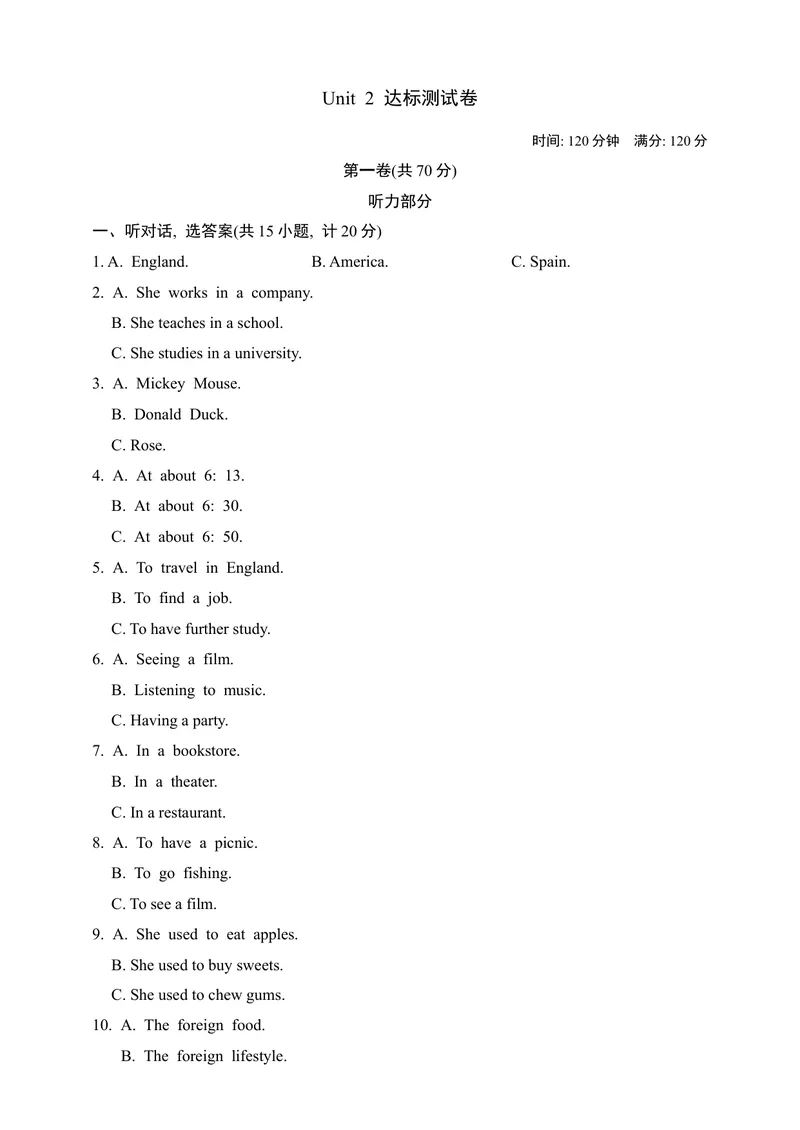
Unit 2 达标测试卷
时间: 120分钟 满分: 120分
第一卷(共70分)
听力部分
一、听对话, 选答案(共15小题, 计20分)
1. A. England. B. America. C. Spain.
2. A. She works in a company.
B. She teaches in a school.
C. She studies in a university.
3. A. Mickey Mouse.
B. Donald Duck.
C. Rose.
4. A. At about 6: 13.
B. At about 6: 30.
C. At about 6: 50.
5. A. To travel in England.
B. To find a job.
C. To have further study.
6. A. Seeing a film.
B. Listening to music.
C. Having a party.
7. A. In a bookstore.
B. In a theater.
C. In a restaurant.
8. A. To have a picnic.
B. To go fishing.
C. To see a film.
9. A. She used to eat apples.
B. She used to buy sweets.
C. She used to chew gums.
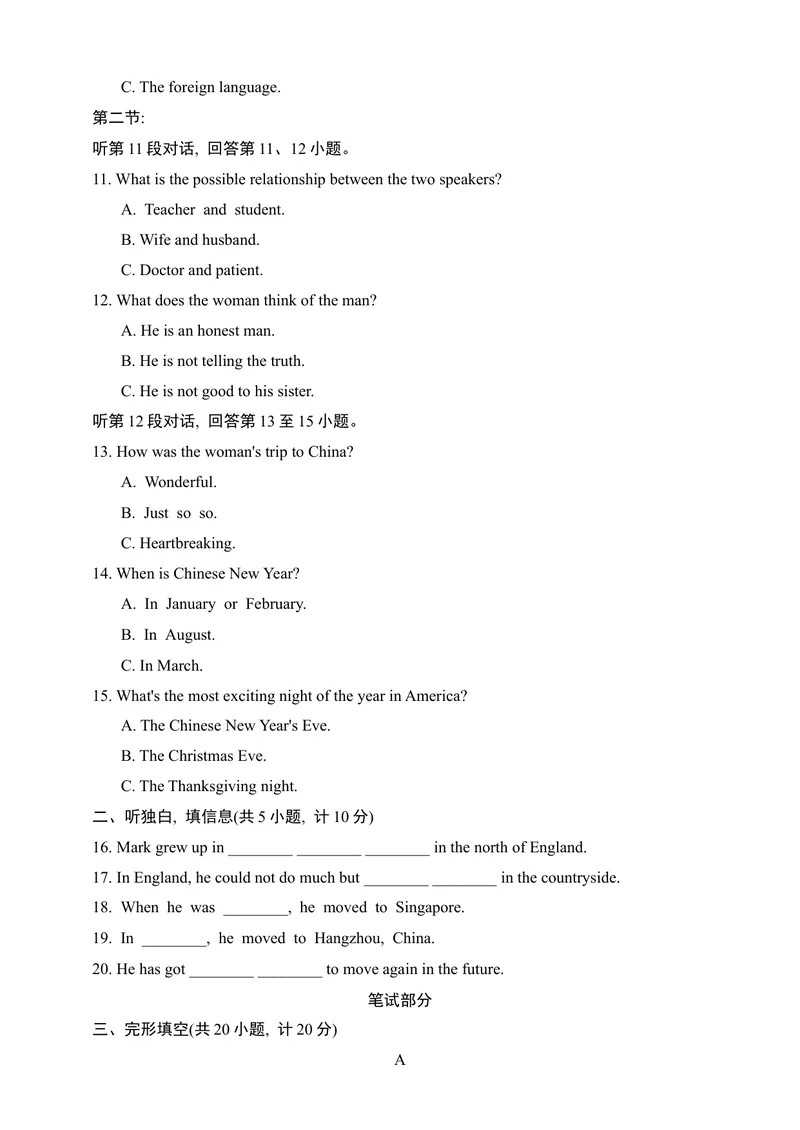
10. A. The foreign food.
B. The foreign lifestyle.C. The foreign language.
第二节:
听第11段对话, 回答第11、12小题。
11. What is the possible relationship between the two speakers?
A. Teacher and student.
B. Wife and husband.
C. Doctor and patient.
12. What does the woman think of the man?
A. He is an honest man.
B. He is not telling the truth.
C. He is not good to his sister.
听第12段对话, 回答第13至15小题。
13. How was the woman's trip to China?
A. Wonderful.
B. Just so so.
C. Heartbreaking.
14. When is Chinese New Year?
A. In January or February.
B. In August.
C. In March.
15. What's the most exciting night of the year in America?
A. The Chinese New Year's Eve.
B. The Christmas Eve.
C. The Thanksgiving night.
二、听独白, 填信息(共5小题, 计10分)
16. Mark grew up in ________ ________ ________ in the north of England.
17. In England, he could not do much but ________ ________ in the countryside.
18. When he was ________, he moved to Singapore.
19. In ________, he moved to Hangzhou, China.
20. He has got ________ ________ to move again in the future.
笔试部分
三、完形填空(共20小题, 计20分)
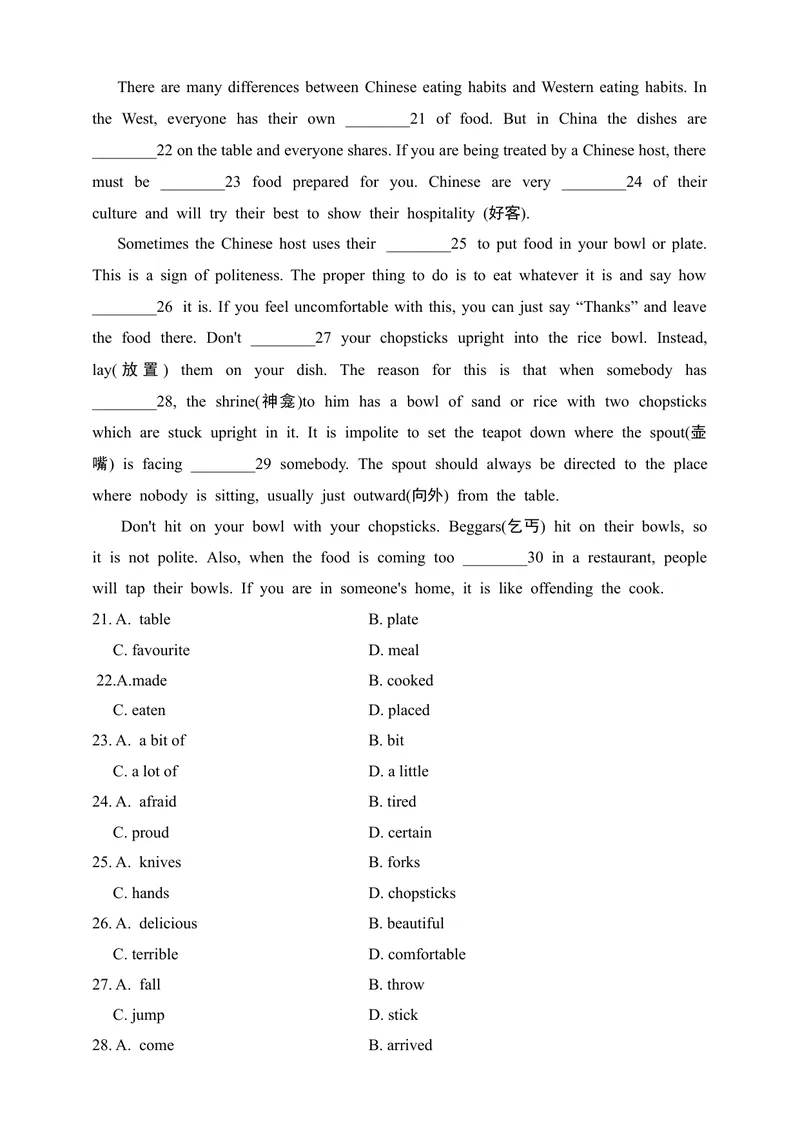
AThere are many differences between Chinese eating habits and Western eating habits. In
the West, everyone has their own ________21 of food. But in China the dishes are
________22 on the table and everyone shares. If you are being treated by a Chinese host, there
must be ________23 food prepared for you. Chinese are very ________24 of their
culture and will try their best to show their hospitality (好客).
Sometimes the Chinese host uses their ________25 to put food in your bowl or plate.
This is a sign of politeness. The proper thing to do is to eat whatever it is and say how
________26 it is. If you feel uncomfortable with this, you can just say “Thanks” and leave
the food there. Don't ________27 your chopsticks upright into the rice bowl. Instead,
lay( 放 置 ) them on your dish. The reason for this is that when somebody has
________28, the shrine(神龛)to him has a bowl of sand or rice with two chopsticks
which are stuck upright in it. It is impolite to set the teapot down where the spout(壶
嘴) is facing ________29 somebody. The spout should always be directed to the place
where nobody is sitting, usually just outward(向外) from the table.
Don't hit on your bowl with your chopsticks. Beggars(乞丐) hit on their bowls, so
it is not polite. Also, when the food is coming too ________30 in a restaurant, people
will tap their bowls. If you are in someone's home, it is like offending the cook.
21. A. table B. plate
C. favourite D. meal
22.A.made B. cooked
C. eaten D. placed
23. A. a bit of B. bit
C. a lot of D. a little
24. A. afraid B. tired
C. proud D. certain
25. A. knives B. forks
C. hands D. chopsticks
26. A. delicious B. beautiful
C. terrible D. comfortable
27. A. fall B. throw
C. jump D. stick
28. A. come B. arrivedC. died D. lived
29. A. against B. towards
C. over D. above
30. A. often B. early
C. slowly D. fast
B
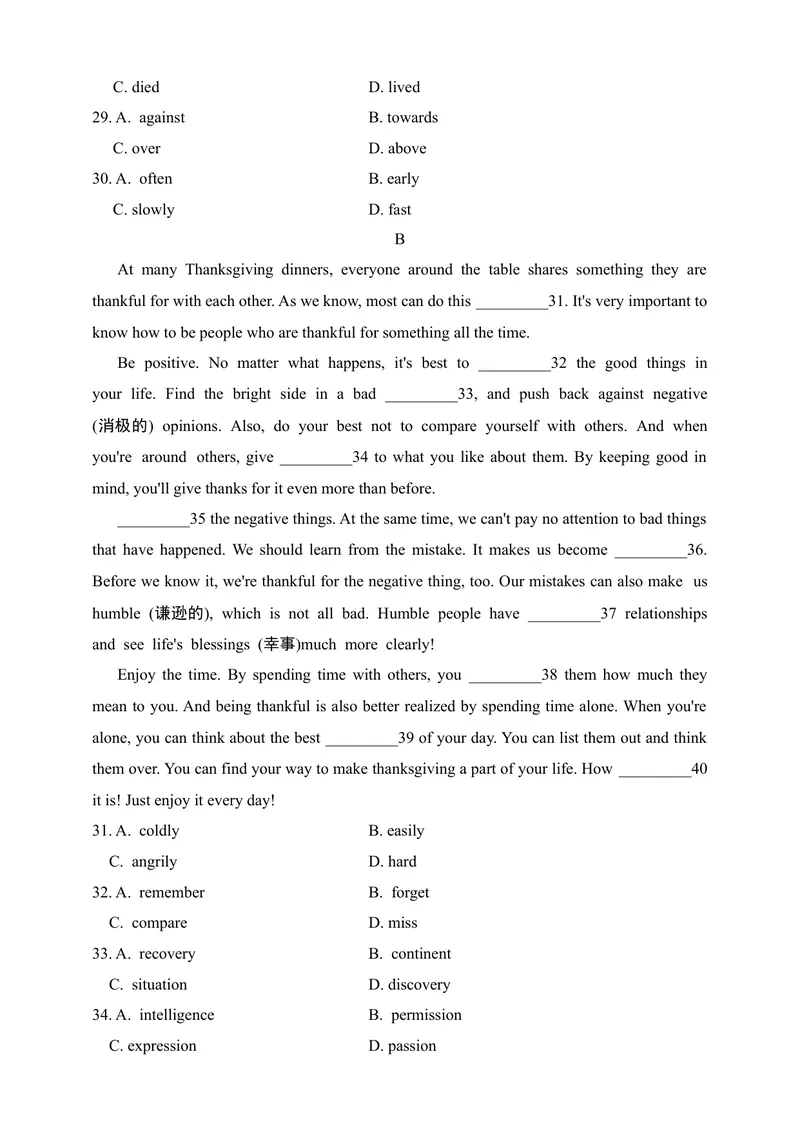
At many Thanksgiving dinners, everyone around the table shares something they are
thankful for with each other. As we know, most can do this _________31. It's very important to
know how to be people who are thankful for something all the time.
Be positive. No matter what happens, it's best to _________32 the good things in
your life. Find the bright side in a bad _________33, and push back against negative
(消极的) opinions. Also, do your best not to compare yourself with others. And when
you're around others, give _________34 to what you like about them. By keeping good in
mind, you'll give thanks for it even more than before.
_________35 the negative things. At the same time, we can't pay no attention to bad things
that have happened. We should learn from the mistake. It makes us become _________36.
Before we know it, we're thankful for the negative thing, too. Our mistakes can also make us
humble (谦逊的), which is not all bad. Humble people have _________37 relationships
and see life's blessings (幸事)much more clearly!
Enjoy the time. By spending time with others, you _________38 them how much they
mean to you. And being thankful is also better realized by spending time alone. When you're
alone, you can think about the best _________39 of your day. You can list them out and think
them over. You can find your way to make thanksgiving a part of your life. How _________40
it is! Just enjoy it every day!
31. A. coldly B. easily
C. angrily D. hard
32. A. remember B. forget
C. compare D. miss
33. A. recovery B. continent
C. situation D. discovery
34. A. intelligence B. permission
C. expression D. passion35. A. Accept B. Refuse
C. Identify D. Check
36. A. weak B. strong
C. simple D. easy
37. A. better B. fewer
C. slower D. less
38. A. notice B. show
C. understand D. give
39. A. part B. skills
C. groups D. trip
40. A. awful B. foolish
C. wonderful D. terrible
四、阅读理解(共15小题, 计20分)
阅读下面短文, 选出最佳答案。(共10小题, 计15分)
A
People use languages to communicate. Any language has its ways to express people's
minds. One of the ways in common is the use of idioms. An idiom is a group of words. It has a
special meaning that is different from the usual meaning. For example, under the weather is
an idiom meaning ill. So when people say “I'm under the weather, ” they are
saying that they're not feeling well. Another example, in all weathers means in all
kinds of weather. So, “There are homeless people sleeping on the streets in all
weathers” tells us that homeless people sleep on the streets no matter whether it is cold or hot.
Different languages may have different ways to make idioms. For people who are
learning a foreign language, idioms could cause misunderstandings and bring them endless
headaches. On the other hand, if things are done right, idioms can also be a fun way of looking
into a new culture and understanding how the people think and talk.
Metaphor (比喻) is often used in idioms. Let's read the following two examples:
● It makes my blood boil (沸腾) when people litter.
● The night was dark and quiet; my blood ran cold when I heard a strange
noise outside at dark night.
In neither situation above, our blood can reach the point so high or so low in
temperature. Yet, with the situations the two sentences created, it is not difficult to work out theunhappy feelings of really angry in the first example and very afraid in the second.
Of course, not all idioms are this easy to understand. When we come to idioms of a
foreign language, a good dictionary of idioms is always suggested.
41. This passage tells us something about ____ in the English language.
A. grammar
B. writing
C. reading
D. idioms
42. If your brother breaks your computer, you can say to him, “____.”
A. I'm under the weather
B. I'm there in all weathers
C. You've made my blood boil
D. My blood runs cold
43. What is the writer's advice when you come to an expression like under the weather?
A. We should look it up in a good idiom dictionary.
B. We should try to express our minds with it.
C. We should find an interesting way to learn it.
D. We should create situations to guess its meaning.
B
This is a tale of two friends—one is blind, and the other has no arms. On their own, the
two are “disabled”. But together, they are a powerful team that has changed part of their village
in North China's Hebei Province into a rich, green forest. Meet Jia Haixia and Jia Wenqi!
Their story began in 2002. Haixia, who was already blind in his right eye, lost
his left one after an illness. Wenqi lost his arms in an accident when he was just
three. Neither could find a job, so the two decided to team up. They rented some
poor land and began to plant trees. Haixia and Wenqi never imagined that they would
end up creating an environmental paradise. Their forest now has over 10, 000 trees,
with hundreds of birds and many other wild animals. In addition, it saves the village
from river flooding during the rainy season. When the friends work together, they
focus on their strength not their disabilities. Their day begins at 7 am, when Wenqi
leads the sightless Haixia across the river to get to their worksite. Since they cannot
afford to buy young trees to plant, the two use branches from existing trees. Haixia climbs tothe treetop and with Wenqi's direction, selects the perfect branch. He then digs a hole and
carefully plants it. Finally Wenqi waters the area.
Though hardworking, the men don't make much money. But as Wenqi puts it, “We stand
on our own feet, so the fruits of our work taste sweeter.”
Neither Haixia nor Wenqi cares about money. Together, they already have everything
they need—a perfect pair of eyes, two strong hands, and the best friendship in the world!
44. Why did Haixia and Wenqi start working together?
A. Haixia needed someone to help him.
B. They both needed a way to make money.
C. They wanted to improve the environment.
D. They were required to do so by local officials.
45. Haixia and Wenqi's forest has helped the village by ____.
A. stopping floods in the rainy season
B. increasing the number of tourists
C. making the villagers richer
D. providing more farmland
46. Why do Haixia and Wenqi plant tree branches?
A. They are easy to get.
B. They do not cost money.
C. They can grow very quickly.
D. They are preferred by animals.
47. What can we learn from this story?
A. Be sure not to give up.
B. We should help the disabled to work.
C. Believe in yourself when facing difficulties.
D. We can achieve more with teamwork.
C
James is an English college student. He wants to study Chinese culture. He says whenforeigners talk about China, they often talk about the Great Wall, Beijing Opera, Chinese tea
and so on. But he wants to learn more about China and Chinese people's life.
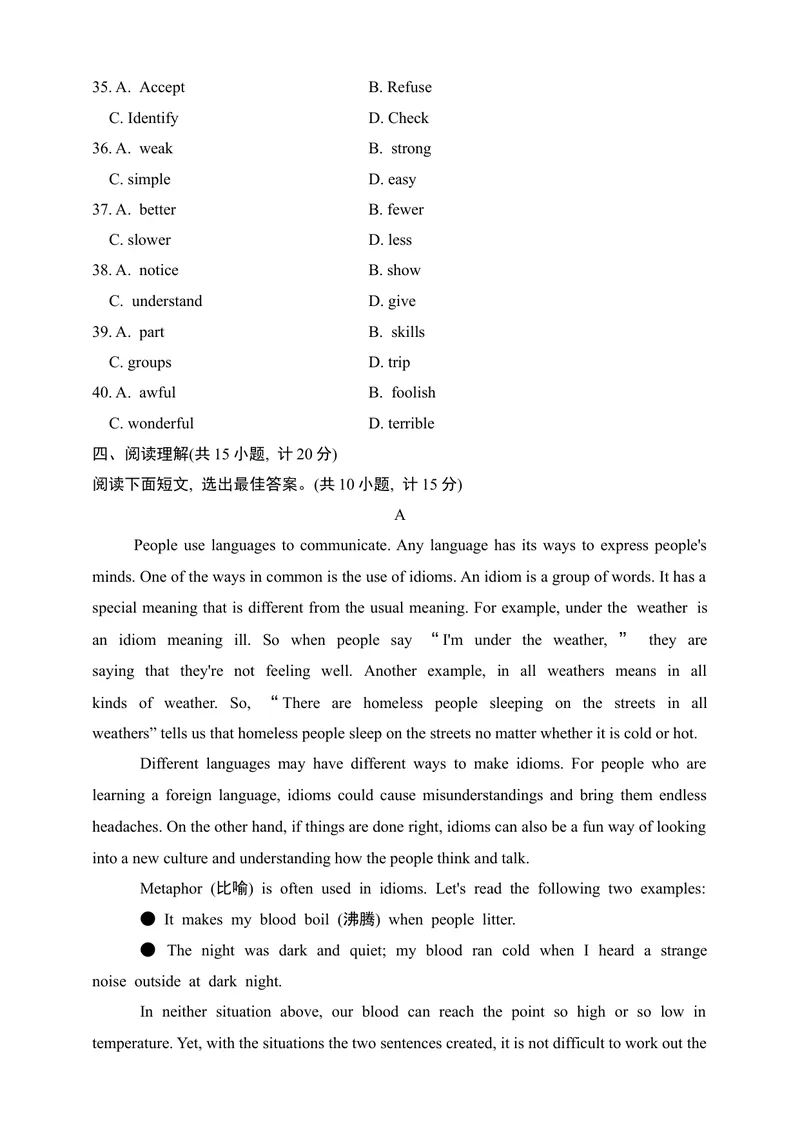
The traditional Chinese food is jiaozi. Dumplings are another way of saying jiaozi. People
can make many kinds of delicious dumplings. And people eat jiaozi when they celebrate
special festivals. Today you can buy dumplings everywhere and eat them all year round. More
and more foreigners like to eat dumplings now. Jiaozi also means “gettogether” in China.
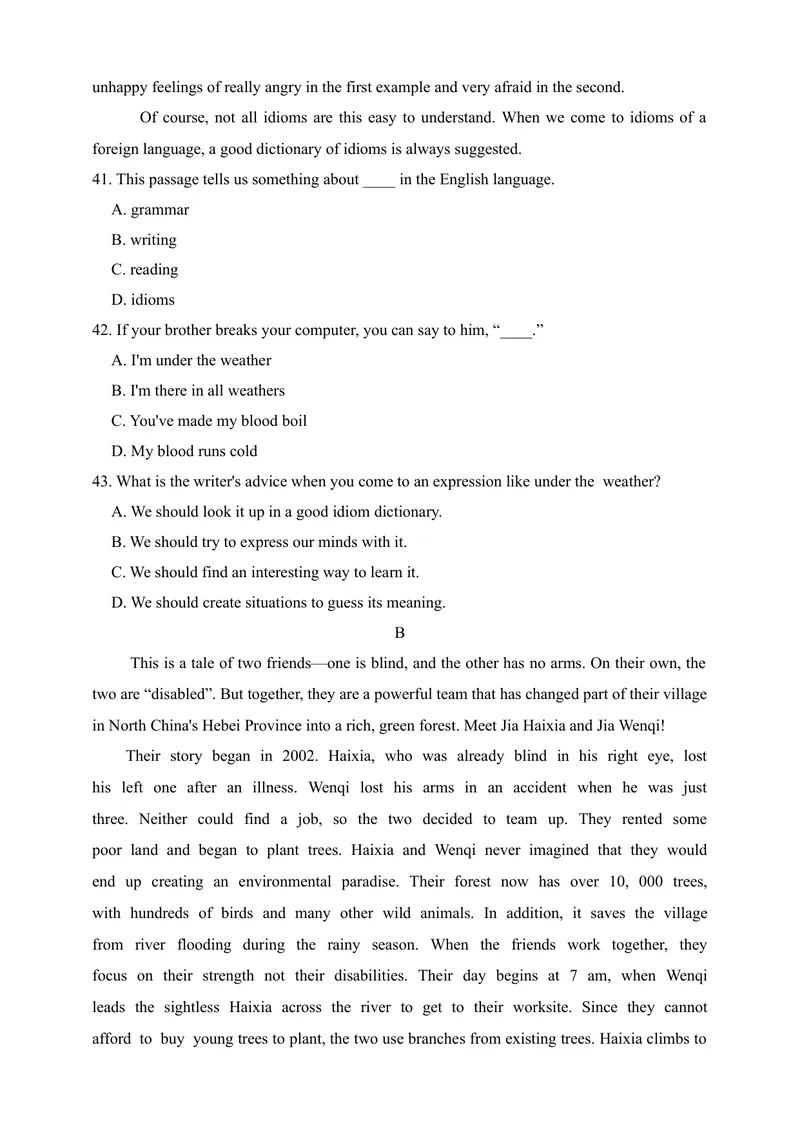
Peonies (牡丹)are regarded as China's national flower. In ancient times, people
planted peonies because they stand for happiness and good luck. Luoyang, Henan, and
Heze, Shandong are famous for peonies. There are many kinds of peonies all around
China now. The flower period often comes in April. Tourists all over the world come to these
places to enjoy peonies every year.
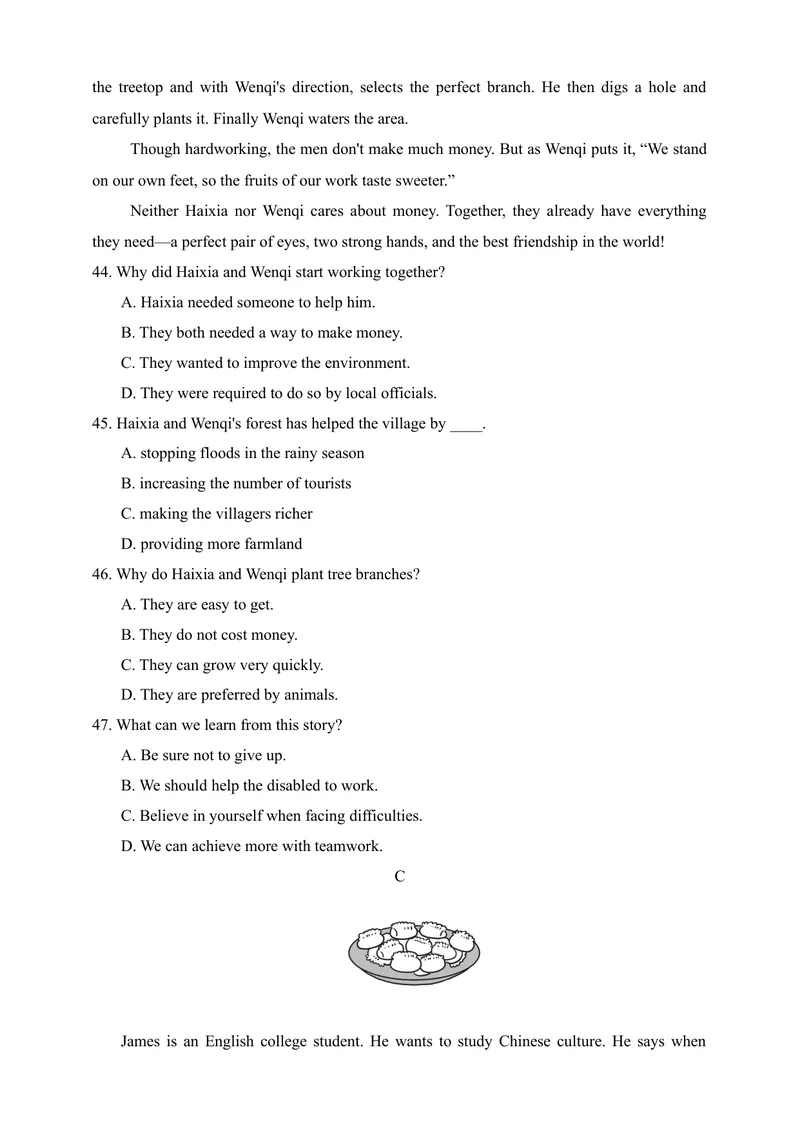
China's national ball game is pingpong. In 1959, Rong Guotuan, a Chinese pingpong
player, got the first gold medal for China. Since then, pingpong has become known to Chinese
people. We also show our friendship by playing pingpong with others. Deng Yaping, another
Chinese pingpong player, got gold medals for many times. Nowadays pingpong is becoming
more and more popular in China.
48. According to the passage, ____ is NOT mentioned when foreigners talk about China.
A. the Great Wall
B. Chinese kung fu
C. Beijing Opera
D. Chinese tea
49. When is the best time for tourists to come to enjoy peonies?
A. In March.B. In April.
C. In June.
D.In July.
50. Chinese people think ____ can show our friendship with others.
A. playing pingpong
B.eating dumplings
C. seeing peonies
D.watching Beijing Opera
根据短文内容, 从短文后的选项中选出能填入空白处的最佳选项。有两项为多余选项。
(共5小题, 计5分)
D
Years ago, I lived in a building in a large city. 51. ______ There lived a woman,
and I had never met her. Yet I could see her sit by her window each afternoon,
sewing(缝纫) or reading. After several months, I began to notice that her window was
dirty. Everything was unclear through the dirty window. I would say to myself, “It really looks
dirty. 52. ________”
One bright morning, I decided to clean my flat, including washing the window on the
inside.
Later in the afternoon when I finished the cleaning, I sat down by the window
with a cup of coffee for a rest. 53. ________ The woman sitting by her window was
clearly visible(看得见的). Her window was clean! Then it dawned on(使开始明白) me.
I had been criticizing(批评) her dirty window, but all the time I was watching hers
through my own dirty window.
54. ________ How many times had I looked at and criticized others through the dirty
window of my heart, through my own shortcomings?
Since then, I haven't judged(评判) someone before knowing about myself
clearly. 55. ________ I try to clean the window of my own world so that I may see
the world around me more clearly.
A. What a surprise!
B. The man was so kind.
C. That was quite an important lesson for me.
D. Even though he thought his window was dirty.E. The window of the old woman should be cleaned.
F. The next building was only a few feet away from mine.
G. I say to myself first that I shouldn't look at him through my own dirty window.
第二卷 (共50分)
五、完成句子(共5小题, 计10分)
56. 王先生因病住院了, 他的女儿正在照顾他。
Mr. Wang is ill in hospital and now his daughter ________ ________ ________
________ him.
57. 他如此诚实, 以至于老师表扬了他。
He was ________ honest ________ he was praised by the teacher.
58. 请将杯子放在一个安全的地方。确保我们两个都能看到它。
Please put the cup in a safe place. ________ ________ both of us can see it.
59. 我问他多长时间没有收到他儿子的信了。
I asked him __________ __________ he didn't __________ ________ his son.
60. 做运动不仅可以强身健体, 还可以缓解我们的压力。
Doing exercise can not only keep us healthy __________ ________ reduce our pressure.
六、短文填空: 用方框中所给词汇的适当形式填空(共10小题, 计10分)
believe in, in the future, allow , strict, worry about, enjoy, do
well in, different from, information, make
Almost all the students go to traditional schools now. But there will probably be a new
type of education 61.____________ —open education. Do you know anything about it? Here
is some 62.________ about the new kind of education.
There are some very good things about open education. This way of teaching
63.________ students to develop their interests in many subjects. Open education asks students
to be 64.________ with their own education. The open classroom may help them to
65.________ learning. Some students will be happier in an open education school. They will
not have to 66.____________ grades or rules.
But many students may not 67.____________ open education. They will not make good
use of open education. Open education is so 68.____________ traditional education that these
students may have a problem in getting used to 69.________ so many choices. The last point
about open education is that some teachers do not like it. They do not 70.____________ open
education.
I think that open education is only a good idea. It may not work very well in a real classor school.
七、任务型阅读(共5小题, 计10分)
Reading an English newspaper is a good way to improve a student's language
ability, as there are many useful and common words in an English newspaper. It may
help students increase their vocabulary(词汇量) as well as improve their reading skills.
They can learn new knowledge from newspapers. But what is the proper way to read
an English newspaper? Do students need to look over all the contents (内容) of the
newspaper?
The first step is to choose a right newspaper with a good language. Then turn to the front
page and read the headlines(to know what has happened). As the most important things are put
on the front page, it's easy to find out what you're interested in and then turn to the page to read
it completely. There is no need to look through all the articles.
Secondly, read newspapers every day. Remember words through context(上下文),
in which these words may appear repeatedly. Once they appear several times, you will
remember them easily. Don't look up every unknown word in your dictionary. You can
try to guess the meaning between sentences. If your guess is wrong, don't give up. Keep
reading, and you will become familiar with the words after reading them several times in
different texts.
Reading English newspapers makes us knowledgeable. It can not only help us know
what is happening in the world but also improve our language.
71. What's the first step of reading an English newspaper?
The first step is ____________________________________________________.
72. Is it necessary for students to look over all the contents of the newspaper?
_________________________________________________________________.
73. How can we get the meaning of the new words in the newspaper?
We can get the meaning of the new words by _____________________________
_________________________________________________________________.
74. What are the benefits of reading English newspapers?
Reading English newspapers can ______________________________________
_________________________________________________________________.
75. What does the passage mainly talk about?
The passage mainly talks about _________________________________________________________________________________________________________.
八、补全对话(共5小题, 计5分)
在空白处填入一个适当的句子, 使对话完整。
A: Hey, Peter! You look tired. 76.________________?
B: I didn't get enough sleep last night.
A: Were you just doing your homework last night?
B: 77.________________. Mountains of homework, maths, chemistry, Chinese... I didn't
finish my homework until midnight.
A: Poor guy! No wonder you don't look well.
B: You know, less sleep is bad for my health. I am not as energetic as before.
78.__________________________?
A: Sure. I advise you to make a plan before doing your homework. First things first.
And you'd better do some outdoor sports.
B: 79.________________. I am going to follow your advice. Thank you.
A: Um... If you are too busy on weekdays, just relax yourself at weekends.
B: Weekends? No kidding. I have to take afterschool classes at weekends.
A: 80.______________________________________________?
B: Because my parents want me to get into a good high school.
A: Yes. I guess that is the reason. Perhaps you should talk to them and explain that health is the
most important.
B: You are right. Thanks for all the good advice. I'll try to talk to them.
九、书面表达(计15分)
假定你是陈军, 你昨天收到了笔友戴维(David)的电子邮件, 得知他要作为交流生到
西安学习中文, 他想了解如何学好中文。
请你给他回复一封邮件, 介绍学习中文的体会和方法。要点提示:
1. 汉语非常有用, 许多外国朋友都在学习它;
2. 汉语较难, 与英语不一样;
3. 必须多记词, 读和写也很重要;
4. 可以通过看电视和听广播锻炼听力。
注意: 词数80左右。开头和结尾已给出, 不计入总词数。
Dear David,
I'm glad to hear that you'll be an exchange student and come to Xi'an to learnChinese.______________________________________________________________
_____________________________________________________________________
_____________________________________________________________________
_____________________________________________________________________
_____________________________________________________________________
_____________________________________________________________________
If you have any question, please ask me. I'm sure you'll learn Chinese well.
Hope to see you soon in Xi'an.
Yours,
Chen Jun参考答案
第一卷 听力部分
听力材料:
一、 第一节: 听下面10段对话, 每段对话后有一个问题, 对话读两遍。请根据每段对话
的内容和后面的问题, 从所给的三个选项中选出最恰当的一项。
1. M: Do you know the girl over there?
W: Yes. She is an exchange student from Spain.
Q: Where does the girl come from?
2. M: I hear you are teaching English in Ohio, Betty. Tell me about it. Do you
like it?
W: Oh, yes, it is very interesting.
Q: What does Betty do in Ohio?
3. M: Do you know Mickey Mouse?
W: Yes, it's a symbol of American culture.
Q: Which is the symbol of American culture?
4. M: When do you get up as an exchange student in Australia, Mary?
W: Well, at about 6: 30 in the morning.
Q: When does Mary get up in the morning?
5. M: Look! What's Tom doing over there?
W: Well, he's practicing speaking English. For he wants to go to England for
further study.
Q: Why does Tom practice speaking English?
6. M: Hi, Kate. My sister and I will go to the concert this evening. Will you
come with us?
W: I'd love to, but I haven't bought a ticket.
Q: What are the speakers talking about?
7. W: Could I take your order, sir?
M: Oh, yes. A cup of coffee.
Q: Where does the conversation take place?
8. M: What about having a picnic on East Hill next Sunday?
W: Sounds great!
Q: What are they going to do?9. M: I used to eat candies all the time. Did you?
W: Yes, I did. And I used to chew gums a lot.
Q: What did the girl use to do?
10. M: I want to study abroad but I'm afraid I won't get used to the lifestyle
there.
W: It's really a difficult decision to make.
Q: What does the man worry about?
第二节: 听下面2段对话, 每段对话后有几个小题, 请根据每段对话的内容和后面的
问题, 从所给的三个选项中选出最恰当的一项。每段对话读两遍。
听第11段对话, 回答第11、12小题。
W: Morning, Bob. Late again?
M: Oh, I'm so sorry.I can't tell you how sorry I am.
W: Hmm, what's the excuse this time?
M: Er, I must have turned the clock off and gone back to sleep again. I. ..
W: Yeah, and last week you said your sister wasn't well.
M: Yes, I know.
W: Um.
M: I'm really sorry. I promise it won't happen again.
听第12段对话, 回答第13至15小题。
W: Hi, I'm back from China.
M: Hey, I miss you so much. China? Cool! How was your trip?
W: Great. I learned many things about Chinese culture.
M: Wow... So, how was it?
W: It's interesting. I was interested in Chinese culture.
M: So tell me about it.
W: Do you know how they celebrate Christmas? Haha! Chinese people don't celebrate
Christmas, but they celebrate Chinese New Year, which is in January or February.
Chinese people would play with their family members and have delicious meals
together. However, Chinese New Year's Eve, like our Christmas Eve in America, is the
most exciting night out of the year.
M: Oh. I never knew that. I wish I were a Chinese. It sounds interesting to me.
二、本题你将听到一段独白, 读两遍, 请根据所听内容, 用单词或短语完成下列各题。(每空限填一个单词。)
Hello, I am Mark. Let me tell you something about the three different countries I
have lived in.
I grew up in a small town in the north of England. Only about 8, 000
people live there, so it's a very quiet place. I can go walking in the countryside.
But I could not do much except that.
When I was 22, I moved to Singapore, which was a huge change. Singapore is a
modern and great place to live in. I met people from so many different countries and I
had a really great time.
I lived in Singapore for ten years, and then in 2016, I moved to Hangzhou, China,
which is where I live now.
Hangzhou is a wonderful place. I live in a quiet neighbourhood not too far from the
city. There are a lot of parks near where I live, and it's a pretty peaceful place. There's so
much to do in Hangzhou, so I never get bored.
I've got no plans to move again in the future. I'm really happy where I am now.
听力答案:
一、1~5: CBABC
6~10: BCACB
11~15: ABAAB
二、16.a small town
17. go walking
18. 22/twentytwo
19. 2016
20. no plans/no plan
笔试部分
三、A)21.B
22.D 点拨: 结合语境可知这里是指在中国, 饭菜被放在桌子上, 大家共享。place
意为“放置”。
23. C
24.C 点拨: be proud of...是固定短语, 意为“为……感到骄傲”。根据语境可知
选C。
25. D26. A 点拨: 空格后的it指的是食物, 因此要用delicious来修饰, 意为“可口的”。
27. D 点拨: 句意: 不要把你的筷子竖着插进盛米饭的碗里。stick...into...意为
“把……插进……里”。
28. C 点拨: 结合上下文可知这里是指当有人“去世”时, 人们把两支筷子插在盛
有沙子或米的碗中。
29. B
30. C 点拨: 根据语境可知这里是指饭店里菜上得太慢的时候, 人们会敲碗。
B)31~35: BACCA
36~40: BABAC
四、A)41.D 42.C 43.A
B)44.B 45.A 46.B 47.D
C)48.B 49.B 50.A
D)51~55: FEACG
第二卷
五、56.is taking care of
57. so; that
58. Make sure
59. how long; hear from
60. but also
六、61.in the future 62.information
63. allows 64.strict
65. enjoy
66. worry about
67. do well in
68. different from
69. making
70. believe in
七、71.to choose a right newspaper with a good language
72. No, it's not necessary
73. guessing the meaning between sentences
74. not only help us know what is happening in the world but also improve our
language75. the proper ways to read an English newspaper
八、76.What's up
77. Yes, I was
78. Can you give me some advice
79. Sounds great
80. Why do you have to take afterschool classes
九、One possible version:
Dear David,
I'm glad to hear that you'll be an exchange student and come to Xi'an to learn Chinese.
Chinese is very useful and many foreigners are learning it now. It may be difficult for you
because it's quite different from English. You have to remember as many Chinese words
as possible. It's also important to do some reading and writing. You can watch TV and
listen to the radio to practice your listening. Try your best to talk with people in Chinese.
You can learn Chinese not only from books but also from people around you. If you have
any question, please ask me. I'm sure you'll learn Chinese well.
Hope to see you soon in Xi'an.
Yours,
Chen Jun