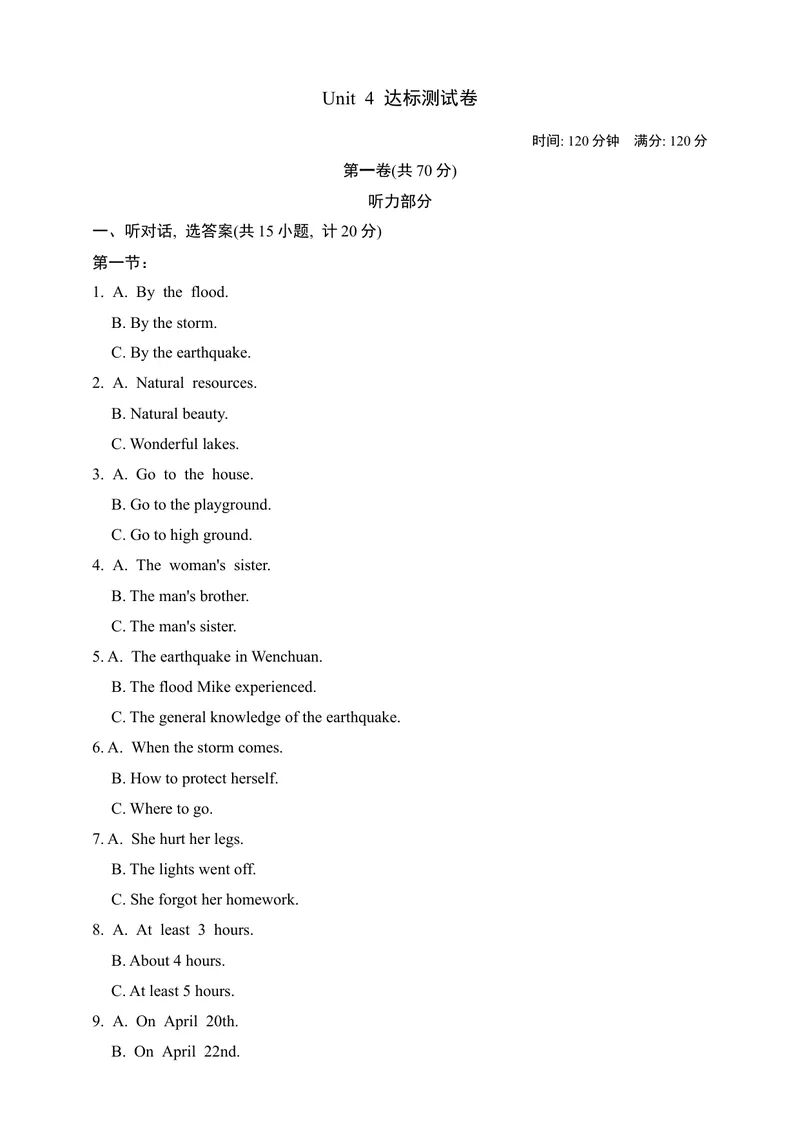
Unit 4 达标测试卷
时间: 120分钟 满分: 120分
第一卷(共70分)
听力部分
一、听对话, 选答案(共15小题, 计20分)
第一节:
1. A. By the flood.
B. By the storm.
C. By the earthquake.
2. A. Natural resources.
B. Natural beauty.
C. Wonderful lakes.
3. A. Go to the house.
B. Go to the playground.
C. Go to high ground.
4. A. The woman's sister.
B. The man's brother.
C. The man's sister.
5. A. The earthquake in Wenchuan.
B. The flood Mike experienced.
C. The general knowledge of the earthquake.
6. A. When the storm comes.
B. How to protect herself.
C. Where to go.
7. A. She hurt her legs.
B. The lights went off.
C. She forgot her homework.
8. A. At least 3 hours.
B. About 4 hours.
C. At least 5 hours.
9. A. On April 20th.
B. On April 22nd.C. On April 25th.
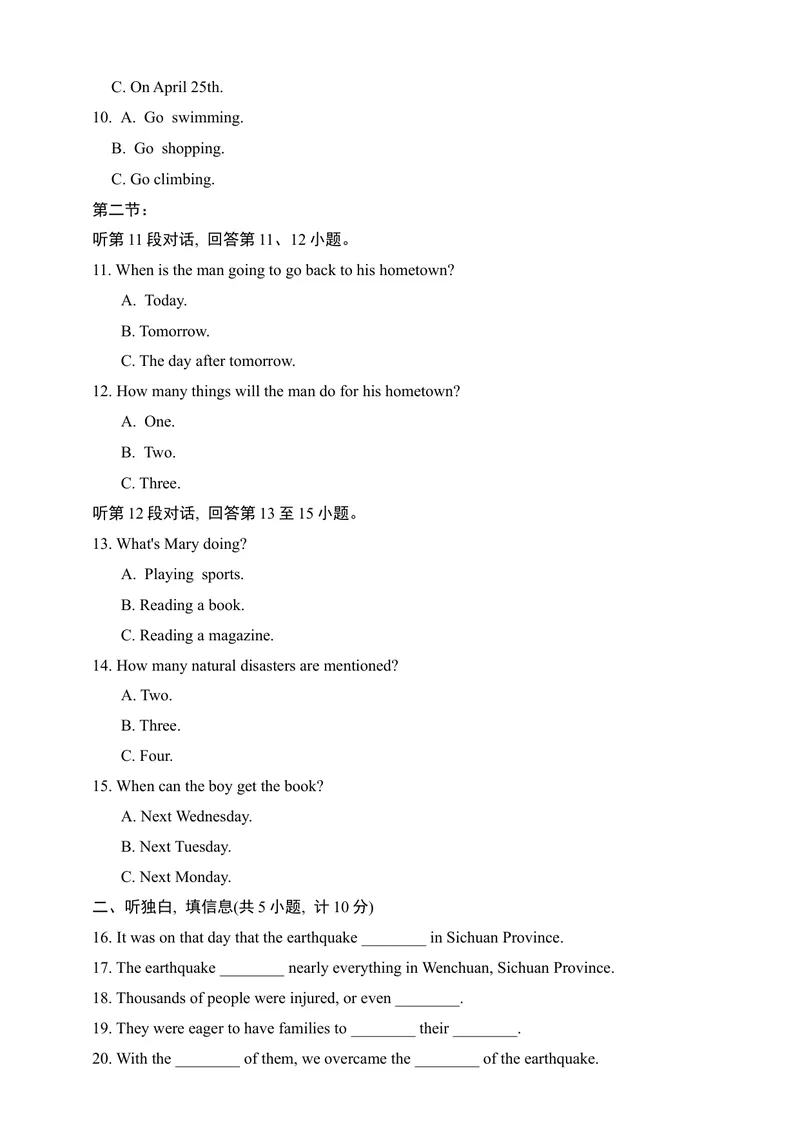
10. A. Go swimming.
B. Go shopping.
C. Go climbing.
第二节:
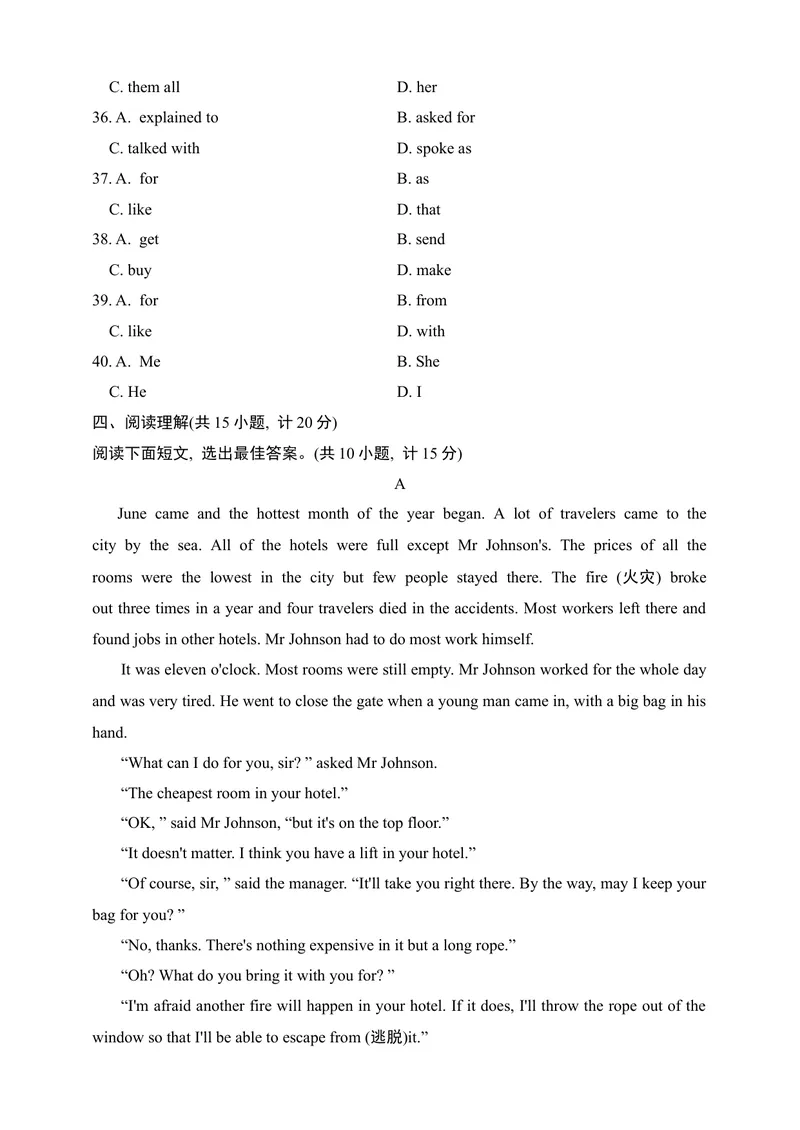
听第11段对话, 回答第11、12小题。
11. When is the man going to go back to his hometown?
A. Today.
B. Tomorrow.
C. The day after tomorrow.
12. How many things will the man do for his hometown?
A. One.
B. Two.
C. Three.
听第12段对话, 回答第13至15小题。
13. What's Mary doing?
A. Playing sports.
B. Reading a book.
C. Reading a magazine.
14. How many natural disasters are mentioned?
A. Two.
B. Three.
C. Four.
15. When can the boy get the book?
A. Next Wednesday.
B. Next Tuesday.
C. Next Monday.
二、听独白, 填信息(共5小题, 计10分)
16. It was on that day that the earthquake ________ in Sichuan Province.
17. The earthquake ________ nearly everything in Wenchuan, Sichuan Province.
18. Thousands of people were injured, or even ________.
19. They were eager to have families to ________ their ________.
20. With the ________ of them, we overcame the ________ of the earthquake.笔试部分
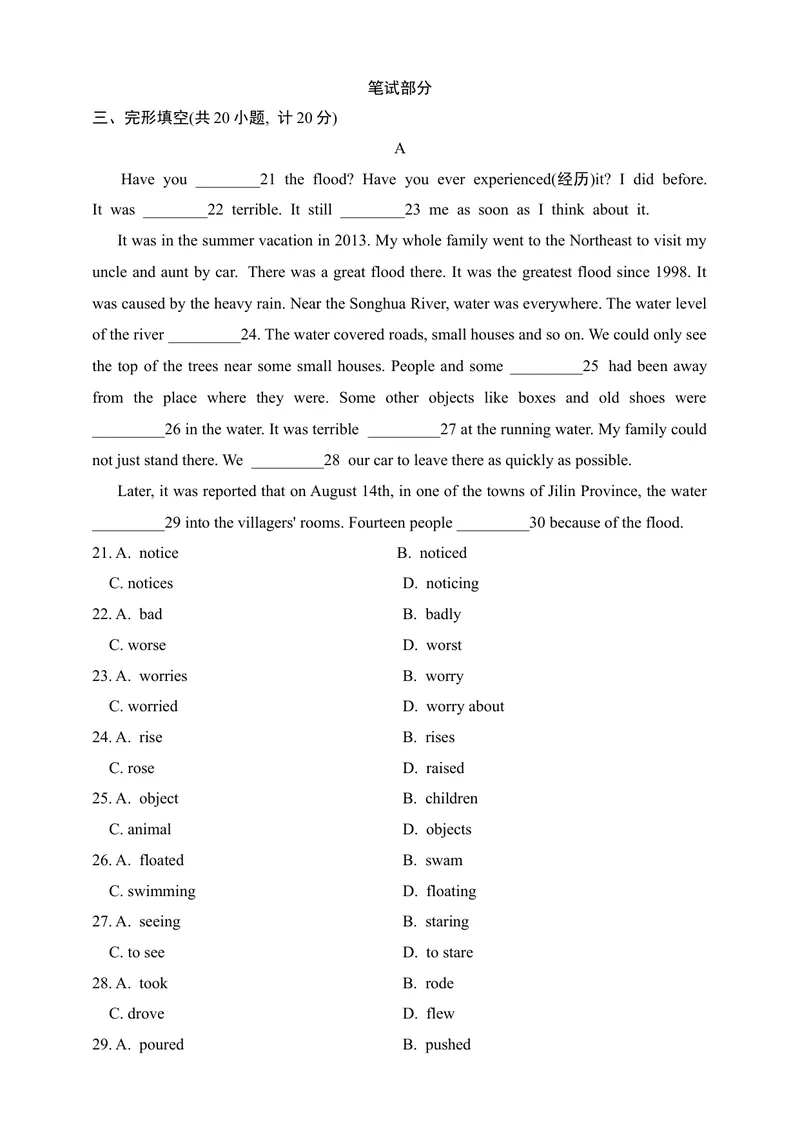
三、完形填空(共20小题, 计20分)
A
Have you ________21 the flood? Have you ever experienced(经历)it? I did before.
It was ________22 terrible. It still ________23 me as soon as I think about it.
It was in the summer vacation in 2013. My whole family went to the Northeast to visit my
uncle and aunt by car. There was a great flood there. It was the greatest flood since 1998. It
was caused by the heavy rain. Near the Songhua River, water was everywhere. The water level
of the river _________24. The water covered roads, small houses and so on. We could only see
the top of the trees near some small houses. People and some _________25 had been away
from the place where they were. Some other objects like boxes and old shoes were
_________26 in the water. It was terrible _________27 at the running water. My family could
not just stand there. We _________28 our car to leave there as quickly as possible.
Later, it was reported that on August 14th, in one of the towns of Jilin Province, the water
_________29 into the villagers' rooms. Fourteen people _________30 because of the flood.
21. A. notice B. noticed
C. notices D. noticing
22. A. bad B. badly
C. worse D. worst
23. A. worries B. worry
C. worried D. worry about
24. A. rise B. rises
C. rose D. raised
25. A. object B. children
C. animal D. objects
26. A. floated B. swam
C. swimming D. floating
27. A. seeing B. staring
C. to see D. to stare
28. A. took B. rode
C. drove D. flew
29. A. poured B. pushedC. walked D. jumped
30. A. dead B. lived
C. died D. alive
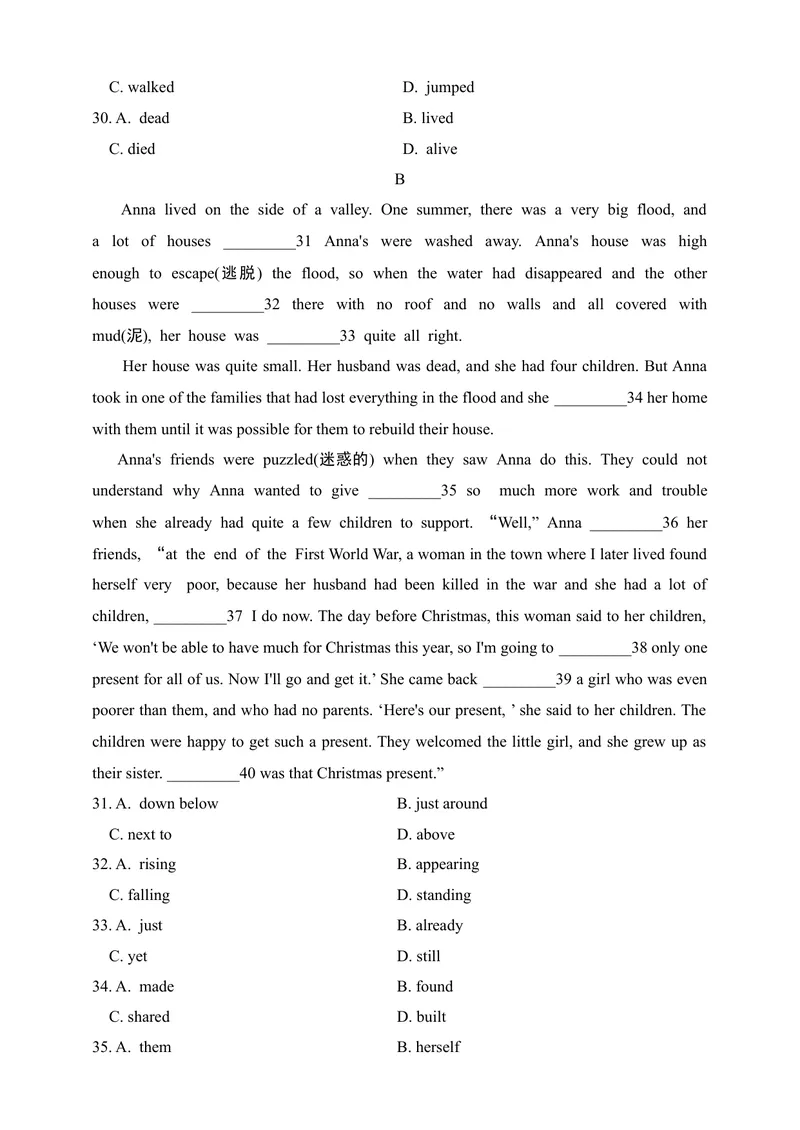
B
Anna lived on the side of a valley. One summer, there was a very big flood, and
a lot of houses _________31 Anna's were washed away. Anna's house was high
enough to escape(逃脱) the flood, so when the water had disappeared and the other
houses were _________32 there with no roof and no walls and all covered with
mud(泥), her house was _________33 quite all right.
Her house was quite small. Her husband was dead, and she had four children. But Anna
took in one of the families that had lost everything in the flood and she _________34 her home
with them until it was possible for them to rebuild their house.
Anna's friends were puzzled(迷惑的) when they saw Anna do this. They could not
understand why Anna wanted to give _________35 so much more work and trouble
when she already had quite a few children to support. “Well,” Anna _________36 her
friends, “at the end of the First World War, a woman in the town where I later lived found
herself very poor, because her husband had been killed in the war and she had a lot of
children, _________37 I do now. The day before Christmas, this woman said to her children,
‘We won't be able to have much for Christmas this year, so I'm going to _________38 only one
present for all of us. Now I'll go and get it.’ She came back _________39 a girl who was even
poorer than them, and who had no parents. ‘Here's our present, ’ she said to her children. The
children were happy to get such a present. They welcomed the little girl, and she grew up as
their sister. _________40 was that Christmas present.”
31. A. down below B. just around
C. next to D. above
32. A. rising B. appearing
C. falling D. standing
33. A. just B. already
C. yet D. still
34. A. made B. found
C. shared D. built
35. A. them B. herselfC. them all D. her
36. A. explained to B. asked for
C. talked with D. spoke as
37. A. for B. as
C. like D. that
38. A. get B. send
C. buy D. make
39. A. for B. from
C. like D. with
40. A. Me B. She
C. He D. I
四、阅读理解(共15小题, 计20分)
阅读下面短文, 选出最佳答案。(共10小题, 计15分)
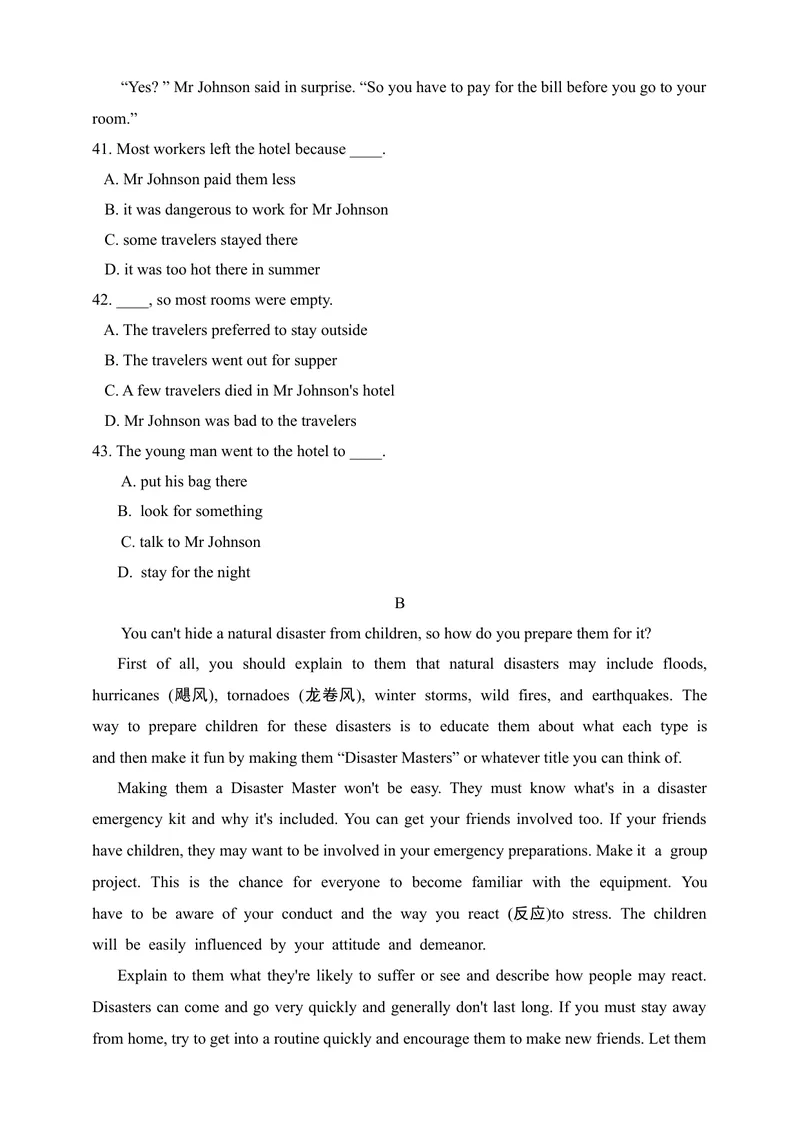
A
June came and the hottest month of the year began. A lot of travelers came to the
city by the sea. All of the hotels were full except Mr Johnson's. The prices of all the
rooms were the lowest in the city but few people stayed there. The fire (火灾) broke
out three times in a year and four travelers died in the accidents. Most workers left there and
found jobs in other hotels. Mr Johnson had to do most work himself.
It was eleven o'clock. Most rooms were still empty. Mr Johnson worked for the whole day
and was very tired. He went to close the gate when a young man came in, with a big bag in his
hand.
“What can I do for you, sir? ” asked Mr Johnson.
“The cheapest room in your hotel.”
“OK, ” said Mr Johnson, “but it's on the top floor.”
“It doesn't matter. I think you have a lift in your hotel.”
“Of course, sir, ” said the manager. “It'll take you right there. By the way, may I keep your
bag for you? ”
“No, thanks. There's nothing expensive in it but a long rope.”
“Oh? What do you bring it with you for? ”
“I'm afraid another fire will happen in your hotel. If it does, I'll throw the rope out of the
window so that I'll be able to escape from (逃脱)it.”“Yes? ” Mr Johnson said in surprise. “So you have to pay for the bill before you go to your
room.”
41. Most workers left the hotel because ____.
A. Mr Johnson paid them less
B. it was dangerous to work for Mr Johnson
C. some travelers stayed there
D. it was too hot there in summer
42. ____, so most rooms were empty.
A. The travelers preferred to stay outside
B. The travelers went out for supper
C. A few travelers died in Mr Johnson's hotel
D. Mr Johnson was bad to the travelers
43. The young man went to the hotel to ____.
A. put his bag there
B. look for something
C. talk to Mr Johnson
D. stay for the night
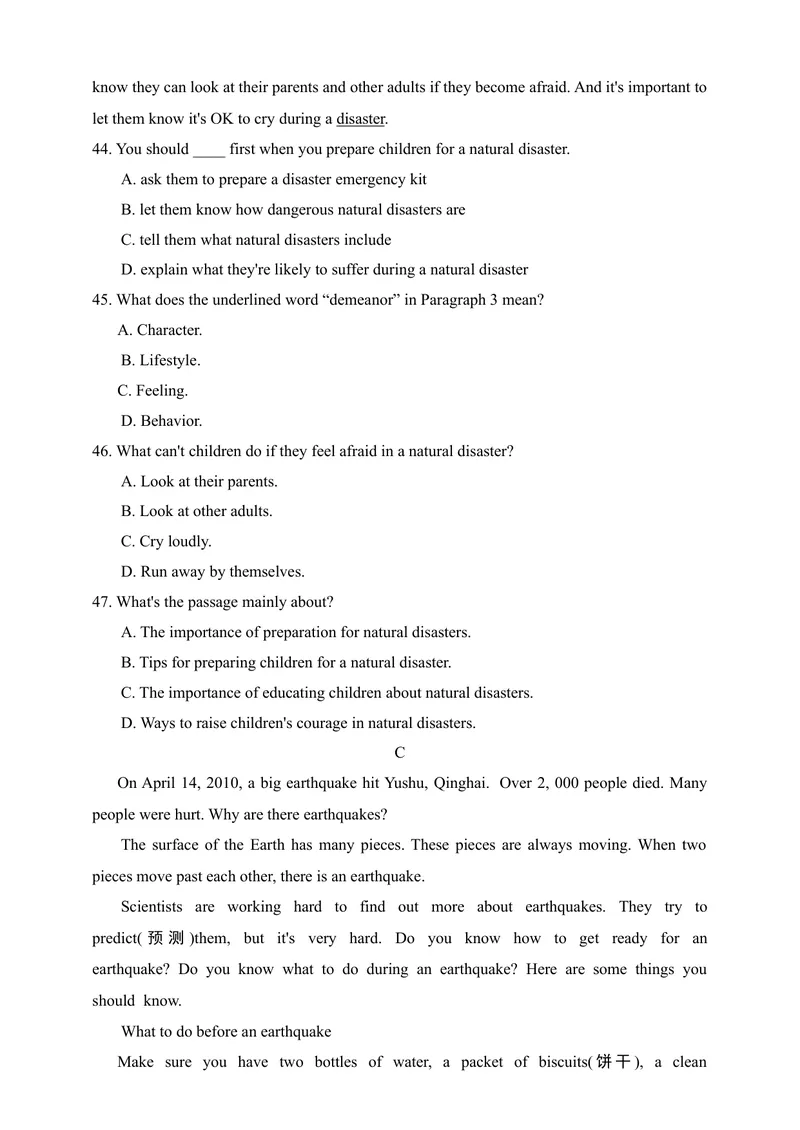
B
You can't hide a natural disaster from children, so how do you prepare them for it?
First of all, you should explain to them that natural disasters may include floods,
hurricanes (飓风), tornadoes (龙卷风), winter storms, wild fires, and earthquakes. The
way to prepare children for these disasters is to educate them about what each type is
and then make it fun by making them “Disaster Masters” or whatever title you can think of.
Making them a Disaster Master won't be easy. They must know what's in a disaster
emergency kit and why it's included. You can get your friends involved too. If your friends
have children, they may want to be involved in your emergency preparations. Make it a group
project. This is the chance for everyone to become familiar with the equipment. You
have to be aware of your conduct and the way you react (反应)to stress. The children
will be easily influenced by your attitude and demeanor.
Explain to them what they're likely to suffer or see and describe how people may react.
Disasters can come and go very quickly and generally don't last long. If you must stay away
from home, try to get into a routine quickly and encourage them to make new friends. Let themknow they can look at their parents and other adults if they become afraid. And it's important to
let them know it's OK to cry during a disaster.
44. You should ____ first when you prepare children for a natural disaster.
A. ask them to prepare a disaster emergency kit
B. let them know how dangerous natural disasters are
C. tell them what natural disasters include
D. explain what they're likely to suffer during a natural disaster
45. What does the underlined word “demeanor” in Paragraph 3 mean?
A. Character.
B. Lifestyle.
C. Feeling.
D. Behavior.
46. What can't children do if they feel afraid in a natural disaster?
A. Look at their parents.
B. Look at other adults.
C. Cry loudly.
D. Run away by themselves.
47. What's the passage mainly about?
A. The importance of preparation for natural disasters.
B. Tips for preparing children for a natural disaster.
C. The importance of educating children about natural disasters.
D. Ways to raise children's courage in natural disasters.
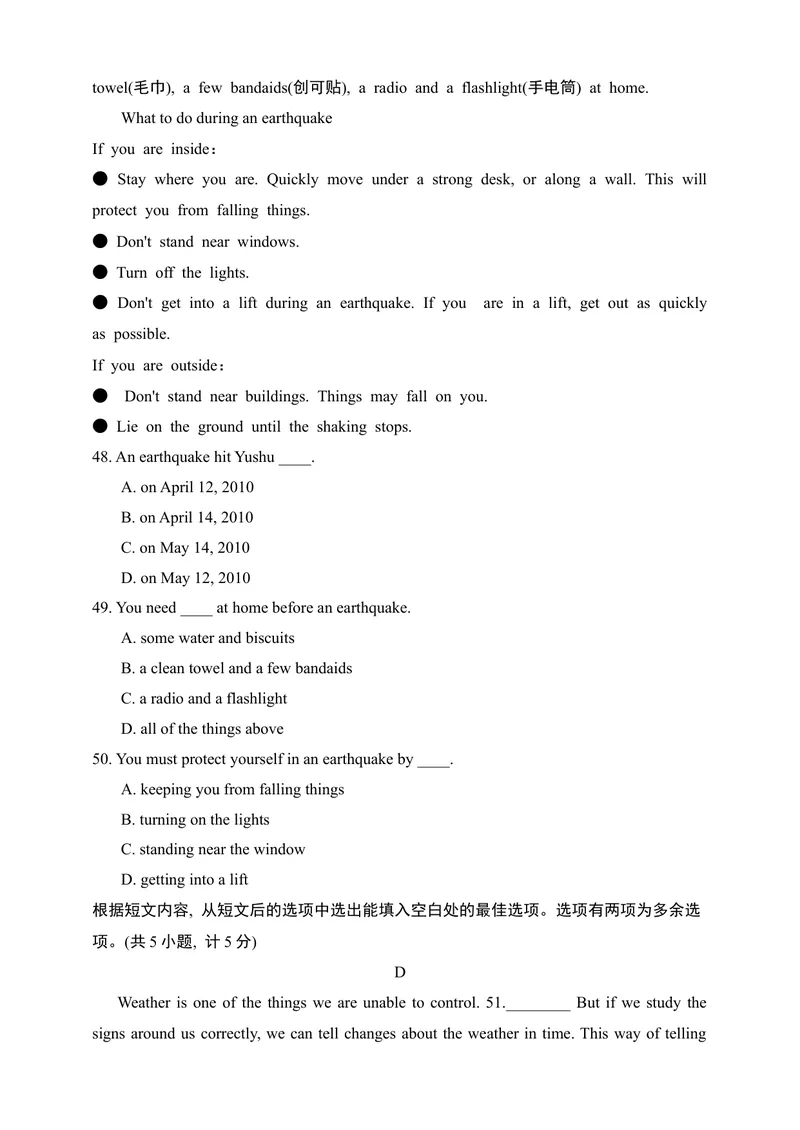
C
On April 14, 2010, a big earthquake hit Yushu, Qinghai. Over 2, 000 people died. Many
people were hurt. Why are there earthquakes?
The surface of the Earth has many pieces. These pieces are always moving. When two
pieces move past each other, there is an earthquake.
Scientists are working hard to find out more about earthquakes. They try to
predict( 预 测 )them, but it's very hard. Do you know how to get ready for an
earthquake? Do you know what to do during an earthquake? Here are some things you
should know.
What to do before an earthquake
Make sure you have two bottles of water, a packet of biscuits(饼干), a cleantowel(毛巾), a few bandaids(创可贴), a radio and a flashlight(手电筒) at home.
What to do during an earthquake
If you are inside:
● Stay where you are. Quickly move under a strong desk, or along a wall. This will
protect you from falling things.
● Don't stand near windows.
● Turn off the lights.
● Don't get into a lift during an earthquake. If you are in a lift, get out as quickly
as possible.
If you are outside:
● Don't stand near buildings. Things may fall on you.
● Lie on the ground until the shaking stops.
48. An earthquake hit Yushu ____.
A. on April 12, 2010
B. on April 14, 2010
C. on May 14, 2010
D. on May 12, 2010
49. You need ____ at home before an earthquake.
A. some water and biscuits
B. a clean towel and a few bandaids
C. a radio and a flashlight
D. all of the things above
50. You must protect yourself in an earthquake by ____.
A. keeping you from falling things
B. turning on the lights
C. standing near the window
D. getting into a lift
根据短文内容, 从短文后的选项中选出能填入空白处的最佳选项。选项有两项为多余选
项。(共5小题, 计5分)
D
Weather is one of the things we are unable to control. 51.________ But if we study the
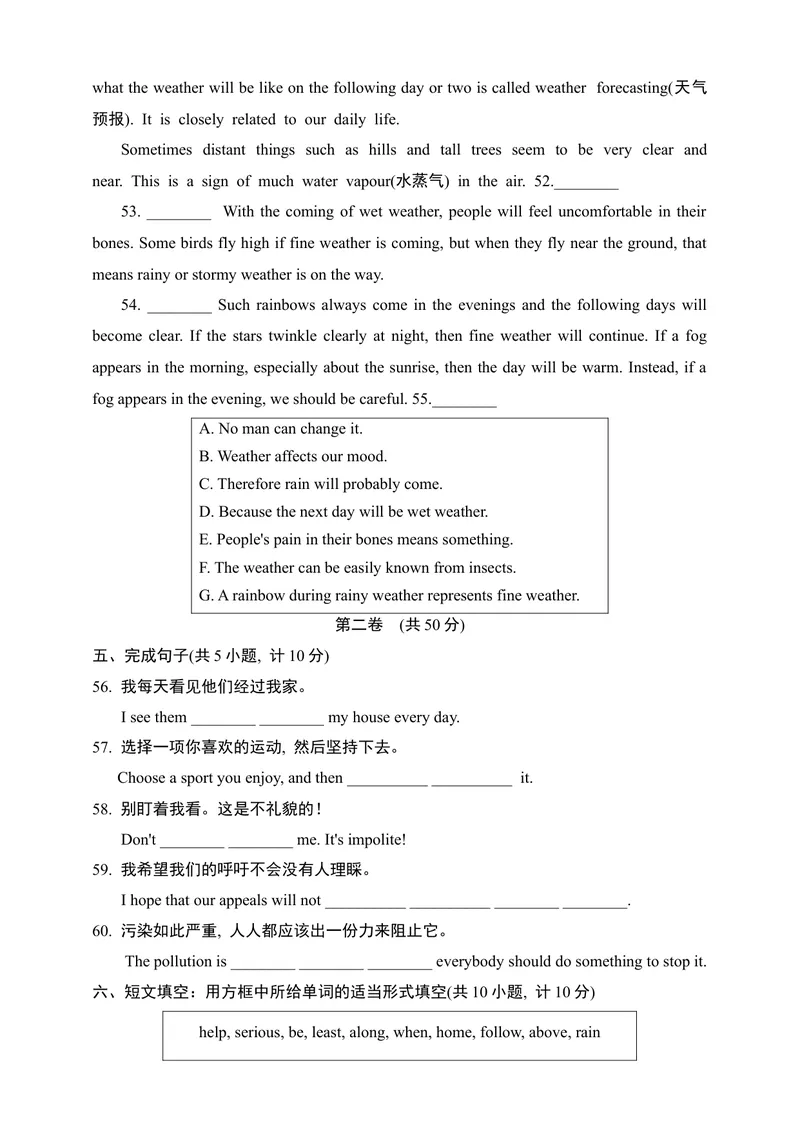
signs around us correctly, we can tell changes about the weather in time. This way of tellingwhat the weather will be like on the following day or two is called weather forecasting(天气
预报). It is closely related to our daily life.
Sometimes distant things such as hills and tall trees seem to be very clear and
near. This is a sign of much water vapour(水蒸气) in the air. 52.________
53. ________ With the coming of wet weather, people will feel uncomfortable in their
bones. Some birds fly high if fine weather is coming, but when they fly near the ground, that
means rainy or stormy weather is on the way.
54. ________ Such rainbows always come in the evenings and the following days will
become clear. If the stars twinkle clearly at night, then fine weather will continue. If a fog
appears in the morning, especially about the sunrise, then the day will be warm. Instead, if a
fog appears in the evening, we should be careful. 55.________
A. No man can change it.
B. Weather affects our mood.
C. Therefore rain will probably come.
D. Because the next day will be wet weather.
E. People's pain in their bones means something.
F. The weather can be easily known from insects.
G. A rainbow during rainy weather represents fine weather.
第二卷 (共50分)
五、完成句子(共5小题, 计10分)
56. 我每天看见他们经过我家。
I see them ________ ________ my house every day.
57. 选择一项你喜欢的运动, 然后坚持下去。
Choose a sport you enjoy, and then __________ __________ it.
58. 别盯着我看。这是不礼貌的!
Don't ________ ________ me. It's impolite!
59. 我希望我们的呼吁不会没有人理睬。
I hope that our appeals will not __________ __________ ________ ________.
60. 污染如此严重, 人人都应该出一份力来阻止它。
The pollution is ________ ________ ________ everybody should do something to stop it.
六、短文填空:用方框中所给单词的适当形式填空(共10小题, 计10分)
help, serious, be, least, along, when, home, follow, above, rainA storm dropped heavy rains on central and southern parts of China. The radio says that
61.________ the Xiangjiang River in Hunan, floods caused by terrible 62.________ in the past
few weeks killed 25 people and 13 others were missing. The Chinese government warned
some parts in Yunnan and the city of Chongqing of possible heavy rains over the 63.________
few days. In Changsha, water levels rose to 38 meters early Monday morning, about 3 meters
64.________ the danger line. In Guangdong, at 65.________ 21 people were killed, while
three were 66.________ hurt and seven went missing 67.________ heavy floods hit northern
parts by Saturday. The cities of Shaoguan, Meizhou and Heyuan 68.________ hardest hit and
many people were left homeless. About 620 million yuan has been lost in the floods. The local
government of Guangdong has sent something 69.________ to Meizhou, Heyuan and
Shaoguan to help the people who had lost homes build their 70.________ again.
七、任务型阅读(共5小题, 计10分)
People do not usually like floods but some farmers need floods when their fields are too
dry. When there is a flood, the water carries mud and sand from the river bed to the fields near
the river. When the water goes away, the mud and sand become good soil.
People in many countries tell stories about a very big flood. The flood covered the world.
Here is just one of those stories.
A long, long time ago, there was a man called Noah(诺亚). He lived with his
wife, his three sons and his sons' wives. One day, Noah heard a voice. It said,
“Noah, soon there will be a big flood. You must build a boat. You must put two of
every kind of animal in the boat. Many, many people will die in the flood but you and your
family will be all right.”
Noah and his family built a boat. They put two of every kind of animal in their boat. They
put food in the boat, too. Then it started to rain. It rained for 40 days and 40 nights. The
water covered the world. The hills and mountains looked like islands. Noah's boat stopped on
the top of a mountain. At last the rain stopped and the flood went away. There was a beautiful
rainbow in the sky. And the animals left Noah's boat. They ran, jumped, walked and flew
away to live on the mountain.
71. Can floods be good for some farmers when their fields are too dry?
______________________________________________________
72. What did Noah build to protect his family from the flood?
He built __________________________________.73. How many people were there in Noah's family?
There were ______________________________.
74. How long did the rain last?
It lasted ______________________________.
75. Where did the animals live finally?
They lived ____________________________.
八、补全对话(共5小题, 计5分)
在空白处填入一个适当的句子, 使对话完整。
A: Hi, Peter! Long time no see. 76._______________________________________?
B: Pretty good. Glad to see you! What are you doing here?
A: 77._____________________________________________ _. She's arriving in 30 minutes.
B: A pen pal from America? Sounds so cool! How do you know her?
A: She is my aunt's neighbor in New York. We've been pen pals for half a year. We often send
emails to each other.
B: 78.______________________________________________________________?
A: Almost in English. Because she can't write Chinese words. You know, Chinese characters
are difficult for foreigners.
B: 79._______________________________________________________________.
After writing so many English emails , your English must have improved a lot.
A: Yes, sure. And this time I'll be a tour guide for Helen. It's a good time to practice spoken
English. 80._________________________________________________?
B: May I? I really want to talk to native speakers in English. That's amazing!
九、书面表达(计15分)
我们都知道近年来发生了很多自然灾害, 而其中很多自然灾害是人类自身引起的,
政府采取了什么措施来减少自然灾害的发生, 我们人类又该如何以身作则来保护我们的
星球, 请根据提示写一篇短文简要谈一下。
措施
1.禁止砍伐树木
政府 2. 限制废水排放
3. ……
我们自身 ……
____________________________________________________________________________
___________________________________________________________________________________________________________________________________
_____________________________________________________________________
_____________________________________________________________________
_____________________________________________________________________参考答案
第一卷 听力部分
听力材料:
一、第一节: 听下面10段对话, 每段对话后有一个问题, 读两遍。请根据每段对话的内容
和后面的问题, 从所给的三个选项中选出最恰当的一项。
1. M: What happened to the ancient town?
W: It was destroyed in the flood.
Q: How was the ancient town destroyed?
2. M: Have you read the introduction of the country you are going to?
W: Yes.Now I know it's famous for natural beauty.
Q: What's the country famous for?
3. M: What should we do when there's a flood?
W: We should get to high ground.
Q: Where should we go when there's a flood?
4. M: What's the matter with your sister?
W: She has a bad cold.
Q: Who has got a cold?
5. W: Do you know when the earthquake took place in Wenchuan, Mike?
M: On May 12th, 2008.
Q: What are they talking about?
6. M: What will the weather be like tomorrow?
W: There will be a thunderstorm. I don't know what to do when the storm comes.
Q: What does the woman probably worry about?
7. M: What a big storm last night!
W: Yes. I was doing my homework. Suddenly, all the lights in my house went
off.
Q: What happened to the woman last night?
8. W: How far is it from here to your hometown?
M: Well, it takes over three hours to get there by coach.
Q: How long does it take to get to the man's hometown by coach?
9. M: Do you know when the earthquake happened in Ya'an?
W: On the 20th of April, 2013.Q: When did the earthquake happen in Ya'an?
10. M: The TV says there will be a storm tomorrow.
W: Bad luck.I planned to go climbing with my classmates.
Q: What did the woman want to do?
第二节: 听下面2段对话, 每段对话后有几个小题, 请根据每段对话的内容和后面
的问题, 从所给的三个选项中选出最恰当的一项。每段对话读两遍。
听第11段对话, 回答第11、12小题
W: I heard your hometown was flooded and many people lost their houses. Is it true?
M: Yes. Many people don't have houses to live in now. I am going to go back to my
hometown to do something for them tomorrow.
W: Really? How will you help them?
M: I will help them rebuild their houses and look after the old and the young.
W: That's very kind of you. May I go with you?
M: Of course you can.
听第12段对话, 回答第13至15小题。
M: What are you doing, Mary?
W: I'm reading a book.
M: What's it about?
W: It's about natural disasters.
M: Natural disasters?
W: Yeah. There are many natural disasters in the world now, such as earthquakes, ice
storms and droughts.
M: Can I read the book?
W: Of course. I will finish reading it next Wednesday and then you can have it.
二、本题你将听到一段独白, 读两遍, 请根据所听内容, 用单词或短语完成下列各题。(每
空限填一个单词。)
May 12th was an ordinary day in 2008. It was on that day that the earthquake
happened in Sichuan Province. The earthquake destroyed nearly everything in
Wenchuan, Sichuan Province. It was terrible. We couldn't describe the scene that we saw
with any words. Thousands of people were injured, or even died. And thousands of
children became such unlucky ones who lost fathers or mothers. They were eager to have
families to continue their lives. Fortunately, love was around us. The people all over theworld helped us. They offered us money, goods, love and so on.
With the help of them, we overcame the damage of the earthquake and faced the
beautiful future.
听力答案:
一、1~5: ABCAA
6~10: BBAAC
11~15: BBBBA
二、16.happened 17.destroyed
18. died 19.continue; lives
20. help; damage
笔试部分
三、A)21.B
22. B 点拨: 副词badly修饰形容词。
23. A 点拨: 此句是一般现在时, 说明现在的状况, 意为“我一想到它, 依然使我感
到不安。”
24. C 25.D 26.D
27. D 点拨: stare at盯着看; it作形式主语, 动词不定式作真正的主语。
28. C 29.A
30. C
B)31.A点拨: 根据下文“Anna's house was high enough...”可知被冲走的是安娜家
下方的房子, 故选A。
32. D点拨: 句意: ……所以当洪水退去的时候, 其他房子立在那里没有房顶和墙而
且全被泥覆盖着……rise意为“升起”; appear意为“出现”; fall意为“下
落”; stand意为“站立”。
33. D点拨: 根据“Anna's house was high enough to escape(逃脱) the flood”可
知, 安娜家的房子依然(still)很好。
34. C点拨: share with sb.意为“与某人共用”, 此处表示“安娜和他们一起住在
这个房子里”。
35. B点拨: 句意: 他们不明白当她已经有好几个孩子要养的时候, 为什么安娜想给
她自己那么多的工作和麻烦。根据句意可知B项正确。
36. A
37. B38. A点拨: 句意: 所以我打算我们所有的人只得到唯一的一份礼物。get意为“得
到”, 符合句意。
39. D点拨: with sb.意为“和某人一起”, 表示伴随。符合句意。
40. D点拨: 安娜就是那个被带回的女孩。此处应该使用主格作主语, 故选D。
四、A)41.B 点拨: 由第一段中的“The fire(火灾)broke out three times in a year and
four travelers died in the accidents. Most workers left there and found jobs
in other hotels.”可知答案。
42. C 点拨: 由第一段可知, Mr Johnson的旅馆因为一年中发生过3次火灾, 4位旅
客死于火灾, 所以几乎没有人去住, 因此Mr Johnson的旅馆的大多数房间都空
着。
43. D
B)44.C 45.D 46.D 47.B
C)48.B 49.D 50.A
D)51~55: ACEGD
第二卷
五、56.pass by
57. stick with
58. stare at
59. fall on deaf ears
60. so terrible that
六、61.along 62.rains 63.following
64. above 65.least
66. seriously 67.when
68. were 69.helpful
70. homes
七、71.Yes./Yes, they can.
72. a boat
73. eight people
74. for 40 days and 40 nights
75. on the mountain
八、76.How's it going/ How's everything going
77. I'm waiting for my pen pal from America78. Do you write emails in English or in Chinese/ In which language do you write emails
79. That's true/ That's right/ So they are
80. Would you like to join
九、One possible version:
As is known to all, many natural disasters happened these years and most of the
natural disasters are caused by humans themselves.
So the governments everywhere in the world try to forbid cutting down the trees
and restrict the emission of waste water. We should all be responsible to our planet,
because we only have one planet.
First, we should tell people around us to pay attention to this serious problem, due
to the fact that there are some people who don't care about this. Second, we should
decrease the toxic gas from ourselves. For instance, we can walk to work instead of
driving to work. We should not only care about the calamities in front of us but also care
about our offspring.
In conclusion, we should be responsible to our planet.