【牛津(广州,深圳,沈阳)版】八年级下学期期中测 试卷
(A卷·夯实基础)
学校:__________班级:__________姓名:_________ 考号:___________
温馨提示:
本试卷共分第Ⅰ卷和第Ⅱ卷两部分,第Ⅰ卷为选择题;第Ⅱ卷为非选择题;满分为90分,考试时间为100
分钟。
第Ⅰ卷 选择题
一、语法选择(15分)
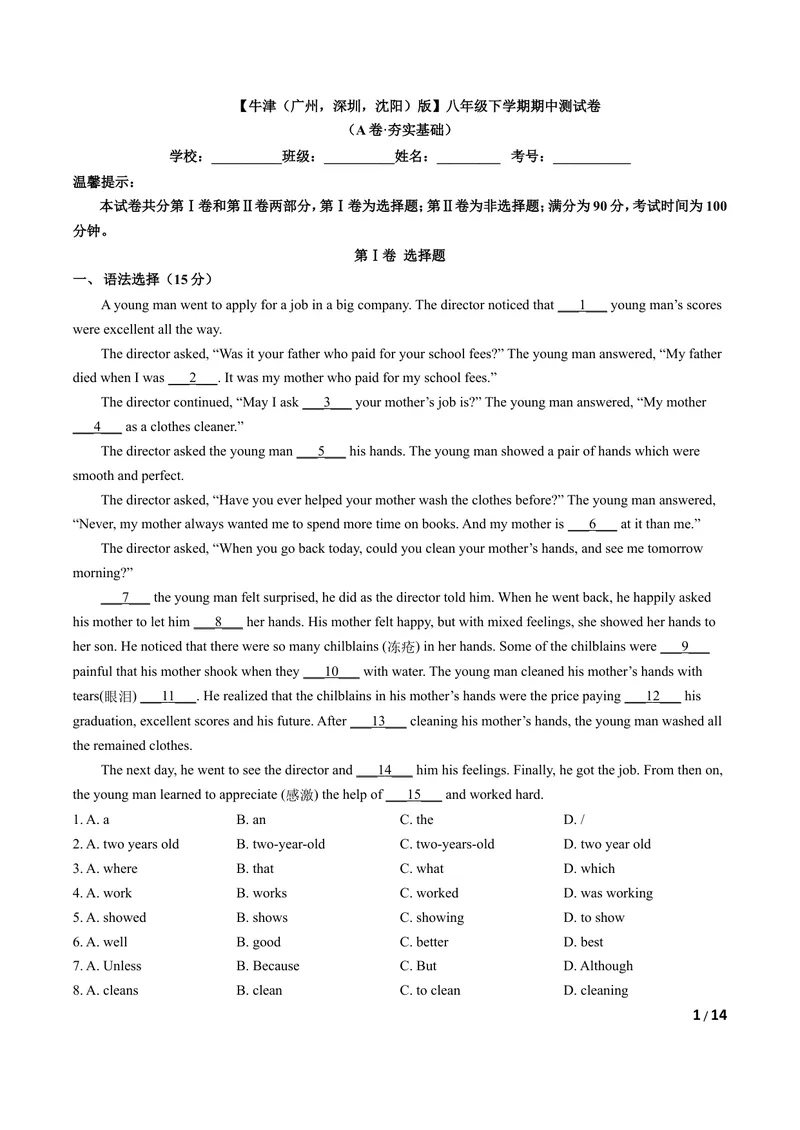
A young man went to apply for a job in a big company. The director noticed that ___1___ young man’s scores
were excellent all the way.
The director asked, “Was it your father who paid for your school fees?” The young man answered, “My father
died when I was ___2___. It was my mother who paid for my school fees.”
The director continued, “May I ask ___3___ your mother’s job is?” The young man answered, “My mother
___4___ as a clothes cleaner.”
The director asked the young man ___5___ his hands. The young man showed a pair of hands which were
smooth and perfect.
The director asked, “Have you ever helped your mother wash the clothes before?” The young man answered,
“Never, my mother always wanted me to spend more time on books. And my mother is ___6___ at it than me.”
The director asked, “When you go back today, could you clean your mother’s hands, and see me tomorrow
morning?”
___7___ the young man felt surprised, he did as the director told him. When he went back, he happily asked
his mother to let him ___8___ her hands. His mother felt happy, but with mixed feelings, she showed her hands to
her son. He noticed that there were so many chilblains (冻疮) in her hands. Some of the chilblains were ___9___
painful that his mother shook when they ___ 1 0___ with water. The young man cleaned his mother’s hands with
tears(眼泪) ___ 1 1___ . He realized that the chilblains in his mother’s hands were the price paying ___ 1 2___ his
graduation, excellent scores and his future. After ___ 1 3___ cleaning his mother’s hands, the young man washed all
the remained clothes.
The next day, he went to see the director and ___ 1 4___ him his feelings. Finally, he got the job. From then on,
the young man learned to appreciate (感激) the help of ___ 1 5___ and worked hard.
1. A. a B. an C. the D. /
2. A. two years old B. two-year-old C. two-years-old D. two year old
3. A. where B. that C. what D. which
4. A. work B. works C. worked D. was working
5. A. showed B. shows C. showing D. to show
6. A. well B. good C. better D. best
7. A. Unless B. Because C. But D. Although
8. A. cleans B. clean C. to clean D. cleaning
1 / 149. A. so B. very C. quite D. too
10. A. washed B. was washed C. were washing D. were washed
11. A. silent B. silence C. silently D. more silently
12. A. on B. for C. with D. of
13. A. finishing B. finished C. finish D. to finish
14. A. to tell B. telling C. told D. was telling
15. A. other B. others C. the other D. another
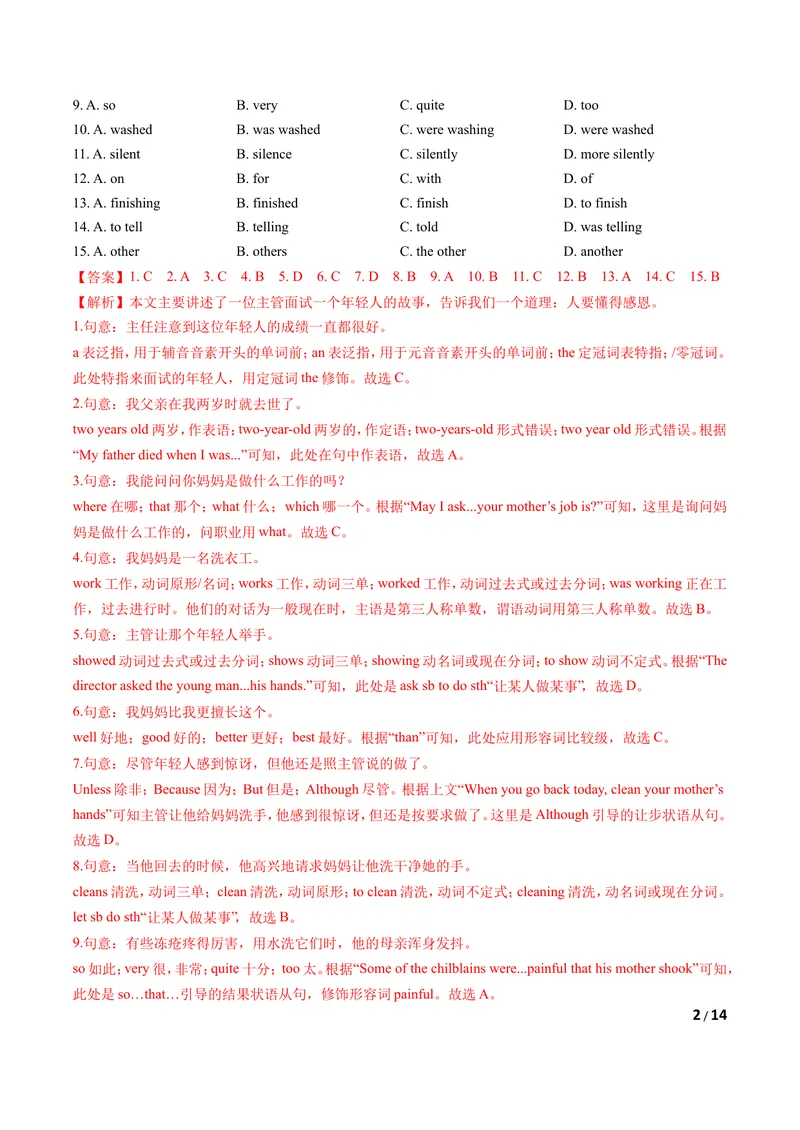
【答案】1. C 2. A 3. C 4. B 5. D 6. C 7. D 8. B 9. A 10. B 11. C 12. B 13. A 14. C 15. B
【解析】本文主要讲述了一位主管面试一个年轻人的故事,告诉我们一个道理:人要懂得感恩。
1.句意:主任注意到这位年轻人的成绩一直都很好。
a表泛指,用于辅音音素开头的单词前;an表泛指,用于元音音素开头的单词前;the定冠词表特指;/零冠词。
此处特指来面试的年轻人,用定冠词the修饰。故选C。
2.句意:我父亲在我两岁时就去世了。
two years old两岁,作表语;two-year-old两岁的,作定语;two-years-old形式错误;two year old形式错误。根据
“My father died when I was...”可知,此处在句中作表语,故选A。
3.句意:我能问问你妈妈是做什么工作的吗?
where在哪;that那个;what什么; which哪一个。根据“May I ask...your mother’s job is?”可知,这里是询问妈
妈是做什么工作的,问职业用what。故选C。
4.句意:我妈妈是一名洗衣工。
work工作,动词原形/名词;works工作,动词三单;worked工作,动词过去式或过去分词;was working正在工
作,过去进行时。他们的对话为一般现在时,主语是第三人称单数,谓语动词用第三人称单数。故选B。
5.句意:主管让那个年轻人举手。
showed动词过去式或过去分词;shows动词三单;showing动名词或现在分词;to show动词不定式。根据“The
director asked the young man...his hands.”可知,此处是ask sb to do sth“让某人做某事”,故选D。
6.句意:我妈妈比我更擅长这个。
well好地;good好的;better更好;best最好。根据“than”可知,此处应用形容词比较级,故选C。
7.句意:尽管年轻人感到惊讶,但他还是照主管说的做了。
Unless除非;Because因为;But但是;Although尽管。根据上文“When you go back today, clean your mother’s
hands”可知主管让他给妈妈洗手,他感到很惊讶,但还是按要求做了。这里是Although引导的让步状语从句。
故选D。
8.句意:当他回去的时候,他高兴地请求妈妈让他洗干净她的手。
cleans清洗,动词三单; clean清洗,动词原形;to clean清洗,动词不定式;cleaning清洗,动名词或现在分词。
let sb do sth“让某人做某事”,故选B。
9.句意:有些冻疮疼得厉害,用水洗它们时,他的母亲浑身发抖。
so如此;very很,非常;quite十分; too太。根据“Some of the chilblains were...painful that his mother shook”可知,
此处是so…that…引导的结果状语从句,修饰形容词painful。故选A。
2 / 1410.句意:有些冻疮疼得厉害,用水洗它们时,他的母亲浑身发抖。
washed过去式或过去分词;were cleaned是一般过去时的被动语态; was cleaning过去进行时,主语是单数;
were cleaning过去进行时,主语是复数。主语是动作的承受者,时态是一般过去时,所以用一般过去时态的被
动语态。故选B。
11.句意:年轻人默默地眼含泪水擦干了母亲的手。
silent沉默的,形容词;silence沉默,名词;silently沉默地,副词;more silently副词的比较级。这里是副词修饰
动词,且无比较含义。故选C。
12.句意:他意识到,母亲手中的冻疮,是为自己的毕业、优异成绩和未来所付出的代价。
on在……上;for为了;with和;of……的。根据“He realized that the chilblains in his mother’s hands were the
price paying...his graduation”可知,此处是pay for短语,意为“为……付钱”,故选B。
13.句意:年轻人洗完妈妈的手后,把剩下的衣服都洗了。
finishing动名词或现在分词;finished动词过去式或过去分词;finish动词原形;to finish动词不定式。After在
这里是介词,其后加动名词。故选A。
14.句意:第二天,他去见主管,告诉他自己的感受。
to tell动词不定式;telling动名词或现在分词;told动词过去式或过去分词;was telling过去进行时。此处为
and连接的两个并列结构,时态与went保持一致。故选C。
15.句意:从那时起,年轻人学会了感激别人的帮助,并努力工作。
other其他的;others其他人;the other两者中的另一个;another三者及以上的另一个。根据“the young man
learned to appreciate (感激) the help of...”可知,此处表示“感激别人的帮助”,在介词后作宾语,故选B。
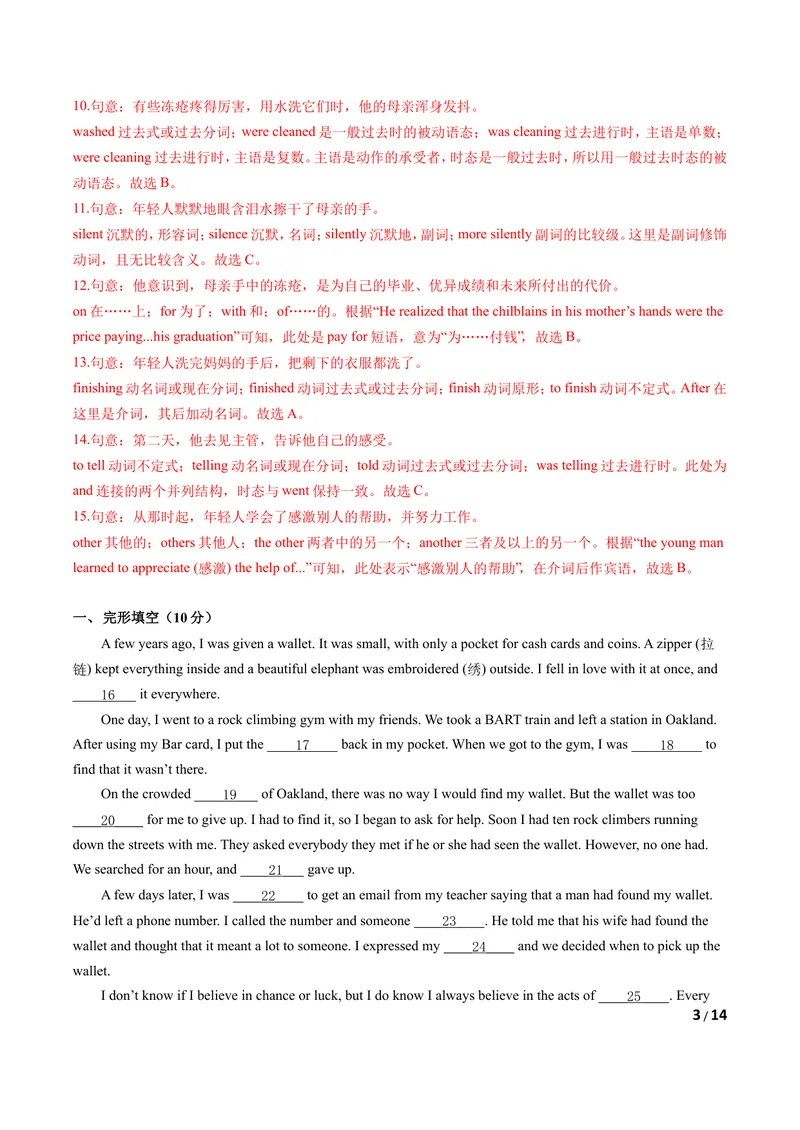
一、完形填空(10分)
A few years ago, I was given a wallet. It was small, with only a pocket for cash cards and coins. A zipper (拉
链) kept everything inside and a beautiful elephant was embroidered (绣) outside. I fell in love with it at once, and
___ _ 1 6 __ _ it everywhere.
One day, I went to a rock climbing gym with my friends. We took a BART train and left a station in Oakland.
After using my Bar card, I put the ___ _ 1 7 ___ _ back in my pocket. When we got to the gym, I was ___ _ 1 8 ___ _ to
find that it wasn’t there.
On the crowded ___ _ 1 9 __ _ of Oakland, there was no way I would find my wallet. But the wallet was too
____ 2 0 ___ _ for me to give up. I had to find it, so I began to ask for help. Soon I had ten rock climbers running
down the streets with me. They asked everybody they met if he or she had seen the wallet. However, no one had.
We searched for an hour, and ____ 2 1 __ _ gave up.
A few days later, I was ____ 2 2 ___ _ to get an email from my teacher saying that a man had found my wallet.
He’d left a phone number. I called the number and someone ____ 2 3 ___ _. He told me that his wife had found the
wallet and thought that it meant a lot to someone. I expressed my ____ 2 4 ___ _ and we decided when to pick up the
wallet.
I don’t know if I believe in chance or luck, but I do know I always believe in the acts of ___ _ 2 5 ___ _. Every
3 / 14day my hope for the world is renewed when I remember all the people who go out of their way to help whomever
they can.
16. A. hung B. carried C. avoided D. discovered
17. A. toy B. letter C. ticket D. wallet
18. A. surprised B. pleased C. patient D. successful
19. A. camps B. restaurants C. streets D. rivers
20. A. dangerous B. valuable C. common D. easy
21. A. suddenly B. brightly C. finally D. correctly
22. A. necessary B. lucky C. silly D. kind
23. A. wondered B. disagreed C. refused D. answered
24. A. thanks B. happiness C. hope D. wishes
25. A. care B. kindness C. pity D. help
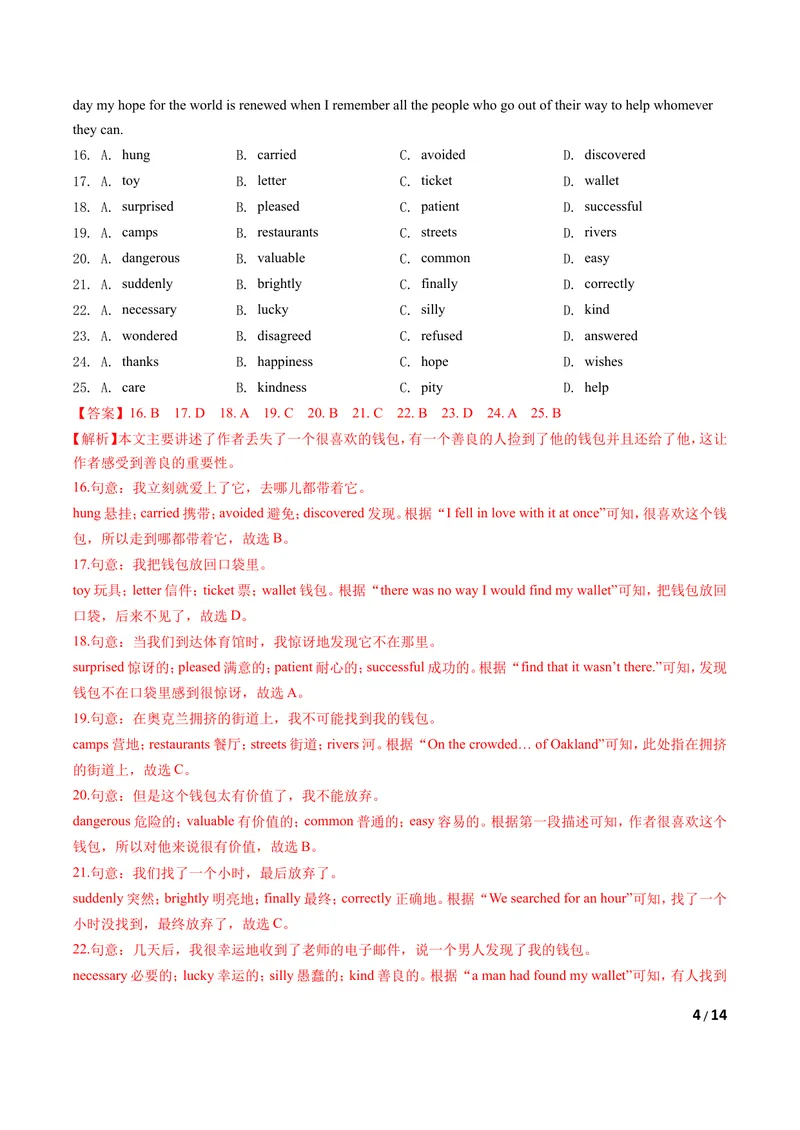
【答案】16. B 17. D 18. A 19. C 20. B 21. C 22. B 23. D 24. A 25. B
【解析】本文主要讲述了作者丢失了一个很喜欢的钱包,有一个善良的人捡到了他的钱包并且还给了他,这让
作者感受到善良的重要性。
16.句意:我立刻就爱上了它,去哪儿都带着它。
hung悬挂;carried携带;avoided避免;discovered发现。根据“I fell in love with it at once”可知,很喜欢这个钱
包,所以走到哪都带着它,故选B。
17.句意:我把钱包放回口袋里。
toy玩具;letter信件;ticket票;wallet钱包。根据“there was no way I would find my wallet”可知,把钱包放回
口袋,后来不见了,故选D。
18.句意:当我们到达体育馆时,我惊讶地发现它不在那里。
surprised惊讶的;pleased满意的;patient耐心的;successful成功的。根据“find that it wasn’t there.”可知,发现
钱包不在口袋里感到很惊讶,故选A。
19.句意:在奥克兰拥挤的街道上,我不可能找到我的钱包。
camps营地;restaurants餐厅;streets街道;rivers河。根据“On the crowded… of Oakland”可知,此处指在拥挤
的街道上,故选C。
20.句意:但是这个钱包太有价值了,我不能放弃。
dangerous危险的;valuable有价值的;common普通的;easy容易的。根据第一段描述可知,作者很喜欢这个
钱包,所以对他来说很有价值,故选B。
21.句意:我们找了一个小时,最后放弃了。
suddenly突然;brightly明亮地;finally最终;correctly正确地。根据“We searched for an hour”可知,找了一个
小时没找到,最终放弃了,故选C。
22.句意:几天后,我很幸运地收到了老师的电子邮件,说一个男人发现了我的钱包。
necessary必要的;lucky幸运的;silly愚蠢的;kind善良的。根据“a man had found my wallet”可知,有人找到
4 / 14了作者丢失的钱包,这是一件很幸运的事,故选B。
23.句意:我打给这个号码,有人接了电话。
wondered想知道;disagreed不同意;refused拒绝;answered接听(电话)。根据“I called the number”可知,此
处指有人接听电话,故选D。
24.句意:我表达了我的感谢,然后我们决定了什么时候去拿钱包。
thanks感谢;happiness开心;hope希望;wishes愿望。有人捡到了作者的钱包,作者表达自己的感谢,故选A。
25.句意:我不知道我是相信机会还是运气,但我知道我一直相信善举。
care关心;kindness善良;pity怜悯;help帮助。有人见到了作者的钱包并且还给了作者,这是一个善举,故选
B。
三、 阅读理解(分二节,共35分)
第一节、阅读选择(每题2分,共30分)
A
Four teenagers took part in voluntary activities for the old and they posted some articles to talk about them.
Helping Seniors (老年人)
Posted 5/ 16/ 20 4:53 PM
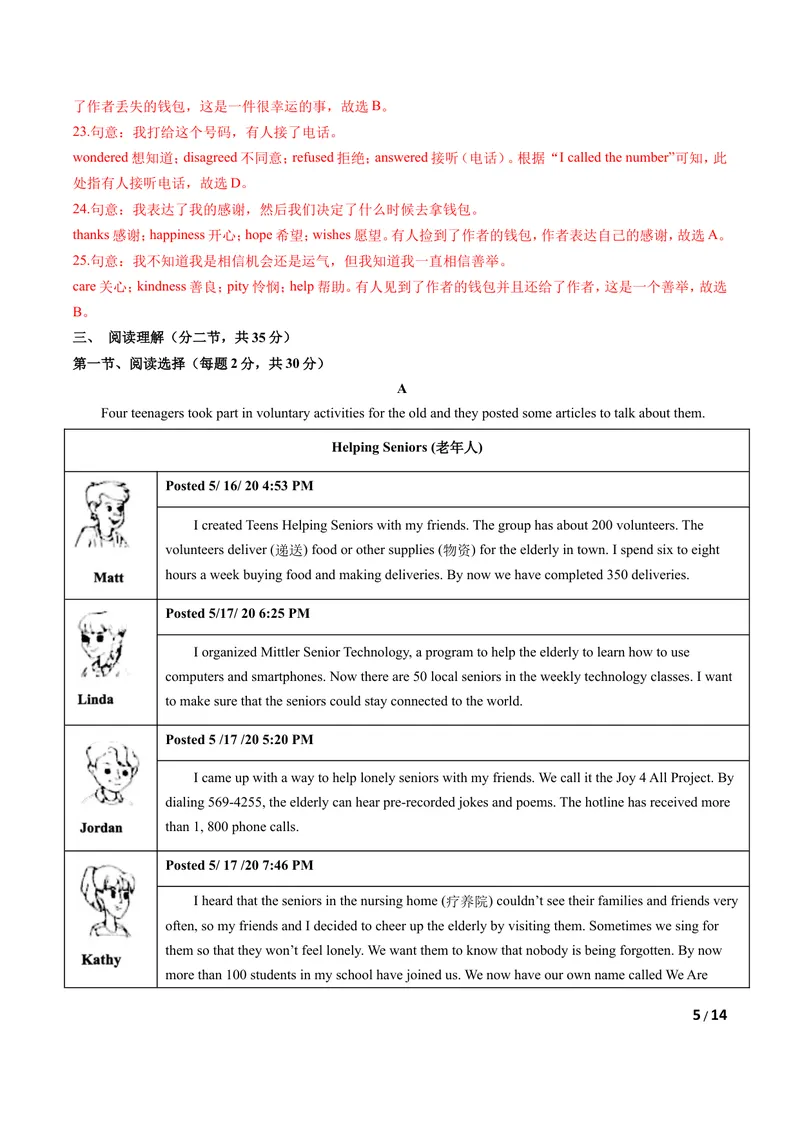
I created Teens Helping Seniors with my friends. The group has about 200 volunteers. The
volunteers deliver (递送) food or other supplies (物资) for the elderly in town. I spend six to eight
hours a week buying food and making deliveries. By now we have completed 350 deliveries.
Posted 5/17/ 20 6:25 PM
I organized Mittler Senior Technology, a program to help the elderly to learn how to use
computers and smartphones. Now there are 50 local seniors in the weekly technology classes. I want
to make sure that the seniors could stay connected to the world.
Posted 5 /17 /20 5:20 PM
I came up with a way to help lonely seniors with my friends. We call it the Joy 4 All Project. By
dialing 569-4255, the elderly can hear pre-recorded jokes and poems. The hotline has received more
than 1, 800 phone calls.
Posted 5/ 17 /20 7:46 PM
I heard that the seniors in the nursing home (疗养院) couldn’t see their families and friends very
often, so my friends and I decided to cheer up the elderly by visiting them. Sometimes we sing for
them so that they won’t feel lonely. We want them to know that nobody is being forgotten. By now
more than 100 students in my school have joined us. We now have our own name called We Are
5 / 14Together.
26. Who created Teens Helping Seniors?
A. Kathy. B. Linda. C. Jordan. D. Matt.
27. Which of the following voluntary work for seniors was NOT mentioned?
A. Teaching them how to play computer games. B. Recording jokes and poems for them.
C. Visiting them to cheer them up. D. Delivering food or other supplies for them.
28. Susie is good at communicating with people. She is also a good singer. Which voluntary group should she
join?
A. Teens Helping Seniors B. Mittler Senior Technology
C. Joy 4 All Project D. We Are Together
【答案】26. D 27. A 28. D
【解析】本文是一篇记叙文。主要是说四个青少年参加了为老人服务的志愿活动,并发表了一些文章来谈论。
26.细节理解题。根据“I created Teens Helping Seniors with my friends.”可知,定位到方框中第一个人物
Matt,是Matt和他的朋友创建的。故选D。
27.细节理解题。根据“I organized Mittler Senior Technology, a program to help the elderly to learn how to use
computers and smartphones.”可知,Linda组织的项目是帮助老年人学习如何使用电脑和智能手机的,并不是
教他们玩电脑游戏的。故选A。
28.细节理解题。根据“Sometimes we sing for them so that they won’t feel lonely.”可知,有时我们为他们唱歌,
这个活动是“We Are Together”,题干中“She is also a good singer.”刚好与之对应。故选D。
B
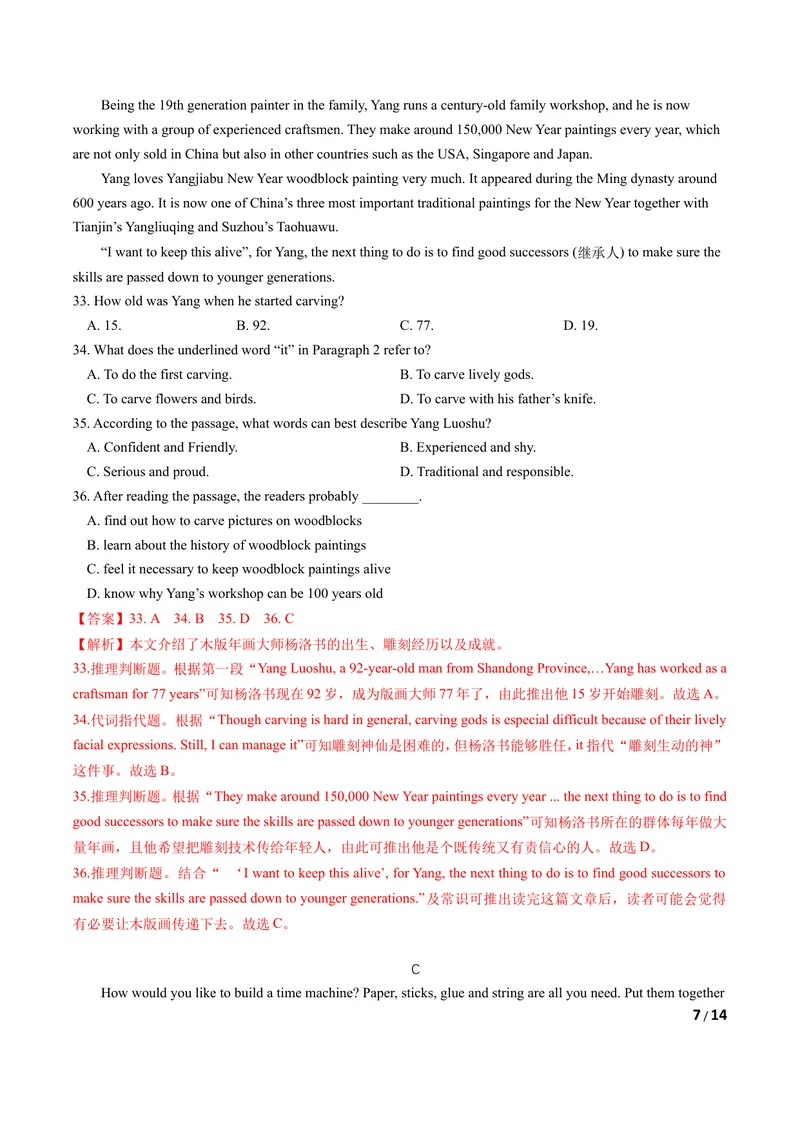
Yang Luoshu, a 92-year-old man from Shandong Province, is among those who show a great love for
woodblock painting. Yang has worked as a craftsman for 77 years, always practising his carving (雕刻) skills.
“When I was young, I often saw my father carving, and I was curious about it.” Yang said, “One day my father
went out for a while. I quickly took up his knife and carved on a woodblock. That was the first carving experience.”
Since then, Yang has carved different kinds, including flowers, birds, mountains, rivers and traditional Chinese
gods. “Though carving is hard in general, carving gods is especial difficult because of their lively facial
expressions. Still, I can manage it,” Yang said confidently, and he also got a prize as a master in 2010.
6 / 14Being the 19th generation painter in the family, Yang runs a century-old family workshop, and he is now
working with a group of experienced craftsmen. They make around 150,000 New Year paintings every year, which
are not only sold in China but also in other countries such as the USA, Singapore and Japan.
Yang loves Yangjiabu New Year woodblock painting very much. It appeared during the Ming dynasty around
600 years ago. It is now one of China’s three most important traditional paintings for the New Year together with
Tianjin’s Yangliuqing and Suzhou’s Taohuawu.
“I want to keep this alive”, for Yang, the next thing to do is to find good successors (继承人) to make sure the
skills are passed down to younger generations.
33. How old was Yang when he started carving?
A. 15. B. 92. C. 77. D. 19.
34. What does the underlined word “it” in Paragraph 2 refer to?
A. To do the first carving. B. To carve lively gods.
C. To carve flowers and birds. D. To carve with his father’s knife.
35. According to the passage, what words can best describe Yang Luoshu?
A. Confident and Friendly. B. Experienced and shy.
C. Serious and proud. D. Traditional and responsible.
36. After reading the passage, the readers probably ________.
A. find out how to carve pictures on woodblocks
B. learn about the history of woodblock paintings
C. feel it necessary to keep woodblock paintings alive
D. know why Yang’s workshop can be 100 years old
【答案】33. A 34. B 35. D 36. C
【解析】本文介绍了木版年画大师杨洛书的出生、雕刻经历以及成就。
33.推理判断题。根据第一段“Yang Luoshu, a 92-year-old man from Shandong Province,…Yang has worked as a
craftsman for 77 years”可知杨洛书现在92岁,成为版画大师77年了,由此推出他15岁开始雕刻。故选A。
34.代词指代题。根据“Though carving is hard in general, carving gods is especial difficult because of their lively
facial expressions. Still, I can manage it”可知雕刻神仙是困难的,但杨洛书能够胜任,it指代“雕刻生动的神”
这件事。故选B。
35.推理判断题。根据“They make around 150,000 New Year paintings every year ... the next thing to do is to find
good successors to make sure the skills are passed down to younger generations”可知杨洛书所在的群体每年做大
量年画,且他希望把雕刻技术传给年轻人,由此可推出他是个既传统又有责信心的人。故选D。
36.推理判断题。结合“ ‘I want to keep this alive’, for Yang, the next thing to do is to find good successors to
make sure the skills are passed down to younger generations.”及常识可推出读完这篇文章后,读者可能会觉得
有必要让木版画传递下去。故选C。
C
How would you like to build a time machine? Paper, sticks, glue and string are all you need. Put them together
7 / 14to build a kite. A kite connects you to the past.
No one knows who flew the first kite. It was probably someone in China or perhaps Indonesia. Indonesian
fishermen hung fishhooks (鱼钩) on kites and sent them out to sea to catch fish. Starting 2000 years ago, Chinese
farmers flew kites to welcome the New Year and bring good luck to Earth.
In China, people also used kites during wartime. One Chinese story tells how soldiers put noise makers on
kites and flew them at night over the enemy camp. The enemies were frightened by the noise and ran away.
About 1,300 years ago, Chinese travelers took kites to Japan. Soon kites filled the skies there. Kites reached
Thailand about 700 years ago. During floods, Thai farmers flew kites over their fields. They hoped the kites would
drive away the clouds and stop the rain. Over time, kites flew their way out of Asia. Today, kites are a passion all
over the world. Kite fans meet at festivals in many parts of the world and have great fun.
Over the years, Kites have also helped people understand the natural world. In 1749, for example,
thermometers (温度计) were tied to kites to measure temperatures. In 1906, cameras hanging from kites took
pictures of San Francisco, California after an earthquake. The photos helped people plan what to do.
Kites also helped inventors find out how to make airplanes. The Wright brothers studied how kites flew, which
helped them make the first successful airplane.
Since the ancient Chinese first set their kites into the air, people have loved flying kites. Kites give us ways to
celebrate, relax and explore. So go fly a kite! Enjoy the feeling of wonder that kite flyers have felt for centuries.
33. According to the Chinese story, the army used kites to ________.
A. celebrate victories during wartime B. make the enemies leave in fear
C. stop the enemies from sleeping well D. carry soldiers to fight against the enemies
34. The underlined word “passion” in Paragraph 4 means ________.
A. strong love B. useful machine C. happy dream D. common treasure
35. How does the writer develop Paragraph 5?
A. By telling stories. B. By listing numbers. C. By comparing facts. D. By giving examples.
36. What’s the purpose of this passage?
A. To show people how to fly kites. B. To explain how kites are used in science.
C. To introduce the roles of kites in history. D. To discuss the difference among kites worldwide.
【答案】33. B 34. A 35. D 36. C
【解析】本文介绍了风筝的发展历史及风筝在不同时期和不同国家的用途。
33.细节理解题。根据“The enemies were frightened by the noise and ran away.”可知军队利用风筝来吓跑敌人。
故选B。
34.词义猜测题。根据“Kite fans meet at festivals in many parts of the world and have great fun.”可知passion在
此处的意思是“激情”,即“强烈的爱”。故选A。
35.推理判断题。根据“In 1749, for example, thermometers were tied to kites to measure temperatures. In 1906,
cameras hanging from kites took pictures of San Francisco, California after an earthquake.”可知坐着是通过举例
子的方式来写这一段的。故选D。
36.主旨大意题。根据“A kite connects you to the past.”和整篇文章的内容可知,文章主要介绍了风筝在历史上
8 / 14的作用。故选C。
D
There is nothing worse than being cheated. Now body language expert Judi James tells you the key signs to
find out whether someone is telling a lie. Here are some ways to help you.
The long stop: Telling a lie is quite difficult for the body and brain to deal with. First your brain produces the
truth. Then, you have to hide the truth and invent a lie. After that, you tell the lie. This often leads to a longer stop
before answering.
The eye dart: Humans have more eye expressions than any other animal and our eyes can look around if
we’re trying to hide something. When we look up to our left, we’re often recalling memory. But when our eyes roll
up to our right, we are thinking new ideas. Also, the guilt of a lie often makes people use an eye contact cut-off
gesture, such as looking down or away.
The lost breath: Bending the truth causes a sudden stress response in most people. The mouth dries, the body
sweats more, the pulse rate(心率)becomes quick and the rhythm of the breathing changes to shorter, shallower
breaths that can often be both seen and heard.
The poker face: Some people prefer to have the poker face, because they think less is more and almost show
less movement and eye contact when they are telling lies.
The face hide: When someone tells a lie they often want to hide their face from their audience. This can lead
to a cut-off gesture like nose-touch or mouth-cover.
,
Self-comfort touches: People often move from side to side touch their hair or play with wedding rings when
they have stress. Most people use self comfort gestures but this will increase greatly when someone is lying.
37. Why do people have a long stop before telling a lie?
A. Because they have stress. B. Because they are recalling memory.
C. Because they don’t want to say anything. D. Because they are thinking of a lie instead of the truth.
38. The underlined word “guilt” in Paragraph 3 is closest in meaning to “________”.
A. sadness B. shame C. peace D. anger
39. What may people do when they feel stressful suddenly?
A. They have the poker face. B. They have less movement.
C. Their hearts beat more quickly. D. They have more eye expressions.
40. The writer wants to tell us ________
A. the problem of telling lies. B. the reason why people tell lies.
C. the importance of body language. D. the ways to discover people telling lies.
【答案】37. D 38. B 39. C 40. D
【解析】本文讲述了一些方法帮助我们分辨别人是否在骗人。长的停顿,眼神闪躲,呼吸急促,扑克脸,表情缺
失,自我安慰的动作等都可以帮助我们进行判断。
37.细节理解题。根据“First your brain produces the truth. Then, you have to hide the truth and invent a lie. After
that, you tell the lie. This often leads to a longer stop before answering”可知,首先,你的大脑产生真相。然后,你
必须隐藏真相,编造谎言。之后,你再说谎。这通常会导致在回答之前停顿更长时间。故选D。
9 / 1438.词义猜测题。根据“Also, the guilt of a lie often makes people use an eye contact cut-off gesture, such as
looking down or away”可知,因说谎而产生的负罪感常常会让人们放弃眼神交流,比如低下头或移开视线,所
以guilt在此处表示“负罪感”与shame同义,故选B。
39.细节理解题。根据“Bending the truth causes a sudden stress response in most people. The mouth dries, the
body sweats more, the pulse rate(心率)becomes quick…”可知,对大多数人来说,歪曲事实会导致突然的压力
反应。口干,身体出汗,心率变得快,故选C。
40.主旨大意题。通读全文可知,本文讲述了一些方法帮助我们分辨别人是否在骗人,故选D。
第二节、阅读选择(5分)
Tea, coffee and cocoa are three major drinks all over the world. ____41____ Tea has a history of over 4,000
years and China is the home of tea. In ancient China, tea was used as a kind of medicine, while nowadays people
drink it every day.
The word for tea in many different languages came from Chinese like “tea” in English; “cha’i” in Russian.
____42____
Over the past centuries, Chinese people have developed their special tea culture, which includes tea planting,
tea making, tea drinking and so on.
____43____ When we use the words “kung fu”, we are not taking about fighting. Instead, “kung fu” means
“work” or “skill”. Kung fu tea takes work and skill to make. It is not as simple as just putting tea in a teapot with
some hot water.
First, we put hot water into the teapot. Then we empty the teapot. ____44____ Next, we put tea leaves into the
teapot and put hot water into the teapot again. Then we pour the hot water into the tea cups. ____45____ Finally,
we put hot water into the teapot a third time, and wait. At the same time, the hot water is emptied from the tea cups.
Then we pour the tea into them.
Everyone then picks up their tea cups, and enjoys the lovely smell of the tea before drinking it.
A. Today, we are going to make Chinese kung fu tea.
B. This washes the tea leaves, and warms the tea cups.
.
C And the Japanese word for tea is written exactly the same as it is in Chinese.
D. However, tea is drunk by the largest number of people in the world.
,
E. This is important for we want to warm the teapot before we make our tea.
【答案】41. D 42. C 43. A 44. E 45. B
【解析】本文讲述中国的茶文化,并讲述功夫茶的制作方法。
41.根据前文“Tea, coffee and cocoa”及后文“Tea has a history of over 4,000 years and China is the home of
tea”可知,此处内容主要与茶有关。选项D“然而,世界上喝茶的人数最多。”符合语境。故选D。
42.根据前文“The word for tea in many different languages came from Chinese”可知,茶在不同语言中的写法
都是来自汉语,所以此处内容与茶在不同国家的写法有关。选项C“而且在日语中茶的写法和中文的写法完
全相同。”符合语境。故选C。
10 / 1443.根据后文“When we use the words ‘kung fu’, we are not taking about fighting…Kung fu tea takes work and
skill to make”可知,下文讲述功夫茶的制作,所以此处内容主要与功夫茶有关。选项A“今天,我们将要制
作的是中国的功夫茶”符合语境。故选A。
44.根据前文“First, we put hot water into the teapot. Then we empty the teapot.”可知,上文讲述制作功夫茶的
步骤,此处内容主要与为什么清空茶壶有关。选项E“这很重要,因为我们在沏茶前想把茶壶热一下。”符合
语境。故选E。
45.根据前文“Then we pour the hot water into the tea cups”可知,上文讲述把热水倒进茶杯,结合选项可知,
选项B“这样可以清洗茶叶,加热茶杯。”符合语境,用来解释把热水倒进茶杯的目的。故选B。
第2卷 非选择题(共30分)
第一节 、短文填词(5分)
Lily is a warm-hearted girl. She is always r____46____ to help others. One day, on the way to school, Lily
saw a man in need of help at the bus stop, but he had d____47____ in communicating with others because he
couldn’t hear or speak. Lily had learned some sign language and o____48____ to help. Lily communicated with the
man with some g____49____ and found out that he wanted to get to the hospital to see his daughter. Lily showed
him the way and the man thanked her with a big smile on his face. A____50____ Lily was late for school, she sill
felt proud and happy.
【答案】46. ready 47. difficulty 48. offered 49. gestures 50. Although
第二节 完成句子。(每题2分,共10分)
1. 这棵大树昨天被风吹倒了。
The big tree _________ _________ _________ _________ the wind last night.
2. 每天吃一个苹果对我们的身体有好处。
_________ _________ _________ every day is _________ for our health.
3.你决定好了什么时候搬家吗?
_________you _________ _________ what time to move?.
4.只要努力,我相信我肯定会取得成功的!
I am sure I will _________ _________ as long as I work hard!
5.我想知道明天你会去哪里。
I want to know ___________ __________ __________ __________ tomorrow.
【答案】1.was blown down by 2.Eating an apple good 3.Have decided on
4.make it/be successful 5.where you will go
三、书面表达(15分)
假如你在上周和去儿童医院参加了一次志愿活动。 请根据下面的内容提示,用英语写简短文,并向学校
11 / 14英文报投稿。
要求:
1. 词数80左右(文章的开头已给出,不计入总词数);
2. 不得透露学校、 姓名等任何个人信息,否则不予评分。
Last weekend, I went to visit the children at the Children’s
Hospital...____________________________________________________________________________________
____________________________________________________________________________________________
____________________________________________________________________________________________
____________________________________________________________________________________________
____________________________________________________________________________________________
____________________________________________________________________________________________
____________________________________________________________________________________________
____________________________________________________________________________________________
____________________________________________________________________________________________
____________________________________________________________________________________________
____________________________________________________________________________________________
____________________________________________________________________________________________
_____________________________
【答案】例文
Last weekend, I went to visit the children at the Children’s Hospital. The children there are lonely. Some of
them are disabled, while some of them suffer from serious illnesses.
I spent time with them, doing a series of activities. I taught them to make comic strips to help them express
their feelings through pictures and stories. Then, I made paper cuttings with them. The paper cuttings were put on
the walls of their rooms and make the rooms warm and beautiful. At the end of the visit, we sang songs together
because music can bring them joy and peace.
12 / 14This unforgettable visit is interesting and meaningful. It raised the children’s spirits. It also offered a good
chance for me to realize how much I can do to help others. I will continue to do voluntary work in the future.
13 / 14