【牛津(广州,深圳,沈阳)版】八年级下学期期末测试卷
(B卷·提升能力)
学校:__________班级:__________姓名:_________ 考号:___________
温馨提示:
本试卷共分第Ⅰ卷和第Ⅱ卷两部分,第Ⅰ卷为选择题;第Ⅱ卷为非选择题;满分为90分,考试时间为100
分钟。
第Ⅰ卷 选择题
一、语法选择(15分)
Nowadays many people get used ___1___ things, especially young
people. In the school, waste can ___2___ everywhere. Some students ask for
___3___ food than they can eat and others often forget to turn off the lights
___4___ they leave the classroom.
Waste can bring a lot of problems. Someone ___5___ China is rich in
some resources, such as coal, oil, trees and so on. Some people even say
“___6___ rich our country is!” But actually we ____7____ no coal or oil to use in one hundred years if we go on
wasting. We really feel ___8___ about what we can use in the future. We can’t imagine how we can go on ___9___
without this resources. Think about it ___10___. I think we should ___11___ no to the students who waste things
every day.
In our daily life, we can do things to stop waste ___12___ happening. For example, we should turn off taps
after using it. Don’t throw the used paper ___13___ we can recycle it. Let’s start out small from now on. Little by
little everything will be changed. Waste can be stopped one day if we do ___14___ best. The nature will be more
harmonious and our country will become ___15___.
1. A. waste B. wasting C. to waste D. to wasting
2. A. be seeing B. are seen C. see D. be seen
3. A. more B. many C. much D. most
4. A. after B. before C. since D. whether
5. A. say B. be said C. says D. is saying
6. A. How B. How a C. What D. What a
7. A. have B. has C. had D. will have
8. A. worry B. worries C. worried D. worriedly
9. A. live B. lives C. lived D. living
10. A. care B. carefulness C. carefully D. careful11. A. say B. to saying C. to say D. saying
12. A. in B. from C. on D. of
13. A. because B. although C. until D. if
14. A. we B. us C. our D. ours
15. A. beautiful B. most beautiful C. more beautiful D. the more beautiful
二、完形填空(10分)
It was a cold windy winter day and I was walking home from work. My head pointed down against the snow
when I noticed an old lady. She was ___ 16 ___ on the sidewalk in her house slippers (拖鞋).
As I ___ 17 __ her, I saw that she was well into her 80s, and she was holding some ___ 18 ___ in her hands. I
walked on and arrived at the traffic light. Waiting there, I saw the mailbox across the street. The light turned green,
but I pretended (假装) to check my phone and waited for her to catch up with me. In this neighborhood, even
crossing with the green light was ___ 19 ___ . Drivers often drove ___2 0 ___ through red lights and stop signs.
I stayed there until she reached me. I turned to her and touched her gently on the arm. She smiled and took my
hand in hers and ___ 21 ___ it. Her small hand was soft and warm. Hand-in-hand, we were waiting for the ___ 22 ___
to change.
When the light turned green, we walked together slowly across the street, dropped the letters in the mailbox.
Then I took her ___ 23 ___ across the street. As I walked the rest of the way home, I could still feel the ___2 4 ___ of
her hand in my own.
People say the first language of all humans is ___ 25 ___ . A caring touch helps to make a bad situation hopeful.
And even now, every time I think of the old lady. I can still feel the power of touch.
16. A. begging B. walking C. running D. riding
17. A. knew B. expected C. missed D. passed
18. A. letters B. pictures C. books D. flowers
19. A. strange B. crazy C. dangerous D. safe
20. A. carefully B. quietly C. wildly D. calmly
21. A. pushed B. pulled C. hit D. held
22. A. way B. light C. ride D. traffic
23. A. forward B. back C. away D. ahead
24. A. warmth B. trust C. care D. love
25. A. help B. kindness C. touch D. action三、阅读 (共两节,满分45分)
第一节 阅读理解(共20小题;每小题2分,满分40分)
阅读下列短文,从每题所给的A、B、C和D项中,选出最佳选项,并答题卡上将该项涂黑。
A
The Beijing 2022 Winter Olympics were more than a sporting event. They were also a showcase ( ) for
展示
science and technology. Let’s look at some.
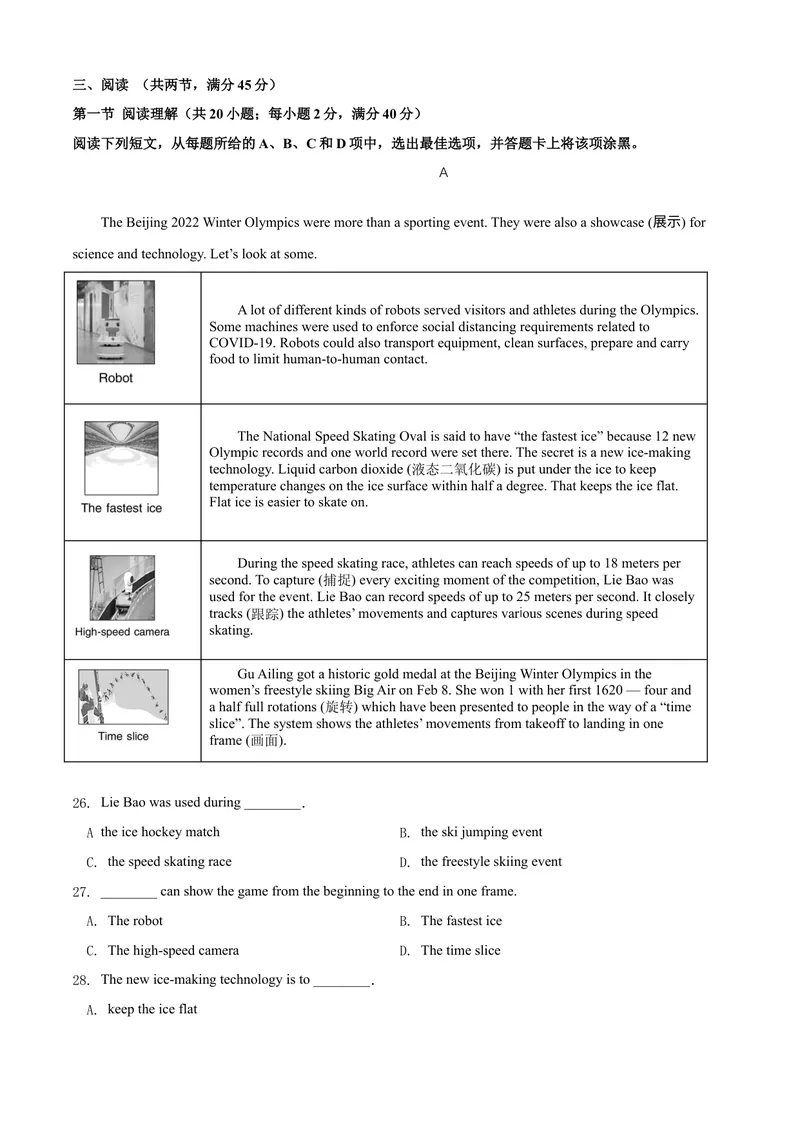
A lot of different kinds of robots served visitors and athletes during the Olympics.
Some machines were used to enforce social distancing requirements related to
COVID-19. Robots could also transport equipment, clean surfaces, prepare and carry
food to limit human-to-human contact.
The National Speed Skating Oval is said to have “the fastest ice” because 12 new
Olympic records and one world record were set there. The secret is a new ice-making
technology. Liquid carbon dioxide (液态二氧化碳) is put under the ice to keep
temperature changes on the ice surface within half a degree. That keeps the ice flat.
Flat ice is easier to skate on.
During the speed skating race, athletes can reach speeds of up to 18 meters per
second. To capture (捕捉) every exciting moment of the competition, Lie Bao was
used for the event. Lie Bao can record speeds of up to 25 meters per second. It closely
tracks (跟踪) the athletes’ movements and captures various scenes during speed
skating.
Gu Ailing got a historic gold medal at the Beijing Winter Olympics in the
women’s freestyle skiing Big Air on Feb 8. She won 1 with her first 1620 — four and
a half full rotations (旋转) which have been presented to people in the way of a “time
slice”. The system shows the athletes’ movements from takeoff to landing in one
frame (画面).
26. Lie Bao was used during ________.
A the ice hockey match B. the ski jumping event
C. the speed skating race D. the freestyle skiing event
27. ________ can show the game from the beginning to the end in one frame.
A. The robot B. The fastest ice
C. The high-speed camera D. The time slice
28. The new ice-making technology is to ________.
A. keep the ice flatB. limit human-to-human contact
C. capture every exciting moment of the competition
D. keep the ice at the same temperature
B
Once upon a time, there was a little boy called Meng Ke. His father died when he was just a baby, so he lived
alone with his mother, Mengmu.
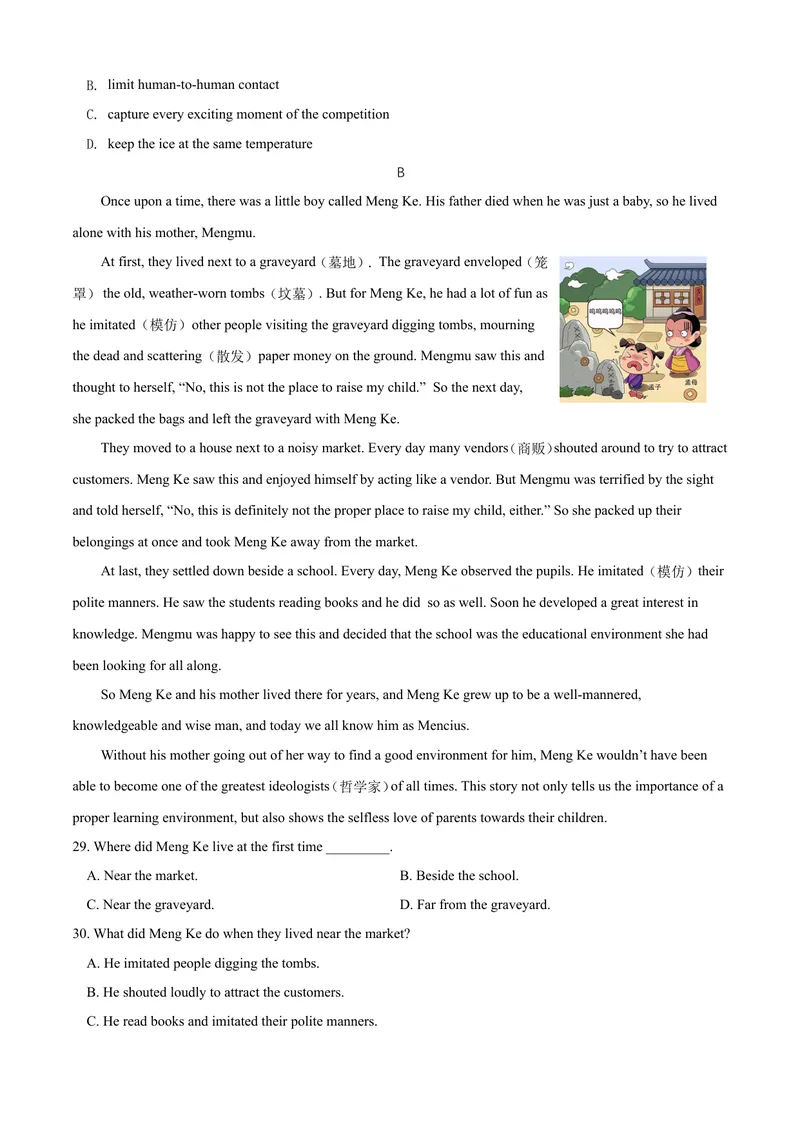
At first, they lived next to a graveyard(墓地). The graveyard enveloped(笼
罩) the old, weather-worn tombs(坟墓). But for Meng Ke, he had a lot of fun as
he imitated(模仿)other people visiting the graveyard digging tombs, mourning
the dead and scattering(散发)paper money on the ground. Mengmu saw this and
thought to herself, “No, this is not the place to raise my child.” So the next day,
she packed the bags and left the graveyard with Meng Ke.
They moved to a house next to a noisy market. Every day many vendors(商贩)shouted around to try to attract
customers. Meng Ke saw this and enjoyed himself by acting like a vendor. But Mengmu was terrified by the sight
and told herself, “No, this is definitely not the proper place to raise my child, either.” So she packed up their
belongings at once and took Meng Ke away from the market.
At last, they settled down beside a school. Every day, Meng Ke observed the pupils. He imitated(模仿)their
polite manners. He saw the students reading books and he did so as well. Soon he developed a great interest in
knowledge. Mengmu was happy to see this and decided that the school was the educational environment she had
been looking for all along.
So Meng Ke and his mother lived there for years, and Meng Ke grew up to be a well-mannered,
knowledgeable and wise man, and today we all know him as Mencius.
Without his mother going out of her way to find a good environment for him, Meng Ke wouldn’t have been
able to become one of the greatest ideologists(哲学家)of all times. This story not only tells us the importance of a
proper learning environment, but also shows the selfless love of parents towards their children.
29. Where did Meng Ke live at the first time _________.
A. Near the market. B. Beside the school.
C. Near the graveyard. D. Far from the graveyard.
30. What did Meng Ke do when they lived near the market?
A. He imitated people digging the tombs.
B. He shouted loudly to attract the customers.
C. He read books and imitated their polite manners.D. He helped his mother to do housework.
31. Which of the following is NOT TRUE?
A. Meng Mu was not satisfied with the graveyard because it’s not good for Meng Ke.
B. Meng Ke had fun living in the noisy market because he could act like a vendor.
C. Meng Mu moved to different places because she wanted to find a place to raise Meng Ke.
D. Meng Ke could become a greatest ideologists because he had found a good environment.
32. What’s the best title of the passage?
A. 三顾茅庐 B. 孟母三迁 C. 三思而后行 D. 三人成虎
C
During the Song Dynasty, there was a famous artist named Wen Tong. He was known for his paintings of
bamboo. He planted only bamboo in his garden even inside his house. His paintings were so good that they almost
looked real! No one else could draw bamboo like Wen Tong did.
One day in spring, a storm moved into the village. Wen Tong rushed outside to his bamboo garden when
everyone stayed inside. He wanted to see how the rain bounced off (弹起) the bamboo. This way, he could see what
water on bamboo leaves looked like. Sure, he got very wet.
One day in summer, the sun was high in the sky and the air was hot. Wen Tong was outside in his bamboo
garden when most people stayed cool at home. He wanted to see the bamboo clearly in the strong sunlight. This
way, he could see every detail of every leaf. Sure, he got super sweaty.
One day in fall, it got very windy. Wen Tong went outside to his bamboo garden. He wanted to see the bamboo
leaves swaying in the wind. This way, he could see how the bamboo moved. Sure, he almost fell over a couple of
times.
One day in winter, it started to snow. When all the other villagers were inside home staying warm, Wen Tong
was outside in his bamboo garden. This way, he could see how the ice sat on the leaves. Sure, he was very, very
cold.
After many days just like these, he memorized all there was to know about bamboo. So when it was time to
paint, he remembered everything he had seen. He knew the bamboo so well that one of his friends said, “When
Wen Tong draws bamboo, he has its image in his mind.”
In modern Chinese, you can say that someone has an image of bamboo in his or her mind. This means that the
person plans ahead, just like Wen Tong planned ahead by always going outside to study his bamboo. Although it
was a hard time for him, studying hard meant that he could later create amazing paintings.
33. What would Wen Tong see if a storm moved into his village?
A. He could see how the rain bounced off the bamboo.B. He could see bamboo clearly in the strong sunlight.
C. He could see how the bamboo leaves moved.
D. He could see how the ice sat on the leaves.
34. When could Wen Tong see every detail of every leaf?
A. In spring. B. In summer. C. In fall. D. In winter.
35. What do you think of Wen Tong?
A. Self-centered. B. Easy-going. C. Open-minded. D. Hard-working.
36. What can we infer from the passage?
A. He worked hard to improve his memory.
B. He was famous because he grew bamboo well.
C. He was successful because he had a beautiful bamboo garden.
D. His spirit of never give up helped him paint bamboo best at that time.
D
When John was growing up, other kids felt sorry for him, as his parents always had him do some housework
or do some part-time jobs. But when John reached adulthood, he was better off than his childhood friends. He had a
better career, a better marriage and was healthier. Most of all, he was happier.
These are the findings of a 40-year study. Researchers followed the lives of 456 teenage boys from Boston.
The study showed that those who worked when they were young enjoyed happier and more successful lives than
those who did not. “Boys who worked in the home or community gained competence (能力) and came to feel they
were useful members of society,” said George Vaillant, the psychologist (心理学家) who made the discovery. “And
because they felt good about themselves, others felt good about them, too.”
Vaillant’s study followed these males all these years. Interviews were repeated at ages 25, 31 and 47. Under
Vaillant, the researchers compared the men’s mental-health scores with their boyhood-activity scores. Points were
awarded for part-time jobs, housework, effort in school, and the ability to deal with problems.
The link between what the men once did as young boys and how they turned out as adults was very sharp.
Those who did the most boyhood activities were twice as likely to have warm relations with other people, five
times as likely to be well paid and 16 times less likely to have been unemployed. The researchers also found that IQ
and family social and economic class (社会和经济阶层) made no real difference in how the boys turned out.
Working-at any age-is important. Childhood activities help a child develop responsibility, independence,
confidence and competence-the basis (基础) of emotional health. They also help him understand that people must
work with others towards common goals. The most competent adults are those who know how to do this. Yet work
isn’t everything. As Tolstory once said, “One can live magnificently in this world if one knows how to work andhow to love, to work for the person one loves and to love one’s work.”
37. Which of the following is TRUE about John?
A. He liked doing part-time jobs. B. He enjoyed his career and marriage.
C. He received little love from his family. D. He had few friends when he was a child.
38. According to Vaillant, why could John be better off than this childhood friends?
A. Because he did part-time jobs after work.
B. Because he felt proud of himself when working.
C. Because his working experience in his childhood was of help.
D. Because he was happier than his friends when they were young.
39. How did Vaillant and his team get the findings of the research?
A. By comparing different sets of scores. B. By checking the men’s mental health.
C. By recording the boy’s effort in school. D. By testing the men’s problem-solving ability.
40. The purpose of the passage is to tell us that ___________.
A. IQ plays an important role in people’s development
B. social and economic class decides how our career goes
C. only working at a young age is important to our adult life
D. the ability of working with others towards goals is very important
第二节 阅读填空(共5小题;每小题1分,满分5分)
根据短文内容,将下面A---E五个句子分别填入文中空缺处,使得补全后的短文意思通顺,结构完整。
Reading is very important. World Book Day falls on April 23 every year. ___41___ It is also the day to honor
great writers.
___42___ On that day, millions of school children can buy books at a much lower price than usual in any
bookstore in England. It has been done every year since 1998. World Book Day is also celebrated in China. The
young people are encouraged to read more books and lots of reading corners are built in China. Japanese regard the
day as one of the most important days. In Japan, you can see people reading almost everywhere.
___43___ Reading helps us to follow the latest developments of science and technology. Reading gives us
information about other cultures and places in the world. Reading is also one of the most important ways to learn a
foreign language like English. ___44___ Books, magazines, and other kinds of reading materials can help us to
know more about the outside world.
As the saying goes, “Books can not change the world, but people can change the world by changing
themselves through reading”. ___45___A . Many countries celebrate World Book Day.
B. Therefore, it is necessary for us to spend time reading every day.
C. For example, the ways English people are living and working today can’t be learnt in the classroom, but it can be
learnt by reading.
D. Reading helps us become more knowledgeable and smarter.
E. It encourages people, especially teenagers, to discover the pleasure of reading.
第2卷 非选择题(共30分)
第一节、 短文填空(5分)
Dogs are excellent pets, friendly and smart. Most dogs are good with people. Some dogs, like watch dogs,
bark l___46_____ to warn people that strangers are coming close.
Some bark to e_____47_____ their feelings, such as loneliness and happiness.
Many people wonder how to f____48____ their dogs. In fact, dogs eat almost anything! Their m____49____
includes meat, rice, biscuits, and so on. Don’t let your dog eat too much. Always leave water for your dog. It can
get thirsty very quickly, especially in summer.
Remember that dogs need exercise. Don’t keep your dog inside all day. It will feel b_____50____. You should
take it for a daily walk to cheer it up. Remember, big dogs need longer walks than small ones.
第二节 完成句子(5小题,共10分)
51. 握手是展示礼貌的好方法。
________ ________ ________ a good way to show your politeness.
52. 可怜的小狗遇到了善良的女孩儿,得到了细心照顾。
The poor dog met a kind girl and ________ ________ ________ well by her.
53. 我想知道如何阻止人们杀害动物。
I wonder how to ________ people ________ ________ animals.
54. 自从我离开,这里发生了很大的变化。
________ I moved out, great changes ________ ________ ________ here.
55.尽管他很努力了,但他在英语学习上还是有困难。
________ he worked so hard, he ________ ________ ________ English.
三、书面表达(15分)
你的班级正在举办主题为“畅想未来”的活动。假如你是李华,请你根据下面的提示,在活动中分享你想
象中的未来生活。Clothes Food House Travelling
What is it
like?
Eatable bubble
Healthcare
Smart house Flying bag
clothes
How does
变颜色来显示健
迅速获得能量,…… …… ……
康问题
it work?
How do
……
you feel?
注意:
1. 词数80-120个左右(文章开头、结尾已给出,不计入词数,请根据要点提示适当发挥)
2. 不得透露学校、姓名等任何个人信息,否则不予评分。
Hello, everyone. I would like to share my ideas of our future life.
____________________________________________________________________________________________
____________________________________________________________________________________________
____________________________________________________________________________________________
____________________________________________________________________________________________
____________________________________________________________________________________________
____________________________________________________________________________________________
____________________________________________________________________________________________
___________________________________________________________________________________________
____________________________________________________________________________________________
____________________________________________________________________________________________
____________________________________________________________________________________________
____________________________________________________________________________________________
___________________________________________________________________________________________
That’s all. Thanks for listening.