【牛津(广州,深圳,沈阳)版】八年级上学期期中测 试卷
(B卷·提升能力)
学校:__________班级:__________姓名:_________ 考号:___________
温馨提示:
本试卷共分第Ⅰ卷和第Ⅱ卷两部分,第Ⅰ卷为选择题;第Ⅱ卷为非选择题;满分为90分,考试时间为100
分钟。
第Ⅰ卷 选择题
一、语法选择(15分)
On a school day, 60 students at Xishan Primary School in Shunde, Guangdong, are learning how to make
corn soup (玉米汤) and fried pork (炸猪排) with cauliflower (菜花) in
____1____ after-school cooking class. Working in groups of four or five, the little
chefs take their responsibilities very____2____. Soon, they are showing off their
own delicious dishes.
Since last September, the school ____3_____after-school classes for students,
with cooking classes being the most popular. It comes after the “double reduction” policy (政策). The aims of the
policy are ____4_____the burdens (减轻负担) of____5______ homework and off-campus tutoring (课外辅导) for
primary and junior high school students.
The policy lists requirements in areas such as reducing the amount and _____6____ of homework assignments
(家庭作业), as well as _____7______ the quality (质量) of education and after-school services. For example,
homework for junior high school students _____8____ take no longer than 90 minutes to finish. It allows students
more free time to pursue (追求) _____9_____hobbies and interests. Also, off-campus tutoring has been further
regulated (管理) to reduce the burden on students.
“Our homework is clearly ____10____than before,” said 13-year-old Shen Yuzhe from Beijing. “We
____11____to buy workbooks anymore. The exercises are mainly from the textbook.” According to Shen, teachers
have taught at a much slower pace (速度), which gives students enough time to process new information.
In December, the Ministry of Education (MOE) reported on the progress made through the policy so far. Almost
all primary and middle schools now offer _____12_____after-school services____13____weekdays. More than 90
percent of students can finish their written homework in the set time. About 92.7 percent of schools have opened
after-school arts and sports classes. More than 80 percent of academic tutoring institutions (学科类校外培训机构)
have closed down or turned to ____14____ fields of business.
“With homework done at school, my child and I can read books and listen to music together in the evening,
1 / 10____15____we can go out to play badminton or skip rope,” said Lu Di, the parent of a fifth-grader in Qiqihar,
Heilongjiang.
1. A. a B. an C. the D. \
2. A. serious B. more serious C. seriously D. more seriously
3. A. sets up B. have set up C. set up D. has set up
4. A. reduce B. reduced C. reduces D. to reduce
5. A. much too B. too much C. too many D. many too
6. A. difficult B. more difficult C. difficulty D. difficultly
7. A. improve B. to improve C. improved D. improving
8. A. should B. must C. can D. may
9. A. they B. them C. their D. themselves
10. A. little B. less C. few D. fewer
11. A. aren’t encouraging B. aren’t encouraged C. don’t encourage D. aren’t encourage
12. A. 2 hour B. 2 hours C. 2-hour D. 2-hours
13. A. on B. in C. for D. at
14. A. other B. the other C. another D. others
15. A. and B. but C. or D. then
二、完形填空(10分)
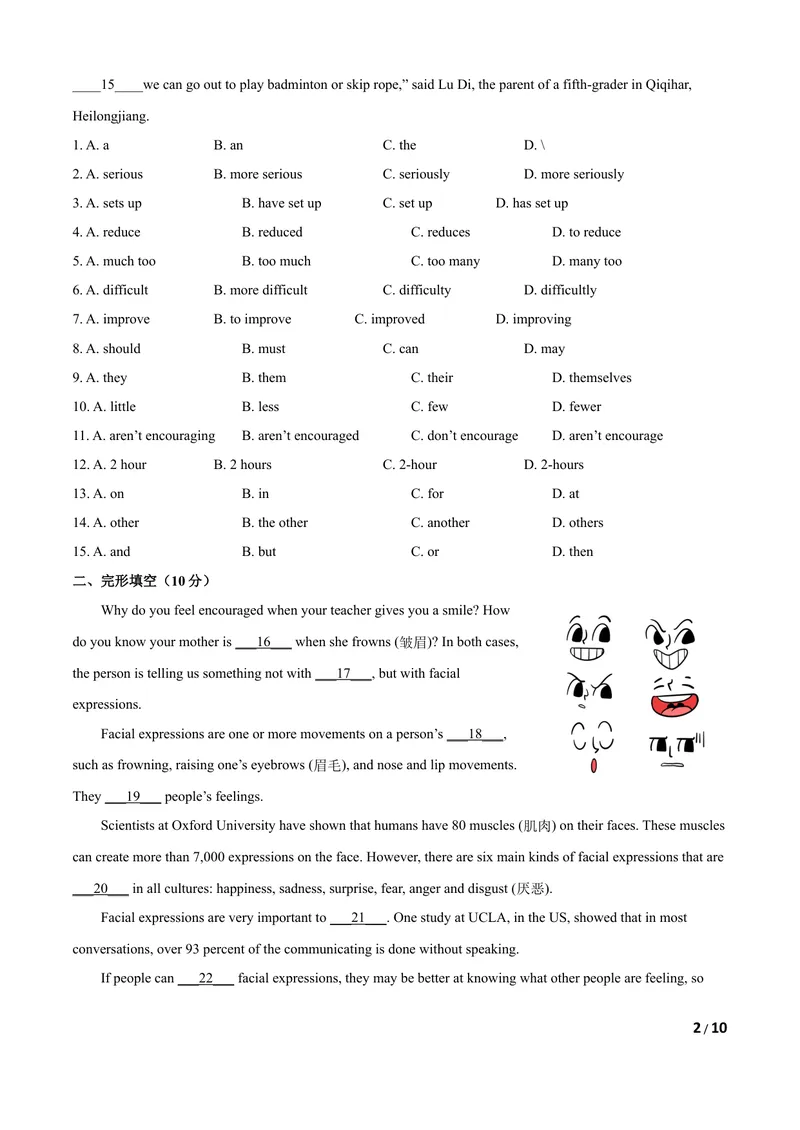
Why do you feel encouraged when your teacher gives you a smile? How
do you know your mother is ___16___ when she frowns (皱眉)? In both cases,
the person is telling us something not with ___17___, but with facial
expressions.
Facial expressions are one or more movements on a person’s ___18___,
such as frowning, raising one’s eyebrows (眉毛), and nose and lip movements.
They ___19___ people’s feelings.
Scientists at Oxford University have shown that humans have 80 muscles (肌肉) on their faces. These muscles
can create more than 7,000 expressions on the face. However, there are six main kinds of facial expressions that are
___20___ in all cultures: happiness, sadness, surprise, fear, anger and disgust (厌恶).
Facial expressions are very important to ___21___. One study at UCLA, in the US, showed that in most
conversations, over 93 percent of the communicating is done without speaking.
If people can ___22___ facial expressions, they may be better at knowing what other people are feeling, so
2 / 10they can understand others better. Someone who does not ___23___ a certain type of food usually will make a face
when they see or taste it. Frowning can express people’s worry or anger ___24___. Raised eyebrows and open eyes
show surprise.
However, there are some taboos (禁忌) for reading people’s facial expressions. For example, it is not a good
idea to stare at someone for a long time while reading his or her facial expressions. They may think you are
___25___.
16. A. surprised B. excited C. happy D. angry
17. A. words B. actions C. expressions D. gestures
18. A. body B. face C. hand D. nose
19. A. mean B. create C. express D. design
20. A. common B. different C. special D. usual
.
21 A. understanding B. imagination C. conversation D. communication
22. A. recognize B. read C. watch D. notice
23. A. hate B. eat C. enjoy D. need
24. A. clearly B. differently C. happily D. carefully
25. A. polite B. rude C. cute D. kind
三、阅读 (共两节,满分45分)
第一节 阅读理解(共20小题;每小题2分,满分40分)
阅读下列短文,从每题所给的A、B、C和D项中,选出最佳选项,并答题卡上将该项涂黑。
A
One day, a man visited an art factory. He saw a sculptor making a sculpture (雕塑). As he watched the man
work on the sculpture found that there was a similar sculpture nearby.
He felt so strange and asked the sculptor, “Why are you making two same sculptures? Do you need two to put
in different places?”
“No,” the man said without looking up, “We need only one, but the first one was damaged before I finished it,
so I’m making a new one.”
The visitor picked up the damaged sculpture and checked it. But he couldn’t find anything wrong with it.
“Where is the damage?” he questioned.
“There is a scratch (划痕) on the sculptures nose,” the sculptor said while he was going on his work.
The man then asked, “Where are you going to show the sculpture?”
The sculptor replied that it would be shown on a six-meter platform (平台). “if the sculpture is up so high,
3 / 10who will see that there is a scratch on the nose?” the man asked.
The sculptor stopped his work, looked up at the man and said, “I will know it.”
The sculptor chose to keep to a high standard (标准) of excellence in his work. Even if other people didn’t
notice it, he tried to make his work the best. We should work hard to keep on it.
26. Why did the visitor feel strange at the beginning of the story?
A. Because he would like to buy two sculptures.
B. Because he preferred one of the sculptures.
C. Because the sculptor was making two same sculptures.
D. Because the sculptor made this sculpture in an art factory.
27. What do you think of the sculptor?
A. Kind. B. Careful. C. Gentle. D. Impolite.
28. From the story, we learn that ________.
A. the sculptor worked hard and replied people without looking up
B. the sculptor hoped to make more works to choose
C. the sculptor didn’t care about what people said
D. the sculptor tried to make his works perfect
B
Have you ever wondered what goes through your mind when you choose where to sit in a new classroom? Or
in a waiting room full of strangers? Or on a bus? Researchers have found out some interesting facts.
Perhaps unsurprisingly, we prefer to sit closer to people like ourselves. Girls sit by girls and boys sit by boys.
Adults sit together and young people choose another young person to sit near. But it goes further than this. We even
choose to sit near someone who looks like us. People with glasses are more likely to sit near other people with
glasses. People with long hair sit closer to other people with long hair.
We seem to believe that people with similar habits or hobbies will share similar attitude and we are more likely
to be accepted by people like ourselves or even, we think we may be safer with people who look like us. Sometimes
that’s true but it’s a pity if we always stick to the same people, the same group. The danger in always staying in our
comfort zone (舒适区) is that we just recycle the same opinions, the same tastes and the same ideas. We lose the
chance to learn something new, find out about interesting things, hear funny stories and discover difference.
When we always stick to the same people, how can we ever break down the barriers which prevent us from
getting to know people with different ideas? And how can we avoid the ignorance (无知), which too often leads to
4 / 10prejudice (偏见) and even fear? If instead you want to live in a society that opens to changes and new things and
different opinions, be the cat among the pigeons.
Move out of your comfort zone. Go and sit next to someone different. And don’t just sit there in silence. Say
hello. Ask a question. Start a conversation. That’s how we make friends. That’s how we learn about people. That’s
how we open our minds to new ideas. That’s how we live an exciting life.
29. From the passage, we know that people prefer sitting by someone who ________.
A. is like themselves B. has a sense of humor C. is open-minded D. lives an exciting life
30. People like staying in their comfort zone because they may ________.
A. remain comfortable and special B. be accepted easily and feel safe
C. find out more interesting things D. discover differences among themselves
31. Why does the writer ask us to meet people of different kinds?
A. Because we feel safer and share similar tastes and ideas.
B. Because we can enjoy interesting and different ideas.
C Because we can say hello and ask them questions.
D. Because we want to live in a society full of humour.
32. What is the title of this passage?
A. Just to be ourselves B. Learn more about the foreign countries
C. Live an exciting life D. Jump out of the comfort zone
C
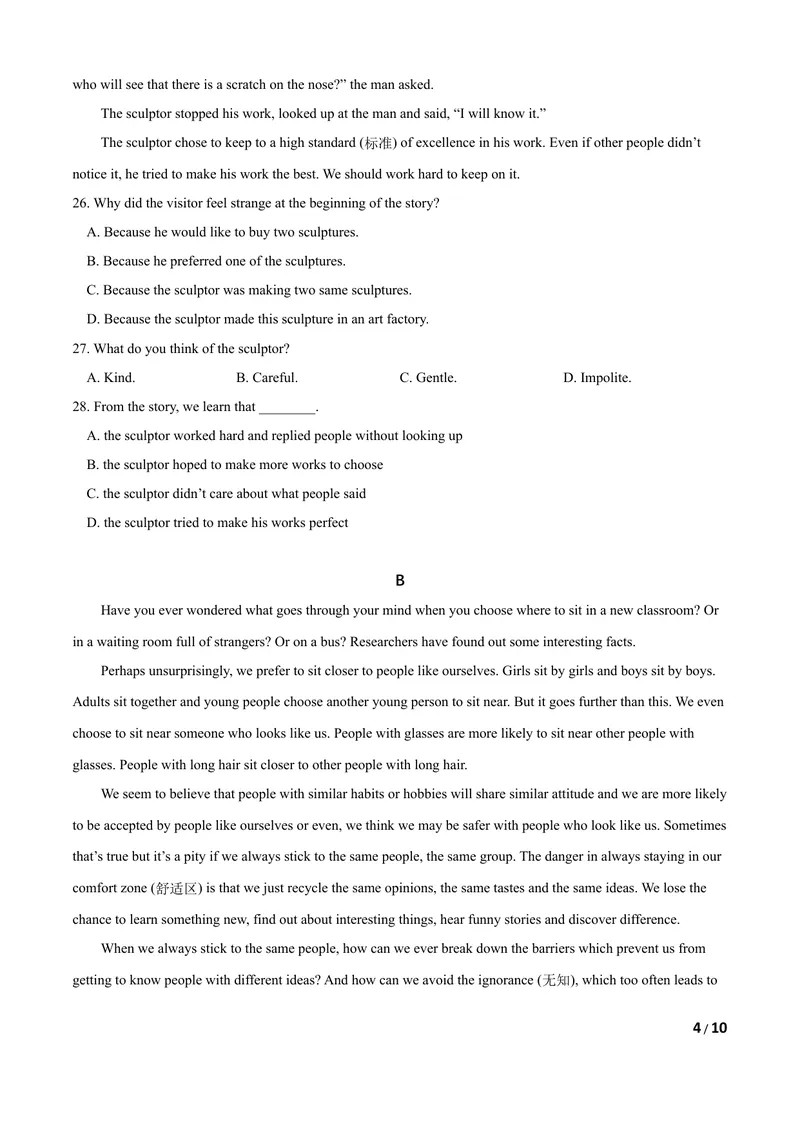
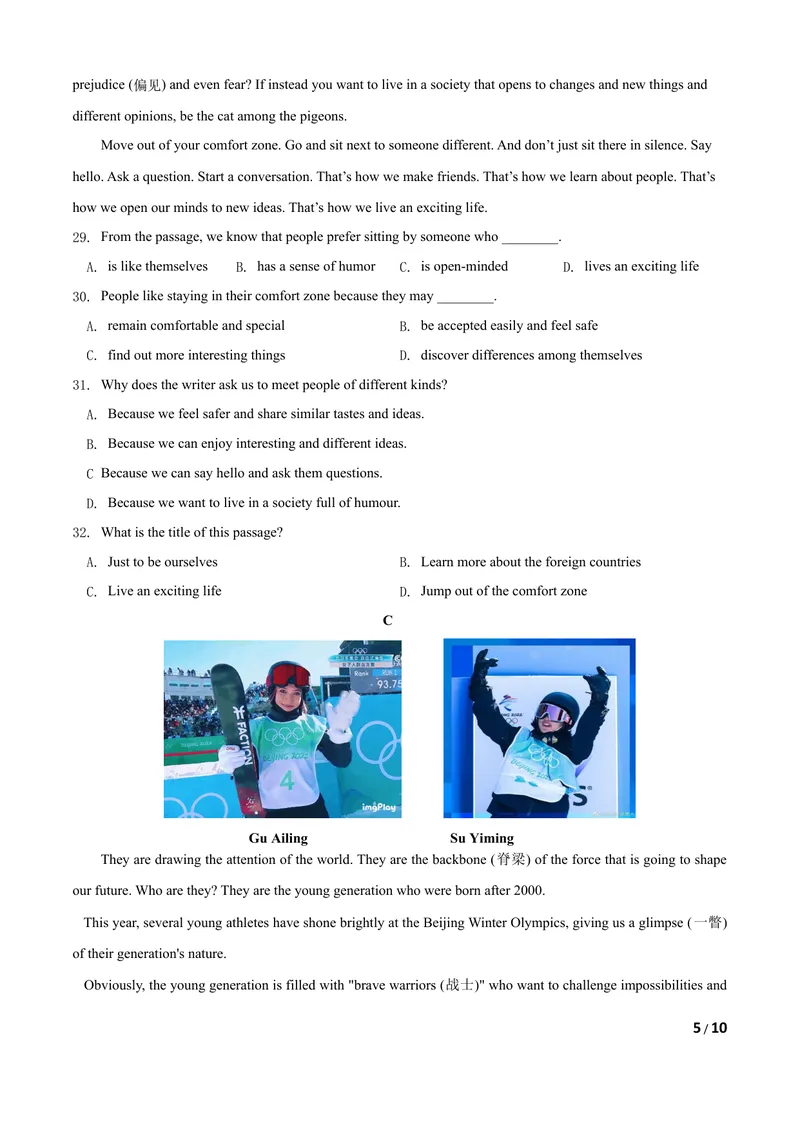
Gu Ailing Su Yiming
They are drawing the attention of the world. They are the backbone (脊梁) of the force that is going to shape
our future. Who are they? They are the young generation who were born after 2000.
This year, several young athletes have shone brightly at the Beijing Winter Olympics, giving us a glimpse (一瞥)
of their generation's nature.
Obviously, the young generation is filled with "brave warriors (战士)" who want to challenge impossibilities and
5 / 10push boundaries. Freestyle skier Gu Ailing is a good example. After she finished strong in the first two jumps in the
women's freeski Big Air event, it was certain that she could get a medal. But instead of playing it safe, the 18-year-
old skier pushed herself to the limit. On the last jump, Gu decided to attempt a difficult trick: a left double cork (左
侧两周空翻转体) 1620-four and a half rotations (旋转) in the air-before landing.
“I have never done the 'left 16' before. I hadn't prepared much for it apart from two days on the air bag," Gu told
China Daily, “ but I felt it was a chance to push myself to the limit”.
But for these young athletes, the sport is never just about scores, but also about having as much fun as possible.
Born in the US, Gu faced criticism and doubts for representing China in the Beijing Winter Olympics.
When questioned by The Guardian at a news conference on Feb 8, the “post-00” said bluntly (直截了当地) that
she wasn't trying to make everyone happy.
“I'm an 18-year-old girl out here living my best life. I'm having a great time,” Gu said. “It doesn't really matter if
other people are happy or not, because I feel I’m doing my best and I’m enjoying the entire process.”
Gu's good friend, Chinese snowboarder Su Yiming also shares a similar attitude. He takes sports as a way to have
fun.
After he was judged to have lost the gold to Canadian athlete Max Parrot in the men's slopestyle (坡面障碍技巧)
final, the 17-year-old didn’t feel upset. Instead, he was happy to have the chance to compete with his idol.
“When I was on the podium (领奖台) hugging Max Parrot, it felt unreal,” Su told China Daily. “All I did today
was enjoy the runs and concentrate on my tricks. As long as I am on my snowboard I am happy.”
This is young generation that dares to push the limits but also enjoys life.
33. Which statement is wrong from the article?
A. Gu Ailing is an American girl B. Gu Ailing is a “post 00”
C. Gu Ailing is a Chinses athlete D. Gu Ailing is a girl who dares to challenge herself
34.Why didn’t Su Yiming feel upset when he lost in the men's slopestyle?
A. Because the Canadian athlete Max Parrot is his idol.
B. Because losing to his idol is reasonable.
C. It was his idol who won the gold.
D. Because he thought he had a chance to challenge his idol.
35.What’s the main idea of paragraph 3 and 4?
A. Gu Ailing is an excellent athlete.
B. Gu Ailing’s spirit of challenging impossibility.
C. Gu Ailing´s enjoying her life.
6 / 10D. Gu Ailing’s good attitude to the Olympics.
36. What’s the common nature of this young generation according to the article?
A. Enjoying adventure but also having delicious food.
B. Challenging impossibility but also enjoying life.
C. Making others happy but also enjoying themselves.
D. Following fashion but also making lots of friends.
D
Chinese has a long history. It has shaped other languages in Asia the way Latin has shaped languages in the
West. With this history, will Chinese have a surprising future?
Over one billion people speak Chinese in the world — far more than any other language. It is the language of
the country which is soon to have the world's largest economy (经济). Chinese people are found studying and doing
business all over the world.
In fact, Chinese is definitely going to be a world language. Why is this certain? We must look at the economic
and political power (政治影响力) of China, which is increasing every day. In the past, world languages have
always been the languages of countries with powerful economics. Latin, French and English were important
because of the power of the countries that spoke those languages.
Foreign interest in Chinese has developed very quickly together with the development of the Chinese
economy. Chinese has become one of the most important and popular languages to learn.
As China develops, more and more people will want to learn about Chinese language and culture, to work and
study in China, and to do business with Chinese companies. Chinese will one day become an international
language.
37. In which way in Chinese similar to Latin?
A. They both have influenced other languages.
B. Both languages have over one billion speakers.
C. They both have a long history and bright future.
D. Both languages are spoken only by Chinese.
38. What is the relationship between language and economy?
A. The more important language is, the stronger economy is.
B. The stronger economy is, the less important language is.
C. The weaker economy is, the more important language is.
D. The stronger economy is, the more important language is.
39. Why is Chinese more widely used?
7 / 10A. Because more and more Chinese go abroad.
B. Because people across the world travel to China.
C. Because many universities in China are world-famous.
D. Because more foreigners are becoming interested in Chinese.
40. What might the writer think of the future of Chinese?
A. Hopeful. B. Unclear. C. Dark. D. Doubtful.
第二节 阅读填空(共5小题;每小题1分,满分5分)
根据短文内容,将下面A---E五个句子分别填入文中空缺处,使得补全后的短文意思通顺,结构完整。
Cartoons are not simply drawings. ____4 1 ____ Working as a cartoonist (漫画家) can be a very interesting job.
You will get to tell stories through drawings while you grow as a cartoonist. ____4 2 ____ Most cartoonists work as
freelancers (自由职业者) or they have an full-time job that allows them to draw cartoons as a part-time job. With
some planning and dedication (奉献), you can make cartooning part of your professional life.
If you like drawing pictures to express your ideas or you are always praised by your teachers or friends for
your artistic abilities, you may have a gift for being a cartoonist. It is better for you to prepare to go to art school in
high school. ____4 3 ____ Instead, learn more drawing skills or take some art courses, which may help you build up
the drawing ability. At the same time, draw for your high school newspaper or magazine to get a sense of whether
you like working as a cartoonist. It is also a great chance to get into the practice of creating your own cartoons.
Creating an online space for your works is a good idea if you want others to know about your cartoons.
____4 4 ___ It is an excellent platform (平台) where you can communicate with your viewers as well.
If you have produced many cartoons for the top projects or have shared your works online, you should also
think about getting some valuable experience of working for some cartoon companies. ____ 45 ____
A. An online space can be attractive to people who like cartoons.
B. In high school, don’t just keep your art in your notebooks.
C. But it can be a very precarious (不稳定的) career.
D. This experience can be a starting point for your job in that field.
E. They may show people a word which is full of wonder.
第2卷 非选择题(共30分)
第一节、 短文填空(5分)
I used to work as a college teacher in England. A_____46_____ it was a good job and I liked my students, I
8 / 10felt tired of doing the same things every day.
I love traveling and I’m interested in wonderful trips. One day, I looked for information about v_____47_____
work online. Then I found a volunteer group. It told me I can go to an i_____48_____ and help to protect the
beach. One week later, it sent me there. My friends were surprised at my decision. However, I wasn’t too worried.
The volunteer job only lasted for two months. When I r_____49_____ the island, I was interested in the life there.
It was hard to e_____50_____ my feelings about the wonderful life. In the end, I decided to stay there. Now I have
a wonderful job as a teacher there.
第二节 完成句子(5小题,共10分)
51. 我喜欢照相,我有多达两千多张相片。
I like ____________ _____________and I have ____________ ____________ two thousand photos.
52.多么可怕的一次自然灾害啊!很多人在这次地爲中丧生。
___________ ___________ ____________natural disaster! Many people died in the earthquake.
53.马路修好后,就不再有噪音了。
After the road_________ _________, there would be__________ __________ noise.
54.我们已经定下了与第一中学比赛的日子。
We have __________ __________ the date when we will _________ _________ No. 1 Middle School.
55.我很想知道他们将怎样处理这个难题。
I wondered how __________ __________ ___________ ___________ the problem.
三、书面表达(15分)
中国有着上下五千年的历史,中华民族有着众多源远流长的传统技艺,比如糖画、剪纸、皮影戏、鸬鹚捕
鱼、捏面人儿等等。假如你是一名交换生,你班上的外国同学对中国的传统技艺很感兴趣。请你根据表格内容
提示写篇短文,向他们介绍其中几种。 需包含以下要点,可适当扩充。
传统技能 介绍 评价
只需要纸和剪刀等简单工具,寓意好
剪纸(paper cutting) 我希望有一天我能学会。
运。
由硬皮革制成,形式丰富多样。
皮影戏(shadow puppet
希望它一直存活下去。
plays)
?(请补充) ?(请补充至少两点) ?(请补充)
要求:
1. 80词左右(开头已给出,不计入词数)
9 / 102. 不得透露学校、姓名等任何个人信息,否则不予评分。
China is a country with a long history of 5.000 years. There are many traditional skills in China, such as sugar
painting, paper cutting, shadow puppet plays and so
on.__________________________________________________________________________________________
____________________________________________________________________________________________
____________________________________________________________________________________________
____________________________________________________________________________________________
____________________________________________________________________________________________
____________________________________________________________________________________________
10 / 10