【牛津(广州,深圳,沈阳)版】
八年级下U3 Traditional skills
(B卷·提升能力)
学校:__________班级:__________姓名:_________ 考号:___________
温馨提示:
本试卷共分第Ⅰ卷和第Ⅱ卷两部分,第Ⅰ卷为选择题;第Ⅱ卷为非选择题;满分为100分,考试时间为
100分钟。
第Ⅰ卷 选择题
一、语法选择(共15小题,每小题1分,满分15分。)
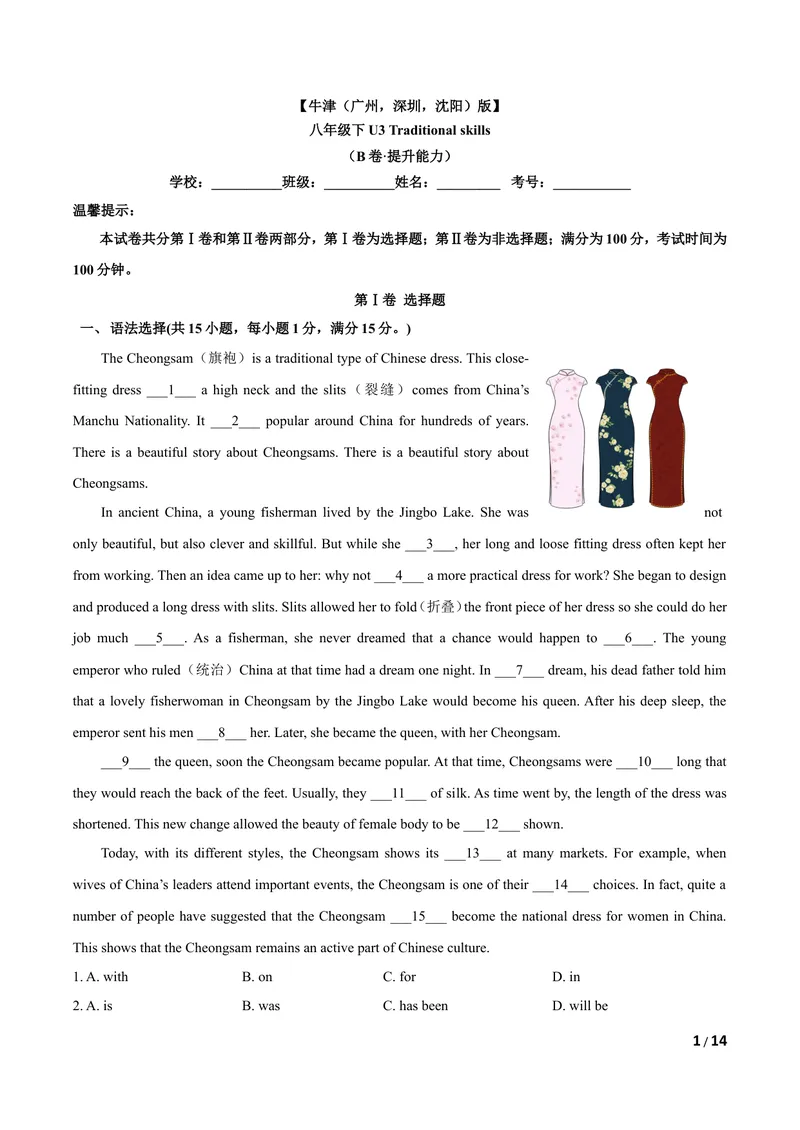
The Cheongsam(旗袍)is a traditional type of Chinese dress. This close-
fitting dress ___1___ a high neck and the slits(裂缝)comes from China’s
Manchu Nationality. It ___2___ popular around China for hundreds of years.
There is a beautiful story about Cheongsams. There is a beautiful story about
Cheongsams.
In ancient China, a young fisherman lived by the Jingbo Lake. She was not
only beautiful, but also clever and skillful. But while she ___3___, her long and loose fitting dress often kept her
from working. Then an idea came up to her: why not ___4___ a more practical dress for work? She began to design
and produced a long dress with slits. Slits allowed her to fold(折叠)the front piece of her dress so she could do her
job much ___5___. As a fisherman, she never dreamed that a chance would happen to ___6___. The young
emperor who ruled(统治)China at that time had a dream one night. In ___7___ dream, his dead father told him
that a lovely fisherwoman in Cheongsam by the Jingbo Lake would become his queen. After his deep sleep, the
emperor sent his men ___8___ her. Later, she became the queen, with her Cheongsam.
___9___ the queen, soon the Cheongsam became popular. At that time, Cheongsams were ___10___ long that
they would reach the back of the feet. Usually, they ___11___ of silk. As time went by, the length of the dress was
shortened. This new change allowed the beauty of female body to be ___12___ shown.
Today, with its different styles, the Cheongsam shows its ___13___ at many markets. For example, when
wives of China’s leaders attend important events, the Cheongsam is one of their ___14___ choices. In fact, quite a
number of people have suggested that the Cheongsam ___15___ become the national dress for women in China.
This shows that the Cheongsam remains an active part of Chinese culture.
1. A. with B. on C. for D. in
2. A. is B. was C. has been D. will be
1 / 143. A. fished B. is fishing C. was fishing D. would fish
4. A. make B. to make C. making D. made
5. A. easy B. easier C. easily D. more easily
6. A. herself B. she C. hers D. her
7. A. a B. an C. the D. /
8. A. look for B. to look for C. looking for D. looked for
9. A. Because B. Since C. Because of D. For
10. A. very B. so C. such D. too
11. A. make B. made C. are made D. were made
12. A. full B. fully C. fullness D. fullest
13. A. attract B. attraction C. attractive D. attractively
14. A. good B. well C. better D. best
15. A. should B. must C. can D. may
【答案】ACCAD DCBCB DBBDA
【解析】本文叙述中国传统服装——旗袍的来历。
1.考查介词用法。句意:这件有高领和开叉的紧身连衣裙来自中国满族.with“带有,具有”答案选A
2.考查时态用法。句意:它在中国流行了几百年。For+一段时间,表示过去动作持续至今用现在完成时态。答
案选C
3.考查时态用法。句意:当她钓鱼的时候。While表示过去某种情景,用过去进行时态。答案选C
4.考查句式用法。句意:为什么不做一件更实用的工作服呢?why not 后面接动词原形。答案选A
5.考查用法。句意:缝隙让她可以折叠衣服的前片,这样她可以更容易地完成工作。修饰动词用副词,much修
饰比较级。答案选D
6.考查代词用法。句意:作为一名渔夫,她做梦也没想到会有机会发生在自己身上。介词后面用宾格形式。答
案选D
7.考查冠词用法。Dream前面提及到,故这里用定冠词。答案选C
8.考查不定式用法。句意:沉睡之后,皇帝派人去找她。这里用不定式表示“目的”答案选B
9.考查从属连词用法。句意:因为女王,旗袍很快就流行起来。Because of 后面接短语。答案选C
10.考查句式用法。句意:当时,旗袍很长,可以伸到脚背。So。。。that如此。。。以致。答案选B
11.考查被动语态用法。句意:通常,他们用丝绸做的。这里叙述过去发生的事情用过去是的被动语态。答案选
D
12.考查副词用法。句意:这一新变化使女性身体的美得以充分展现。修饰动词用副词。答案选B
2 / 1413.考查词汇辨异。句意:今天,旗袍以其不同的风格在许多市场上显示出它的吸引力。its后面应该接名词。答
案选B
14.考查形容词用法。句意:旗袍是他们最好的选择之一。One of+形容词最高级+复数名词。答案选D
15.考查情态动词用法。句意:事实上,不少人建议旗袍应该成为中国女性的民族服装。表示建议应该用
should。答案选A
二、完形填空 (共10分)
Red Packets in Chinese Culture
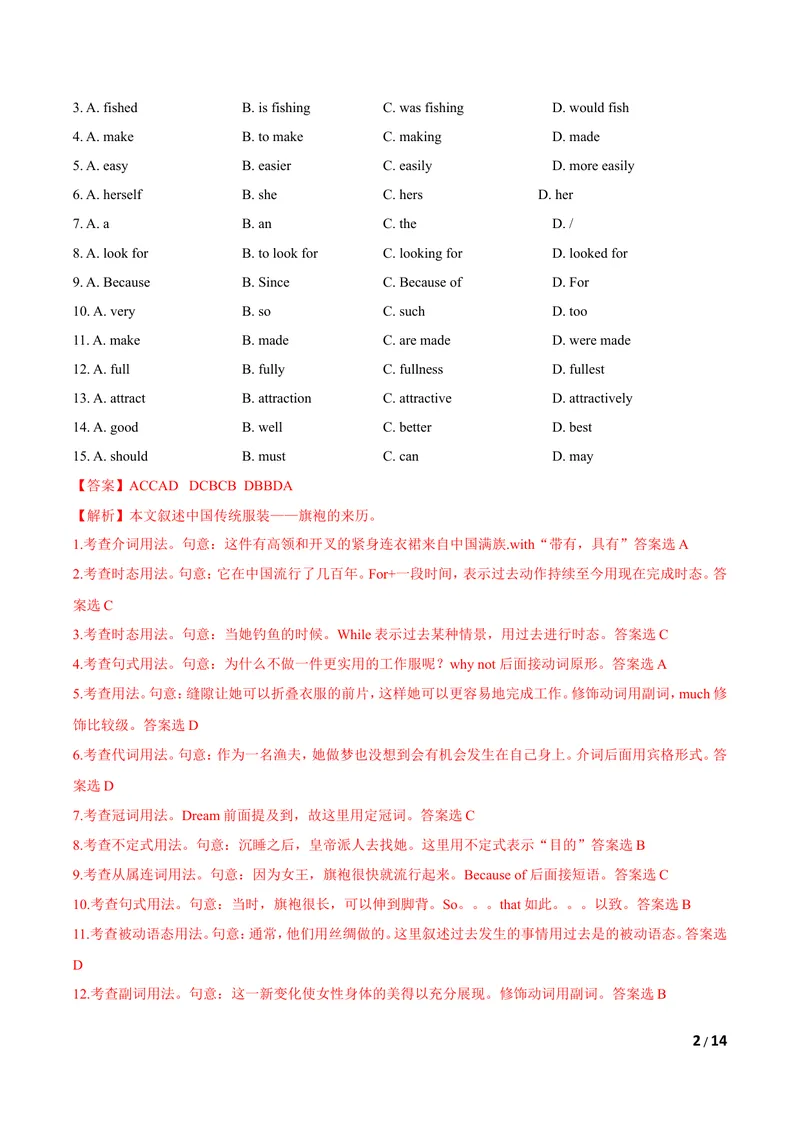
Giving Hongbao (red packets) is a tradition in China. Traditional red pockets are
often decorated with gold Chinese characters(汉字), such as __ 16 __ and wealth.
How red packets are used
During Chinese New Year, __ 17 __ is (are) put inside red packets which are then
handed out to younger generations by their parents, grandparents, relatives, and even
close neighbours and friends.
The __ 18 ___
Red represents luck and good fortune in Chinese culture. That is why red packets are used during Chinese
New Year and other celebrations.
How to give and receive
Giving and receiving red packets is a __ 19 __ act. Therefore, red packets are always presented and received
with both hands.
Someone who receives a red packet at Chinese New Year or on his or her birthday should not __ 20 __ it in
front of the giver. However, things are different at a Chinese wedding, where the guests usually give the red packets
to the attendants and sign their names on a large scroll ( long piece of paper). The attendants will open the packets
at once, _ 21 __ the money inside, and record it on a register(登记簿) next to the guests’ names.
The amount(数量)
The amount of money is relative to your relationship to the person who receives-the __ 22 __ your relationship
is, the more money is expected. Anyway, it is not the amount of the money that matters, but the care and love you
hold for others .
What not to gift
Certain amounts of money are to be __ 23 __ . Anything with a four is not good because four sounds similar to
__ 24 __ in Chinese. Even numbers(偶数), except four, are better than odd-as good things are believed to come in
3 / 14__ 25 __ . For example, gifting $20 is better than $21.
The money inside a red packet should always be new. Folding the money or giving dirty or wrinkled bills is in
bad taste.
Hongbao is a symbol of love from others, as well as a sign of good luck.
16.A.praise B.dream C.happiness D.advice
17.A.paper B.money C.letters D.notes
18.A.colour B.size C.shape D.history
19.A.strange B.simple C.smart D.serious
20.A.watch B.hide C.open D. accept
21.A.count B.change C.choose D.collect
22.A.worse B.harder C.closer D.wider
23.A.avoided B.increased C.afforded D.returned
24.A.birth B.fear C.death D.envy
25.A.groups B.rows C.teams D.pairs
【答案】16.C 17.B 18.A 19.D 20.C 21.A 22.C 23.A 24.C 25.D
【解析】本文是一篇说明文,向我们介绍有关中国红包文化的相关信息。
16.句意:传统的红包通常都装饰着金色汉字,如幸福和财富。
praise赞扬;dream梦想;happiness幸福;advice建议。根据常识可知,红包意味着好的事物,象征着幸福和财
富,故选C。
17.句意:在春节期间,钱被放在红包里,然后他们的父母,祖父母,亲戚,甚至是亲密的邻居和朋友把红包发
给年轻的一代。
paper纸;money钱;letters信;notes笔记。根据常识可知,新年红包里会放钱,故选B。
18.句意:颜色
colour颜色;size尺寸;shape形状;history历史。根据“Red represents luck and good fortune in Chinese
culture.”可知,本段介绍红包的颜色,故选A。
19.句意:收发红包是一种严肃的行为。
strange奇怪的;simple简单的;smart聪明的;serious严肃的。根据“Therefore, red packets are always…and
received with both hands.”给红包和收红包用双手,可知,收发红包是一种严肃的行为,故选D。
20.句意:在春节或生日时收到红包的人不要当着送礼者的面打开。
watch观看;hide隐藏;open打开;accept接受。此处与后文“The attendants will open the packets at once”形成
对比,不会马上打开红包,故选C。
4 / 1421.句意:服务员会立即打开红包,数里面的钱,并把它记录在客人名字旁边的登记簿上。
count数;change改变;choose选择;collect收集。根据“and record it on a register”可知,数好钱再把金额登记
在册,故选A。
22.句意:钱的多少与你和接受者的关系有关——你们的关系越亲密,期望得到的钱就越多。
worse更差;harder更难;closer更近;wider更宽。根据“the…your relationship is, the more money is expected”
可知,关系越亲近,给的红包就越大,故选C。
23.句意:特定数额的钱是要避免的。
avoided避免;increased增加;afforded买得起;returned归还。根据“Anything with a four is not good”可知,有
些数字需要避免,比如含有4的数字。故选A。
24.句意:任何有4的东西都不好,因为4在中文里听起来和死很像。
birth出生;fear害怕;death死亡;envy嫉妒。根据“because four sounds similar to…in Chinese”和常识可知,4
在中文里听起来和死亡很像,故选C。
25.句意:偶数,除了4,都比奇数好,因为人们相信好事成双。
groups组;rows排;teams队;pairs双。根据“Even numbers(偶数), except four, are better than odd-as good
things are believed to come in…”可知,人们相信好事成双,故选D。
三、阅读 (共两节,满分45分)
第一节 阅读理解(共20小题;每小题2分,满分40分)
A
More than 2,000 years ago, Emperor ( 皇 帝 ) Wu's favourite wife of the Han Dynasty died of illness. The
emperor missed her so much that he didn't want to do anything. One day, a minister (大臣) saw children playing
with dolls. The shadows on the floor were interesting. The smart minister had an idea. He made a puppet of the
emperor's favourite wife and painted it. As night fell, he asked the emperor to watch a puppet show behind a
curtain. The emperor was very happy and became interested in it. In this way, puppet shows began.
Shadow puppets were first made of paper, later from the hides of donkeys (驴皮). That's why their Chinese
name is pi ying. Shadow puppet plays were very popular during the Tang and Song dynasties in many parts of
China.
Today, shadow puppet plays face extinction like other traditional art forms such as Nuo Drama. We should do
something to protect them. Shadow puppet plays in Shaanxi are the most famous. The Academy Gate Cultural
Street in Xi'an is a wonderful place for you to buy shadow puppets. There you can choose from hundreds of figures
(人物) in different sizes and poses (姿势).
26. What or who helped the minister have the idea of shadow puppets?
5 / 14A. His wife's painting. B. A movie behind a curtain.
C. The shadows of some trees. D. Children playing with dolls.
27. Why did the minister make a puppet show?
A. To make the emperor happy. B. To remember Emperor Wu.
C. To celebrate New Year. D. To make his life interesting.
28. The underlined words " face extinction" mean "________".
A. will save B. will disappear C. will begin D. will be popular
29. What can visitors do in the Academy Gate Cultural Street in Xi'an?
A. Make their own shadow puppets. B. Enjoy the delicious traditional food.
C. Buy shadow puppets. D. Know more traditional art forms.
30. Why did the writer write the passage?
A. To let us enjoy shadow puppet plays. B. To show what shadow puppets were made of.
C. To show how shadow puppets were made. D. To introduce an ancient Chinese art form.
【答案】26. D 27. A 28. B 29. C 30. D
【解析】本文以一个故事开头,皇帝失去了最心爱的妻子而变得不高兴,大臣们为了让皇帝开心,准备了皮影
戏给皇帝观看。作者写这篇文章的目的就是介绍中国古老的传统艺术——皮影戏。
26细节理解题。根据文中“One day, a minister (大臣) saw children playing with dolls. The shadows on the floor
were interesting. The smart minister had an idea. ”有一天,一位大臣看见孩子们玩洋娃娃。地板上的阴影很有
趣。聪明的大臣有个主意。可知是孩子们玩洋娃娃而有的主意,故选D。
27 细节理解题。根据文中“Emperor ( 皇 帝 ) Wu’s favourite wife of the Han Dynasty died of illness. The
emperor missed her so much that he didn't want to do anything. ”汉武帝的爱妻因病去世。皇帝非常想念她,他
什么也不想做。以及“As night fell, he asked the emperor to watch a puppet show behind a curtain. The emperor
was very happy and became interested in it. ”夜幕降临,他请皇帝在帘子后面看皮影戏。皇帝很高兴,对它产
生了兴趣。可知是为了皇帝开心,故选A。
28词义猜测题。will save将挽救;will disappear将消失;will begin将开始;will be popular将受欢迎;根据文中
“Today, shadow puppet plays face extinction like other traditional art forms such as Nuo Drama. We should do
something to protect them. ”如今,皮影戏与傩戏等其他传统艺术形式一样……。我们应该采取措施保护他们。
可知这里的face extinction指的是“面临消亡”,这里的face是动词“面临”的意思,所以与B选项的意思
比较接近,故选B。
29.细节理解题。根据文中“The Academy Gate Cultural Street in Xi'an is a wonderful place for you to buy
shadow puppets. ”西安书院门文化街是您购买皮影戏的好去处。可知参观者去这里是购买皮影,故选C。
6 / 1430.推理判断题。根据整个文章的理解可知,这里主要是通过一个故事引出了中国古老的传统艺术——皮影,
所以文章主要是为了介绍中国古代艺术形式,故选D。
B
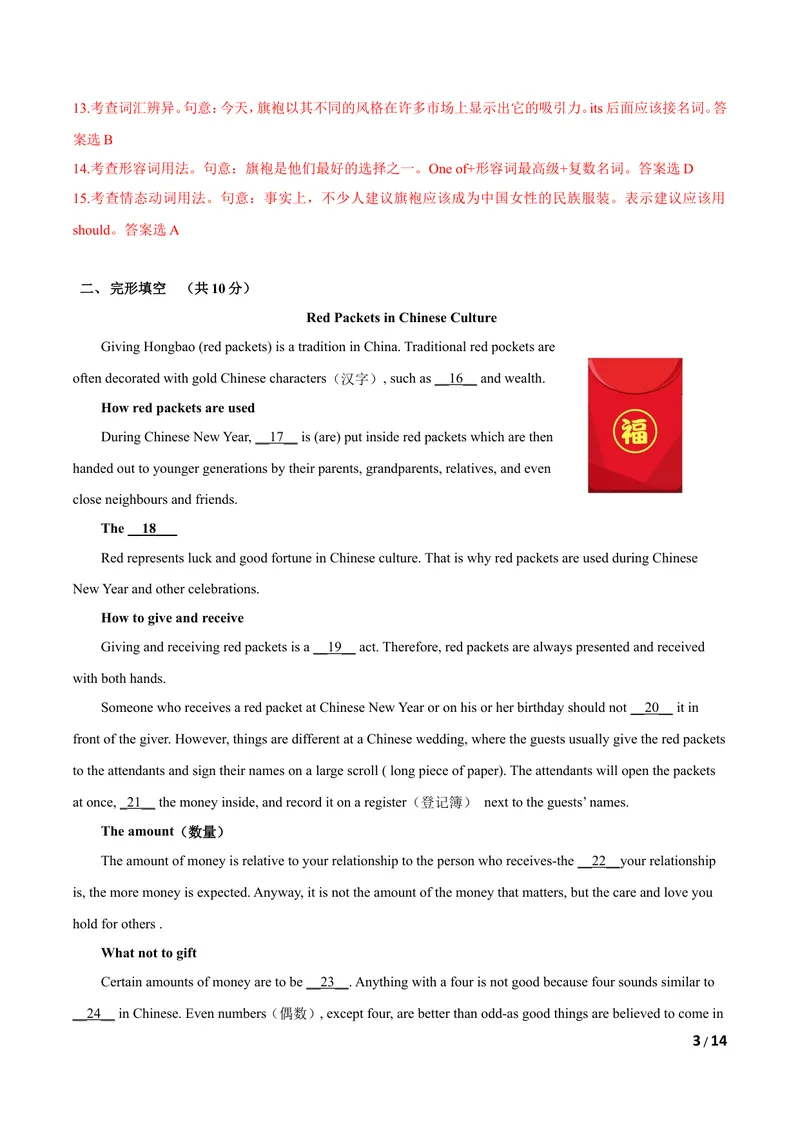
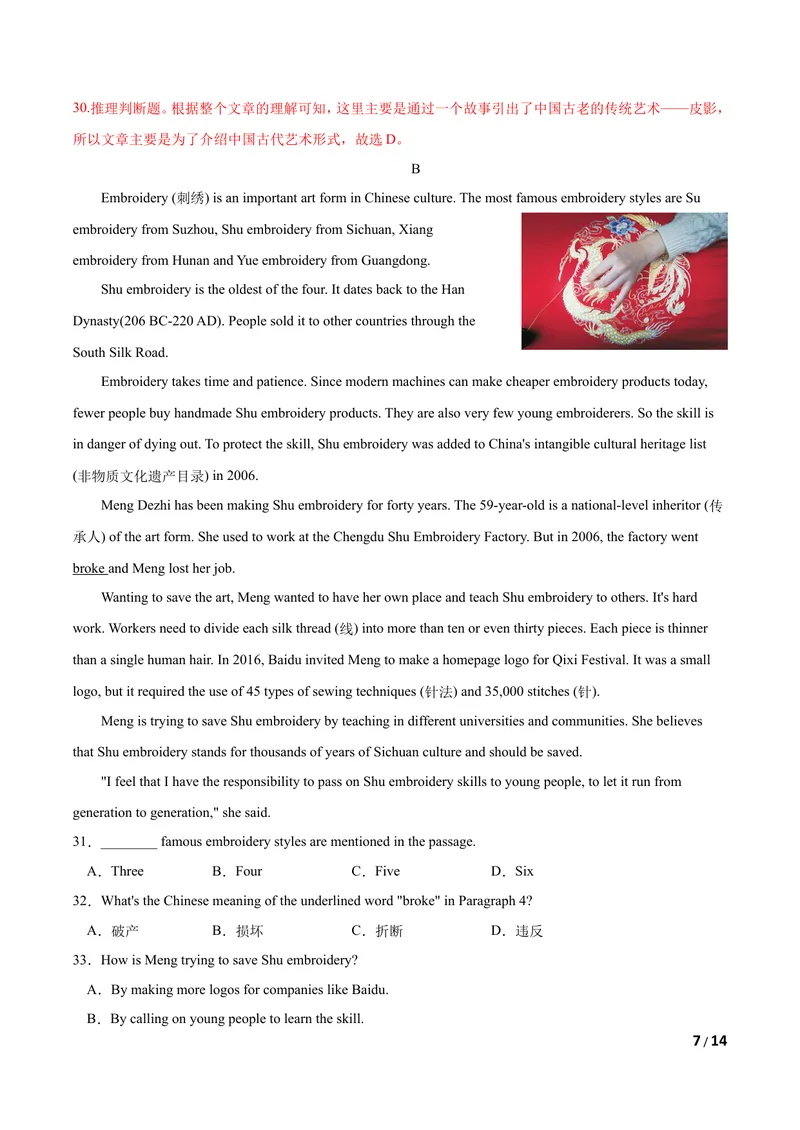
Embroidery (刺绣) is an important art form in Chinese culture. The most famous embroidery styles are Su
embroidery from Suzhou, Shu embroidery from Sichuan, Xiang
embroidery from Hunan and Yue embroidery from Guangdong.
Shu embroidery is the oldest of the four. It dates back to the Han
Dynasty(206 BC-220 AD). People sold it to other countries through the
South Silk Road.
Embroidery takes time and patience. Since modern machines can make cheaper embroidery products today,
fewer people buy handmade Shu embroidery products. They are also very few young embroiderers. So the skill is
in danger of dying out. To protect the skill, Shu embroidery was added to China's intangible cultural heritage list
(非物质文化遗产目录) in 2006.
Meng Dezhi has been making Shu embroidery for forty years. The 59-year-old is a national-level inheritor (传
承人) of the art form. She used to work at the Chengdu Shu Embroidery Factory. But in 2006, the factory went
broke and Meng lost her job.
Wanting to save the art, Meng wanted to have her own place and teach Shu embroidery to others. It's hard
work. Workers need to divide each silk thread (线) into more than ten or even thirty pieces. Each piece is thinner
than a single human hair. In 2016, Baidu invited Meng to make a homepage logo for Qixi Festival. It was a small
logo, but it required the use of 45 types of sewing techniques (针法) and 35,000 stitches (针).
Meng is trying to save Shu embroidery by teaching in different universities and communities. She believes
that Shu embroidery stands for thousands of years of Sichuan culture and should be saved.
"I feel that I have the responsibility to pass on Shu embroidery skills to young people, to let it run from
generation to generation," she said.
31.________ famous embroidery styles are mentioned in the passage.
A.Three B.Four C.Five D.Six
32.What's the Chinese meaning of the underlined word "broke" in Paragraph 4?
A.破产 B.损坏 C.折断 D.违反
33.How is Meng trying to save Shu embroidery?
A.By making more logos for companies like Baidu.
B.By calling on young people to learn the skill.
7 / 14C.By teaching in different universities and communities.
D.By making more Shu embroidery products.
34.According to the passage, we can know Meng is ________.
A.silly B.mean C.honest D.responsible
35.Which of the following might be the best title for the passage?
A.A Famous Embroiderer B.A Traditional Art Form
C.A Hard Job D.Embroidery Needs Protecting
【答案】 31.B 32.A 33.C 34.D 35.D
【解析】本文主要介绍了刺绣的类型和刺绣的特点,以及孟40多年来都在制作蜀绣,之后破产但仍以另一种
方式拯救蜀绣。
31.细节理解题。根据“The most famous embroidery styles are Su embroidery from Suzhou, Shu embroidery
from Sichuan, Xiang embroidery from Hunan and Yue embroidery from Guangdong.”可知,此处共提到4种刺绣
品。故选B。
32.词义猜测题。由后文的“Meng lost her job.”判断,前面应该是指工厂倒闭。因此broke是“破产”的意思。
故选A。
33.细节理解题。根据“Meng is trying to save Shu embroidery by teaching in different universities and
communities.”可知,孟正试图通过在不同的大学和社区教蜀绣来挽救这一艺术。故选C。
34.推理判断题。根据““I feel that I have the responsibility to pass on Shu embroidery skills to young people, to
let it run from generation to generation,” she said.”可以推出她是一位有责任感的人。故选D。
35.最佳标题。根据“Embroidery (刺绣) is an important art form in Chinese culture.”以及句子“So the skill is in
danger of dying out.”和句子“Meng is trying to save Shu embroidery by teaching in different universities and
communities.”可以判断本文的标题为Embroidery Needs Protecting“刺绣需要保护”最合适。故选D。
C
How would you like to build a time machine? Paper, sticks, glue and string are all you need. Put them together
to build a kite. A kite connects you to the past.
No one knows who flew the first kite. It was probably someone in China or perhaps Indonesia. Indonesia.
Indonesian fishermen hung fishhooks on kites and sent them out to sea to catch fish. Starting 2,000years ago,
Chinese farmers flew kites to welcome the New Year and bring good luck to Earth.
In China, people also used kites during wartime. One Chinese story tells how soldiers put noise makers on
kites and flew them at night over the enemy camp. The enemies were frightened by the noise and ran away.
About 1,300 years ago, Chinese travelers took kites to Japan. Soon kites filled the skies there. Kites reached
8 / 14Thailand about 700 years ago. During floods, Thai farmers flew kites over their fields They hoped the kites would
drive away the clouds and stop the rain. Over time, kites flew their way out of Asia. Today, kites are a passion all
over the world. Kite fans meet at festivals in many parts of the world and have great fun.
Over the years, Kites have also helped people understand the natural world. In 1749, for example,
thermometers were tied to kites to measure temperatures. In 1906, cameras hanging from kites took pictures of San
Francisco, California after an earthquake. The photos helped people plan what to do.
Kites also helped inventors find out how to make airplanes. The Wright brothers studied how kites flew, which
helped them make the first successful airplane.
Since the ancient Chinese first set their kites into the air, people have loved flying kites. Kites give us ways to
celebrate, relax and explore. So go fly a kite! Enjoy the feeling of wonder that kite flyers have felt for centuries.
36. According to the passage, in which countries were kites used to make good wishes?
A. China and Japan. B. China and Thailand.
C. Japan and Indonesia. D. Thailand and Indonesia.
37. According to the Chinese story, the army used kites to___________.
A. make the enemies leave in fear B. celebrate victories during wartime
C. stop the enemies from sleeping well D. carry soldiers to fight against the enemies
38. The underlined word “passion” in Paragraph 4 means__________.
A. strong love B. useful machine
C. happy dream D. common treasure
39. How does the writer develop Paragraph 5?
A. By telling stories. B. By listing numbers.
C. By comparing facts. D. By giving examples.
40. What’s the purpose of this passage?
A. To show people how to fly kites.
B. To explain how kites are used in science.
C. To introduce the roles of kites in history.
D. To discuss the difference among kites worldwide.
【答案】36. B 37. A 38. A 39. D 40. C
【解析】本文介绍了风筝在过去所起的作用。自古代中国起,人们就喜欢放风筝。风筝给了我们庆祝、放松和
探索的方式。
36.推理判断题。根据“Chinese farmers flew kites to welcome the New Year and bring good luck to Earth.”和
9 / 14“During floods, Thai farmers flew kites over their fields They hoped the kites would drive away the clouds and
stop the rain.”可知,在中国和泰国,人们用风筝来表达美好的愿望,故选B。
37.细节理解题。根据“One Chinese story tells how soldiers put noise makers on kites and flew them at night over
the enemy camp. The enemies were frightened by the noise and ran away.”可知,根据一个中国故事所说,军队使
用风筝让敌人在恐惧中离开。故选A。
38.词义猜测题。strong love强烈的爱,useful machine有用的机器,happy dream愉快的梦,common treasure共
同的财富。根据“Kite fans meet at festivals in many parts of the world and have great fun.”可知,人们喜欢风筝,
所以passion与A项意思相符。故选A。
39.细节理解题。根据“In 1749, for example,”和“In 1906, cameras hanging from kites took pictures of San
Francisco, ”可知,作者通过举例子来展开第5段,故选D。
40.推理判断题。根据“Over the years, Kites have also helped people understand the natural world.”和“Kites
also helped inventors find out how to make airplanes.”可知,本文主要介绍风筝在历史上起的作用,故选C。
D
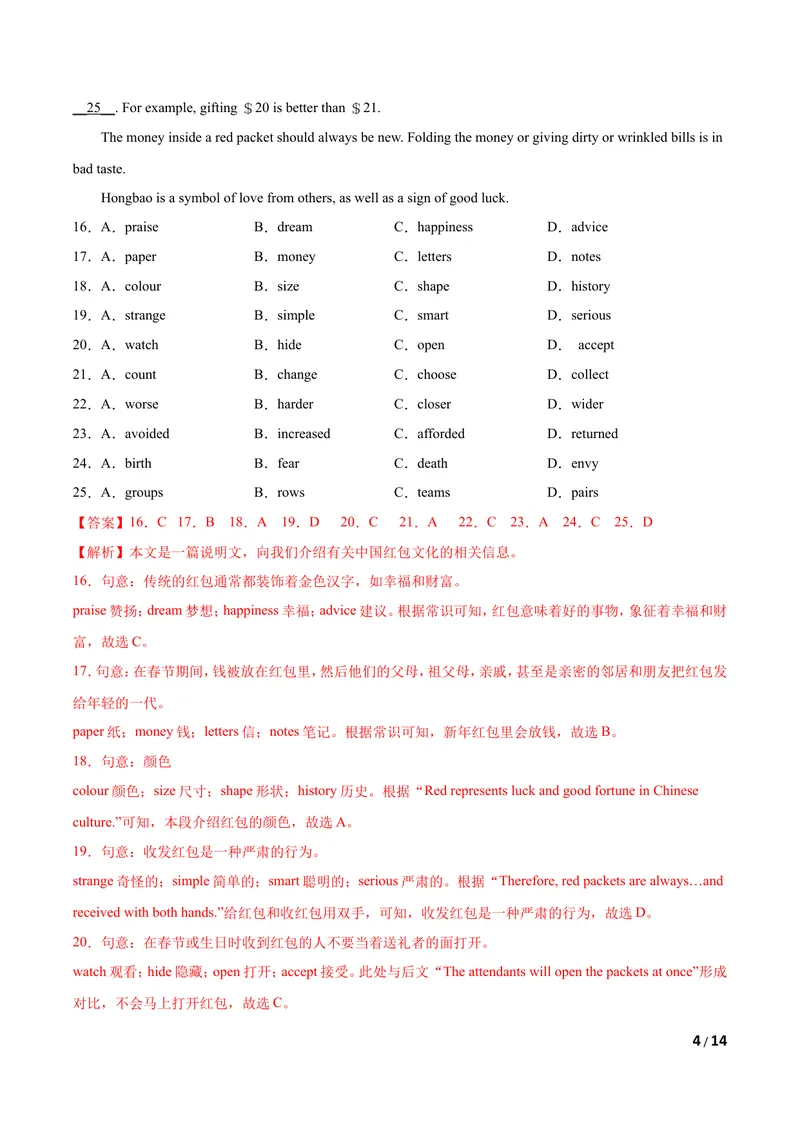
Tiger-head shoes and caps
Tiger-head shoes and caps are traditional Chinese handicrafts (手工艺品)
used for children. In Chinese culture, tigers are thought as lucky and full of
energy. People often decorate shoes and caps with lively tiger-head pictures
hoping that their children will become as strong and healthy as tigers. Great
care is needed to make the handicrafts. Materials are usually colourful cotton
fabrics(棉布)and 97-year-old Jiang Weishi in Anhui Province is one of the
people who can make these handicrafts. The skill is handed down in her family
from generation (—代)to generation. Jiang started to learn the skill at the age
of 15 and her products are very popular with local people
Hair embroidery(刺绣)
Hair embroidery is one of the treasures of ancient Chinese
embroidery art called a “ unique skill of the world”,It is a kind of
embroidery which uses human hair as a thread instead of other
materials. According to historical records, hair embroidery first
appeared in Dongtai, Jiangsu Province, more than 1,300 years ago.
Usually, hair embroidery requires more time and efforts to complete
than other kinds of embroidery because higher skills are needed. Hair
embroidery's designs are lively with many different kinds, including
animals, plants, natural views and historical people.
10 / 14Fluffing cotton (弹棉花)
Fluffing cotton is a traditional skill in China, even though it can hardly be
seen in both city and countryside now. It used to be very popular work. Workers
fluffed cotton with bowstrings (弹弓)and turned a pile of cotton into a quilt(被
子).Now, many quilts are made of synthetic fibers (合成纤维),silk or feather
down and are sold in supermarkets. With the invention of machines, this
traditional skill has been slowly lost is probably gone forever.
Peng Zhicheng, a 69-year-old man from Shuangfeng County, Hunan
Province, has been fluffing cotton for about 50 years. He is probably the last
generation who knows this traditional skill.
41 Tiger-head shoes and caps are made for_______.
A. old people B. woman C. children D. teenagers
42 What material is the hair embroidery made of?
A. Human hair. B. Cotton fabrics. C. Colourful threads. D. Silk.
43 When did Peng Zhicheng begin to fluff cotton?
A. At the age of 15. B. At the age of 19. C. At the age of 50. D. At the age of 69.
44.Which of the following is true according to the passage?
A. Jiang Weishi learned the skill of making tiger-head shoes and caps 15 years ago
B. Hair embroidery appeared in Anhui Province more than 1,300 years ago.
C.The quilts we use now are mostly made by machines.
D. Fluffing cotton is still very popular in the countryside.
45.The passage is mainly about_______ in China
A. works of art B. historical people C. famous cities. D. traditional skills
【答案】CABCD
【解析】本文介绍中国几种传统的手艺——虎头鞋和帽子,刺绣和弹棉花
41.C 细节理解题。Tiger-head shoes and caps are traditional Chinese handicrafts( 手工艺品)used for children.可
知答案选C
42. A 细节理解题。Hair embroidery is one of the treasures of ancient Chinese embroidery art called a “ unique skill
of the world”,It is a kind of embroidery which uses human hair as a thread instead of other materials. 它是一种用
人的头发作为线而不是其他材料的刺绣。故答案选A
42. B细节理解题。Peng Zhicheng, a 69-year-old man from Shuangfeng County, Hunan Province, has been fluffing
cotton for about 50 years.可知答案选B
44.C 细节理解题判断题。从Jiang started to learn the skill at the age of 15。这里知A错误。
从According to historical records, hair embroidery first appeared in Dongtai, Jiangsu Province, more than 1,300
11 / 14years ago.可知B错误。从Now, many quilts are made of synthetic fibers( 合成纤维),silk or feather down and are
sold in supermarkets.可知C正确。从With the invention of machines, this traditional skill has been slowly lost is
probably gone forever.
可知D错误。
45. D主旨大意题。本文介绍中国几种传统的手艺——虎头鞋和帽子,刺绣和弹棉花。故答案选D
第二节 阅读填空(共5小题;每小题1分,满分5分)
根据短文内容,将下面A---E五个句子分别填入文中空缺处,使得补全后的短文意思通顺,结构完整。
Do you like traditional Chinese paper-cutting? Ding Xiang, a student at Nongsishi Middle School in Xinjiang,
is really good at it. At the eighth National Excellent Talents Competition in 2015 in Beijing, the 15-year-old girl got
the gold award for her paper-cutting skills.
__46_____ The piece had two papers. One showed an ancient cave painting and the other was a Chinese-made
spaceship. __47_____
Ding said she wanted to show three things with the piece: Chinas long history, Chinas rapid development, and
her hope for the future of paper-cutting. __48____
I was very surprised to get the award. Ding said in an interview with Yili Daily, a Xinjiang newspaper.
“__49____”
All the hard work had paid off. In two years, Dings skills had improved a lot, and she had the gold award to
prove it.
Ding said she had learned a lot from paper-cutting. “__50_____” Ding told Yili Daily. “I have become more
confident, too. It is a great help in my studies. Also, I have learned a lot of history from the art.”
A. I should thank paper-cutting for bringing me the award.
B. The two papers showed great differences.
C. At the competition, Ding cut a wonderful piece of work.
D. I have learned to watch things carefully.
E. This piece helped Ding walk away with the gold award.
【答案】:CBEAD
第二卷 写作(共30分)
第一节 单词拼写(共5小题,每小题1分,满分5分)
Shadow puppet plays
12 / 14Shadow puppets are made of hard leather. It is cut out in the 1 s_________ of a person. an animal or an
object. Each puppet is painted in bright colours and put on a stick.
2.D__________ a shadow puppet play, Wang stands behind a white screen with lights behind it. The
audience sit in front of the screen. Wang and his friends hold the puppets very close to the screen so the audience
can see the puppets’ shadows clearly. Then they move the puppets around and do the 3.v________of the different
characters.
Shadow puppet plays are an 4.a________ Chinese art . Wang and his friends often work very hard for little
money, but they do not mind. They want to keep this traditional art form 5 a__________.
【答案】1.shape 2.During 3.voice 4.ancient 5.alive
第二节 完成句子。(共5小题,每题2分,满分10分)
1.这首歌不受年轻人喜欢。
The song ______ _________ by young people.
2. 虽然他很疲倦,但依然继续工作。
________ he was tired , he still ________ ________ .
3. 我们会一直练习唱歌 。
we will pracrise_______ _______ ________ __________.
4.他做鬼脸来阻止小女孩哭闹。
He made faces to ________ the little girl ________ ______.
5. 我们一大早为旅行坐准备,以便能按时出发。
We ______ _______ ________the journey this morning, so that I could _________ ________ on time.
【答案】1.is liked/loved 2.Although/though kept working 3.singing all the time 4.stop from crying 5.got ready
for set off
第三节:书面表达
中国有很多传统技艺。请根据下面的提示写一篇短文, 70~80词。
内容包括:
1. 中国的传统技艺有剪纸、鸬鹚捕鱼、皮影戏等;
2. 我们可以从传统技艺中了解生活和文化;
3. 一些传统技艺面临消失的危险;
4. 你对保护传统技艺的想法。
____________________________________________________________________________________________
13 / 14____________________________________________________________________________________________
________________________________________________________________________________________
____________________________________________________________________________________________
____________________________________________________________________________________________
_________________________________________________________________________________________
____________________________________________________________________________________________
____________________________________________________________________________________________
_________________________________________________________________________________________
____________________________________________________________________________________________
__________________________________________________________________________________________
There are many traditional skills in China, such as paper cutting, cormorants fishing, shadow puppet plays and
so on. They are very interesting and important. From these great Chinese traditional skills we can learn about the
life of ancient Chinese. We can also know about cultures in different places of China. However,few young Chinese
are good at these great traditional skills now. Maybe many years later nobody will know these traditional skills. I
think we should not let them die out. We should encourage more young people to learn them and try our best to
protect them.
14 / 14