【牛津(广州,深圳,沈阳)版】八年级下学期期末测试卷
(B卷·提升能力)
学校:__________班级:__________姓名:_________ 考号:___________
温馨提示:
本试卷共分第Ⅰ卷和第Ⅱ卷两部分,第Ⅰ卷为选择题;第Ⅱ卷为非选择题;满分为90分,考试时间为100
分钟。
第Ⅰ卷 选择题
一、语法选择(15分)
阅读下面短文,按照句子结构的语法性和上下文连贯的要求,从1-15各题所给的A、B、C和D项中选出最佳
选项,并在答题卡上将该项涂黑。
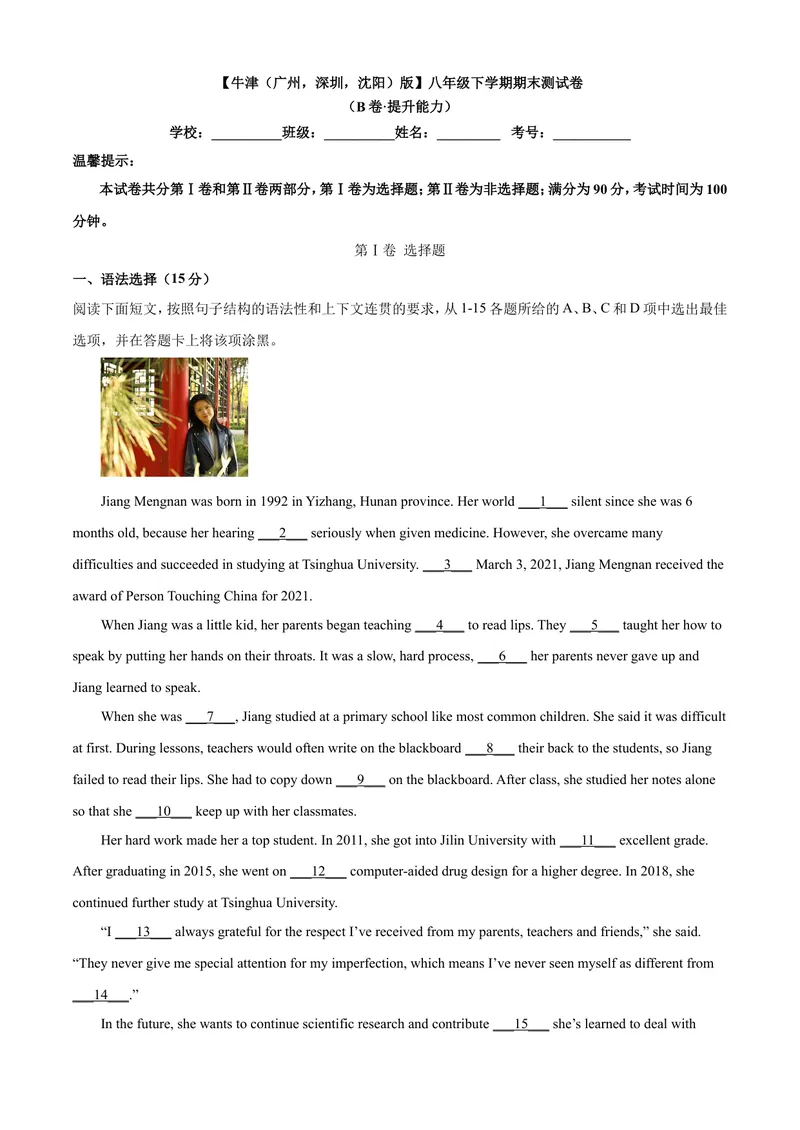
Jiang Mengnan was born in 1992 in Yizhang, Hunan province. Her world ___1___ silent since she was 6
months old, because her hearing ___2___ seriously when given medicine. However, she overcame many
difficulties and succeeded in studying at Tsinghua University. ___3___ March 3, 2021, Jiang Mengnan received the
award of Person Touching China for 2021.
When Jiang was a little kid, her parents began teaching ___4___ to read lips. They ___5___ taught her how to
speak by putting her hands on their throats. It was a slow, hard process, ___6___ her parents never gave up and
Jiang learned to speak.
When she was ___7___, Jiang studied at a primary school like most common children. She said it was difficult
at first. During lessons, teachers would often write on the blackboard ___8___ their back to the students, so Jiang
failed to read their lips. She had to copy down ___9___ on the blackboard. After class, she studied her notes alone
so that she ___10___ keep up with her classmates.
Her hard work made her a top student. In 2011, she got into Jilin University with ___11___ excellent grade.
After graduating in 2015, she went on ___12___ computer-aided drug design for a higher degree. In 2018, she
continued further study at Tsinghua University.
“I ___13___ always grateful for the respect I’ve received from my parents, teachers and friends,” she said.
“They never give me special attention for my imperfection, which means I’ve never seen myself as different from
___14___.”
In the future, she wants to continue scientific research and contribute ___15___ she’s learned to deal withproblems of life and health.
1. A. is B. was C. has been D. have been
2. A. damages B. is damaged C. damaged D. was damaged
3. A. In B. At C. On D. From
4. A. she B. her C. hers D. herself
5. A. also B. too C. either D. as well
6. A. and B. or C. but D. so
7. A. enough old B. enough young C. old enough D. young enough
8. A. with B. by C. without D. before
9. A. something B. everything C. anything D. nothing
10. A. need B. should C. could D. must
11. A. an B. a C. the D. /
12. A. study B. studies C. studied D. studying
13. A. is B. was C. am D. were
14. A. other B. others C. another D. the other
15. A. when B. where C. how D. what
二、完形填空(10分)
Mr. Jackson was our science teacher. On the first day of class, he gave us a talk about an animal called
wampus. He told us that the wampus lived on earth millions of years ago during the Ice Age and died out because
of the change of climate (气候). We all listened carefully and took ____ 1 6____ of everything he said. Later we had
a test.
When the exam paper was ___ 17 ___ to me, I was surprised and sad. There was a big red “×” through each of
my answers. I failed. But how come? Anyway on the test paper, I had ___ 18 ____ what Mr. Jackson said in class.
Then I realized that no one passed the exam at all. What had happened?
“Very simple.” Mr. Jackson explained. “I had made up all that story about the wampus. There had never been
any such animal, so the information in your notes was not correct. Do you expect to get ___ 19 __ marks for
incorrect answers?”
Hearing this, we felt it hard to understand so we were ___ 20 ____ . What kind of test was this? What kind of
teacher was he?
How could we believe he gave us so much information about an animal that had not been there at all? How
was it possible for us students to _____ 21 ___ what the teacher taught us?“The zeros on your papers will be _____ 22 ____ in your grade books,” he said. And he did it.
Through this experience, Mr. Jackson hoped that we would learn something. Teachers and books are not
always ____ 23 _____ . In fact, no one is. He told us not to let our mind go to sleep. Instead, we should keep thinking
all the time and speak up if we think there are ___ 24 ____ in our teachers’ words or in books.
We should develop the habit of doubting, and the ability to decide by ourselves. What a special ____ 25 ___ he
gave us! I will always remember it.
16. A. books B. notes C. supports D. messages
17. A. returned B. directed C. added D. arrived
18. A. cut down B. turned down C. broken down D. written down
19. A. useful B. high C. exact D. low
20. A. polite B. glad C. excited D. angry
21. A. praise B. guard C. doubt D. reflect
22. A. recorded B. described C. collected D. circled
23. A. interesting B. right C. active D. silent
24. A. decisions B. reasons C. points D. mistakes
25. A. call B. promise C. honour D. lesson
三、阅读 (共两节,满分45分)
第一节 阅读理解(共20小题;每小题2分,满分40分)
阅读下列短文,从每题所给的A、B、C和D项中,选出最佳选项,并答题卡上将该项涂黑。
A
There are many classical(古典的) cultures in China. All of them have a very long history. Here we introduce
four of them.
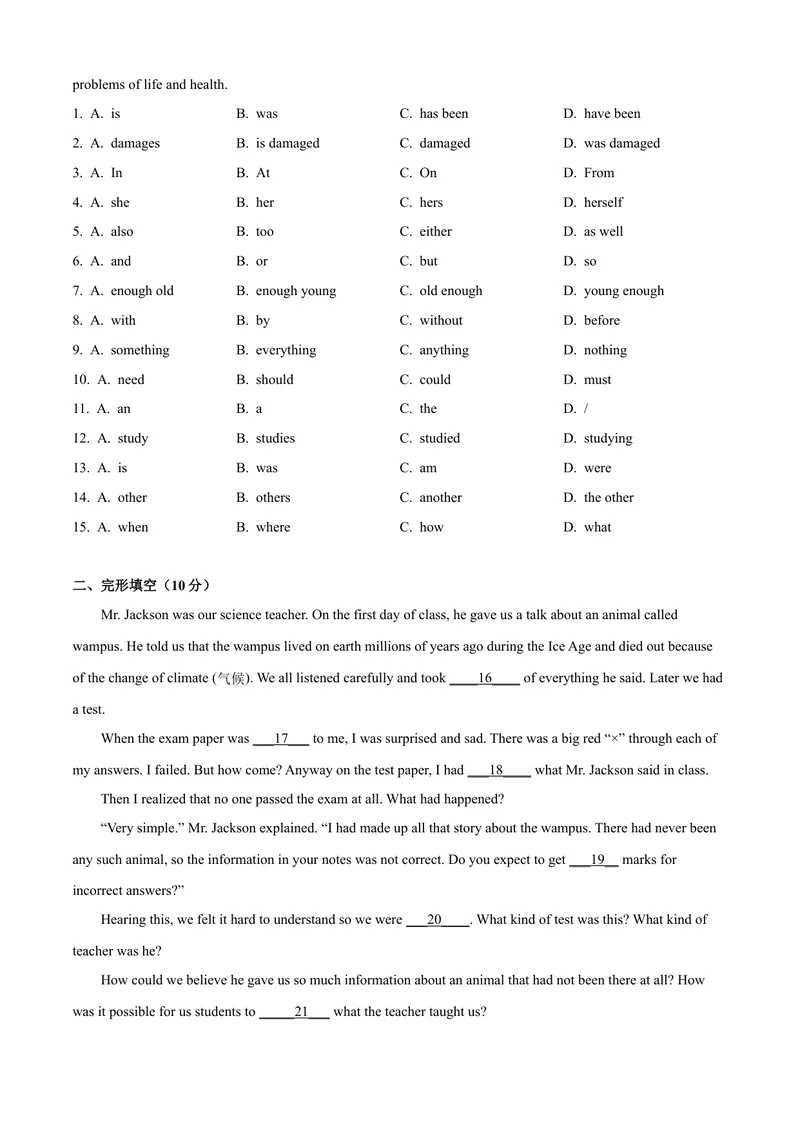
Chinese Handwriting
Chinese handwriting is a special art to Asian cultures. Brush handwriting is much
loved around the world. Wang Xizhi is very famous for his handwriting. He made a
great difference to the development of Chinese handwriting.
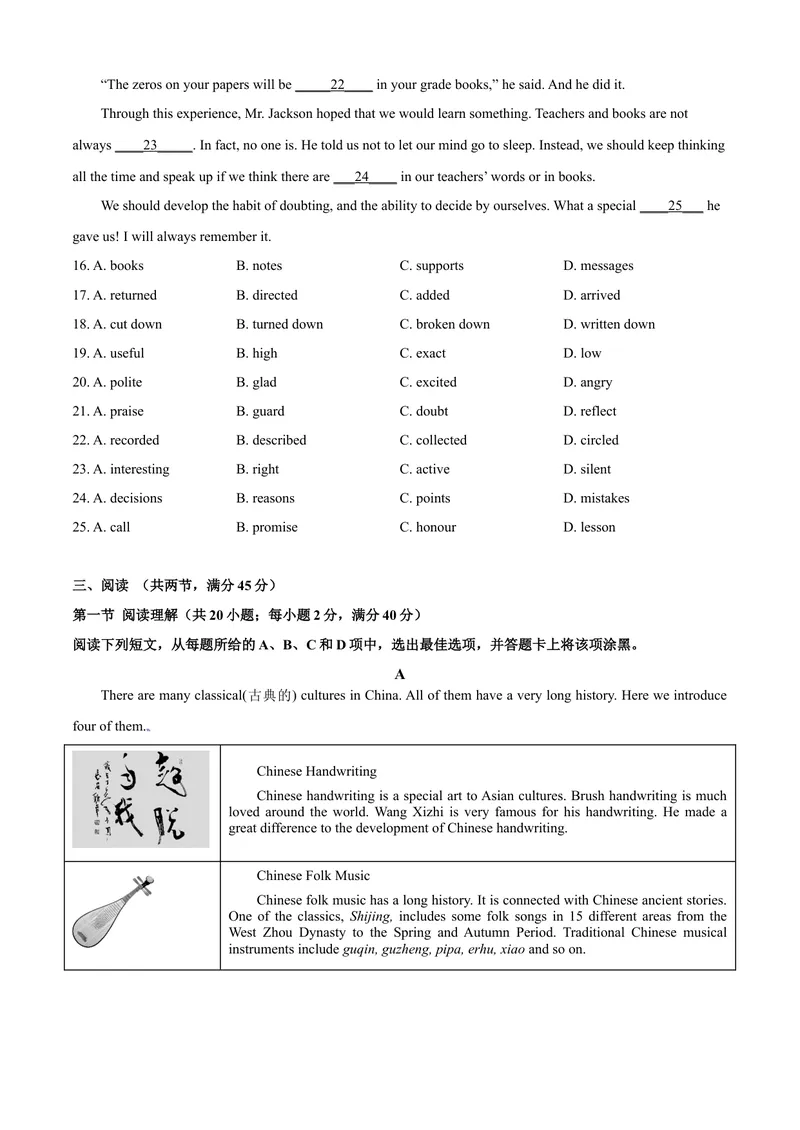
Chinese Folk Music
Chinese folk music has a long history. It is connected with Chinese ancient stories.
One of the classics, Shijing, includes some folk songs in 15 different areas from the
West Zhou Dynasty to the Spring and Autumn Period. Traditional Chinese musical
instruments include guqin, guzheng, pipa, erhu, xiao and so on.Chinese Painting
Chinese painting is one of the oldest traditional painting forms in the world. Most
of the Chinese paintings in ancient China were done on paper or silk. Traditional
Chinese painting includes mountains and water, figures(人物), flowers and birds. The
paintings show different features during the different historical periods.
Weiqi
Weiqi, called yi in ancient China, is a smart board game between two players with a
history of over 3,000 years. The game can be treated as the beginning of all ancient
chess games.
26.The ________ is a traditional Chinese instrument.
A.guitar B.violin C.erhu
27.Weiqi is a board game played by ________.
A.only one player B.two players C.three players
28.Chinese classical cultures ________.
A.have a long history
B.are popular only in China
C.are not welcomed by the higher classes
B
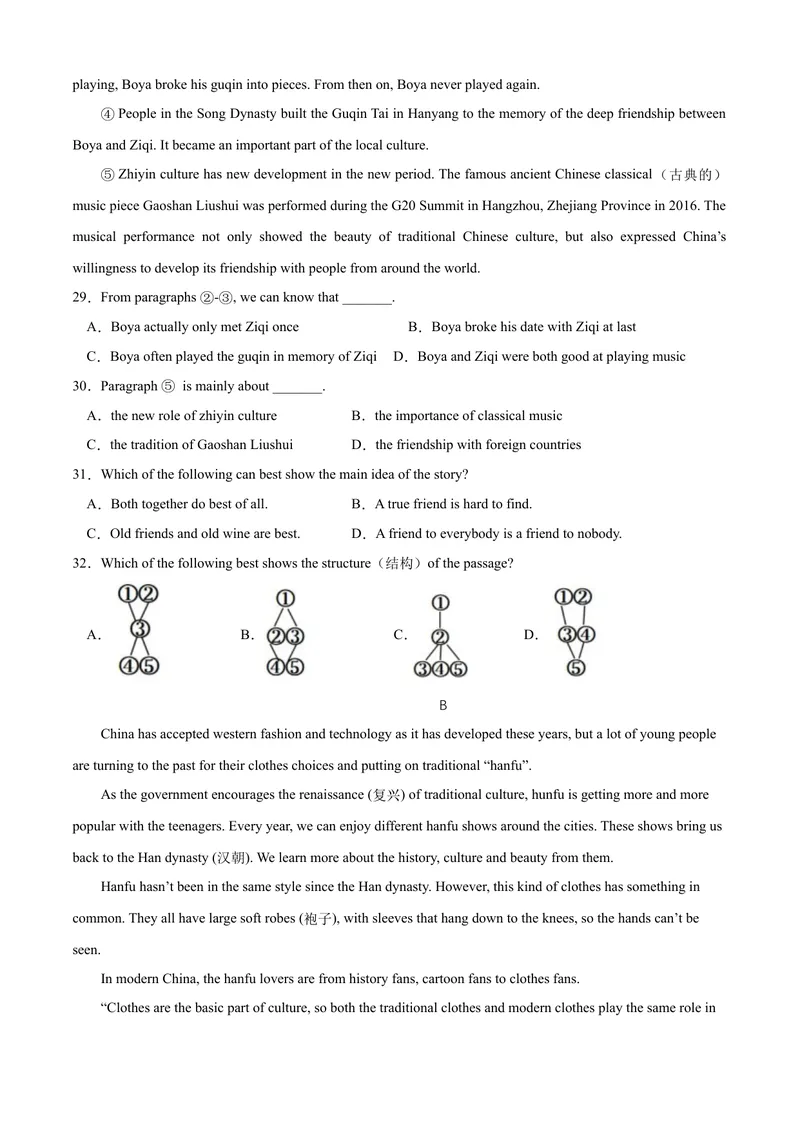
① The word “zhiyin”, which means close friends, comes from the story of Yu Boya and Zhong Ziqi in the
Warring States Period.
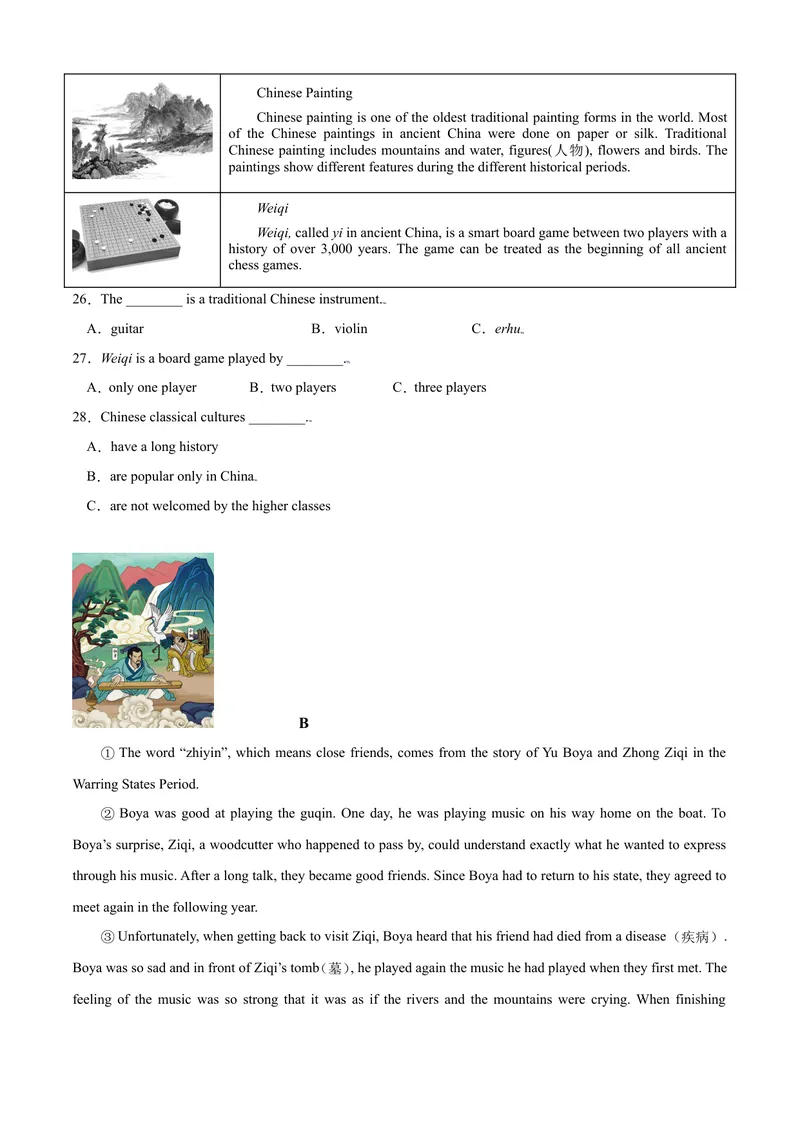
② Boya was good at playing the guqin. One day, he was playing music on his way home on the boat. To
Boya’s surprise, Ziqi, a woodcutter who happened to pass by, could understand exactly what he wanted to express
through his music. After a long talk, they became good friends. Since Boya had to return to his state, they agreed to
meet again in the following year.
③Unfortunately, when getting back to visit Ziqi, Boya heard that his friend had died from a disease(疾病).
Boya was so sad and in front of Ziqi’s tomb(墓), he played again the music he had played when they first met. The
feeling of the music was so strong that it was as if the rivers and the mountains were crying. When finishingplaying, Boya broke his guqin into pieces. From then on, Boya never played again.
④People in the Song Dynasty built the Guqin Tai in Hanyang to the memory of the deep friendship between
Boya and Ziqi. It became an important part of the local culture.
⑤Zhiyin culture has new development in the new period. The famous ancient Chinese classical(古典的)
music piece Gaoshan Liushui was performed during the G20 Summit in Hangzhou, Zhejiang Province in 2016. The
musical performance not only showed the beauty of traditional Chinese culture, but also expressed China’s
willingness to develop its friendship with people from around the world.
29.From paragraphs ②-③, we can know that _______.
A.Boya actually only met Ziqi once B.Boya broke his date with Ziqi at last
C.Boya often played the guqin in memory of Ziqi D.Boya and Ziqi were both good at playing music
30.Paragraph ⑤ is mainly about _______.
A.the new role of zhiyin culture B.the importance of classical music
C.the tradition of Gaoshan Liushui D.the friendship with foreign countries
31.Which of the following can best show the main idea of the story?
A.Both together do best of all. B.A true friend is hard to find.
C.Old friends and old wine are best. D.A friend to everybody is a friend to nobody.
32.Which of the following best shows the structure(结构)of the passage?
A. B. C. D.
B
China has accepted western fashion and technology as it has developed these years, but a lot of young people
are turning to the past for their clothes choices and putting on traditional “hanfu”.
As the government encourages the renaissance (复兴) of traditional culture, hunfu is getting more and more
popular with the teenagers. Every year, we can enjoy different hanfu shows around the cities. These shows bring us
back to the Han dynasty (汉朝). We learn more about the history, culture and beauty from them.
Hanfu hasn’t been in the same style since the Han dynasty. However, this kind of clothes has something in
common. They all have large soft robes (袍子), with sleeves that hang down to the knees, so the hands can’t be
seen.
In modern China, the hanfu lovers are from history fans, cartoon fans to clothes fans.
“Clothes are the basic part of culture, so both the traditional clothes and modern clothes play the same role inculture,” said Zhang Jun, a famous reporter. “If the people and the country do not even understand our traditional
clothes or don’t wear them, how can we talk about other important parts of our culture?”
33. Han fu is getting more and more popular with the teenagers because ________.
A. China has accepted western fashion B. China has accepted western technology
C. China has different hanfu shows D. the government encourages traditional culture
34. Who are hanfu lovers in China nowadays?
A. History fans, B. Cartoon fans. C. Clothes fans. D. All of the above.
35. According to Zhung Jun, he thinks ________.
A. clothes are not the part of culture B. it’s not necessary for us to wear hanfu
C. clothes help us understand our culture better D. hanfu isn’t so important as modern clothes
36. What does the passage mainly talk about?
A. Hanfu and Chinese culture. B. The history of Hanfu.
C. The styles of Hanfu. D. Different hanfu shows.
D
Humans share the earth with different kinds of wildlife. Humans, plants and animals are connected and depend
on each other. They are all important parts of the rich biodiversity (生物多样性) of the earth. However, many kinds
of plants or animals are becoming endangered over the past years because of climate (气候) change and human
activities.
Humans are one of the main reasons for this. According to a report by the United Nations in 2019, the world’s
population has doubled (from 3. 7 to 7. 6 billion) in the past 50 years. Humans have used more than one third of the
world’s land and 75 percent of freshwater. Besides, some human activities like cutting down forests and polluting
rivers also do harm to the environment. As a result, there are fewer habitats (栖息地) and natural resources (资源)
available for animals, as well as more pollution.
To deal with the problem, many countries have taken action. As one of the countries with the richest
biodiversity in the world, China has taken an active part in biodiversity protection. The Chinese government has
developed laws to protect wildlife and set up a biodiversity monitoring (监测) network. It has also built nature
reserves (保护区) with national parks. From January 1, 2019, the first local law about biodiversity protection was
developed in Yunnan province. Yunnan lies in the mountains area of Southwest China and it is the area with the
richest biodiversity in China and it is also the most successful area in China’s biodiversity protection. For this
reason, in 2021, COP 15 was held in Kunming and was a great success.
Biodiversity protection requires efforts from the whole world and China is now playing a leading role in
protecting biodiversity, hoping to build a green home for both humans and nature.36. What can we learn from paragraph 1 about the biodiversity of the earth?
A. Humans live on the earth and own the earth.
B. There is no connection between humans, plants and animals.
C. Humans, plants and animals are all important parts of biodiversity.
D. The biodiversity of the earth is mainly influenced by climate change.
37. What caused the fewer habitats and natural resources for animals?
A. Climate change. B. Short for freshwater.
C. Environment pollution. D. Doubled population and human activities.
38. What did Chinese government do to protect the biodiversity of the earth EXCEPT?
A. Develop laws. B. Set up monitoring network.
C. Build nature reserves. D. Plan trees and save freshwater.
39. Why was Yunnan chosen to hold COP 15?
A. Because it lies in the mountains area of southwest China.
B. Because it developed the first local law about biodiversity protection.
C. Because it has the richest biodiversity in China and does well in biodiversity protection.
D. Because it has built nature reserves with national park.
40. What’s the best title for this passage?
A. China is working on the protection of biodiversity.
B. Help save the endangered animals.
C. China’s nature reserves with national parks.
D. Human activities do harm to the biodiversity of the earth.
第二节 阅读填空(共5小题;每小题1分,满分5分)
根据短文内容,将下面A---E五个句子分别填入文中空缺处,使得补全后的短文意思通顺,结构完整。
When you travel in Chengdu, never miss the wonderful face-changing at the local tea houses. How much do
you know about this traditional skill? Let’s learn something about it.
____41____ And it is also a very lively way to show the thoughts and feelings of different characters of the
play.
It is widely believed that the skill of face-changing could date back to ancient times. To scare away the
dangerous animals and protect themselves, the ancient people painted their faces in different colors, making
themselves look fierce (凶猛的). ____42____
Generally speaking, there are three kinds of skills of face-changing, including wiping(擦) the face, blowing the
face and pulling the face. ____43____Before performing the skill of wiping the face, the actor will first spread some special paint on the face. Then
he could change the color of his face in a second by wiping it. When the actors perform the skill of blowing the
face, he blows a small box full of cosmetic powders(化妆粉) which is placed on the stage. And then the powders
are blown to his face, changing the color into another. ____44____ Under the cover of the dancing movements, the
actor pulls each piece of the facial makeups which is tied with a thin thread(线). The actor must do the movements
carefully and very quickly. ____45____ This was his latest Guinness World record.
In a word, the skill of face changing is very unique(独特的) and amazing in the arts of Sichuan Opera. Do you
like this traditional skill?
A. Later, it developed into a famous art form.
B. The skill pulling the face is more difficult.
C. Sichuan Opera master Peng Denghuai changed 14 masks in 25 seconds.
D. Face-changing is a unique skill which is widely used in Sichuan Opera.
E. Besides, breathing is another skill of face-changing, but few people know it.
第2卷 非选择题(共30分)
第一节、 短文填空(5分)
No one wants to lose. We enjoy the feeling of being a w____46____. But we also need to learn from the
unsuccessful experiences.
During the sports month at our school, all of the classes in Grade 8 played volleyball against each other. After
losing one of our games, no one in our class felt p____47____. It was like big, black clouds hanging over the
classroom. Some of us even c____48____ sadly. I asked myself, “How did we let this happen? ”
The answer was clear. Our players practised a lot. But during the practice time, we didn’t find out the right
way to do better u____49____ the two days before the sports month. I guessed the way we practised didn’t help us
win. So it meant that our practice time was wasted. Also, we were too nervous to face the challenge from the other
team while we were playing. Later in the game, we made a lot of mistakes. That was why we lost so many points in
the second round.
Life is full of unexpected failures. Sometimes, we are fighting with ourselves. Because of our work, we will
win. And because of our faults, we will lose. We should face the facts to find out why we have failed but it is
useless to find an e____50____ for our failure. So, just keep going and trying our best, in a right way.
第二节 完成句子(5小题,共10分)
51. 你先完成作业再出去是明智的。________ ________ ________ ________ you to finish your homework before you go outside.
52. 我们应该永远铭记中国的历史。
The Chinese history ________ ________ ________ by us forever.
53. 这些剪纸真是漂亮的艺术品啊!
________ ________ works of art these paper cuttings are!
54. 我们的国家已经足够强大去面对和解决各种难题。
Our country has been ________ ________ ________ ________ and deal with different problems.
55.昨天晚上9点我在看电影《ET》,我父母在看书。
My parents ________ ________ while I ________ ________ the film ET at nine last night.
七、第三节 书面表达(共1小题, 满分15分)
假如你是李华,在参加交换生项目期间,你住在John家里。为了表达感谢之情,你已选好两份具有中国
特色的礼物,分别送给John和他的父母,请附上一封感谢信,描述所选礼物并说明你挑选礼物的理由。可参
考以下表格的提示内容。
● be made of
● Chinese character
● handsome
● …(自行补充)
● good luck
● hard-working
● the Spring Festival
● …(自行补充)
● in the shape of
● double happiness
● on the wall
● …(自行补充)
……(可自己推荐) ● …(自行补充)● …(自行补充)
● …(自行补充)
● …(自行补充)
注意:
(1)字数:80词左右(短文的开头和结尾已给出,不计入总词数)。
(2)不得透露学校、姓名等任何个人信息,否则不予评分。
Dear John,
It has been so long since I said goodbye to you. I never forget your kindness,
so___________________________________________________________________________________________
____________________________________________________________________________________________
____________________________________________________________________________________________
____________________________________________________________________________________________
____________________________________________________________________________________________
____________________________________________________________________________________________
____________________________________________________________________________________________
____________________________________________________________________________________________
____________________________________________________________________________________________
____________________________________________________________________________________________
____________________________________________________________________________________________
Best wishes!
Yours,
Li Hua