2025 年高考第三次模拟考试(北京卷)01
英语
(考试时间:90 分钟  试卷满分:100 分)
注意事项:
1、考生务必在答题卡指定区域作答,在试卷上作答无效。
2、考试结束后,将本试卷和答题卡一并交回。
第一部分 知识运用(共两节,30 分)
第一节 (共 10 小题;每小题 1.5 分,共 15 分)
阅读下面短文,掌握其大意,从每题所给的 A 、B 、C 、D 四个选项中,选出 最佳选项,并在答
题卡上将该项涂黑。
By the age of seven we moved to an area where I met a girl called Safina, who was a bit younger than me,
and we started to play together. She was a pampered girl who had lots of dolls and a shoebox full of toy jewelry.
But she kept   1   the pink plastic pretend mobile phone my father had bought me, which was one of the few toys
I had. One day it disappeared.
A few days later I saw Safina playing with a phone exactly the same as mine. When asked, she told me she
bought it in the bazaar. I   2   now she could have told the truth but back then I thought, “She is doing this to me
and I will get back at her”. I used to go to her house to study, so whenever I was there, I would   3   her
belongings, mostly earrings and necklaces.
One afternoon I came home from school and rushed into the kitchen as usual for a snack. My mother was
sitting on the floor pounding spices. Her eyes would not meet mine. What had I done? Feeling   4   , I went to
my room. On opening my cupboard, I noticed all the items I had taken were gone. I had been   5   .
My cousin entered my room to inform me that my mother knew I had been stealing. I felt a terrible   6
feeling in my stomach. I walked back to my mother with my head bowed. “What you did was wrong,” she said.
“You are bringing   7   on us.”
“Safina started it,” I protested. “She took the pink phone that dad bought me. ”
My mother was   8   “Safina is younger than you and you should have set an example,” she said. I started
crying, repeatedly apologized and begged her not to tell dad. It’s horrible to feel unworthy in the eyes of your
parents.
My mother and father share everything so he soon knew what happened. My father consoled me by   9
the mistakes great heroes made in their youth, and cited Mahatma Gandhi’s words to ease my embarrassment,
“Freedom is not worth having if it does not include the freedom to make    10    .” I promised myself’d never
do such a thing again.
1.A.holding back
B.eyeing up
C.checking out
D.setting down
2.A.doubt
B.object
C.realize
D.claim
3.A.pocket
B.hunt
C.pack
D.hide
4.A.annoyed
B.uneasy
C.disappointed
D.frightened
5.A.found
B.spotted
C.caught
D.suspected
6.A.aching
B.unlucky
C.regretful
D.sinking
7.A.rumor
B.shame
C.trouble
D.pain
8.A.unchanged
B.uninterested
C.unguarded
D.unmoved
9.A.correcting
B.recounting
C.memorizing
D.observing
10.A.mistakes
B.apologies
C.breakthroughs
D.adaptations
第二节(共 10 小题;每小题 1.5 分,共 15 分)
阅读下列短文,根据短文内容填空。在未给提示词的空白处仅填写 1  个恰当 的单词,在给出提示
词的空白处用括号内所给词的正确形式填空。请在答题卡指 定区域作答。
A
A marketing professor: In my book The Language of Branding, I mention that brand language is a brilliant
way of enhancing customer loyalty (忠诚).    11    (company) that persuade people to use their own terms
create “a sense of belonging and improved loyalty    12    the brand”. It also enables employees to work    13
(efficient) than before.
B
After she     14     (lay) off as a Seattle city planner, Erin was looking for fun at-home projects when an
iPhone box caught her eye. “If you took the plastic tray that held the phone and flipped it upside down, it looked
just like a camera,” says Erin, an arts-and-design talent     15     tooled with that box until she made a working
35mm pinhole camera out of it.     16     Erin’s stack (大量) of these cameras grew, she started posting some
of them on the online crafter’s paradise Etsy for around $200 each.
C
As climate change creates hotter,    17    (dry) conditions, wildfires are becoming more frequent and
severe, destroying homes and ecosystems. Researchers at Stanford University have developed a new gel that can
lock in more water in the face of fires. When    18    (apply) to the surface of buildings, this gel forms a wet
shield. Even in very high temperatures, the gel won’t burn off. Tests showed that this new gel can protect wood
19    over seven minutes, compared to the less than 90 seconds provided by currently used gels. The gel    20
(make) of nontoxic components, making it safe for both people and the environment.
第二部分 阅读理解(共两节,38 分)
第一节(共 14 小题;每小题 2 分,共 28 分)
阅读下列短文,从每题所给的 A 、B 、C 、D 四个选项中,选出最佳选项,并 在答题卡上将该项
涂黑。
A
Interested in writing, photography or current events? Looking for an experience to inspire your college
essays? Or hoping to explore a world-class city with new friends this summer? If so, check out the Boston
University Summer Journalism Academy. It’s a program created and run by Boston University, where high school
students:
●   Learn from award-winning, working journalists — including two who have shared in Pulitzer Prizes for their
reporting.
●   Report on actual events around Boston or your hometown.
●   Place stories with Boston’s Daily Free Press, one of the top college newspapers.
●   Improve their writing, interviewing, and research skills — applicable for any major and career.
The academy offers two options: an on-campus, residential program over three weeks for students with
journalism experience, and a learn-from-home program over two weeks for all experience levels. For students
interested in photography, we offer a special photojournalism track for both. Every option is organized in three
sections:
●   Classroom starts each day with a review of journalism fundamentals in a collegiate format. A university-level
journalism textbook provides daily readings and writing assignments.
●   Newsroom provides time for students to apply what they learn in the Classroom to hands-on journalism
assignments. Over the rest of their day, students conduct interviews and gather information.
●   Guest Talks offer students advice and insight from journalism experts in topics such as radio reporting and
studying journalism in college. Sessions feature a Guest Talk during each three-week session from journalism
experts. Students also visit city newsrooms to hear from famous reporters.
Applications for the on-campus session June 24 to July 12 are due: April 19. Applications for learn-at-home
sessions starting June 17, July 1 and July 15 are due: May 10.
●   On Campus, residential: Three weeks, including tuition (学费), activity fees, room and board: $ 6,200. ($ 400
discounts for Early Bird applicants by Mar 8!)
Learn-from-Home: Two weeks, tuition: $ 1,500. ($200 discounts for Early Bird applicants by Mar 8!)
21.In the program, participants can ______.
A.develop their interviewing skills           B.finish their college essays with help
C.get inspiration from retired journalists       D.publish stories in Boston official website
22.If one chooses to learn in on-campus program, one needs to ______.
A.pay at most $ 1,500
B.apply before May 10
C.have journalism experience
D.have knowledge in photography
23.What will the three sections provide for participants?
A.Advice and insight from top photographers.      B.Reviews of reading and writing fundamentals.
C.A weekly talk with leading journalism experts    D.Chances to put journalism knowledge into practice.
B
William had worked hard to pass the exams to enter high school. When the term began, however, his father
told him that there was no money to pay for his school fees because of the summer drought. Still, William wanted
to learn.
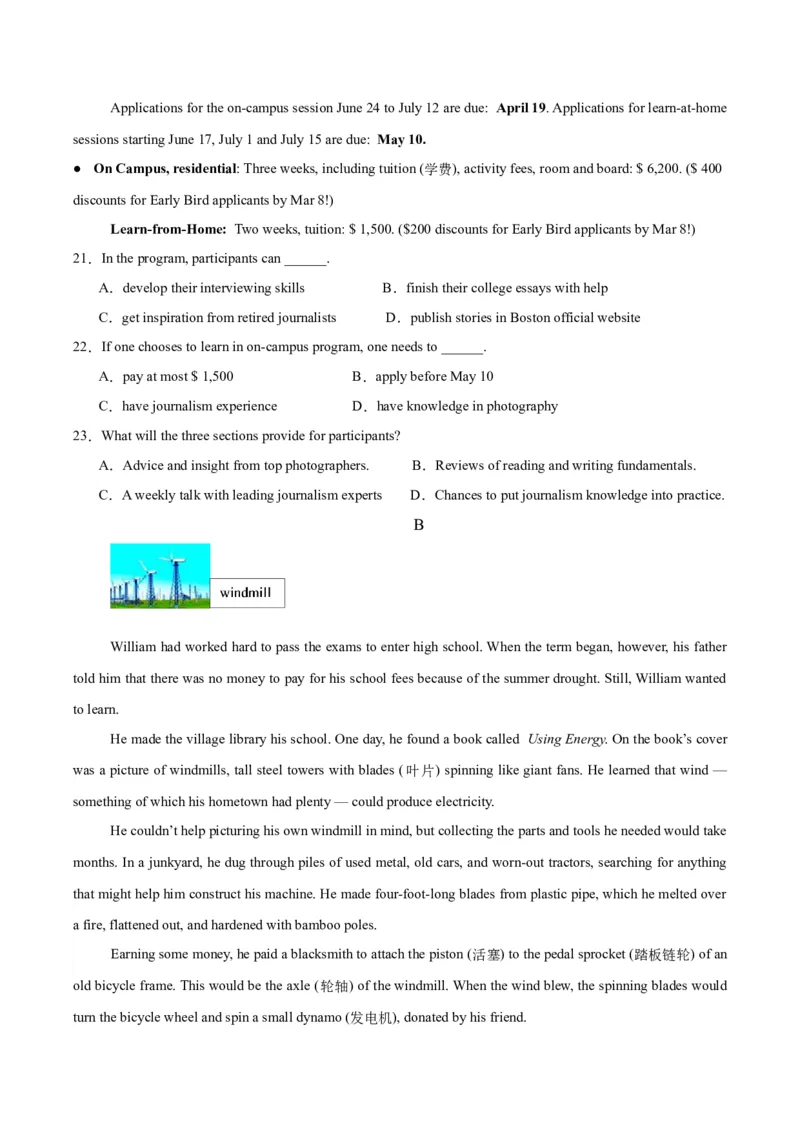
He made the village library his school. One day, he found a book called Using Energy. On the book’s cover
was a picture of windmills, tall steel towers with blades (叶片) spinning like giant fans. He learned that wind —
something of which his hometown had plenty — could produce electricity.
He couldn’t help picturing his own windmill in mind, but collecting the parts and tools he needed would take
months. In a junkyard, he dug through piles of used metal, old cars, and worn-out tractors, searching for anything
that might help him construct his machine. He made four-foot-long blades from plastic pipe, which he melted over
a fire, flattened out, and hardened with bamboo poles.
Earning some money, he paid a blacksmith to attach the piston (活塞) to the pedal sprocket (踏板链轮) of an
old bicycle frame. This would be the axle (轮轴) of the windmill. When the wind blew, the spinning blades would
turn the bicycle wheel and spin a small dynamo (发电机), donated by his friend.
When he had collected all the parts, William began putting them together. He fixed the blades to the tractor
fan he found, using washers (垫圈) he’d made from bottle caps. Next he pushed the fan onto the piston joint to the
bicycle frame. With the help of his two best friends, William built a 16-foot-tall tower from trunks of trees and
lifted the ninety-pound windmill to the top.
The big moments eventually came. He climbed up the tower and connected two wires that held a small bulb.
As the wind whipped around him, the blades began to turn, slowly at first, then faster and faster. The light bulb
flickered (闪烁), then flashed to life. The crowd cheered from below. “Wachitabwina (well done)!”
William’s machine now powered his house. And the story of the boy who’d built a power-generating
windmill to rescue his family from the drought spread across the Internet.
24.After reading Using Energy, what did William decide to do?
A.Learn to survive a drought.
B.Make use of wind.
C.Build a village library.
D.Enter a high school.
25.According to Para.3, which of the following word can best describe William?
A.Determined.
B.Cooperative.
C.Humorous.
D.Optimistic.
26.What can you learn about William’s machine?
A.It was built by villagers.
B.It was made from metal materials.
C.It took him years to complete it.
D.It worked at the first attempt.
27.What is the best title for the passage?
A.Windmills for Villages
B.Ideas Worth Spreading
C.Winds Of Hope
D.Learning from Experience
C
In the state of Georgia, one farmer has made it his mission not only to feed the hungry but to help them grow
their own food in their own backyard.
“My main goal is to make sure that underserved communities that have been excluded or overlooked have
access to locally grown food,” said Bobby Wilson, who operates the nonprofit Metro Atlanta Urban Farm. Since
2009, Wilson has taught thousands of people how to plant and grow their own vegetables and prepare meals with
them, including onions, garlic, cucumbers, tomatoes, collard greens, squash, and eggplant.
“Not only can you learn from my 35 years of doing this type of work,” Wilson said, “but you can learn from
our community gardeners who are growing food in a natural way.”
Wilson, the first college graduate in his family, worked with the University of Georgia for more than 20
years, bringing gardening education and programs to public housing complexes, schools and churches throughout
Metro Atlanta. Through his work, he saw a great need for fresh, healthy food in low-income urban communities.
When he retired in 2009, he used a portion of his retirement savings to purchase the farm and help fill the
gap.
“I saw the need,” Wilson said. “Plus, when you retire, you should do something you really enjoy.”
He estimates with the rising price of food, people could save thousands yearly by growing their own fruits
and vegetables. He also points out the health benefits that fresh produce brings.
Millions of households in the US are struggling to feed their families. And this is what motivates Wilson’s
efforts.
“When small and disadvantaged farmers didn’t have the avenue to get rid of that produce because people
were not coming out to buy, we had an opportunity to help keep them alive,” Wilson said. “We were buying food
from African American farmers who did not have outlets and giving it away.”
Wilson continues to offer free food to those in need at a drive-through giveaway every week, where families
can secure healthy produce.
Over the years, Wilson says he has hosted a lot of students in grades K-12 for farm tours and agricultural
S.T.E.M. field trips. He works with farmers and gardeners of all ages and skill levels, from preschoolers to seniors,
to provide education and access to affordable produce.
“We’re more than just a farm,” he said. “We’re about justice, equity, diversity, and inclusion, because at the
end of the day, I want my grandchildren to have it better than what I have it today.”
28.Wilson started the Metro Atlanta Urban Farm mainly to ______.
A.make a living
B.pursue his career
C.promote health awareness
D.help the communities
29.We can learn from the passage that ______.
A.Wilson’s farm has been around for over 30 years
B.Wilson undertakes some educational initiatives at the farm
C.some small and disadvantaged farmers joined Wilson’s farm
D.thousands of students have attended Wilson’s classes on farming
30.What does Wilson think of his farm?
A.Underestimated.
B.Unexpected.
C.Imperfect.
D.Promising.
D
As global temperatures continue to rise due to human-induced climate change, precise computerized climate
models will be crucial in shedding light on how our climate will evolve in the coming years.
A study published in Journal of Geophysical Research: Atmospheres by Chloe Clark and her team from UC
Irvine highlights a significant issue with a commonly used climate model known as the Energy Exascale Earth
System Model (E3SM). The research reveals that this model currently overestimates a key physical property of
Earth’s climate system called albedo, which is the degree to which ice reflects planet-warming sunlight into space.
Albedo is a measure of the reflectivity of a surface, expressed as the fraction of incoming solar radiation that
is reflected by that surface back into space. It is a critical factor in determining Earth’s climate and energy balance.
Surfaces with high albedo, such as snow and ice, reflect a large portion of solar energy, whereas darker surfaces
like forests or oceans absorb more solar energy.
“We found that with old model versions, the ice is too reflective by about five percent,” said Chloe Clarke,
“Ice reflectivity was much too high.”
The amount of sunlight the planet receives and reflects is important for estimating how much the planet will
warm in the coming years. Previous versions of E3SM overestimated albedo because they failed to account for
microphysical properties of ice in a warming world. These properties include the effects things like algae (藻类)
and dust have on albedo. Dark colored algae and dust can make snow and ice less reflective and less able to reflect
sunlight.
To do the analysis, Clarke and her team studied satellite data to track the albedo of the Greenland Ice Sheet.
They found E3SM overestimates the reflectivity of the ice sheet, meaning the model estimates less melt than what
would be expected from the ice microphysical properties. But with the new ice reflectivity incorporated into the
model, they discovered the Greenland Ice Sheet is melting at a rate of about six gigatons more than in older model
versions. This is based on albedo measurements that are more consistent with satellite observations.
Clarke hopes her team’s study stresses the importance of the seemingly minuscule properties that can have
far-reaching consequences for the overall climate. “I think our work is going to help models do a much better job of
helping us capture snow and ice-related climate feedbacks,” she said.
Next, Clarke wants to study different icy parts of the planet to calculate how widespread the albedo
discrepancy (差异) is in E3SM. “Our next steps are to get it so the model is functional globally and not just valid
over Greenland,” said Clarke, who also intends to compare the new Greenland Ice Sheet melt rates to observations
to measure how much more accurate the new ice albedo is. “It would be useful to apply it to glaciers in places like
the Andes and Alaska.”
31.According to the passage, albedo ______.
A.changes with the lightness of surfaces
B.matches up with the shape of the ice or snow
C.is a measure of the solar energy arriving at the surface
D.varies with the direction of the incoming solar radiation
32.What can be learned from the passage?
A.The new model is more reliable than satellite observations.
B.The previous model versions overestimate Greenland melt.
C.Model adaptation improves the accuracy of climate predictions.
D.Scientists have used the model globally to reduce the discrepancy.
33.What does the underlined word “minuscule” in Paragraph 7 probably mean?
A.Tiny.
B.Invisible.
C.Plain.
D.Stable.
34.The last paragraph is written to ______.
A.note the limitations of the finding
B.point out further research directions
C.illustrate the benefits of a new approach D.sum up the changes made in E3SM
第二节(共 5 小题;每小题 2 分,共 10 分)
根据短文内容,从短文后的七个选项中选出能填入空白处的最佳选项,并在答题卡上将该项涂黑。选
项中有两项为多余选项。
University life is full of fun and experiences. But to make learning much more enjoyable, you should follow
certain steps that will help you out in keeping your stress level down and having the most of the fun in the
university.
Always get involved in the events. Doing something every day is very important not only in the university
life but also in the practical life.    3

 5

  Be active and smart. Join the societies, which will help you develop
personality and increase your confidence.
Always show up. Showing people that you are there with them and always will be. Offer help to everybody.
In this way more people will know you and you will be able to wipe off your fear of social interaction.    3

 6
Make as many friends as possible. Don't restrict yourself in making friends; it will help increase your
knowledge. You will learn a lot about different cultures and this will help you with your practical life too. By
communicating with different people you'll learn different interesting aspects of their lives.
    3

 7

  If you keep thinking all the time about future, you will end up being depressed. You start losing
your focus and begin to worry about less important things.    3

 8

  Release your stress and be present-focused. It
will greatly help you in accomplishing your goals and achieving happiness.
Keep a balance.    3

 9

  Being extreme in one field might bring astonishing results, but this will affect
other aspects of your life. Keep a balance between short-term goals and long-term benefits. This will help you in
achieving a perfect and enjoyable life.
A.Do not waste time doing nothing.
B.Just relax and stop thinking about the future.
C.Never move towards the extreme.
D.Be present-focused.
E.Some students may like to have many friends and enjoy a party lifestyle.
F.The more people you know, the easier it will be for you to walk around without being shy.
G.Nobody cares if you miss class, don't eat properly, nor don't go to a party.
第三部分 书面表达(共两节,32 分)
第一节 (共 4 小题; 第 40、41 题各 2 分, 第 42 题 3 分, 第 43 题 5 分, 共 12 分)
阅读下面短文,根据题目要求用英文回答问题。请在答题卡指定区域作答。
Life felt like a mountain hike with designated (指定的) stops — high school, college — where I could figure
out my direction. I chose chemistry as my college major because it seemed to provide different career options.
Learning organic chemistry reactions wasn’t frustrating or boring, but I did not “love” my subject.
When deciding what to do after finishing my undergraduate degree, I was largely driven by a desire for
financial independence. While exploring job prospects, I found most required a master’s. I was offered a spot in a
graduate program and decided to enroll. It came with the option of continuing to a Ph. D., but I never saw that as
my likely direction.
However, my certainty that I was not suited for a Ph. D.began to waver during my second year, when I
started the mandatory laboratory research project. I spent a lot of time in the lab and I never felt bored. Mastering
my project required constant learning and improvisation. I started to prefer experiments over classes. Standardizing
reactions felt more satisfying than scoring well on exams.
As my master’s was drawing to a close, my confusion peaked. With my scores, I was in a good position to be
hired by government-funded companies — a great opportunity I didn’t want to waste. And everyone I talked to
advised security a stable job instead of pursuing a Ph. D.I continued on to the interview stage. Still, I couldn’t
ignore my growing interest in research. One week before my scheduled interview with my top-choice company, I
backed out. I was going to pursue a Ph. D.
I’ve completed my doctorate and am now an independent academic researcher. I have worked with others
who are far more enthusiastic and were always sure they wanted to be scientists. My absent passion made me feel
inadequate when I saw colleagues reading papers and discussing topics solely out of interest whereas I sometimes
felt unmotivated to read literature relevant to my own project. I wondered how I traveled so far without “love” for
the subject.
Over the years, though, I have realized that neither success nor failure makes me go overboard or slip into
depression. There are ups and downs, but it just feels right every morning to go to the laboratory and do
experiments to learn something new. Having started my career as a “reluctant” (不情愿的) chemist, I am yet to
proclaim my love for what I do. But I try to see the relevant problems and solve them for my own satisfaction. That
makes me no less capable than my peers, and no less deserving of a space in science.
40.Why did the author choose chemistry as his college major?

41.When did the author begin to question his belief about not being suited for a Ph. D.?

42.Please decide which part is false in the following statement, then underline it and explain why.
The author decided to continue to pursue a Ph. D
▶
.because of his failure in the job interview

43.From this story, what can we learn about “reluctance”? (In about 40 words)

第二节 (20 分)
假设你是红星中学学生李华。近期,中国人工智能DeepSeek 在国际上引起广泛关注和热烈讨论。你
的英国笔友Jim 来信向你咨询相关情况,请你用英语给Jim 写一封邮件,内容包括:
1. 介绍中国人工智能发展的成果及意义;
2. 阐述你的感受。
注意:1. 词数100 左右;
2. 开头和结尾已给出,不计入总词数。
Dear Jim,
________________________________________________________________________________________
____________________________________________________________________________________________
____________________________________________________________________________________________
____________________________________________________________________________________________
_______________________________
Yours,
Li Hua