2026 年高考第二次模拟考试(全国二卷)
高三英语·全解全析
(考试时间:120 分钟  试卷满分:150 分)
注意事项:
1.答卷前,考生务必将自己的姓名、准考证号等填写在答题卡和试卷指定位置上。
2.回答选择题时,选出每小题答案后,用铅笔把答题卡上对应题目的答案标号涂黑。如需
改动,用橡皮擦干净后,再选涂其他答案标号。回答非选择题时,将答案写在答题卡上。写
在本试卷上无效。
3.考试结束后,将本试卷和答题卡一并交回
第一部分  听力(共两节,满分30 分)
做题时,先将答案标在试卷上。录音内容结束后,你将有2 分钟的时间将试卷上的答案转涂
到答题卡上。
第一节(共5 小题;每小题1.5 分,满分7.5 分)
听下面5 段录音。每段录音后有一个小题,从题中所给的A、B、C 三个选项中选出最佳选
项。听完每段录音后,你都有10 秒钟的时间来回答有关小题和阅读下一小题。每段录音播放
两遍。
1. Where does the conversation probably take place?
A. In a supermarket.
B. At the railway station.
C. In a park.
【答案】C
【解析】
【原文】W: You should have come earlier to see the appealing beginning of the live music festival
in this park.
M: Well, I just finished my housework and bought some groceries on the way here.
2. How does the man usually go to the library?
A. By bus.
B. By underground.
C. By taxi.
【答案】B
【解析】
【原文】W: Excuse me, do you know how to get to the library without being stuck on the way?
Taxi or bus?
M: Neither! I usually choose the subway due to its fixed schedule and convenience.
3. What time will the man have a conference?
A. At 7:00.
B. At 7:15.
C. At 7:30.
【答案】C
【解析】
【原文】M: Why did you set the alarm for 7:00?
W: Dear, you said you had a meeting to attend at 7:30. Hurry up! You have to get to the office in 15
minutes.
M: Oh, I’m so tired.
4. What is the probable relationship between the speakers?
A. Teacher and student.
B. Doctor and patient.
C. Husband and wife.
【答案】B
【解析】
【原文】W: How are you feeling this morning?
M: Much better after taking your medicine.
W: I suggest that you should stop working and lie in bed for enough rest.
5. What event did the woman just attend?
A. An art exhibition.
B. A musical performance.
C. A robot display.
【答案】C
【解析】
【原文】W: I’ve just come from the exhibition in the school gym. You can’t imagine how much the
children enjoyed designing the robots.
M: You bet! It’s a great event to develop kids’ innovation.
W: The kids built all the robots themselves. It was amazing to see how smoothly the robots
performed various tasks.
第二节(共15 小题;每小题1.5 分,满分22.5 分)
听下面5 段录音。每段录音后有几个小题,从题中所给的A、B、C 三个选项中选出最佳选
项。听每段录音前,你将有时间阅读各个小题,每小题5 秒钟;听完后,每小题都有5 秒钟
的作答时间。每段录音播放两遍。
听第6 段录音,回答第6、7 题。
6. What is the woman preparing for?
A. A lesson.
B. A speech.
C. A discussion.
7. Where will the speakers have a discussion?
A. At the woman’s home.
B. At school.
C. At a cafe.
【答案】6. B    7. C
【解析】
【原文】M: Hey, Lucy! What have you been doing these days?
W: I’m busy with my speech draft. I have just decided on the topic but I don’t know how to write it
well.
M: Sorry to hear that! But I can help since I have finished one named “Hard work has shaped my
life”.
W: Wow, so considerate of you. Can we meet after school to discuss it?
M: No problem. We can gather at the school gate at 5:00 pm and find a cafe to polish the draft.
W: See you!
听第7 段录音,回答第8 至10 题。
8. Which of the following is the man’s favorite?
A. Classic fictions.
B. Romantic stories.
C. Detective novels.
9. What attracts the man most about Pride and Prejudice?
A. Its characters.
B. Its plot.
C. Its author.
10. When does the woman choose to read short stories?
A. In the morning.
B. In the afternoon.
C. In the evening.
【答案】8. C    9. A    10. A
【解析】
【原文】W: What kind of literature do you like best?
M: I prefer stories with a fast-paced, exciting plot like detective novels. You’re into classic literature,
right?
W: Yeah, it’s so insightful. I often read works by Dickens or Austen at night after a tiring day of
classes.
M: Actually, I like some classic novels too, like Pride and Prejudice. The characters in this book are
really vivid.
W: Classic literature is said to be great for shaping your perspective. Students who read it regularly
get better at understanding complex human emotions.
M: Really? Maybe I should read more of it then. I heard it also helps improve writing skills.
W: That’s why I make time for it in the evening. But first thing in the morning, I like short stories
better. They’re quick to finish but still full of depth.
听第8 段录音,回答第11 至13 题。
11. What motivated Mr. Jason to step into the herbal field?
A. His passion for plants.
B. His teacher’s impact.
C. His childhood experience.
12. What makes herbs a powerful tool in Mr. Jason’s opinion?
A. The widespread interest in natural treatments.
B. Their connection with traditional wisdom.
C. The high quality of herbal medicines.
13. What should be a priority for students learning herbs?
A. Learning herbal functions.
B. Doing various experiments.
C. Mastering medical terms.
【答案】11. B    12. B    13. A
【解析】
【原文】W: Tonight, we have a very special guest, Mr. Jason, the 2025 National Herbal Research
Award winner. Welcome to the show, Jason.
M: Thank you, Zoe.
W: It’s fantastic to have you here. So what first got you into researching herbs?
M: Actually, I had a college professor who showed me studying herbs isn’t just about leaves and
roots. It’s about promoting human health.
W: I see. What do you think makes herbs such a powerful tool for modern medicine?
M: Herbs help scientists explore natural treatments. But more importantly, it connects with
traditional wisdom.
W: That’s beautifully said. So how do you keep students engaged?
M: By reminding them that technology is just a tool. The natural balance is irreplaceable. My
students do various experiments with herbs, but I recommend that they should learn herbal functions
first.
W: You are so sensible! Thank you for sharing.
听第9 段录音,回答第14 至16 题。
14. What is Lisa?
A. A designer.
B. A trainer.
C. A manager.
15. What did Lisa major in at college?
A. Electrical engineering.
B. Project management.
C. Communication skills.
16. What does Lisa like best about her job?
A. The high salary.
B. The product launch.
C. The flexible schedule.
【答案】14. C    15. A    16. B
【解析】
【原文】M: Lisa, long time no see! What are you up to these days? Are you a designer at the
fashion studio or a trainer at the gym?
W: Neither. I’m a manager at a Canadian company that develops smart home devices.
M: Wow, that sounds like a challenging job. Does it pay well?
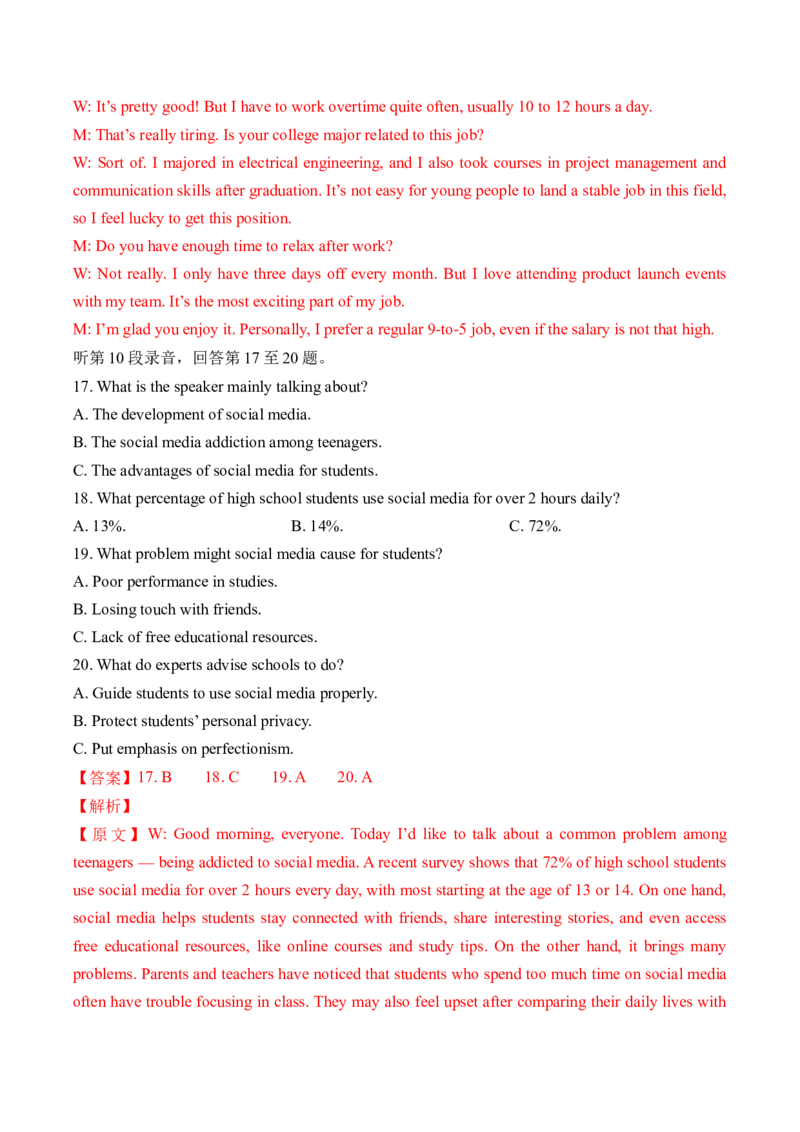
W: It’s pretty good! But I have to work overtime quite often, usually 10 to 12 hours a day.
M: That’s really tiring. Is your college major related to this job?
W: Sort of. I majored in electrical engineering, and I also took courses in project management and
communication skills after graduation. It’s not easy for young people to land a stable job in this field,
so I feel lucky to get this position.
M: Do you have enough time to relax after work?
W: Not really. I only have three days off every month. But I love attending product launch events
with my team. It’s the most exciting part of my job.
M: I’m glad you enjoy it. Personally, I prefer a regular 9-to-5 job, even if the salary is not that high.
听第10 段录音,回答第17 至20 题。
17. What is the speaker mainly talking about?
A. The development of social media.
B. The social media addiction among teenagers.
C. The advantages of social media for students.
18. What percentage of high school students use social media for over 2 hours daily?
A. 13%.
B. 14%.
C. 72%.
19. What problem might social media cause for students?
A. Poor performance in studies.
B. Losing touch with friends.
C. Lack of free educational resources.
20. What do experts advise schools to do?
A. Guide students to use social media properly.
B. Protect students’ personal privacy.
C. Put emphasis on perfectionism.
【答案】17. B    18. C    19. A    20. A
【解析】
【原文】W: Good morning, everyone. Today I’d like to talk about a common problem among
teenagers — being addicted to social media. A recent survey shows that 72% of high school students
use social media for over 2 hours every day, with most starting at the age of 13 or 14. On one hand,
social media helps students stay connected with friends, share interesting stories, and even access
free educational resources, like online courses and study tips. On the other hand, it brings many
problems. Parents and teachers have noticed that students who spend too much time on social media
often have trouble focusing in class. They may also feel upset after comparing their daily lives with
the “perfect” posts online, which makes them lose confidence. What’s worse, some students get
disturbed by messages during study time, leading to a drop in grades. Experts suggest that instead of
banning social media completely, schools should teach students to manage their screen time wisely.
For example, setting a fixed time for checking social media after finishing homework, or choosing
educational accounts to follow instead of those with meaningless content. Remember, social media is
a tool. It can either help us or harm us, depending on how we use it.
第二部分  阅读(共两节, 满分50 分)
第一节(共15 小题;每小题2.5 分, 满分37.5 分)
阅读下列短文, 从每题所给的A、B、C 和D 四个选项中选出最佳选项。
A
2026 National Youth Cultural Heritage Protection Volunteer Program
Do you want to help protect traditional cultural heritage and pass down Chinese history to the
younger generation? Our national volunteer program is now officially open for application to all
eligible senior high school students across the country.
Hosted by the National Cultural Heritage Administration and China Youth League, the program
runs from July 10 to August 20, 2026, covering a total of 6 weeks of on-site service and pre-job
training. It warmly welcomes all senior high school students aged 15-18 across China, with no
professional background or previous work experience required to apply.
Volunteers will be sent to 8 key cultural heritage sites across the country, with 3 core tasks:
1. Guide daily visitors and explain the cultural stories behind the precious relics in a vivid and
easy-to-understand way;
2. Help professional staff sort out cultural relic materials and digitalize precious old historical
documents and photos;
3. Hold small popular cultural lessons for local left-behind children in nearby villages, including
hand-painting of cultural relic patterns and simple traditional craft experience.
All volunteers will receive a 3-day systematic pre-training delivered by senior cultural heritage
experts, combining online pre-learning and on-site practical teaching. The training covers basic relic
protection knowledge, public explanation etiquette and emergency response for site visits. We will
also provide free accommodation, daily meals and traffic allowance during the entire service period.
Excellent volunteers will win an official certificate issued by the National Cultural Heritage
Administration, plus a set of hardcover cultural heritage books.
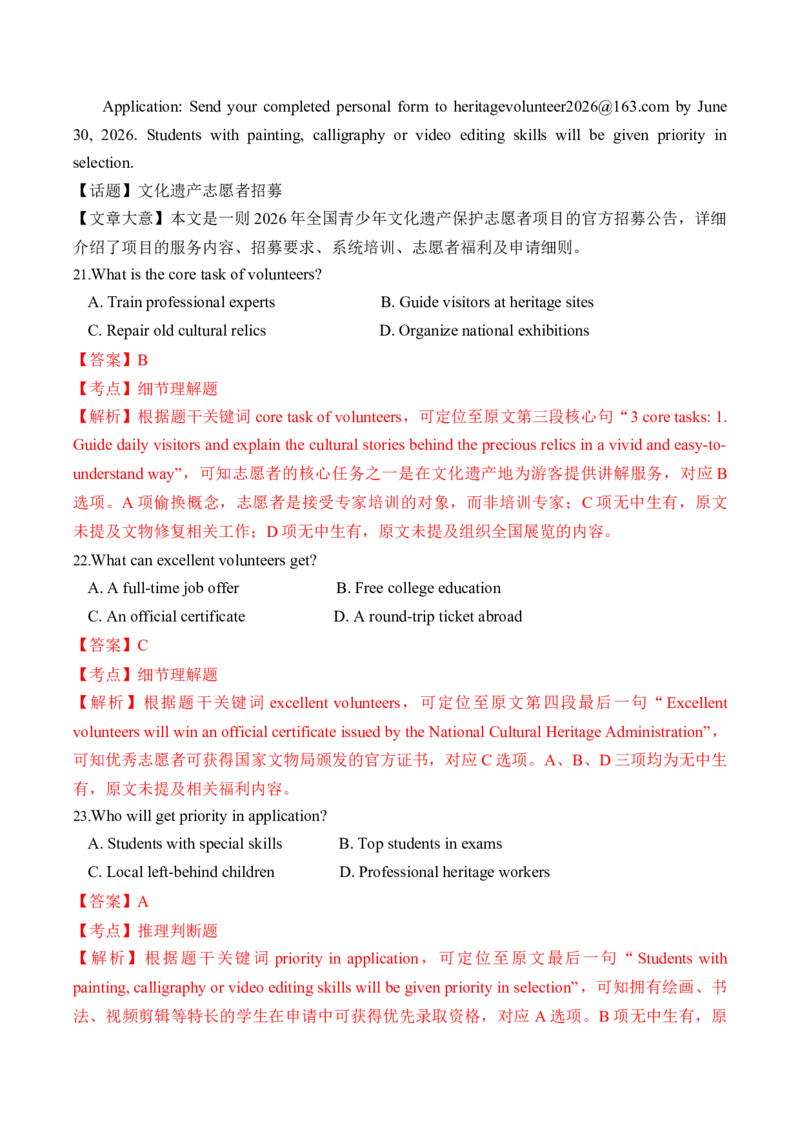
Application: Send your completed personal form to heritagevolunteer2026@163.com by June
30, 2026. Students with painting, calligraphy or video editing skills will be given priority in
selection.
【话题】文化遗产志愿者招募
【文章大意】本文是一则2026 年全国青少年文化遗产保护志愿者项目的官方招募公告,详细
介绍了项目的服务内容、招募要求、系统培训、志愿者福利及申请细则。
21.What is the core task of volunteers?
A. Train professional experts             B. Guide visitors at heritage sites
C. Repair old cultural relics              D. Organize national exhibitions
【答案】B
【考点】细节理解题
【解析】根据题干关键词core task of volunteers,可定位至原文第三段核心句“3 core tasks: 1.
Guide daily visitors and explain the cultural stories behind the precious relics in a vivid and easy-to-
understand way”,可知志愿者的核心任务之一是在文化遗产地为游客提供讲解服务,对应B
选项。A 项偷换概念,志愿者是接受专家培训的对象,而非培训专家;C 项无中生有,原文
未提及文物修复相关工作;D 项无中生有,原文未提及组织全国展览的内容。
22.What can excellent volunteers get?
A. A full-time job offer            B. Free college education
C. An official certificate           D. A round-trip ticket abroad
【答案】C
【考点】细节理解题
【解析】根据题干关键词excellent volunteers,可定位至原文第四段最后一句“Excellent
volunteers will win an official certificate issued by the National Cultural Heritage Administration”,
可知优秀志愿者可获得国家文物局颁发的官方证书,对应C 选项。A、B、D 三项均为无中生
有,原文未提及相关福利内容。
23.Who will get priority in application?
A. Students with special skills       B. Top students in exams
C. Local left-behind children        D. Professional heritage workers
【答案】A
【考点】推理判断题
【解析】根据题干关键词priority in application,可定位至原文最后一句“ Students with
painting, calligraphy or video editing skills will be given priority in selection”,可知拥有绘画、书
法、视频剪辑等特长的学生在申请中可获得优先录取资格,对应A 选项。B 项无中生有,原
文未提及考试成绩相关录取要求;C 项偷换概念,留守儿童是志愿者授课的服务对象,而非
招募对象;D 项与原文相反,项目面向高中生开放,不招募专业文物工作者。
B
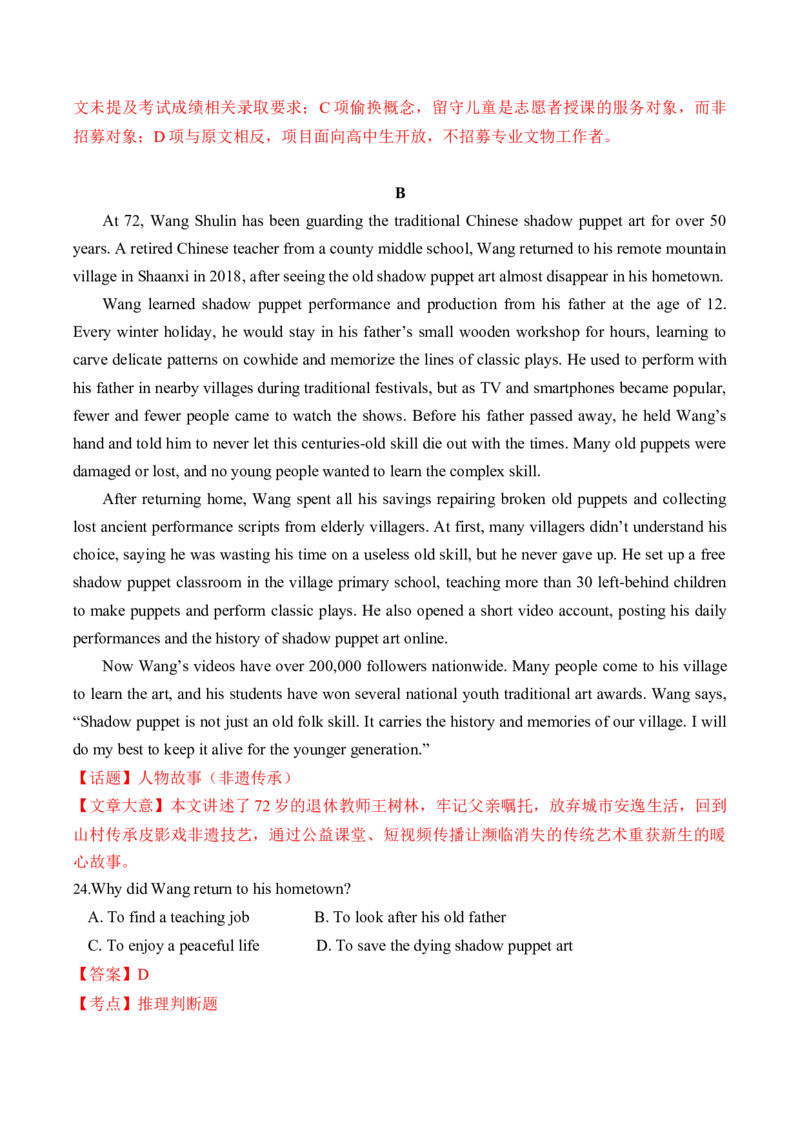
At 72, Wang Shulin has been guarding the traditional Chinese shadow puppet art for over 50
years. A retired Chinese teacher from a county middle school, Wang returned to his remote mountain
village in Shaanxi in 2018, after seeing the old shadow puppet art almost disappear in his hometown.
Wang learned shadow puppet performance and production from his father at the age of 12.
Every winter holiday, he would stay in his father’s small wooden workshop for hours, learning to
carve delicate patterns on cowhide and memorize the lines of classic plays. He used to perform with
his father in nearby villages during traditional festivals, but as TV and smartphones became popular,
fewer and fewer people came to watch the shows. Before his father passed away, he held Wang’s
hand and told him to never let this centuries-old skill die out with the times. Many old puppets were
damaged or lost, and no young people wanted to learn the complex skill.
After returning home, Wang spent all his savings repairing broken old puppets and collecting
lost ancient performance scripts from elderly villagers. At first, many villagers didn’t understand his
choice, saying he was wasting his time on a useless old skill, but he never gave up. He set up a free
shadow puppet classroom in the village primary school, teaching more than 30 left-behind children
to make puppets and perform classic plays. He also opened a short video account, posting his daily
performances and the history of shadow puppet art online.
Now Wang’s videos have over 200,000 followers nationwide. Many people come to his village
to learn the art, and his students have won several national youth traditional art awards. Wang says,
“Shadow puppet is not just an old folk skill. It carries the history and memories of our village. I will
do my best to keep it alive for the younger generation.”
【话题】人物故事(非遗传承)
【文章大意】本文讲述了72 岁的退休教师王树林,牢记父亲嘱托,放弃城市安逸生活,回到
山村传承皮影戏非遗技艺,通过公益课堂、短视频传播让濒临消失的传统艺术重获新生的暖
心故事。
24.Why did Wang return to his hometown?
A. To find a teaching job        B. To look after his old father
C. To enjoy a peaceful life       D. To save the dying shadow puppet art
【答案】D
【考点】推理判断题
【解析】根据题干关键词return to his hometown,可定位至原文第一段第二句“Wang returned
to his remote mountain village in Shaanxi in 2018, after seeing the old shadow puppet art almost
disappear in his hometown”,结合第二段父亲临终前的嘱托,可推知王树林返乡的核心目的是
拯救濒临消失的皮影戏技艺,对应D 选项。A 项偷换概念,他本身是退休教师,返乡并非为
了寻找教学工作;B、C 两项无中生有,原文未提及照顾父亲、回乡享受安逸生活的相关内
容。
25.What did Wang spend his savings on?
A. Building a new primary school
B. Repairing puppets and collecting scripts
C. Buying smartphones for children
D. Traveling around the country
【答案】B
【考点】细节理解题
【解析】根据题干关键词spend his savings,可定位至原文第三段首句“After returning home,
Wang spent all his savings repairing broken old puppets and collecting lost ancient performance
scripts from elderly villagers”,可知王树林将积蓄用于修复破损的老木偶和收集失传的古剧
本,对应B 选项。A 项偷换概念,他在村小开设免费课堂,并非出资新建学校;C、D 两项无
中生有,原文未提及相关内容。
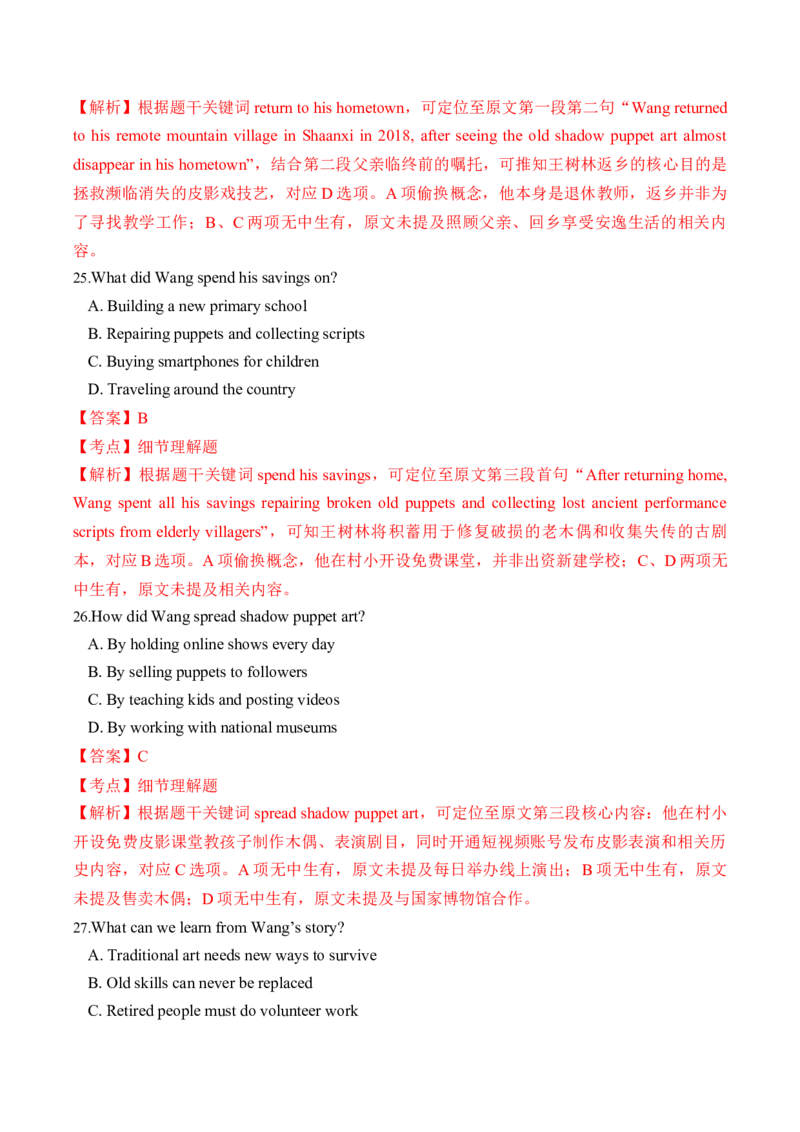
26.How did Wang spread shadow puppet art?
A. By holding online shows every day
B. By selling puppets to followers
C. By teaching kids and posting videos
D. By working with national museums
【答案】C
【考点】细节理解题
【解析】根据题干关键词spread shadow puppet art,可定位至原文第三段核心内容:他在村小
开设免费皮影课堂教孩子制作木偶、表演剧目,同时开通短视频账号发布皮影表演和相关历
史内容,对应C 选项。A 项无中生有,原文未提及每日举办线上演出;B 项无中生有,原文
未提及售卖木偶;D 项无中生有,原文未提及与国家博物馆合作。
27.What can we learn from Wang’s story?
A. Traditional art needs new ways to survive
B. Old skills can never be replaced
C. Retired people must do volunteer work
D. Rural areas need more middle schools
【答案】A
【考点】推理判断题
【解析】通读全文可知,王树林通过开设公益课堂、短视频传播等符合时代特点的新方式,
让濒临消失的皮影戏重新获得大众关注,延续了传统艺术的生命力,由此可推知“传统艺术
需要新的方式才能存续发展”,对应A 选项。B 项表述绝对化,原文未提及传统技艺“永远
不可替代”;C 项表述绝对化,并非所有退休人员都必须参与志愿工作;D 项以偏概全,文
章核心并非乡村学校建设。
C
As cities expand rapidly, large areas of natural green land are replaced by concrete buildings and
wide roads. This has led to a sharp drop in urban insect populations over the past decade, breaking
the natural balance of the local ecosystem. Many insect species that were once common in cities
have now become rare, and some have even been listed as local endangered species. Insects like wild
bees and ladybugs play a key role in pollinating flowering plants and controlling harmful pests, and
their decline will bring long-term harm to the whole urban environment. Now, a simple eco-friendly
solution is gaining popularity around the world: insect hotels.
An insect hotel is a man-made structure made of natural materials, designed to provide refugia
for insects to live, breed and spend the cold winter. Unlike common single-function bee boxes, insect
hotels are fit for hundreds of different insect species. Different materials are designed for different
insects: hollow bamboo sticks are for solitary bees, while pine cones and straw are perfect for
ladybugs and other small insects. They are usually made of recyclable things like hollow bamboo
sticks, pine cones, dry wood and straw, all easy to find in daily life.
Many cities in Europe and China have built insect hotels in community parks, school yards and
office rooftops. A 2025 study in Shanghai found that parks with insect hotels have 3 times more
insect species than those without, and the number of local flowering plants has also increased
greatly. Some schools even use insect hotels as a science education tool, letting students observe
insects and learn about ecological protection.
Experts say insect hotels are a low-cost and highly effective way to improve urban biodiversity.
They not only help protect endangered local insect species, but also let people feel closer to nature in
busy city life. Even a small insect hotel on your balcony can make a difference to the local
environment.
【话题】科普环保(城市生物多样性)
【文章大意】本文先指出城市发展导致昆虫数量锐减、破坏生态平衡的问题,随后介绍
了“昆虫旅馆”的概念、功能、搭建方式及实际应用效果,最后展望了其在城市生态建设中
的前景。
28.What problem does the first paragraph mention?
A. Urban insect populations drop sharply
B. Concrete buildings are harmful to health
C. There are too many pests in cities
D. No green land is left in cities
【答案】A
【考点】细节理解题
【解析】根据题干定位至原文第一段,核心句为“This has led to a sharp drop in urban insect
populations over the past decade, breaking the natural balance of the local ecosystem”,可知第一段
提出的核心问题是城市快速发展导致昆虫数量锐减,对应A 选项。B 项无中生有,原文未提
及混凝土建筑对人体健康的危害;C 项与原文相反,昆虫数量减少会导致害虫失控,而非城
市本身害虫过多;D 项表述绝对化,原文仅提及自然绿地面积减少,并非完全消失。
29.What does the underlined word “refugia” mean?
A. Food sources    B. Breeding seasons    C. Natural materials     D. Safe shelters
【答案】D
【考点】词义猜测题
【解析】划线词refugia 为高考考纲外超纲词,根据划线词所在句的后置定语“for insects to
live, breed and spend the cold winter” ,以及前文对昆虫旅馆的定义“ man-made structure
designed to provide safe...”,可推知refugia 的核心含义是“供昆虫生存、繁殖、越冬的安全庇
护所、栖息处”,与D 选项Safe shelters 同义。A 项“食物来源”、B 项“繁殖季节”、C
项“天然材料”均与句子核心逻辑不符,无法与“供昆虫生存、繁殖、过冬”形成匹配。
30.What is the function of the third paragraph?
A. To explain how to build insect hotels
B. To show the application effect of insect hotels
C. To put forward a new opinion on ecology
D. To give a final conclusion of the text
【答案】B
【考点】段落功能题(高考创新题型)
【解析】梳理全文行文逻辑:第一段提出城市昆虫减少的生态问题→第二段介绍昆虫旅馆的
定义、制作材料与核心功能→第三段通过国内外城市的应用案例、上海的研究数据,展示昆
虫旅馆的实际应用效果→第四段专家评价与未来前景展望。由此可知,第三段的核心功能是
展示昆虫旅馆的实际应用效果,对应B 选项。A 项错位,解释昆虫旅馆的制作原理是第二段
的功能;C 项无中生有,本段未提出新的生态观点;D 项错位,全文最终结论在第四段。
31.What do experts think of insect hotels?
A. They are only fit for big parks
B. They cost too much money
C. They help improve urban ecology
D. They will replace natural green land
【答案】C
【考点】推理判断题
【解析】根据题干关键词experts think,可定位至原文最后一段首句“Experts say insect hotels
are a low-cost and highly effective way to improve urban biodiversity”,而城市生物多样性提升是
城市生态改善的核心标志,由此可推知专家认为昆虫旅馆有助于改善城市生态,对应C 选
项。A 项与原文相反,专家认为阳台的小型昆虫旅馆也能发挥作用,并非仅适合大型公园;B
项与原文相反,昆虫旅馆是低成本的生态方案;D 项无中生有,原文未提及昆虫旅馆会取代
自然绿地。
D
In the age of booming social media, many young people are used to “fast socializing”: adding
hundreds of friends online, exchanging quick empty greetings, and joining endless meaningless
group chats. Some young people even have thousands of online friends, but can’t find a single person
to talk to when they are in a bad mood. But in recent years, more and more young people in China
are turning to “slow socializing”, and voluntarily giving up those superficial and meaningless social
connections.
Slow socializing means building deep, long-term relationships with a small group of like-
minded people, instead of making a large number of one-sided “friends” online. It focuses on sincere
and in-depth communication, rather than the number of online followers or likes on posts. For
example, instead of sending a copied holiday greeting to hundreds of contacts, you have a long face-
to-face talk with a close friend, or read a book together with a person who shares the same interest.
Many young people say fast socializing only brings them growing anxiety and a sense of
emptiness. They have to spend a lot of time maintaining online contacts, but still feel lonely and
helpless when they meet real trouble. On the contrary, slow socializing brings them a strong sense of
security and belonging. They no longer pursue the number of friends on their social accounts, but
focus on building real, heart-to-heart connections with people who truly understand them. A 2025
national survey found that over 68% of young people aged 16-25 prefer slow socializing, and most
of them have better mental health than those who prefer fast socializing.
The writer holds that slow socializing is not refusing to make friends, but choosing the right way
to connect with others. In a fast-paced society, it helps young people keep away from meaningless
social chaos, and focus on the people and things that really matter.
【话题】社会现象议论(青年社交,高考D 篇高频议论文体裁)
【文章大意】本文针对当下年轻人中兴起的“慢社交”现象展开论述,先对比了快餐式快社
交的弊端,随后分析了慢社交的核心价值,最后提出作者的核心观点:慢社交能带来更深度
的人际关系与更健康的心理状态,是年轻人对抗社交焦虑的有效方式。
32.What is the feature of slow socializing?
A. It focuses on sincere communication
B. It needs a lot of online followers
C. It happens in holiday greetings
D. It requires a large friend circle
【答案】A
【考点】细节理解题
【解析】根据题干关键词feature of slow socializing,可定位至原文第二段第二句“It focuses
on sincere and in-depth communication, rather than the number of online followers or likes on
posts”,可知慢社交的核心特征是注重真诚、深入的交流,对应A 选项。B、D 两项是快社交
的特征,与慢社交的定义完全相反;C 项偷换概念,群发复制的节日问候是快社交的典型表
现,并非慢社交的场景。
33.What does the 2025 survey show?
A. Fast socializing makes people popular
B. Slow socializing benefits mental health
C. Most young people hate online socializing
D. Less than half of people prefer slow socializing
【答案】B
【考点】推理判断题
【解析】根据题干关键词2025 survey,可定位至原文第三段最后一句“A 2025 national survey
found that over 68% of young people aged 16-25 prefer slow socializing, and most of them have
better mental health than those who prefer fast socializing”,可知调查数据显示,偏好慢社交的年
轻人心理健康状态更好,由此可推知慢社交对心理健康有益,对应B 选项。A 项无中生有,
原文未提及快社交能让人受欢迎;C 项表述绝对化,年轻人只是放弃无意义的快社交,并非
讨厌所有线上社交;D 项与原文相反,68%的年轻人偏好慢社交,远超半数。
34.What is the writer’s attitude towards slow socializing?
A. Doubtful    B. Disapproving     C. Supportive      D. Uncaring
【答案】C
【考点】观点态度题
【解析】根据原文最后一段作者的核心表述“slow socializing is not refusing to make friends,
but choosing the right way to connect with others... It helps young people keep away from
meaningless social chaos, and focus on the people and things that really matter”,可知作者认为慢
社交是一种更成熟的社交方式,对其持认可、支持的态度,对应C 选项。A 项“怀疑的”、
B 项“反对的”均与作者态度完全相反;D 项“漠不关心的”错误,作者全文围绕慢社交展
开论述,明确表达了自己的观点与态度。
35.What is the main idea of the text?
A. The harm of social media to young people
B. The ways to reduce social anxiety
C. The importance of sincere friendship
D. The rise and value of slow socializing
【答案】D
【考点】主旨大意题
【解析】通读全文可知,文章开篇提出年轻人从快社交转向慢社交的社会现象,随后解释了
慢社交的定义与核心特征,通过调查数据分析了慢社交的积极作用,最后表达了作者对慢社
交的认可与支持。全文始终围绕“慢社交的兴起与核心价值”展开,对应D 选项。A 项以偏
概全,社交媒体仅在文章开头提及,并非全文论述核心;B 项扩大范围,文章仅讨论慢社交
对社交焦虑的缓解作用,并非所有减少社交焦虑的方法;C 项偏离核心,文章重点是社交方
式的选择,而非真诚友谊的重要性。
第二节(共5 小题;每小题2. 5 分, 满分12. 5 分)
阅读下面短文, 从短文后的选项中选出可以填入空白处的最佳选项。选项中有两项为多余选
项。
High school can be a stressful time, with endless exams, heavy homework, peer pressure and
uncertainty about the future. Many students feel overwhelmed when facing setbacks, whether it’s a
poor test grade, a fight with a friend, or a missed opportunity. What they need most is resilience
(情绪韧性).  36  The good news is that this skill is not a trait you are born with — it can be
developed through small, consistent daily habits.

  37
   It’s easy to ignore your feelings when you’re busy with study, or to tell yourself to “just
stop being sad”. But ignoring negative emotions only makes them stronger. Instead, take a few
minutes every day to name what you’re feeling — whether it’s anxiety, disappointment, or anger.
Acknowledging your emotions is the first step to dealing with them in a healthy way.
The second step is to build a reliable support system.     38
       You don’t have to deal with
stress alone. Talk to a parent, a teacher, a close friend, or a school counselor about what you’re going
through. Even just sharing your feelings can make a huge difference.
Another key habit is to take care of your body, as physical and mental health are closely
connected. You don’t have to join a sports team or spend hours at the gym.  39

      Even 20 minutes
of walking outside, a short dance break can help reduce stress and improve your mood.
Finally, remember that building resilience takes time. You don’t have to be perfect, and it’s okay
to have bad days.     40
       Over time, these small habits will help you face high school challenges
with confidence, and build skills that will serve you for life.
A. Negative emotions harm daily life.
B. Keep practicing skills in small ways.
C. Small movements make a big difference.
D. Many students see asking for help as weakness.
E. The first step is to accept your true emotions.
F. This key skill can be learned through daily small habits.
G. It helps improve students’ daily study and school performance.
【答案】36.F  37.E  38.D  39.C  40.B
话题】高中生情绪韧性培养(生活与成长类)
【文章大意】本文指出情绪韧性是高中生应对挫折的关键能力,且该能力可通过日常小习惯
培养,并介绍了接纳情绪、建立支持系统等四种培养方法。
解析
36.【答案】F
【考点】段中逻辑衔接题
【解析】空格前文对核心概念“情绪韧性(resilience)”进行了定义,空格后文点明“这项
技能并非天生,可通过日常小习惯培养”。F 选项中This key skill 精准指代前文的“情绪韧
性”,既完美承接了前文的概念定义,又与后文的can be developed through small, consistent
daily habits 形成严丝合缝的逻辑呼应,衔接自然。
37.【答案】E
【考点】段首主旨题
【解析】空格位于段首,是本段的核心主旨句。后文详细阐述了“压抑负面情绪只会加剧内
耗,要学会正视、接纳自身真实情绪”的核心内容,且下一段以The second step 形成了明确
的步骤递进关系。E 选项既精准总领了本段的全部内容,又与后文的步骤形成了清晰的逻辑
呼应,完全符合文章分步骤的行文结构。
38.【答案】D
【考点】段中逻辑衔接题
【解析】空格前文提出了“建立可信赖的支持系统”的分论点,空格后文给出了“不必独自
面对压力,要主动向身边人倾诉求助”的正确做法。D 选项精准点出了高中生在寻求支持时
的普遍心理误区,既承接了前文“支持系统”的核心话题,又为后文的正确做法做了反向铺
垫,形成了“提出观点→点出普遍误区→给出正确做法”的完整逻辑闭环。
39.【答案】C
【考点】段中逻辑衔接题
【解析】空格前文提出了“不必加入运动队或花费大量时间健身”的观点,空格后文列举了
户外散步、简短跳舞、规律睡眠等无需耗费大量时间的身体护理方式。C 选项既完美承接了
前文的观点,又为后文的具体例子做了总起,前后内容高度呼应,逻辑通顺。
40.【答案】B
【考点】段尾总结升华题
【解析】空格前文提到“培养情绪韧性需要时间,不必追求完美,状态不佳是正常现象”,
空格后文对全文进行了最终升华,点明了这些小习惯的长期价值。B 选项既承接了前文“不
必完美、需要长期积累”的观点,又呼应了全文“通过小习惯培养情绪韧性”的核心主旨,
同时自然衔接了后文对长期价值的阐述,起到了承上启下的总结作用。
第三部分 语言运用(共两节,满分30 分)
第一节(共15 小题,每小题1 分,满分15 分)
阅读下面短文, 从每题所给的A、B、C 和D 四个选项中选出可以填入空白处的最佳选项。
When 17-year-old Mia sat through her high school biology lesson on the decline of native
pollinators n. 传粉昆虫, she had no idea that a simple idea would turn into a community-wide
movement. She  41  that 90% of local wild bees had lost their natural  42  as roadside grasslands
were cleared and native wildflowers were removed to keep the city neat.
Mia decided to  43  a plan: to plant native wildflowers in unused roadside areas of her
community, to provide food and shelter for the declining bees. She first went to the community
committee with her idea, but was  44  — the members worried the flowers would look like messy
weeds and damage the community’s appearance.
Instead of choosing to  45

    ,  Mia spent two weeks working with her biology teacher to make
a  46  report, including photos of successful projects from other cities, expected effects and daily
management rules. She  47  the report to the committee again, along with a 200-signature petition
from her classmates and neighbors. This time, she  48  got a 10-square-meter patch of land for a
trial.
Mia and her classmates  49  the wildflower seeds in early spring. For months, they watered,
weeded and checked the growth of the plants. By late summer, the patch was filled with blooming
flowers, and bees and butterflies began to  50

    . Neighbors who once doubted the plan were  51
by the beautiful scene and the return of the insects.
The project’s success  52  quickly. Other communities in the town began to start their own
wildflower patches, and even the local city government included the model into its 2026 urban  53
plan.
Mia says the experience taught her a valuable lesson: you don’t have to be a scientist to make a
54  to the environment.  55

    , young people with small ideas and steady determination can also
drive great changes.
41
A. learned
B. admitted
C. doubted
D. imagined
42
A. food
B. habitat
C. energy
D. knowledge
43
A. judge
B. follow
C. design
D. buy
44
A. accepted
B. praised
C. invited
D. refused
45
A. give up
B. take up
C. put off
D. hold back
46
A. vague
B. casual
C. detailed
D. difficult
47
A. returned
B. presented
C. lent
D. copied
48
A. never
B. even
C. hardly
D. eventually
49
A. removed
B. buried
C. planted
D. hid
50
A. return
B. leave
C. escape
D. wander
51
A. annoyed
B. shocked
C. disappointed
D. frightened
52
A. faded
B. spread
C. dropped
D. changed
53
A. educational
B. commercial
C. environmental
D. tourist
54
A. promise
B. choice
C. comment
D. difference
55
A. Actually
B. Therefore
C. Instead
D. Otherwise
【答案】
41.A  42.B  43.C  44.D  45.A  46.C  47.B  48.D  49.C  50.A
51.B  52.B  53.C  54.D  55.A
【话题】青少年环保实践与社区生态保护(人与自然+青年担当类)
【文章大意】本文讲述17 岁女孩米娅为保护传粉昆虫设计社区野花种植方案,历经申请波折
后试验成功,项目影响力扩散并被纳入城市环保规划的故事。
解析
41.【答案】A
【考点】动词辨析
【解析】根据前文“sat through her high school biology lesson”可知,米娅是在生物课上了解、
学习到了本土野生蜜蜂锐减的相关数据,learned 贴合课堂学习的场景与语境。
【错项分析】B 项admitted(承认)、C 项doubted(怀疑)、D 项imagined(想象)均
与“生物课学习专业知识”的语境不符,排除。
42.【答案】B
【考点】名词辨析
【解析】根据后文“as roadside grasslands were cleared and native wildflowers were removed”可
知,草地被清理、野花被移除,直接导致野生蜜蜂失去了赖以生存的自然栖息地,habitat 精
准契合语境。
【错项分析】A 项food(食物)仅为栖息地提供的配套要素,表述片面;C 项energy(能
量)、D 项knowledge(知识)与语境完全无关,排除。
43.【答案】C
【考点】动词辨析
【解析】根据后文冒号引出的计划具体内容可知,米娅为解决传粉昆虫锐减的问题,针对性
设计了一套在社区闲置土地种植野花的方案,design 符合语境。
【错项分析】A 项judge(评判)、B 项follow(跟随)、D 项buy(购买)均与“制定、设
计解决方案”的语境不符,排除。
44.【答案】D
【考点】动词辨析
【解析】根据后文破折号引出的原因“the members worried the flowers would look like messy
weeds”可知,社区委员会担心野花影响社区市容,因此拒绝了她的申请,refused 符合语境。
【错项分析】A 项accepted(接受)、B 项praised(表扬)、C 项invited(邀请)均与后文的
担忧形成相反逻辑,排除。
45.【答案】A
【考点】动词短语辨析
【解析】根据前文她首次申请被拒绝,后文她联合生物老师制作详细报告再次申请的内容可
知,她没有选择放弃,give up 贴合语境。
【错项分析】B 项take up(开始从事;占据)、C 项put off(推迟)、D 项hold back(抑
制;隐瞒)均与上下文语境不符,排除。
46.【答案】C
【考点】形容词辨析
【解析】根据后文“including photos of successful projects from other cities, expected effects and
daily management rules”可知,这份报告涵盖了多维度的详实内容,信息非常详细,detailed 符
合语境。
【错项分析】A 项vague(模糊的)、B 项casual(随意的)与后文的详细内容逻辑相反;D
项difficult(困难的)无法用于修饰报告内容,排除。
47.【答案】B
【考点】动词辨析
【解析】根据语境可知,米娅再次向社区委员会正式提交、展示了这份完善后的详细报告,
presented 为高考高频核心词,意为“提交;呈现”,贴合官方申请场景的用语规范。
【错项分析】A 项returned(归还)、C 项lent(借出)、D 项copied(复制)均与“向委员
会正式提交申请报告”的语境不符,排除。
48.【答案】D
【考点】副词辨析
【解析】根据前文她第一次申请被拒绝,本次做了充分准备的情节铺垫可知,她最终获得了
一块10 平方米的土地用于项目试验,eventually 精准契合“历经波折最终达成目标”的语
境。
【错项分析】A 项never(从不)、C 项hardly(几乎不)与语境逻辑相反;B 项even(甚
至)无法体现事件的最终结果,排除。
49.【答案】C
【考点】动词辨析
【解析】根据后文“wildflower seeds in early spring”的场景可知,米娅和同学们在早春种下了
野花种子,planted 是播种场景的固定规范用词,符合语境。
【错项分析】A 项removed(移除)、D 项hid(隐藏)与语境逻辑相反;B 项buried(埋
葬)无法用于描述规范播种的动作,排除。
50.【答案】A
【考点】动词辨析
【解析】根据全文核心主旨可知,种植野花的核心目的是让此前消失的蜜蜂和蝴蝶重新回
来,return 贴合语境,也与后文“the return of the insects”形成原词复现,是高考完形填空的高
频命题手法。
【错项分析】B 项leave(离开)、C 项escape(逃跑)与语境逻辑相反;D 项wander(徘
徊)无法体现项目的核心成效,排除。
51.【答案】B
【考点】形容词辨析
【解析】根据前文“Neighbors who once doubted the plan”可知,曾经质疑、反对计划的邻
居,被盛放的花海和回归的昆虫所震撼,shocked 精准契合“从质疑否定到亲眼见证成效后的
心理转变”。
【错项分析】A 项annoyed(恼怒的)、C 项disappointed(失望的)与语境的积极情感基调
完全相反;D 项frightened(恐惧的)不符合“质疑者看到实际成效后的第一反应”的逻辑,
排除。
52.【答案】B
【考点】动词辨析
【解析】根据后文“Other communities in the town began to start their own wildflower patches”可
知,这个项目的成功很快传播开来,spread 贴合“项目影响力从一个社区扩散到全镇”的语
境。
【错项分析】A 项faded(消退)、C 项dropped(下降)与语境逻辑相反;D 项changed(改
变)无法体现“项目影响力扩散”的核心含义,排除。
53.【答案】C
【考点】形容词辨析
【解析】根据全文“生物多样性保护、环保公益行动”的核心主题可知,当地市政府将该模
式纳入了2026 年城市环保规划,environmental 贴合全文主题语境。
【错项分析】A 项educational(教育的)、B 项commercial(商业的)、D 项tourist(旅游
的)均与全文的环保核心主题无关,排除。
54.【答案】D
【考点】名词辨析
【解析】make a difference to 是高考完形填空高频固定短语,意为“对……产生影响、带来积
极改变”,完美契合语境:你不必成为专业科学家,也能为生态环境带来改变。
【错项分析】A 项promise(承诺)、B 项choice(选择)、C 项comment(评论)均无法构
成符合语境的固定搭配,排除。
55.【答案】A
【考点】副词辨析
【解析】前文提出“不必成为科学家也能为环境带来改变”,后文补充强化观点“有着微小
想法和坚定决心的年轻人,也能推动巨大的社会变革”,前后为补充说明、强化观点的关
系,Actually(事实上)符合逻辑。
【错项分析】B 项Therefore(因此)表因果,C 项Instead(相反)表转折,D 项Otherwise
(否则)表条件,均不符合前后文的逻辑关系,排除。
第二节(共10 小题;每小题1.5 分 ,满分15 分)
阅读下面短文,在空白处填入1 个适当的单词或括号内单词的正确形式。
When 16-year-old Lila noticed her grandmother struggling to use her smartphone to video call
her cousins overseas, she launched Silver Digital Buddies,   56
     community program that matches
high school volunteers with elderly residents in her neighborhood.
The project,   57
     was started in early 2025, has now grown to include over 50 volunteers. Lila
and her team create simple, step-by-step guides   58
     (design) for elderly users, covering everything
from making video calls, using mobile payment apps   59
     accessing health services online. They
also teach volunteers how to explain tech skills  6
  0     (patient) to seniors with no digital experience.
Each week, volunteers meet one-on-one with their elderly buddies, helping them practice  6
  1
(learn) skills. Many elderly participants have shared that the program not only makes their daily lives
easier, but also helps them feel less lonely. "I used to feel scared  6
  2     my phone, but now I can
video call my granddaughter every weekend," said 78-year-old Mrs. Henderson, one of the first
people  6
  3       (join) the program.
The program  6
  4       (recognize) by the local government last month, and Lila and her team
plan to expand it to other   65
    (community) in the city this year. They also hope that more young
people will join them to help bridge the digital divide between generations.
【答案】
56.a         57.which   58.designed    59.and           60.patiently
61.learning   62.of       63.to join     64.was recognized  65.communities
【话题】青少年助力老年群体跨越数字鸿沟(社会关爱+青年行动类)
【文章大意】本文介绍16 岁女孩莱拉发起公益项目,招募高中生志愿者帮助老年人学习使用
数码产品,该项目获当地政府认可并计划进一步推广。
解析
56.【答案】a
【考点】冠词
【解析】此处泛指“一个社区项目”,community 以辅音音素开头,故填不定冠词a.
57.【答案】which
【考点】定语从句引导词
【解析】此处为非限制性定语从句,先行词为The project,指物,且从句中缺少主语,故填
关系代词which.
58.【答案】designed
【考点】非谓语动词-过去分词
【解析】句中已有谓语动词create,此处需填非谓语动词;guides 与design 之间为被动关系,
意为“为老年用户设计的指南”,故填过去分词designed.
59.【答案】and
【考点】并列连词
【解析】此处连接三个并列的动名词短语(making video calls, using mobile payment apps,
accessing health services online),表并列关系,故填并列连词and.
60.【答案】patiently
【考点】词性转换(形容词→副词)
【解析】此处修饰动词explain,需用副词形式;patient 为形容词,意为“耐心的”,其副词
形式为patiently.
61.【答案】learning
【考点】非谓语动词-动词ing 形式
【解析】practice doing sth 为高考高频固定搭配,意为“练习做某事”,此处需填动名词作宾
语,故填learning.
62.【答案】of
【考点】介词
【解析】be scared of 为高考高频固定短语,意为“害怕……”,故填介词of.
63.【答案】to join
【考点】非谓语动词-动词不定式
【解析】名词前有序数词the first 修饰时,需用动词不定式作后置定语,意为“第一批加入该
项目的人”,故填to join.
64.【答案】was recognized
【考点】动词时态+动词语态
【解析】根据时间状语last month 可知,此处用一般过去时;主语The program 与recognize 之
间为被动关系,意为“项目被当地政府认可”,故用一般过去时的被动语态,填was
recognized.
65.【答案】communities
【考点】名词单复数
【解析】other 后接可数名词复数形式,community 为可数名词,意为“社区”,其复数形式
为communities.
第四部分 写作(共两节, 满分40 分)
第一节(满分15 分)
假定你是校学生会主席李华,你校将于3 月6 日举办“中国传统非遗文化校园体验日
(Chinese Traditional Intangible Cultural Heritage Campus Experience Day)”主题活动。请你
给在你校就读的英国交换生Chris 写一封邮件,邀请他参加。内容包括:
1.活动的时间与地点;
2.活动的主要内容;
3.邀请他参加的原因。
注意:
1.写作词数应为80-100;
2.可以适当增加细节,以使行文连贯。
Dear Chris,
I'm Li Hua, chairman of our school Students' Union.


Looking forward to your early reply.
Yours,
Li Hua
参考范文
Dear Chris,
I'm Li Hua, chairman of our school Students' Union. I'm writing to sincerely invite you to our
Chinese Traditional Intangible Cultural Heritage Campus Experience Day, which will be held on
March 6 in the school lecture hall.
The event includes a professional folk artist's lecture on the history of Chinese intangible
culture, hands-on paper-cutting and Chinese knot-making experiences, all specially prepared for
students to feel the beauty of traditional culture. I know you're deeply fond of Chinese folk culture,
so this is a perfect chance for you to experience it in person.
Looking forward to your early reply.
Yours,
Li Hua
解析
一、审题核心要点拆解(高考写作避跑题核心步骤)
1.体裁:邀请信(高考全国卷近10 年考查频次最高的应用文体裁,格式、语气有明确规范)
2.人称:以第一人称为主,第二人称为辅
3.时态:以一般现在时、一般将来时为主
4.必答核心得分要点:
要点1:明确告知活动时间(3 月6 日)、地点(学校报告厅)
要点2:清晰介绍活动核心内容(非遗文化讲座、剪纸+中国结手工体验)
要点3:说明邀请原因(对方热爱中国民间文化,活动适配其兴趣需求)
5.交际要求:语气真诚礼貌,符合给外国友人写信的交际场景,无中式英语。
第二节(满分25 分)
阅读下面材料,根据其内容和所给段落开头语续写两段,使之构成一篇完整的短文。
Lin Hao, a 17-year-old key member of the school track and field team, had been training hard
for the important city trial. Only the top four teams could qualify for the provincial competition. The
team’s timing device, necessary for their daily practice, was lost the day before.
Worried that the team might lose the qualification, Lin Hao went alone at dawn to search for it
on the suburban training path. Soon the weather turned much worse: heavy snow was falling, and the
wind was blowing strongly. The path was quiet and empty, with no people or cars around.
Suddenly, a low cry broke the silence. Lin Hao ran over at once and found a junior student trembling
under a tree. He was cold and scared, for he had lost his way back to school. Worse still, Lin Hao
found there was no signal on his phone in this remote area.
Lin Hao was facing a difficult choice. If he kept searching for the timing device, the lost boy
might be in great danger in the heavy snow. If he stopped to help the boy, he might miss the only
chance to find the device, and his team would fail to take part in the trial. Standing in the snow, Lin
Hao hesitated, torn between honor and duty.
注意:
1.续写词数应为150—160 词;
2.请按如下格式在答题卡的相应位置作答。
Paragraph 1:
After a short inner struggle, Lin Hao made his decision firmly.


Paragraph 2:
Weeks later, Lin Hao received an unexpected and precious result.


参考范文
Paragraph 1:
After a short inner struggle, Lin Hao made his decision firmly. He took off his thick coat and
wrapped it around the trembling boy to keep him warm in the freezing snow. Then he held the boy’s
icy hand tightly and led him step by step back to school, making his way carefully through the heavy
snow. It took them nearly an hour to reach the school gate safely. Lin Hao didn’t leave until he saw
the boy taken good care of by his teacher and felt completely relieved.
Paragraph 2:
Weeks later, Lin Hao received an unexpected and precious result. The lost timing device was
found by a cleaner and returned to the team, so they still got the chance to compete in the provincial
trial. Besides, the school praised Lin Hao in public for his kindness and responsibility. He finally
realized that the true spirit of sports is not just winning honors, but sticking to kindness and
shouldering responsibility, which is the most valuable treasure in his teenage life.
评分细则(满分25 分)
评分档次
分数区间
核心评分标准
第五档(满
分)
21—25
情节与原文高度融合,所有伏笔闭环呼应;衔接自然,结构严谨;
句式词汇丰富准确;主题正向深刻
第四档
16—20
情节合理连贯,核心伏笔呼应;语法词汇满足任务要求;主题正确
第三档
11—15
情节基本完整,少量逻辑瑕疵;语法词汇错误不影响理解
第二档
6—10
情节脱节,连贯性差;错误较多,影响文意表达
第一档
1—5
内容偏离原文,逻辑混乱;无法传递有效信息
0 分
0
未作答、内容无关或词数严重不足
1.原文逻辑:备赛→丢设备→寻设备→遇困境→两难选择,情节推进自然,无逻辑断层;
2.续写逻辑:
第一段:坚定救人→雪地护送→平安返校,贴合「大雪、迷路、无信号」伏笔,行动链完
整;
第二段:设备找回→团队参赛→精神升华,呼应「设备遗失、团队备赛」伏笔,结局闭环合
理;
3.整体逻辑:起因→冲突→抉择→解决→升华,符合高考读后续写严谨叙事逻辑,无任何漏
洞、矛盾或不合理情节。