《2024年高考英语新课标卷真题深度解析与考后提升》
专题23 阅读理解D篇(2024全国甲卷)原卷版
(答案解析+官方评价+三年真题+词汇变式+满分策略+话题变式)
目录
一、原题呈现 P2
二、答案解析 P 3
三、官方评价 P3
四、题源网站 P 3
五、词汇变式 P5
(一)考纲词汇词形转换 P5
(二)考纲词汇识词知意 P5
(三)高频短语厚积薄发 P 5
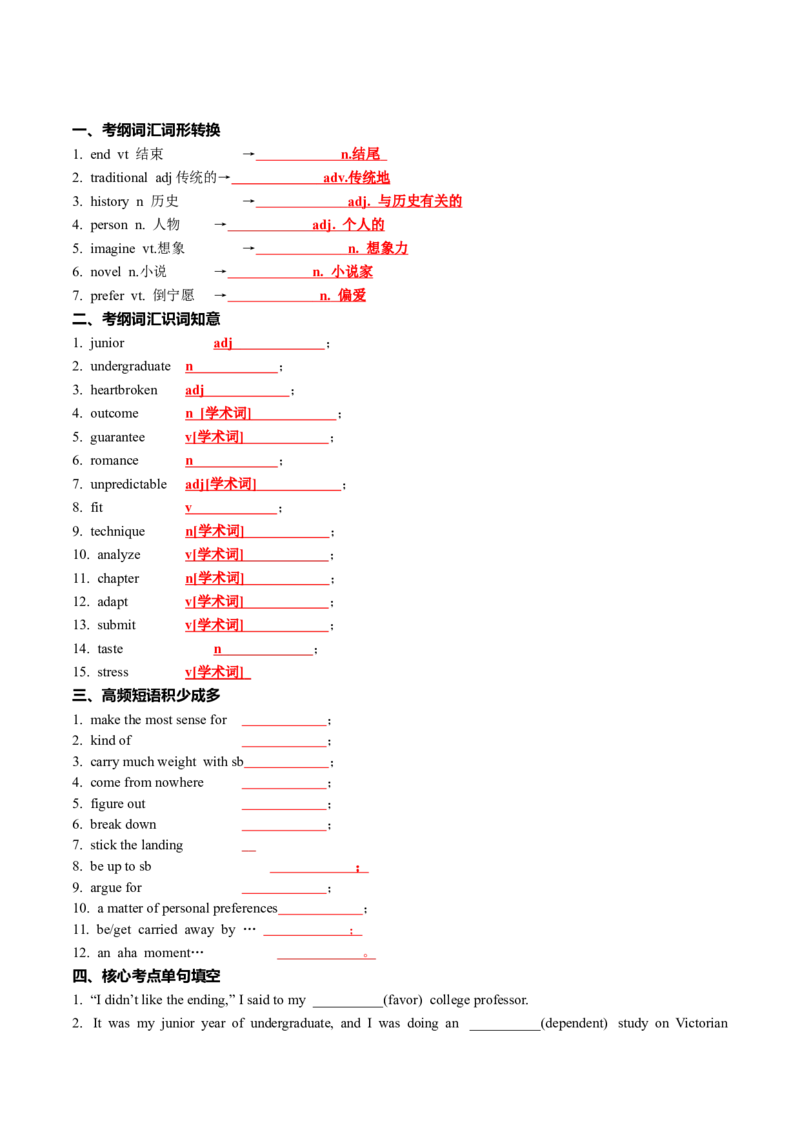
(四)真题语料单句填空 P6
(五)长难句分析 P6
六、三年真题 P 7
(一)2023 年全国甲卷阅读理解 D 篇 P7
(二)2023 年全国乙卷阅读理解 D 篇 P 8
(三)2022 年全国甲卷阅读理解 D 篇 P 9
(四)2022 年全国乙卷阅读理解 D 篇 P 10
(五)2021 年全国甲卷阅读理解 D 篇 P 11
(六)2021 年全国乙卷阅读理解 D 篇 P 12
七、满分策略(议论文) P1 3
八、话题变式 P1 3
变式一:文学课程+文学评论 6 篇 P1 4
变式二:书评 4 篇 P2 1一、原题呈现
阅读理解D篇关键词:议论文;人与社会;文学作品结尾;书评;文学创作;文学课程;关键品质;核心素养
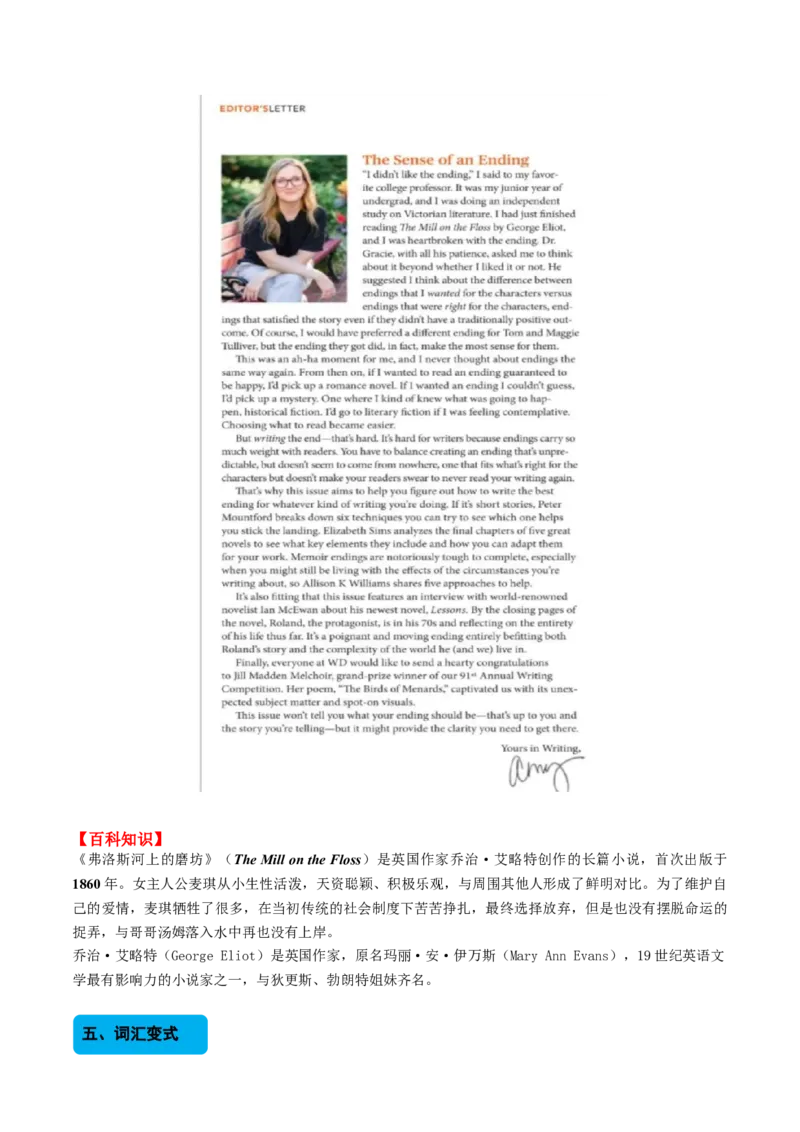
“I didn’t like the ending,” I said to my favorite college professor. It was my junior year of undergraduate,
and I was doing an independent study on Victorian literature. I had just finished reading The Mill on the Floss by
George Eliot, and I was heartbroken with the ending. Prof. Gracie, with all his patience, asked me to think about
it beyond whether I liked it or not. He suggested I think about the difference between endings that I wanted for the
characters and endings that were right for the characters, endings that satisfied the story even if they didn’t have a
traditionally positive outcome. Of course, I would have preferred a different ending for Tom and Maggie Tulliver,
but the ending they got did make the most sense for them.
This was an aha moment for me, and I never thought about endings the same way again. From then on, if I
wanted to read an ending guaranteed to be happy, I’d pick up a love romance. If I wanted an ending I couldn’t
guess, I’d pick up a mystery (悬疑小说). One where I kind of knew what was going to happen, historical fiction.
Choosing what to read became easier.
But writing the end—that’s hard. It’s hard for writers because endings carry so much weight with readers.
You have to balance creating an ending that's unpredictable, but doesn’t seem to come from nowhere, one that
fits what’s right for the characters.
That’s why this issue (期) of Writer’s Digest aims to help you figure out how to write the best ending for
whatever kind of writing you’re doing. If it’s short stories, Peter Mountford breaks down six techniques you can
try to see which one helps you stick the landing. Elizabeth Sims analyzes the final chapters of five great novels to
see what key points they include and how you can adapt them for your work.
This issue won’t tell you what your ending should be—that’s up to you and the story you’re telling—but it
might provide what you need to get there.
32. Why did the author go to Prof. Gracie?
A. To discuss a novel. B. To submit a book report.
C. To argue for a writer. D. To ask for a reading list.
33. What did the author realize after seeing Gracie?
A. Writing is a matter of personal preferences.
B. Readers are often carried away by character.
C. Each type of literature has its unique end.
D. A story which begins well will end well.
34. What is expected of a good ending?
A It satisfies readers’ taste. B. It fits with the story development.
C. It is usually positive. D. It is open for imagination.
35. Why does the author mention Peter Mountford and Elizabeth Sims?
A. To give examples of great novelists. B. To stress the theme of this issue.
C. To encourage writing for the magazine. D. To recommend their new books.二、答案解析
三、官方评价
结合生活实际,强调学用融合互促
2024年高考英语命题选取贴近学生学习和生活实际的语篇,通过设置真实易懂的试题情
境,考查学生运用英语进行日常交际以及使用英语解决实际问题的能力,引导学生理解并掌
握学以致用、以用促学的方法,提高英语学习效率。听力部分设置了日常对话、电话访谈、
专题讨论、主持发言、通知报告等常见场景,话题包括大学入学、校园活动、天气情况、交
通方式、课后作业等,易于考生带入情境、理解材料。全国甲卷阅读D篇选取的语篇围绕文
学作品结尾的创作进行探讨,为学生平时欣赏文学作品和开展写作练习提供了有益建议。新
课标Ⅰ卷阅读第二节选取的语篇介绍了作者使用英语词典的经验、心得与乐趣,引导学生在
日常学习和运用英语的过程中充分利用好各类词典。新课标Ⅱ卷阅读第二节选取的语篇围绕
过度旅游的问题进行探讨并给出应对建议,利用社会热点话题引导学生关注现实生活中的问
题并思考解决办法。【中国考试·教育部教育考试院】
四、题源网站
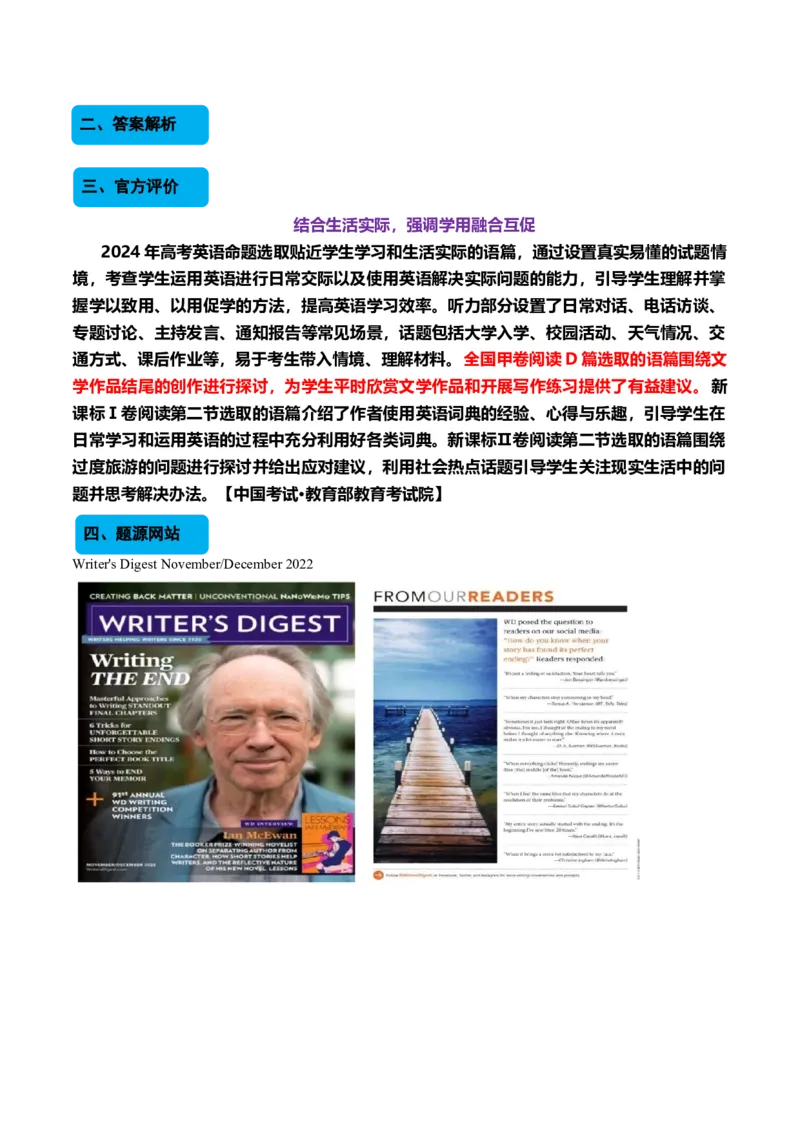
Writer's Digest November/December 2022【百科知识】
《弗洛斯河上的磨坊》(The Mill on the Floss)是英国作家乔治·艾略特创作的长篇小说,首次出版于
1860年。女主人公麦琪从小生性活泼,天资聪颖、积极乐观,与周围其他人形成了鲜明对比。为了维护自
己的爱情,麦琪牺牲了很多,在当初传统的社会制度下苦苦挣扎,最终选择放弃,但是也没有摆脱命运的
捉弄,与哥哥汤姆落入水中再也没有上岸。
乔治·艾略特(George Eliot)是英国作家,原名玛丽·安·伊万斯(Mary Ann Evans),19世纪英语文
学最有影响力的小说家之一,与狄更斯、勃朗特姐妹齐名。
五、词汇变式一、考纲词汇词形转换
1. end vt 结束 → n . 结尾
2. traditional adj传统的→ adv . 传统地
3. history n 历史 → adj . 与历史有关的
4. person n. 人物 → adj . 个人的
5. imagine vt.想象 → n . 想象力
6. novel n.小说 → n . 小说家
7. prefer vt. 倒宁愿 → n . 偏爱
二、考纲词汇识词知意
1. junior adj ;
2. undergraduate n ;
3. heartbroken adj ;
4. outcome n [ 学术词 ] ;
5. guarantee v[ 学术词 ] ;
6. romance n ;
7. unpredictable adj[ 学术词 ] ;
8. fit v ;
9. technique n[ 学术词 ] ;
10. analyze v[ 学术词 ] ;
11. chapter n[ 学术词 ] ;
12. adapt v[ 学术词 ] ;
13. submit v[ 学术词 ] ;
14. taste n ;
15. stress v[ 学术词 ]
三、高频短语积少成多
1. make the most sense for ;
2. kind of ;
3. carry much weight with sb ;
4. come from nowhere ;
5. figure out ;
6. break down ;
7. stick the landing
8. be up to sb ;
9. argue for ;
10. a matter of personal preferences ;
11. be/get carried away by … ;
12. an aha moment… 。
四、核心考点单句填空
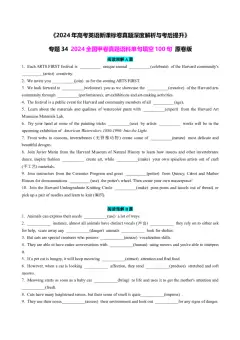
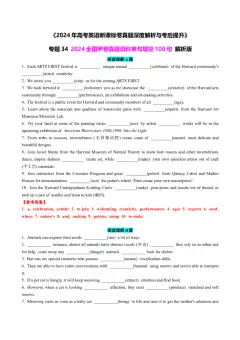
1. “I didn’t like the ending,” I said to my __________(favor) college professor.
2. It was my junior year of undergraduate, and I was doing an __________(dependent) study on Victorianliterature.
3. I had just finished __________(read) The Mill on the Floss by George Eliot, and I was heartbroken with the
ending.
4. Prof. Gracie, with all his __________(patient), asked me to think about it beyond __________ I liked it or not.
5. He suggested I __________(think) about the difference between endings that I wanted for the characters and
endings that were right for the characters, endings that __________(satisfy) the story even if they didn’t have a
__________(traditional) positive outcome.
6. Of course, I would __________(prefer) a different ending for Tom and Maggie Tulliver, but the ending they
got did make the most sense for them.
7. This was __________ aha moment for me, and I never thought about endings __________ same way again.
8. From then on, if I wanted to read an ending __________(guarantee) to be happy, I’d pick up a love romance.
9. If I wanted an ending I couldn’t guess, I’d pick __________ a mystery (悬疑小说).
10. One where I kind of knew what was going to happen, __________(history) fiction. Choosing __________ to
read became easier.
11. But writing the end—that’s hard. It’s hard for writers because endings carry so much __________(weigh)
with readers.
12. You have to balance creating an ending that's __________(predictable), but doesn’t seem to come from
__________, one that fits what’s right for the characters.
13. That’s __________ this issue (期) of Writer’s Digest aims to help you figure out how to write the best ending
for whatever kind of writing you’re doing.
14. If it’s short stories, Peter Mountford breaks __________ six techniques you can try to see __________ one
helps you stick the landing.
15. Elizabeth Sims analyzes the final chapters of five great novels __________(see) what key points they include
and how you can adapt them for your work.
16. This issue won’t tell you what your ending should be—that’s up to you and the story you’re telling—but it
might provide __________ you need to get there.
五、长难句分析
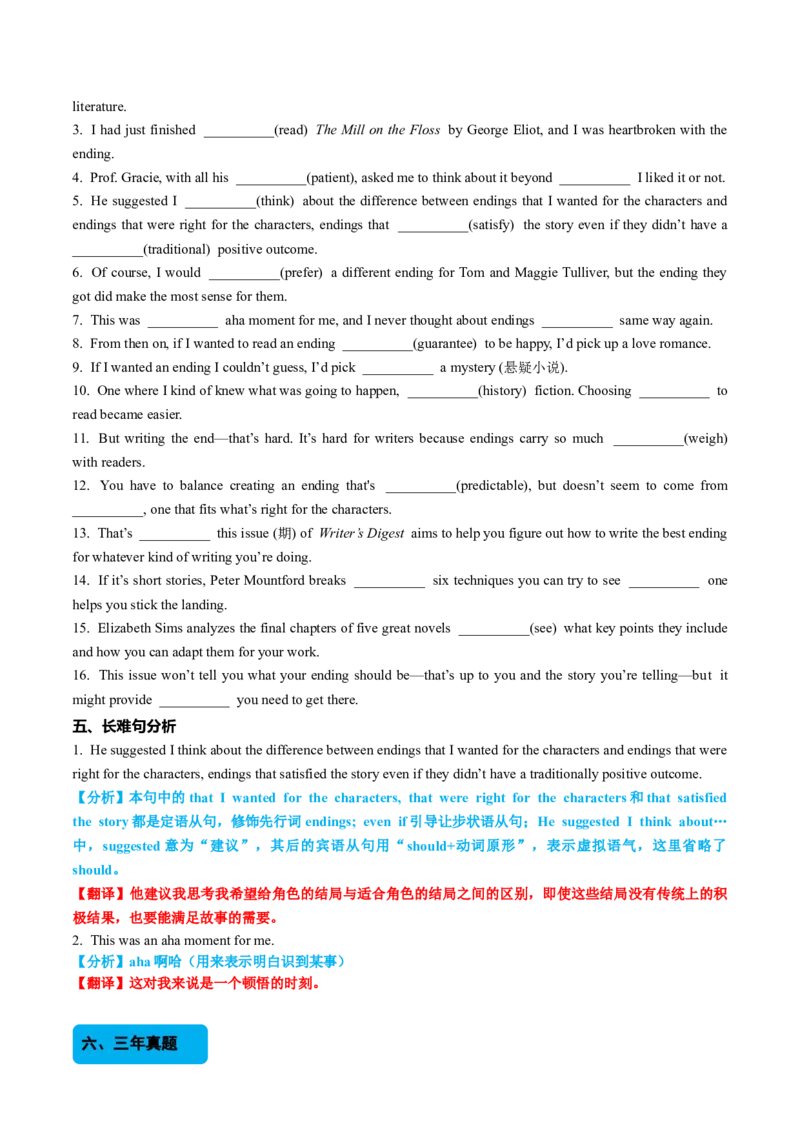
1. He suggested I think about the difference between endings that I wanted for the characters and endings that were
right for the characters, endings that satisfied the story even if they didn’t have a traditionally positive outcome.
【分析】本句中的that I wanted for the characters, that were right for the characters和that satisfied
the story都是定语从句,修饰先行词endings; even if引导让步状语从句;He suggested I think about…
中,suggested意为“建议”,其后的宾语从句用“should+动词原形”,表示虚拟语气,这里省略了
should。
【翻译】他建议我思考我希望给角色的结局与适合角色的结局之间的区别,即使这些结局没有传统上的积
极结果,也要能满足故事的需要。
2. This was an aha moment for me.
【分析】aha啊哈(用来表示明白识到某事)
【翻译】这对我来说是一个顿悟的时刻。
六、三年真题【2023年全国甲卷阅读理解D篇】
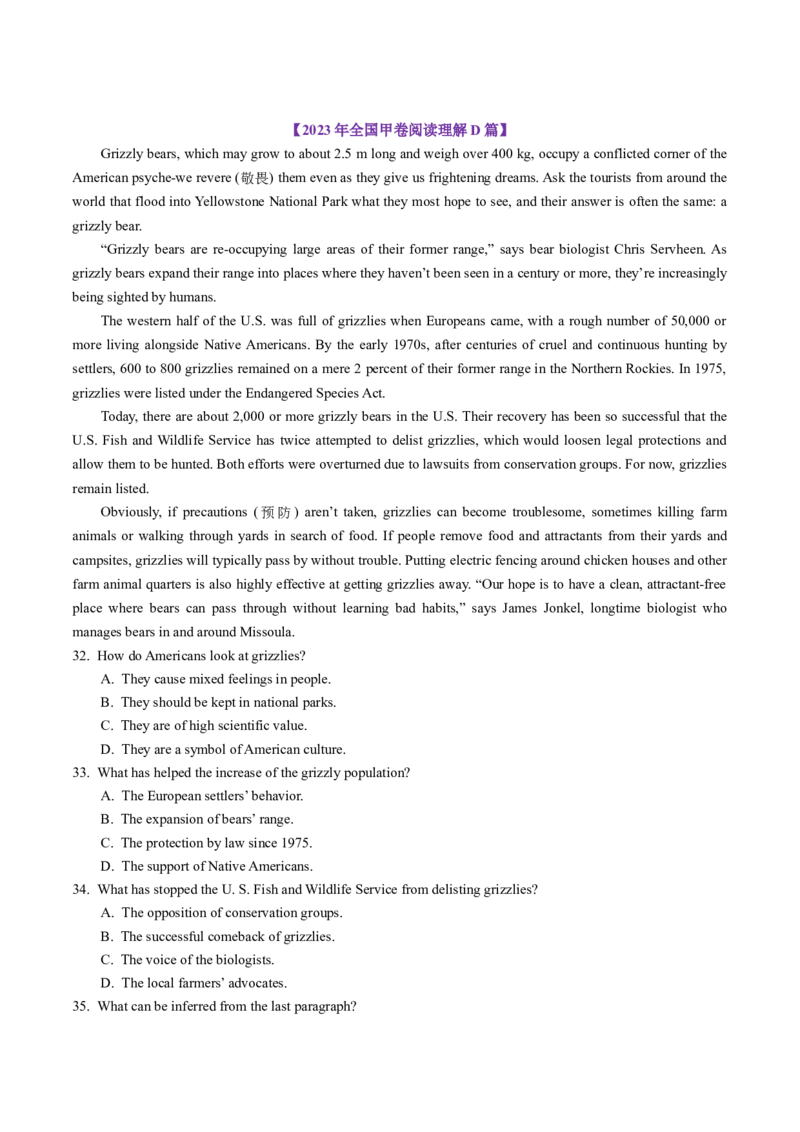
Grizzly bears, which may grow to about 2.5 m long and weigh over 400 kg, occupy a conflicted corner of the
American psyche-we revere (敬畏) them even as they give us frightening dreams. Ask the tourists from around the
world that flood into Yellowstone National Park what they most hope to see, and their answer is often the same: a
grizzly bear.
“Grizzly bears are re-occupying large areas of their former range,” says bear biologist Chris Servheen. As
grizzly bears expand their range into places where they haven’t been seen in a century or more, they’re increasingly
being sighted by humans.
The western half of the U.S. was full of grizzlies when Europeans came, with a rough number of 50,000 or
more living alongside Native Americans. By the early 1970s, after centuries of cruel and continuous hunting by
settlers, 600 to 800 grizzlies remained on a mere 2 percent of their former range in the Northern Rockies. In 1975,
grizzlies were listed under the Endangered Species Act.
Today, there are about 2,000 or more grizzly bears in the U.S. Their recovery has been so successful that the
U.S. Fish and Wildlife Service has twice attempted to delist grizzlies, which would loosen legal protections and
allow them to be hunted. Both efforts were overturned due to lawsuits from conservation groups. For now, grizzlies
remain listed.
Obviously, if precautions (预防) aren’t taken, grizzlies can become troublesome, sometimes killing farm
animals or walking through yards in search of food. If people remove food and attractants from their yards and
campsites, grizzlies will typically pass by without trouble. Putting electric fencing around chicken houses and other
farm animal quarters is also highly effective at getting grizzlies away. “Our hope is to have a clean, attractant-free
place where bears can pass through without learning bad habits,” says James Jonkel, longtime biologist who
manages bears in and around Missoula.
32. How do Americans look at grizzlies?
A. They cause mixed feelings in people.
B. They should be kept in national parks.
C. They are of high scientific value.
D. They are a symbol of American culture.
33. What has helped the increase of the grizzly population?
A. The European settlers’ behavior.
B. The expansion of bears’ range.
C. The protection by law since 1975.
D. The support of Native Americans.
34. What has stopped the U. S. Fish and Wildlife Service from delisting grizzlies?
A. The opposition of conservation groups.
B. The successful comeback of grizzlies.
C. The voice of the biologists.
D. The local farmers’ advocates.
35. What can be inferred from the last paragraph?A. Food should be provided for grizzlies.
B. People can live in harmony with grizzlies.
C. A special path should be built for grizzlies.
D. Technology can be introduced to protect grizzlies.
【2023年全国乙卷阅读理解D篇】
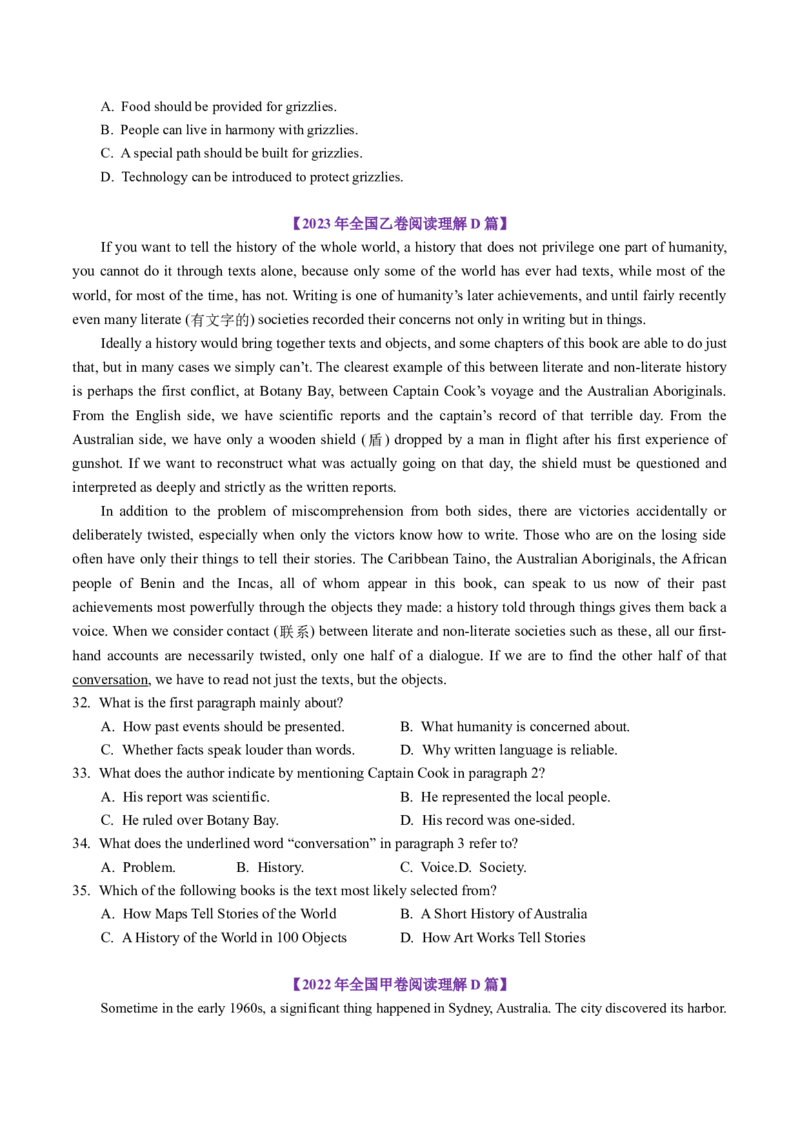
If you want to tell the history of the whole world, a history that does not privilege one part of humanity,
you cannot do it through texts alone, because only some of the world has ever had texts, while most of the
world, for most of the time, has not. Writing is one of humanity’s later achievements, and until fairly recently
even many literate (有文字的) societies recorded their concerns not only in writing but in things.
Ideally a history would bring together texts and objects, and some chapters of this book are able to do just
that, but in many cases we simply can’t. The clearest example of this between literate and non-literate history
is perhaps the first conflict, at Botany Bay, between Captain Cook’s voyage and the Australian Aboriginals.
From the English side, we have scientific reports and the captain’s record of that terrible day. From the
Australian side, we have only a wooden shield (盾) dropped by a man in flight after his first experience of
gunshot. If we want to reconstruct what was actually going on that day, the shield must be questioned and
interpreted as deeply and strictly as the written reports.
In addition to the problem of miscomprehension from both sides, there are victories accidentally or
deliberately twisted, especially when only the victors know how to write. Those who are on the losing side
often have only their things to tell their stories. The Caribbean Taino, the Australian Aboriginals, the African
people of Benin and the Incas, all of whom appear in this book, can speak to us now of their past
achievements most powerfully through the objects they made: a history told through things gives them back a
voice. When we consider contact (联系) between literate and non-literate societies such as these, all our first-
hand accounts are necessarily twisted, only one half of a dialogue. If we are to find the other half of that
conversation, we have to read not just the texts, but the objects.
32. What is the first paragraph mainly about?
A. How past events should be presented. B. What humanity is concerned about.
C. Whether facts speak louder than words. D. Why written language is reliable.
33. What does the author indicate by mentioning Captain Cook in paragraph 2?
A. His report was scientific. B. He represented the local people.
C. He ruled over Botany Bay. D. His record was one-sided.
34. What does the underlined word “conversation” in paragraph 3 refer to?
A. Problem. B. History. C. Voice.D. Society.
35. Which of the following books is the text most likely selected from?
A. How Maps Tell Stories of the World B. A Short History of Australia
C. A History of the World in 100 Objects D. How Art Works Tell Stories
【2022年全国甲卷阅读理解D篇】
Sometime in the early 1960s, a significant thing happened in Sydney, Australia. The city discovered its harbor.Then, one after another, Sydney discovered lots of things that were just sort of there — broad parks, superb
beaches, and a culturally diverse population. But it is the harbor that makes the city.
Andrew Reynolds, a cheerful fellow in his early 30s, pilots Sydney ferryboats for a living. I spent the whole
morning shuttling back and forth across the harbor. After our third run Andrew shut down the engine, and we went
our separate ways — he for a lunch break, I to explore the city.
“I’ll miss these old boats,” he said as we parted.
“How do you mean?” I asked.
“Oh, they’re replacing them with catamarans. Catamarans are faster, but they’re not so elegant, and they’re not
fun to pilot. But that’s progress, I guess.”
Everywhere in Sydney these days, change and progress are the watchwords (口号), and traditions are
increasingly rare. Shirley Fitzgerald, the city’s official historian, told me that in its rush to modernity in the 1970s,
Sydney swept aside much of its past, including many of its finest buildings. “Sydney is confused about itself,” she
said. “We can’t seem to make up our minds whether we want a modern city or a traditional one. It’s a conflict that
we aren’t getting any better at resolving (解决).”
On the other hand, being young and old at the same time has its attractions. I considered this when I met a
thoughtful young businessman named Anthony. “Many people say that we lack culture in this country,” he told me.
“What people forget is that the Italians, when they came to Australia, brought 2000 years of their culture, the
Greeks some 3000 years, and the Chinese more still. We’ve got a foundation built on ancient cultures but with a
drive and dynamism of a young country. It’s a pretty hard combination to beat.”
He is right, but I can’t help wishing they would keep those old ferries.
32. What is the first paragraph mainly about?
A. Sydney’s striking architecture. B. The cultural diversity of Sydney.
C. The key to Sydney’s development. D. Sydney’s tourist attractions in the 1960s.
33. What can we learn about Andrew Reynolds?
A. He goes to work by boat. B. He looks forward to a new life.
C. He pilots catamarans well. D. He is attached to the old ferries.
34. What does Shirley Fitzgerald think of Sydney?
A. It is losing its traditions. B. It should speed up its progress.
C. It should expand its population. D. It is becoming more international.
35. Which statement will the author probably agree with?
A. A city can be young and old at the same time.
B. A city built on ancient cultures is more dynamic.
C. modernity is usually achieved at the cost of elegance.
D. Compromise should be made between the local and the foreign.
【2022年全国乙卷阅读理解D篇】
The Government's sugar tax on soft drinks has brought in half as much money as Ministers first predicted it
would generate, the first official data on the policy has shown.
First announced in April, 2016, the tax which applies to soft drinks containing more than 5g of sugar per100ml, was introduced to help reduce childhood obesity(肥胖). It is believed that today's children and teenagers
are consuming three times the recommended level of sugar, putting them at a higher risk of the disease.
Initially the sugar tax was expected to make £520m a year for the Treasury. However, data of the first six
months showed it would make less than half this amount. At present it is expected to generate £240m for the year
ending in April 2019, which will go to school sports.
It comes after more than half of soft drinks sold in shops have had their sugar levels cut by manufacturers(制
造商)so they can avoid paying the tax. Drinks now contain 45 million fewer kilos of sugar as a result of
manufacturers' efforts to avoid the charge, according to Treasury figures. Since April drinks companies have been
forced to pay between 18p and 24p for every litre of sugary drink they produce or import, depending on the sugar
content.
However, some high sugar brands, like Classic Coca Cola, have accepted the sugar tax and are refusing to
change for fear of upsetting consumers. Fruit juices, milk-based drinks and most alcoholic drinks are free of the tax,
as are small companies manufacturing fewer than 1m litres per year.
Today's figures, according to one government official, show the positive influence the sugar tax is having by
raising millions of pounds for sports facilities(设施)and healthier eating in schools. Helping the next generation
to have a healthy and active childhood is of great importance, and the industry is playing its part.
12. Why was the sugar tax introduced?
A. To collect money for schools. B. To improve the quality of drinks.
C. To protect children’s health. D. To encourage research in education.
13. How did some drinks companies respond to the sugar tax?
A. They turned to overseas markets.
B. They raised the prices of their products.
C. They cut down on their production.
D. They reduced their products’ sugar content.
14. From which of the following is the sugar tax collected?
A. Most alcoholic drinks. B. Milk-based drinks.
C. Fruit juices. D. Classic Coke.
15. What can be inferred about the adoption of the sugar tax policy?
A. It is a short-sighted decision. B. It is a success story.
C. It benefits manufacturers. D. It upsets customers.
【2021年全国甲卷阅读理解D篇】
Who is a genius? This question has greatly interested humankind for centuries.
Let's state clearly: Einstein was a genius. His face is almost the international symbol for genius. But we want
to go beyond one man and explore the nature of genius itself. Why is it that some people are so much more
intelligent or creative than the rest of us? And who are they?
In the sciences and arts, those praised as geniuses were most often white men, of European origin. Perhaps this
is not a surprise. It's said that history is written by the victors, and those victors set the standards for admission to
the genius club. When contributions were made by geniuses outside the club—women, or people of a different
color or belief—they were unacknowledged and rejected by others.A study recently published by Science found that as young as age six, girls are less likely than boys to say that
members of their gender (性别) are “really, really smart.” Even worse, the study found that girls act on that belief:
Around age six they start to avoid activities said to be for children who are “really, really smart.” Can our planet
afford to have any great thinkers become discouraged and give up? It doesn't take a genius to know the answer:
absolutely not.
Here's the good news. In a wired world with constant global communication, we're all positioned to see flashes
of genius wherever they appear. And the more we look, the more we will see that social factors(因素)like gender,
race, and class do not determine the appearance of genius. As a writer says, future geniuses come from those with
“intelligence, creativity, perseverance (毅力), and simple good fortune, who are able to change the world.”
12. What does the author think of victors' standards for joining the genius club?
A. They're unfair. B. They're conservative. C. They're objective. D. They're strict.
13. What can we infer about girls from the study in Science?
A. They think themselves smart.
B. They look up to great thinkers.
C. They see gender differences earlier than boys.
D. They are likely to be influenced by social beliefs
14. Why are more geniuses known to the public?
A. Improved global communication.
B. Less discrimination against women.
C. Acceptance of victors' concepts.
D. Changes in people's social positions.
15. What is the best title for the text?
A. Geniuses Think Alike
B. Genius Takes Many Forms
C. Genius and Intelligence
D. Genius and Luck
【2021年全国乙卷阅读理解D篇】
During an interview for one of my books, my interviewer said something I still think about often. Annoyed by
the level of distraction(干扰)in his open office, he said, “That’s why I have a membership at the coworking space
across the street — so I can focus”. His comment struck me as strange. After all, coworking spaces also typically
use an open office layout(布局). But I recently came across a study that shows why his approach works.
The researchers examined various levels of noise on participants as they completed tests of creative thinking.
They were randomly divided into four groups and exposed to various noise levels in the background, from total
silence to 50 decibels(分贝), 70 decibels, and 85 decibels. The differences between most of the groups were
statistically insignificant; however, the participants in the 70 decibels group — those exposed to a level of noise
similar to background chatter in a coffee shop — significantly outperformed the other groups. Since the effectswere small, this may suggest that our creative thinking does not differ that much in response to total silence and 85
decibels of background noise.
But since the results at 70 decibels were significant, the study also suggests that the right level of background
noise — not too loud and not total silence — may actually improve one’s creative thinking ability. The right level
of background noise may interrupt our normal patterns of thinking just enough to allow our imaginations to wander,
without making it impossible to focus. This kind of “distracted focus” appears to be the best state for working on
creative tasks.
So why do so many of us hate our open offices? The problem may be that in our offices, we can’t stop
ourselves from getting drawn into others’ conversations while we’re trying to focus. Indeed, the researchers found
that face-to-face interactions and conversations affect the creative process, and yet a coworking space or a coffee
shop provides a certain level of noise while also providing freedom from interruptions.
32. Why does the interviewer prefer a coworking space?
A. It helps him concentrate.
B. It blocks out background noise.
C. It has a pleasant atmosphere.
D. It encourages face-to-face interactions.
33. Which level of background noise may promote creative thinking ability?
A. Total silence. B. 50 decibels C. 70 decibels. D. 8 5 decibels.
34. What makes an open office unwelcome to many people?
A. Personal privacy unprotected.
B. Limited working space.
C. Restrictions on group discussion.
D. Constant interruptions.
35. What can we infer about the author from the text?
A. He’s a news reporter.
B. He’s an office manager.
C. He’s a professional designer.
D. He’s a published writer.
七、满分策略
阅读理解议论文满分策略
议论文是英语中的重要文体,在阅读理解中占有一定的比例。议论文就是说理性的文章,一般由论点、
论据和论证过程组成。议论文都要提出论题、观点、提供充分的证据,使用一定的逻辑方法证明观点或得
出结论。
议论文涉及的论题具有生活化的特征,与社会生活密切相关。从命题上看,议论文阅读理解以考查细
节理解和推理判断为主,偶尔考查文章的主旨大意和作者的情感态度。考生在平时的阅读训练中要阅读一
定数量的议论文,以了解和掌握议论文的结构和行文特征。
【考情分析】议论文涉及的论题具有生活化的特征,与社会生活密切相关。从命题上看,议论文阅读理解以考查细
节理解和推理判断为主,但不排除对观点态度的考查。考生在平时的阅读训练中要阅读一定数量的议论文,
以了解和掌握议论文的结构和行文特征。
1. 语言与结构特点
议论文应该观点明确、论据充分、语言精练、论证合理、有严密的逻辑性。议论文通常采用三段论式
的结构,即“提出问题(引论)—分析问题(本论)—解决问题(结论)”。由此可见,要理解议论文有
两个关键点,一是要弄清文章的论点是什么、采用了哪些论据、如何论证;二是要理清其基本结构——三
段论式结构。
2. 答题误区
议论文阅读理解题易错点往往在于事实与观点的区分以及观点本身。解题时,一要弄清哪些是所引述
的事实,哪些是作者的观点以及引述中不同人物的观点;二要弄清作者真正的观点是什么,既要考虑全文,
又要重视结论部分,谨防将文章中引述的某人的观点和作者的观点混为一谈。
阅读理解议论文解题秘笈
一、抓住论点找主旨。
阅读议论文最重要的是抓住文章的论点,找到文章的论点也就把握了文章的主旨。一般来说,作者会
在开头段落交代文章的论点,因此,细读文章首段尤为重要。
议论文多采用“倒三角形”结构,因此“首段”和“段首”就是做题最大的要领,据此可以做好写作
意图题、主旨大意题和标题推断题。
二、理清文章结构。
议论文一般采用“总分总”的结构,作者先给出论点,然后从不同方面(正面,反面)进行论证,最
后给出总结或者自己的观点。文章中会出现较为明显的转折,递进,并列或者归纳总结等的逻辑关系词。
考生在阅读时,要理清文章结构,找到论点的基础上进而理解作者给出的论据,突破细节理解题和推理判
断题。
三、体会语言特点。
能否正确把握作者的观点和态度是体现阅读能力的重要方面。一般来说,对作者的总的态度和倾向,
必须在通读全文,掌握了论点和论据后,方能做出判断。在判断作者观点态度时,我们应注意,有时候作
者的观点和态度并不是明确地表达出来的,需要我们认真体察。做推理判断时,一定要遵循逻辑规律,以
事实为依据进行合理的推理。
四、注意干扰项特点。
①包含项原则
在答案选项分析中,假如对A选项的理解概括了对其他三项 (或其中某一项)的理解,那么我们就说选
项A与其他三项是包含或概括关系,包含项A往往就是正确答案。如在"花"与"玫瑰"两选项中,正确
答案肯定是"花",花包含了玫瑰。
②正反项原则
所谓正反项,是指两选项陈述的命题完全相矛盾。两个相互矛盾的陈述不能都是假的,其中必有一真。
所以,假如四选项中A、B互为正反项,那我们通常先排除C、D项,正确答案一般在A、B项当中。
③委婉项原则
所谓委婉,这里是指说话不能说死,要留有余地。阅读理解选项中语气平和、委婉的往往是正确答案。
这些选项一般含有不十分肯定或试探性语气的表达,如:probably, possibly, may, usually, might, most of,more or less, relatively, be likely to, not necessary, although, yet, in addition, tend to等等,而含有绝对
语气的表达往往不是正确答案,如:must, always, never, all, every, any, merely, only, completely, none,
hardly, already等等。
④同形项原则
命题者往往先将正确答案设置在一个大命题范围,然后通过语言形式的细微变化来考查考生的理解能
力与分析能力。同形项原则告诉我们:词汇与句法结构相似的选项中有正确答案的存在。
⑤常识项原则
议论文中,那些符合一般常识、意义深刻富有哲理、符合一般规律、属于普遍现象的往往是正确答案。
⑥因果项原则
阅读理解的逻辑推理基本都是通过因果链进行的,前因后果,一步步循序渐进。然而,在推理题的选
项中,有的选项会推理不到位(止于前因),或者推理过头(止于后果),这就是所谓的干扰项。因果项原则启
示我们:假如四个选项中有两项互为同一事物推理过程中的因果关系,那么正确答案就是两个因果项中的
其中之一。如果因项可产生几个结果,那么答案就是因;如果果项可以对应几个原因,那么答案就是果。
八、话题变式
变式一:文学课程+文学评论6篇
Stories of immigrants attract me a lot, especially the life stories of Italians who have come to America since
the 1700s. In each of these stories I see elements of my own story, that of leaving my birthplace and family and
creating a new life in a different culture and in a different language.
The child of Italian immigrants and an award-winning scholar of Italian literature, in the book My Two
Italies, Joseph Luzzi struggled to create or find his own identity from an early age. Even more problematic for him
was “which” Italy to “choose,” the one he inherited from his family, poor and linked to old traditions and customs
he finds rude and somewhat cruel, or the one he finds in literature and art books that show him a country with a
modern literary culture.
The choice becomes even sadder as in his professional life he becomes a scholar of Italian literature and
culture. He describes episodes of his youth that show the clash between the first and the second generation
immigrants that are both funny and tragicomic (悲喜剧式的). These episodes highlight the daily customs his
parents brought from their hometown that are in conflict with Joseph’s desire to “fit in” the American culture.
Joseph’s visits to Italy as a student and then as a scholar deepen the divide between his two Italies and highlight his
quest for identity.
The author’s personal changes are full of quotes and comments on the cultural and political landscape of
Italy. I find that his insights on contemporary Italian cultural and political phenomena are particularly interesting. In
this book, Joseph touches or comments in depth about several issues concerning Italian life, such as the relationship
between dialects and the official “Italian” language, and the Southern “question” or the uneasy interaction between
Northern and Southern Italians.
I enjoyed reading this book. It is personal, moving, educational and entertainment. I hope you will enjoy it
too!1.Why is the author interested in stories of immigrants?
A.He left his birthplace to go to America. B.He was a child of Italian immigrants.
C.He lived in America as an immigrant. D.He likes to learn the Italian language.
2.Which of the following is more difficult for Joseph to deal with?
A.Seeking out the the true Italian within himself.
B.Inheriting traditions and customs from his family.
C.Bridging the gap between the rude and modern culture.
D.Finding the country with a modern literacy culture.
3.What does the underlined word “clash” mean in paragraph 3?
A.Interaction. B.Divide. C.Difference. D.Conflict.
4.What can we learn from Joseph’s life?
A.He developed the desire of fitting in American culture after his first visit to Italy.
B.Deep understanding of Italian culture and politics helped him settle inner changes.
C.Joseph’s parents hardly required him to inherit traditional Italian culture and customs.
D.Issues concerning Italian life had a positive impact on the relation within his family.
What are your strongest memories of reading and writing? These stories, otherwise known as “literacy
narratives,” allow writers to talk through and discover their relationships with reading, writing, and speaking in all
its forms. Narrowing in on specific moments reveals the significance of literacy’s impact on our lives, bringing
buried emotions tied to the power of language, communication, and expression. To be “literate” implies the ability
to decode language on its most basic terms, but literacy also expands to one’s ability to “read and write” the world-
to find and make meaning out of our relationships with texts, ourselves, and the world around us.
Everyone has their own story to tell about their relationships with reading and writing. Even famous writers
like Annie Dillard, author of “The Writing Life,” and Anne Lammot, “Bird by Bird,” have penned literacy
narratives to reveal the highs and lows of language learning, literacies, and the written word.
Ready to write your own literacy narrative assignment but don’t know where to begin? Think of a story
linked to your personal history of reading and writing. Perhaps you want to write about your favorite author or book
and its impact on your life. Wherever you begin, picture the first scene that comes to mind in relation to this story,
using descriptive details. Continue from there to explore the ways in which this experience had meaning for you.
What other memories are triggered in the telling of this first scene?
Writing literacy narratives can be a joyful process, but it can also trigger untapped feelings about the
complexities of literacy. Many of us carry scars and wounds from early literacy experiences. Writing it down can
help us explore and make peace with these feelings in order to strengthen our relationship with reading and writing.
Writing literacy narratives can also help us learn about ourselves as consumers and producers of words, revealing
the complexities of knowledge, culture, and power connected with language and literacies. Ultimately, telling our
literacy stories brings us closer to ourselves and each other in our collective desire to express and communicate a
shared humanity.
5.A literacy narrative serves to ___.
A.illustrate basic terms of a native language
B.discover emotional ties to different readersC.share memories of learning powerful lessons
D.reflect on personal experiences with language
6.Why does the author list famous writers in Paragraph 2?
A.To praise their writing literacy skills.
B.Ta encourage writing literacy memories.
C.To help. readers relate to their feelings.
D.To introduce the twists of language learning.
7.What is the power of literacy narratives?
A.It helps us live with painful feelings with literacy.
B.It enables us to complicate languages and literacies.
C.It allows us to communicate and create a shared future.
D.It reminds us to explore more about the world literature.
8.Which section is this text likely from?
A.Fun and games. B.History and culture.
C.Admissions. D.Homework help.
Math and literature are probably two of the subjects that bring students headaches. However, mathematicians
choose to join the two together—they wonder whether the beauty of math can be found in literary works.
Once Upon a Prime: The Wondrous Connections between Mathematics and Literature, a book published
recently by UK mathematician Sarah Hart, presents some interesting thoughts about “three”. She argues that the
number has a special hold on Western literature and languages in general.
Many common phrases are in three words, such as “ready, set, go”. Being the first things kids may learn,
some nursery rhymes (童谣) have a word repeated three times, such as “row, row, row your boat”. In stories, there
are usually three main characters, such as Harry. Ron and Hermione in the Harry Potter series. For a series of
novels, there are usually three books rather than four, according to Hart.
Three is the minimum number of points that can define a two-dimensional shape. Three sticks can create a
triangle, a stable structure. These characteristics behind the number three give it “a sense of strength and
completeness” which balances a story, according to the book.
Similarly, another study connected math and storytelling by mapping out readers’ “emotional experiences”.
Researchers at the University of Vermont, US, analyzed more than 1,300 fiction works. As each book was divided
into many 10,000-word parts, they rated how “happy” each part made readers feel. The ratings were then grouped
into arcs (弧线), which showed how the readers’ emotions changed while reading.
The researchers summarized the arcs in six shapes, which covered almost all novels. The simplest patterns
were “rise” and “fall”, showing that the plot was straightforward. Two of the most popular story shapes among
readers were “rise-fall” and “fall-rise-fall”. It showed that more twists and turns in the stories are preferred by
readers.
So why do researchers analyze the mathematics of literature? As the study’s lead author Andrew Reagan told
Scientific American, turning words into data “can teach us more about stories.”
9.What does paragraph 3 focus on in relation to the number “three”?
A.Its significance in literary works.B.Its various interpretations in literature.
C.Its occurrences in literature and language.
D.Its importance in mathematical concepts.
10.Why is the number “three” significant in Western literature and languages according to Hart’s book?
A.It brings a feeling of power and unity. B.It carries a special meaning in math.
C.It can create a strong emotional impact. D.It indicates the innovation of storytelling.
11.How did researchers at the University of Vermont connect math and storytelling?
A.By recording the use of numbers in fiction works.
B.By analyzing math knowledge used in different novels.
C.By comparing the number of characters in some works.
D.By using shapes to show the readers’ reading experiences.
12.What is the point of analyzing the mathematics of literature according to Reagan?
A.To improve readers’ mathematical skills.
B.To gain a deeper understanding of stories.
C.To explore the role of literature in teaching math.
D.To uncover hidden mathematical patterns in stories.
Poetry and science seem like opposites. Yet, if we look through our history, we’ll see that navigating (理解)
science through poetry is not a new concept. In fact, records of scientific poetry can date back to the late 1700s.
English physician and naturalist Erasmus Darwin (Charles Darwin’s grandfather) used poetry to celebrate
scientific discoveries and inventions in The Botanic Garden, which he published in 1791. His book was well-
received in Britain and the United States. In the next few decades, many European and North American poets y
followed his lead.
This relationship unfortunately became weak as literature and the natural sciences gradually grew apart by
the end of the 19th century. While scientific research expanded rapidly, the topics being studied also became more
specialized Experts believe that poetry — a relatively time-consuming art form — simply couldn’t keep up with the
demand for more efficient science communication. All of this has led to scientific literature being gas we know it
today: articles written in complicated, academic language that is not easily understood by non-scientists.
In recent years, there’ve been calls to explore the intersections between science and the creative arts. For
example, in 2014, Dr. Sam Illingworth, a senior lecturer at the University We stem Australia, started a weekly blog
called The Poetry of Science where he reads a piece of scientific research and translates the findings into an original
piece of poetry. His blog reached tens of thousands of readers, and he has since extended his work to research
publications.
Like many other experts, Dr. Illingworth believes that poetry can help facilitate dialogue between scientists
and non-scientists, and this view is supported by studies from around the world!
As we continue to make advances in science and technology, perhaps we can also turn to poetry to help us
navigate the ever-growing fountain of knowledge reported by scientists each day.
13.Why does the author mention The Botanic Garden?
A.To propose new means to combine poetry and science.
B.To explain the historical concepts of poetry and scienceC.To prove poetry and science have long been integrated.
D.To show poetry and science functioned differently in history.
14.What is said about today’s scientific literature?
A.It is written in poetic language.
B.It is unfriendly to non-scientists
C.It becomes a time-consuming art form.
D.It contributes to the scientific research.
15.What does Dr. Illingworth use his blog to do?
A.Summarize research findings in a poem.
B.Stress the influence of science on poetry.
C.Encourage scientists to share their research.
D.Offer readers a platform to create poems.
16.What is the best title for the text?
A.Science gives new life to poetry.
B.Poetry and science change our life.
C.Communicating science through poetry.
D.Firing our enthusiasm for science education.
We have been defending humanities for many decades now, but the crisis of the humanities only grows. In the
face of declining student interest and mounting political scrutiny (审查), universities and colleges are increasingly
putting humanities departments on the chopping block.
As a humanist, I am prepared to admit that I do not know what the value of the humanities is. I once asked the
best teacher I ever had why she no longer taught her favorite novel, and she said that she stopped teaching a book
when she found she was no longer curious about it. The humanistic spirit is, fundamentally, an inquisitive one.
In contrast, defenses of the humanities are not - and cannot be - conducted in an inquisitive spirit, because a
defensive spirit is inimical to an inquisitive one. Defensiveness is, it must be admitted, an understandable response
when the chopping block is brought out and you need to explain why you shouldn’t be on it, which requires their
participants to pretend to know things that they do not actually know.
Nonetheless, we should be alert to the danger of becoming accustomed to putting our worst foot forward. An
atmosphere of urgency and calls for immediate action are hostile to fields of study like literature and philosophy
that require a reflective mood, and the pretense (假装) of knowing what one doesn’t actually know is hostile to
forms of inquiry that demand an open mind.
A defensive mindset also encourages politicization. If the study of literature or philosophy helps to fight
sexism or to promote democracy — and everyone agrees that sexism is bad, and democracy is good-then you have
your answer as to why we shouldn’t cut funding for the study of literature or philosophy. Politicization is a way of
arming the humanities for its political battles, but it comes at an intellectual cost. Why is sexism so bad? Why is
democracy so good? Politicization silences these and other questions, whereas the function of the humanities is to
raise them.
Humanists are not alone in their ignorance about the purpose of their disciplines. But scientists are under a lot
less pressure to explain why they exist because the society at large believes itself to already have the answer to thatquestion. If at some point I am called on to defend the study of Homer or Descartes at some official hearing, I will
do my best, but I will not run to battle; the battle will have to come to me.
The task of humanists is to invite, to welcome, to excite, to engage. And when we let ourselves classrooms but
also in our public-self presentation, we find we don’t need to defend or prove anything: We are irresistible.
17.What is the main concern regarding the crisis in humanities?
A.Students’ lack of interest in studying humanities courses.
B.People’s little knowledge regarding the purpose of humanities.
C.The mounting political scrutiny faced by humanities departments.
D.The pressure on humanists to argue for the value of their disciplines.
18.What does the word “inimical” underlined in Paragraph 3 most probably mean?
A.contrary. B.relevant. C.sensitive. D.immune.
19.What can be inferred about a defensive mindset?
A.It is the worst action to take in the face of the crisis.
B.It leads to a compromise on human’s intellectual depth.
C.It requires a reflective mood on the study of humanities.
D.It brings about a lower chance of survival for humanities.
20.Which of the following might the author most probably agree?
A.Humanities may not need any defense. B.Science is more useful than humanities.
C.The future of humanities remains cloudy.D.The battle of humanities is a hard one to fight.
Saving Us: A Climate Scientist's Case for Hope and Healing in a Divided World is one of the most important
books about climate change to have been written. Hayhoe is a gifted public speaker and Saving Us is a follow-up to
her awesome TED talk in 2018, “The most important thing you can do to fight climate change: talk about it. ”
One of the many refreshing aspects of this book is that Hayhoe recounts both her successes and her failures
to communicate, through which she has gathered evidence about what works and what does not. Much of the
book's advice is common sense, all backed up not just by Hayhoe's experience but also with convincing research by
psychologists and social scientists.
Hayhoe advises against trying to engage with a small minority, the “Dismissives”, who “angrily reject the
idea that human-caused climate change is a threat; they are most receptive (易接受的) to misinformation and
conspiracy theories (阴谋论)”. There is a warning that offering up more facts about climate change can actually
increase polarisation(两极化) among them.
The book includes amusing examples of her encounters with the “Dismissives” , almost entirely older men
— including an engineer who was unconvinced about the evidence but with whom she was able to establish mutual
(相互的) respect through a shared passion for knitting (打毛线衣) — and is packed with inspiring accounts of how
she has won over even the most suspicious of crowds. Her motto is “bond, connect and inspire” , which represents
her approach of always looking for points of commonality.
She also tells of a man who approached her after an event in London in 2019. He had been so inspired by her
TED talk that he had started to speak to everybody he could in his neighborhood of Wandsworth. He showed her
details of 12,000 conversations that had taken place as a result, claiming that they had helped to convince thegovernment to declare a climate emergency and to switch investments from fossil fuels to renewable energy.
And so, while it may feel difficult to influence the outcome of the COP26, Hayhoe’s uplifting book makes a
persuasive case that we can all do our bit to bring about success just by talking about the issue.
21.What does the book mainly focus on?
A.Promoting people's insight into climate change.
B.Introducing presentation skills with TED talks.
C.Sharing communication tips on climate change.
D.Developing critical thinking through literature.
22.Which of the following best describes the advice in the book?
A.Humorous but one-sided. B.Novel and interesting.
C.Serious and hard to follow. D.Well-based and workable.
23.What did Hayhoe do to win over the "Dismissives"?
A.She changed their political identity.
B.She sought common ground by bonding.
C.She challenged their fundamental beliefs.
D.She provided more facts about climate change.
24.What does the author intend to say by telling the story in Paragraph 5?
A.Talks can affect climate decision-making.
B.The shift to renewable energy is unstoppable.
C.Policymakers turn a blind eye to climate change.
D.We need to call on people to prepare for the climate crisis.
变式二:书评4篇
In 1916, two girls of wealthy families, best friends from Auburn, N. Y. — Dorothy Woodruff and Rosamond
Underwood — traveled to a settlement in the Rocky Mountains to teach in a one-room schoolhouse. The girls had
gone to Smith College. They wore expensive clothes. So for them to move to Elkhead, Colo. to instruct the children
whose shoes were held together with string was a surprise. Their stay in Elkhead is the subject of Nothing Daunted:
The Unexpected Education of Two Society Girls in the West by Dorothy Wickenden, who is a magazine editor and
Dorothy Woodruff’s granddaughter.
Why did they go then? Well, they wanted to do something useful. Soon, however, they realized what they
had undertaken.
They moved in with a local family, the Harrisons, and, like them, had little privacy, rare baths, and a blanket
of snow on their quilt when they woke up in the morning. Some mornings, Rosamond and Dorothy would arrive at
the schoolhouse to find the children weeping from the cold. In spring, the snow was replaced by mud over ice.
In Wickenden’s book, she expanded on the history of the West and also on feminism, which of course
influenced the girls’ decision to go to Elkhead. A hair-raising section concerns the building of the railroads, which
entailed (牵涉) drilling through the Rockies, often in blinding snowstorms. The book ends with Rosamond and
Dorothy’s return to Auburn.
Wickenden is a very good storyteller. The sweep of the land and the stoicism (坚忍) of the people move herto some beautiful writing. Here is a picture of Dorothy Woodruff, on her horse, looking down from a hill top:
“When the sun slipped behind the mountains, it shed a rosy glow all around them. Then a full moon rose. The snow
was marked only by small animals: foxes, coyotes, mice, and varying hares, which turned white in the winter.”
1.Why did Dorothy and Rosamond go to the Rocky Mountains?
A.To teach in a school. B.To study American history.
C.To write a book. D.To do sightseeing.
2.What can we learn about the girls from paragraph 3?
A.They enjoyed much respect. B.They had a room with a bathtub.
C.They lived with the local kids. D.They suffered severe hardships.
3.Which part of Wickenden’s writing is hair-raising?
A.The extreme climate of Auburn. B.The living conditions in Elkhead.
C.The railroad building in the Rockies. D.The natural beauty of the West.
4.What is the text?
A.A news report. B.A book review. C.A children’s story. D.A diary entry.
In a world filled with things that take our attention away, and ego-driven (自尊心驱使的) ambition, it’s easy
to lose sight of what’s truly important. Among the chaos of modern life, humility(谦逊) emerges as a powerful
force that, if embraced, can help us navigate challenges, understand ourselves and those around us, and change our
true values and purpose.
Drawing from personal experiences and reflections, Peter Ash talks about the transformative power of
embracing humility as a tool to navigate the challenge, build true confidence, and lead life as our authentic selves.
In Humble: Reflections On The Power Of Humility And Its Place In An Ego-Obsessed World, the author
Peter Ash puts forward a different perspective on a happy life, by addressing what he considers to be the definition
of what humility is, and what it is not. Using his experiences to set a backdrop, Ash’s guidance is designed to
intentionally flow between autobiography and reader guidance.
The book has ten chapters, covering topics such as making the case for humility, personal ego, and the
importance of humility in the digital age and in the workplace. The guidance provided is less around direct bullet
points and key takeaways, but more asking the reader to draw general reflections and conclusions. This is done by
comparıng and contrasting themselves to the author’s experiences as they progress through the book.
The book comes in at just over one hundred pages in length. Ash has a clear and well put together writing
style to take readers on that journey to highlight his argument for living a more modest existence.
The book is suitable for anyone who wishes to reflect and gain inspiration on how to live a more meaningful
life. When terms such as “be kind” and “be humble” are bounced around the Internet with no clear definition, this
book could be seen as an interesting story to the chaos of modern life.
5.What do we know about humility?
A.It leads us to a deeper understanding of self and others.
B.It is the key to achieving our ego-driven ambition.
C.It is the most powerful tool for us to overcome difficulties.
D.It definitely contributes to success in all aspects of life.
6.What can we learn about the book?A.It provides numerous direct suggestions.
B.Its writing style is formal and academic.
C.It is based on the author’s childhood experiences.
D.Its contents are enlightening and inspiring.
7.Which of the following can best describe the author’s attitude toward the book?
A.Skeptical. B.Approving. C.Dismissive. D.Ambiguous.
8.Where is the text most probably taken from?
A.A news report. B.A book review.
C.A novel. D.An autobiography.
The ocean is a rich and seemingly lawless frontier. It’s a watery wild west, irresistible to humans hoping to
rob its many riches. That is the point throughout The High Seas: Greed, Power and the Battle for the Unclaimed
Ocean, a fast-paced and thoroughly reported book by science journalist Olive Heffernan.
The book begins by going rapidly through the waves of history that brought us to today. Then Heffernan
devotes a chapter each to different ways people are increasingly occupying international waters, an expansion
called the Blue Acceleration. Some are hunting for new fishing grounds. Others are searching for new medicines in
the DNA of deep-sea living things. Still others are exploring how to boost the ocean’s carbon uptake to help slow
climate change. Even the space industry wants a piece of the ocean — to create watery graveyards for useless
spacecraft.
The description from one ocean ambition to another emphasizes one of the book’s biggest takeaways: We’ve
established an unstable new type of ocean ecosystem, and it is going to be incredibly difficult maybe impossible to
balance all the priorities while also protecting ocean health and biodiversity.
Conflicting desires to rob the sea and protect it show up over and over again. “Nations urging conservation
in one area may push for increasing exploration in another,” Heffernan writes. The European Union in 2021, for
example, offered prizes to its fishing boats to range farther offshore, even as it committed to sustainable fishing.
Nations promising to protect sea life and fighting climate change may be the same countries that support deep-sea
mining, which may be harmful to life on the ocean floor. “The problem,” Heffernan says, “isn’t that the high seas
are without any rules. Rather, organizations and bodies each use their own rulebook.”
By the final chapter —“Hope for the high seas”— it’s hard to know what anyone could actually do to help
save the ocean. “We’re at a crucial crossroads.” Heffernan writes. “We can continue going ever deeper and further
offshore in our search for new sources of wealth, or we can strike a more sustainable balance.” she added.
9.What might the Blue Acceleration refer to?
A.The extensive exploration of oceans.
B.The negative influence of climate change.
C.The rapid expansion of oceanic research.
D.The increased competition in space industry.
10.What might be the reason for “conflicting desires” according to Heffernan?
A.The greed of human nature.
B.The absence of ocean laws.
C.The lack of a consistent ocean policy.D.The gap in technological development.
11.What can we know about Heffernan?
A.She doubts international cooperation.
B.She cares about the ecological consequences.
C.She is optimistic about technological advancements.
D.She is certain of the success of ocean exploration.
12.What is the text?
A.A news report. B.A book review.
C.A research paper. D.A policy proposal.
The novel Restart was written by Gordon Korman and published in 2018. The book tells the story of Chase, a
middle school student who loses his memory after an accident. At the beginning of the story, Chase gets knocked
unconscious when he falls off a roof. When he wakes up, he can remember his name, but he doesn’t remember his
past or his identity.
When Chase recovers and returns to school, he begins to learn about his own history through the reactions of
the other students. As it turns out, Chase, once a star athlete, used to have fun hurting weaker students. Some people
are afraid of him, some are angry with him, and some treat him like a hero. He finds that he doesn’t really like the
people who used to be his best friends.
After his accident, Chase also has a different personality. He is no longer mean to other kids. However,
everyone expects him to act the same as before. It takes time for the other students to learn to trust this new version
of their old classmate. Each chapter is narrated (叙述) by a different character, so we get to hear every side of the
story.
Gordon Korman has said that he enjoys writing for junior high school students because this is the age when
kids begin to form their own opinions. In Restart, Korman addresses the themes of friendship, making mistakes,
and getting a second chance. The novel explores the stories of a former bad guy and his victims, and gives readers a
close look at the ways trust can be lost and rebuilt. The big picture comes together in little bits and pieces as each
character offers their own details.
Everyone makes mistakes, and sometimes each of us would like to start over. In Restart, Korman shows us
how to correct our mistakes and make it up to the people we have hurt.
13.What helps Chase rediscover his past?
A.His memory of the accident.
B.His fellow students’attitude towards him.
C.His status as a school hero.
D.His best friends’ account of his school life.
14.How is Restart unique in writing style?
A.It features vivid pictures.
B.It consists of obvious comparisons.
C.It is written from the view of an adult.
D.It contains narrations of different characters.
15.Which statement would Gordon Korman most likely agree with?A.Friendship and trust can be regained.
B.Lost memories can be brought back.
C.Some mistakes can never be corrected.
D.High school is the best age to restart.
16.What is the text?
A.A news report. B.A book review. C.A fairy story. D.A diary entry.