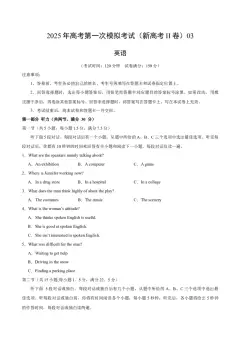
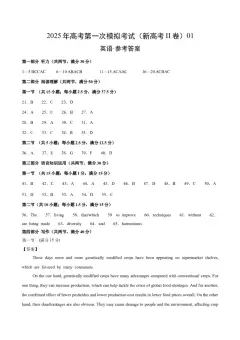
2025 年高考第二次模拟考试(新高考 II 卷)03
英语
(考试时间:120分钟 试卷满分:150分)
注意事项:
1.答卷前,考生务必将自己的姓名、考生号等填写在答题卡和试卷指定位置上。
2.回答选择题时,选出每小题答案后,用铅笔把答题卡对应题目的答案标号涂黑。如需改动,用橡
皮擦干净后,再选涂其他答案标号。回答非选择题时,将答案写在答题卡上。写在本试卷上无效。
3.考试结束后,将本试卷和答题卡一并交回。
第一部分 听力(共两节,满分 30 分)
第一节(共5小题;每小题1.5分,满分7.5分)
听下面5段对话。每段对话后有一个小题,从题中所给的A、B、C三个选项中选出最佳选项。听完每
段对话后,你都有10秒钟的时间来回答有关小题和阅读下一小题。每段对话仅读一遍。
1. What is the woman doing?
A. Making cakes. B. Planting flowers. C. Shopping.
2. What is the weather like now?
A. Sunny. B. Rainy. C. Cloudy.
3. What will the man buy for his parents this month?
A. A television.
B. A refrigerator.
C. A washing machine.
4. Who noticed the boat?
A. Colin. B. Jane. C. Dave.
5. What will the woman do next?
A. Change the time of the meeting.
B. Send regards to the president.
C. Talk to the head of sales.
第二节 (共15小题;每小题1.5分,满分22.5分)
听下面5段对话或独白。每段对话或独白后有几个小题,从题中所给的A、B、C三个选项中选出最佳
选项。听每段对话或独白前,你将有时间阅读各个小题, 每小题5秒钟; 听完后,各小题将给出5秒钟的作
答时间。每段对话或独白读两遍。听下面一段对话,回答第6、7题。
6. Why doesn’t the man like the food?
A. It is unhealthy.
B. It tastes terrible.
C. It doesn’t have salad.
7. Where are the speakers probably?
A. At the woman’s home.
B. In a supermarket.
C. In a restaurant.
听下面一段对话,回答第8至10题。
8. Where is the woman visiting first?
A. Peru. B. The USA. C. Brazil.
9. How long will the whole trip take?
A. Two days. B. Three weeks. C. Four months.
10. How does the woman mainly feel about the trip?
A. Worried. B. Scared. C. Excited.
听下面一段对话,回答第11至13题。
11. What is the weather like now probably?
A. Sunny. B. Cloudy. C. Rainy.
12. Why hasn’t Amy arrived yet?
A. She has been stuck in heavy traffic.
B. She is watching a big football match.
C. The bus broke down on the halfway.
13. What does the man offer to do?
A. Pick up Amy. B. Check the weather. C. Help with the dinner.
听下面一段对话,回答第14至17题。
14. Where are the speakers?
A. At the exit of a gallery.
B. In the first gallery space.
C. At the entrance of a gallery.
15. What do the speakers have in common?
A. They have the same friend.B. They both work in the art industry.
C. They’re both currently traveling abroad.
16. Who is the man’s favorite artist?
A. Botticelli. B. Van Gogh. C. Da Vinci.
17. How much is the man most likely willing to spend?
A. Around $450 million.
B. About $50 million.
C. Less than $1 million.
听下面一段对话,回答第18至20题。
18. Who is the speaker probably?
A. A student. B. A team manager. C. A cleaner.
19. What has the team’s performance been like so far?
A. Disappointing. B. Outstanding. C. Satisfying.
20. What is the main purpose of the speech?
A. To offer some information.
B. To motivate the players.
C. To ask for help.
第二部分 阅读(共两节,满分50分)
第一节 (共15小题;每小题2.5分,满分37.5分)
阅读下列短文,从每题所给的A、B、C、D四个选项中选出最佳选项。
A
By our very rough calculations, Reader’s Digest has published some 35,000 articles in nearly 1,200 issues.
These small pages have held some very big names, including U.S. presidents, world leaders, sports legends, and,
indeed, the biggest contributors of all, everyday Americans with a story to tell. These are some of our proudest
moments.
How to Keep Young Mentally by Mary B. Mullett
This first article in the first issue highlighted inventor Alexander Graham Bell and his belief in lifelong
learning: “The first essential of any real education is to observe. Observe! Remember! Compare!” It was an
appropriate beginning. reflecting our self-educated founder’s endless curiosity.
I’ve Come to Clean Your Shoes by Madge Harrah
The morning of a family funeral, an acquaintance shows up unannounced and says, “I’ve come to clean yourshoes.” He spends the day quietly shining every pair in the house. The writer ends with: “Now, whenever I hear of
an acquaintance who has lost a loved one. I try to think of one specific task suiting that person’s need. And if the
person says, ‘How did you know I needed that done?’ I reply, ‘it’s because a man once cleaned my shoes.’”
Strange Encounter on Coho Creek by Morris Homer Erwin
A miner spends days camping in the Alaskan wilderness, working hard to earn the trust of a mother wolf stuck
in a trap before she and her four pups starve to death. Eventually, he is able to free her. Four years later, he
encounters a wolf in the same meadow. Yes, the same wolf. When we shared this classic on rd.com in 2019, it went
viral and it has now been read by many millions online and in print.
How Honest Are We by Ralph Kinney Bennett
Our famous “wallet drop” set up the ultimate test of honesty: If we left wallets in cities around the country,
how many would be returned? Well over half, it turned out—67 percent. The most honest city? Seattle, whose
upstanding residents returned nine out of ten wallets.
21. What do we know about the acquaintance in the story I’ve Come to Clean Your Shoes?
A. He shows concern by cleaning shoes.
B. He cleans shoes at the owner’s request.
C. He comforts the owner by telling his own story.
D. He visits the house where the owner is severely sick.
22. Which article gained significant popularity online?
A. How to Keep Young Mentally. B. I’ve Come to Clean Your Shoes.
C. Strange Encounter on Coho Creek. D. How Honest Are We.
23. Where can the text be found?
A. In a history book. B. In a magazine. C. In a novel. D. In a brochure.
B
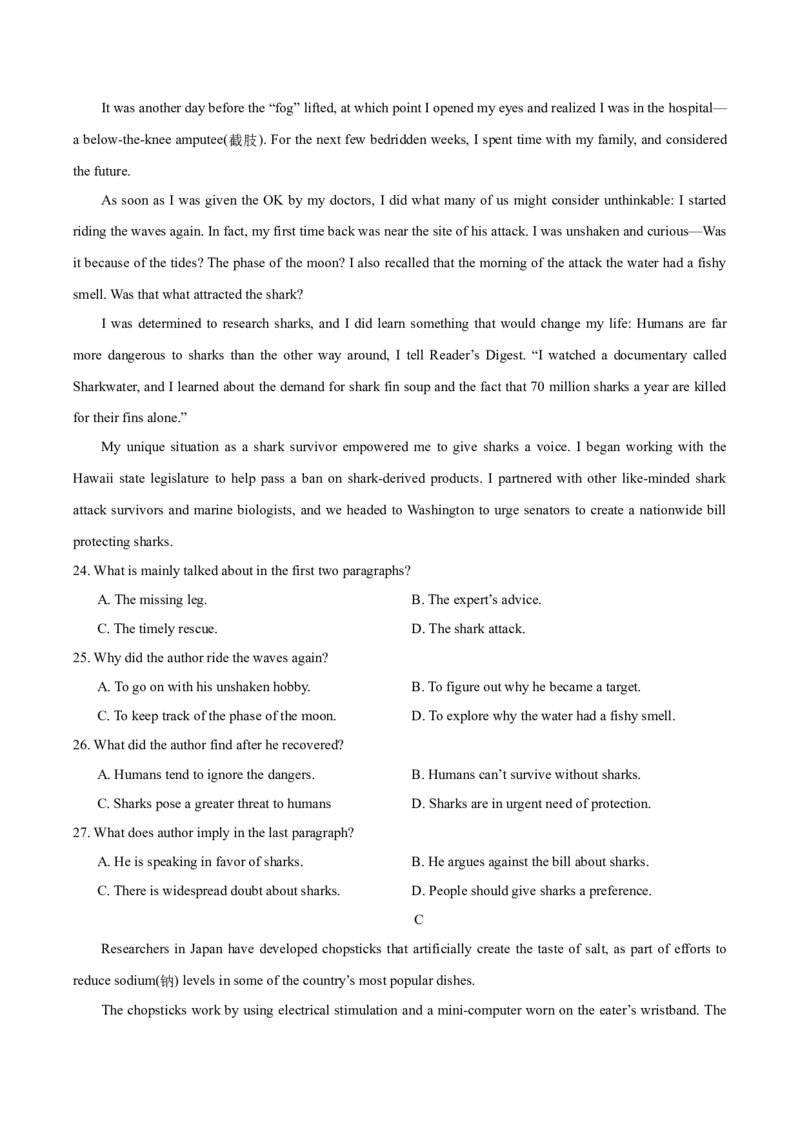
I was attacked by a tiger shark in late October 1997. It was near my home on the island of Kauai—a typical
fall morning with friends. The waves were really good, so nothing was stopping us.
That is until a large shark came right up under me and sank his teeth into my lower leg. There had been no
splashing, no noise, and I felt no pain, only great pressure on my lower body.
Then I followed my instinct: I punched the shark in the face, again and again which happens to be what the
expert advice, until the shark released me. As I swam back into shore, I felt my lower right leg spasming(痉挛).
When I looked down, I realized it was gone. The shark had bit my lower leg off. My friends rushed to my aid, and
rushed me to hospital.It was another day before the “fog” lifted, at which point I opened my eyes and realized I was in the hospital—
a below-the-knee amputee(截肢). For the next few bedridden weeks, I spent time with my family, and considered
the future.
As soon as I was given the OK by my doctors, I did what many of us might consider unthinkable: I started
riding the waves again. In fact, my first time back was near the site of his attack. I was unshaken and curious—Was
it because of the tides? The phase of the moon? I also recalled that the morning of the attack the water had a fishy
smell. Was that what attracted the shark?
I was determined to research sharks, and I did learn something that would change my life: Humans are far
more dangerous to sharks than the other way around, I tell Reader’s Digest. “I watched a documentary called
Sharkwater, and I learned about the demand for shark fin soup and the fact that 70 million sharks a year are killed
for their fins alone.”
My unique situation as a shark survivor empowered me to give sharks a voice. I began working with the
Hawaii state legislature to help pass a ban on shark-derived products. I partnered with other like-minded shark
attack survivors and marine biologists, and we headed to Washington to urge senators to create a nationwide bill
protecting sharks.
24. What is mainly talked about in the first two paragraphs?
A. The missing leg. B. The expert’s advice.
C. The timely rescue. D. The shark attack.
25. Why did the author ride the waves again?
A. To go on with his unshaken hobby. B. To figure out why he became a target.
C. To keep track of the phase of the moon. D. To explore why the water had a fishy smell.
26. What did the author find after he recovered?
A. Humans tend to ignore the dangers. B. Humans can’t survive without sharks.
C. Sharks pose a greater threat to humans D. Sharks are in urgent need of protection.
27. What does author imply in the last paragraph?
A. He is speaking in favor of sharks. B. He argues against the bill about sharks.
C. There is widespread doubt about sharks. D. People should give sharks a preference.
C
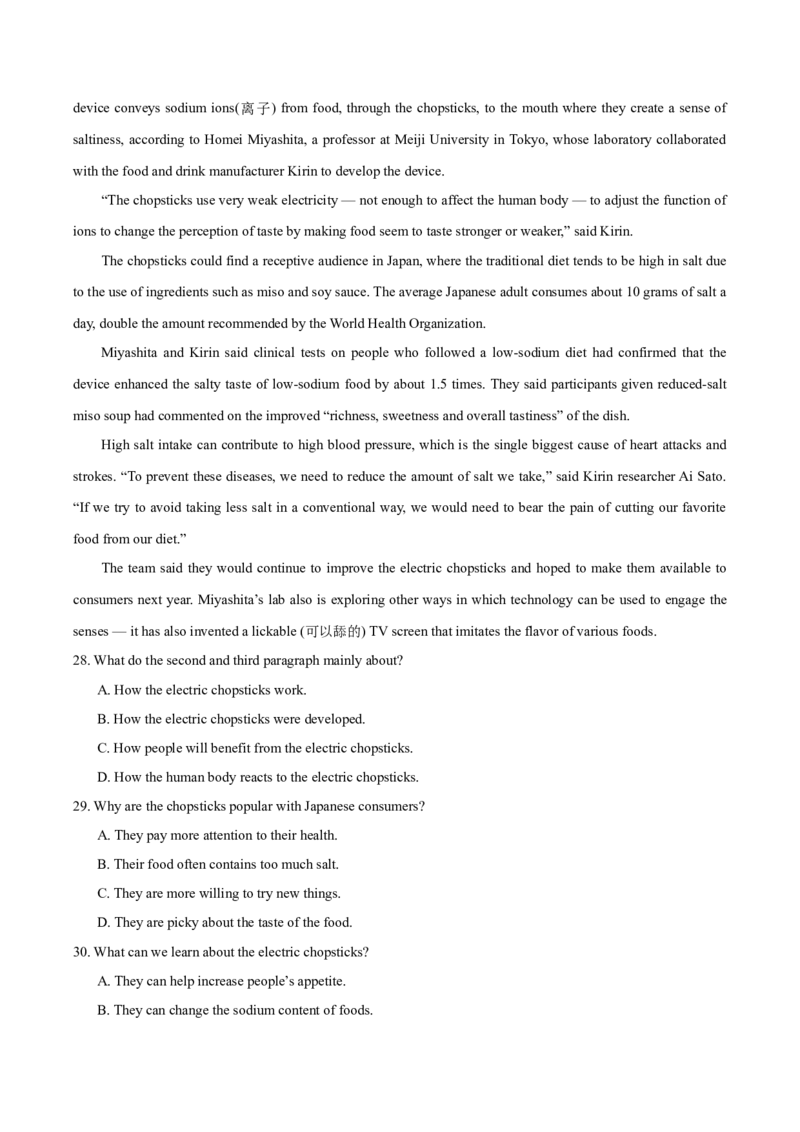
Researchers in Japan have developed chopsticks that artificially create the taste of salt, as part of efforts to
reduce sodium(钠) levels in some of the country’s most popular dishes.
The chopsticks work by using electrical stimulation and a mini-computer worn on the eater’s wristband. Thedevice conveys sodium ions(离子) from food, through the chopsticks, to the mouth where they create a sense of
saltiness, according to Homei Miyashita, a professor at Meiji University in Tokyo, whose laboratory collaborated
with the food and drink manufacturer Kirin to develop the device.
“The chopsticks use very weak electricity — not enough to affect the human body — to adjust the function of
ions to change the perception of taste by making food seem to taste stronger or weaker,” said Kirin.
The chopsticks could find a receptive audience in Japan, where the traditional diet tends to be high in salt due
to the use of ingredients such as miso and soy sauce. The average Japanese adult consumes about 10 grams of salt a
day, double the amount recommended by the World Health Organization.
Miyashita and Kirin said clinical tests on people who followed a low-sodium diet had confirmed that the
device enhanced the salty taste of low-sodium food by about 1.5 times. They said participants given reduced-salt
miso soup had commented on the improved “richness, sweetness and overall tastiness” of the dish.
High salt intake can contribute to high blood pressure, which is the single biggest cause of heart attacks and
strokes. “To prevent these diseases, we need to reduce the amount of salt we take,” said Kirin researcher Ai Sato.
“If we try to avoid taking less salt in a conventional way, we would need to bear the pain of cutting our favorite
food from our diet.”
The team said they would continue to improve the electric chopsticks and hoped to make them available to
consumers next year. Miyashita’s lab also is exploring other ways in which technology can be used to engage the
senses — it has also invented a lickable (可以舔的) TV screen that imitates the flavor of various foods.
28. What do the second and third paragraph mainly about?
A. How the electric chopsticks work.
B. How the electric chopsticks were developed.
C. How people will benefit from the electric chopsticks.
D. How the human body reacts to the electric chopsticks.
29. Why are the chopsticks popular with Japanese consumers?
A. They pay more attention to their health.
B. Their food often contains too much salt.
C. They are more willing to try new things.
D. They are picky about the taste of the food.
30. What can we learn about the electric chopsticks?
A. They can help increase people’s appetite.
B. They can change the sodium content of foods.C. They do not pose any safety threat to the human body.
D. Their clinical test results did not meet the expectations.
31. What is the best title for the text?
A. Electric chopsticks that make food seem saltier
B. Electric chopsticks that make food more delicious
C. Electric chopsticks that help adjust people’s dietary habits
D. Electric chopsticks that urge people to care for their diets
D
Over the past few months, I’ve been invited to speak with well-known writers, musicians and film producers
regarding my recent book, Extraterrestrial. Prior to these conversations, I was on the receiving (and admiring) end
of their artistic work, but now they were curious about my own research as a scientist. The reverse led me to
recognize the similarities between innovation in the arts and the sciences.
In sciences and arts alike, creativity appears magically as an unpredictable fountain of inspiration from the
subconscious (潜意识). Its unexpected content breaks routines within traditional thinking. It delivers something
new that is distinct from common practices, often taking people out of their comfort zone because it is ahead of its
time. As a result, many innovators are laughed at and denied the recognition they deserve when they need it the
most.
There are many examples of such circumstances. In 1933 Fritz Zwicky inferred the existence of “dark matter”,
but it took four decades for this concept to gain recognition within the astronomy community. Vincent van Gogh
was considered a madman and a failure throughout his life. Today, his paintings are among the most expensive ever
sold, though.
Typically, life offers two ways of acquiring objects. One is by collecting available items, and the other is by
creating things that never existed before. Whereas most items on the shelves of supermarkets are mass-produced,
products that are newly created by artists or scientists are originally unique. Just like aging wine, a product of
creative work acquires quality over time. It is colored by the response of the audience as well as by imitations. The
initial circumstances are a reminder of an admirable baby. It is fascinating for a scientist or an artist to watch the
interaction of their creation with the world, just as it is for parents to watch their children.
Creativity in arts and sciences establishes a backdrop for human existence, as the content it invents gives
pleasure and meaning to our lives. The human act of creation is an infinite-sum game, from which all of us benefit.
And we can all participate in the creative process.
32. Which can best replace the underlined word “reverse” in paragraph 1?A. Priority. B. Assumption. C. Shift. D. Preference.
33. What can best describe creativity in sciences and arts?
A. It tends to be forecastable. B. It mirrors common beliefs.
C. It usually leads the times. D. It enjoys instant acceptance.
34. What can be inferred from paragraph 4?
A. Inventiveness starts from childhood.
B. Mass-produced items are preferable.
C. Old wine can’t be put into new bottles.
D. Creative works withstand the test of time.
35. What’s the purpose of the last paragraph?
A. To clarify a concept. B. To launch an appeal.
C. To offer an entertainment. D. To advocate a lifestyle.
第二节 (共5小题;每小题2.5分,满分12.5分)
阅读下面短文,从短文后的选项中选出可以填入空白处的最佳选项。选项中有两项为多余选项。
Experts often tell students to center their efforts on a narrow field to get a job after school. ____36____
One of the winners of this year’s Nobel Prize in Chemistry was Danish scientist Morten Meldal, who is 68
years old and works at the University of Copenhagen. When describing his career, Meldal said he started out as an
engineer but changed to chemistry because he “wanted to understand the world.”
____37____ They might believe they have to center their work and school lives in one field to be successful.
But a study from professors at Michigan State University shows that is not always the case. The researchers looked
into past Nobel Prize winners and their students. ____38____ some of what they learned from their teachers is how
to live a life with many interests. They are, in a way, learning how to be creative.
Nobel winners are nine times more likely to have experience in working with wood, metal or in the arts than
most scientists. The researchers also found that the Nobel winners have an open mind about their life experiences.
Unlike many people who spend long hours at work and give up their outside interests, ____39____
The researchers say that, even among people who do not win big prizes, those with many interests are often
successful. They pointed to a 2022 report about students who study two major fields in college. ____40____
Double majors are often more creative and more interested in starting their own businesses than those who centered
on only one study area.
A. That study plan is called a “double major”.
B. What we believe is of great benefits to them.C. Meldal’s experience may come as a surprise to students.
D. They discovered that if they helped each other afterwards,
E. Nobel winners believe their hobbies are important to creativity.
F. They found that when the students of winners went on to win Nobel Prizes,
G. But recent research into Nobel Prize winners suggests that wider interests are important.
第二部分 语言运用(共两节,满分30分)
第一节 (共15小题;每小题1分,满分15分)
阅读下面短文,从每题所给的A、B、C、D四个选项中选出可以填入空白处的最佳选项。
“Hi! Ms. Brooks!” It was Sunday morning, my daughter and I were visiting a model home when I heard
a(n)____41____ voice. Standing in the yard was a boy. “Evans! What are you doing here?” I cried, feeling
surprised and a little annoyed. “I’m helping my father grow flowers,” he answered ____42____. Looking at his
happy appearance, I stood there, ____43____.
Then my daughter pulled me away, but Evans stayed on my mind for the rest of the weekend. Evans was a
____44____. He was very fond of plants and animals. ____45____ he struggled with his reading, he never once
complained.
Evans’s grades showed no sign of ____46____ despite his determination. So I sometimes ____47____
whether he would be able to pass the exams. It was not until we studied the life cycle of plants together that I
changed my ____48____. Evans behaved attentively. I had never seen him so ____49____ in the classroom.
In a class project, I _____50_____ a task to each student. That was planting a sunflower seed in one
container. Sowing the seeds was _____51_____ for many of the students, but the growing part was much less so.
Except Evans, they all lost interest and forgot to _____52_____ their sunflowers-to-be. Every afternoon, he
_____53_____ the plants in his container. Some time later, few seeds successfully fully sprouted (发芽) because of
too dry soil, but the _____54_____ in his container were about four inches tall. At that moment, I saw that special
seed planted inside him. And one day, he would _____55_____ just as his sunflower.
41. A. impolite B. uncivilized C. familiar D. female
42. A. mournfully B. awkwardly C. vaguely D. proudly
43. A. warm-hearted B. open-mouthed C. easy-going D. hard-working
44. A. gardener B. volunteer C. pioneer D. racer
45. A. In case B. Even though C. For fear that D. As long as
46. A. improvement B. confusion C. judgment D. intention
47. A. inquired B. proposed C. decided D. doubted48. A. determination B. lifestyle C. hobby D. tune
49. A. tired B. devoted C. casual D. independent
50. A. advised B. admitted C. assigned D. asked
51. A. strange B. difficult C. important D. exciting
52. A. pack up B. care for C. move away D. show off
53. A. irrigated B. cleaned C. filled D. polished
54. A. fruits B. flowers C. shoots D. roots
55. A. appear B. fade C. shine D. adjust
第二节 (共10小题;每小题1.5分,满分15分)
阅读下面短文,在空白处填入1个适当的单词或括号内单词的正确形式。
In the coming weeks, China Daily will be publishing special reports focusing____56____ the ongoing
development of the country’s national park system, looking at areas coming under stronger____57____ (protect)
and the species benefiting from many new____58____ (facility).
The Sanjiangyuan National Park, covering 190, 700 square kilometers, ____59____ (be) China’s largest such
facility. It is about 14 times the area of Yellowstone National Park in the United States and 19 times____60____
(large) than the Banff National Park in Canada. Standing at an average altitude of more than 4, 500 meters, the
sparsely populated park in Qinghai Province is the ideal habitat for many wildlife species, ____61____ (include)
Tibetan antelopes and snow leopards.
Sanjiangyuan, ____62____ means “source of three rivers”, is home to the headwaters of the Yangtze River,
the Yellow River and the Lancang River____63____ (know) as the Mekong once it leaves Chinese territory. As
such, the parks has been dubbed “Asia’s water tower”. 2% of the total water volume of the Yangtze River, 49% of
the Yellow River and 17% of the Lancang River come from the Sanjiangyuan area, with tributaries providing the
rest.
Decades ago, climate change and human activity caused serious____64____ (environment) degradation in
Sanjangyuan, which resulted in a large number of lakes drying out and wildlife numbers falling_____65_____
(sharp). In 2016, the pilot program for the Sanjiangyuan National Park management system was launched, and the
area was officially designated as a national park in September in 2021.
第三部分 写作(共两节,满分40分)
第一节 (满分15分)
假定你是学生会主席李华。近期,流感病毒在周围社区发展迅猛,请你围绕“从小事做起,预防流
感”这一主题给全校师生写一封倡议书,内容包括:1. 倡议的原因及目的;
2. 倡议的具体内容;
3. 发出倡议。
注意:1. 写作词数应为80左右;2. 请按如下格式在答题卡的相应位置作答。
相关词汇:流感 flu
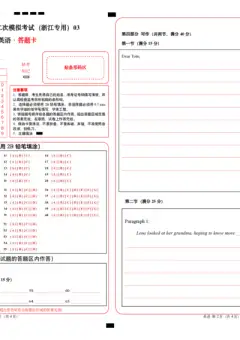
Dear teachers and students,
____________________________________________________________________________________________
____________________________________________________________________________________________
____________________________________________________________________________________________
____________________________________________________________________________________________
____________________________________________________________________________________________
The Students’ Union
第二节 (满分25分)
阅读下面材料,根据其内容和所给段落开头语续写两段,使之构成一篇完整的短文。
One year, I went out of town to attend a writer’s conference. As I went back home, I started telling my family
about my trip. However, it seemed that they were not interested in my words. Everyone wanted to tell me
something—especially eight-year-old Jeremy. He jumped up and down in order to be heard, and his voice carried
above the other children’s.
“Everyone needs something from me,” I thought. “They don’t want to hear about my trip. What is it Jeremy
keeps saying?”
“Poster paper, Mama! I have to have poster paper. We’re having a contest at school.”
I put him off, promising we’d talk about it later. Back at home I readjusted to the telephone, doorbell, sorting
laundry, driving car-pools, and answering questions. I found that no matter how hard I tried, I couldn’t keep up
with the needs of my family. As I moved about hurriedly, Jeremy kept reminding me, “I need the poster paper,
Mama.”
Gradually though, he began to speak more softly, almost as though he were talking to himself. So I put
Jeremy’s request at the bottom of my long “to-do” list.
My third day home I managed to spare about fifteen minutes to try to type an article. Sitting at the typewriter,
I heard the dryer stop. Another load of clothes should be put in. Two important phone calls needed to be returned.
One of my daughters had pleaded with me several times to listen to her recite part of The Canterbury Tales. It was
time to start supper, but I hadn’t even eaten lunch. Nevertheless, I typed joyfully for a few delicious minutes.A small shadow fell across my paper. I knew who it would be before I looked up. I glanced up anyway.
Jeremy stood quietly watching me. “Oh, dear, please don’t let him say it again. I know he needs poster paper. I
need to type.” I smiled weakly at Jeremy and kept typing.
注意:
1. 续写词数应为150个左右;
2. 请按如下格式在答题卡的相应位置作答。
“Contest is over tomorrow, anyway,” Jeremy sighed and walked away.
____________________________________________________________________________________________
____________________________________________________________________________________________
____________________________________________________________________________________________
____________________________________________________________________________________________
_______________________________________________________________________________________
He still didn’t move, asking, “You’re going to the store just for me?”
____________________________________________________________________________________________
____________________________________________________________________________________________
____________________________________________________________________________________________
____________________________________________________________________________________________
_______________________________________________________________________________________