2026 年高考第二次模拟考试(浙江专用)03
高三英语
(考试时间:120 分钟  试卷满分:150 分)
注意事项:
1.答卷前,考生务必将自己的姓名、准考证号等填写在答题卡和试卷指定位置上。
2.回答选择题时,选出每小题答案后,用铅笔把答题卡上对应题目的答案标号涂黑。如需改动,用
橡皮擦干净后,再选涂其他答案标号。回答非选择题时,将答案写在答题卡上。写在本试卷上无效。
3.考试结束后,将本试卷和答题卡一并交回
第一部分 听力(共两节,满分30 分)
做题时,先将答案标在试卷上,录音内容结束后,你有两分钟的时间将试卷上的答案转涂到答题卡上。
第一节(共5 小题:每小题1.5 分,满分7.5 分)
听下面5 段对话。每段对话后有一个小题,从题中所给的A、B、C 三个选项中选出最佳选项。听完每段对
话后,你都有10 秒钟的时间来回答有关小题和阅读下一小题。每段对话读两遍。
1.What was the man about to throw away?
A.A plastic bag.
B.Some Paper.
C.A glass bottle.
2.What is the woman’s suggestion for the man?
A.Practicing driving cars. B.Mastering road rules.
C.Remembering answers.
3. What affects the man’s phone bill?
A.His family’s Internet use.  B.The taxes and extra fees. C.His calls and texts.
4.What has the man decided about the skiing holiday?
A.To invite his grandparents along.   B.To change it to another time.
C.To go without the children.
5.Why does the man feel sleepy according to the woman?
A.He stayed up late last night.     B.He ate too much for breakfast.
C.He got up too early this morning.
第二节(共15 小题;每小题1.5 分,满分22.5 分)
听下面5 段对话或独白。每段对话或独白后有几个小题,从题中所给的A、B、C 三个选项中选出最佳选项。
听每段对话或独白前,你将有时间阅读各个小题,每小题5 秒钟;听完后,各小题将给出5 秒钟的作答时间。
每段对话或独白读两遍。
听第6 段材料,回答第6、7 题。
6.How is the woman feeling about the man?
A.Worried.
B.Proud.
C.Surprised.
7.Where is this conversation probably taking place?
A.At home.
B.At a shop.
C.At school.
听第7 段材料,回答第8 至10 题。
8.What can people enjoy in Richmond?
A.Local foods.
B.Local artworks.
C.Local shopping centers.
9.How far away is Sun Valley from Richmond?
A.5 minutes’ walk.
B.10 minutes’ walk.
C.15 minutes’ bike ride.
10.Where do the speakers decide to stay?
A.In a tent.
B.In a hotel.
C.In a villager’s house.
听第8 段材料,回答第11 至13 题。
11.What are the speakers mainly discussing?
A.Causes of work stress.   B.Benefits of using animals to relax.
C.Ways to organize team-building events.
12.What positive result has the woman noticed?
A.Most staff reported higher productivity.  B.All employees overcame their fear of dogs.
C.Team discussions became more open and relaxed.
13.What does the man think of the activity in the end?
A.He’s interested in trying it.       B.He’s unsure if it would work.
C.He’s worried about potential problems.
听第9 段材料,回答第14 至17 题。
14.What is the man planning to do?
A.To earn more credits.
B.To change his major.  C.To move to another university.
15.How does the man feel at Hillside University?
A.Homesick.
B.Stressed.
C.Bored.
16.What was one of the reasons why Mr. Johnson chose Hillside University initially?
A.It is located just in his hometown.    B.It has a first- class business school.
C.His older friends graduated from there.
17.What does the woman imply about the man’s plan?
A.Johnson will start all over again.    B.Central’s business school is worse.
C.Freshman year at Central is easier.
听第10 段材料,回答第18 至20 题。
18.What is most travelers’ biggest difficulty according to the speaker?
A.Food.
B.Darkness.
C.Transportation.
19.What does the speaker like most about the region?
A.The northern culture.
B.The quiet environment.
C.The breathtaking views.
20.What is the first activity of the camp trip?
A.Going ice fishing.
B.Riding snow vehicles.
C.Seeing the northern lights.
第二部分  阅读(共两节, 满分50 分)
第一节(共15 小题;每小题2.5 分, 满分37.5 分)
阅读下列短文, 从每题所给的A、B、C 和D 四个选项中选出最佳选项。
A
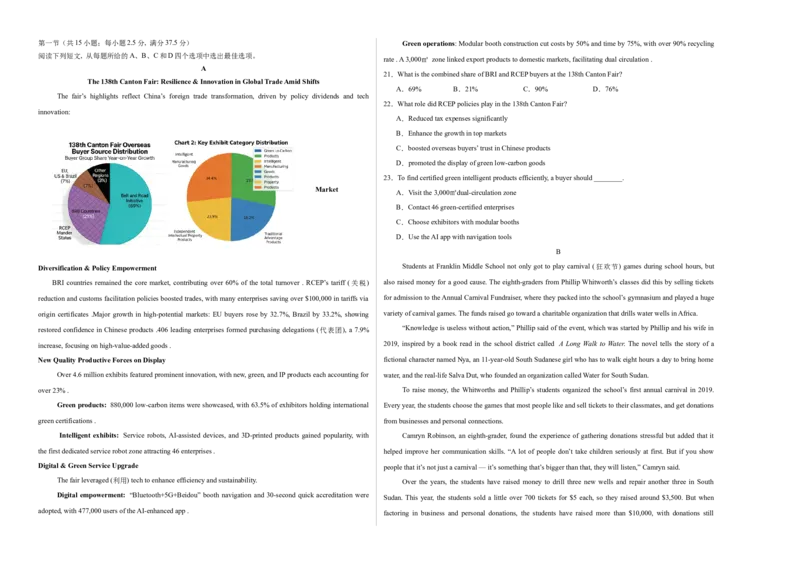
The 138th Canton Fair: Resilience & Innovation in Global Trade Amid Shifts
The fair’s highlights reflect China’s foreign trade transformation, driven by policy dividends and tech
innovation:
Market
Diversification & Policy Empowerment
BRI countries remained the core market, contributing over 60% of the total turnover . RCEP’s tariff ( 关税)
reduction and customs facilitation policies boosted trades, with many enterprises saving over $100,000 in tariffs via
origin certificates .Major growth in high-potential markets: EU buyers rose by 32.7%, Brazil by 33.2%, showing
restored confidence in Chinese products .406 leading enterprises formed purchasing delegations (代表团), a 7.9%
increase, focusing on high-value-added goods .
New Quality Productive Forces on Display
Over 4.6 million exhibits featured prominent innovation, with new, green, and IP products each accounting for
over 23% .
Green products: 880,000 low-carbon items were showcased, with 63.5% of exhibitors holding international
green certifications .
Intelligent exhibits: Service robots, AI-assisted devices, and 3D-printed products gained popularity, with
the first dedicated service robot zone attracting 46 enterprises .
Digital & Green Service Upgrade
The fair leveraged (利用) tech to enhance efficiency and sustainability.
Digital empowerment: “Bluetooth+5G+Beidou” booth navigation and 30-second quick accreditation were
adopted, with 477,000 users of the AI-enhanced app .
Green operations: Modular booth construction cut costs by 50% and time by 75%, with over 90% recycling
rate . A 3,000㎡ zone linked export products to domestic markets, facilitating dual circulation .
21.What is the combined share of BRI and RCEP buyers at the 138th Canton Fair?
A.69%
B.21%
C.90%
D.76%
22.What role did RCEP policies play in the 138th Canton Fair?
A.Reduced tax expenses significantly
B.Enhance the growth in top markets
C.boosted overseas buyers’ trust in Chinese products
D.promoted the display of green low-carbon goods
23.To find certified green intelligent products efficiently, a buyer should ________.
A.Visit the 3,000㎡dual-circulation zone
B.Contact 46 green-certified enterprises
C.Choose exhibitors with modular booths
D.Use the AI app with navigation tools
B
Students at Franklin Middle School not only got to play carnival ( 狂欢节) games during school hours, but
also raised money for a good cause. The eighth-graders from Phillip Whitworth’s classes did this by selling tickets
for admission to the Annual Carnival Fundraiser, where they packed into the school’s gymnasium and played a huge
variety of carnival games. The funds raised go toward a charitable organization that drills water wells in Africa.
“Knowledge is useless without action,” Phillip said of the event, which was started by Phillip and his wife in
2019, inspired by a book read in the school district called A Long Walk to Water. The novel tells the story of a
fictional character named Nya, an 11-year-old South Sudanese girl who has to walk eight hours a day to bring home
water, and the real-life Salva Dut, who founded an organization called Water for South Sudan.
To raise money, the Whitworths and Phillip’s students organized the school’s first annual carnival in 2019.
Every year, the students choose the games that most people like and sell tickets to their classmates, and get donations
from businesses and personal connections.
Camryn Robinson, an eighth-grader, found the experience of gathering donations stressful but added that it
helped improve her communication skills. “A lot of people don’t take children seriously at first. But if you show
people that it’s not just a carnival — it’s something that’s bigger than that, they will listen,” Camryn said.
Over the years, the students have raised money to drill three new wells and repair another three in South
Sudan. This year, the students sold a little over 700 tickets for $5 each, so they raised around $3,500. But when
factoring in business and personal donations, the students have raised more than $10,000, with donations still
coming in.
“We might not be able to solve the whole problem, but we can absolutely make a difference for some people,”
Phillip said.
24.What role did A Long Walk to Water play in the fundraising campaign?
A.It inspired Salva Dut to join the mission.B.It taught students to organize a carnival.
C.It led to the start of the charitable cause. D.It motivated businesses to donate money.
25.What do Phillip’s students do for the annual carnival?
A.They drill wells in person.
B.They organize some games.
C.They work at different companies.
D.They collect tickets from cinemas.
26.What did Camryn Robinson say about gathering donations?
A.It was very rewarding.
B.It was unchallenging.
C.Kids shouldn’t get involved.
D.Most people initially supported it.
27.What is paragraph 5 mainly about?
A.Phillip’s objective comments.
B.Dramatic changes in South Sudan.
C.The outcome of the students’ efforts.
D.Donations from all over the world.
C
(原创题)Monk fruit, known as Luo Han Guo in China, is a sweet fruit from the gourd family. For centuries,
people in southern China have used it in food and medicine. Recently, scientists have become very interested in it
because it is full of antioxidants. These special substances protect our cells from damage caused by free radicals,
which can lead to aging and serious diseases.
New research has looked closely at the chemicals inside monk fruit. The study focuses on three main groups of
natural compounds: terpenoids(萜类), flavonoids(类黄酮), and amino acid(氨基酸). Terpenoids and
flavonoids are famous for fighting inflammation and neutralizing harmful free radicals. Amino acids are essential for
repairing tissues and helping the immune system work well. Scientists studied both the skin and the flesh of four
different types of monk fruit to see where these healthy compounds are found.
The study also explored how these compounds work inside the human body. They interact with specific cell
receptors, acting like keys opening locks to trigger helpful responses. This process influences biological pathways
that control inflammation, metabolism, and cell protection. This explains why monk fruit offers health benefits
beyond just being a sugar substitute.
Researchers stressed that not all monk fruits are the same. Different varieties contain different levels of active
compounds. Therefore, it is important to study various types carefully. This detailed chemical mapping helps
determine which varieties are best for making food products or health supplements.
However, monk fruit is more than just a zero-calorie sweetener. It is a unique plant packed with bioactive
compounds that support overall health. As research continues, we may discover even more ways this ancient fruit
can improve modern lives through its natural chemical makeup.
28. What is the primary function of antioxidants mentioned in the text?
A. To increase the sweetness of the fruit.
B. To repair damaged tissues immediately.
C. To shield cells from harmful molecules.
D. To replace traditional medical treatments.
29. Why did scientists examine both the peel and the pulp of the fruit?
A. To compare the weight of different varieties.
B. To locate the concentration of beneficial compounds.
C. To determine the best method for cooking the fruit.
D. To find out which part tastes better to consumers.
30. What can be inferred about the different varieties of monk fruit?
A. They all contain exactly the same chemical structure.
B. Only one variety is effective for health purposes.
C. They grow best in northern regions of China.
D. Their suitability for products depends on their chemical profiles.
31. What is the main purpose of the text?
A. To advertise a new type of sugar substitute.
B. To explain the history of traditional Chinese medicine.
C. To instruct farmers on how to grow more monk fruit vines.
D. To introduce the health value and scientific findings of monk fruit.
D
(原创题)Many high achievers in science and technology fields carry a secret fear. Despite their excellent
grades and awards, they worry that others will soon discover they do not truly belong. They feel like frauds. In their
minds, their success is not due to talent or hard work. Instead, they believe it is just luck or good timing. This
psychological pattern is known as "impostorism." It is different from low self-esteem. Even with clear proof of
ability, these individuals doubt themselves constantly.
Recent research by Jiyun Elizabeth Shin from Binghamton University shows how common this feeling is. Her
study found that nearly all women in graduate STEM programs experience impostor feelings. The number is even
higher for women of color. These women feel like intellectual cheats. They think people overestimate their
intelligence. They live in fear of being exposed as incompetent and undeserving of their positions.
Why does success feel like luck? Impostorism changes how people view their achievements. They cannot
accept that they earned their success. Instead, they credit outside factors. This makes them worry that they cannot
repeat their success. For women in STEM, negative stereotypes make this worse. Society often wrongly suggests
that women lack natural ability in these fields. When few women are seen in leadership roles, it reinforces the doubt.
This makes it harder for them to believe in their own skills.
The consequences of these feelings are serious. Shin’s research links impostorism to poor mental health and
burnout. It also leads many to consider dropping out of their programs. A fixed mindset, which believes ability
cannot change, makes things worse. If people think they cannot grow, any failure seems to prove they were never
good enough. However, adopting a flexible view of ability can help reduce these fears.
Although many high achievers suffer in silence, talking about it matters. Keeping these feelings secret increases
stress and isolation. Open conversations can be a powerful step toward healing. While more research is needed to
find the best solutions, social support is already known to help. By sharing their stories, women in STEM can realize
they are not alone. This connection may protect their emotional well-being and encourage them to stay in their
chosen fields.
32. What is the main characteristic of people suffering from impostorism?
A. They lack actual professional skills.
B. They attribute success to external chances.
C. They suffer from severe depression daily.
D. They refuse to accept any form of awards.
33. Why do negative stereotypes affect women in STEM more deeply?
A. They prevent women from entering universities.
B. They suggest women rely only on luck for jobs.
C. They make it hard to accept personal achievements.
D. They force women to hide their true intelligence.
34. What can be inferred about a "fixed mindset" from the text?
A. It helps people avoid taking unnecessary risks.
B. It encourages people to seek social support actively.
C. It turns small failures into proof of incompetence.
D. It guarantees high achievements in scientific fields.
35. What is the author's purpose in writing the last paragraph?
A. To call for more financial support for researchers.
B. To emphasize the value of open communication.
C. To criticize the current education system strictly.
D. To list all the symptoms of mental health issues.
第二节(共5 小题;每小题2. 5 分, 满分12. 5 分)
阅读下面短文, 从短文后的选项中选出可以填入空白处的最佳选项。选项中有两项为多余选项。
     36     A new paper in Science suggests the path may involve more meandering than lifelong, laser-
focused dedication. Counterintuitively, performers showing the greatest childhood promise rarely reached the
pinnacle as adults.
The findings challenge the popular “10,000-hour rule,” which posits that deliberate practice alone leads to
mastery. Importantly,     37     . Instead they show that top adult performers tend to be “late bloomers,”
Macnamara says.In sports, for instance, world-class athletes peak later than national-class athletes. Those that peak
early achieve a level that is the best for their age     38     .
The findings are intriguing, says Edson Filho, an associate professor of sport.Certain sports, such as
gymnastics, see athletes hit peak performance far earlier in life than others, he points out, and the analysis doesn’t
get into other factors, such as money and coaching, that can influence who becomes the cream of the crop.
The research emphasizes that people change.     39     To become an expert, you need to consistently
perform at a high level under the most challenging of conditions, he says. “That’s a long journey.”
The findings matter for institutions and coaches who might be biased toward directing resources at the kids
who show the most promise in a given field early on rather than those who have the most potential to reach a world-
class level. The research holds a message, too, for people who want to pursue a skill or dream but who didn’t win
their school competition or make it to the top of their youth league: do not despair,Macnamara says.“For people who
didn’t follow the prodigy route,      40     ” she says. “Most world-class performers didn’t achieve that goal
immediately either.”
A.know you are in good company!
B.your journey is just beginning!
C.What does it take to become the best?
D.the findings don’t suggest that you don’t need to put in effort to become a grandmaster or a winner
E.The research dispels the notion that early, narrow focus is essential
F.but that isn’t as high as what the other group will eventually achieve at a later age
G.Children can get burned out or simply lose interest
第三部分 语言运用(共两节,满分30 分)
第一节(共15 小题,每小题1 分,满分15 分)
阅读下面短文, 从每题所给的A、B、C 和D 四个选项中选出可以填入空白处的最佳选项。
Some people were born gifted, but I wasn’t. Well into my sixties, I was     41     searching for something
I did really well. When my friend advised me to join an art class, I     42     but finally decided to have a go.
Now here I was staring at a     43     canvas (画布), with a photograph of a sunflower beside it,
wondering what I was doing in this class. “Grid off (分格) the photo and canvas into squares,” Debbie, my teacher,
walked us through the     44     of painting. As I followed the instructions, I thought back on my past     45
to make artwork. In junior high, I eagerly chose art, but my enthusiasm was     46    . The teacher’s harsh
criticism quickly made me drop the class. Then in college, I     47     a drawing class but barely kept up, leaving
my confidence     48     again. After that, my creative energies were restricted only to secret     49    .
This time, I wouldn’t let that happen again. I gridded off my picture and painted just one     50     at a
time. My shaky hands gradually     51     and found their rhythm. Little by little, a cheerful sunflower came to
life. Debbie had told us, “Don’t think of it as part of a bigger picture. And don’t guess at where it     52     with
the rest.” A single sunflower had brought me more     53     than an entire field of flowers.
The sunflower finally     54     and bloomed (开花) within me: I was a late bloomer, finally uncovering a
truth we too often forget — take small steps and dreams have no     55     limit.
41.A.already
B.still
C.ever
D.just
42.A.resolved
B.accepted
C.hesitated
D.yielded
43.A.blank
B.strange
C.rough
D.painted
44.A.trends
B.chores
C.tests
D.basics
45.A.attempts
B.excuses
C.promises
D.reactions
46.A.short-sighted
B.short-lived
C.ever-growing
D.far-reaching
47.A.missed
B.skipped
C.designed
D.braved
48.A.on alert
B.on purpose
C.in pieces
D.in chains
49.A.hobbies
B.careers
C.collections
D.rules
50.A.photo
B.square
C.sunflower
D.class
51.A.steadied
B.froze
C.ached
D.sweated
52.A.conflicts
B.competes
C.agrees
D.fits
53.A.joy
B.luck
C.patience
D.fame
54.A.took shape
B.took root
C.died out
D.faded away
55.A.status
B.gender
C.age
D.ability
第二节(共10 小题;每小题1.5 分 ,满分15 分)
阅读下面短文,在空白处填入1 个适当的单词或括号内单词的正确形式。
Li Bai, honored as “the Immortal Poet” in Chinese literary history, lived a life as dramatic and passionate as
his verses. Besides his poetic genius, Li Bai was famous    56    his uninhibited soul—a spirit that resisted
imperial restrictions, drank with the moon, and turned every mountain, river, and cup of wine into a testament to
life’s boundless passion. His travels, which took him from Sichuan’s misty mountains to Chang’an’s grand palaces,
57    (shape)his unique style—bold, imaginative, and free from rigid literary rules.
In his early    58    (thirty), Li Bai was invited to the imperial court as a Hanlin Scholar,    59    role
that let him compose poems for Emperor Xuanzong. But his    60    (refuse) to flatter corrupt officials and love
for unrestrained living made him unpopular. He once asked eunuch Gao Lishi to remove his boots, showing
contempt for authority, and later left Chang’an voluntarily,    61    (choose) a wandering, wine-filled life.
Li Bai’s poems blended emotions with landscapes. His masterpiece Hard Roads in Shu described Sichuan’s
62    (terrifying) steep mountains so vividly that readers felt the danger of “one misstep may bring eternal regret.”
The vivid and emotional lines are expressions of Li Bai’s feelings, and with the scenes changing    63    (come)
the shift of his emotions. During the An Lushan Rebellion, Li Bai joined Prince Yong’s army, which led to his exile
to Yelang.    64    (pardon) halfway, he created Bringing in the Wine, declaring, “When life gives its joys, let us
drink a hundred cups a day!”
Li Bai’s legacy lies in his skill and free spirit. He showed the world     65     a true artist uses words to
transcend suffering and celebrate life.
第四部分 写作(共两节, 满分40 分)
第一节(满分15 分)
66.假定你是李华,你的英国笔友Tom 询问你校新设立的校园AI 体育角(AI-Powered Sports Corner)
使用情况。请你给他回信介绍该体育角,内容包括:
1. 智能亮点;
2. 师生反响。
注意:1. 写作词数应为80 个左右;
2. 请按如下格式在答题卡的相应位置作答。
Dear Tom,
_____________________________________________________________________________________________
_____________________________________________________________________________________________
_____________________________________________________________________________________________
_____________________________________________________________________________________________
__________________________________________________________________________________
Yours,
Li Hua
第二节(满分25 分)
67.阅读下面材料,根据其内容和所给段落开头语续写两段,使之构成一篇完整的短文。
Lena walked home slowly, her schoolbag feeling heavier than ever. She couldn’t forget how she had frozen in
front of her classmates that morning. Their teacher, Mrs. Johnson, had asked each student to give a three-minute
presentation about their favorite hobby. When Lena’s turn came, her hands shook so much that her note cards fell to
the floor. As she picked them up, her voice became quieter and quieter until she couldn’t speak at all. Mrs. Johnson
kindly told her she could stop and asked Lena to stay for a moment after class.
“I know you love writing stories, Lena,” Mrs. Johnson said gently. “I read your wonderful article in the school
newspaper last week. Would you like to try again tomorrow? I believe you can do it.” Lena nodded, feeling both
nervous and grateful for this second chance.
That afternoon, the smell of fresh bread welcomed Lena as she opened the front door. Her grandmother stood
in the kitchen, wiping her hands on her apron (围裙). Grandmother had been a journalist for many years before
retiring. She immediately noticed Lena’s red eyes.
“What’s troubling you, my dear?” Grandmother asked, putting a warm arm around Lena’s shoulders.
Lena poured out the whole story while they sat at the kitchen table. “I prepared so much, Grandma. I knew
every word I wanted to say. But when I saw all those eyes watching me... my mind went completely blank.”
Grandmother nodded understandingly. “Come with me to my study,” she said after a moment. “I want to show
you something.”
In her study, Grandmother opened a wooden box on her desk. Inside, among many photographs and
souvenirs, lay a small bronze medal. “This was my first journalism award,” Grandmother said. “I received it forty
years ago for a speech that I gave at a big conference. At first, I was so frightened that I practiced for two weeks in
front of the mirror!”
注意:1. 续写词数应为150 个左右;
2. 请按如下格式在答题卡的相应位置作答。
Lena looked at her grandma, hoping to know more.
_____________________________________________________________________________________________
_____________________________________________________________________________________________
_____________________________________________________________________________________________
_____________________________________________________________________________________________
________________________________________________________________________________________
The next day, Lena touched the medal in her pocket and walked forward.
_____________________________________________________________________________________________
_____________________________________________________________________________________________
_____________________________________________________________________________________________
_____________________________________________________________________________________________
________________________________________________________________________________________