文档文本内容
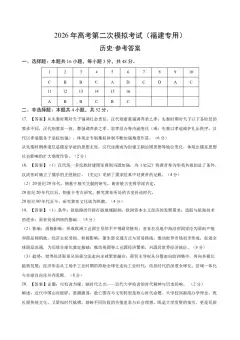
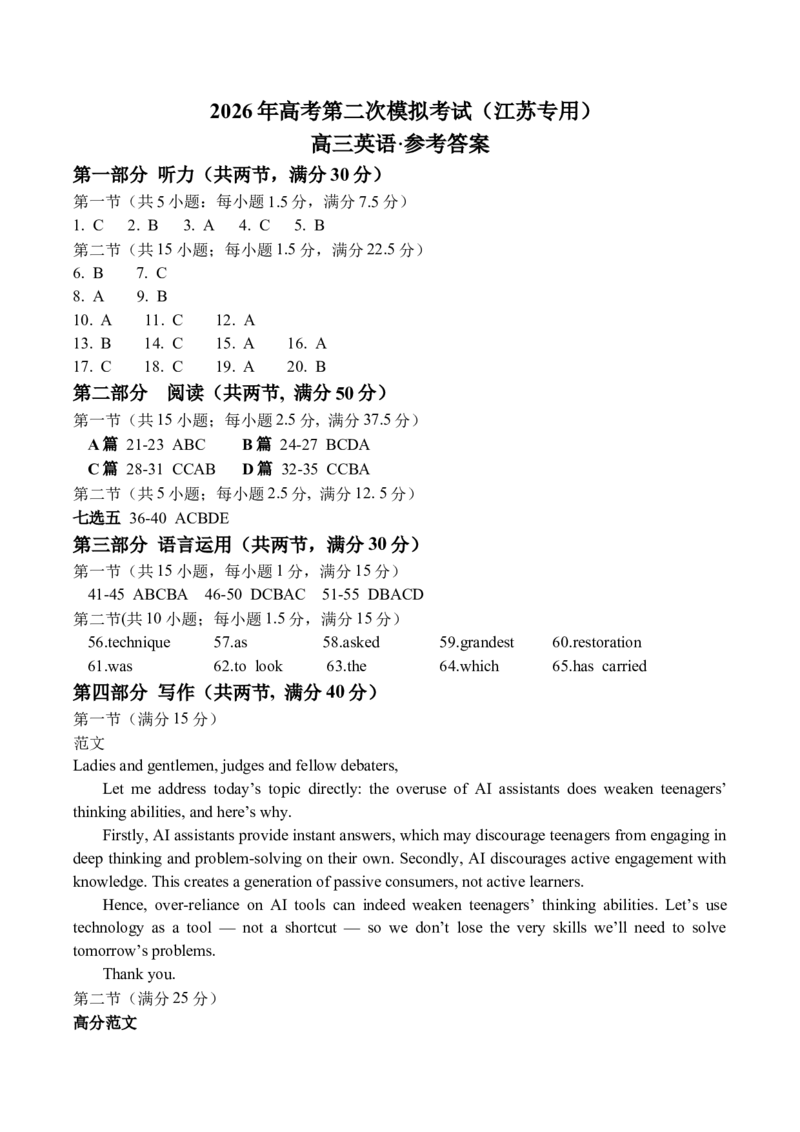
 2026 年高考第二次模拟考试(江苏专用)
高三英语·参考答案
第一部分 听力(共两节,满分30 分)
第一节(共5 小题:每小题1.5 分,满分7.5 分)
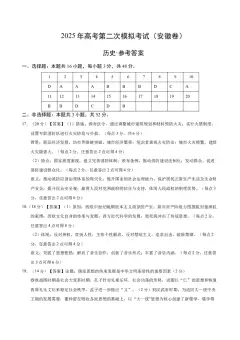
1. C   2. B   3. A   4. C   5. B
第二节(共15 小题;每小题1.5 分,满分22.5 分)
6. B    7. C
8. A    9. B
10. A    11. C    12. A
13. B    14. C    15. A    16. A
17. C    18. C    19. A    20. B
第二部分  阅读(共两节, 满分50 分)
第一节(共15 小题;每小题2.5 分, 满分37.5 分)
A 篇 21-23 ABC
B 篇 24-27 BCDA
C 篇 28-31 CCAB   D 篇 32-35 CCBA
第二节(共5 小题;每小题2.5 分, 满分12. 5 分)
七选五 36-40 ACBDE
第三部分 语言运用(共两节,满分30 分)
第一节(共15 小题,每小题1 分,满分15 分)
41-45 ABCBA  46-50 DCBAC  51-55 DBACD
第二节(共10 小题;每小题1.5 分,满分15 分)
56.technique    57.as
   58.asked
59.grandest
60.restoration
61.was
62.to look
63.the
64.which
65.has carried
第四部分 写作(共两节, 满分40 分)
第一节(满分15 分)
范文
Ladies and gentlemen, judges and fellow debaters,
Let me address today’s topic directly: the overuse of AI assistants does weaken teenagers’
thinking abilities, and here’s why.
Firstly, AI assistants provide instant answers, which may discourage teenagers from engaging in
deep thinking and problem-solving on their own. Secondly, AI discourages active engagement with
knowledge. This creates a generation of passive consumers, not active learners.
Hence, over-reliance on AI tools can indeed weaken teenagers’ thinking abilities. Let’s use
technology as a tool — not a shortcut — so we don’t lose the very skills we’ll need to solve
tomorrow’s problems.
Thank you.
第二节(满分25 分)
高分范文
Paragraph 1
The next day at school, I saw Mark in the classroom as usual. He sat quietly at his desk, as if
nothing had happened, but I noticed a bandage on his arm. I walked over, patted his shoulder and
thanked him for saving the child. He looked up, a little surprised, and nodded slightly with a faint
smile. Soon, the story of his bravery spread around the class. My classmates and I gathered around
him, expressing our admiration and concern. For the first time, Mark didn’t look indifferent; he
listened patiently, his eyes softening a little.
Paragraph 2
    After that day, something changed. Mark no longer stayed alone all the time. When I asked
him to join our basketball team again, he agreed without hesitation. During practice, he played
skillfully and cooperated well with us. He even started talking to classmates, sharing small moments
of his life. We all realized that behind his quiet appearance was a kind and brave heart. The once
distant boy became part of our group, and our class became warmer because of this brave and gentle
boy.