英语试题
第1 页共8 页
姓名
座位号
(在此卷上答题无效)
★启用前绝密
2026 届高三5 月学业质量检测
英语
注意事项:
1.答卷前,考生务必将自己的姓名、准考证号填写在答题卡上。
2.回答选择题时,选出每小题答案后,用铅笔把答题卡上对应题目的答案标号框涂黑。
如需改动,用橡皮擦干净后,再选涂其他答案标号框。回答非选择题时,将答案写在答题
卡上,写在本试卷上无效。
3.考试结束后,将答题卡交回。
第一部分
听力(共两节,满分30 分)
做题时,先将答案标在试卷上。录音内容结束后,你将有两分钟的时间将试卷上的答
案转涂到答题卡上。
第一节(共5 小题;每小题1.5 分,满分7.5 分)
听下面5 段对话。每段对话后有一个小题,从题中所给的A、B、C 三个选项中选出
最佳选项。听完每段对话后,你都有10 秒钟的时间来回答有关小题和阅读下一小题。每
段对话读两遍。
1. What did the woman dislike about last night’s meal?
A. The soup.
B. The cake.
C. The pizza.
2. What are the speakers talking about?
A. Their hobbies.
B. A popular book.
C. An electronic device.
3. What is the relationship between the speakers?
A. Husband and wife.
B. Workmates.
C. Doctor and patient.
4. What might Mr. Jones be?
A. A repairman.
B. A salesman.
C. A deliveryman.
5. How will the man help the woman?
A. By dusting the house.
B. By doing the washing.
C. By taking out the rubbish.
第二节(共15 小题;每小题1.5 分,满分22.5 分)
听下面5 段录音。每段录音后有几个小题,从题中所给的A、B、C 三个选项中选出
最佳选项。听每段录音前,你将有时间阅读各个小题,每小题5 秒钟;听完后,每小题都
有5 秒钟的作答时间。每段录音播放两遍。
听第下面的录音,回答第6、7 题。
6. What does Sam have trouble with?
A. Staff training.
B. Account registration.
C. Computer setup.
7. What will Sam do next?
A. Delete an e-mail.
B. Give a name list.
C. Ask for photos.
听第下面的录音,回答第8、9 题。
8. Where do the speakers work?
A. At a school.
B. At a toy store.
C. At the dentist’s.
英语试题
第2 页共8 页
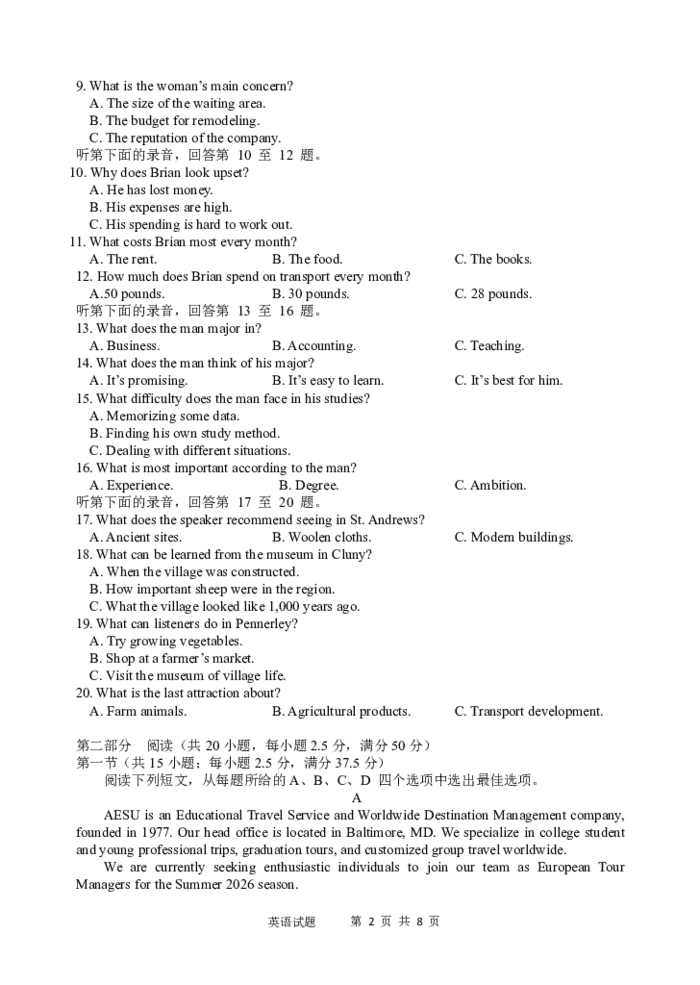
9. What is the woman’s main concern?
A. The size of the waiting area.
B. The budget for remodeling.
C. The reputation of the company.
听第下面的录音,回答第10 至12 题。
10. Why does Brian look upset?
A. He has lost money.
B. His expenses are high.
C. His spending is hard to work out.
11. What costs Brian most every month?
A. The rent.
B. The food.
C. The books.
12. How much does Brian spend on transport every month?
A.50 pounds.
B. 30 pounds.
C. 28 pounds.
听第下面的录音,回答第13 至16 题。
13. What does the man major in?
A. Business.
B. Accounting.
C. Teaching.
14. What does the man think of his major?
A. It’s promising.
B. It’s easy to learn.
C. It’s best for him.
15. What difficulty does the man face in his studies?
A. Memorizing some data.
B. Finding his own study method.
C. Dealing with different situations.
16. What is most important according to the man?
A. Experience.
B. Degree.
C. Ambition.
听第下面的录音,回答第17 至20 题。
17. What does the speaker recommend seeing in St. Andrews?
A. Ancient sites.
B. Woolen cloths.
C. Modern buildings.
18. What can be learned from the museum in Cluny?
A. When the village was constructed.
B. How important sheep were in the region.
C. What the village looked like 1,000 years ago.
19. What can listeners do in Pennerley?
A. Try growing vegetables.
B. Shop at a farmer’s market.
C. Visit the museum of village life.
20. What is the last attraction about?
A. Farm animals.
B. Agricultural products.
C. Transport development.
第二部分
阅读(共20 小题,每小题2.5 分,满分50 分)
第一节(共15 小题;每小题2.5 分,满分37.5 分)
阅读下列短文,从每题所给的A、B、C、D 四个选项中选出最佳选项。
A
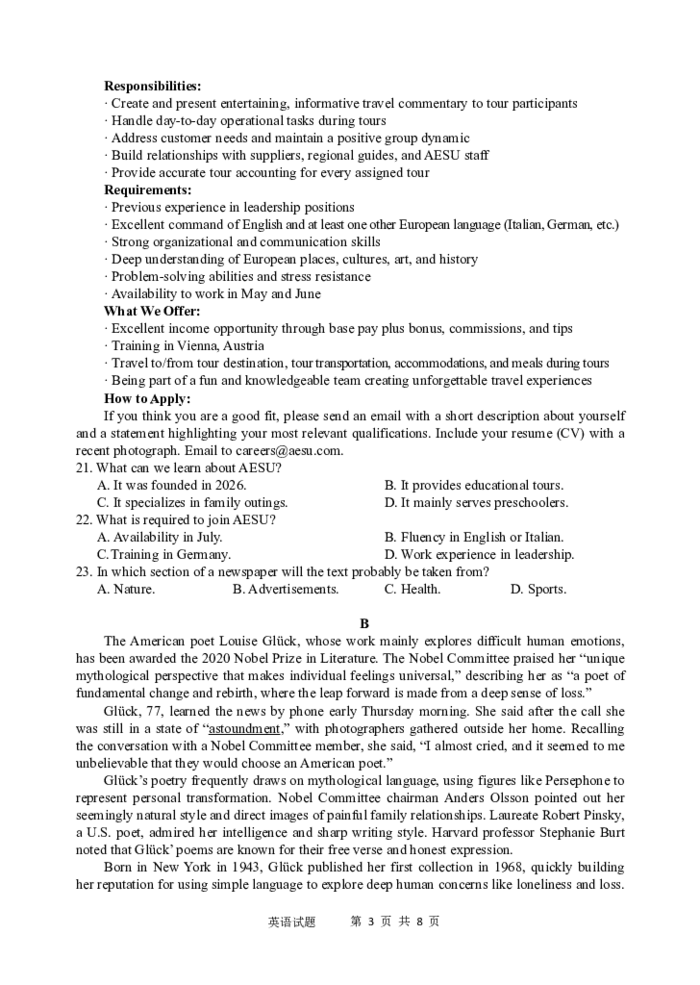
AESU is an Educational Travel Service and Worldwide Destination Management company,
founded in 1977. Our head office is located in Baltimore, MD. We specialize in college student
and young professional trips, graduation tours, and customized group travel worldwide.
We are currently seeking enthusiastic individuals to join our team as European Tour
Managers for the Summer 2026 season.
英语试题
第3 页共8 页
Responsibilities:
· Create and present entertaining, informative travel commentary to tour participants
· Handle day-to-day operational tasks during tours
· Address customer needs and maintain a positive group dynamic
· Build relationships with suppliers, regional guides, and AESU staff
· Provide accurate tour accounting for every assigned tour
Requirements:
· Previous experience in leadership positions
· Excellent command of English and at least one other European language (Italian, German, etc.)
· Strong organizational and communication skills
· Deep understanding of European places, cultures, art, and history
· Problem-solving abilities and stress resistance
· Availability to work in May and June
What We Offer:
· Excellent income opportunity through base pay plus bonus, commissions, and tips
· Training in Vienna, Austria
· Travel to/from tour destination, tour transportation, accommodations, and meals during tours
· Being part of a fun and knowledgeable team creating unforgettable travel experiences
How to Apply:
If you think you are a good fit, please send an email with a short description about yourself
and a statement highlighting your most relevant qualifications. Include your resume (CV) with a
recent photograph. Email to careers@aesu.com.
21. What can we learn about AESU?
A. It was founded in 2026.
B. It provides educational tours.
C. It specializes in family outings.
D. It mainly serves preschoolers.
22. What is required to join AESU?
A. Availability in July.
B. Fluency in English or Italian.
C.Training in Germany.
D. Work experience in leadership.
23. In which section of a newspaper will the text probably be taken from?
A. Nature.
B. Advertisements.
C. Health.
D. Sports.
B
The American poet Louise Glück, whose work mainly explores difficult human emotions,
has been awarded the 2020 Nobel Prize in Literature. The Nobel Committee praised her “unique
mythological perspective that makes individual feelings universal,” describing her as “a poet of
fundamental change and rebirth, where the leap forward is made from a deep sense of loss.”
Glück, 77, learned the news by phone early Thursday morning. She said after the call she
was still in a state of “astoundment,” with photographers gathered outside her home. Recalling
the conversation with a Nobel Committee member, she said, “I almost cried, and it seemed to me
unbelievable that they would choose an American poet.”
Glück’s poetry frequently draws on mythological language, using figures like Persephone to
represent personal transformation. Nobel Committee chairman Anders Olsson pointed out her
seemingly natural style and direct images of painful family relationships. Laureate Robert Pinsky,
a U.S. poet, admired her intelligence and sharp writing style. Harvard professor Stephanie Burt
noted that Glück’ poems are known for their free verse and honest expression.
Born in New York in 1943, Glück published her first collection in 1968, quickly building
her reputation for using simple language to explore deep human concerns like loneliness and loss.
英语试题
第4 页共8 页
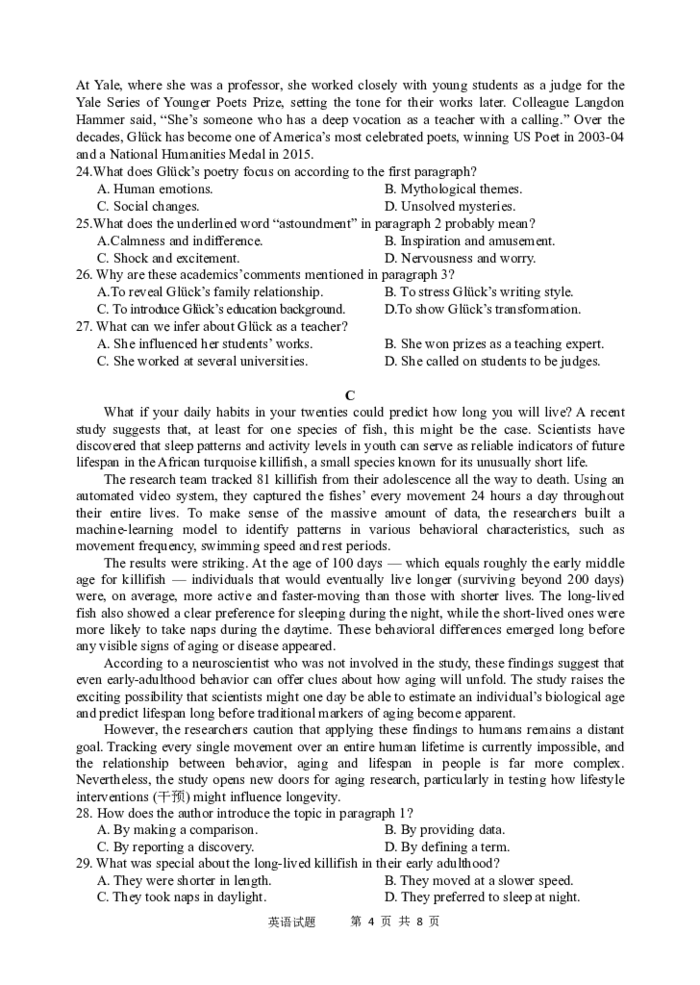
At Yale, where she was a professor, she worked closely with young students as a judge for the
Yale Series of Younger Poets Prize, setting the tone for their works later. Colleague Langdon
Hammer said, “She’s someone who has a deep vocation as a teacher with a calling.” Over the
decades, Glück has become one of America’s most celebrated poets, winning US Poet in 2003-04
and a National Humanities Medal in 2015.
24.What does Glück’s poetry focus on according to the first paragraph?
A. Human emotions.
B. Mythological themes.
C. Social changes.
D. Unsolved mysteries.
25.What does the underlined word “astoundment” in paragraph 2 probably mean?
A.Calmness and indifference.
B. Inspiration and amusement.
C. Shock and excitement.
D. Nervousness and worry.
26. Why are these academics’comments mentioned in paragraph 3?
A.To reveal Glück’s family relationship.
B. To stress Glück’s writing style.
C. To introduce Glück’s education background.
D.To show Glück’s transformation.
27. What can we infer about Glück as a teacher?
A. She influenced her students’ works.
B. She won prizes as a teaching expert.
C. She worked at several universities.
D. She called on students to be judges.
C
What if your daily habits in your twenties could predict how long you will live? A recent
study suggests that, at least for one species of fish, this might be the case. Scientists have
discovered that sleep patterns and activity levels in youth can serve as reliable indicators of future
lifespan in the African turquoise killifish, a small species known for its unusually short life.
The research team tracked 81 killifish from their adolescence all the way to death. Using an
automated video system, they captured the fishes’ every movement 24 hours a day throughout
their entire lives. To make sense of the massive amount of data, the researchers built a
machine-learning model to identify patterns in various behavioral characteristics, such as
movement frequency, swimming speed and rest periods.
The results were striking. At the age of 100 days — which equals roughly the early middle
age for killifish — individuals that would eventually live longer (surviving beyond 200 days)
were, on average, more active and faster-moving than those with shorter lives. The long-lived
fish also showed a clear preference for sleeping during the night, while the short-lived ones were
more likely to take naps during the daytime. These behavioral differences emerged long before
any visible signs of aging or disease appeared.
According to a neuroscientist who was not involved in the study, these findings suggest that
even early-adulthood behavior can offer clues about how aging will unfold. The study raises the
exciting possibility that scientists might one day be able to estimate an individual’s biological age
and predict lifespan long before traditional markers of aging become apparent.
However, the researchers caution that applying these findings to humans remains a distant
goal. Tracking every single movement over an entire human lifetime is currently impossible, and
the relationship between behavior, aging and lifespan in people is far more complex.
Nevertheless, the study opens new doors for aging research, particularly in testing how lifestyle
interventions (干预) might influence longevity.
28. How does the author introduce the topic in paragraph 1?
A. By making a comparison.
B. By providing data.
C. By reporting a discovery.
D. By defining a term.
29. What was special about the long-lived killifish in their early adulthood?
A. They were shorter in length.
B. They moved at a slower speed.
C. They took naps in daylight.
D. They preferred to sleep at night.
英语试题
第5 页共8 页
30. What is a challenge of applying the findings ?
A. Tracking lifetime human movements.
B. Testing lifestyle interventions.
C. Simplifying human aging patterns.
D. Picking out the key factors.
31. What can be a best title for the text?
A. Daily Habits Decide Your Characters
B. Youth Behaviors Predict Lifespan
C. Enough Sleep Contributes to Long Life
D. Machine Learning Unlocks Aging
D
For decades, cancer research has been disturbed by a persistent problem: the data used to
train artificial intelligence (AI) often excludes diverse populations. Many medical datasets are
overwhelmingly concluded from patients of European descent (血统), meaning AI models learn
to diagnose and treat cancer depending on a narrow slice of humanity. This lack of diversity can
lead to misdiagnosis or ineffective treatment for underrepresented groups.
Now, a team at MIT’s Computer Science and Artificial Intelligence Laboratory (CSAIL) has
developed a novel technique that uses generative AI to address this inequality head-on. Instead of
simply getting rid of biased data, their model creates synthetic (合成的) medical images — such
as breast cancer scans — that are based on the characteristics of real patients from diverse racial
and ethnic backgrounds. These synthetic images are not of real people; they are digitally
generated representations designed to fill the gaps in existing datasets.
The potential is transformative. By training diagnostic AI on a more balanced dataset
enriched with these synthetic images, the system’s accuracy across all population groups
improves significantly. Early tests show that the technique can reduce a form of algorithmic bias
known as “underspecification,” where models perform well on paper but fail in real-world,
diverse clinical settings. “We are not just fixing the data; we are fundamentally re-engineering the
fairness of the model,” explains lead researcher Dr. Sarah Chen.
However, the method is a double-edged sword. While it can “unbias” data, the very same
technology could be weaponized to increase bias. If an unintended researcher uses the same
technique to generate synthetic data that over-represents a particular group or leads to harmful
stereotypes (刻板印象), it could create AI models that are even more prejudiced than those
trained on real-world data. The line between correcting historical unfairness and creating new,
synthetic ones is pretty thin.
This concern places a significant ethical burden on researchers. What should be confirmed is
no longer the accuracy of an AI model but the safety of ethics. After all, in the scientists’ eyes it
can promise fairer healthcare in the years to come.
32. What problem has puzzled researchers in cancer treatment?
A. High cost of collecting data.
B. Overuse of AI in diagnosis.
C. Biased data sampling.
D. Misdiagnosis for patients.
33. What is paragraph 2 of the text mainly about?
A. The principle of the technique.
B. The process of the representation.
C. The purpose of the study.
D. The achievements of the design.
34. What is Dr. Sarah Chen’s attitude towards the new method?
A. Objective.
B. Worried.
C. Optimistic
D. Doubtful.
35. What should future scientists pay attention to when using AI models?
A. Getting rid of the concern.
B. Creating more training images.
C. Checking for ethical risks.
D. Avoiding negative stereotypes.
英语试题
第6 页共8 页
第二节(共5 小题;每小题2.5 分,满分12.5 分)
根据短文内容,从短文后的选项中选出能填入空白处的最佳选项。选项中有两项为多
余选项。
In a world crazy about grades and rankings, it’s easy to define our worth by external
outcomes. However, psychologist Carol Dweck’s concept of “mindset” offers a different path.
She distinguishes between a fixed mindset (the belief that our intelligence is stable) and a growth
mindset (the belief that abilities can be developed through dedication and hard work).
36
They
shape our relationship with challenges and effort.
So, how does this play out in daily life? The answer lies in how we handle difficulties.
Those with a fixed mindset tend to avoid challenges, fearing that failure might expose a lack of
intelligence.
37
They understand that struggle is not a sign of weakness but an essential
part of mastering something new. For them, effort is what actually strengthens their abilities.
This perspective is backed by neuroscience.
38
When we step out of our comfort zone
and tackle difficult problems, our brain forms new neural connections. This process, known as
neuroplasticity, proves that we can literally make ourselves smarter through learning and
practice.
How can we develop this mindset? Start by listening to your inner voice. When you think, “I
can’t do this,” add one simple word: “yet”.
39
It transforms a statement of limitation into a
promise of future potential. This small shift in self-talk can be the first step toward embracing
lifelong growth.
Ultimately, a growth mindset frees us from the need for constant confirmation. It allows us
to see setbacks not as judgments of our worth, but as valuable feedback.
40
We begin to
value the process of learning itself, finding joy in the journey of improvement rather than just the
final destination.
A. This tiny word implies that learning is a gradual process.
B. However, the other group of people do exactly the opposite.
C. There is a scientific explanation for why this mindset works.
D. These two mindsets fundamentally alter how we view ourselves.
E. They firmly believe that true potential is unknown and achievable.
F. Therefore, we should avoid difficult tasks to protect our self-esteem.
G. It also helps us separate our core identity from the outcomes we experience.
第三部分英语知识运用(共两节,满分30 分)
第一节完形填空(共15 小题;每小题1 分,满分15 分)
阅读下面短文,从每题所给的A、B、C、D 四个选项中选出可以填入空白处的最佳选项。
68-year-old Ana had been living alone in her small apartment. She rarely spoke to anyone,
and her loneliness seemed to be a wall that no one could
41
.
One day, a volunteer named Sarah arrived with a golden retriever (寻回犬) named Buddy, a
therapy dog. Ana didn’t even look up when they entered. Quietly, Buddy lay down on the floor.
“This is Buddy,” Sarah said softly. “He comes to visit every week.” Ana didn’t
42
.
For the first few visits, nothing changed. Ana remained
43
. However, each time,
Buddy would lie quietly near her chair, occasionally looking up at her with his gentle brown eyes.
On the fourth visit, something
44
happened. As Buddy lay beside her, Ana slowly lowered
her hand and let it rest on his back. Her fingers moved slightly,
45
his soft fur. Sarah held
her breath, not wanting to
46
the moment.
“He’s warm!” Ana whispered. From that day on, things changed. She started
47
Buddy’s
visits. She began to talk — first about Buddy, then
48
about her life.
The
49
was obvious. Ana was eating more, sleeping better, and even
50
a smile
英语试题
第7 页共8 页
now and then. She also joined group activities she had
51
refused to do.
Actually, therapy dogs can greatly reduce loneliness by
52
stress levels and increasing
social interaction.The simple presence of a non-judgmental animal can be deeply
53
.
On Sarah’s last visit, Ana hugged Buddy and whispered into his ear. “You
54
me!”
She stood up, looking out the window, her eyes filled with
55
.
41. A. build up
B. turn to
C. set aside
D. break through
42. A. respond
B. sing
C. run
D. argue
43. A. angry
B. happy
C. active
D. silent
44. A. funny
B. magical
C. terrible
D. ordinary
45. A. touching
B. pulling
C. holding
D. wetting
46. A. ruin
B. seize
C. forget
D. treasure
47. A. monitoring
B. expecting
C. shortening
D. avoiding
48. A. badly
B. gradually
C. merely
D. suddenly
49. A. mistake
B. expression
C. difference
D. pressure
50. A. faking
B. hiding
C. controlling
D. wearing
51. A. willingly
B. previously
C. immediately
D. eagerly
52. A. raising
B. ignoring
C. lowering
D. assessing
53. A. healing
B. convincing
C. challenging
D. embarrassing
54. A. hurt
B. saved
C. disappointed
D. warned
55. A. pride
B. innocence
C. doubt
D. hope
第二节(共10 小题;每小题1.5 分,满分15 分)
阅读下面短文,在空白处填入1 个适当的单词或括号内单词的正确形式。
The 2026 CCTV Spring Festival Gala, known as “Chunwan” to Chinese people, kicked off
on the eve of the Chinese New Year,
56
(mark) the arrival of the Year of the Horse. Under
the theme “Galloping Steed, Onward Unstoppable”, the gala was characterized by a rich variety
of
57
(show), from singing and dancing to opera, martial arts, and sketches.
This year’s gala was particularly special because of its
58
(impress) use of technology.
The integration of artificial intelligence and robotics created
59
visual experience that
amazed audiences worldwide. According to China Media Group, the gala used advanced
“5G+4K/8K+AI” technologies
60
(enhance) the viewing experience.
The gala also made history by broadcasting an accessible version
61
the
first time on CCTV-15 channel,
62
featured sign language performances and
AI-generated captions. This important step toward inclusivity ensured that the deaf and
hard-of-hearing could also enjoy the cultural feast.
63
(international), the gala cooperated with more than 3,300 media outlets in over 200
countries and regions and
64
(broadcast) to a global audience through CGTN’s
multi-language channels. For millions of Chinese people at home and abroad, watching Chunwan
on New Year’s Eve is not just entertainment
65
a symbol of family reunion and cultural
identity.
第四部分写作(共两节,满分40 分)
第一节(满分15 分)
假定你是李华,你刚参观了一场令你深受触动的中国传统艺术展览—— “发现中国美”。
你的英国笔友Chris 对中国文化很感兴趣,请你给他写一封邮件,分享这次观展的经历与
感受。
英语试题
第8 页共8 页
注意:
1. 写作词数应为80 左右;
2. 请按如下格式在答题卡的相应位置作答。
第二节(满分25 分)
阅读下面材料,根据其内容和所给段落开头语续写两段,使之构成一篇完整的短文。
If someone had told me in June that I would take part in a marathon event, I would have
laughed. Yet there I was on an October morning with a medal around my neck.
Okay, it was only the 4.2K race, and I walked more than I ran. But I still did it.
Did I mention that I weigh around 300 pounds? I also have asthma, but medication helps.
What’s more, I live with four anxiety disorders. Social anxiety makes me deadly afraid of
people’s judgment. But in August, I decided that registering for the 4.2K event of our local
marathon would be a great motivator to get in shape. So I signed up and started walking every
day. I told only a few people — my family and some trusted friends.
Training went well until mid-September, when work got so exhausting that I could barely do
anything. Still, I kept going. The real struggle came when I went to pick up my race number. I
kept wondering what others would think. I didn’t have the usual runner’s profile. When I saw the
T-shirt table, I turned away quickly. There were no shirts that would fit me. That made me doubt
myself again. What was I doing here? The 4.2K was the “popular event,” with families and
young children. But I was willing to bet that not many obese people had registered.
The night before the race, I had nightmares. When I woke up, I considered not going. Then I
realized I had forgotten to wash my best running pants. Walmart opened at 8 a.m., and the race
wasn’t until 10 a.m. I drove there, bought a pair, and headed to the starting line.
Once there, I quickly found that people didn’t really care about me; they were focused on
their own experience. That relaxed me a little, but not completely. Soon I found myself at the
back of the pack. Those real athletes must be wondering what I was doing there. But it was too
late to turn back. I started walking, my earphones playing loud music to drown out possible
hurtful comments.
注意:
1. 续写词数应为150 词左右;
2. 请按如下格式在答题卡的相应位置作答。
However, it turned out that the voices I was afraid of never came.
When I finally crossed the finish line, I heard someone calling my name.
Dear Chris,
How’s everything going?
Yours,
Li Hua