文档文本内容
高 中
时 事
人工智能会比人类更聪明吗?
Will artificial intelligence outsmart humankind?
technology [tekˈnɒlədʒi]
n.[U,C]科技;工艺;技术
artificial [ˌɑːtɪˈfɪʃl]
adj.①人工的;人造的;假的
②人为的;非自然的
③虚假的;假装的
human [ˈhjuːmən]
adj.人的;人本性的
n.[C]人
complex [ˈkɒmpleks]
adj.①复杂的;难懂的
②(语法)复合的
n.③[C]建筑群
④[C]相关联的一组事物
⑤[C]不正常的精神状态;情结
problem [ˈprɒbləm]
n.[C]问题;难题
champion [ˈtʃæmpiən]
n.①[C]冠军;第一名;优胜者
②[C]斗争者;捍卫者;声援者;
拥护者
vt.③为……而斗争;捍卫;声援
mean [miːn]
vt.意思是;意味着,意指
adj.小气的;刻薄的
process [ˈprəʊses]
n.①[C](为达到某一目标的)过
程;进程
②[C](事物发展的)过程,步
骤,流程
vt.③加工;处理
④审阅,审核,处理(文件、请
求等)
⑤数据处理
vast [vɑːst]
adj.辽阔的;巨大的;庞大的;大
量的;广大的
information [ˌɪnfəˈmeɪʃn]
单词数:207个
@2025/06/0706   ✅每日1篇时事阅读  ✅高效积累高中3500词
DATE:
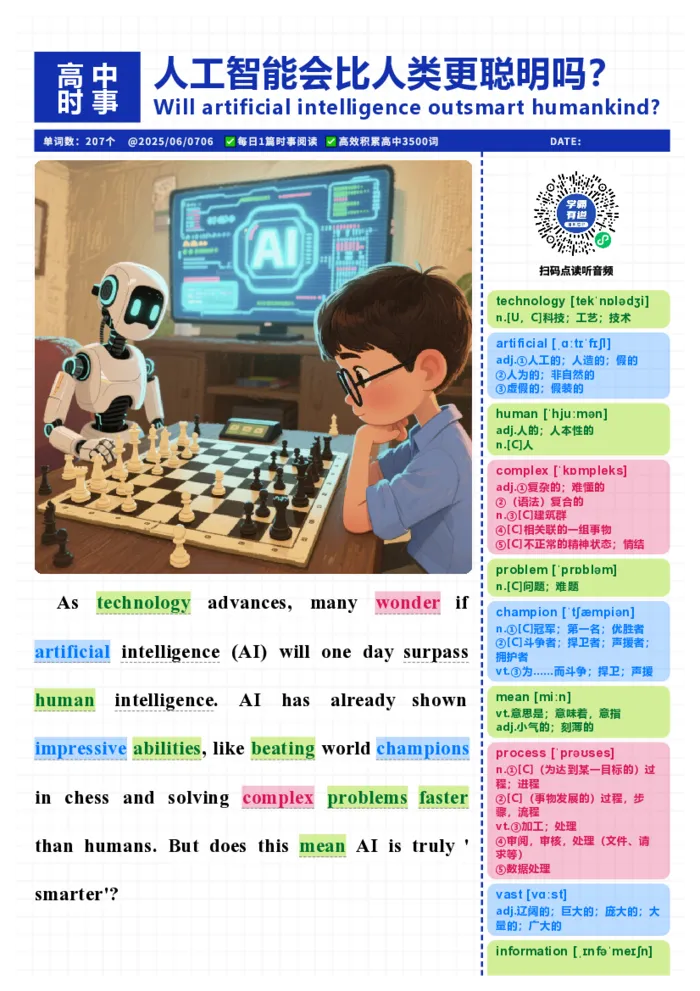
As   technology   advances,   many   wonder   if
artificial   intelligence   (AI)   will   one   day surpass
human   intelligence. AI   has   already   shown
impressive abilities, like beating world champions
in   chess   and   solving   complex   problems   faster
than humans. But does this mean AI is truly '
smarter'?
扫码点读听音频
n.[U]信息;消息;情报;资料
quick [kwɪk]
adj.快的;敏捷的,迅速的
ad.快地;迅速地
defeat [dɪˈfiːt]
n.①[U,C]失败;战败;挫败
②[C,常用sing.]击败;战胜
v.③击败;战胜
④使失败;阻挠;挫败
⑤使困惑;难住
million [ˈmɪljən]
num.①(abbr.m)[pl.]一百万
②大量
match [mætʃ]
n.①[C]火柴
②[C]比赛;竞赛
③[sing.]敌手;旗鼓相当的人
④[sing.]相配的人(或物)
⑤[C]婚姻;配偶
v. ⑥般配;相配;相似;相一致
vt. ⑦与……相匹敌;和……不相
上下;使等同于
⑧找相称(或相关)的人(或
物);配对
creative [kriˈeɪtɪv]
adj.①创造(性)的;富有创意的
②有创造力的
n.③[C]富于创造力的人;搞创作
的人
④[U]创意;创作素材
understand [ˌʌndəˈstænd]
v.理解,明白;体谅;了解
emotion [ɪˈməʊʃn]
n.[C,U]情绪;强烈的感情;情
感
situation [ˌsɪtʃuˈeɪʃn]
n.[C]形势;情况;局面
lack [læk]
vt.①没有;缺乏;不足;短缺
n.②[U,sing.]缺乏;匮乏;短缺
rely [rɪˈlaɪ]
vi.①依赖;依靠
②信任;信赖
objective [əbˈdʒektɪv]
n.①[C]目标;目的
adj.②客观的;就事论事的;不带
个人感情的
③宾格的
unique [juˈniːk]
adj.①唯一的;独一无二的
②独特的;罕见的
③(某人或事物)独具的
involve [ɪnˈvɒlv]
AI excels in specific tasks, such as processing
data or playing games, because it can analyze vast
information   quickly. For   example,   the   AI
program   AlphaGo   defeated   the   best   human go
players by learning millions of moves. However,
this 'intelligence' is limited to predefined goals,
not general thinking.
Experts hold different views. Some believe AI
might   develop   'general   intelligence'   (AGI) that
matches humans by 2030, while others argue it
will take decades. The key difference: humans can
think creatively, understand emotions, and adapt
to new situations—skills AI still lacks.
Moreover, AI relies on human programming.
Even   the   smartest   AI   systems   need   humans to
design their algorithms and set their objectives.
They can’t independently imagine, dream, or feel,
which   are   unique   to   human   intelligence.
vt.①包含;需要;使成为必然部
分(或结果)
②涉及;牵涉;牵连;影响
③(使)参加,加入
explore [ɪkˈsplɔːr]
v.①探索;考察;探险;勘探;勘
察
vt.②探讨;探究;调查研究
③(用手或身体某部)探察,探
查
alongside [əˌlɒŋˈsaɪd]
prep.①沿着……的边;在……旁
边
②与……一起;与……同时
ad.③在旁边
In conclusion, AI may outperform humans in
specific tasks, but true 'smartness' involves more
than speed or data processing. Human creativity,
emotion,   and   intuition   remain   irreplaceable.
Instead of fearing AI, we should explore how to
use it wisely alongside our unique human abilities
.