主题语境:人与社会
主题群:文学、艺术与体育
语篇类型:记叙文
来源:The New York Times, May 4, 2020
Word count:463
Flesch-Kincaid Grade Level:9.6
Lexile Range:1010L - 1200L

I Spent a Weekend Bingeing Airbnb’s Virtual Experiences.
Was it Worth It?
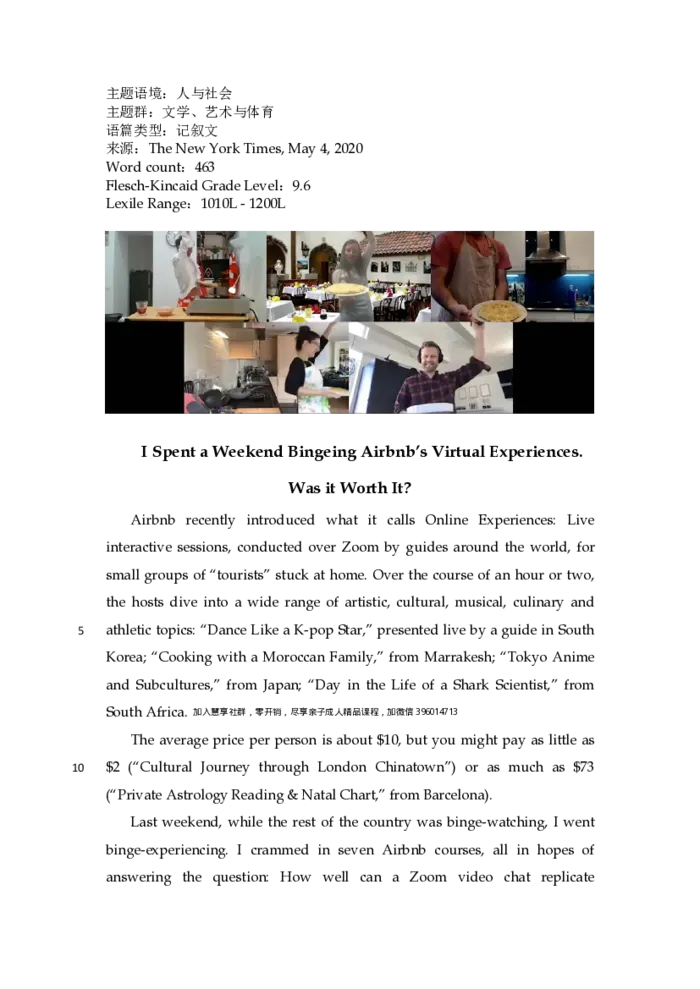
Airbnb recently introduced what it calls Online Experiences: Live
interactive sessions, conducted over Zoom by guides around the world, for
small groups of “tourists” stuck at home. Over the course of an hour or two,
the hosts dive into a wide range of artistic, cultural, musical, culinary and
athletic topics: “Dance Like a K-pop Star,” presented live by a guide in South
5
Korea; “Cooking with a Moroccan Family,” from Marrakesh; “Tokyo Anime
and Subcultures,” from Japan; “Day in the Life of a Shark Scientist,” from
South Africa.
The average price per person is about $10, but you might pay as little as
$2 (“Cultural Journey through London Chinatown”) or as much as $73
10
(“Private Astrology Reading & Natal Chart,” from Barcelona).
Last weekend, while the rest of the country was binge-watching, I went
binge-experiencing. I crammed in seven Airbnb courses, all in hopes of
answering the question: How well can a Zoom video chat replicate
加入慧享社群,零开销,尽享亲子成人精品课程,加微信 396014713
experiencing another place or culture?
15
A weekend of experiences
I discovered the answer to the question immediately. These classes are not
canned videos. They are live and two-way, and you are with people. The
classes are generally small enough that you can chat, discuss and joke with
both your instructor and your fellow classmates. You hear their various
accents, notice the sun’s different position in their time zones, and get a sense
20
of their interior decoration tastes.
The main event, though, is the hosts’ presentations, and they can be
mind-blowing. “Meet the Dogs of Chernobyl” ($52), for example, is one of the
few classes in which the host actually ventures away from home. Lucas
Hixson, a radiation specialist, arrived in Ukraine in 2015 to discover more
25
than 1,000 dogs, starving and unattended, in the Chernobyl Exclusion Zone.
They’re the descendants of pets who were abandoned by their fleeing owners
after the 1986 power-plant disaster.
Mr. Hixson took us on his daily rounds to visit and feed these dogs near
the
creepily
still,
silent
power
plant.
Apart
from
Mr.
Hixson’s
30
driver/cameraman, we didn’t see another person.
We did see the famous Unit 4 reactor, now covered by a massive
containment shell; the smoke from the local wildfires that have been burning
since April 4; and, of course, the dogs.
Some approached Mr. Hixson, wagging their tails, clearly delighted by his
35
visit. Others hovered warily at a distance, waiting to approach the food until
he left. “The dogs of Chernobyl have what I would call a street-dog mentality,”
Mr. Hixson told us. “They’re not feral, but they’re also not still domesticated.”
This tour was like stepping into a documentary — one where you can
freely cut between two camera angles (one in the car, one in Mr. Hixson’s
40
hands) and pause the film whenever you have a question for the director.