文档文本内容
主题语境:人与自然
主题群:宇宙探索
语篇类型:说明文
来源:Army News Service
Word count:839
Flesch-Kincaid Grade Level:10.6
Lexile Range:1010L - 1200L


Army astronaut returns from historic nine-month space
voyage
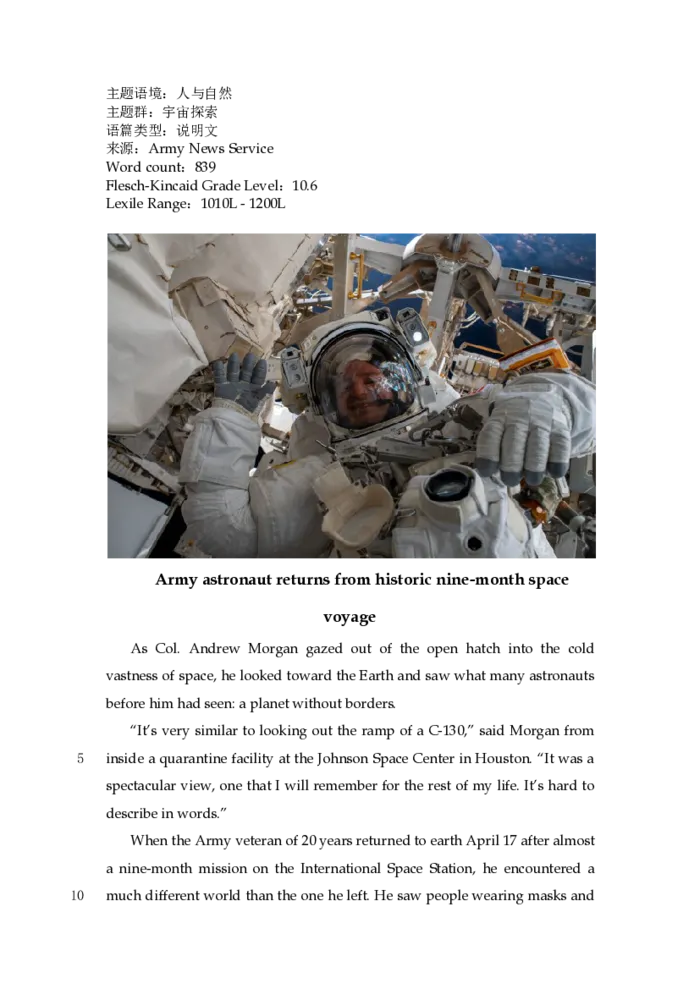
As Col. Andrew Morgan gazed out of the open hatch into the cold
vastness of space, he looked toward the Earth and saw what many astronauts
before him had seen: a planet without borders.
“It’s very similar to looking out the ramp of a C-130,” said Morgan from
inside a quarantine facility at the Johnson Space Center in Houston. “It was a
5
spectacular view, one that I will remember for the rest of my life. It’s hard to
describe in words.”
When the Army veteran of 20 years returned to earth April 17 after almost
a nine-month mission on the International Space Station, he encountered a
much different world than the one he left. He saw people wearing masks and
10
gloves, keeping their distance from each other.
Morgan stayed updated on the spread of coronavirus from the ISS by
watching regular news broadcasts. On March 30, he tweeted from space his
support for the work of American doctors and healthcare professionals
during the pandemic.
15
“We expect that the earth changes when you go away for a month just like
when you deploy you expect that some things are going to change,” said
Morgan, who landed in the small city of Baikonur, Kazakhstan, last week
before traveling to Houston. “I don’t know that I expected things would
change quite as much; I didn’t think I was going to come back to a country
20
that has more or less closed down.”
As an Army emergency care physician and flight surgeon, the pandemic
breakout gravely concerned him as he watched on his monitor 250 miles
above in space. He also applauded the Defense Department and Army’s
response to helping control the spread of the virus.
25
“Most astronauts will describe when you look down on the earth and see
an earth without borders and you see that problems … often face us all
without borders as well,” Morgan said. “There are many problems like that
(that) affect us all globally regardless of what country we are from. And
COVID-19 is just one.”
30
Morgan said he expects to remain in quarantine for a few more days
before returning to his family, as the astronauts’ immune systems may be
weakened from a lengthy stay in space, making them more susceptible to the
virus.
The lengthy space mission saw Morgan and his crew make 4,352 orbits
35
around the earth, totaling 115 million miles. Morgan successfully completed
the first seven spacewalks of his career and helped orchestrate NASA’s first
all-female spacewalk, taken by fellow astronauts Christina Koch and Jessica
Meir. Morgan’s spacewalks totaled 45 hours and 48 minutes.
Morgan said the mission ranked as the busiest in NASA history for
40
spacewalks and cargo and robotics operations.
“It was a more rigorous and more operationally intense period than I ever
expected to have on my first mission,” Morgan said. “Most first missions are
not nine months long. So I was fortunate enough to be trusted to do a mission
of that length for my first mission and all of the spacewalks and cargo
45
vehicles and robotics operations that we had during that time.”
Morgan and his crew conducted hundreds of experiments in Earth science,
human research, biology, physical sciences and technology development. The
astronauts studied how to go beyond earth’s orbit to the moon and possibly
Mars. Morgan said their research also made advances on how the human
50
body adapts to a microgravity environment beyond the earth’s atmosphere.
Crew members included a Russian cosmonaut and an Italian astronaut.
“We’re learning a lot about the human body and how it responds,” he
said. “And I can tell you firsthand from my experience, some of the unique
adaptations that our body makes when we first adapt to microgravity and
55
then return back to a gravity environment back here on earth and the changes
our bodies undergo; our bodies are pretty miraculous in their ability to
adapt.”
The West Point graduate considers himself a soldier first and has stressed
the positive impact the Army has had on his career. He likened the mission to
60
an extended deployment, having served in Special Forces during
deployments to Iraq and Afghanistan.
He said the toughest challenge he faced while working at the ISS:
separation from his wife, Stacey, and their four children. On April 10, Morgan
tweeted from the ISS “Being away from my family for nine months has been
65
the toughest challenge of my mission.”
Morgan said he brought unit patches and coins from each of the Army
units he served with to the space station. He credited his Army training and
field experiences with helping him successfully complete three NASA
expeditions. Morgan’s Army training includes Ranger School, Airborne
70
School and completing the Army’s Combat Diving Course.
“Everything that I am is a result of my experiences in the Army,” Morgan
said. “All of the skills and experiences that I have are a result of my time as a
soldier. So it was important to me when I was on board the ISS to represent
that, to represent the Army well in space.”
75