文档文本内容
主题语境:人与自然
主题群:宇宙探索
语篇类型:说明文
来源:National Post, 20200512
Word count:460
Flesch-Kincaid Grade Level:8.7
Lexile Range:1010L - 1200L


A new black hole has been found, and it’s closer to Earth
than any other
Just 1,000 light years away, it’s part of a double star system visible from the
southern hemisphere
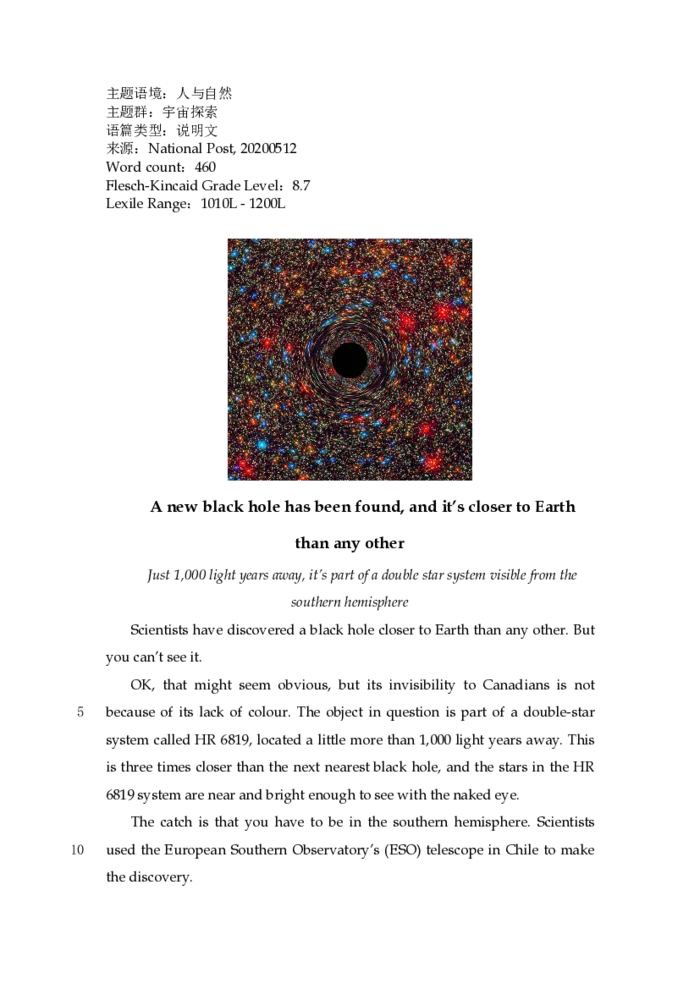
Scientists have discovered a black hole closer to Earth than any other. But
you can’t see it.
OK, that might seem obvious, but its invisibility to Canadians is not
because of its lack of colour. The object in question is part of a double-star
5
system called HR 6819, located a little more than 1,000 light years away. This
is three times closer than the next nearest black hole, and the stars in the HR
6819 system are near and bright enough to see with the naked eye.
The catch is that you have to be in the southern hemisphere. Scientists
used the European Southern Observatory’s (ESO) telescope in Chile to make
10
the discovery.
They were studying double-star systems and noticed that one of them
was orbiting an unseen object every 40 days, while the other orbited a large
distance away.
They estimated the mass of the invisible object by observing its visible
15
companion. At four times the mass of the sun, it could only be a black hole.
The discovery so close to Earth – though not near enough to pose any
threat, it should be added – opens up the possibility of other black holes even
closer to home.
“There must be a bunch of them closer … that we haven’t found yet,” said
20
the ESO’s Dr. Marianne Heida. “Based on the number of stars in the Milky
Way, we expect that there are about 100 million of these small black holes,
and we’ve only found less than 100 of them.”
If black holes were spread evenly throughout the galaxy, she added, the
closest should be just 30 to 40 light years away.
25
The object in HR 6819 isn’t pulling in much material, making it truly dark.
“This black hole is close enough that if it had an accretion disc, it could be
visible with the naked eye,” Heida said. But even without that shine, it’s a
prime candidate for further research. “Because it’s so close by, we will be able
to make very detailed observations in the future that should let us measure
30
the mass of this black hole with higher precision than is possible for black
holes that are further away.”
The newly discovered black hole is not a new arrival, said Heida. “We
think the two normal stars in the system are probably about 50 to 75 million
years old, and the black hole would have been formed around the same time,
35
which means the dinosaurs may have seen the supernova explosion” that
created it. Well, not all the dinosaurs. Only the ones in the south.