文档文本内容
主题语境:人与社会
主题群:名人、文学艺术
语篇类型:新闻报道
来源:vaticannews.va, 2020/04/05
Word count: 561
Flesch-Kincaid Grade Level: 13.2
Lexile Range: 1410L - 1600L

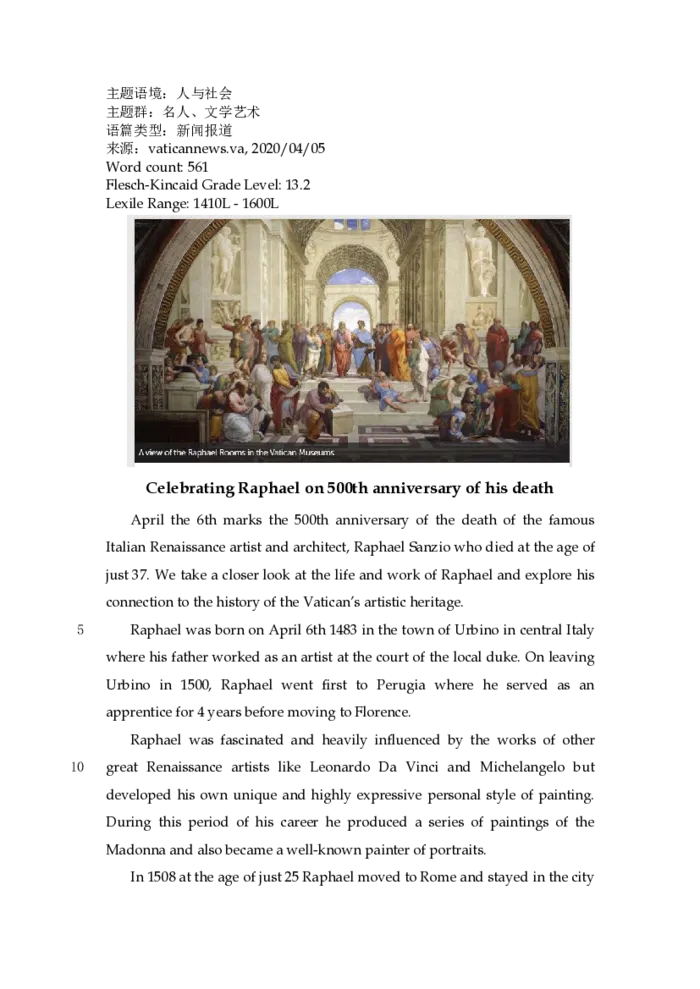
Celebrating Raphael on 500th anniversary of his death
April the 6th marks the 500th anniversary of the death of the famous
Italian Renaissance artist and architect, Raphael Sanzio who died at the age of
just 37. We take a closer look at the life and work of Raphael and explore his
connection to the history of the Vatican’s artistic heritage.
Raphael was born on April 6th 1483 in the town of Urbino in central Italy
5
where his father worked as an artist at the court of the local duke. On leaving
Urbino in 1500, Raphael went first to Perugia where he served as an
apprentice for 4 years before moving to Florence.
Raphael was fascinated and heavily influenced by the works of other
great Renaissance artists like Leonardo Da Vinci and Michelangelo but
10
developed his own unique and highly expressive personal style of painting.
During this period of his career he produced a series of paintings of the
Madonna and also became a well-known painter of portraits.
In 1508 at the age of just 25 Raphael moved to Rome and stayed in the city
for the rest of his life. Here he soon found himself working for Pope Julius II
15
and painted a series of frescoed walls in the papal palace. Raphael was not
just an artist but also a poet, a draughtsman and an architect and in 1514 he
was appointed by Pope Leo X as the Vatican’s chief architect following the
death of Donato Bramante.

Raphael tapestries on display in Sistine Chapel
Around the world, a series of exhibitions and celebrations to mark the
20
500th anniversary of Raphael’s death were planned for 2020 but most have
closed, been cancelled or else put on hold due to the coronavirus pandemic.
The biggest exhibition ever devoted to Raphael opened on March 5th in
Rome’s Scuderie del Quirinale and includes over 100 works by the artist
himself.  Unfortunately, the exhibition was forced to close its doors just four
25
days after its opening when Italy imposed a nationwide lockdown.
One exhibit in honour of Raphael that was held before the start of Italy’s
coronavirus lockdown, took place in the Vatican Museums.  For one week
only in February, the ten tapestries designed by Raphael went on display in
the original location for which they were intended, on the walls of the Sistine
30
Chapel beneath Michelangelo’s frescoed ceiling.
Commissioned by Pope Leo X, the tapestries’ designs, or cartoons as they
are known, depict events from the lives of Saints Peter and Paul.  They were
woven in Brussels over a four year period using silk, wool and gilded silver
thread. Only seven of Raphael’s original cartoons still exist and are preserved
35
in London’s Victoria and Albert Museum while the tapestries themselves are
normally displayed on a rotating basis in the “Raphael Rooms” inside the
Vatican Museums.
Sadly, Raphael himself did not live to see all the tapestries completed and
together. Following a sudden illness, he died on April 6th, 1520 which was his
40
37th birthday. His passing was widely mourned and the artist was given an
加入慧享社群,零开销,尽享亲子成人精品课程,加微信 396014713
elaborate funeral and buried in Rome’s Pantheon.
Five centuries after his untimely death, Raphael’s legacy as one of the
towering artistic figures of the Italian Renaissance period shines as brightly as
ever.  But how much more could he have accomplished if his life had not
45
been cut so tragically short?