义
务
教
育
教
科
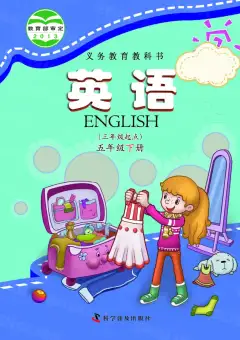
书
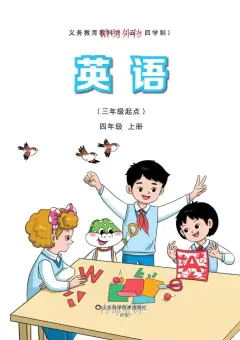
(一年级起点)
五年级 下册
五年级 下册
(一年级起点)
主     编:
副主编:
陈    琳       Printha Ellis (英)
鲁子问
Name ( 姓名):               Class ( 班级):               School ( 学校):
义
务
教
育
教
科
书
前        言
各位同学,你们好!欢迎大家学习本套英语教材!
2000年,外语教学与研究出版社与麦克米伦出版(中国)有限公司依据
国家《义务教育 英语课程标准(实验稿)》共同组织开发了本套教材;作为
我国第一套中小学“一条龙”英语教材,本套教材已出版使用十余年。2011
年,基于新颁布的国家《义务教育 英语课程标准(2011年版)》,我们对教
材进行了认真修订。
在修订后的小学教材中,我们为同学们保留了大家熟悉并喜爱的四个小
伙伴—中国学生大明和玲玲、英国学生Sam和Amy,还增加了其他一些人物
和小动物。他们会带领大家在一系列有趣的故事、对话、游戏、活动和歌曲中
学习英语。
修订后的教材每册包括10个学习模块(Module)、一个复习模块
(Review Module)、四个单词表、一个补充阅读(Reading for Pleasure)
版块以及一个综合运用实践项目(Project)。每个学习模块分两个单元
(Unit),一般情况下,第一单元呈现本模块所要学习的语言内容,第二单元
提供若干任务型(Task-based)活动,包括一首歌曲、歌谣或韵句。学习模
块的课文中呈现了一些语法内容,但不要求老师做理论的讲解,更不要求大家
孤立地、脱离语境地掌握,只希望大家初步学会在恰当的语境中运用包含这些
语法的句子。这一原则也希望老师在教学过程中以及家长在辅导孩子学习的
时候注意。复习模块对前面10个模块所学的内容进行综合和融合性复习,使
大家的语言知识和相应的语言技能得到进一步的巩固与提高。教材有四个单词
表,包括:分模块按出现顺序收录的单词,按字母顺序收录的全书单词,歌
曲、歌谣或韵句中出现的单词以及人名、地名。在歌曲、歌谣或韵句中出现的
新词,只要求理解,不要求学会运用。补充阅读为大家选用了篇幅短小、内容
丰富、形式多样的材料。教材最后设计了一个综合运用实践项目,供同学们根
据兴趣自由选择使用。
本套教材同时还配有对应的网络教材,可供同学们在线学习使用。
同学们,希望大家积极尝试,大胆实践,主动学做教材中的英语活动,
努力学唱英语歌曲、歌谣和韵句。相信你们会在参与活动、完成任务的过程中
体会到学习英语的乐趣,实现英语的灵活运用和自由交际。
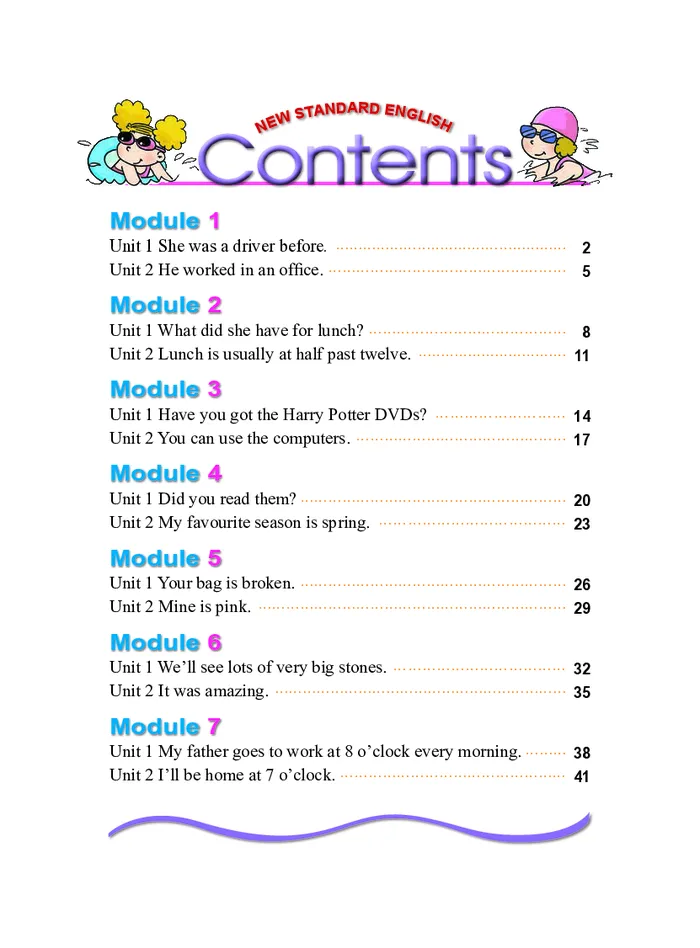
……………………………………………  2
……………………………………………  5
……………………………………  8
…………………………… 11
……………………… 14
……………………………………… 17
………………………………………………… 20
………………………………… 23
………………………………………………… 26
………………………………………………………… 29
……………………………… 32
……………………………………………………… 35
……… 38
………………………………………… 41
Unit 1 She was a driver before.
Unit 2 He worked in an office.
Unit 1 What did she have for lunch?
Unit 2 Lunch is usually at half past twelve.
Unit 1 Have you got the Harry Potter DVDs?
Unit 2 You can use the computers.
Unit 1 Did you read them?
Unit 2 My favourite season is spring.
Unit 1 Your bag is broken.
Unit 2 Mine is pink.
Unit 1 We’ll see lots of very big stones.
Unit 2 It was amazing.
Unit 1 My father goes to work at 8 o’clock every morning.
Unit 2 I’ll be home at 7 o’clock.
Module 1
Module 4
Module 2
Module 5
Module 3
Module 6
Module 7
N
E
W
 S
TA
N
DA
RD
 E
N
G
LI
S
H
Review Module
Words and Expressions in Each Module
Word List
Words in Songs and Chants
Proper Nouns
Reading for Pleasure
Unit 1
Unit 2
………………………………………………… 44
………………………………………………………… 47
…………………………………………………… 50
………………………… 53
………………………………… 56
…………………………………………… 59
…………………………………………………………………………… 62
…………………………………………………………………………… 64
…… 66
……………………………………………………………… 69
………………………… 72
……………………………………………………… 73
…………………………………………………… 74
………………………………………………………………… 78
………………………………………………………………… 82
……………………………………………………………………………… 89
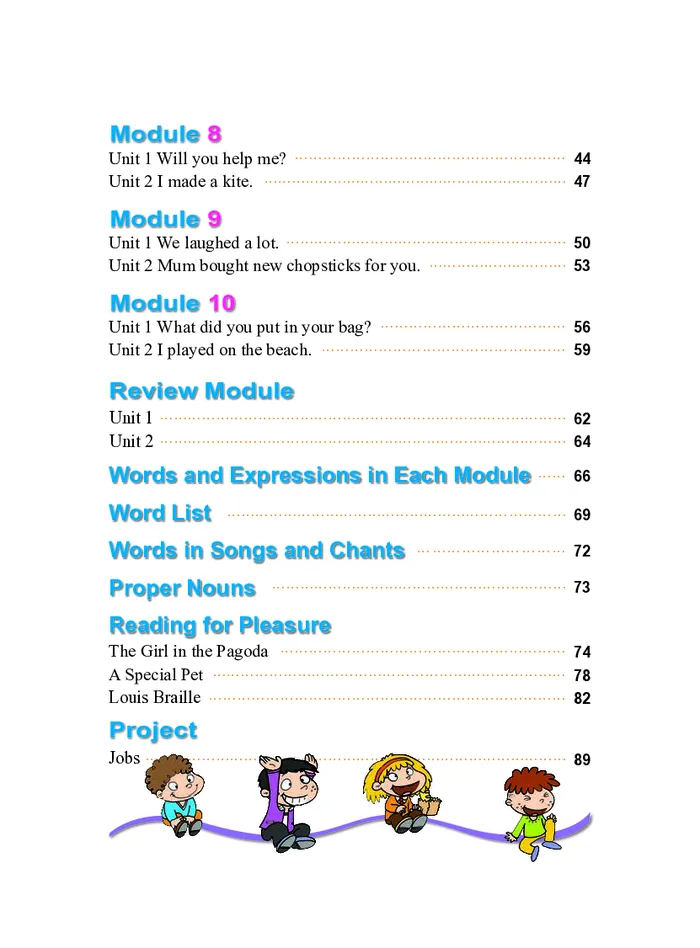
Module 8
Project
Module 9
Module 10
Jobs
The Girl in the Pagoda
A Special Pet
Louis Braille
Unit 1 Will you help me?
Unit 2 I made a kite.
Unit 1 We laughed a lot.
Unit 2 Mum bought new chopsticks for you.
Unit 1 What did you put in your bag?
Unit 2 I played on the beach.
2
1
1
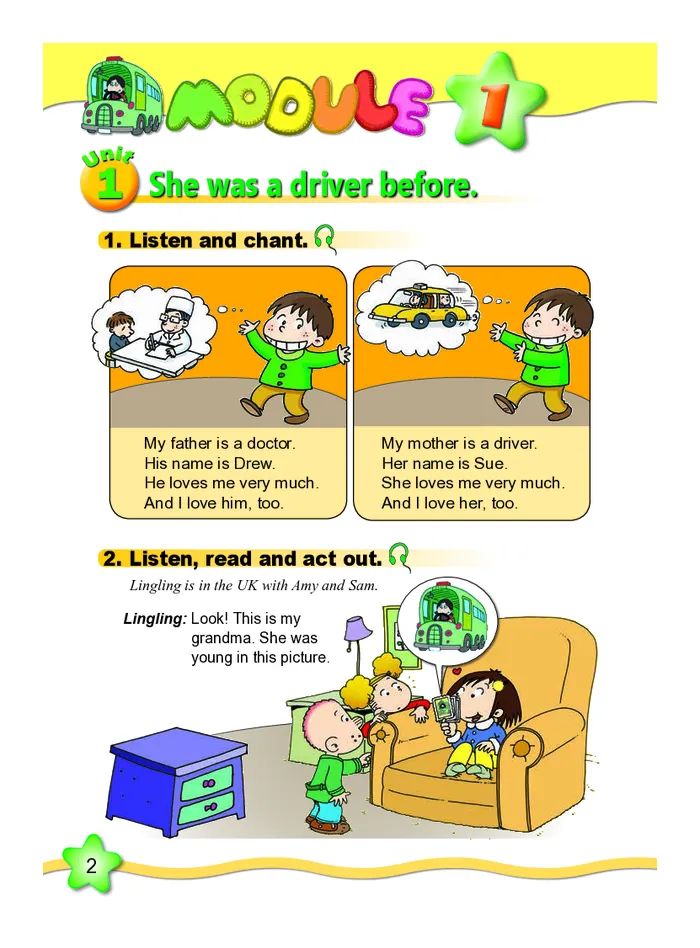
My father is a doctor.
His name is Drew.
He loves me very much.
And I love him, too.
My mother is a driver.
Her name is Sue.
She loves me very much.
And I love her, too.
1. Listen and chant.
2. Listen, read and act out.
She was a driver before.
1
t
i
n
U
Lingling is in the UK with Amy and Sam.
Look! This is my
grandma. She was
young in this picture.
Lingling:
3
1
t
i
n
U
1
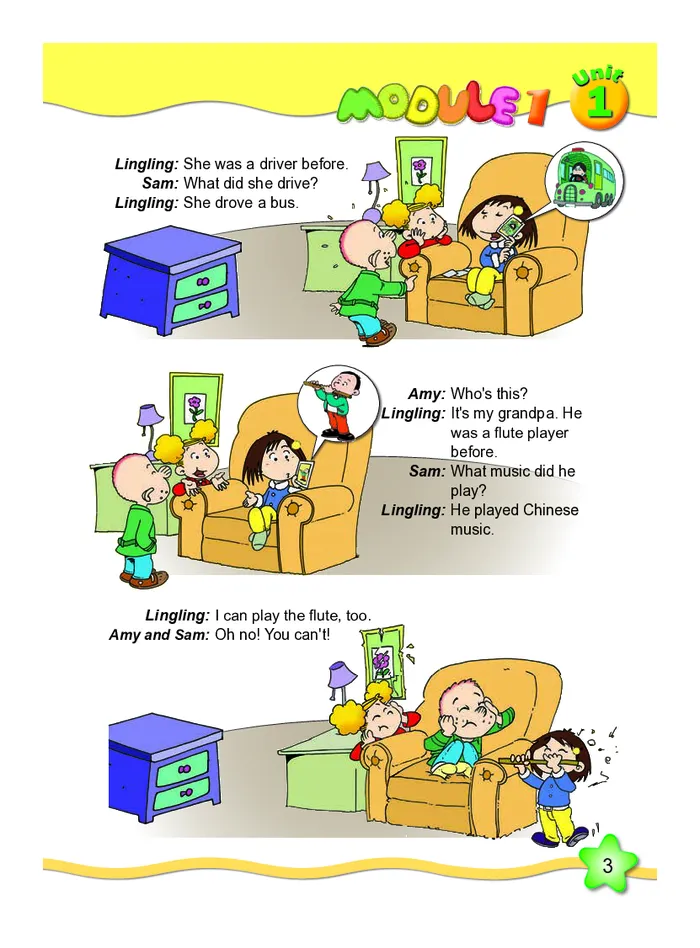
She was a driver before.
What did she drive?
She drove a bus.
I can play the flute, too.
Oh no! You can't!
Lingling:
Sam:
Lingling:
Lingling:
Amy and Sam:
Who's this?
It's my grandpa. He
was a flute player
before.
What music did he
play?
He played Chinese
music.
Amy:
Lingling:
Sam:
Lingling:
4
1
t
i
n
U
1
1
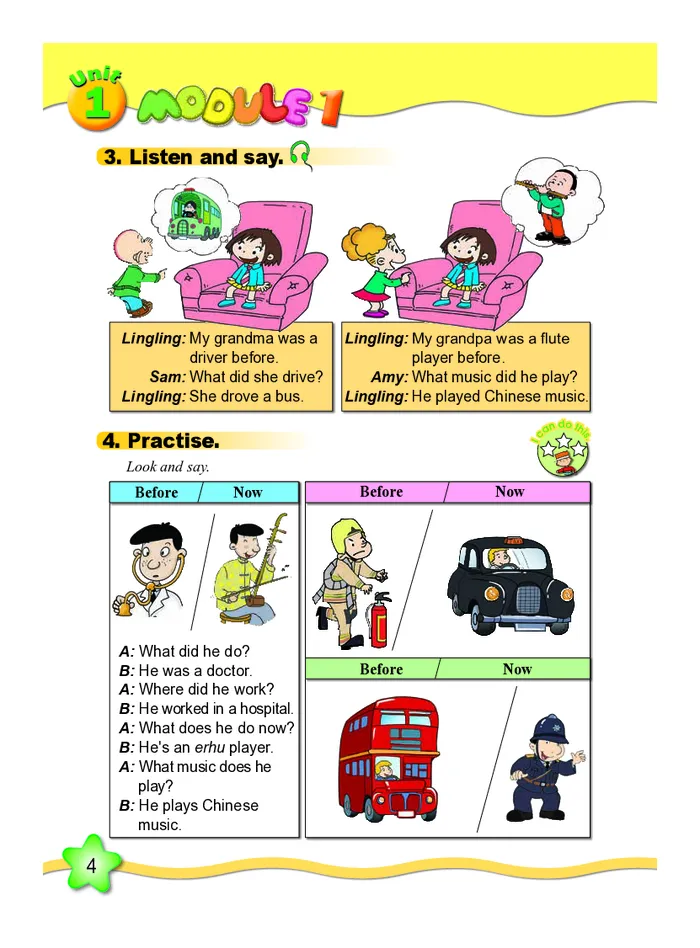
3. Listen and say.
4. Practise.
Look and say.
My grandma was a
driver before.
What did she drive?
She drove a bus.
My grandpa was a flute
player before.
What music did he play?
He played Chinese music.
Lingling:

Sam:
Lingling:
Lingling:

Amy:
Lingling:
Before
Before
Now
Now
A: What did he do?
B: He was a doctor.
A: Where did he work?
B: He worked in a hospital.
A: What does he do now?
B: He's an erhu player.
A: What music does he
     play?
B: He plays Chinese
     music.
Before
Now
5
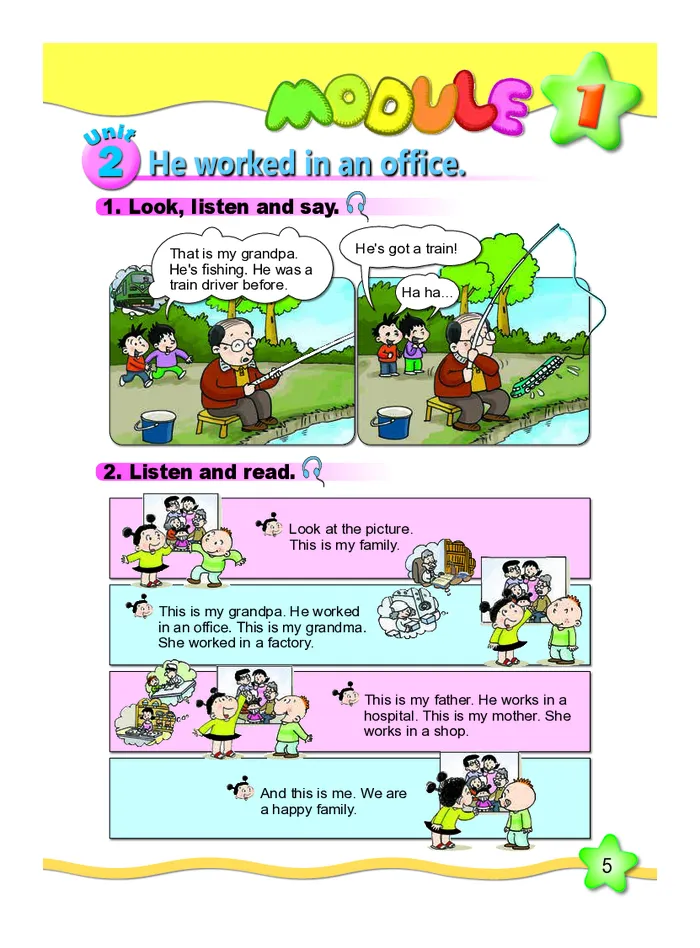
He worked in an office.
2
t
i
n
U
1
1
1. Look, listen and say.
2. Listen and read.

This is my grandpa. He worked
in an office. This is my grandma.
She worked in a factory.
Look at the picture.
This is my family.
And this is me. We are
a happy family.
This is my father. He works in a
hospital. This is my mother. She
works in a shop.
He's got a train!
Ha ha...
That is my grandpa.
He's fishing. He was a
train driver before.
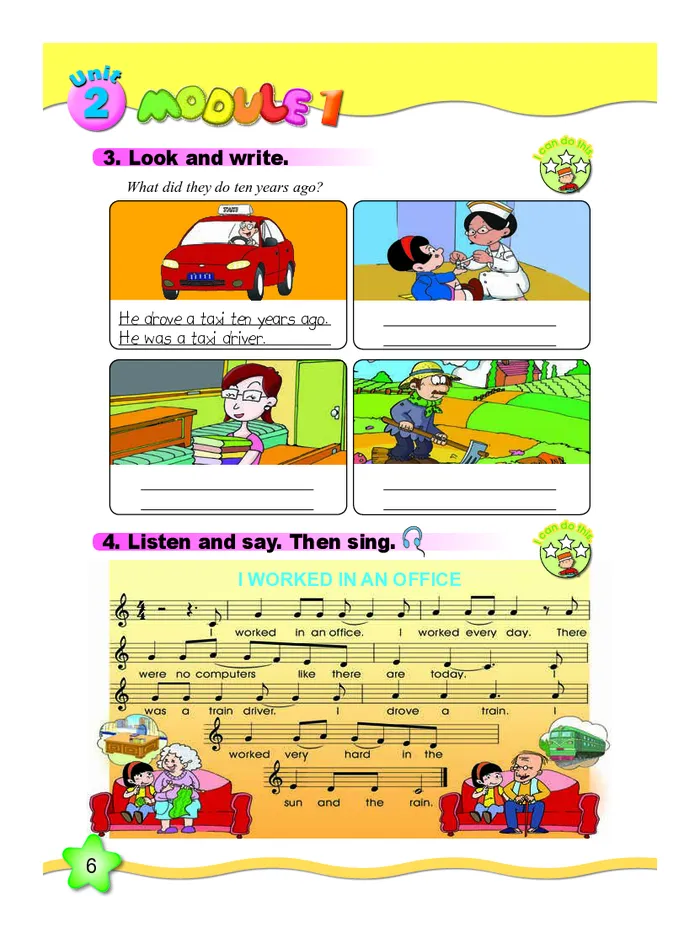
3. Look and write.
4. Listen and say. Then sing.

He drove a taxi ten years ago.
He was a taxi driver.
I WORKED IN AN OFFICE
6
2
t
i
n
U
1
1
What did they do ten years ago?
What did
you do?
Make a survey and talk about it.
Where did
you work?
I was a(n)…
I…
I…
What do you
do now?
Where do
you work?
I'm a(n)…
5. Ask and answer.
6. Do and say.
He worked in
a hospital.
She worked
on a farm.
Where did your
grandma work,
Alice?
Where did your
grandpa work,
Xiaoyong?
Xiaoyong's grandpa
worked…
7
2
t
i
n
U
1
1
8
1
t
i
n
U
2
1. Listen and chant.
2. Listen, read and act out.

What did she have for lunch?
What did you have for dinner?
Bread, meat and vegetables.
What did you have for dinner?
Fish, eggs and vegetables.
Look. I've got an email from Lingling.
It's about English food.
What does it say?
Daming:
Fanfan:
9
And what did she
have for lunch?
She had sandwiches.
Fanfan:
Daming:
1
t
i
n
U
2
Yesterday she had an
English breakfast.
What did she have?
She had eggs and
sausages.
What did she have for dinner?
She had fish and chips.
Fish and chips?
Yes. It's a traditional English dish.
Does Lingling like English
food?
Yes, she does. She says
it's delicious!
Daming:
Fanfan:
Daming:
Fanfan:
Daming:
Fanfan:
Daming:
Fanfan:
Daming:
10
1
t
i
n
U
2
2
3. Listen and say.

4. Practise.
What did she have for
breakfast?
She had eggs and
sausages.
breakfast
lunch
dinner
What did she have
for dinner?
She had fish and
chips.
Fanfan:
Daming:
Fanfan:
Daming:
What did you
have for breakfast
yesterday?
I had…
11
Lunch is usually at half past twelve.
1. Look, listen and say.

2
t
i
n
U
2
2
2. Listen and read.

In the UK, people usually have
breakfast at 7 o'clock.
Lunch is usually at half
past twelve. Dinner is
usually at half past six.
Sundays are special in
the UK. Families usually
eat lunch together. They
eat chicken, potatoes and
other vegetables.
Daming usually has meat,
vegetables and rice for dinner. But
today he has noodles and an egg.
It's my birthday
today. Wait,
who are you?
12
3. Look, ask and answer.
4. Listen and say. Then sing.

2
2
2
t
i
n
U
A: When does Sam have breakfast?
B: He has breakfast at 7.
A: What does he have for breakfast?
B: He has eggs and sausages.
BREAKFAST, LUNCH AND DINNER
Breakfast,	lunch	 and
dinner,
we	 want	 to
eat	 them
all.
Let's	 try	 English
food.
We
want	 to
eat
it
all.
Eggs	 and	 chips	 and	sausages,
fish
and	 chicken,
too.
Sandwiches
and
vegetables
are
very
good
for
you.
13
5. Follow and say.
6. Write and report.
2
2
2
t
i
n
U
I'm hungry.
I want noodles.
We're hungry.
He wants noodles.
I want fish.
We're hungry.
He wants noodles.
She wants fish. I want
a hamburger.
We're hungry.
He wants…
Feifei had apples and bread
for breakfast yesterday…
apples, bread
...
Feifei
...
What did you have for
breakfast yesterday?
Make a survey and talk about it.
14
1
t
i
n
U
1. Listen and chant.

2. Listen, read and act out.

Have you got the Harry Potter DVDs?
I'm Mr Hook.
Here's my book.
It's a present for you,
please take a look.
Excuse me. Have you got
the Harry Potter DVDs?
I'll look on the computer.
Sorry, we haven't got the
DVDs. But we have got
the books.
Amy:
Librarian:
3
At the Library
15
1
t
i
n
U
3
Oh good. Where
are they?
I'll show them to
you.
Aah. You've got lots
of Harry Potter books
here!
Yes, we have.
Harry Potter is our
favourite.
Children in China like
Harry Potter, too.
Amy:
Librarian:
Lingling:
Librarian:
Amy:
Lingling:
Your library card,
please.
Here you are.
Please give the
books back in
two weeks.
We will. Thank
you.
Librarian:
Amy:
Librarian:
Amy and Lingling:
16
1
t
i
n
U
3. Listen and say.

4. Practise.
3
Have you got the Harry
Potter DVDs?
Sorry, we haven't got the
DVDs. But we have got
the books.
You've got lots of
Harry Potter books
here!
Yes, we have.
Amy:
Librarian:
Lingling:
Librarian:
Yes, we have. /
No, we haven't.
Excuse me.
Have you got…?
The Three
Little Pigs
Wolf!
Wolf!
Maths for
Children
Ma Liang and
the Magic
Paintbrush
This Is
London
17
You can use the computers.
1. Look, listen and say.
2
t
i
n
U
2. Listen and read.
This is our library.
You can borrow
books from here.
3
This is our library.
All our books are here.
You can do lots of things in libraries. You can borrow books,
CDs and DVDs. You can use the computers. You can do
your homework. But you can't talk to your friends.
18
3
3. Look, think and say.
In the library,
Shelves of books,
in the library,
old and new,
there is so much
lots of stories
for you to see.
for me and you.
You can borrow books in a library.
You can't talk to your friends.
So many CDs
In the library,
for us to choose.
in the library,
DVDs to borrow,
there is so much
computers to use.
for you to see.
Library
School
Shop
Hospital
Park
Zoo
4. Listen and say. Then chant.
2
t
i
n
U
19
3
6. Think and do.
Make rules for your school library.
5. Draw, ask and answer.
You can
borrow books.
You can't talk to
your friends.
2
t
i
n
U
Can I have some
sweets, please?
Sorry, you
can't.
20
4
I sent you a bike.
I sent you a kite.
Did you ride the bike?
Did you fly the kite?
Daming's grandma lives in the US.
2. Listen, read and act out.

Ni hao!
Daming, it's Grandma!
Hello, Grandma. How are
you?
I'm fine, thanks. Daming,
I sent you a maths game.
Did you get it?
Yes, Grandma. Thank you.
Daming:
Grandma:
Daming:
Grandma:
Daming:
Did you read them?
1
t
i
n
U
1. Listen and chant.
21
1
t
i
n
U
4
And I sent you English
books. Did you read
them?
Yes, Grandma. I read
them. They are
interesting.
Good. Do you want to
come to the US this
summer?
Yes, Grandma. Oh, Mimi
is eating my chocolate!
Grandma:
Daming:
Grandma:
Daming:
And I sent you American
chocolate. Did you eat it?
Yes, I ate some of it. Thank
you. It was delicious.
Grandma:
Daming:
22
1
t
i
n
U
3. Listen and say.
4. Practise.
4
Look and say.
I've got some books. I read them last week.
I sent you a maths
game. Did you get it?
Yes, Grandma.
Thank you.
And I sent you English
books. Did you read them?
Yes, Grandma. I read
them. They are
interesting.
Grandma:
Daming:
Grandma:
Daming:
23
4
1. Listen and chant.

What's your favourite season?
My favourite season is spring.
It's warm. There are flowers
on the trees. I can see ducks
in the river.
I love summer. It's hot.
I can go swimming.
I can wear shorts.
I love autumn. It's cool. The
leaves fall from the trees.
I can play with them.
I love winter. It's cold.
I can play with the snow.
I can wear gloves.
2. Listen and read.

My favourite season is spring.
2
t
i
n
U
I can go skiing in winter.
I love skiing with my father.
I can go swimming in summer.
I love swimming with my mother.
24
3. Read and write.
4
4. Listen and say. Then chant.

What can you do in spring/summer/autumn/winter?
I love summer.
The temperature is high.
In summer it is hot.
The sun is in the sky.
I love winter.
The temperature is low.
In winter it is cold.
And there is snow.
I can fly my kite in spring.
2
t
i
n
U
25
5. Make funny sentences.
6. Do and say.
4
My favourite season is
spring. It's warm. I can go to
the park and fly my kite…
 Make a poster of your favourite season and talk about it.
2
t
i
n
U
Ha ha…
It's cold in summer. We
go skiing in summer.
26
5
Your bag is broken.
1
t
i
n
U
1. Look, listen and say.

2. Listen, read and act out.

Lingling, your bag is broken!
You can't take it to China.
I'll buy you a new one.
Thank you.
Ms Smart:
Lingling:
It's only
thirty yuan.
It's very
cheap.
But it looks
dirty.
How much is
that bag?
27
1
t
i
n
U
5
This black bag is
nice. It's big.
But it's very heavy.
Look at this green
one. It's light.
But it's very small,
Ms Smart. I really like
the black one.
Lingling:
Ms Smart:
Lingling:
This red bag has
got wheels. It will be
easy for her to carry.
How much is it?
It's 30 pounds.
Great! We'll take it,
please.
Thank you very much.
Sales assistant:
Ms Smart:
Sales assistant:
Ms Smart:
Lingling:
At the Shop
28
3. Listen and say.

4. Practise.
5
Look and write. Then say.
This black bag is
nice. It's big.
Look at this green
one. It's light.
Lingling:
Ms Smart:
1
t
i
n
U
The yellow pencils are broken.
The blue pencils are new.
29
5
1. Look, listen and say.

2. Listen and read.

Mine is pink.
Mine is brown.
I carry it with
my hand.
Mine is
broken. I can't
carry it.
My schoolbag
is red and blue.
I carry it on my
back.
I can carry you
and your bag
with my hands.
Can you carry my
bag on your back?
Mine is pink.
I carry it over
my shoulder.
2
t
i
n
U
30
3. Listen and write.
4. Listen and say. Then chant.

5
Legs, legs!
It walks with its legs.
It's got eight thin legs.
Mouth, mouth!
It eats with its mouth.
It's got a very big mouth.
Ears, ears!
It hears with its ears.
It's got very long ears.
Eyes, eyes!
It sees with its eyes.
It's got very small eyes.
2
t
i
n
U
3
2
4
1
Wang Fei's bag
is small and light.
31
A: Is it white?
B: No, it isn't. It's yellow.
A: Is it light?
B: No, it's heavy.
A: Is it small?
B: Yes, it is.
A: It's the small box.
B: Yes, you're right.
5. Ask and find.
6. Do and say.
5
A: Xiaoyong's birthday is coming. Let's buy a present for him.
B: This bag is big, but it looks old.
A: This bag is big and beautiful.
B: Let's take this one.
C: Let's make a birthday card for him, too.
2
t
i
n
U
A
B
B
A
C
Choose a birthday present for your friend/classmate.
32
How old is the Great Wall?
And what did they build it for?
We'll visit it tomorrow.
You'll find the things you want to know.
1. Listen and chant.

2. Listen, read and act out.

On Saturday, we're going to see Stonehenge.
What's that?
It's a very old place. It's about five thousand years old.
That's very old! What will we see there?
Amy:
Lingling:
Amy:
Lingling:
6
6
We'll see lots of very big stones.
1
t
i
n
U
33
You're clever. Maybe you will
find the answer!
I hope so!
How will we get there?
By car. It will take three hours.
Well, I can't wait!
Amy:
Lingling:
Lingling:
Amy:
Lingling:
We'll see lots of very big stones. They are in a circle.
Some stones are on top of the others.
It's very interesting. Why did people build it?
No one knows.
Amy:
Lingling:
Amy:
1
t
i
n
U
6
34
3. Listen and say.

4. Practise.
What will we see there?
We'll see lots of very big
stones.
A: What will Lingling and Amy do on Saturday?
B: They'll…
How will we get there?
By car. It will take three
hours.
Lingling:
Amy:
Lingling:
Amy:
1
t
i
n
U
6
6
35
1. Look, listen and say.

2. Listen and read.
Daming, come and
take a bike ride.
Then come and
take a bus ride.
All right!
No, I'm tired.
Dear Daming,
Last Saturday, we went to Stonehenge. There was a very big
surprise waiting for me. We took a short helicopter ride over
Stonehenge!
The stones are very big, but they looked small from the sky.
It was amazing. I took some nice photos there.
What will you do this summer?
Love,
Lingling
6
6
It was amazing.
2
t
i
n
U
36
3. Read and write.
4. Listen and say. Then chant.
We went to the Great Wall.
We took some nice photos there.
2
t
i
n
U
6
6
We do the same things
all around the world.
We sing songs
and clap along
all around the world.
We go to schools
and follow rules
all around the world.
We play games.
It's the same
all around the world.
37
What did you do last
weekend?
5. Make funny sentences.
6. Ask and answer. Then report.
Make a survey and talk about it.
…
2
t
i
n
U
6
6
     I went to
 the Great
   Wall.
I saw an
elephant
there.
   The
elephant
danced.

Went swimming
Went to
Visited
Played football
Watched TV


the park
grandparents
  4
  3
  2
1
No. of children
I…
Four children went swimming last
weekend. Two…
Activity
38
7
1. Look, listen and say.
2. Listen, read and act out.
My father goes to work
at 8 o'clock every morning.
1
t
i
n
U
I go home at 5 pm. He
goes home at 5 am.
Am? Pm?
Daming:
Fangfang:
Daming:
My father goes to work at
8 o'clock every morning.
What does he do?
He's a policeman.
I go to school at 7 am.
My cousin goes to work at 7 pm.
39
1
t
i
n
U
7
Fangfang:
Daming:
Fangfang:
My father goes to work at 6
o'clock every evening.
That's late. What does he do?
He's an actor. He's very busy.
Fangfang:
Fangfang's mother:
Daming and Fangfang:
Look! Here's my
mother!
Hello, children. I'll
take you to school.
Thank you!
Daming:
Fangfang:
Daming:
My mother goes to work
at 11 o'clock every night.
That's very, very late.
What does she do?
She's a nurse.
Fangfang:
Daming:
Fangfang:
My mother goes to work at
half past five every morning.
That's very early. What does
she do?
She's a taxi driver.
40
1
t
i
n
U
7
7
3. Listen and say.
4. Practise.
My father goes to work at
8 o'clock every morning.
He's a policeman.
My brother is a teacher. He goes to work at...
My brother
My father
My mother
My father goes to work at
6 o'clock every evening.
He's an actor.
41
I'll be home at 7 o'clock.
1. Look, listen and say.

2
t
i
n
U
7
7
2. Listen and read.

It's half past eight
now. I'm late and
I'm tired.
It's a quarter to seven. Are you
going to be late?
Don't worry! I'll be home at 7
o'clock. Why?
It's 7 o'clock. Here he is.
Happy birthday!
Thank you!
Dad, it's 6 o'clock now. What time
will you be home?
I'll be home at 7 o'clock.
Sam:
Mr Smart:
Ms Smart:
Mr Smart:
Amy:
All:
Mr Smart:
It's half past six now. Will you still
be home at 7 o'clock, Dad?
Yes, I will.
Amy:
Mr Smart:
Oh no! It's a quarter to
eight now. School starts
at 8 o'clock. I'll be late.
42
3. Read and write.
4. Listen and say. Then chant.

7
7
2
t
i
n
U
Dad goes to work at 7 o'clock,
7 o'clock, 7 o'clock.
Dad goes to work at 7 o'clock.
He's a busy man.
Mum goes to work at half past six,
half past six, half past six.
Mum goes to work at half past six.
She's a busy woman.
I go to school at 8 o'clock,
8 o'clock, 8 o'clock.
I go to school at 8 o'clock.
And we'll all be home at 6.
It's 5 o'clock in the afternoon
now. Dad will be home at 7
o'clock in the evening.
43
She gets up
at 7 o'clock.
What time
does your
mum get up?
5. Say and guess.
6. Ask and answer. Then write.
2
t
i
n
U
Do you get up at
7 o'clock every
morning?
I do it at 7 o'clock
every morning.
Yes, I do.
get up
have breakfast
go to school
have lunch
go home
have dinner
go to bed
7
My mum gets up at half past six. David's mum gets up at 7
o’clock…
David's Family
44
I'm going to visit my cousin in New York.
His name is Simon.
What present can I take?
What about chopsticks?
I think he's got some
chopsticks. His mother
is Chinese.
8
1. Look, listen and say.

2. Listen, read and act out.

Will you help me?
1
t
i
n
U
Daming:
Fangfang:
Daming:
It will be a
great present.
44
Tomorrow is my
cat's birthday.
I'll make a paper
fish for her.
45
1
t
i
n
U
Will you help me?
Of course I will.
Daming:
Fangfang:
What about a kite?
Good idea! I'll make
a kite!
But will it be windy
in New York?
I think so.
Fangfang:
Daming:
Fangfang:
Daming:
Daming, your cousin
will love this kite. It's
a Chinese dragon.
Thank you for your
help. It will be a
great present.
Fangfang:
Daming:
45
8
8
46
I'll make a kite!
Daming:
3. Listen and say.

4. Practise.
A: Will you... tomorrow?
B: Yes, I will. / No, I won't.
Will you help me?
Of course I will.
Daming:
Fangfang:
8
1
t
i
n
U
46
47
2. Listen and read.
I Made a Kite
I drew a dragon on a piece of
yellow paper.
I painted it.
I cut the paper with scissors.
I put sticks on it.
I tied strings to it.
Then I could fly my kite.
I drew a dragon.
I cut the paper.
I made a kite
for my sister.
8
8
I made a kite.
2
t
i
n
U
1. Listen and chant.
47
48
3. Look and say.
4. Listen and say. Then sing.
FLY, FLY IN THE SKY
1
2
3
4
What did Lingling do?
8
8
2
t
i
n
U
48
49
6. Write and say.
5. Do, ask and answer.
What will you
do tomorrow?
Write how you made your dragon kite and talk about it.
8
8
2
t
i
n
U
49
I drew a dragon on
a piece of paper.
I'll go swimming
tomorrow.
50
9
2. Listen and read.

I saw a dog.
It wore a coat.
I saw a dog.
It wore a hat.
I saw a man.
He wore a skirt.
Wow! I've got two letters in
English! One is from the UK
and one is from the US.
Daming:
1
t
i
n
U
We laughed a lot.
1. Look, listen and say.
51
1
t
i
n
U
9
15 Marling Street
London, NW2
UK
Dear Daming,
Last week, we went to a children's theatre. The men wore
women's clothes. The women wore men's clothes. The actors
told lots of jokes. It was very funny. We laughed a lot.
Children here love the theatre.
After the show, we went to a restaurant. We all ate
hamburgers and chips.
Are you ready for your trip to the US?
Love,
Lingling
51
52
1
t
i
n
U
3. Listen and say.
4. Practise.
9
Last week, we went to a
children's theatre.
The actors told lots of jokes.
We laughed a lot.
We had a party yesterday.
Look and say.
53
9
2. Listen and read.

He borrowed some books.
And he read them all.
Dear Daming,
How are you? We are getting ready for your visit. Dad put
another bed in my room. Mum bought new chopsticks for
you. And we borrowed a bike for you.
Dad read a book about Chinese history. He is going to ask
you some questions! Me too! History is my favourite subject.
We’ll visit a lot of places together. It will be fun!
See you soon!
Love,
Simon
He bought many books.
But he didn't read at all.
2
t
i
n
U
Mum bought new chopsticks for you.
1. Listen and chant.

54
3. Read and write.
9
4. Listen and say. Then sing.

Yesterday
Now
Tomorrow
He ate a hamburger
yesterday.
POSTMAN, POSTMAN
2
t
i
n
U
55
She played a lot of
games. She was very
happy.
Dear Mary,
Love,
Lily
5. Say and guess.
6. Read and write.
Read Lily's story and help her write a letter to her cousin Mary.
9
A: I've got a letter from a friend. He saw a koala.
B: Is the letter from Australia?
A: Yes, it is.
She ate
hamburgers and
chips. She liked
them.
Lily went to Hong
Kong with her parents
this summer.
She visited
Disneyland.
2
t
i
n
U
56
10
10
2. Listen, read and act out.

Hello, Daming.
Hello, Grandma.
Are you ready
for your trip
tomorrow?
I don't know,
Grandma.
Grandma:
Daming:
Grandma:
Daming:
What did you put in your bag?
1
t
i
n
U
1. Look, listen and say.

Ms Smart:
Sam:
Ms Smart:
Sam:
Sam:
Ms Smart:
Mum, what did you
say to me?
I don't know!
Where are you going
this weekend, Sam?
I don't know.
When are you going
to get up?
I don't know.
57
1
t
i
n
U
10
10
What did you put in
your bag?
My clothes, my shoes,
some presents, my
ticket and my passport.
And where will you go
tomorrow?
I'll go to the airport.
Then I'll take the
plane to the US.
When will you
leave tomorrow?
At 7 o'clock in
the morning.
Who is going to the
airport with you?
Who? Mum!
Great! You are
ready for your trip!
See you in the US,
Daming!
OK. Bye, Grandma!
Grandma:
Daming:
Grandma:
Daming:
Grandma:
Daming:
Grandma:
Daming:
Grandma:
Daming:
58
3. Listen and say.

4. Practise.
10
10
I got up at 8 o'clock in the morning yesterday.
Look and say.
What did you put in
your bag?
My clothes, my shoes,
some presents,
my ticket and my
passport.
And where will you go
tomorrow?
I'll go to the airport.
Grandma:
Daming:
Grandma:
Daming:
1
t
i
n
U
59
10
10
2. Listen and read.

Last night, I went to
the moon. I took some
photos for you.
Look! What's in
the photo?
I'm Hannah. Last summer, I went
to Brighton. I went there in July.
I played on the beach. I ate fish
and chips. I made a new friend
there. Her name is Daisy. I often
write to her.
I'm Wang Fei. Last summer, I
went to Mount Tai. I went there in
August. I climbed the mountain
and had a picnic. I met my
classmates there. We had a really
good time together.
Oh, it's our city!
2
t
i
n
U
1. Look, listen and say.

I played on the beach.
60
3. Read and write.
4. Listen and say. Then chant.

10
10
She went to the Great Wall
last summer.
I'm getting ready for my trip.
I'm getting ready for my trip.
I'm not going by train.
I'm not going by plane.
This is going to be a different trip,
because I'm going by ship.
Last Summer
2
t
i
n
U
Yesterday
Last Month
61
5. Follow and say.
6. Write and say.
Write about your plan for a trip and talk about it.
10
10
We had a party
yesterday. He
danced. She played
a game. I...
We had a party
yesterday. He danced.
I played a game.
We had a party
yesterday. I danced.
2
t
i
n
U
We’ll go to the zoo this weekend.
We’ll have bread and juice for lunch.
We’ll take lots of pictures. We'll...
62
2
Say five
parts of the
body.
Say the
days of the
week.
Say five
types of fruit.
Say five
things you do
every day.
3 Say four
types of
weather.
4
Say six types
of clothes.
11
1
Say four
jobs.
Start
1. Do and say.
12
13
1
t
i
n
U
Use the dice and follow the instructions.
63
Say four jobs.
My mother is a nurse. My father is a...
Say the four
seasons.
Say six
animals.
Say four
school
subjects.
7 Say the
three meals
of the day.
5
Say four
countries.
2. Play again and answer with full sentences.
6
Say three
sports.
8
Say five
places.
Say six
colours.
Finish
14
16
15
1
t
i
n
U
9
Say four
types of food.
10
64
Thirty Years Ago
What does he/she do?
Where did he/she work?
What did he/she wear?
What did he/she do?
1. Listen, point and say.
2. Now ask and answer.
He was
a farmer.
What did
Grandpa Jim do?
2
t
i
n
U
65
breakfast
lunch
dinner
3. Ask and answer.
4. Look and write.
I had dinner at
6 o'clock.
What did you
have for dinner
yesterday?
I had eggs, meat
and vegetables.
When did you have
dinner yesterday?
2
t
i
n
U
I’ll go to London by plane.
Words and Expressions in Each Module
Module 1
drive 驾驶
drove (drive的过去式)驾驶
player 演奏者
office 办公室
fish 捕鱼,钓鱼
Module 2
*sausage 香肠
sandwich 三明治
*fish and chips 炸鱼加炸薯条
traditional 传统的
dish 食品,菜肴
delicious 美味的
chicken 鸡肉
Module 3
*DVD 数字化视频光盘
*librarian 图书馆管理员;
 图书馆馆长
show 给(某人)看
borrow 借入,借来
Module 4
sent (send的过去式)寄,
 发送
American 美国的;美国人的
read (read的过去式)阅读
interesting 令人感兴趣的;
 有趣的
season 季节
snow 雪
Module 5
How much...? ……多少钱?
66
light 轻的
*sales assistant 售货员,营业员
carry 提;抱;扛;背;搬
pound 英镑
back 背,背部
over 在……的上方,
 在……的上面
shoulder 肩,肩膀
Module 6
build 建造
place 地方
thousand (数字)一千
circle 圆,圆形
answer 答案
hope 希望
so 如此,这样
get 到达(某地)
hour 小时
*amazing 令人吃惊的
take 搭乘,乘坐
short 短暂的,短期的
*helicopter 直升机
Module 7
evening 傍晚,晚上
actor 演员
busy 忙的,忙碌的
quarter 一刻钟
Module 8
Chinese 中国人的
drew (draw的过去式)绘画,画
piece 张,片,块
painted (paint的过去式)
 给……涂颜料
67
scissors (常复)剪刀
stick 棍,棒
tied (tie的过去式)扎上,系上
*string 线,细绳
Module 9
theatre 剧院
men (man的复数形式)男人
women (woman的复数形式)
 女人
told (tell的过去式)口述,讲
joke 笑话
funny 滑稽的,可笑的
show 演出,表演
put (put的过去式)放置
history 历史;历史学
subject 学科,科目
Module 10
ticket 票
passport 护照
leave 离开,动身
July 七月
August 八月
met (meet的过去式)遇见
classmate 同班同学
68
(注:黑体词为义务教育英语课
程标准二级词汇,标有*的词为
五级词汇表外的词汇)
69
Aa
actor 演员
*amazing 令人吃惊的
American 美国的;美国人的
answer 答案
August 八月
Bb
back 背,背部
borrow 借入,借来
build 建造
busy 忙的,忙碌的
Cc
carry 提;抱;扛;背;搬
chicken 鸡肉
Chinese 中国人的
circle 圆,圆形
classmate 同班同学
Dd
delicious 美味的
dish 食品,菜肴
drew (draw的过去式)
 绘画,画
drive 驾驶
drove (drive的过去式)驾驶
*DVD 数字化视频光盘
Ee
evening 傍晚,晚上
Ff
fish 捕鱼,钓鱼
*fish and chips 炸鱼加炸薯条
funny 滑稽的,可笑的
Word  List
Gg
get 到达(某地)
Hh
*helicopter 直升机
history 历史;历史学
hope 希望
hour 小时
How much...? ……多少钱?
Ii
interesting 令人感兴趣的;
 有趣的
Jj
joke 笑话
July 七月
Ll
leave 离开,动身
*librarian 图书馆管理员;
 图书馆馆长
light 轻的
Mm
men (man的复数形式)男人
met (meet的过去式)遇见
Oo
office 办公室
over 在……的上方,
 在……的上面
Pp
painted (paint的过去式)
 给……涂颜料
passport 护照
piece 张,片,块
place 地方
player 演奏者
70
71
pound 英镑
put (put的过去式)放置
Qq
quarter 一刻钟
Rr
read (read的过去式)阅读
Ss
*sales assistant 售货员,
 营业员
sandwich 三明治
*sausage 香肠
scissors (常复)剪刀
season 季节
sent (send的过去式)寄,
 发送
short 短暂的,短期的
shoulder 肩,肩膀
show 给(某人)看;演出,
 表演
snow 雪
so 如此,这样
stick 棍,棒
*string 线,细绳
subject 学科,科目
Tt
take 搭乘,乘坐
theatre 剧院
thousand (数字)一千
ticket 票
tied (tie的过去式)扎上,系上
told (tell的过去式)口述,讲
traditional 传统的
Ww
women (woman的复数形式)
 女人
Words in Songs and Chants
above 在……上方,
 在……之上
cloud 云,云雾
follow 遵照,遵守
nobody 没有人
postman 邮递员
same 相同的,同样的
sun 太阳;阳光
temperature 气温,温度
way 路程,距离
72
Proper Nouns
Names
Alice 艾丽斯
Daisy 黛西
David 戴维
Drew 德鲁
Hannah 汉娜
Harry Potter 哈利·波特
Hook 胡克
Lily 莉莉
Mary 玛丽
Sue 休
Places
Brighton 布赖顿(英国
 南部城市)
Disneyland 迪斯尼乐园
Mount Tai 泰山
Spain 西班牙
Stonehenge 巨石阵(英国一
 处史前巨石建筑遗址)
73
74
A beautiful girl lived in a village. There was a
very tall pagoda in the village. One day, it was
very hot. The girl sat under a big tree.
Suddenly a strong wind came.
It carried the girl into the sky.
The girl's family were very sad. "We want our
beautiful girl back," they said.
The Girl in the Pagoda
75
When the girl opened her eyes, she was at the top of the pagoda. A
young man was in front of her.
"Will you marry me?" asked the young man. "No, I won't," said the
girl. "I want to go home."
The young man was angry. "Then you will stay in this pagoda," he said.
Every day, the young man visited the girl. But the girl still didn't want
to marry him.
76
One day, the window of the pagoda was open. The girl looked
out and saw the young man below. But he wasn't a young man
anymore. He was a monster now! The girl was very scared.
Later, the girl saw a man at the foot of the pagoda. "Help! Help!"
she cried.  But the man didn't hear her. So the girl threw her coat
out of the window. The man saw the coat. Then he looked up and
saw the girl at the top of the pagoda. He ran to the village for help.
77
Then the people in the village went to the pagoda to help the girl.
When the girl's brother saw the monster, he hit it with a thick stick.
The monster flew away.
The girl was safe. "I missed you so much!" said the girl to her
brother. Everyone in the village had parties for many days.
anymore (用于谈论或询问已经
结束的情况或某人已经停止做的
事)再也
threw (throw的过去式)扔
hit (hit的过去式)打,击
flew (fly的过去式)逃离
Word List
pagoda 塔
sat (sit的过去式)坐
suddenly 突然
strong 高速移动的
wind 风
marry 娶,嫁,和……结婚
below 在……下面
78
A Special Pet
One day, Amy wanted to buy a pet. She didn't want a cat or
a dog. She didn't want a goldfish. "I want a special pet," Amy
thought. So she went to the pet shop.
79
"Thank you, but I don't want a kitten," said Amy.
"This is a very nice dog," the woman said.
"I don't want a dog," said Amy.
"And what about this goldfish? It's very beautiful."
"My brother's got a goldfish," said Amy. "I want to buy a really
special pet."
"Can I help you?" asked the woman in the shop.
"I want to buy a pet," said Amy.
"Here's a lovely kitten," the woman said.
80
Hello!
Goodbye.
Amy pulled the string.
"Hello!" said the parrot.
"Wow!" said Amy.
"Now pull the other
string," the woman said.
Amy pulled the other
string. "Goodbye," said
the parrot.
"That's great!" said Amy.
"Here's a special pet," said the woman.
"It's very beautiful," said Amy.
"It's a parrot," said the woman. "And it's very clever."
"Look! It's got two strings on its feet," said Amy.
"That's right," said the woman.
"Why?" Amy asked. "Well, pull this string and find out," the woman
said.
81
pet 宠物
pull  拉,拽
kitten 小猫
perch  栖息之处
goldfish 金鱼
Word List
I will fall off
my perch,
of course!
"Do you want to buy the parrot?" asked the woman.
"Oh yes!" said Amy. "But what will happen when I
pull both strings?" she asked.
"I will fall off my perch, of course!" said the parrot.
82
Louis Braille
Louis Braille lived near Paris in France. His father made saddles
for horses.
Don't touch the
knife, Louis. It's
dangerous.
83
We must find a
doctor.
When Louis was three, he played with one of his father's
tools. It slipped and went into his eye.
But it was 1812. There were no buses or cars. And there
were no doctors nearby.
There is a
good doctor in Paris.
84
My other eye
hurts, too, Papa.
The doctor checked Louis' eyes. Louis couldn't see.
Nothing.
It's very
dark.
What can
you see?
Louis and his father went to Paris. They travelled all day.
85
Louis and his father went home. But Louis still couldn't see.
He was blind.
At first, Louis went to the village school. He was a very good
student.
He can't write,
but he remembers
everything!
Louis will
never read
or write.
86
I want to go
to a special
school for blind
children.
I can feel the
letters, but it's
very slow.
Louis could read the alphabet with his fingers. But he wanted
to read more quickly.
When he was ten, Louis went to a special school for blind
children in Paris.
87
So Louis invented an alphabet for the blind. He made
different dots for each letter on a piece of paper.
A man came and read books to Louis. Louis then wrote the
books in the new alphabet.
These three dots
are the letter "d".
Now I can read
and write!
88
Word List
Paris 巴黎
France 法国
saddle 马鞍
tool  工具
slip 滑落
nearby 在附近
papa (口语)爸爸
check 检查
never 永不
alphabet 字母表
dot 点
die 死,去世
Louis died when he was only 42. Now blind people all over the
world can read and write with Braille's alphabet.
We will call this
new alphabet
"Braille".
89
1. Cut out or draw pictures of six different
  jobs you like to do.
This is a doctor.
And this is
a farmer.
Jobs
● What do they do?
● Where do they work?
2. Write sentences for each job.
90
4. Decorate your poster.
3. Stick the pictures and sentences on a large
  piece of paper.
91
5. Present your poster to the class.
A: This is a teacher.

B: She works at a school.
C: She teaches English.
D: I want to be a teacher, too.
6. Display your poster.
后 记
后 记
既名为“后记”,一般应该是本教材使用完毕后才看到的吧。
那么,同学们,你们喜欢这套教材吗?大明、玲玲以及他们的小伙
伴们是否让你们喜爱上了英语,并且帮助你们掌握了一定的英语运用能
力呢?如果是这样,那就太好啦!希望你们在以后的英语学习中继续大
胆地开口说英语——课上说、课下说;继续积极地参与各项语言活动。
一句话,你们要尽量主动使用英语来表达意思和做事情,这样才能把英
语学好。
可敬的老师们,感谢你们的辛勤劳动,以及你们为国家英语课程改
革付出的努力和做出的贡献。在修订本套教材的过程中,我们也充分考
虑了英语课程改革以及一线教学的需求。修订后的教材更加突出了英语
课程工具性和人文性的统一,优化了各册的结构设计和内容安排,以使
教学脉络更加清晰、梯度更加合理。
为了在最大程度上保证教材与课程标准的契合,便于一线教学使用,
所有参与本套教材编写的人员均付出了艰辛的努力。在此我想特别感谢
我的编写团队,没有他们的努力与付出,就没有本教材的问世。
本册教材的主要编写人员如下(中方编写人员按姓氏笔画排序):
Naomi Simmons(英)   Carlos Barcenas(英)
于业宏      王馨悦      孙  泓      张  琦      樊  波
你们的
二〇一二年春日