Tiger Times
01
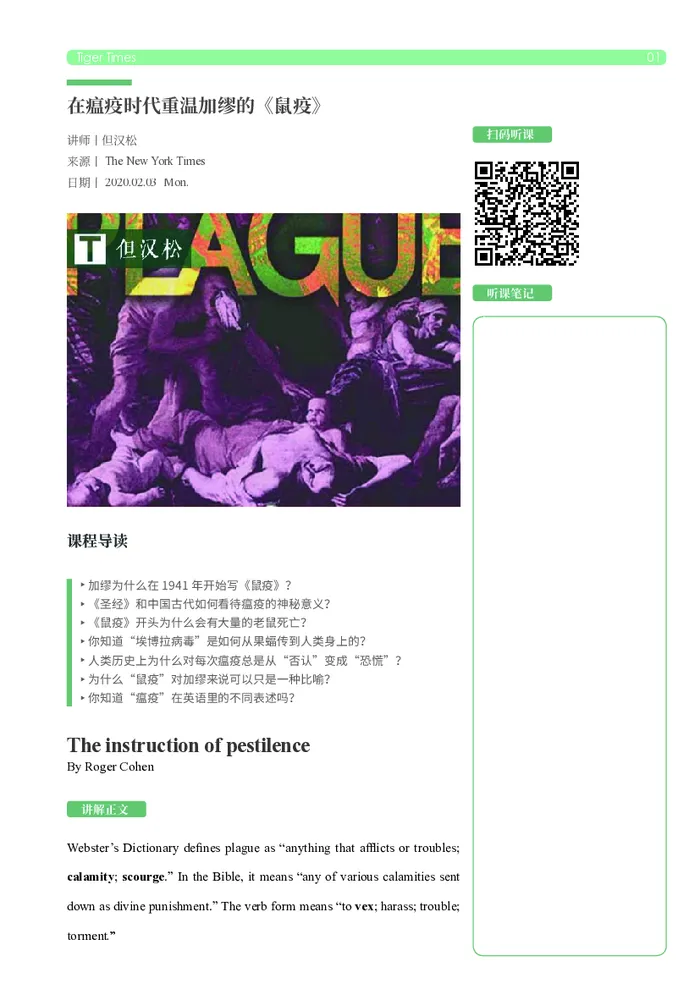
在瘟疫时代重温加缪的《鼠疫》
讲师丨但汉松
来源丨The New York Times
日期丨2020.02.03 Mon.
课程导读
▶ 加缪为什么在1941 年开始写《鼠疫》?
▶ 《圣经》和中国古代如何看待瘟疫的神秘意义?
▶ 《鼠疫》开头为什么会有大量的老鼠死亡?
▶ 你知道“埃博拉病毒”是如何从果蝠传到人类身上的?
▶ 人类历史上为什么对每次瘟疫总是从“否认”变成“恐慌”?
▶ 为什么“鼠疫”对加缪来说可以只是一种比喻?
▶ 你知道“瘟疫”在英语里的不同表述吗?
扫码听课
听课笔记
The instruction of pestilence
By Roger Cohen
讲解正文
Webster’s Dictionary defi nes plague as “anything that affl icts or troubles;
calamity; scourge.” In the Bible, it means “any of various calamities sent
down as divine punishment.” The verb form means “to vex; harass; trouble;
torment.”
Tiger Times
02
In Albert Camus’ novel, “The Plague,” written soon after the Nazi
occupation of France, the first sign of the epidemic is rats dying in numbers:
“They came up from basements and cubby-holes, cellars and drains, in
long swaying lines; they staggered in the light, collapsed and died, right
next to people. At night, in corridors and side-streets, one could clearly hear
the tiny squeaks as they expired. In the morning, on the outskirts of town,
you would find them stretched out in the gutter with a little floret of blood
on their pointed muzzles, some blown up and rotting, other stiff, with their
whiskers still standing up.”
The rats are messengers, but — human nature being what it is — their
message is not immediately heeded. Life must go on. There are errands
to run, money to be made. The novel is set in Oran, an Algerian coastal
town of commerce and lassitude, where the heat rises steadily to the point
that the sea changes color, deep blue turning to a “sheen of silver or iron,
making it painful to look at.” Even when people start to die — their lymph
nodes swollen, blackish patches spreading on their skin, vomiting bile,
gasping for breath — the authorities’ response is hesitant. The word “plague”
is almost unsayable.
The sequence of emotions feels familiar. Denial is followed by faint
anxiety, which is followed by concern, which is followed by fear, which is
followed by panic. The phobia is stoked by the sudden realization that there
are uncontrollable dark forces, lurking in the drains and the sewers, just
beneath life’s placid surface. The disease is a leveler, suddenly everyone is
vulnerable, and the moral strength of each individual is tested. The plague
is on everyone’s minds, when it’s not in their bodies. Questions multiply:
What is the chain of transmission? How to isolate the victims?
Tiger Times
03
A virus contracted in West Africa, perhaps by a man hunting fruit bats in
a tropical forest to feed his family, and cutting the bat open, cannot affect
a nurse in Dallas, Texas, who has been wearing protective clothing as she
tended a patient who died. Except that it does. “Pestilence is in fact very
common,” Camus observes, “but we find it hard to believe in a pestilence
when it descends upon us.” The scary thing is that the bat that carries the
virus is not sick. It is simply capable of transmitting the virus in the right
circumstances. In other words, the virus is always lurking even if invisible.
It is easily ignored until it is too late.
Pestilence, of course, is a metaphor as well as a physical fact. It is not just
blood oozing from gums and eyes, diarrhea and vomiting. A plague had
descended on Europe as Camus wrote. The calamity and slaughter were
spreading through the North Africa where he had passed his childhood. This
virus hopping today from Africa to Europe to the United States has come
in a time of beheadings and unease. People put the phenomena together as
denial turns to anxiety and panic.
At the end of the novel, the doctor contemplates a relieved throng that
has survived: “He knew that this happy crowd was unaware of something
that one can read in books, which is that the plague bacillus never dies
or vanishes entirely, that it can remain dormant for dozens of years in
furniture or clothing, that it waits patiently in bedrooms, cellars, trunks,
handkerchiefs and old papers, and that perhaps the day will come when, for
the instruction or misfortune of mankind, the plague will rouse its rats and
send them to die in some well-contented city.”
Tiger Times
04
pestilence /ˈpestɪləns/ n. 瘟疫,(尤指)腺鼠疫
○ any infectious disease that spreads quickly and kills a lot
of people
○ e.g. Pandemics, plagues and pestilence have beset humans
throughout history.
calamity /kəˈlæməti/ n. 灾祸
○ an event that causes great damage to people's lives, proper
ty, etc
○ e.g. He gave the money to the victims of a natural calamity
in order to crown his father's wish.
scourge /skɜ:dʒ/ n. 灾害
○ a person or thing that causes trouble or suffering
○ e.g. Inflation was the scourge of the 1970s.
vex /veks/ v. 使烦恼
○ to annoy or worry sb
○ e.g. Everything about her vexed him.
cubbyhole /ˈkʌbihəʊl/ n. 狭小的空间
○ a small room or a small space
○ e.g. My office is a cubbyhole in the basement.
cellar /ˈselə(r)/ n. 地下室
○ an underground room often used for storing things
○ e.g. Things are cooler and more damp as we descend to
the cellar.
expire /ɪkˈspaɪə(r)/ v. 死亡
○ When someone expires, they die.
○ e.g. He endured excruciating agonies before he finally
expired.
gutter /ˈgʌtə(r)/ n.(人行道旁的)排水沟
○ a channel at the edge of a road where water collects and is
carried away to drains
○ e.g. It is supposed to be washed down the gutter and into
the city's vast sewerage system.
floret /ˈflɒrət/ n.(复花花序的)小花
○ On a flowering plant, a floret is a small flower that is part
of a larger flower.
○ e.g. The aspic is one kind of strongly fragrant purple blue
color floret.
muzzle /ˈmʌzl/ n.(动物的)鼻口部
○ the nose and mouth of an animal, especially a dog or a
horse
○ e.g. The square black muzzle of Buller pushed the door
fully open.
messenger /ˈmesɪndʒə(r)/ n. 通信员
○ a person who gives a message to sb or who delivers mes
sages to people as a job
○ e.g. He gave the instruction for the document to be sent by
messenger.
词汇
heed /hi:d/ v. 注意
○ If you heed someone's advice or warning, you pay atten
tion to it and do what they suggest.
○ e.g. Chris would have been well advised to heed the old
saying 'Never bite the hand that feeds you.'
lassitude /ˈlæsɪtju:d/ n. 倦怠
○ a state of feeling very tired in mind or body; lack of energy
○ e.g. Symptoms of anaemia include general fatigue and
lassitude.
sheen /ʃi:n/ n. 光泽
○ a soft smooth shiny quality
○ e.g. The carpet had a silvery sheen to it.
lymph node /lɪmf nəud/ n. 淋巴结
○ one of the small round parts of the lymphatic system that
stores lymphocytes and helps fight infection
○ e.g. Lymph node enlargement occurs early in chronic lym
phocytic leukemia.
bile /baɪl/ n. 胆汁
○ the greenish brown liquid with a bitter unpleasant taste that
is produced by the liver to help the body to deal with the fats
we eat, and that can come into your mouth when you vomit
with an empty stomach
○ e.g. The critic's review of the play was just a paragraph of
bile.
stoke /stəʊk/ v. 煽起
○ If you stoke something such as a feeling, you cause it to be
felt more strongly.
○ e.g. These demands are helping to stoke fears of civil war.
lurk /lɜ:k/ v. 潜伏
○ to wait somewhere secretly, especially because you are
going to do sth bad or illegal
○ e.g. Why are you lurking around outside my house?
placid /ˈplæsɪd/ adj. 平静的
○ calm and peaceful, with very little movement
○ e.g. Marcus remained placid in the face of her outburst.
leveler /ˈlevələ/ n. 平均主义者
○ one that levels
○ e.g. Thus, we have the saying , Death is the great leveler.
ooze from sth 慢慢流出
○ if a thick liquid oozes from a place, or if sth oozes a thick
liquid, the liquid flows from the place slowly
○ e.g. Blood oozes from my lips in such a dry day.
gum /gʌm/ n. 牙龈
○ either of the firm areas of flesh in the mouth to which the
teeth are attached
○ e.g. When not removed, plaque causes tooth decay and
gum disease.
Tiger Times
05
diarrhea /ˌdaɪəˈrɪə/ n. 腹泻
○ frequent and watery bowel movements; can be a symptom
of infection or food poisoning or colitis or a gastrointestinal
tumor
○ e.g. The doctors attempted to reduce his high fever by
inducing diarrhea with a purgative.
bacillus /bəˈsɪləs/ n. 杆菌
○ a type of bacteria. There are several types of bacillus ,
some of which cause disease.
○ e.g. Spiral bacillus are good for human health if taken
regularly.
dormant /ˈdɔ:mənt/ adj. 蛰伏的
○ not active or growing now but able to become active or to
grow in the future
○ e.g. During the winter the seeds lie dormant in the soil.
Tiger Times
06
今日习题
1. 根据英文释义写出文中出现的对应单词
:any infectious disease that spreads quickly and kills a lot of people
:to wait somewhere secretly, especially because you are going to do sth bad or illegal
2. 一词多义
Which of the following underlined word is closest in meaning to the one in the sentence “At night, in
corridors and side-streets, one could clearly hear the tiny squeaks as they expired.” ?
A. When does your driving licence expire?
B. His term of office expires at the end of June.
C. The flowers expire fragrance.
D. He endured excruciating agonies before he finally expired.
3. 翻译:根据给定中文回译英文
政府否认后,随之而来的是轻微焦虑,紧接着是担忧,然后是恐惧,最后是恐慌。
Tiger Times
07
习题答案
1. pestilence; lurk
2. D
3. Denial is followed by faint anxiety, which is followed by concern, which is followed by fear, which
is followed by panic.
朗读 | Darryl 编辑丨吴景颐
剪辑丨Bell 小彭 Anchor
美编丨凤阙龙城
责编丨小萝卜 Anchor