Tiger Times 01
麦卡锡主义为什么曾在美国横行无忌?
讲师丨但汉松     来源丨The New Yorker     日期丨2020.08.10 Mon.
▶   为什么麦卡锡明明不掌握证据却声称自己有名单?
▶   作为参议员,麦卡锡那些可怕的指控为什么不需要证据?
▶   你知道罗森堡夫妇为什么被判处死刑吗?
▶   麦卡锡如何将清除苏联间谍的行动变成了一次猎巫迫害?
▶   为什么国会和政府无人敢站出来公开反对麦卡锡?
▶   麦卡锡和川普有什么相似之处?
▶   你知道“one-trick pony”这个短语是什么意思?
扫码听课
听课笔记
Joseph McCarthy and the Force of Political
Falsehoods
讲解正文
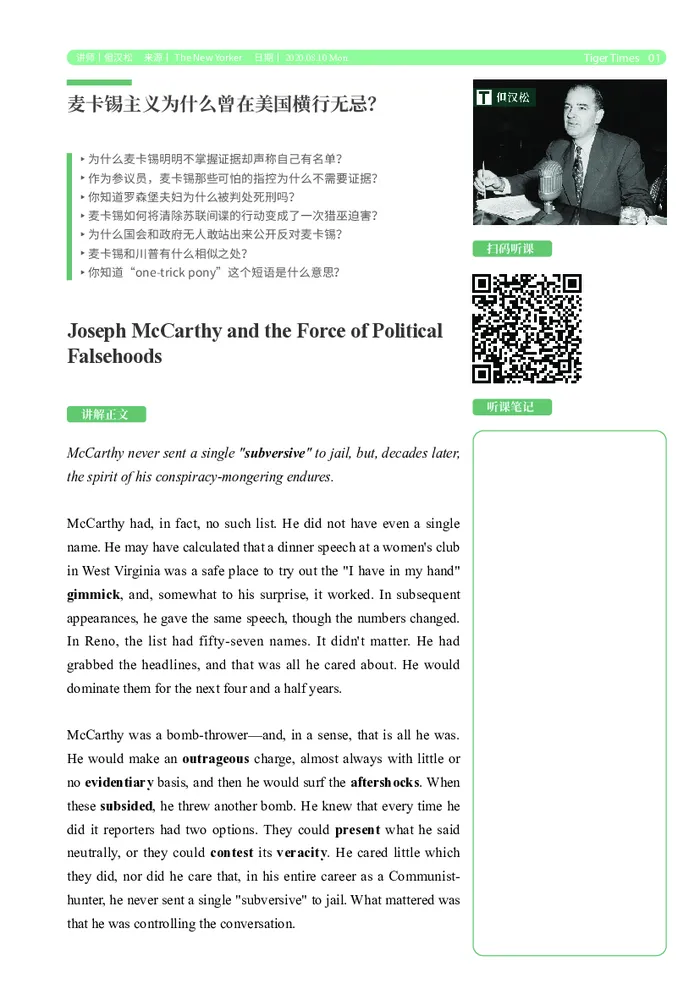
McCarthy never sent a single "subversive" to jail, but, decades later,
the spirit of his conspiracy-mongering endures.
McCarthy had, in fact, no such list. He did not have even a single
name. He may have calculated that a dinner speech at a women's club
in West Virginia was a safe place to try out the "I have in my hand"
gimmick, and, somewhat to his surprise, it worked. In subsequent
appearances, he gave the same speech, though the numbers changed.
In Reno, the list had fifty-seven names. It didn't matter. He had
grabbed the headlines, and that was all he cared about. He would
dominate them for the next four and a half years.
McCarthy was a bomb-thrower—and, in a sense, that is all he was.
He would make an outrageous charge, almost always with little or
no evidentiary basis, and then he would surf the aftershocks. When
these subsided, he threw another bomb. He knew that every time he
did it reporters had two options. They could present what he said
neutrally, or they could contest its veracity. He cared little which
they did, nor did he care that, in his entire career as a Communist-
hunter, he never sent a single "subversive" to jail. What mattered was
that he was controlling the conversation.
McCarthy had the support of a media conglomerate, the Hearst
papers, which amplified everything he said, and he had cheerleaders
in the commentariat, who reached millions of readers in a time
when relatively few households had a television set. He tried to block
a hostile newspaper from his press conferences, and he egged on the
crowds at his rallies to harass the reporters.
Right from the start, McCarthy had prominent critics. But almost the
entire political establishment was afraid of him. You could fight him,
in which case he just made your life harder, or you could ignore him,
in which case he rolled right over you. He verbally abused people
who disagreed with him. He also had easy access to money, much of
it from Texas oilmen, which he used to help unseat politicians who
crossed him.
McCarthy forced government agencies, by the constant threat of
investigations, to second-guess appointments, and to fire people he
had smeared just because he had smeared them. He didn't need to
prove anything, and he almost never did, because it didn't matter.
Your name in McCarthy's mouth was the kiss of death. He was a
destroyer of careers.
There were spies to be caught. The historians who have examined
documents from K.G.B. files and from the Venona project—in which
the U.S. government intercepted coded messages from Soviet
intelligence agencies—say that more than five hundred Americans
gave intelligence to the Soviets. Rooting out spies and informants
was therefore a perfectly sensible policy, and that part did not take
long.
The problem was that the process didn't stop there. It was allowed
to sweep up people who had only a notional connection to national
security, like high-school teachers and Hollywood screenwriters.
It licensed anti-Communist groups of all types to pursue their own
investigations. And it constantly redefined what made a person a
security risk or disloyal.
Tiger Times
02
Many national politicians would probably have been happy to drop
loyalty investigations after 1953, but no one wanted to speak out
against them. It was not an issue one could afford to be on the wrong
side of. So subversive-hunting lasted until 1957, when a series of
Supreme Court opinions curtailed the power of government agencies
to inquire into the political beliefs of citizens. The reign of inquiry
had lasted ten years. Joseph McCarthy was only one episode in that
miserable saga.
But what is puzzling about McCarthy is also puzzling about Trump.
Once McCarthy was in a position of power, he was incapable of
modifying his behavior. He could not shut it off, even when everyone
around him was begging him to. He had a single explanation for
everything, and the only way he knew how to do his job was by
threatening and prevaricating. Trump, too, is a one-trick pony. He
says the same things on every issue and in response to every crisis.
Tiger Times
03
Tiger Times
04
falsehood /ˈfɔːlshʊd/ n. 虚假的话,谎言
 ○ a statement that is untrue
 ○ e.g. Saunders is deliberately telling a falsehood. 桑德斯在
故意说假话。
subversive /səbˈvɜːsɪv/ n. 颠覆分子,破坏分子
 ○ someone who secretly tries to damage or destroy the
government or an established system
 ○ e.g. He was a known political subversive. 他是一个有名
的政治颠覆分子。

gimmick /ˈɡɪmɪk/ n. 引人注意的花招,噱头(含贬义)
 ○ a trick or something unusual that you do to make people
notice someone or something – used to show disapproval
 ○ e.g. The exhibition is informative, up to date, and
mercifully free of gimmicks. 这个展览既能让人增长见识,
又紧跟时代前沿,而且幸运的是没有华而不实的东西。
outrageous /aʊtˈreɪdʒəs/ adj. 骇人的;无法容忍的
 ○ very shocking and unacceptable
 ○ e.g. I must apologise for my outrageous behaviour. 我必须
为自己极端无礼的行为道歉。
evidentiary /ˌevɪ'denʃərɪ/ adj. 证据的,根据证据的
 ○ being, relating to, or affording evidence
 ○ e.g. Illegal evidence is the evidentiary material with illegal
factors. 非法证据是指含有违法因素的证据材料。
aftershock /ˈɑːftəʃɒk/ n.(令人震惊之事的)余波
 ○ the effects of a shocking event
 ○ e.g. They were already under stress, thanks to the
aftershock of last year's drought. 去年遭受的旱灾让他们心
有余悸、倍感忧虑。
subside /səbˈsaɪd/ v. 趋于平静;平息;减弱;消退
 ○ to become calmer or quieter
 ○ e.g. She waited nervously for his anger to subside. 她提心
吊胆地等他的怒气平息下来。
present /prɪˈzent/ v.(以某种方式)展现,显示,表现
 ○ to show or describe sth./sb. in a particular way
 ○ e.g. The company has decided it must present a more
modern image. 公司已决定,必须展现出更加现代的形象。
contest /kənˈtest/ v. 争辩;就… 提出异议
 ○ to say formally that you do not accept something or do not
agree with it
 ○ e.g. The divorce was not contested. 这桩离婚案没有人提
出异议。
veracity /vəˈræsəti/ n. 真实;真实性;诚实
 ○ the quality of being true; the habit of telling the truth
 ○ e.g. They questioned the veracity of her story. 他们质疑她
所述事情的真实性。
conglomerate /kənˈɡlɒmərət/ n. 联合大公司;企业集团
 ○ a large business organization consisting of several different
companies that have joined together
 ○ e.g. a media conglomerate 大众传媒集团
词汇
commentariat /ˌkɒmən'teriæt/ n. 评论界
 ○ a group of powerful and influential commentators
 ○ e.g. But among India's commentariat, the lack of
enthusiasm in the run-up to the president's visit is palpable.
但据印度评论界认为,印度对这位总统的来访明显缺乏
热情。
egg on 怂恿;煽动;唆使
 ○ to encourage someone to do something, especially
something that they do not want to do or should not do
 ○ e.g. He was lifting up handfuls of leaves and throwing
them at her. She was laughing and egging him on. 他正抓起
把把树叶朝她扔去。她笑着,怂恿他继续扔。
rally /ˈræli/ n. 集会
 ○ a large public meeting, especially one that is held outdoors
to support a political idea, protest etc.
 ○ e.g. a mass rally in support of the strike 支持罢工的群众
大会
abuse /əˈbjuːz/ v. 辱骂;对… 恶语相加;诋毁
 ○ to say rude or offensive things to someone
 ○ e.g. The referee had been threatened and abused. 裁判遭到
了恐吓和谩骂。
unseat /ʌnˈsiːt/ v. 罢免;解除职务;赶下台
 ○ to remove someone from a powerful job or position
 ○ e.g. an attempt to unseat the party leader 罢免政党领导的
企图
second-guess /ˌsekəndˈges/ v. 事后批评;对… 放马后炮
 ○ to criticize something after it has already happened
 ○ e.g. The decision has been made – there's no point in
second-guessing it now . 决定已经做了——现在放马后炮已
经没有意义。
smear /smɪə/ v. 污蔑,诽谤(尤用于报纸上)
 ○ to tell an untrue story about someone important in order
to make people lose respect for them – used especially in
newspapers
 ○ e.g. The story was an attempt to smear the party leader. 这
篇报道企图玷污该党领袖的声誉。
intercept /ˌɪntəˈsept/ v. 拦截;拦阻;截住
 ○ to stop something or someone that is going from one place
to another before they get there
 ○ e.g. The letter was intercepted. 信被截查了。
intelligence /ɪnˈtelədʒəns/ n.(尤指关于敌对国家的)情报;
情报人员
 ○ secret information that is collected, for example about a
foreign country, especially one that is an enemy; the people
that collect this information
 ○ e.g. the US Central Intelligence Agency 美国中央情报局
root out 根除,铲除,根绝
 ○ to find and get rid of someone or something regarded as
pernicious or dangerous
Tiger Times
05
 ○ e.g. a campaign to root out corruption 一场根除腐败的运
动
informant /ɪnˈfɔːmənt/ n.(向警方、军队等)提供秘密消
息者; 线人;告密者
 ○ someone who secretly gives the police, the army etc.
information about someone else
 ○ e.g. The journalist did not want to reveal the identity of his
informant. 那个新闻工作者不想透露线人的身份。
sweep up 扫除;清扫
 ○ If you sweep up rubbish or dirt, you push it together with a
brush and then remove it.
 ○ e.g. Get a broom and sweep up that glass, will you? 拿一
把扫帚把那些玻璃扫干净,行吗?
notional /ˈnəʊʃənəl/ adj. 猜测的;估计的;理论上的;想
象的
 ○ based on a guess, estimate or theory; not existing in reality
 ○ e.g the notional value of state assets 国有资产的名义价值
license /ˈlaɪsəns/ v. 批准,许可
 ○ to give official permission for someone to do or produce
something, or for an activity to take place
 ○ e.g. The new drug has not yet been licensed in the US. 这
种新药尚未在美国获得许可。
curtail /kɜːˈteɪl/ v. 减少,缩减,消减;限制
 ○ to reduce or limit something
 ○ e.g. Spending on books has been severely curtailed. 购书
开支已被大大削减。
reign /reɪn/ n. 主宰期,支配期,极盛期
 ○ a period during which something is the most powerful or
most important feature of a place
 ○ e.g. the reign of Stalinism in the Soviet Union 斯大林主义
主导苏联的时期
one-trick pony n. 仅在一个方面突出的人(或事物);仅
有一种才能的人;仅通一种专业知识的人
 ○ a person or thing with only one special feature, talent or
area of expertise
 ○ e.g. All this suggests that Google's one-trick pony is really
more of a thoroughbred. 这一切表明,谷歌“一招鲜吃遍天”
的本事,真的相当优良。
saga /ˈsɑːɡə/ n.(讲述许多年间发生的事情的)长篇故事;
家世小说
 ○ a long story about events that happen over many years
 ○ e.g. a 600-page saga about 18th century slavery 一个关于
18 世纪奴隶制的600 页的长篇故事
prevaricate /prɪˈværɪkeɪt/ v. 支吾搪塞;闪烁其词;吞吞吐
吐
 ○ to try to hide the truth by not answering questions directly
 ○ e.g. Stop prevaricating and come to the point. 别吞吞吐吐
的,有话快说吧。
Tiger Times
06
今日习题
1. 根据英文释义写出文中出现的对应单词
_________: to criticize something after it has already happened
_________: to stop something or someone that is going from one place to another before they get there
_________: to try to hide the truth by not answering questions directly
2. 一词多义
Which of the following underlined words is closest in meaning to the one in the sentence "They could
present what he said neutrally, or they could contest its veracity."?  ____
A. There is no way at present of predicting which individuals will develop the disease.
B. Analysis showed that traces of arsenic were present in the body.
C. You've got to forget the past and start living in the present.
D. The government has presented these changes as major reforms.
3. 翻译:根据给定中文回译英文
因此对颠覆分子的追查一直持续到1957 年, 直到最高法院提出了一系列意见限制政府机构调查
民众政治信仰的权力。这股问讯之风盛行了10 年,乔瑟夫· 麦卡锡不过是这段悲惨往事中的一段
插曲。
_____________________________________________________________________________________
_____________________________________________________________________________________
_______________________________________________________
习题答案
1. second-guess; intercept; prevaricate
2. D
3. So subversive-hunting lasted until 1957, when a series of Supreme Court opinions curtailed the
power of government agencies to inquire into the political beliefs of citizens. The reign of inquiry
had lasted ten years. Joseph McCarthy was only one episode in that miserable saga.
编辑丨牛轧糖