必 修
第一册
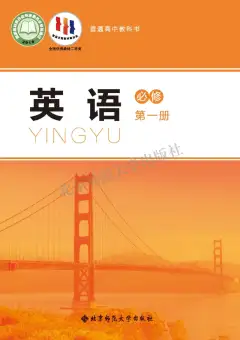
英语
普通高中教科书
全国优秀教材二等奖
第一册
必 修
普
通
高
中
教
科
书
·北京·
ENGLISH
英语
人民教育出版社 课程教材研究所
英语课程教材研究开发中心
圣
智
学
习
集
团
(中国)
(美国)
编著
普通高中教科书 英语 必修 第一册
(中国)
人民教育出版社 课程教材研究所
英语课程教材研究开发中心 编著
(美国)圣
智
学
习
集
团
出版发行
(北京市海淀区中关村南大街17 号院1 号楼 邮编:100081)
网 址 http://www.pep.com.cn
版权所有·未经许可不得采用任何方式擅自复制或使用本产品任何部分·违者必究
如发现内容质量问题,请登录中小学教材意见反馈平台:jcyjfk.pep.com.cn
主 编:刘道义 郑旺全
副 主 编:吴 欣 张献臣
编写人员: Sarah H. Miller Nils-Olov Fors Patrick Wallace
生 平 辜翔宇 庄 力 葛炳芳 贵丽萍
责任编辑:辜翔宇 游晓霞
美术编辑:胡白珂
封面设计:
版面设计:
插图绘制:
前 言
《普通高中教科书 英语》是为了适应新时代的发展需要,依据《普通高中英语课程标
准(2017年版)》的精神,充分征求广大师生的反馈意见,在《普通高中课程标准实验教科
书 英语》的基础上精心修订而成。此次教材修订的主要目的是:全面落实立德树人根本任
务,培育社会主义核心价值观,弘扬中华优秀文化,充分体现英语课程工具性和人文性的统
一,发展学生的语言能力、文化意识、思维品质和学习能力等英语学科核心素养,充分体现
英语学科特殊的育人价值,培养具有中国情怀、国际视野和跨文化沟通能力的社会主义建设
者和接班人。
修订后的教材主要具有以下特点:
注重思想引领 教材融入了社会主义核心价值观的基本内容和要求,注重培养学生良好
的政治素质、道德品质和健全人格,弘扬中华优秀文化,增强文化自信,引导学生形成正确
的世界观、人生观和价值观。
反映时代要求 教材充分反映当代社会发展新变化、科技进步新成果,展示新时代中国
特色社会主义新成就,将先进的教育思想和理念融入到教材之中,同时紧密结合学生的学习
和生活实际,关注信息化环境下学生的发展需求。
强调语言实践 教材以英语学习活动观为指导,以主题为引领,以语篇为依托,通过板
块式设计将语言知识与听、说、读、看、写等技能有机整合,强调学习过程和学习策略,突
出活动目标,让学生用语言做事情,在实践中培养语言运用能力和创新思维。
突出文化意识 教材通过展示多姿多彩的中外文化来培养学生对中华文化的认同和传承,
加深对人类优秀文化的学习和鉴赏;通过让学生分析中外文化异同,发展其多元思维和批判
性思维,增强学生跨文化理解和跨文化沟通能力,构建人类命运共同体意识。
激发学习动机 教材以真实性、趣味性、规范性和经典性作为内容选编原则,主题覆盖
面广,语篇题材和体裁丰富,活动呈现形式多样,版式设计生动活泼且富有美感,力求激发
学生的学习兴趣和动机,引发他们积极思考、主动参与语言实践活动,提升英语学习效率。
满足不同需求 教材编排内容和活动设计既充分考虑学生的共同基础,又兼顾学生不同
的能力水平和学习需求,提供了拓展性的教学内容,为教师灵活使用教材进行教学提供了便利,
也切实促进学生的个性发展。
本套教材为高中英语教学提供了丰富的教学资源。希望教材能够帮助同学们打下坚实的
语言基础,提高英语水平,获得全面发展;同时也希望老师们能够充分利用教材,在实践中
不断完善教学,取得良好的教学效果。
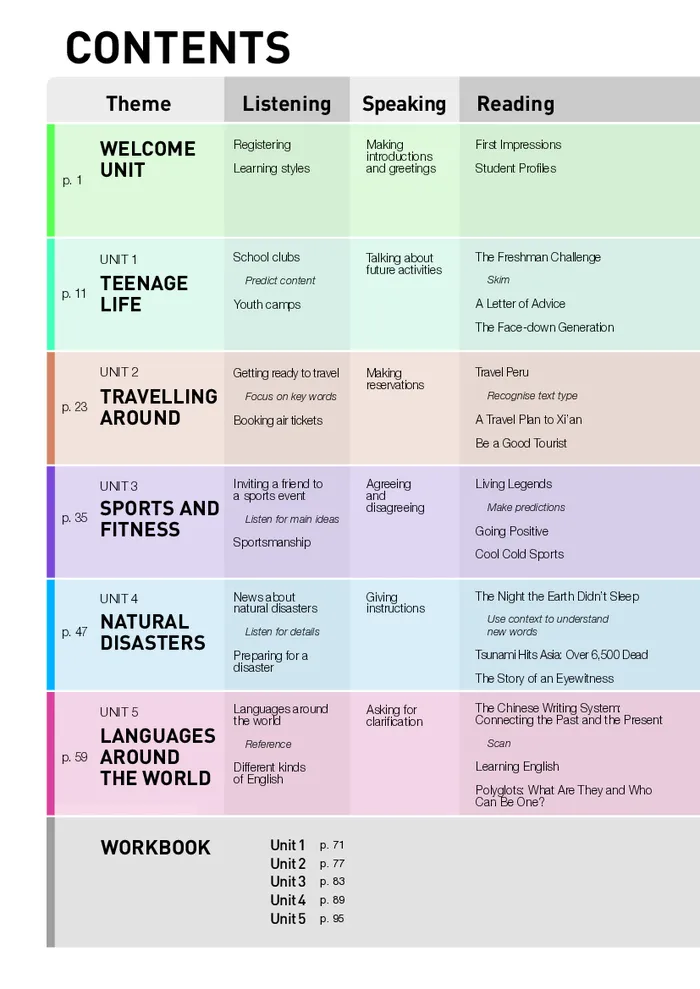
CONTENTS
Listening
Speaking
Reading
Unit 1 p. 71
Unit 2 p. 77
Unit 3 p. 83
Unit 4 p. 89
Unit 5 p. 95
Registering
Learning styles
Making
introductions
and greetings
First Impressions
Student Profiles
School clubs
Predict content
Youth camps
Talking about
future activities
The Freshman Challenge
Skim
A Letter of Advice
The Face-down Generation
Getting ready to travel
Focus on key words
Booking air tickets
Making
reservations
Travel Peru
Recognise text type
A Travel Plan to Xi’an
Be a Good Tourist
Inviting a friend to
a sports event
Listen for main ideas
Sportsmanship
Agreeing
and
disagreeing
Living Legends
Make predictions
Going Positive
Cool Cold Sports
News about
natural disasters
Listen for details
Preparing for a
disaster
Giving
instructions
The Night the Earth Didn’t Sleep
Use context to understand
new words
Tsunami Hits Asia: Over 6,500 Dead
The Story of an Eyewitness
Languages around
the world
Reference
Different kinds
of English
Asking for
clarification
The Chinese Writing System:
Connecting the Past and the Present
Scan
Learning English
Polyglots: What Are They and Who
Can Be One?
p. 1
p. 11
p. 23
p. 35
p. 47
p. 59
Theme
WORKBOOK
WELCOME
UNIT
UNIT 1
TEENAGE
LIFE
UNIT 2
TRAVELLING
AROUND
UNIT 3
SPORTS AND
FITNESS
UNIT 4
NATURAL
DISASTERS
UNIT 5
LANGUAGES
AROUND
THE WORLD
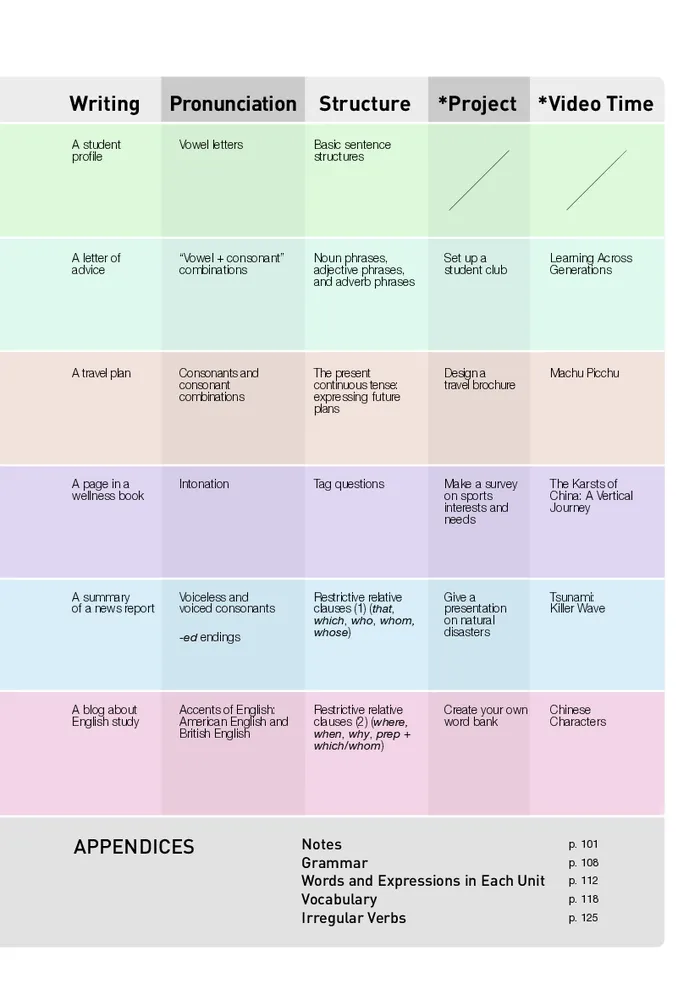
Writing
Pronunciation
Structure
APPENDICES
Notes
p. 101
Grammar
p. 108
Words and Expressions in Each Unit
p. 112
Vocabulary
p. 118
Irregular Verbs
p. 125
Vowel letters
Basic sentence
structures
A student
profile
“Vowel + consonant”
combinations
Noun phrases,
adjective phrases,
and adverb phrases
Set up a
student club
A letter of
advice
Consonants and
consonant
combinations
The present
continuous tense:
expressing future
plans
Design a
travel brochure
A travel plan
Voiceless and
voiced consonants
-ed endings
Tag questions
Make a survey
on sports
interests and
needs
A page in a
wellness book
Intonation
Restrictive relative
clauses (1) (that,
which, who, whom,
whose)
Give a
presentation
on natural
disasters
A summary
of a news report
Accents of English:
American English and
British English
Restrictive relative
clauses (2) (where,
when, why, prep +
which/whom)
Create your own
word bank
Learning Across
Generations
Machu Picchu
The Karsts of
China: A Vertical
Journey
Tsunami:
Killer Wave
Chinese
Characters
A blog about
English study
*Project
*Video Time
WELCOME UNIT
WELCOME
In this unit, you will
1 read about a student’s first day of school.
2 hear and talk about choosing and registering
for courses.
3 write a student profile.
4 learn about first-year senior high school students
in different countries.
Look and discuss
1 Where do you think these students are?
2 How do you think they feel?
3 How do you feel on the first day of school?
A thousand-mile journey
begins with the first step.
—Laozi
UNIT
1
WELCOME UNIT
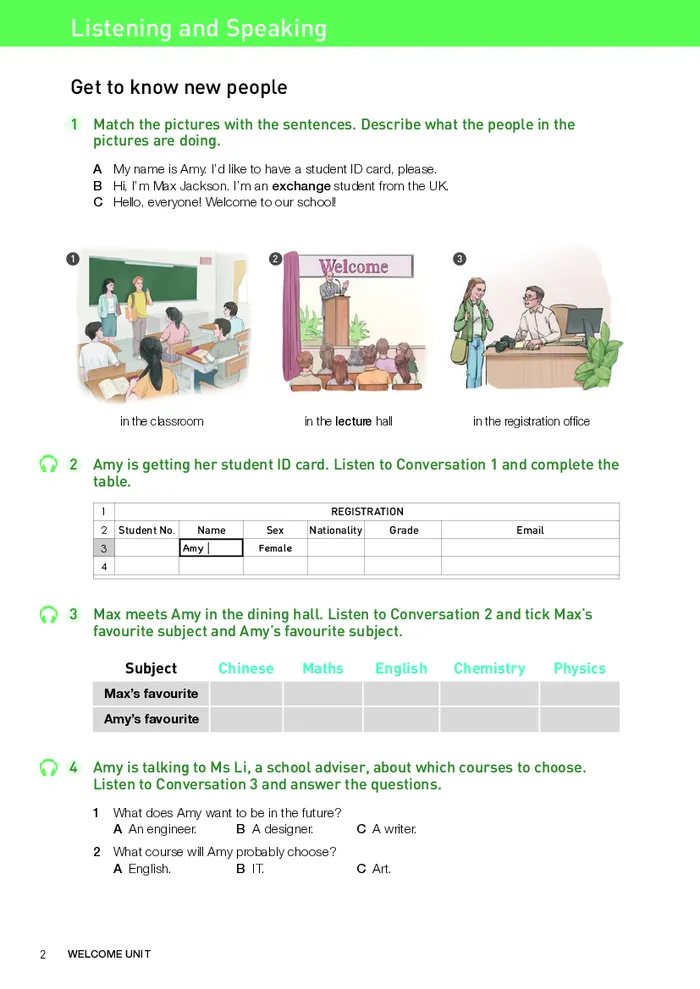
Listening and Speaking
Get to know new people
in the classroom
1
in the lecture hall
in the registration office
2
3
1 Match the pictures with the sentences. Describe what the people in the
pictures are doing.
A My name is Amy. I’d like to have a student ID card, please.
B Hi, I’m Max Jackson. I’m an exchange student from the UK.
C Hello, everyone! Welcome to our school!
3 Max meets Amy in the dining hall. Listen to Conversation 2 and tick Max’s
favourite subject and Amy’s favourite subject.
Subject
Chinese
Maths
English
Chemistry
Physics
Max’s favourite
Amy’s favourite
2 Amy is getting her student ID card. Listen to Conversation 1 and complete the
table.
Student No.
Name
Amy
Female
1
2
3
4
Sex
Grade
Nationality
Registration
Email
4 Amy is talking to Ms Li, a school adviser, about which courses to choose.
Listen to Conversation 3 and answer the questions.
1 What does Amy want to be in the future?
A An engineer.
B A designer.
C A writer.
2 What course will Amy probably choose?
A English.
B IT.
C Art.
2
WELCOME UNIT
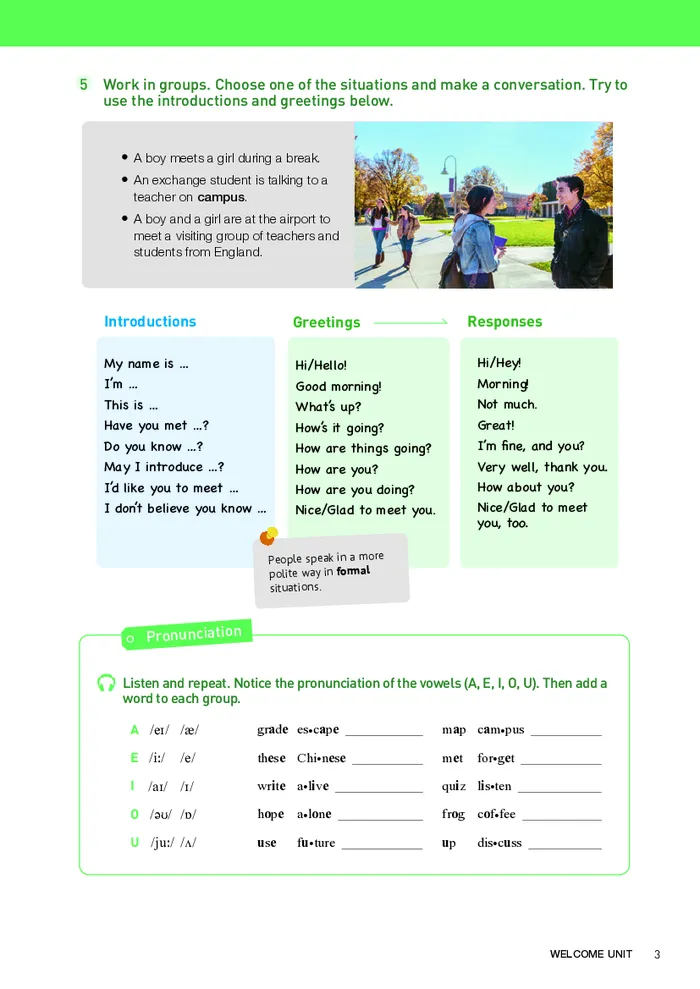
5 Work in groups. Choose one of the situations and make a conversation. Try to
use the introductions and greetings below.
Introductions
My name is …
I’m …
This is …
Have you met …?
Do you know …?
May I introduce …?
I’d like you to meet …
I don’t believe you know …
Greetings
Hi/Hello!
Good morning!
What’s up?
How’s it going?
How are things going?
How are you?
How are you doing?
Nice/Glad to meet you.
Responses
Hi/Hey!
Morning!
Not much.
Great!
I’m fine, and you?
Very well, thank you.
How about you?
Nice/Glad to meet
you, too.
People speak in a more
polite way in formal
situations.
Pronunciation
Listen and repeat. Notice the pronunciation of the vowels (A, E, I, O, U). Then add a
word to each group.
A /eI/ //
grade es•cape
map cam•pus
E /i:/
/e/
these Chi•nese
met
for•get
I /aI/ /I/
write a•live
quiz lis•ten
O /U/ //
hope a•lone
frog cof•fee
U /ju:/ //
use
fu•ture
up
dis•cuss
A boy meets a girl during a break.
An exchange student is talking to a
teacher on campus.
A boy and a girl are at the airport to
meet a visiting group of teachers and
students from England.
3
WELCOME UNIT
Reading and Thinking
Describe your first senior high school day
1 How did you feel on your first day of senior high school? Circle the pictures
that describe how you felt.
happy
anxious
excited
annoyed
2 Read the text quickly and draw pictures to show Han Jing’s feelings on her first
school day.
9
2
11
7:00 a.m.
12:30 p.m.
5:32 p.m.
6
10:29 p.m.
Han Jing's World
FIRST IMPRESSIONS
10:45 p.m.
frightened
4
So this is it—senior high school at
last! I’m not outgoing so I’m a little
anxious right now. I want to make a
good first impression. Will I make any
friends? What if no one talks to me?
I just had my first maths class
at senior high school! The
class was difficult, but the
teacher was kind and friendly. He even told
us a funny story, and everyone laughed so
much! I found most of my classmates and
teachers friendly and helpful.
This afternoon, we had our chemistry
class in the science lab. The lab is
new and the lesson was great, but the
guy next to me tried to talk to me the
whole time. I couldn’t concentrate
on the experiment. I really wanted to
tell him to please be quiet and leave
me alone!
What a day! This morning, I was worried that
no one would talk to me. But I was wrong.
I didn’t feel awkward or frightened at all. I
miss my friends from junior high school, but
I believe I will make new friends here, and
there’s a lot to explore at senior high. I feel
much more confident than I felt this morning.
I think that tomorrow will be a great day!
WELCOME UNIT
Complete the passage with the correct forms of the words and phrases below.
Word Study
explore
impression
feel confident
senior
experiment
concentrate on
Tian Hua is a new student at a school in America.
She is studying at an American high school for
one year. In China, Tian Hua was in Grade 1 at
high school, but in America, she is in
Grade 10! She did not
at all when she
arrived. Her first
was that English was
difficult and people spoke too quickly, but soon
she found that if she
the ideas, not the
single words, she could understand! She also made
friends and began to
the city with them.
Her new friends were happy to explain things to her
after class. Her favourite class is chemistry because
the teacher lets the students do cool
!
Tian Hua is not sure how well she will do at school
this year, but she is not nervous any more. She is
excited!
1 Why did Han Jing feel anxious before school?
2 How was her first maths class?
3 What happened in the chemistry class? What would you do if this happened to you?
4 What did Han Jing learn from her first day at senior high school?
3 Read the text again and discuss the questions.
4 Fill in the table with the words and phrases from the text, and tell a partner
about Han Jing’s day. Then talk about your own first day of senior high school.
Time
What was Han Jing texting about?
7:00 a.m.
senior high school, a little anxious
12:30 p.m.
5:32 p.m.
10:29 p.m.
5
WELCOME UNIT
Discovering Useful Structures
Analyse basic sentence structures
S (subject)
V (verb)
O (object)
P (predicative)
A (adverbial)
DO (direct object) IO (indirect object)
C (object complement)
Sentence structure
Sentence
SV
All of us laughed!
SVO
I miss my grandma.
SP
The teacher was kind and friendly.
S V IO DO
He told us a funny story.
SVOC
I found most of my classmates and teachers friendly and helpful.
SVA
He talked too much.
SVOA
I had my first maths class at senior high school.
There be …
There’s a lot to explore at senior high.
3 Read the passage and analyse the structures of the
underlined sentences.
How would you like to go to school and travel the world at the
same time? For Tim, that dream has come true! This term, Tim
and his classmates are living on a ship! They take the same
subjects as you do, like maths and English. They also learn
about ships and the sea. Tim writes his parents an email every
week and tells them what happened on the ship. Tim loves living
on the ship. There’s always something exciting to do. And, after
a long day of study, he likes to watch the sun go down and wait
for the stars to come out. Studying and doing homework seem
much more fun when you are at sea!
1 Study the sentence structures.
2 Read the sentences and analyse the structures.
EXAMPLE: We laughed.
S V
1 The 100-year-old school lies in the
centre of the city.
2 We must act.
3 The maths homework looks easy.
4 The teacher found the classroom empty.
5 My mum bought me a new dictionary.
6 Tom is looking forward to meeting the
new exchange student.
7 There is an English Corner at our school.
8 We had chemistry in the newly built lab.
6
WELCOME UNIT
Listening and Talking
Reflect on your learning styles and strategies
4 Work in pairs. Share your ideas with your partner and discuss the questions.
1 What learning strategies do you and your partner share?
2 What is the best strategy for you to learn new words? How about grammar?
3 What is the best way for you to improve your reading skills? How about writing?
3 How do you learn English? Rate the learning methods below. You can add
more of your own to the questionnaire.
1 I have learning goals and make plans for my English studies.
☆☆☆☆☆
2 I exchange learning experience with my classmates.
☆☆☆☆☆
3 I take notes while listening and reading.
☆☆☆☆☆
4 I read English newspapers and magazines.
☆☆☆☆☆
5 I write down new words in my notebook and review them often.
☆☆☆☆☆
6 I use dictionaries to check for new words.
☆☆☆☆☆
7 I like to write about what I read or hear in English.
☆☆☆☆☆
8 I like to watch movies in English.
☆☆☆☆☆
2 Listen again and answer the questions.
1 Why does Amy like group work?
2 How does Li Ming organise his thoughts?
3 Does Li Ming like to keep a learning diary? Why or why not?
1 Li Ming and Amy are talking about learning strategies. Listen to their
conversation and tick what Li Ming likes to do.
work in groups
listen to the teacher
and take notes
watch videos
use flash cards
make mind maps
keep a learning diary
7
WELCOME UNIT
Reading for Writing
1 Read the student profiles and discuss the questions.
Write a student profile
1 What is Ann like? How do you know?
2 What does “You’ll never see me without a book or a pen” mean?
3 Which profile do you like better? Why?
Ann, 15
Lakeside High School
USA
Thando, 16
South Hill High School
South Africa
My name is Ann Wells and I’m a Grade
10 student at Lakeside High School. I’m
an active person and I love sports. I’m
curious about everything. I often ask
questions, but I learn best by doing. My
favourite subject is physics. Dancing and
skating are my hobbies, and I also like to
read short stories. I plan to become an
engineer in the future.
I’m Thando Gowon. I’m 16 this year. I
come from South Africa. I’m a Grade 10
student at South Hill High School. I look
good, think fast, and play hard. You’ll
never see me without a book or a pen.
If I’m not in class, I’m either in the library
or in the computer lab. At the weekends,
I play computer games if I’m not busy
studying. My dream is to start my own IT
company!
8
WELCOME UNIT
2 Study the organisation and language features.
1 A student profile can include the following parts. Fill in each part with the information from
the student profiles.
A Name, age, grade, school
B Personality
C Favourite subject
D Learning style
E Hobbies
F Future plans and dreams
2 Circle the phrases that Ann and Thando use to describe their personalities and underline
the sentences that they use to describe their learning styles.
4 Collect all the student profiles and create a class book.
A
A
D
D
B
B
C
C
F
F
E
E
3 Use what you have learnt to write your own student profile.
1 Complete the outline and use it to draft your student profile.
2 Exchange drafts. Use the checklist to give feedback on your partner’s draft.
Does the profile give you a good impression of the student?
Are all the parts in Activity 2 included and organised in good order?
Are the sentence structures correct?
Do all the sentences begin with capital letters?
Are there any spelling mistakes?
3 Get your draft back and revise it.
4 Add a photo or drawing of yourself and show your student profile to your class.
Name:
Age:
Grade:
School:
Personality:
Favourite subject:
Learning style:
Hobbies:
Future plans and dreams:
My name is
and I’m a
student
at
.
9
WELCOME UNIT
Building Up Your Vocabulary
1 Match the pictures with the best adjectives. Then describe each picture in
two or three sentences.
2 Match the verbs on the left with the nouns on the right. Then make sentences
with your new phrases.
anxious awkward annoyed frightened confident curious excited
Um, I ..., I don’t know
what to say.
What if I make a mistake?
I wish I didn’t have to do this!
Hi! Long time
no see!
What is it?
I think I’ll do very well in the exam!
Help! Help!
Argh! Why do you always
do this? Leave me alone!
1
2
3
4
5
6
7
Know yourself.
How you like to learn depends on what kind of person you are. If you like to talk, then it may be best
to study in groups. If you are quiet, you may concentrate best on your own.
Use the right
strategy.
If you are learning new words, it is wise to use
small cards with the words written on them. If you are
organising your thoughts or notes, try a mind map.
Decide on what you want to learn.
Do you want to learn spelling rules? Do you want to learn how to take notes during a
talk by a teacher?
No matter what you want to learn, it is important to decide on your goal before you make a plan.
3 Read the learning tips. Rewrite the underlined parts with the new words
from this unit that have the similar meaning.
EXAMPLE
Good morning. I’d like to register for a class. I’m interested in any classes on music!
exchange register (for)
design
explore give
take
a class
a dress
a lecture
ideas the world
notes
10
UNIT 1 TEENAGE LIFE
Good habits formed at youth
make all the difference.
—Aristotle
In this unit, you will
1 read about school life in the USA.
2 hear and talk about extra-curricular activities
of senior high school students.
3 write about teenage problems and solutions.
4 learn about teenage life in other countries.
Look and discuss
1 What are the teenagers doing in the photo?
2 What do you do to relax outside of school?
3 What kind of life do you live? What kind of
life do you wish to live?
TEENAGE
LIFE
UNIT 1
11
UNIT 1 TEENAGE LIFE
Choose a school club
Listening and Speaking
1 Match the photos with the names of the clubs. What do you think students do
in these clubs?
Ballet Club
Nature Club
Volunteer Club
Debate Club
2 Listen to the first two conversations and choose the correct answers.
1 What are they learning about in Conversation 1?
A Hearing.
B Sounds.
C Dogs.
2 The students are discussing
in Conversation 2.
A schoolwork
B relationships
C dating
3 Circle the two clubs where these two conversations happened.
A Science Club.
B Ballet Club.
C Nature Club.
D Debate Club.
Predict content
Before you listen, you can
read the questions and the
choices. It will help you to
predict what you will hear.
3 Listen to Conversation 3. Then help Adam choose a club.
1 Tick the activities that happen in each club.
I enjoy discussing
different questions.
I love dancing!
I prefer helping
others.
I’m interested in
plants and animals.
1
2
3
4
2 Adam says that he likes
but is not so interested in
.
A stories, cartoons
B animals, plants
C making friends, cleaning up
3 Which club do you think is suitable for Adam? Why?
I think Adam should join the
Club because he says that he
.
Ballet Club
learn new movements
watch dance programmes
make ballet clothes
Nature Club
listen to lectures
grow plants
work in a greenhouse
Volunteer Club
help old people
clean up parks
give directions
Cartoon Club
watch cartoons
write stories
draw cartoons
12
UNIT 1 TEENAGE LIFE
2 Listen to the proverbs and repeat. Notice the pronunciation of the letters in bold.
1 The early bird catches the worm.
2 Always prepare for a rainy day.
3 Actions speak louder than words.
4 All work and no play makes Jack a dull boy.
5 Distance tests a horse’s strength. Time reveals a person’s character.
Pronunciation
1 Listen and repeat. Then add more words to each group.
al
ay
ai
are
talk
pay
paint
care
wall
stay
daily
declare
ee
ea
ea
ear
ear
keen
clean
head clear
earn
tree
eager
ready appear heard
oa
ow
ow
ou
ore
boat
show
now
out
more
coach grow
shower loud
bored
ar
ir
er
or
or
ur
bar
her
bird horse
word burn
hard prefer circus absorb
work hurt
4 Work in pairs. Help each other choose a school club.
EXAMPLE
A: Hi, Sam! I’ve decided to join the Music Club.
B: Good decision!
A: How about you? Are you going to join a club?
B: Yes. I’m wondering which one I should choose:
the Acting Club or the Ballet Club?
A: I guess the question is … Do you like dancing better
than acting?
B: Actually, I like acting better, but my friends go to the
Ballet Club and I want to be with them.
A: Hmm ... If you ask me, I think you should choose what
you like.
13
UNIT 1 TEENAGE LIFE
Reading and Thinking
1 Work in groups. Discuss the questions.
1 What do you want to know about school life in other countries?
2 What would you tell a teenager from another country about school life in China?
2 Read the text quickly to find the main idea of each paragraph.
Paragraph 1:
Paragraph 2:
Paragraph 3:
Paragraph 4:
Senior high school is a challenge.
Compare school life in different places
Skim
You can find main ideas by
first taking a quick look at the
title, picture(s), key words and
phrases, and topic sentences.
THE FRESHMAN CHALLENGE
Hi! My name is Adam and I’m a freshman at senior high school.
Going from junior high school to senior high school is a really big
challenge. The first week was a little confusing.
First, I had to think very carefully about which courses I wanted
to take. The school adviser helped me choose the suitable ones:
maths, English, chemistry, world history, and Chinese. I know that
Chinese is a very difficult language, but I hope to be fluent when
I graduate. My adviser recommended that I should sign up for
advanced literature because I like English and I’m good at it.
I had to choose extra-curricular activities, too. I tried to join the
school football team, but the coach told me that I didn’t play well
enough. Obviously, I was unhappy, but I won’t quit. I’ll find a
way to improve on my own so that I can make the team next year.
I joined a volunteer club instead. Every Wednesday, we work
at a soup kitchen and hand out food to homeless people in the
community.
I know I’ll have to study harder as a senior high school student
and get used to being responsible for a lot more. I’m a bit worried
about keeping up with the other students in my advanced course,
and it’ll be quite difficult to get used to all the homework. Still, I’m
happy to be here. Studying hard isn’t always fun, but I’ll be well
prepared for university or whatever else comes in the future.
14
UNIT 1 TEENAGE LIFE
3 Read the text again and answer the questions.
1 What courses did Adam choose? Which one do you think would be his favourite? Why?
2 What does “make the team” in Paragraph 3 mean?
3 What is Adam worried about?
4 Is Adam confident that he will get used to senior high school life? How do you know?
5 Complete the sentences with the correct forms of the new words from the text.
1 I’m good at maths, so my teacher
that I should choose advanced maths
in my first year.
2 Finding time for both studies and extra-curricular activities is a big
, so I
need to make a workable schedule.
3 It’s a little
to choose suitable courses. I hope that my adviser can help me
make a good decision.
4 We can try a course for two weeks after we
up for it. After that, we cannot
change it.
5 The main purpose of the course is to help
each student’s reading ability.
6 Some of the students want to become writers or editors after they
, so the
teacher advised them to start a writing club.
7 The school is
for the safety of all the students.
8 Whenever I’m facing a difficulty, I always tell myself, “Don’t let anything stop you. Don’t ever
.”
4 Complete the outline. Then discuss the questions below with a partner.
1 What kind of person do you think Adam is? Why?
2 Do you face the same challenges as Adam? What other challenges are you facing?
How do you deal with them?
3 What are some differences between Adam’s school life and your school life?
Paragraph
Challenge
How Adam feels
Solution
1
Confused
2
Choosing
courses
The school adviser
.
3
He will find a way to
.
4
He will
.
15
UNIT 1 TEENAGE LIFE
Discovering Useful Structures
1 Find and mark the phrases in the sentences that fit the categories below. Then
state their functions.
Improve a draft
2 Answer the questions using the phrases in brackets.
1 How soon do you think you’ll finish your homework? (pretty soon)
2 What do you think of your new teachers? (very nice and patient)
3 How many clubs have you joined this year? (two clubs)
4 How well does Rita play the violin? We need a new violinist in our music club. (quite well)
5 What did your adviser say about the advanced literature course?
(too difficult but very interesting)
3 Joyce has just written a draft. Help her improve it by using noun/adjective/
adverb phrases to add more information.
Cheerleader Try-outs
I’ve always wanted to be a cheerleader. Yesterday, I tried out for the team. It was hard. First,
we had to dance. The teacher showed us how to move, and then we tried. Second, we
practised singing a song about the school basketball team. Finally, some girls had to lift their
partners. The other girls jumped and cheered. I think I did well, but the other girls were
better. I’m not sure if I’ll make the team or not.
I’ve always wanted to be a high school cheerleader. Yesterday, I tried out
for my school’s cheerleading team. It was really hard. First, …
word group with a noun as
its head word
Noun Phrase (NP)
word group with an adjective
as its head word
Adjective Phrase (AdjP)
word group with an adverb as
its head word
Adverb Phrase (AdvP)
1 The first week was a little confusing.
2 The building is so big that I’m completely lost.
3 The kids over there are putting something on a round paper plate.
4 Linda thinks and speaks quite quickly, and she can do well in the debate.
5 The new coach told me that I didn’t play well enough.
6 My first French class was very confusing. The teacher spoke so fast!
NP
AdjP
16
UNIT 1 TEENAGE LIFE
Listening and Talking
1 Cao Jing and Max are talking about camps. Listen to the conversation and
tick what they are going to do at the camps.
2 Listen again. Underline the expressions in the sentences above that Cao Jing
and Max use to talk about the future.
3 Work in groups. Plan a youth camp.
1 Think of ideas for the camp. You can use the questions below to get started.
What kind of camp is it?
Who will be there?
What will they do?
What will they learn?
2 Present your ideas for a youth camp to the class.
EXAMPLE
Camp
Do you want to have fun and learn at the same time? Then come to our camp. In
our camp, you can learn about ... There’ll be many interesting activities. First, we are
going to ... Then we’ll ... We also plan to ... Finally, we’ll ... Please come to our camp!
Plan a camp for teenagers
Adventure Camp
International Youth Camp
Talking about future activities
We’ll learn survival skills.
I’ll learn how to make a fire.
We’ll learn how to live in the wild from
some experts.
We’re going to learn about wildlife.
I think it’s going to be fun.
I plan to improve my spoken English.
We’ll talk about teenage life.
There’ll be students from different
countries at the camp.
I’m going to give a speech.
I hope to make some friends.
17
UNIT 1 TEENAGE LIFE
Reading for Writing
1 Susan Luo, an adviser for teenagers, has received a letter asking for some
advice. Read her reply and discuss the questions.
1 What is Worried Friend’s problem?
2 Do you think Ms Luo’s advice is useful? Why or why not?
3 What other kinds of advice would you give?
2 Study the organisation and language features.
1 Find and mark the parts of the letter that match the following points.
A I know what the problem is.
B I understand how you feel.
C This is my advice and reason(s).
D I think my advice will help.
2 What expressions does Ms Luo use to make suggestions? Circle them in the letter.
Write a letter of advice
10 September 2018
Dear Worried Friend,
You wrote that you are very worried about your friend, Chen Lei.
I understand quite well that you are anxious and feel terrible.
You think that your friend plays computer games too often and
spends too much time online.
I recommend that you talk to your friend about his behaviour. It
is not unusual for teenagers of your generation to be attracted
to computer games and the online world. But spending too much
time online is unhealthy and makes it very difficult to focus on
other things in life. Some students even become addicted to the
Internet and cannot concentrate on school and family life. I think
you should encourage your friend to try new hobbies. Why not
discuss the problem together? I am sure he will listen to you,
since you are his good friend.
All the best,
Date
Greeting
Close
Body
Signature
18
UNIT 1 TEENAGE LIFE
3 Use what you have learnt to write a letter of advice to one of the teenagers below.
1 Work in groups. Choose one of the teenagers and discuss his/her problem. List possible
suggestions and reasons.
Suggestion
Reason
3 Exchange drafts. Use the checklist to give feedback on your partner’s draft.
Are all the parts of a letter included and organised in good order?
Does the writer give reasons for the advice?
Does the writer use proper expressions to give suggestions?
Does the writer use commas and stops correctly?
Is the handwriting easy to read?
4 Get your draft back and revise it.
My parents won’t listen when
I tell them things. I guess it’s
because they’re adults and
can’t understand me. Do
you have any suggestions?
I always feel lonely after
school because my parents
work in another city. What
can I do?
There is a girl I like in my
class, but I’m too shy to
talk to her. Please help me!
Eric, 15, Chicago
Xu Ting, 14, Hangzhou
Min Ho, 15, Seoul
4 Put up your letter in the classroom or read it to the class.
2 Draft your letter according to the outline below.
Dear
,
You wrote that
.
I understand that
.
I think
because
. I am sure
that
.
Best wishes,
Write the date and greet the reader.
Close and sign the letter.
Show the reader that you know
what the problem is.
Tell the reader that you
understand how he/she feels.
Tell the reader what you think
he/she should do.
Explain your reason(s).
Tell the reader what you
think will happen.
19
UNIT 1 TEENAGE LIFE
1 Circle the correct word(s) in each sentence.
1 Today’s teenagers seem to prefer/like the Internet more than TV.
2 Martin did not enjoy pop music until he became a generation/teenager.
3 Which course did your teacher recommend to/with you?
4 Don’t quit trying/to try if there is still hope.
5 I think he is addicted/attracted to smoking. He just can’t seem to quit.
6 The library project has already fallen behind schedule/plan.
7 The research has focused on/for the relationship between a teenager’s sleep and health.
8 The instructions on the box made him confusing/confused, and he did not know what to do.
Assessing Your Progress
Which reading in this unit did you find the most interesting? Why?
What new things did you learn about teenage life from this unit?
What new vocabulary and structures did you learn in this unit? Did you use any of
them in your language activities? How well could you use them?
Do you think skimming was useful for you to understand the texts?
What problems did you or your friends have with this unit? How did you solve the
problems? What advice did you give each other?
REFLECTING
Do you agree with the writer’s opinion? Give your reasons.
2 Find the noun/adjective/adverb phrases in the passage and state their functions.
If you have learnt some maths at school, you
can quite quickly work out that one eleventh
is about 9 percent. But did you know that 9
percent is also the number of children who
are not at school? That’s right—one in 11
children is not studying and probably even
cannot do the simple maths you just did so
very easily. They drop out of school because
their families are too poor and they have to
work like adults. In 2013, millions of children
and teenagers were out of school. Most live
in poor countries, but there are also some
boys and girls who cannot go to school in
rich countries. If you are one of the lucky
ones who can go to a senior high school,
you should be grateful for the opportunity. So
the next time you feel like you do not want to
do boring, difficult homework or go to class,
think about the children who don’t have the
chance to get a good education. Make the
most of your education and make the world
a better place.
20
UNIT 1 TEENAGE LIFE
1 You are going to set up a student club. Work in groups and choose one of the clubs
from below, or create a new club you think others would be interested in joining.
* Project: Set up a student club
Club name
Slogan
Aim
(Why form the club? What does it hope to achieve?)
Activity
(What will members usually do at the meetings? Any special events or
outings?)
Requirement
(What should members prepare and bring?)
Meeting time
and place
2 Decide on the following details of your club.
3 Design an eye-catching logo for your club and make a poster including the club’s
name, slogan, and logo.
4 Prepare an introduction to recruit new members during a school assembly.
Include some details that are not mentioned on your poster.
EXAMPLE
Hello, everyone! We’re very pleased to introduce our club to you. It is called … Our slogan
is …, and our club aims to …
Student
Club
Basketball
Club
Photography
Club
Club
Chess Club
Psychology
Club
Biology
Club
Calligraphy
Club
Debate
Club
21
UNIT 1 TEENAGE LIFE
BEFORE YOU WATCH
Look through the title, introduction, and photos. Then guess whether the
statements are true (T) or false (F).
1 In South Africa, many teenagers graduate from university.
T
F
2 Mamorena’s life is the same as Tandi’s when she was young.
T
F
3 Tandi had a difficult childhood.
T
F
4 Tandi is now a successful businesswoman.
T
F
WHILE YOU WATCH
1 Check your answers in Before You Watch.
2 Circle the correct word(s) in each sentence.
1 Mamorena is a student at an expensive/inexpensive private school.
2 Tandi grew up in a poor/wealthy area of Johannesburg.
3 Mamorena does not understand/understands about her mother’s childhood.
AFTER YOU WATCH
Work in pairs. Discuss the questions.
1 In what ways is your life similar to or different from your parents’ life when they were young?
2 Tandi said, “I don’t think you become a person if you don’t know where you come from.”
Do you agree or disagree with this statement? Why or why not?
A shanty town is a poor
area. People in a shanty
town make their own
houses, often from
wood or materials that
have been thrown away.
Mamorena Chaane is a teenage girl. She
lives in the suburbs of Johannesburg, South
Africa with her mother, Tandi.
Learning Across Generations
* Video Time
22
UNIT 2 TRAVELLING AROUND
2
UNIT
TRAVELLING
AROUND
Travel, in the younger sort,
is a part of education;
in the elder, a part of experience.
—Francis Bacon
In this unit, you will
1 read about tours to Peru and China.
2 listen to people discuss their travel plans.
3 talk about preparing for travel and how to
make reservations for a trip.
4 write a travel plan.
5 learn about travelling at home and abroad.
Look and discuss
1 Where do you think the travellers in the photo are?
2 Do you like travelling? Who do you like to travel with?
3 What places have you travelled to? What words can
you use to describe your trips?
23
UNIT 2 TRAVELLING AROUND
Listening and Speaking
Get ready to travel
1 Before you listen, discuss the questions in groups.
1 If you have the chance to travel anywhere in the world, where will you go?
2 What do you need to do to prepare for the trip?
the Eiffel Tower, France
Neuschwanstein Castle, Germany
Lijiang, China
Tianshan, China
get a passport apply for a visa book tickets book a hotel room
rent a car buy a guidebook pack some clothes research the local weather
Focus on key words
Do not try to catch every word
in a conversation. Instead,
listen for key words and
phrases. You should focus on
getting the main idea, not on
single words or grammar.
2 Paul and Meilin are talking about the coming holiday. Listen to the first part
of the conversation and choose the correct answers.
1 Circle the two places Meilin is going to for holiday.
A Germany.
B England.
C Iceland.
D France.
2 How is she going to get there?
A By sea.
B By air.
C By train.
3 How is she planning to get around after she arrives?
A By car.
B By train.
C On foot.
3 Listen to the second part of the conversation and answer the questions.
1 Where is Paul’s family going over the holiday?
2 Why are they going there?
4 Listen to the whole conversation again and fill in the table below.
Travel
Preparations
Meilin
Get her passport
for her visa
air tickets online
a car
Paul
a few light
sweaters and a coat
a guidebook
1
2
3
4
24
UNIT 2 TRAVELLING AROUND
5 Choose a travel destination and think about what you would do to prepare to
travel there. Then share your travel plans with a partner.
Where: Neuschwanstein Castle, Germany
Why famous: the model for the castle
in Disneyland
Best time to visit:
September/October (autumn)
Where: Jiuzhaigou, China
Why famous: amazing waterfalls,
colourful lakes, beautiful mountains
Best time to visit:
April/May or September/October
EXAMPLE
A: Hi, Julie! Do you have any plans for the holiday?
B: Hi, Wang Lei! Yes, I’m planning to travel to Jiuzhaigou. Actually, I’ve just
finished the travel arrangements!
A: Oh, good idea! Jiuzhaigou is an extremely beautiful place.
B: Yes, I’m looking forward to seeing the colourful lakes, amazing waterfalls ...
A: How are you getting ready for your trip?
B: I’m …
2 Listen to the sentences below. Notice the pronunciation of the letters in bold.
1 A traveller without observation is a bird without wings. (Moslih Eddin Saadi)
2 To travel is to discover that everyone is wrong about other countries. (Aldous
Huxley)
3 I see my path, but I don’t know where it leads. Not knowing where I’m going is
what inspires me to travel it. (Rosalia de Castro)
1 Listen and repeat. Then add more words to each group.
ck
tch
ch
ph
sh
ticket
search catch
photo
wish
pack
check
Dutch graph
shock
th
wh
th
wh
ng
qu
gu
igh
kn
mb
wr
guest
high
know climb write
guide
night
knee
comb wrist
copy
face
green large
text
exam
local
twice
blog
general except exact
c
g
c
g
x
x
thing weather when who
song quarter
think neither
what whose wing request
Pronunciation
25
UNIT 2 TRAVELLING AROUND
Reading and Thinking
Explore Peru
1 Watch the video Welcome to Peru and answer the questions.
1 What did you see in the video?
2 What other sources of information can you find about Peru?
2 Below are two texts about Peru. Look through them quickly. What types of text
are they: encyclopedia or brochure?
This four-day walking tour will take you
on amazing paths through the Andes
Mountains on the way to the city of Machu
Picchu. After reaching your destination, you
will have a day to explore and be amazed
by this ancient city. Especially amazing is
the Incas’ dry stone method of building.
Inca builders cut stones to exact sizes so that
nothing was needed to hold walls together
other than the perfect fit of the stones.
TRAVEL PERU
Amazon Rainforest Tour
A short flight from Cusco takes you
from the Andes into the Amazon
rainforest. From there, you’ll spend
one day travelling by boat to your
accommodation in the middle of the
forest. You can then spend three days
exploring the rainforest with a local
guide and enjoying the plants and
animals unique to the rainforest.
Machu Picchu Tour
Recognise text
type
Before you read,
look through the
text quickly for
titles, headers,
pictures, charts,
and any other
information that
might tell you
what type of text
it is.
Peru is a country on the Pacific coast
of South America with three main
areas: narrow, dry, flat land running
along the coast, the Andes Mountains,
and the Amazon rainforest.
In the 1400s and 1500s, Peru was the
centre of the powerful ancient Inca
Empire. The Inca emperor lived in
the now-famous site Machu Picchu.
Spain took control of Peru in the 16th
century and ruled until 1821. It is for
this reason that Spanish is the main
official language of Peru.
26
UNIT 2 TRAVELLING AROUND
Spend four days enjoying the unique Spanish
and local Indian culture high in the Andes
at Cusco, the capital of the Inca Empire from
the 13th until the 16th century. Stay in a
local hotel, visit the museums, admire the
architecture, enjoy the excellent local food,
and go shopping at the local markets.
Cusco Tour
Enjoy the beautiful countryside as you
spend a day driving along the new highway
connecting Cusco to Lake Titicaca. There, a
boat will take you to stay with a local Uros
family on an island for three days. Both
the island and the Uros homes are made of
water plants from the lake.
Lake Titicaca Tour
So come and experience what Peru has to offer: everything from the ancient Inca culture and centuries-old
Spanish villages to deep rainforests, high mountains, and a beautiful coastline.
For more brochures about other package tours around Peru, please contact us on our official website.
3 Complete the passage with the correct forms of the new words from the two texts.
Cusco is a popular d
for tourists, because of its u
place in the history
of South America. Cusco was the capital city of the Inca E
which was the most
powerful in South America until the 1500s. There are two especially interesting things to
a
about the Inca civilisation. The first is the roads and p
they built to
connect their important cities. These Inca roads were made up of two north-south highways
and many small roads crossing the mountains east to west. The roads were for Inca soldiers
and their o
. Second, the Incas built wonderful cities full of amazing architecture—
but there were no markets in these cities. One of the interesting questions of history is how the
Incas lived without shopping!
4 Read the text and fill in the table. Then discuss the question below with a partner.
Which tour(s) would you recommend for people who enjoy history and culture?
CUSCO
LAKE TITICACA
local home
Number of days
Place
Accommodation
Transport
Activity
MACHU PICCHU
CUSCO
LAKE TITICACA
4 days
local home
AMAZON RAINFOREST
boating, h iking,
exploring nature
27
UNIT 2 TRAVELLING AROUND
Discovering Useful Structures
Talk about your future plans
EXAMPLE
A: What are you doing on Saturday morning?
B: Well, it’s going to be sunny in the morning and not very windy, so I’m having a picnic
with my friends.
Saturday
Morning
20℃
weather: sunny
wind: light
Afternoon
25℃
weather: sunny
wind: light
Evening
19℃
weather: clear
wind: strong
Sunday
Morning
21℃
weather: cloudy
wind: strong
Afternoon
20℃
weather: rainy
wind: light
Evening
17℃
weather: cloudy
wind: none
4 Discuss weekend plans with a partner, based on the weather report below.
3 Read the sentences and tick those that express future plans. Rewrite them in the
present continuous tense.
1
I’ve just booked my air ticket! I’ll visit my grandparents in December.
2
Gary might visit China next year, but he’s still not sure.
3
Kate has been invited to a meeting in Iceland. She will apply for a visa soon.
4
Could you help me with this box, please? I’m afraid I’m going to drop it.
5
A: Hey, are you free for dinner tonight?
B: I’m sorry, no. I’ll have dinner with my cousins tonight.
2 Read the conversation and underline verbs in the present continuous tense.
Discuss with a partner when and how these verbs are used.
Amy:
Hello, Jeremy! What are you doing this weekend?
Jeremy: Hi, Amy! Some friends and I are going to that new water park on Saturday. Do you
want to join us?
Amy:
Sure, I’d love to! What time and where?
Jeremy: We’re meeting at 10:00 a.m. at the bus stop near our school.
Amy:
How about lunch? Are you eating at the water park?
Jeremy: Well, I’m bringing my own lunch. I think some of the others are eating at the park,
but the food there is really expensive.
1 Look at the sentences. What do you think the tense in the sentences expresses?
I’m travelling around Europe for two weeks with my aunt and uncle.
We’re renting a car and driving!
My parents are taking me to Hong Kong during the October holiday.
28
UNIT 2 TRAVELLING AROUND
Listening and Talking
Make reservations
1 Listen to the phone call and answer the questions.
1 What are the two speakers talking about?
2 What is the relationship between the two speakers?
2 Listen again and complete the table with the words you hear.
Booking a hotel room
Details
check in/check out
breakfast
Internet
Kind of room
2 single beds
double bed
king bed
Special requests
a view
a non-smoking room
a quiet room
Booking a table for dinner
Details
date
time
number of people
Special requests
non-smoking area
high chair(s)
other:
Details
travel date(s)
preferred time
one-way or return
Flight class
first class
business class
economy class
Other information
name
method of payment
Booking air tickets
3 Imagine you are making plans for the holiday. Choose one of the situations
below and role-play a phone call with a partner.
Opening
can I help you?
to buy a plane
ticket ...
Talking about
time
are you
travelling?
On the 23rd of December.
Talking about
what you prefer
There are two flights ...
Which
?
Would
travel
business class or economy?
book a return
flight this time?
The 9:30 flight, please.
to travel
business class.
No,
. I’m taking
the train back.
Other information
your name, sir? Robert Williams.
Payment
to pay?
By credit card.
Making reservations
29
UNIT 2 TRAVELLING AROUND
Reading for Writing
Write to a friend about a travel plan
1 Read Richard’s email to his friend and the brochure that he found. Do you think
his plan sounds interesting? Why?
TERRACOTTA ARMY
30
To:
xl@youthlife.com
Cc:
Subject: A travel plan to Xi’an
Dear Xiao Li,
My time here in China is going well. I love my new school and classmates. Over the
October holiday, my parents and I are planning to go to Xi’an to see the Terracotta
Army. I’ve heard that it is an amazing sight, and I can’t wait to go. To me, the story of
the Terracotta Army is almost unbelievable. It’s amazing that there are more than 8,000
statues, and no one in modern times knew about them until the 1970s.
We’re also planning to visit several other places in Xi’an. My dad and I are both
looking forward to going to the Shaanxi History Museum, because my dad loves
history and I have heard that this museum is known as a “Chinese treasure house”!
We’re also going to the Xi’an City Wall and a few other famous sights.
We’re taking the train, leaving the day before the October holiday begins. We’re arriving at
9:30 a.m. and will start sightseeing right away, so I hope we sleep well on the train!
I guess that’s all for now! I’ll write again soon and send photos! Do you have any plans for
the coming holiday? Hope to hear from you soon.
Your friend,
Richard
Come and see the Terracotta Army: more than 8,000 statues were made in
the third century BCE to guard the tomb of the Chinese Emperor Qinshihuang!
Each statue has a different face, leading researchers to believe that each one
is a copy of a real soldier. The statues fill only one part of the emperor’s huge
tomb, which still has not been completely unearthed. More than 700,000
people worked for nearly 40 years to build this tomb. However, no one in
modern times knew about the tomb or the terracotta statues until 1974, when
some farmers discovered the tomb while they were digging a well!
UNIT 2 TRAVELLING AROUND
2 Study the organisation and language features.
1 Summarise the email in the table.
Paragraph
Main idea
Detail
1
main purpose for the trip
2
other plans for the trip
3
transport
4
final thoughts
It is an amazing sight.
... is almost unbelievable.
It is
.
I’m amazed.
I can’t believe it.
It’s hard
.
It’s an
story.
3 Use the tables above to help you write a travel plan. Then follow the steps
below.
1 Pretend you are Xiao Li and reply to Richard’s email.
2 Exchange drafts. Assess each other’s work according to the checklist.
3 Revise your draft according to your partner’s comments.
4 Put up your email in the classroom or read it to the class.
Is there a clear purpose for the trip?
Does each paragraph have a clear main idea?
Does the writer use the present continuous tense for future plans?
Does the writer use commas, stops, and question marks correctly?
Are all the words spelt correctly?
Are all the proper nouns capitalised?
2 Underline the words and phrases used to express emotion in the email. Then complete the
sentences below.
31
UNIT 2 TRAVELLING AROUND
Assessing Your Progress
1 Complete the postcard with the correct forms of the words below.
destination sight pack credit detail amazing rent admire
Role-play the conversation with a partner. Pay attention to your stress and intonation.
REFLECTING
My favourite part of this unit was
because
.
In this unit, I had a hard time with
because
.
I wish I could learn more about
because
.
Overall, I thought this unit was
cool
useful
just OK
difficult.
2 Read the conversation and mark the phrases expressing future plans.
Hey Meilin. This is Paul, calling from the Old Town of Lijiang!
Hi Paul! You are already in Lijiang?! Great to hear you! So what do you think of the Old
Town there?
Oh, we love it. You know, it is so different from big cities.
Really? How long are you staying there?
About four days, since my dad has to go back to work next Monday. We arrived
yesterday and visited the Old Town. Tomorrow we’re going to Yulong Snow Mountain.
In order to save time, we’re taking the cable car up there. If we still have time, we’re
planning to see Blue Moon Valley and Yak Meadow.
Sounds great! Oh, don’t forget it’s much colder on Snow Mountain. Be sure to keep
warm!
Thanks! We’re bringing sweaters and coats with us, so I hope we’ll be OK. I’ll see you in
a few days! Talk to you soon.
Paul:
Paul:
Paul:
Meilin:
Meilin:
Meilin:
Paul:
32
Hi Paul,
Hello from our final
—Neuschwanstein Castle! We arrived
in Europe about six days ago. I’m so glad that we
a car.
The h ighways here a re wonderfu l, a nd driv ing lets you see lots of
a mazing
. I’m a lso pleased I
good wa lking
shoes, because we’ve walked A LOT in the last few days. I feel like
we drive for on ly a short tim e a nd then wa lk a nd wa lk a nd wa lk!
I th in k what I
m ost so fa r is the a rch itectu re. The
on the buildings here are so unusual, so different from
China. Of cou rse, I’m also enjoying the shopping! I bought g ifts for
all of my family and friends. I’m very glad my
card works
here, so I don’t have to carry a lot of money. I hope I can come back
here some day and see all of these
places again.
You r friend,
Me ilin
STAMP
UNIT 2 TRAVELLING AROUND
1 Read the posts and find out what each student’s reason is for travelling.
* Project: Design a travel brochure
2 Work in groups. Research, plan, and design a tour.
1 Brainstorm different types of tours and add them to the list below.
Education
History
Adventure
Culture
Cuisine
2 Choose one person and a tour he/she might like. Work out a week-long travel plan for the tour.
Time
Place
Activity
Day 1
Day 2
Day 3
Day 4
Day 5
Day 6
Day 7
3 Design a travel brochure for the tour. Make your brochure as attractive as possible.
Hi everybody! I’m Fraser, and I’m from the UK. I’m going to visit China
this year because I’m very interested in China’s history and culture. I’m
going to see the Great Wall, but other than that, I’m not sure where to go.
Any ideas?
Hello! My name is Anthony. I’m from France. I want to go hiking in
China over the summer holiday. I love nature, and I really want to
see the beautiful sights there. The mountains, the sky, the lakes—
the photos I’ve seen of China’s countryside are wonderful.
Hi! My name is Anna, and I’m from Russia. I’ve just started my last year
of high school, and I want to visit a few universities or colleges in China,
since I hope to study there next year. I want to experience some Chinese
culture and see the natural beauty there, but my main goal is to find out
which university is the best for me to attend.
33
UNIT 2 TRAVELLING AROUND
BEFORE YOU WATCH
Complete the sentences with the words and phrases below. You may use a dictionary
to help you.
1 Machu Picchu was once part of the
.
2 For many years, Machu Picchu was lost to the
.
3 Machu Picchu is now made up of
.
4 People believe that Machu Picchu is a(n)
, attracting many tourists
each year.
5 Apart from being a magical place, Machu Picchu also brings a lot of
to Peru.
6 Local people sell things at
to tourists.
WHILE YOU WATCH
Choose the correct answers.
1 Another name for Machu Picchu is
.
A Aguas Calientes
B one of the magnetic centres of the ancient world
C the Lost City of the Inca
2 Machu Picchu was built
.
A in 1911
B more than 500 years ago
C 500 years ago
3 Some people worry that too many tourists going to Machu Picchu
.
A will be bad for the environment
B will be bad for business
C will be too noisy
4 The people in the town live completely
.
A on the money from tourism
B by selling art
C by driving buses
5 Machu Picchu may be changed forever by
.
A the weather
B poverty
C tourism
AFTER YOU WATCH
Work in groups. Discuss the questions.
1 Are there any places like Machu Picchu in China? In what ways are they alike?
2 Should tourism be stopped in places like Machu Picchu? Why or why not?
magnetic centre Inca civilisation outside world stalls business and money ruins
Machu Picchu is an ancient city high up
in the Andes Mountains of Peru in South
America. It is very popular with tourists
and brings money into Peru.
Machu Picchu
* Video Time
34
UNIT 3 SPORTS AND FITNESS
3
UNIT
SPORTS AND
FITNESS
All sports for all people.
—Pierre de Coubertin
In this unit, you will
1 read about famous athletes at home and abroad.
2 hear and talk about sports events and
sportsmanship.
3 write about health and fitness.
4 learn about sports and games around the world.
Look and discuss
1 Do you jog often? What sports and
exercise do you like?
2 What do you think sports and exercise can
do for you?
35
UNIT 3 SPORTS AND FITNESS
Listening and Speaking
1 Look at the posters. What sports events do you like to watch? Which sport
would you like to try?
Invite a friend to a sports event
2 Listen to Conversation 1. What is Shen Qi's main purpose for talking to Amy?
A To invite Amy to an e-sports event.
B To invite Amy to a soccer match.
C To explain an e-sports event.
Listen for main ideas
Try to catch the main ideas
instead of trying to remember and
translate each word you hear.
3 Listen to Conversation 1 again and circle the words that the speaker stresses.
1 Did you hear that there’s an e-sports event this weekend?
2 Would you like to come along?
3 Really? I’d love to!
4 Why don’t you join us this Saturday afternoon?
5 Oh, sorry. I can’t.
Sunday, 30 October
Olympic Park, Beijing
Full Marathon and Half Marathon
Tickets
on sale
now
SOCCER GAME
3:00 p.m. October 22
Wuhan vs Guangzhou
Wuhan Stadium
Beijing International
Marathon Day
B
O
X
I
N
G
BADMINTON
MATCH
No. 8 High School
16th
Do you want to watch
the boxing match?
Would you like
to go to the
soccer game?
Why not run
an exciting
marathon?
How about
watching
badminton this
afternoon?
36
UNIT 3 SPORTS AND FITNESS
4 Adam is inviting Julie to a sports event. Listen to Conversation 2 and answer
the questions.
1 When will the event happen?
The event will happen
.
2 What’s a “Blue Paint” run?
A “Blue Paint” run is a fun run that
.
3 Why is it called a “Blue Paint” run?
Because people can buy water balloons filled with
and
the runners.
4 If 200 people take part in the run and 400 balloons are sold, how much money will
they collect?
5 What event or activity would you like to invite your friend to? Make a conversation
with a partner.
Ski Race: Zhangjiakou, a
beautiful city in northern
China, will host the Youth
Ski Race in December.
Track Meet: A great
event for track-and-field
lovers on 26 October.
Gym Class: Come and work out
at a gym! Sweat your way to
good health! You can make it!
Pronunciation
1 Read the conversation. Decide whether the intonation of the tag questions is
rising or falling.
2 Listen and check your answers. Then practise it with a partner.
Dave: Wonderful gym, isn’t it?
Jack: Er… yes. It’s great.
Dave: This isn’t your first time here, is it?
Jack: Actually, it is. You come here often, don’t you?
Dave: Yep. At least three times a week.
Jack: You’ve lost some weight, haven’t you?
Dave: Yes. All that fat has become muscle now. If you want to lose weight, too, I
recommend using the spin bike.
Jack: OK, but it won’t make me too tired, will it?
Dave: Maybe at first, but you’ll get used to it. I used to come here every day when I
first started.
Jack: Oh, I don’t have to come here every day, do I?
Dave: No. Of course not. It’s up to you, isn’t it?
37
UNIT 3 SPORTS AND FITNESS
Reading and Thinking
1 Look at the titles and pictures below. What do you think the text is about?
Choose your favourite athlete
Lang Ping
As a player, Lang Ping brought honour and
glory to her country. As a coach, she led the
China women’s volleyball team to medals
at world championships and the Olympics.
As a person, Lang Ping is loved by fans at
home and abroad. When the Chinese team
was preparing for the 2015 World Cup, her
determination was tested. The team that
Lang Ping had built was falling apart. One
of the best players had been injured, and the
team captain had to leave because of heart
problems. Losing two important players was
a big challenge, but Lang Ping did not lose
heart. She had faced difficulties before, and
she knew that her young players could win if
they worked together as a team. Two weeks
later, they were world champions! Then in
2016, Lang Ping led her volleyball team to
Olympic gold in Brazil.
When Michael Jordan’s feet left the ground,
time seemed to stand still. The player who
became known as “Air Jordan” changed
basketball with his graceful moves and
jumps. Jordan’s skills were impressive, but
the mental strength that he showed made
him unique. In the final seconds of a game,
Jordan always seemed to find a way to win.
Jordan says that the secret to his success
is learning from his failures. “I can accept
failure; everyone fails at something. But
I can’t accept not trying.” Losing games
taught him to practise harder and never
give up. In life, Jordan has learnt to share
his success with others. The Boys and Girls
Club which he started in Chicago has been
helping young people since 1996.
Make predictions
Look at the pictures and think
about the content before
reading. This helps you to
relate what you read to what
you already know and to
understand the new text.
Send your suggestions for “Living Legends of
Sports” to LLS@sports.net.
Michael Jordan
Help us choose some “Living Legends of Sports”. They must be athletes
who are masters in their sports and also set good examples for others.
Here are our first two choices.
38
UNIT 3 SPORTS AND FITNESS
2 Read the text and decide what is stated in the text (S), what can be inferred (I),
and what you know to be true from experience (E).
3 Read the text again and answer the questions.
1 How was Lang Ping’s determination tested in the 2015 World Cup?
2 What examples does the writer use to describe Lang Ping?
3 What does the first sentence in the paragraph introducing Michael Jordan mean?
4 Why does the writer mention “the final seconds of a game”?
Lang Ping won several championships before she became a coach.
Lang Ping believed that her young players could win.
Many people in China and the US love Coach Lang.
Michael Jordan is loved by basketball fans around the world.
Before people saw Michael Jordan play, they did not know that basketball could be played
that way.
Michael Jordan believes that it is important to help others.
5 Use the words and phrases below to talk about Lang Ping, Michael Jordan, and
the athlete that you admire.
Lang Ping:
Michael Jordan:
The athlete I admire:
athlete
champion determination captain bring glory and honour
injured
impressive
medal unique set a good example
give up strength graceful failure lose heart
4 Work in groups. Discuss the questions.
1 What reasons does the writer give for choosing Lang Ping and Michael Jordan? Who would
you choose as another “living legend”? Give your reasons.
2 What can we learn from successful athletes?
Yao Ming
Chinese
Basketball
2.26 m
Care for wildlife
39
UNIT 3 SPORTS AND FITNESS
Discovering Useful Structures
Make small conversations
2 Complete the conversations with appropriate tag questions or correct answers.
Then act them out.
1 A: It’s not going to rain, is it?
B:
. It’s a good day for sports.
A: Then we can play football,
?
B:
. We don’t have a ball.
2 A: It’s Sports Day next Thursday,
?
B: You’re right, it is. Let’s ask Xia Lei if she wants to join a team.
A: She likes soccer,
?
B:
. But she loves volleyball. She could be in the volleyball team.
3 A: It’s time for badminton class. Where is the coach? He’s late,
?
B: It’s been 10 minutes already. He isn’t coming,
?
A: Cool! We can have a good time. That’s great!
B: Shh!
A: Oh no, he’s right behind me,
?
C: Yes, I am!
1 Read the conversations below and underline the tag questions and their answers.
What functions do the tag questions have?
1 Amy:
It’s not a real sport, is it?
Shen Qi: Yes, it is.
2 Adam:
That sounds interesting, doesn’t it?
Julie:
Sure, it does.
3 Lin Tao:
Hi! It’s a beautiful day, isn’t it?
Han Jing: Yes, it is. I’m going to play soccer. Can you come along and join us?
Lin Tao:
Sorry, I can’t. I’ve got to meet my adviser. By the way, our school soccer team
won at last, didn’t they?
Han Jing: No, they didn’t. It’s too bad.
3 Work in pairs. Use tag questions to role-play one of the situations below.
1
2
EXAMPLE
A: The Sports Day is coming soon, isn’t it?
B: Yes, it is. They need some volunteers, don’t they?
A: Yes, they do. …
40
UNIT 3 SPORTS AND FITNESS
Listening and Talking
Voice your opinion on sportsmanship
EXAMPLE
A: I agree with the idea that a soccer player should never pretend to fall down even if it
helps his or her team. You should never cheat.
B: Exactly! It’s important to do the right thing.
C: Well, I don’t think so. Many players do it, and they think it helps their team to win.
A: That doesn’t make any sense!
B: I see what you mean, but the audience wants fair play.
C: ...
3 Work in groups. Choose one of the situations below and make a conversation.
A soccer player should not pretend to
fall down even if it helps his/her team.
In school teams, everyone should get a
chance to play, not only the best players.
It is wrong to pay people millions of
yuan to play sports.
Athletes should play only for their own
country.
1 Three students are talking about sportsmanship. Listen to the conversation
and match each opinion with the right speaker. Who do you agree with? Why?
A An athlete should do his/her best to win.
B The girl should stop and help the other girl. Good sportsmanship is more important than winning!
C An athlete should think about honour and his/her fans if he/she is competing for his/her country.
Cao Jing
Lily
Max
2 Listen again and circle the expressions that you hear in the conversation.
Agreeing
I agree.
Yes, I think so.
So do I.
Me too.
Exactly!
Sure./Certainly./Of course.
All right.
You’re right/correct.
Good idea.
I guess so.
Disagreeing
I’m sorry, but I disagree/don’t agree.
I don’t think so.
That’s not right.
That doesn’t make any sense!
That’s not how I see it.
I see what you mean, but …
41
UNIT 3 SPORTS AND FITNESS
Reading for Writing
1 What problem did Kayla have in the past?
2 What does the sentence “I almost went bananas” mean?
3 What made her change her thinking?
GOING POSITIVE
I always wanted to look like the
slim girls on TV even though I
knew that it was impossible.
I worried about my weight
and tried every new diet I
read about online. I tried no-
fat, low-fat, 5:2, only bananas,
no bananas—I almost went
bananas, too.
Then I read an article that said
instead of asking “Am I fat?” I
should be asking “Am I fit?” I had no idea a letter could make such a difference! Once
I started thinking about fitness rather than weight, things began to change. Instead
of saying “I want to lose three kilos”, I would say “I want to run two kilometres in eight
minutes” or “I want to be able to do 30 push-ups”. Rather than cutting out the foods I
enjoyed, I added healthy foods to my meals. I could still have a burger now and then,
but I would add a salad or an apple.
Finally, I stopped comparing myself with actresses and models and looking for things
that were wrong with my face or body. Instead, I made a list of the things I liked
about myself. By being positive about myself and my body, I became both happier
and healthier.
Write a page in a wellness book
2 Underline the words and phrases used in the text to show similarities and differences.
The past
The present
think about
worried about
and tried
compared myself with
2 Study the organisation and language features.
1 Complete the outline with the words and phrases from the text.
1 A high school class has a wellness book in which they exchange ideas about
health and fitness. Read what Kayla wrote and answer the questions.
42
UNIT 3 SPORTS AND FITNESS
3 Write a page for a class wellness book.
1 Work in groups. Discuss the questions below.
2 Use the ideas from your discussion to list some positive changes.
• What you used to do/do now and results:
• Useful expressions to show similarities
and differences
• What you do now/will do in the future
and possible results:
like so too still similarly
similar to the same (… as …)
in common (with) both … and …
instead than however/but/though
different from rather than
instead of the difference is …
Exercise
What can you do to make exercise
like jogging more enjoyable?
Stress
How can you plan your work and
make sure that you also have time
to rest and relax?
Self-confidence
What can you do to become more
confident and feel better about
yourself?
Food
How can you make your meals
healthier?
4 Collect the entries for a class wellness book.
3 Write a short paragraph to describe and explain your changes.
4 Exchange drafts. Use the checklist to give feedback on your partner’s draft.
Does the writer explain why he/she changed/wants to change?
Does the writer tell how the changes have improved or will improve his/her life?
Is the text well-organised?
Does the writer use words and expressions to show similarities and differences?
Are there any grammar or spelling errors?
Does the writer use correct punctuation?
5 Get your draft back and revise it.
• Start with a general statement about the topic and your situation.
• Tell the reader about how and why you changed or want to change.
• Describe the changes and compare the (possible) results.
• Tell the reader how the changes have improved or will improve your life.
43
UNIT 3 SPORTS AND FITNESS
Assessing Your Progress
1 Read the passage and find suitable words for the blanks.
compete cheating master pretending events failure audience stress
Sports play a very valuable role in children’s lives. Children who
in a sport will
learn how to deal with
, because even though they work hard to
the skills needed for a sport, it does not mean they will always win. Sports also help children
see that
is foolish. In sports, there is no use
to fall down or be hurt,
because in the end, the
will see through it. Taking part in sports
is
fun but not always easy, so it helps children learn how to deal with
, something
that everyone must learn to face in life.
In your opinion, what are the most useful words and expressions you learnt in this unit?
Do you think the grammar in this unit is more useful in spoken or written English?
Do you think sports are a valuable part of life? Why or why not?
Overall, I thought this unit was
cool
useful
just OK
difficult.
REFLECTING
2 Complete the conversation with appropriate tag questions or answers.
A: There’s a basketball game at our school this Saturday,
?
B: Yeah, our school is playing against No. 2 Senior High School.
A: Oh, good! I really want to see our team play. I missed the last game. You went, didn’t you?
B: Oh, yes,
! It was a great game. So you’re planning to go this Saturday,
? Do you want to go together?
A: Sure! I’d love to. What time shall we meet?
B: Well, the game starts at 1:00 p.m., so I can come to your home at 12:30 and we can walk
to school together. You’ll be coming from home, won’t you?
A: No,
. I’ll be at the library all morning studying for that big test on Monday.
B: Oh, then why don’t we meet outside the library at 12:15?
A: I’ll need to stop at the noodle restaurant and get something to eat before the game. You
wouldn’t mind,
?
B: Not at all. I’ve never said no to food,
? How about meeting at 12:00, going
there for lunch together, and then heading to the game?
A: Sounds great!
Act out the conversation with a partner.
44
UNIT 3 SPORTS AND FITNESS
* Project: Make a survey on sports interests and needs
Your school wants to start some new sports clubs. Which clubs would best fit students’
interests and needs? Do a survey and write up the survey results.
EXAMPLE
This week, our group of five students did a survey of our classmates to find out what
sports interests and needs our students have. We hope that the results of our survey
will be useful to the school in deciding what new sports clubs should be set up.
The first question we asked was, “What is your favourite sport?” Eight out of 15
students said that playing one-on-one sports is their favourite way to get exercise,
like ping-pong or badminton. Five out of 15 said that they prefer team sports, such as
football. Only two said that they like to exercise alone, such as jogging or walking.
Our second question was …
4 Work in groups. Complete your report.
3 Use the data to write up the survey results. Be sure to include the following
points.
• The questions you asked
• The results of the survey
• Your suggestions to the school, based on the survey results
2 Each group member chooses three classmates and asks the questions from
the list above. Write down their answers in the table.
Name
Question 1
Question 2
Question 3
Question 4
Question 5
1 Work in groups of five. Read the questions below and then add one more that
you would like to ask your classmates.
1 What is your favourite sport?
2 At what time of day do you like to do sports?
3 How often do you
every week?
4 How long
?
5
?
45
UNIT 3 SPORTS AND FITNESS
* Video Time
Karsts are found in many places in
southwestern China. Rock climbers
like to go there to enjoy climbing and
challenge themselves.
The Karsts of China:
A Vertical Journey
AFTER YOU WATCH
Work in groups. Discuss the questions.
1 Describe your feelings after watching the video. How are they the same as or different from
the feelings the climber describes when he talks about climbing the karsts?
2 What is your opinion of extreme sports such as rock climbing? Is it something worthwhile
to do? Why or why not?
WHILE YOU WATCH
Complete the sentences below with the adjectives in the box.
amazing natural adventurous spectacular unexplored gymnastic
1 For me, it’s important not just to go and see these __________ landscapes but to interact
with them, too.
2 The stone here offers up __________, athletic movement, but it can also be very __________,
sometimes dangerous, but always beautiful.
3 This is what we love to do—to come to these beautiful __________ areas and climb and
explore and push ourselves mentally and physically.
4 China is relatively __________ and new to climbers and to adventurers who want to go out
and see something new and __________.
BEFORE YOU WATCH
Read the introduction of karsts and discuss the questions below.
1 Would you like to have a go at karst climbing? Why or why not?
2 What can rock climbing bring to climbers?
Karsts are rock formations made of limestone. They have been
sculpted by water and millions of years of erosion into these
beautiful natural sculptures. One of the most famous places in the
world for karsts is Guilin. The karsts there provide a lot of exciting
opportunities to rock climbers.
46
UNIT 4 NATURAL DISASTERS
4
UNIT
NATURAL
DISASTERS
In this unit, you will
1 read about natural disasters.
2 listen to news reports about natural disasters
and discuss disaster safety measures.
3 write a summary.
4 learn about disaster relief work.
Look and discuss
1 What’s going on in this photo?
2 What kinds of natural disasters can you
think of?
Live to Tell: Raising Awareness,
Reducing Mortality.
—United Nations International Strategy
for Disaster Reduction (2016)
47
UNIT 4 NATURAL DISASTERS
Report natural disasters
3 Circle the key word(s) in the questions below and
write the kind of information they refer to. Then
listen again and answer the questions.
Listen for details
Think about what you are
listening for before you
listen: numbers, dates, times,
addresses, activities, people
or places, reasons, etc.
Listening and Speaking
1 Watch the video Natural Disasters and look at the photos. Do you know what
these disasters are? Write down their names.
1
4
2
5
3
2 Listen to the news reports and tick the disasters that you hear.
earthquake
tornado
wildfire
drought
landslide
tsunami
flood
volcanic eruption
1 What was the magnitude of the earthquake in Ecuador?
5 When did people see the tornado in Memphis?
6 Which buildings were damaged in Seoul?
7 What caused the landslide in Seoul?
3 Where are the floods?
2 How many people were killed or injured in Ecuador?
4 What are the rescue workers and soldiers doing in the flood-hit area?
Question
Type of information
Answer
number
48
UNIT 4 NATURAL DISASTERS
4 Read about the disasters below and prepare a short news report on one of
them. Then present your news report to a partner.
Earthquake
Wenchuan, China
14:28 Monday, 12 May
Magnitude 7.8 (8.0)
At least 8,500 killed (by 13
May)
Rescue workers (medical
teams, troops, volunteers,
etc.) organised quickly
Wildfire
Alberta, Canada
Began on 1 May
2,400 homes destroyed
Almost 88,000 people
evacuated
Hundreds of firefighters arrived
Planes, helicopters used to
fight the fire
No deaths, no injuries
Flood
Colombo, Sri Lanka
Began in May
82 killed, 500,000 affected
Rescue teams provided food
and water
Shelters set up by the
government
EXAMPLE
Good morning. Today is 13 May. A huge earthquake hit Wenchuan, China yesterday afternoon ...
2 Read the words aloud. Pay attention to the pronunciation of the -ed endings.
Then write the words in the boxes.
Pronunciation
1 Listen and repeat. Pay attention to the letters in bold.
pipe brick
tend death
keen glory
fond view
think they
campus amaze
flash garage
French bridge
truly draw
events friends
begged
breathed
described
concentrated
confused
debated
exchanged
helped
laughed
learned
depended
embarrassed
pretended
reserved
shocked
viewed
watched
wished
3 Listen to the words in each box and repeat.
/t/
/d/
/Id/
49
UNIT 4 NATURAL DISASTERS
Reading and Thinking
Describe a natural disaster
1 Work in pairs. Discuss what can happen to a city during a big earthquake.
2 Look at the title and photo below and guess what the text is about. Then read
and check if you are right.
THE NIGHT THE EARTH DIDN’T SLEEP
Strange things were happening in the countryside of northeastern Hebei. For several days,
the water in the village wells rose and fell, rose and fell. There were deep cracks that
appeared in the well walls. At least one well had some smelly gas coming out of it. Chickens
and even pigs were too nervous to eat, and dogs refused to go inside buildings. Mice ran out
of the fields looking for places to hide, and fish jumped out of the water. At about 3:00 a.m.,
on 28 July 1976, bright lights were seen in the sky outside the city of Tangshan and loud
noises were heard. But the city’s one million people were asleep as usual that night.
At 3:42 a.m., everything began to shake. It seemed as if the world were coming to an end!
Eleven kilometres directly below the city, one of the most deadly earthquakes of the 20th
century had begun, a quake that even caused damage more than 150 kilometres away in
Beijing. Nearly one third of the whole nation felt it! A huge crack, eight kilometres long
and 30 metres wide, cut across houses, roads, and waterways. Hard hills of rock became
rivers of dirt. In less than one minute, a large city lay in ruins. Two thirds of the people
who lived there were dead or injured. Thousands of children were left without parents. The
number of people who were killed or badly injured in the quake was more than 400,000.
Everywhere survivors looked, there was nothing but ruins. Nearly everything in the city
was destroyed. About 75 percent of the city’s factories and buildings, 90 percent of its
homes, and all of its hospitals were gone. Bricks covered the ground like red autumn
leaves, but no wind could blow them away. Most bridges had fallen or were not safe to
cross. The railway tracks were now useless pieces of metal. Tens of thousands of cows,
hundreds of thousands of pigs, and millions of chickens were dead. Sand now filled the
wells instead of water. People were in shock— and then, later that afternoon, another big
quake shook Tangshan again. Even more buildings fell down. Water, food, and electricity
were hard to get. People began to wonder how long the disaster would last.
But hope was not lost. Soon after the quakes, the army sent 150,000 soldiers to Tangshan
to dig out those who were trapped and to bury the dead. More than 10,000 doctors and
nurses came to provide medical care. Workers built shelters for survivors whose homes
had been destroyed. Hundreds of thousands of people were helped. Water and food were
brought into the city by train, truck, and plane. Slowly, the city began to breathe again.
Tangshan started to revive itself and get back up on its feet. With strong support from the
government and the tireless efforts of the city’s people, a new Tangshan was built upon the
earthquake ruins. The new city has become a home to more than seven million people, with
great improvements in transportation, industry, and environment. Tangshan city has proved
to China and the rest of the world that in times of disaster, people must unify and show the
wisdom to stay positive and rebuild for a brighter future.
50
UNIT 4 NATURAL DISASTERS
3 Read the text carefully and then write down the main idea of each paragraph.
Paragraph 1: Warning signs before the earthquake.
Paragraph 2:
Paragraph 3:
Paragraph 4:
Paragraph 5:
4 Scan the text and find the words below. Guess what
they mean from the context.
ruin brick trap bury
Use context to
understand new words
When you see a word you do
not know, do not stop and
look it up in a dictionary. If
you continue reading, the
context will probably help you
understand what it means.
5 Read the sentences describing what happened after a huge earthquake.
Complete the sentences with the correct forms of the new words and phrases
from the text.
1 The huge earthquake left nearly the whole city
.
2 Everyone was
, thinking the world must be coming to an end.
3 Millions of people were left without water, food, or
.
4 Soldiers and volunteers worked as hard as they could to pull away
and
rocks, and rescue those who were
under the ruins.
5 Some were found alive, though they were suffering from terrible injuries, but others had
already stopped
when they were discovered.
6 A few buildings were still standing, but people were afraid to use them as shelters,
worrying they would be
if the buildings fell.
6 Read the text again and answer the questions.
1 What were some of the strange things happening before the earthquake? Do you think they
were warning signs? Why or why not?
2 What does the writer mean by “Slowly, the city began to breathe again”?
3 What kind of help do you think people who have suffered an earthquake need?
7 Work in groups. Discuss the questions.
1 What do you think helped in the revival of Tangshan city?
2 What other cities or towns have gone through similar changes? What lessons can we learn
from these events?
51
UNIT 4 NATURAL DISASTERS
Discovering Useful Structures
Describe pictures of disasters
1 Find and underline the restrictive relative clauses in the sentences below.
What function do the restrictive relative clauses have?
The Tangshan earthquake was a terrible experience that my great-grandma cannot forget.
The couple who live next to us volunteered to help after the volcano erupted.
The supplies which were provided to the disaster area were collected from around the country.
Mr Li is an architect whose designs for the new town have won praise.
A doctor with whom James used to work died in the 2016 earthquake in Ecuador.
Find more sentences with restrictive relative clauses from the text on page 50.
2 Complete each sentence with that, which, who, whose, whom, or “/”. Then
translate the sentences into Chinese.
1 Here are some of the people
homes were destroyed by the typhoon.
2 The terrible shaking of the building woke up all the people
were asleep.
3 The next day, people put up shelters in the open air using anything
they
could find.
4 Several days later, most of the buildings
had been damaged by the hurricane
were repaired.
5 The injured boy
mother was lost in the disaster was taken to the hospital.
6 The woman wrote a thank-you letter to the soldier by
she was rescued.
7 Is this the young boy
saved several other students trapped under buildings?
3 Work with a partner. Take turns to ask each other about the pictures. Make
sentences with restrictive relative clauses using that, which, who, whose, or
whom.
EXAMPLE
A: What’s the search and rescue dog doing?
B: It’s looking for the people who survived the earthquake.
1
2
3
52
UNIT 4 NATURAL DISASTERS
Listening and Talking
Prepare for a disaster
1 Mrs Fors is a rescue worker. She and her dog, Lucky, are visiting a senior high
school. Listen to the conversation and complete the table below.
Before an earthquake
During an earthquake
(in a building)
During an earthquake
(outdoors)
After an earthquake
(if you’re trapped)
Make a safety list of
,
, and
.
Remember to “
,
, and
”.
Go to a(n)
space away from
,
, or power lines.
Use a(n)
to get help.
Tap on a pipe or
or whistle for help.
2 Work in pairs. Choose a disaster and prepare a list of safety instructions. The
expressions below may help you.
EXAMPLE
If you find yourself in danger from a forest fire, first of all, stay calm. Cover your face with ...
Then go to a safer place if you can. …
Now for our emergency supplies, we would suggest always having on hand enough water
and food for three days, a radio, …
4 Report to the class the safety instructions you listed and then explain what
emergency supplies people should keep on hand.
3 Having an emergency kit prepared is also very important. Look at the
emergency supplies below. Discuss with a partner what else you would add.
EMERGENCY
SUPPLIES
water and food
for three days
radio
flashlight
whistle
first aid kit
First/First of all, you should ...
Cover your ...
Call an emergency number.
Stay calm.
Listen to the news.
Stay away from ...
Don’t drive or walk outside.
Move to a safe place. Make sure ...
Collect water and food if you can. Finally, ...
Stay indoors.
Giving instructions
53
UNIT 4 NATURAL DISASTERS
Reading for Writing
Write a summary
1 Read the news report released the day after a tsunami and answer the
questions.
1 When did the tsunami happen?
2 What caused the tsunami?
3 Why would it be difficult to deliver food and supplies?
The most powerful earth-
quake in the past 40 years
caused a tsunami that crashed
into coastlines across Asia
yesterday, killing more than
6,500 people in Indonesia,
India, Thailand, Malaysia, and
at least four other countries.
Fishermen, tourists, hotels,
homes, and cars were swept
away by huge waves caused
by the strong earthquake that
reached a magnitude of 9.0.
The undersea quake struck
around 7:00 a.m., Sunday off
the west coast of Indonesia’s
Sumatra Island. In that area
alone, at least 1,870 people
were killed.
In Sri Lanka, some 1,600
kilometres west of the quake
centre, the number of deaths
stood at 2,498, and one million
more were affected by the
tsunami, government officials
said. Indian officials said as
many as 1,900 had been killed
along the southern coast.
Another 254 were found dead
in Thailand and 54 in three
other countries. In southern
Thailand, 1,900 people were
hurt and many more were
missing, local officials said.
“I was having breakfast with
my three children when water
started filling my home. We
had to leave everything and
run to safety,” said Chandra
Theeravit, a local Thai woman.
Thousands of people are
still missing, and the number
of deaths is expected to grow
even higher over the next few
days. Foreign aid is being
organised for the tsunami-hit
countries. However, dangerous
conditions and damaged
roads will make it difficult to
deliver food and supplies.
The Daily News
Tsunami Hits Asia:
Over 6,500 Dead
By Robert Woodhouse Monday, 27 December 2004
54
UNIT 4 NATURAL DISASTERS
2 Read the summary of the news report. Check the main points it includes.
Summary: On 26 December 2004, a tsunami killed more than 6,500 tourists, fishermen, and other
locals in Asia. Thousands of people are missing and the number of deaths is expected to grow. The
damage caused by the tsunami is making it difficult for rescue workers to help the survivors.
Does the summary give you a clear idea of what the text is about?
Does the summary include only the most important information of the text?
Is the summary the proper length?
Are there any spelling or punctuation errors?
Does the writer use correct tenses?
3 Follow the steps below to write a summary for the text on page 50.
1 Read the text and write a list of the main details.
• Strange things happened in the countryside before the earthquake.
• An earthquake hit
China on 28 July 1976.
•
•
•
•
2 Write down the main idea of each paragraph based on the details above.
3 Organise the ideas and draft your summary. Pay attention to the following:
4 Exchange drafts. Use the checklist to give feedback on your partner̓s draft.
• A summary should be around one third the length of the original text.
• Write down the key supporting points for the topic.
• Do not include unimportant details or examples.
5 Get your draft back and revise it.
4 Put up your summary in the classroom or read it to the class.
date
time
place
event
cause
effect
following events
A summary is a short
statement of main points.
A summary paragraph tells
the main ideas and the most
important information of a
longer passage.
55
UNIT 4 NATURAL DISASTERS
Assessing Your Progress
REFLECTING
What did you learn about natural disasters in this unit that you did not know before?
What else do you want to know about natural disasters?
What did you find the most difficult in this unit?
What in this unit motivated you most?
Overall, I thought this unit was
interesting
useful
so-so
difficult.
1 Circle the correct word in each sentence.
1 The tornado that hit Mississippi last week caused a lot of damage/destroy.
2 The mother thanked the rescue/save worker who found her baby.
3 According to experts, the volcano could crash/erupt this week.
4 Thousands of people are suffering/trapping from illnesses after the disaster.
5 An emergency delivery/supply of food was transported to the area by the army.
6 The earthquake affected/effected an area of several hundred square kilometres.
7 During a natural disaster, the most important thing is to keep calm/quiet.
8 “She’s still breathing/surviving! Come and help me dig her out!” shouted the soldier.
2 Read the passage and fill in the blanks with relative pronouns.
The people
live in Wenchuan
county will never forget the day 12 May 2008. The
8.0-magnitude earthquake
killed over 80,000 people and left many more
injured turned many towns and counties into
ruins. The rescue work
followed was carried out by people from all
over the country, and even abroad.
Now, the people
suffered the earthquake are living a new life. Many live in
new towns
are earthquake-safe, in local communities
have
been beautifully rebuilt by the government. The people will never forget those
rescued them and helped them rebuild their home. Out of gratitude, many young adults
were students during the earthquake have chosen to study medicine or
join the army in a wish to help more people. Wenchuan, the county
was
completely destroyed and then completely rebuilt, has become a symbol of the Chinese spirit
of never giving up.
56
UNIT 4 NATURAL DISASTERS
* Project: Give a presentation on natural disasters
earthquake
typhoon/hurricane
tornado
landslide/snowslide
wildfire
tsunami
volcanic eruption
drought
flood
1 BRAINSTORM: Work in groups of three or four. Choose one of the natural
disasters below and brainstorm answers to the questions.
Understanding the disaster
Are there any known causes of the disaster? What can be done to prevent it?
Preparing for the disaster
What are the possible effects of the disaster? What can be done to prepare for it?
In the event of a disaster
What can you do to stay safe during the disaster? What kind of help do survivors need?
2 RESEARCH: Which questions do you not know the answers to? Which ones do you
need more information on? Use the Internet or your school library to find out more.
3 ORGANISE: Put together a presentation using the information you have
gathered. Use the tips below to help you.
4 PRESENT: Give a group presentation to your class.
• Start your presentation with a “hook” (a story or fact to catch the attention of your
listeners).
On Monday, 5 September 20XX, 600 people disappeared when …
• Reduce your ideas to three main points to help listeners remember what you say.
So always remember to drop, cover, and hold on. …
• Prepare visual aids for your presentation (photos, charts, tables, etc.).
57
UNIT 4 NATURAL DISASTERS
* Video Time
WHILE YOU WATCH
1 Decide whether the statements are true (T) or false (F).
1 There are few warning signs just before a tsunami hits.
T
F
2 A tsunami breaks just like an ordinary wave but is bigger.
T
F
3 Scientists at the Pacific Tsunami Warning Center monitor the earth’s
movements 24 hours a day in order to track tsunamis.
T
F
2 Circle the correct word(s) in each sentence.
1 An earthquake occurs when plates below the earth’s surface push together/pull apart.
2 Tsunami waves deep at sea move fast and rise only a few/hundreds of feet.
3 As these killer waves enter shallow waters, their speed is reduced/raised.
4 Most tsunami damage is caused when the waves come in from/move back out to the sea.
AFTER YOU WATCH
Work in pairs. Discuss the questions.
1 What have you learnt about tsunamis?
2 What kind of help do you think people who have suffered from a tsunami need?
BEFORE YOU WATCH
Read the sentences about the formation and effects of tsunamis. Then match
each sentence with the correct picture.
A Tectonic plates push together.
B A series of waves expands in all directions.
C Whole sections of cities are destroyed.
Tsunami waves can strike out of nowhere
and cause a lot of destruction. Scientists
study and track tsunamis in order to warn
people and minimise deaths.
Tsunami: Killer Wave
58
UNIT 5 LANGUAGES AROUND THE WORLD
UNIT 5
UNIT
LANGUAGES
AROUND
THE WORLD
One language sets you in a
corridor for life. Two languages
open every door along the way.
—Frank Smith
In this unit, you will
1 read about the development of Chinese characters
and students’ difficulties in learning English.
2 listen to a speech about learning foreign languages
and talk about reasons why people study a foreign
language.
3 write a blog about language study.
4 learn about the history of the Oxford English Dictionary.
Look and discuss
1 Do you know where the photo was taken?
2 Which languages do you think are officially
used here?
59
UNIT 5 LANGUAGES AROUND THE WORLD
Listening and Speaking
Listening and Speaking
Explore languages around the world
3 Listen to the speech again and answer the questions.
1 What is the main topic of this speech?
2 How many languages are there in the world?
3 How many billion people speak the UN’s official languages as their native or second
language?
4 What is the attitude of the speaker towards foreign language learning?
2 Listen to a speech and tick the two languages with the most native speakers.
Circle the official languages of the United Nations (UN).
Russian
Spanish
Japanese
French
English
Korean
Arabic
Chinese
Pronouns (it, they, she, etc.)
refer to something or somebody
mentioned earlier. Pay attention to
the context of words to help you
understand what the pronouns
refer to.
Reference
4 Listen to the speech again. What do the italicised
words refer to in the sentences?
1 They think it means better job chances in the future.
2 They are spoken by around 2.8 billion people ...
1 Before you listen, match each photo with the correct country name. Then
discuss which languages are spoken in these countries.
France
Russia
Germany
Spain
Canada
India
1
4
2
5
3
6
Hallo!
Bonjour!
Здравствуйте!
!
60
UNIT 5 LANGUAGES AROUND THE WORLD
EXAMPLE
A: What language do you want to study?
B: I really want to study French. I think that the French language sounds beautiful.
A: Why? Do you want to go to France some day?
B: Yes, I’d love to. Also, French is used by many international organisations around the
world. Do you know that FIFA’s full name is in French?
A: Oh, I remember that. But I don’t know how to pronounce it.
I like watching Japanese cartoons,
so I’d like to learn Japanese.
My father is doing business with
Russians. I’d like to learn Russian
so I can help him in the future.
Perhaps I should study French. I
think it sounds beautiful, and I
know it’s used in many countries.
Pronunciation
1 Work in pairs. Read the words to each other and see if you pronounce
them differently.
schedule
hostile
either
address
direct
laboratory
advertisement
shone
Listen and pay attention to how the speakers pronounce them.
2 Listen to the paragraph read by two different speakers. Which speaker
has a British accent and which has an American accent?
English is a crazy language. There is no egg in eggplant nor ham in hamburger; neither
apple nor pine in pineapple. English muffins weren’t invented in England or French fries
in France. Sweetmeats are candies while sweetbreads, which aren’t sweet, are meat.
... We find that quicksand can work slowly, boxing rings are square, and a guinea pig
is neither from Guinea nor is it a pig. And why is it that writers write but … hammers
don’t ham?(Richard Lederer)
*
5 Work in pairs or groups. Discuss which other language(s) you want to learn and why.
61
UNIT 5 LANGUAGES AROUND THE WORLD
Reading and Thinking
THE CHINESE WRITING SYSTEM:
CONNECTING THE PAST AND THE PRESENT
China is widely known for its ancient civilisation which has continued all the way through into
modern times, despite the many ups and downs in its history. There are many reasons why this
has been possible, but one of the main factors has been the Chinese writing system.
At the beginning, written Chinese was a picture-based language. It dates back several thousand
years to the use of longgu—animal bones
and shells on which symbols were carved
by ancient Chinese people. Some of the
ancient symbols can still be seen in today’s
hanzi.
By the Shang Dynasty (around 1600–
1046 BCE), these symbols had become a
well-developed writing system. Over the
years, the system developed into different
forms, as it was a time when people
were divided geographically, leading to
many varieties of dialects and characters.
This, however, changed under Emperor
Qinshihuang of the Qin Dynasty (221–207
BCE).
Emperor Qinshihuang united the seven major states into one unified country where the Chinese
writing system began to develop in one direction. That writing system was of great importance in
uniting the Chinese people and culture. Even today, no matter where Chinese people live or what
dialect they speak, they can all still communicate in writing.
Written Chinese has also become an important means by which China’s present is connected
with its past. People in modern times can read the classic works which were written by Chinese
in ancient times. The high regard for the Chinese writing system can be seen in the development
of Chinese characters as an art form, known as Chinese calligraphy, which has become an
important part of Chinese culture.
Today, the Chinese writing system is still an important part of Chinese culture. As China plays
a greater role in global affairs, an increasing number of international students are beginning to
appreciate China’s culture and history through this amazing language.
Explore the Chinese writing system
1 Look at the title and picture below. Predict what the text will be about.
2 Read the text quickly to find the main idea of each paragraph.
马
人
鹿
子
鱼
大
牛
止
燕
赵
韩
秦
齐
魏
楚
秦统一后
的文字
马
62
UNIT 5 LANGUAGES AROUND THE WORLD
3 Scan the text to find the words and phrases
that describe a time. Then write down what
happened at each of those important times.
Scanning is looking at the
text quickly to find specific
information, such as dates
or numbers.
Scan
5 Complete the passage with the correct
words and phrase below.
Chinese calligraphy has developed along with
China’s
. It is difficult to say when
exactly calligraphy started. Chinese writing was
first done by
symbols onto bones
and shells, but as it developed into a writing
, it also developed as a form of art
done with a brush. It is believed that Chinese
calligraphy
to at least the Han
Dynasty (202 BCE–220 CE). Soon after that,
the idea developed that calligraphy was not only
a beautiful art form but also a
of
showing the character of the “man behind the
brush”. Today, anyone from small children to old
people can enjoy practising the
art of
Chinese calligraphy.
system
carving
means
dates back
classic
civilisation
4 Read the text again and discuss the questions.
1 How did written Chinese unify Chinese people divided by geography and dialects?
2 How does written Chinese connect Chinese people today with those of the past?
3 According to the writer, the Chinese writing system is one factor that has helped the
Chinese language and culture survive. What do you think are some of the other factors?
6 Guess the meaning of the underlined words in the sentences. Then look in
the text for the words they are related to.
1 Many Chinese characters symbolise their meanings, unlike English words which are spelt
out according to how they sound.
2 The basic forms of the English writing system are known as letters.
3 A unified writing system is considered to be an important part of civilised society.
4 Learning Chinese calligraphy will increase your appreciation of Chinese culture.
63
UNIT 5 LANGUAGES AROUND THE WORLD
Discovering Useful Structures
Describe your favourite things
1 Look at these sentences and underline the restrictive relative clauses. What
kind of information does each clause communicate?
It was a time when people were divided geographically.
Emperor Qinshihuang united the seven major states into one unified country where the
Chinese writing system began to develop in one direction.
There are many reasons why people learn a foreign language.
These were animal bones and shells on which symbols were carved by ancient Chinese
people.
2 Fill in the table to complete each phrase with a restrictive relative clause.
Then use the phrases to make complete sentences.
the day
the reason
the place
the place/time
when
why
where
in/at which
3
Complete the passage with the correct relative adverbs or pronouns. Add a
preposition where necessary.
When I started studying German, it was a struggle. The words felt strange on my tongue,
and the grammar would not stay in my head. I told my mum that I wanted to give up, and
that I would never live in a country
German was spoken. My mum told me that
studying a language was not just for my future. It was exercise for the brain; the more I learnt of
a language, the more my brain would grow. And I remember that day
I suddenly
felt like German was no longer a foreign language. It felt like my brain had doubled in size. I had
finally come to a place
I could think in this foreign language, and I could see the
world from a different point of view. I felt as if I had reached the goal
I had been
fighting for. I could open a book and see meanings, not just a sea of words. I finally understood
the reason
my mum had encouraged me not to give up. Thanks, Mum!
4 Work in pairs. Ask and answer the questions.
B: It’s a day when …
A: What’s your favourite place at school?
B: It’s …, because it is a place where …
A: What kind of teachers do you like best?
B: I like teachers who …
A: Who do you admire most? Why?
B: I admire … That’s the reason
why …
A: What kind of day makes you happy?
64
UNIT 5 LANGUAGES AROUND THE WORLD
Listening and Talking
Do you mean …? Does that mean …?
I’m sorry. What does … mean?
I’m sorry. Would you mind repeating …?
I beg your pardon.
So am I right in saying …?
So what you’re really saying is …
Explore different kinds of English
1 Listen to the first part of the talk. What are the different kinds of English
mentioned?
2 Listen to the second part of the talk. What are the two pairs of words that the
student is confused by? Tick them in the boxes.
semester/term Ъ
restroom/toilet Ъ Ъ
gas/petrol Ъ
subway/underground
3 Look at the pairs of words below. Which words are British English and which are
American English? Try to think of more pairs of words like these.
4 Read and role-play the conversation. What misunderstanding has happened?
Martin:
Hey, Zhou Wei, do you want to go shopping? There’s a sale at my favourite store.
Zhou Wei: Oh, yes! I really need to buy some pants.
Martin:
Pants? That’s funny. I don’t usually go shopping with my friends for pants.
Zhou Wei: You don’t? Don’t you like to have somebody tell you if the pants look good or not?
Martin:
Er… Not really … Hey, wait, do you mean trousers—what you and I are
wearing on our legs right now?
Zhou Wei: Oh, yes. That’s what I mean by pants! That’s American English, isn’t it?
Martin:
Yes, it is! I knew what you meant, by the way. I was just joking with you. Did you
know that in British English, “pants” means something very different?
Zhou Wei: Really? So what does it mean?
Martin:
In British English, the word “pants” means underwear. ...
5 Choose one or two pairs of words in Activity 3 and make a conversation. The
expressions below may help you.
petrol
sweet
toilet
honour
mum
flat
gas
candy
restroom
honor
mom
apartment
Asking for clarification
65
UNIT 5 LANGUAGES AROUND THE WORLD
Reading for Writing
Write a blog about English study
1 Read these posts from an online forum for Chinese students who are learning
English and fill in the table on page 67.
Liu Wen
Jia Xin
Li Rui
Wang Le
2
2
1
0
0
2
4
0
0
login
sign up
1 2 3 4 5 6 7 ...12
Hi! I’ve been studying English since primary school. I used to get high marks
in English, but now I’m having a lot of trouble with my listening. When I listen
to native English speakers talking in a video, I can catch only a few words. I
can never quite get the main idea. Any advice?
Listening to English radio programmes helps me get used to how fast native
speakers talk. I also repeat what I hear to help myself to experience the
feeling of the language. Sometimes I even record my voice so I can listen
to myself and compare my pronunciation with the radio host’s! My biggest
headache is how to be polite in English. It’s so much easier to just say “Open
the window!”, but in English that can sound really terrible. I have to think
about who I’m talking to and then decide whether to say, “Open the window,
please!” or “Could you open the window, please?” or even longer “Would you
mind opening the window, please?”
Yeah, that’s really hard! I think it all depends on who you’re talking to. If I’m
talking to a close friend, I can use short requests, like “Open the window”—our
relationship is close and we’re equals, so I only need a few words to bridge
the gap between us. But if I’m talking to someone who isn’t very close to me, I
must make my request longer—and I must make it a question, not a demand,
e.g., “Could you open the window, please?” If I’m talking to someone senior
to me, then I should say, “Would you mind opening the window, please?” For
me, vocabulary is my biggest problem—there are just SO MANY new words!
I can’t keep all the new vocabulary straight in my head, and I certainly can’t
remember how to use them all properly. HELP!
Learning English
Hey, everybody, what are your biggest problems with learning English?
66
UNIT 5 LANGUAGES AROUND THE WORLD
Liu Wen
Jia Xin
Li Rui
Name
Problem
Advice
Jia Xin’s advice
Listen to English radio programmes
Li Rui’s advice
Your advice
3 Choose one of the problems from your group discussion and write a blog about it.
1 Describe the problem clearly.
2 Write one or two ideas on how to solve the problem.
3 Exchange drafts. Assess each other’s work according to the checklist.
Does the writer use pronouns to refer to things or people correctly?
Does the writer use correct spelling, punctuation, and capitalisation?
Are there any grammar mistakes?
Basic writing skills
Does the writer give a clear description of the problem?
Is the advice clearly explained?
Does each sentence relate to the main idea?
General content
4 Get your draft back and revise it.
4 Put up your writing in the classroom or read it to the class.
I cannot understand the teacher’s English
in class.
Problem
Advice
2 Work in groups. List your problems in learning English and brainstorm some
useful advice.
I don ̓t know how to …
I have no idea how/what …
… is a big difficulty for me.
My biggest problem is …
I cannot …
I (also) have trouble with …
You might try …
My advice is …
It’s very important to …
This worked for me.
67
UNIT 5 LANGUAGES AROUND THE WORLD
Assessing Your Progress
1 Read the first part of a passage and find suitable words for the blanks.
Part I The first foreign language I ever learnt was French, but it didn’t go very well. My mother
asked our neighbour to teach me when I was seven. French wasn’t his
language,
but he used to live in France, so he could speak a little. However,
his help, I learnt
very little French. I just didn’t feel that it
my daily life in any way, so I didn’t try.
When I entered senior high school, my
towards language learning changed. I
had to learn Latin, which I’ve always been interested in because I want to study law. For this
reason, learning Latin wasn’t a
for me like learning French. Soon I began to read
books in Latin. It certainly wasn’t easy, but I got to read lots of interesting stories
about ancient
. Reading those books opened a window for me to another world
and gave me a new
on my own world.
What ways did the writer use to learn foreign languages?
Reflecting
What did you think of the quote at the beginning of the unit?
Did you find it easy or difficult to talk about your reasons for learning a foreign language?
Why?
Did you learn anything new from the text about Chinese characters? If so, what did you
learn?
How does learning about different kinds of English affect your English study?
Overall, I thought this unit was
good
useful
just OK
difficult.
attitude
classic
point of view
civilisation
despite
native
related to
struggle
2 Read the second part of the passage and combine the words in the two boxes
to complete the restrictive relative clauses.
building class day way someone
when in which where who that
Part II I became interested in learning more languages aside from English. Then I saw
an advertisement that offered a wonderful summer course in German, and that was the
I decided to take on a new language. The
we met for classes was
quite small, but there was a whole world of language to explore. Our teacher was Mrs Haus:
a tall, thin, quiet, grey-haired lady. I’ll never forget the first
she introduced herself
to us. She never once raised her voice, but as soon as she began to speak, the room fell
silent. What was the reason? Because Mrs Haus LOVED German language and culture—and
everybody who was in her classes couldn’t help but love the language, too. We all loved the
she talked about German food and traditions. And I realised what makes a good
teacher. A good teacher is
is in love with what she or he is teaching.
68
UNIT 5 LANGUAGES AROUND THE WORLD
* Project: Create your own word bank
1 Study an English-English dictionary to help you create a word bank.
There are many different English-English dictionaries. Here is an entry from a commonly used
dictionary.
3 Work in pairs. Exchange ideas with each other about how you made your word
bank. Then discuss how you are going to use it to help your English study.
grammar
information
word
demand /dImnd; dIm:nd/
n.1 [C] a firm request for something • a demand for equal pay
2 [pl.] (˜ of sth) things required that are usually difficult
and/or tiring • the demands of the new job 3 [C, U] the request of
customers for goods or services • There is an increasing demand
on English translators these days. IDM by popular demand; in
demand; on demand
v. 1 to ask for something strongly • I demand to know what’s going on.
• The boss demanded that all workers arrive in time. 2 to need
one’s effort, time, skill, etc. • Many sports demand speed and
strength.
meaning
example
pronunciation
tongue
n. the soft part inside one’s mouth that
we use for speaking and eating
cab
n. a taxi
calligraphy
n. the art of producing beautiful writing
using special pens or brushes
2 Choose the words that are most difficult/useful to you and put them into your
word bank.
1 Decide how to organise the words. For example:
• in alphabetical order: A, B, C, etc.
• by group: all the words related to a certain topic, pronunciation, part of speech, etc.
• by commonly confused words, such as “chicken/kitchen”, “diary/dairy”, etc.
• by memory devices: words that you have memorised together, such as words with the
same roots, etc.
2 Complete the entries.
• English definitions
• grammar information
• one or two example sentences
3 Illustrate them.
• drawings • diagrams
• tables • cartoons
69
UNIT 5 LANGUAGES AROUND THE WORLD
Chinese Characters
The Chinese writing system has evolved from
ancient times. Learning Chinese characters
can connect us with people from long ago.
Written Chinese has also been adapted so it
can be used by future generations.
carved classics era origins radicals
BEFORE YOU WATCH
Complete the sentences with the words below.
1 Ancient Chinese people
symbols onto turtle shells or bones of animals.
2 Many of today’s characters have their
in the observations of ancient Chinese
people.
3 About 80 percent of Chinese characters are made up of smaller parts, called
.
4 If you can read Chinese characters, you can read Chinese
from thousands of
years ago.
5 Chinese characters have been adapted into digital form in the modern
.
WHILE YOU WATCH
Choose the correct answers.
1 How many tales or legends about the origin of Chinese characters are mentioned in the video?
A Three.
B Four.
C Five.
2 Today, written Chinese is the
system of writing in the world.
A most complicated
B oldest continuously used
C hardest
3 The character jia probably originated from the idea that
.
A animals should live in family homes
B a good family home has plenty of food
C ancient homes always kept pigs
4 China’s unified writing system forms a strong bridge linking
.
A China with the rest of the world
B Asia, Africa, and Europe
C the present and the past
5 Written Chinese spreads
wherever it goes.
A Chinese culture B Chinese classics
C tales and legends
AFTER YOU WATCH
Work in groups. Discuss the questions.
1 Why do you think written Chinese has survived for so long?
2 Why do you think an increasing number of international students become interested in
learning the Chinese language?
* Video Time
70
UNIT 1 TEENAGE LIFE
1 Look at the words below. Cross out
the one that does not belong to this
group and think of more words to
add to this group.
teenage
freshman
literature
outgoing
greenhouse
wildlife
online cheerleader extra-curricular
Use the words below to make
compound words and then explain
their meanings.
air
country
hand
bed
home
under
web
line
man
side
made
site
room
sick
+
2 Complete the passage with the
correct forms of the words below.
online sign
debate
attract youth speech
schedule prefer recommend
What are teenagers into and what turns them
off ? A(n)
questionnaire asked
1,000 senior high school students about their
likes and dislikes. According to the results,
taking exams and speaking in front of others are
among the least popular activities for today’s
. Many students like to
interesting topics with their classmates but feel
Using Words and Expressions
awkward or uncomfortable when they have to
give a(n)
in class. Nearly half of the
teenagers think that their
are too
busy. They wish they had not
up for
so many courses and extra-curricular activities.
The older teenagers say that they
that freshmen wait until the second term before
they join a team or club. What
today’s teenagers the most? Not surprisingly,
listening to music and playing computer games
are common favourites. Watching videos is
popular, too, and 21 percent say that they
reading.
3 Some words can be used as a verb
and as a noun. Find these words
in the sentences and explain their
meanings.
volunteer challenge
focus graduate schedule
1 Oscar challenged me to a game of chess and
I accepted the challenge.
2 Some experts worry that parents schedule
too many extra-curricular activities for their
kids. The kids have a busy schedule every
day and do not get enough sleep.
3 OK, listen up, please! We need a volunteer
to help organise the school dance on
Saturday. Who wants to volunteer?
4 The focus of today’s meeting is how to stay
safe at school. Please focus on this problem.
5 My cousin Jim is a Tsinghua University
graduate. After graduating, he now works as
a designer .
Can you find other similar words
from the unit?
TEENAGE LIFE
UNIT 1
WORKBOOK
71
WORKBOOK
4 Complete the sentences with the
correct forms of the phrases below.
be suitable for
be concerned about
be responsible for be addicted to
be attracted to
1 Sheila is the coach of the school badminton
team; she
training the
players.
2 This course seems difficult and
(not) freshman students.
3 Many teenagers today
online games, but they should manage their
time so that they won’t
those games.
4 You don’t have to
getting low grades at the end of the term if
you try your best now.
5 Translate the English sentences
into Chinese.
1 Some behaviours of my generation
are considered strange by my parents’
generation.
2 We will try our best to give you a detailed
schedule soon.
3 Recently, there has been a strong movement
around the country encouraging people to
quit smoking.
4 Adventure travel has become more and
more popular, not only among the youth
but even among the middle-aged.
5 Obviously, students are required to ask their
parents whether they can go on the school
trip, and they are also responsible for giving
notice in advance if they cannot.
Using Structures
1 Decide whether the underlined
parts are noun/adjective/adverb
phrases and state their functions.
1 The students will do group discussions,
timed writing, and research in the advanced
literature course.
2 It’s raining quite heavily. He won’t be back
very soon.
3 What you learn at school plays a very important
part in shaping your behaviour in society.
4 Just sign up for one activity for the joy of
trying something new.
5 Strangely enough, she didn’t seem to like
ballet very much.
2 Read the poem aloud and see how
the underlined parts work in the
poem.
Nothing so rare
As a day in June,
The air so fine
And the blossoms all blue.
The weather just perfect,
The skies never gray
The bugs always buzzing
And the trees seem to sway.
The sun beats so warmly
On the tenderness of my skin,
And the birds ... they fly,
Far away in the wind.
June is the month
That carries a tune.
Its beautiful melody
Floats like a balloon.
by Danielle Owens
72
UNIT 1 TEENAGE LIFE
3 The words in some of the sentences
are not in the correct order. Put
them in the correct order.
EXAMPLE
I’m very interested in Chinese modern
literature. →
I’m very interested in modern Chinese
literature.
1 What a beautiful old French painting!
2 We can find a public reading quiet room.
3 They plan to build a new volunteer centre in
town.
4 She owns a white small cute cat.
5 Don’t worry. He will do the job enough
well.
4 Choose the phrases below to
replace the underlined parts.
well enough
quite silly
some of the
a very difficult test
very bad
really angry
too many
really great
very kind
not such a big deal
A: Oh! What a day!
B: Why? What happened?
A: We had an impossible quiz in chemistry
class. I thought I’d prepared very well but
couldn’t answer a single question. I felt like a
fool!
B: Sorry to hear that. But it’s just a quiz. I’m
sure you got a few questions right. It’s not
the end of the world.
A: Oh, it’s terrible! My mum will be cross. She’s
told me a thousand times I need to become
a better student.
B: She won’t. She knows you tried your best.
Don’t worry. It’s nothing!
A: Yeah, I guess you’re right. I just wish I’d done
better.
B: Why don’t we study together next time?
A: That would be wonderful! You’re the best!
5 Complete the passage by translating
the Chinese in brackets into English.
What do you think of Chinese tea
culture?
Move over, mochaccino—Chinese tea culture
is coming! If
( 一群来自杭州的高中生) get their way, the
world will
( 很快) be drinking
Chinese tea instead of coffee. The students
created a project to make Chinese tea and
tea culture more popular at home and
abroad. They gave speeches on the history
and traditions of Chinese tea and organised
( 很多令人激
动的活动). In
( 其中
一些活动中), people could taste
( 各种不同类
型的茶) and even try picking tea leaves.
The students also used the Internet to make
teenagers
( 更加感兴
趣) in tea culture. The project was so successful
that the students won second prize in
( 一次大型的国
际性的) competition. Best of all, they learnt to
work as a team and use their creativity.
73
WORKBOOK
1 Skim the text. Write down the main idea of the text.
2 Read the text carefully and answer the questions.
1 Was the writer born in the 2000s? How do you know?
2 Read the last sentence in Paragraph 2. How does the writer answer the question? How
would you answer the question?
3 What is a “helicopter parent”?
4 What does the writer think about the younger generation? Do you agree?
If you’re reading this, you were probably born in
the 2000s. The oh-ohs. The 21st century. That
would make you young, creative, connected,
global, and no doubt smart. Maybe good-
looking, too. Right? But what do other people
think about your generation?
Some adults worry that you’re more interested
in the screen in front of you than the world
around you. They think of you as the “face-
down generation” because you use your phone
so much and they wonder how you will deal
with school, friends, and family. Are today’s teenagers too busy texting and taking selfies to become
successful in real life—or “IRL”, as you would say?
Other adults worry that today’s youth are spoilt ( 宠坏的) and don’t want to face the challenges of
adult life. Many children born in the 1990s and 2000s were raised by “helicopter parents” who were
always there to guide and help them with a busy schedule filled with homework and extra-curricular
activities such as dancing, drawing, or sports. With parents who do everything for them, today’s
youth seem to prefer to live like teenagers even when they are in their 20s or 30s.
Does the face-down generation need a heads-up? Well, probably not. The fact is that many of
today’s teenagers are better educated and more creative than past generations. They also seem to
be enthusiastic ( 热情的) and willing to become leaders. More young people than ever volunteer to
help their communities. There are also brave young people such as Malala Yousafzai, the teenager
who won the 2014 Nobel Peace Prize for pushing girls’ rights to go to school.
So if you’re one of the oh-ohs, there’s reason to be hopeful about the future. Things are looking up
for the face-down generation. Chances are that you will do GR8 (great) and LOL (laugh out loud).
THE FACE-DOWN GENERATION
Reading
74
UNIT 1 TEENAGE LIFE
“Talking Teens” provides advice for
parents. Read the parents’ questions.
Choose one of the questions or one
from your parents’, and then write a
letter of advice.
Dear Talking Teens,
My son will turn 15 next week. I want to
give him something special, but I have
no idea what to buy. It used to be easy
to know what he liked. Now it seems like
we don’t have the same taste any more.
Please help!
Sincerely,
Loving Father
Dear Talking Teens,
My daughter wants to study abroad but
I think she is too young. She is only 14.
Besides, it would cost a lot of money to
send her to a school in another country. I
think she should finish senior high school
first, and then maybe study abroad when
she’s in university. What do you think?
Best wishes,
Mum in Yunnan
Dear Talking Teens,
My son is 16 and wants to get a
girlfriend. I think he is too young and
should focus on school instead. He says
that his friends have girlfriends and
that I am being too old-fashioned. Is he
right?
Yours truly,
Old-school Dad
Dear Talking Teens,
I have a daughter who has just started
senior high school. She wants to choose
her own courses and decide everything
by herself. In the past, she would always
ask me for advice, but now she talks
to her friends instead. Why doesn’t she
want my advice any more?
Best regards,
Confused Mum
Writing
75
WORKBOOK
Asha, Tanzania
Frieder, Germany
TEENAGE LIFE
AROUND THE WORLD
Hi there! My name is Asha and I’m from
Tanzania. Like most teenagers, I start my
day early and end it late. After school, I
study at a night school to prepare for the
university entrance exam. When I have time
off, I prefer to be outdoors. I love nature and
animals. I’m quite upset about how we treat
the environment, so I do my best to help. I
volunteer to plant trees and I’m a member
of our school’s Nature Club.
Hi! I’m Samika and I’m 15. I wish I were a
student, but I’m not. I had to leave school
when I was 13 so that I could get a job and
help my family. I work in a garment factory. It’s
unbelievably hard work and the days are so long.
Although everyone works hard, we still find time
to play and laugh together. At times like these,
the world feels like a wonderful place.
Samika, Bangladesh
Hi, Frieder here. So, I’m 16 and I go to a high school in
Munich. I’m not crazy about school—listening to a teacher
isn’t my thing—but I know I have to get an education. It’s
very difficult for young people to find a job in Europe, so I
worry a lot about the future. Oh, and I’m a gaming nerd. I
love Internet games so much that I have started a gaming
club at my school. Maybe I’ll see you online—my screen
name is FastFreddy.
* Expanding Your World
76
UNIT 2 TRAVELLING AROUND
1 Make compound words and explain
what they mean. Then use them to
complete the sentences below.
guide
high
pass
water
sight
over
Ice
rain
night
forest
port
land
book
way
seeing
fall
+
1 A(n)
is a book which gives
information to visitors so they can know
more about the place they are visiting.
2 A(n)
is flowing water that
drops from a high to a low place, often from
a great height.
3 A(n)
is an important public
road that connects cities and towns.
4
is the activity of visiting
interesting and/or beautiful places, usually
as a tourist.
5 A(n)
is a small book given by
your government to prove that you are a
citizen ( 公民) of your country.
6
means during or for the night.
7 A(n)
is a large forest, usually in
a hot place, that gets a lot of rain.
8
is a country that is beautiful
and green, although its name sounds like it
is cold and icy.
2 Complete the passage with the
words and phrases below.
amazing check in unique other than
economy sights
view
destinations
One of the most relaxing ways to travel is a
cruise. A cruise needn’t be expensive! Cruise
ships have lots of
class rooms and
lots of free activities.
the ticket, you
don’t have to pay for anything you don’t want.
You can enjoy
food in the ship’s
many dining rooms and have a wonderful
ocean
every day. You can experience
local cultures when the ship stops
at different seaside
. Of course, if the
ship stays at a city for several days, you can even
at a local hotel for a few nights, so you
can see more of the local
.
3 Complete the poster with the correct
forms of the words from this unit.
Using Words and Expressions
TRAVELLING AROUND
UNIT 2
Popular tourist destinations include the
Zhongshan Walking Street, famous for its
food and shopping, and the Island Ring
Road, where tourists can cycle on the
43-km bike p
that runs along the
seaside.
Other famous s
are the Nanputuo
Temple and the Xiamen Botanical Garden
( 植物园), which is m
u
of more than 20 areas filled with beautiful
plants. Hulishan Fortress, built in the
Qing Dynasty, is also worth a visit. It
helped s
stop any enemies from
t
c
o
the city.
A must-see for visitors is Gulangyu Island,
with its n
streets, beautiful
beaches, and unusual a
. It has
a piano museum with over 200 pianos.
Visitors can enjoy a wonderful v
of the island from Dragon Head Hill.
77
WORKBOOK
1 Use the present continuous
tense of the verbs in brackets to
complete the sentences.
1 He
(apply for) a
credit card next Tuesday.
2 He
(not, visit) the
Eiffel Tower next week since he
(attend) a meeting in Seoul.
3 I
(not, pack) until the
day after tomorrow.
4 I don’t know if she
(check in) tonight or tomorrow.
5
(you, check out) of
the hotel tomorrow?
6 How long
(you, stay)
here?
2 Combine the words and phrases to
make sentences using the present
continuous tense.
1 they/rent/a car/this weekend
2 he/go hiking/with us/this Sunday/?
3 where/you/go/for the Spring Festival/?
4 what time/the flight/take off/?
5 I/pick up/the package/from the post office/
after lunch
6 I/book/tickets/for the castle tour/tomorrow
4 Use the words and phrases in
brackets to translate the Chinese
into English.
A: Do you have any plans for the holiday?
B: Yes! My parents and I are going to drive out
to the countryside and stay in a farmhouse.
A: Why aren’t you going to
( 游览一个著名的旅游胜
地)? (tourist destination)
B: Well, all of us really want to relax and enjoy
some peace and quiet.
( 我们打算每天去山
里远足,欣赏美景). (hike, admire, view)
A: That sounds nice. How did you hear about
this kind of holiday?
B:
( 我爸爸
看到了一份乡村度假的宣传册). (brochure,
countryside) So he decided to call and
see whether we could book a farmhouse.
( 我迫不及待想
要出发了). (can’t wait to)
5 Try to expand the mind map with
as many words and phrases as you
can think of.
Preparing for a trip
Using Structures
choose a
destination
collect
information
go online to look at
travel websites
book transport
make travel
arrangements
amazing sights
78
UNIT 2 TRAVELLING AROUND
3 Decide whether will do or the present
continuous tense is better and fill in
the blanks.
1 I
(always, love) you.
2 My parents and I
(visit)
the Architecture Museum this weekend.
3 I think you
(find) this
guidebook useful.
4 We
(take) a trip to
Hubei next month to see my grandmother.
5
(you, contact) the
travel agent this Friday?
6 If you ask him, I’m sure he
(give) you a ride to the airport.
4 Tick the sentences expressing
future plans and change will do
into the present continuous tense.
Then complete the email.
The cruise will leave on 23 March and
return on 1 April.
We will take a cruise to Thailand!
I know you will want to read more about
the tour.
I will also send you the brochure soon.
5 Choose one of the two itineraries
below. Write a few sentences to
describe your travel plans, using
the present continuous tense.
Mon
1:50 a.m.: flight to Auckland
late afternoon: check in at the hotel
Tue
Te Papa (National Museum of New
Zealand)
Wed
take a cable car ( 缆车) up to the
Botanical Gardens
Thur
morning: go shopping
afternoon: visit the Sky Tower
Fri
take a road trip into the mountains
Sat
return to the city
Sun
leave for home
Mon
9:00 a.m.: flight to Hangzhou
afternoon: check in at the hotel
Tue
West Lake
Wed
Grand Canal ( 大运河)
Thur
Wuzhen: experience the beauty of the
ancient water town
Fri
morning: Botanical Garden
afternoon: National Silk Museum
Sat
morning: go shopping
afternoon: pack
Sun
leave for home
Dear Dad,
I hope you and Mum are well! Mia and I want
to invite you to join us for our spring holiday.
We found a great package tour for the end of
March.
Mia is especially excited about the trip. She
loves warm weather! I really hope you can
come with us.
You can find more information online.
Let me know what you think!
Love,
Paul
Auckland, New Zealand
Hangzhou, China
79
WORKBOOK
1 Read the editorial below.
What is its main idea?
Tourism can be both good and bad. Yes, it brings in money for the local economy and
creates lots of jobs for locals, but it may also bring some problems.
One growing problem is tourists who want to prove that they have visited a destination.
Tourists have used paint, rocks, or even keys to write on the Luxor Temple in Egypt, the
Colosseum in Rome, Stonehenge in the UK, memorial stones at the bottom of Qomolangma,
and many, many other places. Thousands of tourist sites are being destroyed by tourists
who “love them to death”. I have three words for people like this: please stop it. If you want
to leave a mark on the world, do it by changing someone’s life with kindness and love. Pass
kindness along to future generations, not destruction ( 破坏).
Another big problem in some places has been tourists disturbing ( 打扰) the local people
and life. Some tourists wander around and take pictures of local people without asking for
their permission. For example, Chiang Mai University in Thailand and Yonsei University in
South Korea have great numbers of tourists visiting their campuses and walking through
their libraries and other public areas, taking pictures of students, and disturbing their studies.
Another example is Sanlitun, a neighbourhood in Beijing, China. Some tourists love to party
there late into the night, making it difficult for locals to sleep. I have three words for tourists
like this: please be considerate. Have fun in a way that does not disturb others.
The number of problems from tourists is endless: walking in large groups without considering
others who need to walk by, crossing roads without thinking of local traffic laws, and many
more. The only way to solve the problem of the terrible tourist is to make sure that you are not
one! Be the best, kindest, most polite tourist possible. Remember, whenever you step outside
your country’s borders, you are representing ( 代表) your country to the rest of the world.
Reading
2 Scan the text for answers to the questions.
1 What kind of mark does the writer suggest that tourists should make?
2 What does the writer say is the only way to solve the problem of the terrible tourist?
3 Look at the sentences. Which are facts (F) and which are opinions (O)?
( ) 1 Tourists have used paint, rocks, or even keys to write on some famous sites.
( ) 2 If you want to leave a mark on the world, do it by changing someone’s life with kindness and love.
( ) 3 Some tourists wander around and take pictures of local people.
( ) 4 Be the best, kindest, most polite tourist possible.
4 Do you agree with the writer’s suggestions for tourists? What other
suggestions do you have?
80
UNIT 2 TRAVELLING AROUND
Writing
1 Look at the pictures below. Write down what the tourists are doing wrong in
each picture and think about the consequences.
1
2
3
2 What are some other wrong or foolish things that tourists do? What are some
good things that tourists should do?
4 Write a passage to express your opinions on how to be a good tourist.
3 Organise your ideas using one of the outlines below or your own.
Your Outline
Outline 1
1 Introduction
2 Dos and don’ts: First ...
3 Dos and don’ts: Second ...
4 Dos and don’ts: Third ...
5 Conclusion
Outline 2
1 Introduction
2 Be a good tourist by ...
3 Be a good tourist by ...
4 Be a good tourist by ...
5 Conclusion
81
WORKBOOK
* Expanding Your World
Dear Sir,
Pisa is a fine old city. The houses are well-built; the streets open,
straight, and well-paved; the shops well-furnished; and the markets
well-supplied. There are some beautiful palaces. The churches are
built with taste and well decorated. There is a stone wharf on each
side of the Arno River ( 阿尔诺河), which runs through the city, and
there are three bridges over it. The number of people there is rather
small. This gives the place an air of wonderful quietness, which is
very pleasant.
Of course, I visited the beautiful leaning tower, which is eight floors high, each having
a round of columns, rising one above another. It leans so far on one side that if you
dropped a stone from the top, which is 188 feet high, it would fall 16 feet from the base
of the tower. I would have never dreamt that this would have happened for any other
reason than an accident; but some people have said that it was done on purpose
by the architect! Anyone with eyes can see that the columns on one side have sunk
rather far. These leaning towers are not uncommon in Italy;
there is one in Bologna ( 博洛尼亚), another in Venice ( 威尼斯),
a third between Venice and Ferrara ( 费拉拉), and a fourth at
Ravenna ( 拉韦纳).
A most interesting person you might meet in Italy is the
Improvisatore; this is what they call certain people who have
the surprising ability to make up poems on any subject you
suggest. Mr Corvesi, my landlord, has a son who is amazingly
good at this. When a subject is given, his brother picks up
his violin to play along as he begins to make up poems with
wonderful speed and skill. He will, at a minute’s warning,
recite two or three hundred beautifully written verses, with
compliments to the listeners! The Italians are so fond of
poetry that many of them have memorised the best parts
of their great poets; these are the sources from which the
Improvisatori take their rhymes, rhythms, and expressions.
Tobias Smollett
Pisa today
82
UNIT 3 SPORTS AND FITNESS
36
35
34
33
32
31
36
35
34
33
32
31
1 Match the two parts to make definitions.
An athlete is
An event is
A stadium is
A gym is
a thing that happens, especially
something important.
a large sports area with
rows of seats all round it.
a large room with things for
doing physical exercise.
someone who competes in a
sport.
2 Which sports record is stated in each
sentence? Fill in the blanks to find out.
1 The first ever FIFA World Cup goal was
scored by Lucien Laurent, a French
player, at the 1930 World Cup.
2 The greatest number of rounds in a
match was 276 when Jack Jones beat Patsy
Tunney in Cheshire, England,1825.
3 The longest time spent
non-stop
is 202 hr 1 min by Nick Willey in Australia
in 2005. He skied over 1,150 km in the
process.
4 The first Chinese Olympic gold medals in
were won by Ge Fei and Gu Jun in
Atlanta in 1996.
5 Xu Yongjiu won the gold medal in a 10-km
walking race in the Norway World Cup in
1983. She became the first Chinese world
champion in
and field.
6 The
became a modern Olympic
event in 1896, though the distance was not
standardised until 1921.
3 Complete the sentences with the
correct forms of the phrases below.
at home and abroad
work out
come along
give up
even though
fall apart
learn from one’s failures
lose heart
1 Do not
. You should
work harder to solve the problem.
2 It is a shame that their friendship finally
and they became
enemies.
3
we will certainly
fail at times, learning from the mistakes we
make will be invaluable.
4 Even in the middle of his busiest schedule,
he
three times a week
to keep fit.
5 As much as we value our successes, we need
to
.
6 Ping-pong has now become an international
sport; it is played
.
7 I hope you can come to our party after the
final game, and please feel free to invite a
friend
if you like.
8 If you could choose to remember only six
words in your life, remember these: “Never,
ever
. Keep trying.”
Using Words and Expressions
SPORTS AND FITNESS
UNIT 3
SPORTS AND FITNESS
UNIT 3
skiing marathon track
boxing badminton soccer
83
WORKBOOK
4 Write down as many phrases as you
can using make or out. Then make
sentences with them.
5 Read the passage and answer the
questions. Do you agree with the
writer?
What is the difference between a
good athlete and a great one? What is
the difference between a player of a
sport and a master of a sport? A sports
psychologist (心理学家) suggests there
are four things that all great athletes
have in common. First, all great
athletes love competition. They are not
afraid to compete with other people.
Second is their self-confidence; they
are positive about themselves and their
abilities. Great athletes can also deal
with stress well. They are able to cut
out things from their lives that add to
their stress, such as unhealthy food
or bad friendships. Finally, all great
athletes have the mental strength to
focus on what is most important. They
will not let themselves be distracted (使
分心) from their goal. Great athletes set
an example to all of us not only in how
to play sports well but also in how to
live life well.
Using Structures
1 Read the conversation aloud and
pay attention to the tones of the tag
questions.
A: We’re all so busy, but we can’t just sit around
and study all the time, can we?
B: No, we can’t. Sometimes I just have to get
up and do a few jumping jacks.
A: Jumping jacks? Those are a kind of exercise,
aren’t they?
B: Yes, they are! You jump and bring your
hands together above your head and move
your feet apart. Then you jump again,
bringing your hands to your side and your
feet together. I’m sure you’ve done them
before, haven’t you?
A: I know what you mean now. They are also
called star jumps, aren’t they? Why don’t we
do a few now?
B: Sure.
1 What do all great athletes have in common?
2 How do all great athletes feel about
themselves and their abilities?
3 What are all great athletes able to do to help
handle ( 处理) stress?
4 What makes it possible for all great athletes
to focus on what is most important?
6 Translate the sentences into English
using the words and phrases in brackets.
1 有些女孩子进行不健康的节食,因为她
们想保持苗条的身材。(go on unhealthy
diets, slim)
2 足球运动员在比赛中不应该假装摔倒,
这是一种作弊行为。 (pretend, cheat)
3 美式足球与英式足球没有可比性,因为
它们是两种截然不同的运动。(compare ...
with/to)
4 安娜喜欢打网球,而不是羽毛球。(prefer,
rather than, badminton)
5 吉姆偶尔会买几本体育杂志。(now and
then)
make
out
it
cut
a difference
work
84
UNIT 3 SPORTS AND FITNESS
2 Add tag questions to the statements.
1 Let’s go and work out in the gym,
?
2 You don’t take part in a marathon when
you’re ill,
?
3 Turn off the TV,
?
4 She’s doing all she can for us in times
of stress, so we must back her up,
?
5 Henry thinks you are cheating your friends,
?
6 Andy’s never been anything but a friendly
guy,
?
7 Emily had to cut out sugar from her diet as her
doctor suggested,
?
8 There’s going to be a talk on wellness and
fitness next week,
?
3 Complete the conversation with
appropriate tag questions.
4 Complete the questionnaire for Chris.
Then fill in the blanks below and write
an ending to the conversation, using
tag questions where necessary.
Tom: Mum, I can have one more burger,
?
Mum: No, you can’t. You’ve already had two!
But you can have some yoghurt. Oh,
what’s that noise?
Dad: It isn’t a storm coming,
?
Tom: Yes, it is! But it’s on TV!
Dad, come and see,
?
Dad: What movie are you watching?
Tom: The Day after Tomorrow.
Mum: Let’s watch it together,
?
Family time!
Dad: Good idea!
A: Hi Chris! My name is Steve. I’m a trainer
here at the gym. So you’ve just filled out
our questionnaire,
?
B: Yes. It’s nice to meet you, Steve.
A: It’s good to meet you, too! OK, let me
take a look at your answers. Hmm … So
you’ve never worked out in a gym before,
?
B: No, I haven’t, Steve. Embarrassing ( 让人尴
尬的 ), but true.
A: Oh, don’t be embarrassed! It’s never too
late to start. But I have to ask … You think
working out for … hours a week is enough,
?
...
1
How long have you been working out at
the gym?
○Never. ○1–6 months. ○Over 6 months.
2
How many hours do you (plan to) spend
at the gym each week?
○2 hours.
○4 hours.
○6 hours.
3
What do you like to do at the gym?
○Running. ○Weight training. ○Yoga.
4
Why do you go to the gym?
○To keep fit. ○To build muscle. ○For fun.
Name: Chris Chang
Age: 17
Gender: Male
Be your best
PRIME GYM
√
85
WORKBOOK
1 What do you know about the sports below? Match them with their descriptions.
The Winter Olympic Games are not just an opportunity for athletes to win medals and honour for their
countries. Every four years, the Games also offer audiences a chance to get to know more about
winter sports from around the world. The Winter Olympics may not have the large crowds and huge
stars of its summer sibling, but they share the same Olympic spirit.
3 Read the text again and answer the questions.
1 What is the “summer sibling” of the Winter Olympics? Why do you think the writer uses that
phrase?
2 How does the writer describe figure-skaters?
3 Which of these three Winter Olympics events do you find the most interesting? Why?
2 Read the text and check your answers.
One of the most popular
sports of the Winter Olympic
Games is skiing. Skiers
compete in the downhill and
slalom ( 回转赛), and in the
short and long cross-country
ski races. Skiing was originally
a sport played only in cold
northern countries, but now
athletes from all over the
world compete in this sport,
even those from countries
without any snow!
The skeleton is one of the strangest-
named sports of the Olympics. The
skeleton is named after the shape of the
metal sleds used in the 1890s, when
the sport first started. The skeleton is a
downhill sled race, usually on ice. This
sport looks a little like the luge ( 无舵雪
橇), where a person sits on the back of
the sled with his or her feet forward, but
the skeleton is a lot more exciting and
dangerous than that. In the skeleton,
a person lies on his or her stomach on
the sled, with his or her head pointing
downhill!
Skaters compete with
each other in speed
races or in figure-
skating events. The
figure-skaters are
generally considered
to be the stars of the
Winter Olympic Games.
These ice princes and
princesses are so
graceful that it’s easy
to forget that they are
actually highly skilled
athletes.
Reading
1 Skiing …
was originally a sport only in cold northern countries.
2 Skating …
is named after the shape of the sleds ( 雪橇) used in the 1890s.
3 The skeleton … can involve speed and graceful figures.
86
UNIT 3 SPORTS AND FITNESS
Writing
Write a letter to the International Olympic Committee (IOC) to propose a new sport or
event that you think should be added to the Olympics. Use the outline below to help you.
The name of the sport or event
Where it comes from and a short history about it
Why you think it should be an Olympic sport or event
(Address of the sender)
(Title of the recipient)
(Address of the recipient)
(Date)
Dear Sir/Madam,
My name is
, and I’m a student in
, China. I’m writing to you to ask
whether
.
This sport comes from
. It first started in
.
I think
should be included as an Olympic sport because
.
Yours faithfully,
Li Hua
Room 301, Building 5
Jingyuan Road, Chaoyang District
Beijing, China, 10020
IOC Headquarters
Route de Vidy 9 1007
Lausanne, Switzerland
Postage stamp area
Sender’s
name
and address
Recipient’s
name and
address
87
The World Series (baseball, USA)
The World Series is the final championship of the American
baseball leagues. The seven-game series is played in October
or November and attracts a great number of fans. Baseball is
one of America’s favourite sports and has many traditions,
such as the “seventh-inning stretch ( 七局伸展操)”. The song
“Take Me Out to the Ball Game” is played so that everyone
can get up after sitting for a long time. The break is also a
good time for a snack. Hot peanuts are a hit with hungry
baseball fans, but the hot dog is the real winner!
Indian Premier League (cricket, India)
Cricket is from England but has become as Indian as saris
and curry. The Indian Premier League has the largest
audience of all cricket leagues in the world and is the sixth
most-watched sports league in the world. Cricket is a unique
sport and may seem a little confusing at first, but once you
start learning the rules, you’ll love it. The most popular
cricket snacks are finger foods like biscuits and cucumber
sandwiches.
Wimbledon (tennis, England)
Wimbledon is a treat for all tennis fans. The tournament
started in 1877 and many of the rules are the same today.
For example, the players may only wear white clothes. The
event, however, is quite colourful since fans often dress up
for the games and wear amazing hats. And when it comes
to snacks, it’s “game, set, and match” at Wimbledon. Where
else can you enjoy champagne and strawberries as you cheer
for the champion?
What makes a sports event a winner? Exciting action? Tick. Athletes competing to win honour
and glory for their club or motherland? Tick. History and tradition? Tick. Delicious snacks?
Tick. Most people think global events such as the Olympic Games and the World Cup are
the most exciting, but there is some serious competition. Here’s a look at some of the hottest
tickets in sports.
* Expanding Your World
WORKBOOK
88
UNIT 4 NATURAL DISASTERS
1 Match each word with its definition.
1
: a long period of time with
little or no rain
2
: the falling of a lot of earth and
rocks down a mountain
3
: a large amount of water
overflowing and causing a lot of damage
4
: a form of power for lighting,
heating, machines, etc.
5
: a mountain from which gas,
ash, and hot rocks sometimes burst out
6
: a place built to give protection,
especially from danger or bad weather
2 Circle the verbs in the puzzle. Then
complete the sentences with the
correct forms of the verbs.
1 He made a stupid decision and now he is
for it.
2 My brother
a bone in his arm
when he fell off his bike.
3 A truck went out of control and
into the back of a bus.
4 An earthquake can
suddenly,
but there may sometimes be warning signs.
5 Few sheep and cows
the
Earthquakes are a form of natural
.
They are so powerful that they can cause tall
buildings to
to the ground in just
a few seconds. In fact, most of the
in an earthquake are caused by falling houses or
buildings. New research data from earthquake
zones is helping architects to design safer
buildings that will not be
during
an earthquake. Instead of being fixed in place
like most ordinary buildings, the new buildings
they have designed can move. Other researchers
have designed small round houses that will not
fall down when there is a quake. Because the
houses are round, they can
strong
winds and floods, and are good
during a disaster.
The photo below shows a special earthquake-
proof house in Sichuan, China. Do you have
any other ideas to make houses safer?
death destroy survive
crash shelter disaster
Using Words and Expressions
snowstorm last night.
6 The child was
from the ruins
by a young volunteer after the earthquake.
7 I was shocked when I saw on TV that so
many people were
in the
burning buildings.
8 The Red Cross Society of China is
the disaster-hit area with
doctors and medical supplies.
R
O
F
S
E
S
F
U
R
R
C
M
S
P
A
A
H
I
Z
N
D
S
C
W
A
V
H
U
U
I
E
S
L
E
Y
T
C
G
S
V
C
H
T
V
K
M
F
L
W
L
T
H
N
E
R
O
U
S
T
E
E
C
S
A
B
I
M
T
P
W
R
K
B
H
O
I
P
W
E
T
K
U
L
G
E
A
R
P
E
P
A
P
S
N
U
B
V
M
R
K
J
Y
D
E
X
R
I
H
C
M
H
A
Y
F
O
S
A
3 Complete the passage with the correct
forms of the words below.
NATURAL DISASTERS
UNIT 4
electricity
volcano
flood
landslide
drought
shelter
89
WORKBOOK
4 Translate the sentences into English
using the words and phrases in brackets.
1 志愿者给被困在村子里的人送去了食物
和其他补给品。(trap, deliver, supply)
2 多年以后,他在乡下过着平静的生
活,似乎灾难从未发生过。(calm, as if,
disaster)
3 在震区,因为没有栖身之所,人们只好
露宿户外。(quake-hit area, in the open air,
shelter)
4 这个援助项目将对非洲女童的教育产生
巨大影响。(aid, effect)
5 虽然洪水没有影响我们的学校,但是却
冲毁了低地的许多房屋。(affect, ruin)
6 幸运的是,志愿者手上有一些船只,
可以帮助人们转移到安全的地方。(on
hand)
Using Structures
1 Fill in the blanks with that, which,
who, whose, or whom.
1 A disaster is a very bad accident or a sudden
event
usually causes great
damage and can ruin many people’s lives.
2 The woman wanted to find and thank the
firefighter
rescued her from the
fire.
3 A typhoon is an extremely strong wind
often happens in the Western
Pacific Ocean.
4 The children
parents could not
be found were looked after by neighbours
and friends.
5 A tsunami is a very large wave
is often caused by an earthquake under the
sea.
6 People to
much is given are
people of
much will be expected.
2 Use a restrictive relative clause to
combine each pair of sentences.
EXAMPLE
The baby was crying. The baby was rescued
from the building. (who)
The baby who was rescued from the building
was crying.
OR
The baby who was crying was rescued from the
building.
1 The CCTV reporter is interviewing a
woman. The woman’s family survived the
earthquake. (whose)
2 The soldier will remember the rescue
worker. The soldier worked with the rescue
worker during the quake. (with whom)
5 Gile, a girl in Bangladesh, is talking
about floods in her country. Write her
story with the help of the notes below.
*
Gile frightened a flood sweep over
her village
neighbours sweep away huge waves
Gile’s house destroy her family
safe now live a shelter
Bangladesh often affected disasters
like flooding
Gile think people better prepared
protect flooding
90
UNIT 4 NATURAL DISASTERS
4 Add more information to the passage
by using restrictive relative clauses
that answer the questions in brackets.
You may use a library or the Internet
to help you.
EXAMPLE
Who should be warned? →
people who might be in danger
Tornadoes are strong winds (What
kind of winds are they?). It is not
easy to know where they will go, so
it can be difficult to warn people (Who
should be warned?). In order to learn
more about how tornadoes form and
move, some brave researchers (What
is their job?) do what most of us
would not. They chase ( 追赶) storms
in order to collect more detailed
information first hand. Of course, the
researchers have special equipment
(What kind of equipment?), but they
need to get close enough to use it
and still keep safe from the danger.
*
3 The rescue workers had to walk slowly
through the bricks. The bricks covered the
ground. (that/which)
4 My family will always be thankful for the
people. We received aid from the people.
(from whom)
5 The people lost everything in the quake. We
need to help them prepare for the coming
winter. (who)
3 Complete the passage with that,
which, who, whose, or prep + whom.
For people
love the sun, summer
is a time of fun. But for people
families were destroyed by the super typhoon
hit East China in July 2016, that
summer was a time of great sadness. The floods
and landslides caused by the typhoon killed
161 people, left 61 missing, and forced the
evacuation of hundreds of thousands of people.
The victims
the typhoon brought
death or great loss were in several provinces
along the Yangtze River. In the months
have passed since then, much has
been done to make things better and help the
thousands of people
homes were
destroyed, although the sadness will never leave
those
summer now marks the death
of a loved one.
91
WORKBOOK
Reading and Writing
1 Read the text quickly. Who is the eyewitness? What event is the eyewitness
describing?
Jack London
San Francisco, May 5, 1906.
The earthquake that hit San
Francisco on April 18
shook down hundreds
of thousands of dollars’
worth of walls and
chimneys ( 烟囱). But the
fire that followed burned
up hundreds of millions of
dollars’ worth of buildings
and homes. Never before in
history has a city been so completely
destroyed. San Francisco is gone. The factories,
the great stores and newspaper buildings, the
hotels, and the great houses of the rich are all
gone.
On Wednesday morning at a quarter past five
came the earthquake. A moment later, the
disaster was a fact. South of Market Street,
in the working-class neighbourhoods and in
the factories, fires started. Within an hour
of the first quake, the smoke could be seen
100 miles away. The sun was red in the dark
sky. There was no stopping the fires. The
firefighters to whom the task was given did
their best but there was no way to organise
or communicate. The railway tracks were
now useless and there was no water in
water pipes. All of the ways man had made
to keep the city safe were gone in the 30
seconds the earth moved.
By Wednesday afternoon, half the heart of
the city was gone. At that time, I watched
the disaster from a ship on the bay ( 海湾).
Out at sea it was calm. No wind came up. Yet
from every direction—east, west, north, and
south—strong winds blew upon the unlucky
city and those whose homes had once stood
in its green hills.
Wednesday night saw the destruction of
the very heart of the city. Man himself
had to make ruins of some of the city’s
best buildings so that they would not be
a danger to those in the streets. Tens of
thousands who had lost their homes left the
city to look for shelter from the fires. Some
were dressed only in blankets and carried
the things that they had been able to rescue
from the fires. But there were no fights
and no pushing or shoving. Somehow
this worst of disasters brought out the
best in the survivors. Never in all of San
Francisco’s history were her people so kind
as on this night of terror.
92
UNIT 4 NATURAL DISASTERS
3 What do the underlined sentences mean? Rewrite each sentence in your own words.
1
2
2 Read the text again and answer the questions.
1 Which was more destructive, the earthquake or the
fire? Why?
2 Why couldn’t the firefighters put out the fires when
they first started?
3 Where was the writer? Did he suffer from the fire?
4 How long did it take for half of the city centre to
burn? Why did the fire spread so fast?
5 How did the people of San Francisco behave during
the disaster?
5 Use your answers to the above questions to write a summary of the text.
4 Find answers to the questions from the text.
What was the first disaster?
When and where did it happen?
What was the second disaster?
What damage did it cause?
How did people behave?
Who described the event?
93
WORKBOOK
CHINA TO THE RESCUE!
* Expanding Your World
The China International Search and Rescue Team (CISAR) was formed in 2001 and is now
made up of several hundred rescue workers and about 20 sniffer dogs. The team brings
help and hope to those whose lives are changed by a storm, flood, earthquake, or any other
natural disaster.
After long and careful training, the team went on its first international rescue missions in
2003. That year, the Chinese team helped save lives after earthquakes in Algeria (阿尔及利亚)
and Iran ( 伊朗). It was the first time that a Chinese team had worked outside China, and
the team won high praise for their bravery and skill.
Since then, the CISAR has completed many missions. The list of people to whom help has
been given is long. The team treated more than 3,000 people who were injured in the 2006
earthquake in Indonesia, helped 2,500 wounded people after the earthquake that hit Haiti ( 海
地) in 2010, and spent several months giving aid to over 25,000 victims of the 2010 floods in
Pakistan ( 巴基斯坦) .
Rescue workers are trained to find people, treat injuries, and hand out food, water, and
other supplies. They have to be able to do work that is difficult under conditions which can
be very dangerous. After a disaster, there is usually no electricity or water, and there may
be diseases and accidents. Rescue workers get to save lives, but they must also bury the
dead. That means they have to be strong in both body and mind.
Rescue workers must have big hearts, too. It takes a lot of love and courage to risk one’s
own life to save someone else’s. The members of the CISAR have plenty of both and are
always ready to go wherever help is needed.
94
UNIT 5 LANGUAGES AROUND THE WORLD
1 Read the definitions of each word
below. Then choose the correct one
for each sentence.
1 major
[1] adj. more important than other things
of the same kind
[2] n. the most important subject that a
student studies in university
Sugar is a major cause of health problems. [ ]
His major is the French language. [ ]
2 base
[1] n. the main part of something
[2] v.
to be in the main place where a
company does its business
The company is based in Guangzhou. [ ]
This dish has a milk base. [ ]
3 character
[1] n. the qualities of a person or place that
make it different from others
[2] n. a letter, number, or other mark used in
writing
[3] n. a person in a story or film
Old Korean and Japanese characters are related
to Chinese characters. [ ]
Work hard to be known as a person of good
character. [ ]
The story is about two main characters, a
little boy and his mother. [ ]
4 affair
[1] n. a situation or matter that is being
considered
[2] n. an event
The meeting was a long and boring affair. [ ]
Hu Ming manages student union affairs. [ ]
ups and downs
(be) related to
as if no matter
struggle for
Using Words and Expressions
2 Fill in the blanks with the correct forms
of the phrases below. Use a dictionary
to help you if there are words you do
not know.
1 Money and fame are not
happiness. True happiness lies in being satisfied
with your life and being grateful for all the
things you have received.
2
how much money you can
earn and how successful you become in the
future, you should always remember where
you are from and keep your family and friends
close to your heart.
3 Life is always full of
. Be
brave and do not complain when you
experience hard times. Just be strong and
make the best of things. You will get over
tough times sooner than you think.
4 Studying is not easy for me at all. However,
I fully understand it is something worth
putting effort into. I am not
good scores in exams, but rather, a chance
for a better future.
5 Be comfortable with who you are. Be happy
and laugh every day. Dance
nobody is watching. Sing
no one is listening.
LANGUAGES AROUND THE WORLD
UNIT 5
5 equal
[1] adj. the same as something else
[2] n. someone of the same importance
[3] v. to be exactly the same
He treats all his students as equals. [ ]
All work is of equal value. [ ]
Two plus four equals six. [ ]
95
WORKBOOK
4
Translate the underlined parts in the
conversation into Chinese.
A: Hey, I’m going to sign up for a Chinese
calligraphy class at that new language
school. Do you want to join me?
B: You know, I’m learning Chinese at my
school, and to be honest, my teacher’s
method is really boring. I’m not sure I want
to take another Chinese class.
A: I think learning calligraphy will help you
feel better about Chinese! Calligraphy is
regarded as an art form. Many people enjoy it.
Using Structures
1 Underline the clauses in the
sentences and decide whether they
are restrictive relative clauses or
object clauses.
1 The reason why he found German so
difficult was because of its grammar.
2 A: Have you decided where we should go
for our holiday yet?
B: After learning for two years, I really
want to visit a country where French is
spoken.
3 According to an old story, there was once a
time when the whole world spoke only one
language.
4 This passage introduces how Chinese
characters have changed over time.
2 Fill in the blanks with the correct
relative pronouns or adverbs. Add
a preposition where necessary.
1 Japanese uses three writing systems,
including kanji
originated
( 起源) in China.
2 Nineteen fifty-three was the year
Xinhua Zidian, or the New
Chinese Dictionary, first came out.
3 Bones
symbols were carved,
known as “oracle bones”, have contributed a
lot to our understanding of China’s past.
4 There are many reasons
English is so widely used around the world
in the fields of science, business, and more.
5 Sign language is of great importance for
people
are deaf or have poor
hearing.
3
Complete the advertisement with the
correct forms of the words below.
B: I guess it would be good to learn! After all,
there’re over a billion people who speak and
read Chinese. OK, I’ll find some time in my
schedule and try the class.
classic equal demand native
despite gap
system
struggle
Have you ever tried to learn Chinese but
failed,
your best efforts? Do you
with remembering vocabulary or
lose heart over the writing
? Have
you studied for the HSK ( 汉语水平考试) but
still feel there is a large
to close
before you can hope to pass? Do you want
to read the great Chinese
from
early Chinese dynasties? High Point Chinese
Language School has the answers to all of
these questions! We welcome students from
everywhere, because we believe everybody
should have a(n)
opportunity to
learn Chinese! We have classes for all levels
and interests. But sign up soon, as all of our
teachers are
Chinese speakers
and are in great
!
96
UNIT 5 LANGUAGES AROUND THE WORLD
3 Complete the passage with the
correct relative pronouns or
adverbs below.
that when where (in) which who why
4 Match the sentence parts with the
times, places, and reasons. Then
make complete sentences with
restrictive relative clauses.
when/prep + which
A Lu Xun was born
B I have my debating class
1 ( A ) 1881
Eig hteen e ig hty-one was the yea r
when Lu Xun was born.
2 (
) Sunday
where/prep + which
C the oldest written European language
has been found
D language is processed
3 (
) the left part of the brain
4 (
) modern Turkey
why
E some students like to do volunteer work
F people often choose to learn a foreign language
5 (
) caring about others
6 (
) spending some time abroad
5 Think about one of your favourite
memories, and then write a
short paragraph about it. Use the
expressions below to help you.
One of my favourite memories is of the time
when …
The place where it happened was …
That was the day when …
The reason why …
The United Nations (UN) is an organisation
aims to promote international
cooperation. It was founded in 1945 and has
about 190 member states. This is the reason
the UN has a huge number of
translators and interpreters, since international
meetings in the UN are attended by people
speak so many different languages.
Translators are people
usually work
with written language, while interpreters work
with spoken language. Meetings
only two languages are used may need only
one interpreter, while larger events
leaders from many countries gather may need
over 70 interpreters.
There are two main ways that an interpreter
can provide spoken translation. First is the
method
requires the speaker to
stop every few sentences, so the interpreter can
translate those sentences for the audience. The
second method is the one
the
interpreter listens and translates at the same
time. This second method is more difficult, but
the place
the interpreter is located
is not so important. The interpreter can be in a
completely different location from the speaker,
listen through headphones, and translate for an
audience sitting in another location!
97
WORKBOOK
1 Look at the pictures below. Do you know who they are? Can you think of any
similarities among these people? Read the text and check your answers.
Reading
Some polyglots, who can speak quite a few languages, may seem especially talented.
Zhao Yuanren, a Chinese American linguist, could speak seven languages and more than
30 dialects. England’s Queen Elizabeth I could speak about 10 languages. A famous Italian
named Giuseppe Mezzofanti was reported to have been able to communicate in 30 to 40
languages. Polyglots are indeed amazing, but American teenager Tim Doner is living proof
that anyone can try to be one.
As a child, Tim studied French and Latin at school, but he found it difficult to be interested
in just words and grammar rules. When he was 13, Tim started listening to Hebrew rap
music. One day, he looked up the words in a dictionary and realised he could put them
together to make sentences! He started looking for people who spoke Hebrew so he could
practise, and then, he decided to sign up for a summer Arabic class. One evening, just for
fun, he posted a video of himself speaking Arabic and another of him speaking Hebrew.
Hebrew and Arabic speakers wrote nice comments on his videos and gave him advice. Tim
loved it. He could actually communicate with people! After that, Tim started looking for new
languages to learn, and posting more videos of himself speaking new languages, including
Chinese. Tim also began to use many other methods to make learning fun.
Tim wishes everyone would learn more than one language and not just as a school subject.
“Knowing a language is a lot more than knowing a couple of words out of a dictionary,”
Tim says. Languages are for communicating with people, learning about their culture, and
understanding how different people think. “Open up your mind to the fact that language
represents a cultural world view,” says Tim. “You can translate words easily, but you can’t
quite translate meaning.” Or, as Nelson Mandela said, “If you talk to a man in a language
he understands, that goes to his head. If you talk to him in his language, that goes to his
heart.”
POLYGLOTS:
WHAT ARE THEY AND WHO CAN BE ONE?
2 Scan the text for answers to the questions.
1 How did Tim Doner first become interested in learning languages?
2 Do you think that Tim Doner would say that polyglots are “especially talented”? Explain.
3 Underline the ways that Tim Doner used to learn foreign languages. Which
ones did he find successful? Have you ever used any of the methods in your
language learning?
98
UNIT 5 LANGUAGES AROUND THE WORLD
Writing
1 Discuss in groups: What is wrong or inappropriate in the pictures below?
What similar experiences have you had or heard of?
A small black dog
belonging to a girl
with a short tail and
long ears.
LOST
Thank you.
No, thanks.
How old
are you?
Put the kitchen
in the chicken.
Thanks!
2 Write a short description of your experiences in learning English. You can
refer to the outline below.
Introduction
How I felt when I started
learning English
Funny
experiences/
mistakes
in learning
English
Learning
methods that
I use to learn
English
Problems that
I still have
in learning
English
Conclusion
How I hope to improve my
English in the future
1
2
3
4
5
99
UNIT 5 LANGUAGES AROUND THE WORLD
THE BOOK THAT KEEPS ON GROWING
It is one of the most famous books in the
world; yet it has no story and no interesting
characters, no exciting beginning and no
satisfying ending. And yet this book keeps
being printed—and it keeps growing! At its last
printing, it was 20 volumes, with nearly 22,000
pages. This strangely popular book is one of
the most famous dictionaries in the English-
speaking world, the Oxford English Dictionary.
The Oxford English Dictionary, or OED for
short, began in 1857 as just an idea of a group
of people who thought the world needed an
English-language dictionary to show the history
of English words from 1150 CE to the present.
It wasn’t until the late 1870s, however, when
James Murray joined the project that it began to
grow. Murray planned for a dictionary of about 6,400 pages in four volumes, completed in
10 years.
James Murray (1837–1915) did most of his work in a small metal building called the
Scriptorium. That small building, hot in summer and cold in winter, was the place where
Murray and his assistants collected millions of pieces of paper, each one with a word and
an example sentence or phrase written on it. Murray and his assistants worked hard, but
after five years they had only reached the word ant!
It was not until 1928 that the dictionary was declared complete and published: 10 volumes
with over 400,000 words and phrases. James Murray did not live to see the completion of
his life’s work; he passed away in 1915, over a decade before the OED came out.
As soon as the dictionary was published, however, the editors started to update it! In
1933, the Oxford English Dictionary was reprinted in 12 volumes. Between 1972 and
1986, four more volumes were added with new technical and scientific vocabulary and
words from other English-speaking countries, such as Canada, the USA, Australia, New
Zealand, and South Africa. In 1989, the entire dictionary was reprinted in 20 volumes!
Three years later, all 20 volumes were put onto CD-ROM, and the entire dictionary is
available online today.
With about 600,000 words and three million quotations from over 1,000 years of English,
the OED not only is a record of where the English language has come from but has also
become an important part of the history of English-speaking cultures around the world.
WORKBOOK
* Expanding Your World
100
Notes
Notes 注释
Unit 1
1 Going from junior high school to senior high school is a really big challenge. 从初中
过渡到高中真是一项巨大的挑战。
going from junior high school to senior high school在句中作主语。英语中,当动词或动词短语用作
主语时,可以使用动词-ing形式。如:
Seeing is believing.【谚】百闻不如一见。
Reading outside school is necessary and important in learning English. 课外阅读对于英语学习既必
要又重要。
【思考】本单元使用动词-ing形式作主语的句子还有哪些?你能找出它们并理解其意义吗?
2 The school adviser helped me choose the suitable ones: maths, English, chemistry,
world history, and Chinese. 学校的指导老师帮我选择了适合我的课程:数学、英语、化学、世
界史和中文。
美国高中学制多为四年,采取学分制,不分文理科,一般按要求完成相应学分可以获得高中毕业证
书。高中课程设置分基础必修和选修两类。基础必修课程通常包括英语、数学、自然科学(如生物、化
学、物理、地理)、社会科学(如历史、经济学、心理学)。选修课程内容丰富,有视觉艺术(如绘画、摄
影)、行为艺术(如合唱、戏剧、舞蹈、电影)、职业课程(如木工、汽车修理)、计算机、商业、体育、新
闻、外语、家庭和消费者科学、健康等。
3 My adviser recommended that I should sign up for advanced literature because I
like English and I’m good at it. 我的指导老师建议我选修高级文学,因为我喜欢英语而且成绩不错。
recommend 意为“建议;推荐”,其后常用that 从句表示所推荐或建议的内容,从句谓语常用
“(should)+动词原形”。如:
We highly recommend that students (should) read some real-life materials from the English-speaking
countries. 我们强烈建议学生读一些来自英语国家的真实生活读物。
I recommend that you (should) see your doctor. 我建议你去看看医生。
recommend后面除了可以接that引导的宾语从句,也可以接名词或代词。如:
I recommended the novel to my pen pal. 我把这本小说推荐给了我的笔友。
【思考】你还知道哪些表达“建议;推荐”的动词?请写出来并查阅词典,看看它们是否具有与
recommend类似的用法。
sign up (for sth)是一个短语动词,意思是add your name to a list for something because you want
to take part in it,尤其指报名参加课程学习。如:
I have decided to sign up for evening classes this term. 我决定这个学期报名上夜校。
My sister is thinking of signing up for a yoga club. 我姐姐正考虑报名加入瑜伽俱乐部。
4 Every Wednesday, we work at a soup kitchen and hand out food to homeless people
in the community. 每周三,我们会在食品救济站里干活,把食物分发给社区里的无家可归者。
soup kitchen是为救济贫民、灾民而设的食品施舍场所,这里通常有志愿者团体承办的、向救济
对象免费发放或低于市价出售食品的活动。英语中,与soup kitchen具有类似功能的场所,还有meal
centre、food kitchen等。
Appendices
附录
101
Appendices
Unit 2
1 the Eiffel Tower 埃菲尔铁塔
埃菲尔铁塔位于法国巴黎塞纳河南岸的马尔斯广场,高300多米,为钢铁构架。铁塔最初是为
1889年巴黎世博会搭建的临时建筑。该建筑在设计竞标和建设过程中备受争议,但铁塔建成后却深受
法国人的喜爱。铁塔以其设计者居斯塔夫· 埃菲尔的姓氏命名。如今它不仅是巴黎城市的地标、法国文
化的象征,也是吸引世界各地游客前来观光的旅游景点。
2 Neuschwanstein Castle 新天鹅堡
新天鹅堡位于德国巴伐利亚西南部,靠近奥地利边界。新天鹅堡建于1869年,是巴伐利亚国王路德
维希二世(Ludwig II)耗巨资建造的一座私人行宫。新天鹅堡外形独特,是许多童话城堡的灵感源泉,
美国加州迪士尼乐园中的睡美人城堡就是以此为原型设计建造。
3 Peru 秘鲁
全称秘鲁共和国(Republic of Peru),国土面积100多万平方千米,拉美第四大国家。秘鲁位于南
美洲西部,濒临太平洋,首都利马(Lima),人口3,000多万,官方语言为西班牙语。秘鲁是印加文明
的发源地,旅游资源丰富。境内有库斯科古城、马丘比丘、的的喀喀湖等世界遗产。
库斯科(Cusco或Cuzco),位于秘鲁境内安第斯山脉的山谷中,是库斯科省首府。库斯科是印加
帝国的首都,是当时的政治、经济、文化及宗教中心。古城区内的建筑具有典型的古印加石建筑风格,
许多石板街道蜿蜒于建筑的石墙之间,游人行走其中犹如在石廊中穿行。除此以外,城内还有许多西班
牙殖民时代的建筑。
马丘比丘(Machu Picchu),秘鲁著名的印加帝国古城遗迹,位于库斯科西北方。马丘比丘大约建
于公元15世纪。全城分为两大部分:梯田和城区。城区内有广场、庙宇和居住区等。古城建筑风格独
特,全用巨石建成,打磨光滑且形状规则的石墙之间接缝严密,毫无灰浆痕迹。遗迹于1911年被考古
学家发现,并借用附近的山名将其称作“马丘比丘”。这一遗迹被认为是历史悠久的安第斯文化的集中
代表。
的的喀喀湖(Lake Titicaca),位于玻利维亚和秘鲁交界的科亚奥高原上,属两国共有。该湖是南
美洲第三大湖,某些地方水深超过270米,享有“高原明珠”的美誉,也是著名的游览胜地。湖中有很
多岛屿,一些岛屿上还有印第安文明遗址。
乌鲁斯人(the Uros,也作Uru),是生活在的的喀喀湖上的古老民族。他们长年生活在湖中的浮岛
上,主要以捕鱼和出售手工编织的芦苇工艺装饰品为生。
4 the Andes Mountains 安第斯山脉
安第斯山脉纵贯南美洲西岸,是世界海平面以上最长的山系,拥有不少海拔6,000米以上且山顶终
年积雪的高峰。安第斯山脉有“南美洲脊梁”之称,植被和矿产资源丰富。
5 the Amazon rainforest 亚马孙热带雨林
亚马孙热带雨林位于南美洲的亚马孙盆地。雨林总面积的三分之二位于巴西境内,其余覆盖了玻利
维亚、秘鲁、厄瓜多尔、哥伦比亚及委内瑞拉等地区,是全球面积最大、物种最多的热带雨林。亚马孙
雨林占世界雨林总面积的一半,占全球森林面积的20%。如今大约10%的亚马孙雨林已遭破坏;砍伐、
采矿等还威胁着亚马孙热带雨林地区的土著居民文化。
102
Notes
6 the Inca Empire 印加帝国
印加帝国是南美洲古代印第安人建立的。帝国以首都库斯科为中心向外扩张,鼎盛时期版图几乎涵
盖了整个南美洲西部。印加帝国于16世纪因西班牙殖民者入侵而被颠覆瓦解。印加文明是南美洲古代
印第安人文明,它与玛雅文明、阿兹特克文明并称为“印第安三大古老文明”。
【思考】你还知道其他有关古印加文化的情况吗?如果你感兴趣,可以通过网络或者百科全书搜寻
更多详细的资料。
7 You can then spend three days exploring the rainforest with a local guide and
enjoying the plants and animals unique to the rainforest. 在接下来的三天里,您可以在当
地导游的陪同下,深入雨林进行探索,欣赏雨林特有的动植物。
unique to the rainforest是形容词短语,用作定语,修饰the plants and animals。英语中,形容词短
语用作定语可以位于被修饰词之后。如:
a book interesting to me 一本我觉得有趣的书
the student worried about the exams 担心考试的学生
形容词unique与介词to搭配,构成(be) unique to sb/sth结构,表示“(某人、地或事物)独具的、
特有的”。如:
This flower is unique to the area. 这种花是这一地区独有的。
8 Especially amazing is the Incas’ dry stone method of building. 特别令人惊叹的是印加人
的干式石头搭砌的建造方法。
这是一个倒装结构,因语篇衔接和语义需要而使用,表语especially amazing前置是为了突出和强
调。正常语序的句子为“The Incas’ dry stone method of building is especially amazing.”。如:
Higher up was an old castle where a king once lived. 再往高处去就是一座旧城堡,一位国王曾在此
居住。
9 Inca builders cut stones to exact sizes so that nothing was needed to hold walls
together other than the perfect fit of the stones. 印加的建筑工人将石头切割成精确的尺寸,
仅仅凭着石头间的完美契合,即可稳固墙体。
other than在句中是“除了”之意,用法较为正式,常用于否定语气之后。此处,other than的作用
相当于介词。如:
There is nobody here other than the teacher. 这里除老师外再无别人了。
The form cannot be signed by anyone other than yourself. 该表除了你本人,别人不能代签。
【思考】你能想出几个与other than意义相近的单词或短语吗?
Unit 3
1 Would you like to go to the soccer game? 你想去看足球比赛吗?
soccer足球,英式英语中用football表示。现代足球是世界上开展最广泛、影响最大的运动项目。
在北美地区,尤其是美国,soccer和football是两种完全不同的运动。美式英语中soccer指英式足球,
football则是美式足球,即美式橄榄球,是一种运动员必须穿戴规定服装和护具的强对抗性运动。在英
国,人们把橄榄球运动称作rugby football(简称rugby),把美式橄榄球称作American football。
2 e-sports 电子竞技
全称electronic sports,也译作 “电子体育”。电子竞技运动是利用电子设备作为运动器械进行的、
人与人之间的智力对抗运动。2003年11月18日,中国国家体育总局正式批准将电子竞技列为第99个正
103
Appendices
式体育竞赛项,2011年将其改批为第78个正式体育竞赛项。2017年10月国际奥委会同意将其视为一项
“运动”。
【思考】你对电子竞技如何客观评价?
3 One of the best players had been injured, and the team captain had to leave because
of heart problems. 最优秀的队员中有一人受伤了,而且队长也因心脏问题离队。
had been injured是过去完成时的被动语态。过去完成时态指先于过去某动作发生前完成的动作,
即“过去的过去”,用“had +过去分词”表示。在这里,had been injured与后半句the team captain
had to leave ...形成参照,指这名优秀队员受伤在前,队长因心脏问题离队在后。如:
By the time I rushed to the train station, the train had already left. 当我赶到火车站时,火车已经开走了。
She had finished her homework before she started to read the novel. 她看小说之前就已经完成了
作业。
【思考】现在完成时和过去完成时在形式上有何区别?其表达的意义有什么不同?
captain的基本词义是“队伍或团体的领导者(the leader of a group of people)”,在不同的语境中
有不同的中文翻译。在体育运动队中可译作“队长”;在航空飞行领域则是“机长”;在航海舰船上为
“舰长;船长”;在军队中则是“上尉;上校”等。captain还可以指在某一领域内有能力和影响力的人
物。如:
a captain of food industry 食品工业巨头
4 The Boys and Girls Club which he started in Chicago has been helping young people
since 1996. 他(乔丹)在芝加哥所创建的“男孩女孩俱乐部”从1996 年至今一直在帮助年轻人。
本句主句时态为现在完成进行时,这一时态主要用于表示过去开始并一直延续的动作,可能刚刚停
止,也可能还在进行。如:
How long have you been waiting here? 您在这儿等了多久了?
He has been running since 4:00 p.m., but doesn’t want to stop at all. 他从下午四点开始跑,丝毫不
愿停下来。
5 I tried no-fat, low-fat, 5:2, only bananas, no bananas—I almost went bananas, too.
我尝试了无脂肪、低脂肪、5:2 饮食法、只吃香蕉、不吃香蕉 ——我也几近疯狂。
作者采用幽默的方式陈述了自己所试过的各种节食疗法。其中5:2读作five to two,指the 5:2 diet,
即“一周有五天正常饮食,两天(不连续)以减肥为目的控制饮食”。
go bananas是非正式用法,用来表示“发疯;疯狂”,在本文中是双关语,一方面比喻作者几乎
要变成了香蕉,另一方面说明自己被节食疗法搞得几近疯狂。go用作系动词,多表示趋向消极意味的
“变得;变成”。如:
The jelly’s gone mouldy. 果酱发霉了。
My grandma’s hair is going grey. 我奶奶的头发日渐花白。
6 I want to be able to do 30 push-ups. 我希望能做30 个俯卧撑。
push-up是由短语动词push up转化而来的名词。这是一种构词方式,用连字符或者连写的方式将
短语动词转化为名词。这种结构的名词具备名词的基本特征,如可数和不可数、单复数等。类似的名词
还有sit-up(仰卧起坐)、clean-up(大扫除)、check-up(体检,亦作checkup)等。遇到这些词语时,
可以先猜测词义,然后查阅词典进行核实。
【思考】你能说出下面句子中的lift-off和take-off的意思吗?
The rocket lift-off is set for 4:35 p.m., depending on the weather.
Our plane is on the runway, ready for take-off.
104
Notes
Unit 4
1 It seemed as if the world were coming to an end! 仿佛世界末日即将来临!
as if是一个连词结构,用来引导从句,意为“好像;似乎;仿佛”。从句根据说话人所陈述内容的
真实性或可能性,可用陈述语气或虚拟语气。如:
The pot is smoking. It looks as if the food is overcooked. 锅在冒烟,看样子食物都煮过头啦。
He talks as if he knows everything. 他说话的口气好像是知道了一切。
She was sitting there as if nothing had happened. 她坐在那儿,若无其事的样子。
come to an end此处与the world搭配,表示“世界末日来临”的意思。come to 还常常与 decision、
conclusion、agreement 等词汇搭配,表示“达成;得到”等意思。如:
They finally came to an agreement after a long discussion. 他们在长时间讨论之后终于达成了一
致意见。
2 Nearly one third of the whole nation felt it! 全国几乎三分之一的地方均有震感。
one third表示“三分之一”。英语中分数词由基数词和序数词构成,分子用基数词(one, two, …),
分母用序数词(first, second, …)。当分子大于一时,分母用复数。如:
1
5 one fifth 2
3 two thirds 3
4 three fourths 2 5
6 two and five sixths
If an apple is cut into six equal slices, each slice is called one sixth. If you eat two slices, you eat
two sixths or one third. 如果一个苹果被平分为六块,每块就是六分之一。如果你吃掉两块,就是吃掉
了六分之二或三分之一。
3 Everywhere survivors looked, there was nothing but ruins. 幸存者目及之处无一不是废
墟。
everywhere在句中作连词用,引导状语从句。如:
Everywhere we go, we hear people predicting the election results. 无论我们走到哪里,都听见人们
在预测选举结果。
Everywhere they appeared, they were welcomed with applause and flowers. 他们不论在哪里出现,
都会得到掌声和鲜花的欢迎。
4 ... the army sent 150,000 soldiers to Tangshan to dig out those who were trapped
and to bury the dead. ⋯⋯部队派出了15万名士兵奔赴唐山,将受困群众从废墟中挖出,并掩埋死者。
the dead意为“死者;逝者”。“the +形容词转化而来的名词”表达具有该形容词语义特征或状态
的“人”或“物”,为集合概念。这类名词无复数词尾,通常当作复数词使用。如:
The old sometimes help the young to enrich their social experiences. 长者有时帮助年轻人丰富社会
阅历。
For the disabled, life can sometimes be difficult. We should care for them in every way possible. 对
残疾人来说,生活有时会有困难。我们应该尽可能地关心他们。
【思考】 你还能举出类似the dead、the young、the old的例子吗?
5 In Sri Lanka, some 1,600 kilometres west of the quake centre, the number of deaths
stood at 2,498 ... 在斯里兰卡,震中以西约1,600 千米处,死亡人数高达2,498 人⋯⋯
stand at sth表示“达特定水平(或数量、高度等)”。如:
It is said that the highest death toll caused by a lightning strike stands at 91, when a plane was
struck and crashed into the Amazon rainforest in 1971. 据说,被雷电击中造成死亡的最高纪录为91人。
那是1971年,一架飞机被击中并坠毁于亚马孙雨林。
105
Appendices
Unit 5
1 It dates back several thousand years to the use of longgu ... 它可以追溯到数千年前使用龙
骨的时期……
date back常和to搭配,意为“追溯到……”,相当于date from。如:
His family history dates back to the 1700s. 他的家族历史可以追溯到18世纪。
longgu 龙骨,英文为oracle bones,此处指我国上古时期(主要指商朝后期)镌刻在龟甲、兽骨上
向神灵、祖先叩问吉凶、解疑释惑时所记载下来的卜辞符号。这些符号统称为“甲骨文”。甲骨文已经
是一种相当成熟的文字,使用了象形、会意、形声、假借等造字方法。1899年,甲骨文被我国清代学者
王懿荣发现,至今发掘的甲骨文片已达16万片以上。甲骨文记录了商朝大量历史事件,是研究中国早
期历史的宝贵资料。
2 Even today, no matter where Chinese people live or what dialect they speak, they can
all still communicate in writing. 即使在今天,不论住在哪里,也不论说何种方言,中国人都仍能
通过书写(文字)进行交流。
no matter (what/how/where/when/whether) … 是一个引导让步状语从句的连词结构,意为“无论
(什么、怎样、哪里、何时、是否等)……”,可置于句首、句中和句尾。如:
No matter how fast the rabbit ran, it could not escape the big grey wolf. 无论这兔子跑多快,都无法
逃过那大灰狼。
Any person, no matter who they are, must go through an identity check. 任何人,无论是谁,都要
接受身份检查。
I’ll leave anyway, no matter what you say. 不管你说什么,我都要离开。
3 Chinese calligraphy 中国书法
书法是使书写优美的艺术。中国书法具有独特的艺术价值和悠久的历史,早在两千多年前就发展为
一种艺术形式。书法字体多样,最为知名的有楷书、行书、草书、隶书、篆书等。中国古代有许多著名
的书法家,如:王羲之、赵孟
、柳公权、颜真卿、欧阳询、黄庭坚等,这些书法家的作品是我国书法
艺术宝库中的瑰宝。除了作为一门艺术独立存在,优秀的书法还能装饰书籍和画稿,美化建筑物和其他
艺术品。研习书法不仅能够学习中国传统文化艺术,还能培养美感、陶冶性情、修身养性。
4 As China plays a greater role in global affairs, an increasing number of international
students are beginning to appreciate China’s culture and history through this amazing
language. 随着中国在全球事务中扮演着更为重要的角色,越来越多的国际学生开始通过汉语这一奇
妙的语言了解和欣赏中国的文化和历史。
a number of 意为“很多;好些”,这时number 还可被large、small、good、growing 等形容词修
饰。increasing在句中修饰number,表示“不断增加;持续增多”。如:
A good number of my classmates agree with me. 我班上的不少同学都赞同我(的意见)。
Though she is quite a popular writer, only a small number of her works can be found in public
libraries. 尽管她是一位十分知名的作家,但公共图书馆中能够找到的她的作品却不多。
【思考】在第四单元我们学过另外一个短语the number of。 你能说出the number of与a number of
的用法有何不同吗?请查阅工具书,找出更多的例句并说明它们的不同。
5 I can never quite get the main idea. Any advice? 我从来就没能完全搞懂过大意。有什么建
议吗?
这是英语口语中的常用表达,句中never quite get sth意指说话人往往能听懂部分词句,但不敢保
证完全听明白了。这种表达的另一种近似说法为can’t always quite get sth。如:
106
Notes
I’m afraid I can’t always quite get what he says. He has a strong accent, you know. 我担心自己总是
不能完全听懂他说的话。你知道的,他口音很重。
“Any advice?”是一个省略句,其完整形式是“Have you got any advice?”或“Do you have any
advice?”。这里的网络留言是非正式文体,所以作者使用了口语中常见的省略句形式。
【思考】除了“Sounds great!” “How nice!”“Any questions?”等表达以外,你知道口语中还有哪
些省略形式的表达?
6 ... so I only need a few words to bridge the gap between us. ……因此我只需说几个字,就
能消除我们之间的距离。
句中bridge作动词,表示“减小、消除两者间的隔阂、鸿沟或分歧”。如:
The differences between two cultures can always be bridged if the people of these areas continue to
communicate. 只要两种文化地域的人们不断交流沟通,两种文化间的差异总是可以缩小的。
Sometimes it is really hard to bridge the generation gap. 有时候要消除代沟确实非常困难。
107
Appendices
Grammar 语法
I Phrases 短语(1)
短语或词组(Phrases)是具有一定意义但不构成句子或从句的一组词。
1 名词短语(Noun Phrase):指以一个名词为中心构成的短语,在句中的功能相当于名词。
2 形容词短语(Adjective Phrase):指以一个形容词为中心构成的短语,在句中的功能相当于形容词。
3 副词短语(Adverb Phrase):指以一个副词为中心构成的短语,在句中的功能相当于副词。
短语类型
组成
功能
例子
名词短语
(Noun Phrase)
(限定词)+(形容
词、形容词短语、
描述性名词)+ 名
词+(介词短语)
在句中当作名词用,
一般用作主语、宾
语、表语或宾语补
语。
a beautiful campus
some school clubs
a beautiful campus of my school
形容词短语
(Adjective Phrase)
(副词)+ 形容词+
(介词短语)
在句中当作形容词
用,可以修饰名词
或代词,还可以用
作表语或者宾语补
语。
very suitable
really very confusing
strong enough
good for nothing
副词短语
(Adverb Phrase)
(副词)+ 副词
在句中当作副词用,
可以修饰动词、形
容词或副词。
very quickly
quite well
far too fast
much more creatively
说明:
1 在“组成”中,括号里的成分是可选项。
2 在名词短语的“组成”中,限定词包括冠词(a/an/the)、指示代词(this、that、these、those 等)、
物主代词(my、your、his、her、our、their 等)和不定代词(some、no、neither、both 等)。
3 副词enough 在修饰形容词或者副词构成形容词短语或者副词短语时,一般放在所修饰的形容词或者副
词后面。
II Tenses 时态(1)
现在进行时(The Present Continuous Tense) 表示将来
初中阶段学习过be going to do 和will/shall do 的形式表示将来意义。英语中还可以用现在进行时(be
doing)表示计划安排好要采取的行动或要做的事情。如:
What are you doing for the National Day holiday? 你国庆假期打算做什么?
Sam is taking advanced literature next term. 萨姆下学期要选修高级文学。
We are spending the Spring Festival in Sanya. My parents have booked the air tickets. 我们打算在三亚
过春节。我爸妈已经订好机票了。
在使用现在进行时表示将来的句子中,除非上下文意思清楚,通常都需要时间状语。如:
Are you meeting your coach this weekend? 这个周末你要和教练见面吗?
We are having a few guests over tomorrow. 明天有几位客人要来。
108
Grammar
be doing 表示将来与be going to do 和will do 的比较
1 be doing、be going to do 都可以表示即将要做的事情。前者更强调事先计划好的安排、确定要做的事情;
后者表示说话者的打算和意图,还可表示根据当前情况作出的预言。试体会下面两个句子的不同含义:
A: Hey, your room is really a mess … 嗨,你的房间真是一团糟……
B 1:I know. I’m cleaning it this afternoon. 知道啦,我打算今天下午就打扫。
B 2:I know. I’m going to clean it. 知道啦,我会打扫的。
2 be doing 与will do 表示即将发生的事情时, will 更强调个人意愿和瞬间的决定。试体会下面句子中两者
的用法:
A:Oh, it’s 8:20. I’m going to be late for my class. I’m giving my students a very important test this
morning. 噢, 8:20 啦, 我上课要迟到了。今天早上我要给学生一场重要考试呢。
B:Honey, don’t worry. I’ll drive you to your school right away. 亲爱的,别担心。我马上开车送你去学校。
III Tag Questions 附加疑问句
附加疑问句,又称反意疑问句,主要用于口语,其作用是说话人向对方验证自己的陈述或者判断,也
可以用于祈使句表示请求或者建议。
1 附加疑问句的组成
附加疑问句包括陈述部分和附加疑问部分。附加疑问部分一般由助动词、be 动词或情态动词和表示主
语的代词构成。
组成
例句
肯定式陈述部分 + 否定附加疑问部分
You often play badminton, don’t you?
You’re going to the gym with me, aren’t you?
否定式陈述部分 + 肯定附加疑问部分
It’s not a real sport, is it?
They can’t finish it by Friday, can they?
含有否定词的陈述部分 + 肯定附加疑问部分
Nobody saw him walk into the room, did they?
You’ve never been to Paris, have you?
祈使句 + 附加疑问部分
Come along with me, will you?/can you?/won’t
you?/can’t you?
Don’t make any noise, will you?
2 附加疑问句的回答
附加疑问句的答语与一般疑问句类似,注意其与汉语表达习惯的差异。如:
(1) A:The 29th Olympic Games were held in Beijing, weren’t they?
B:Yes, they were. (Yes, that’s right.)
(2) A:Michael Jordan started to play basketball in college, didn’t he?
B:No, he didn’t. He first played in a team at senior high school.
(3) A:David has been to a boxing match, hasn’t he?
B:No, he hasn’t. He always watches boxing on TV.
(4) A:You can’t cook, can you? 你不会做饭,是吗?
B:Yes, I can. I’m good at cooking. 不,我会。我做饭很好。
3 附加疑问部分的读法
陈述部分一般用降调,而附加疑问部分既可用升调也可用降调,但含义有所不同。通常情况下,用升
调时,多表示疑问或请求;用降调时,多表示求证或希望对方同意。如:
The school team have won the gold medal,
haven’t they?
The school team have won the gold medal,
haven’t they?
109
Appendices
IV Restrictive Relative Clauses 限制性定语从句(1) (2)
在复合句中,修饰名词或代词的从句叫作定语从句。
1 关系代词和关系副词
定语从句通常由关系代词或关系副词引导,说明事物的具体信息,从句位于被修饰词之后。如:
The man who lives next to us is a police officer. 住在我们隔壁的那位男士是一位警官。
A drone is an aircraft without a pilot that is operated by remote control. 无人机是一种无飞行员、被遥
控操作的飞机。
We will start at the point where we left off last time. 我们从上次结束的地方开始吧。
上面例句中的man、aircraft和point都是被定语从句修饰的词,叫作先行词。其后的黑体部分是定语从句,
其中who 和that 叫作关系代词,where 叫作关系副词。引导定语从句的词通常有关系代词that、which、
who(宾格whom, 所有格 whose);关系副词where、when、why 等。
2 关系代词that、which、who(宾格whom) 引导的定语从句
关系代词
例句
that
在从句中作主语
或宾语
指物
This is a book that interests a large number of people. ( 作主语)
Is there anything (that) I can do for you? ( 作宾语)
指人
He that would eat the fruit must climb the tree. ( 作主语)
He is a man (that) you can safely trust. ( 作宾语)
which
在从句中作主语
或宾语
指物
The bus which has just left was the last one today. ( 作主语)
The fish (which) I bought this morning were not fresh. ( 作宾语)
who, whom
在从句中分别作
主语或宾语
指人
The expert who visited our class yesterday is from Canada. ( 作主语)
Is he the boy who always wins maths competitions? ( 作主语)
The one (who/whom) we are talking about is a scientist. ( 作宾语)
This is the teacher to whom I referred. ( 作宾语)
说明:
关系代词that、which、who (宾格whom) 在从句中作宾语时,特别是在口语或非正式的书面表达中,
常常省略。
3 关系代词whose 引导的定语从句
关系代词whose 引导的定语从句先行词既可以是人,也可以是物。whose 在从句中作定语。如:
She is the girl whose brother is studying abroad.
The room whose window faces south is mine.
I talked with the man whose house was destroyed in the flood.
He has written a book whose name I’ve forgotten.
4 关系副词when、where、why 引导的定语从句
定语从句可以由关系副词when、where、why 等引导,关系副词在从句中作状语。当when、where 引
导定语从句时,其对应的先行词分别是表示时间的名词和表示地点的名词。
110
Grammar
关系副词
例句
when
在从句中作
时间状语
The first of October, 1949, is the day when ( = on which) the People’s Republic
of China was founded.
I’ll never forget the time when ( = during which) we visited Xi’an.
Do you remember the day when ( = on which) we first met?
where
在从句中作
地点状语
This is the place where ( = at/in which ) we first met.
The hotel where ( = at/in which ) we stayed was very clean.
I recently went back to the town where ( = in which ) my father was born.
I’d like to live in a country where ( = in which ) there is plenty of sunshine.
why
在从句中作
原因状语
That’s the reason why ( = for which ) he missed his bus.
I didn’t get a pay rise, but this wasn’t the reason why ( = for which ) I left.
111
Appendices
Welcome Unit
exchange /IksteInd/
n. 交换;交流
vt. 交换;交流;交易;兑换
lecture /lekt(r)/ n. 讲座;讲课;教训
vi. (开)讲座;讲课
vt. 训斥
registration /redIstreIn/
n. 登记;注册;挂号
register /redIst(r)/ vt. & vi. 登记;注册
sex /seks/ n. 性别
female /fi:meIl/ adj. 女(性)的;雌的
n. 雌性动(植)物;女子
male /meIl/ adj. 男(性)的;雄的
n. 雄性动(植)物;男子
nationality /nnlti/ n. 国籍;民族
nation /neISn/ n. 国家;民族;国民
designer /dIzaIn(r)/ n. 设计者
design /dIzaIn/ n. 设计;设计方案
vt. 设计;筹划
campus /kmps/ n. 校园;校区
formal /fO:ml/ adj. 正式的;正规的
anxious /Nks/ adj. 焦虑的;不安的
annoyed /nOId/ adj. 恼怒的;生气的
annoy /nOI/ vt. 使恼怒;打扰
frightened /fraItnd/ adj. 惊吓的;害怕的
p.m. /pi: em/ abbr.(源自拉丁语)下午;午后
a.m. /eI em/ abbr.
(源自拉丁语)上午;午前;午夜至正午
senior /si:nI(r)/ adj. 级别(或地位)高的
n. 较年长的人
senior high school (美国)高中
at last 终于;最终
outgoing /atgIN/ adj. 爱交际的;外向的
impression /Impren/ n. 印象;感想
impress /Impres/
vt. 使钦佩;给……留下深刻的好印象
vi. 留下印象;引人注目
make an impression 留下好印象
what if 要是……会怎么样呢?
guy /gaI/ n. 小伙子;男人;家伙
concentrate /knsntreIt/
vi. & vt. 集中(注意力);聚精会神
concentrate on 集中精力于
experiment /IksperImnt/ n. 实验;试验
leave ... alone 不打扰;不惊动
awkward /O:kwd/ adj. 令人尴尬的;难对付的
junior /du:nI(r)/
adj. 地位(或职位、级别)低下的
n. 职位较低者;(体育运动中)青少年
junior high school(美国)初级中学
explore /IksplO:(r)/ vt. & vi. 探索;勘探
confident /knfIdnt/ adj. 自信的;有把握的
confidence /knfIdns/ n. 信心;信任
forward /fO:wd/
adv. (also forwards) 向前;前进
adj. 向前的;前进的
look forward to 盼望;期待
take notes 记笔记
flash /fl/ n. 光;信号
vi. 闪耀;闪光;发出信号
vt. 使闪耀;发出(信号)
flash card 教学卡片;识字卡
organise (NAmE -ize) /O:gnaIz/
vt. 组织;筹备;安排;组建
vi. 组建;成立
organisation (NAmE -ization)
/O:gnaIzeIn/ n. 组织;团体;机构
goal /gl/ n. 目标;球门;射门
strategy /strtdi/ n. 策略;策划
partner /p:tn(r)/ n. 同伴;配偶;合伙人
improve /Impru:v/ vi. & vt. 改进;改善
Words and Expressions in Each Unit
各单元生词和习惯用语
注:黑体部分为课标词和短语;白体部分为非课标词;专有名词在每单元词表后面单独列出。
112
Words and Expressions in Each Unit
curious /kjris/ adj. 好奇的;求知欲强的
company /kmpni/ n. 公司;商行;陪伴
personality /p:snlti/ n. 性格;个性
style /staIl/ n. 方式;作风
revise /rIvaIz/ vt. & vi. 修改;修订;复习
Unit 1
teenage /ti:neId/
adj. 十几岁的(指13 至19 岁);青少年的
teenager /ti:neId(r)/
n. (13 至19 岁之间的)青少年
ballet /bleI; NAmE bleI/ n. 芭蕾舞
volunteer /vlntI(r)/ n. 志愿者
debate /dIbeIt/ n. 辩论;争论
vt. & vi. 辩论;争论
prefer /prIf:(r)/ vt. 较喜欢
prefer … to … 喜欢……多于……
content /kntent/ n. 内容;[pl.] 目录;
(书、讲话、节目等的)主题
movement /mu:vmnt/ n. 动作;运动;活动
greenhouse /gri:nhas/ n. 温室;暖房
clean up 打扫(或清除)干净
suitable /su:tbl/ adj. 合适的;适用的
suitable for 对……适合的
actually /ktli/ adv. 事实上;的确
challenge /tlInd/ n. 挑战;艰巨任务
vt. 怀疑;向……挑战
title /taItl/ n. (书、诗歌等的)名称;
标题;职称;头衔
topic /tpIk/ n. 话题;标题
freshman /fremn/ n.(especially NAmE)
(大学或高中)一年级新生
confusing /knfju:zIN/ adj. 难以理解的;不清楚的
confuse /knfju:z/ vt. 使糊涂;使迷惑
confused /knfju:zd/ adj. 糊涂的;迷惑的
fluent /flu:nt/ adj. (尤指外语)流利的;熟练的
graduate /grdueIt/ vi. & vt. 毕业;获得学位
/grdut/ n. 毕业生
recommend /rekmend/ vt. 建议;推荐;介绍
sign up (for sth) 报名(参加课程)
advanced /dv:nst/
adj. 高级的;高等的;先进的
advance /dv:ns/ n. 前进;发展
vi. 前进;发展
vt. 发展;促进
literature /lItrt(r)/ n. 文学;文学作品
extra-curricular /ekstrkrIkjl/
adj. 课外的;课程以外的
extra /ekstr/ adj. 额外的;附加的
obviously /bvisli/ adv. 显然;明显地
quit /kwIt/ vi. & vt. (quit/quitted, quit/quitted)
停止;戒掉;离开(工作职位、学校等)
responsible /rIspnsbl/ adj. 负责的;有责任的
responsibility /rIspnsbIlti/ n. 责任;义务
be responsible for 对……负责
solution /slu:n/ n. 解决办法;答案
schedule /edju:l; NAmE skedu:l/
n. 工作计划;日程安排
vt. 安排;预定
editor /edIt(r)/ n. 主编;编辑;编者
plate /pleIt/ n. 盘子;碟子
adventure /dvent(r)/ n. 冒险;奇遇
youth /ju:/ n. 青年时期;青春
survival /svaIvl/ n. 生存;幸存;幸存事物
expert /eksp:t/ n. 专家;行家
adj. 熟练的;内行的;专家的
behaviour /bIheIvj(r)/ n. 行为;举止
generation /denreIn/ n. 一代(人)
attract /trkt/ vt. 吸引;引起……的注意(或兴趣)
be attracted to 喜爱
focus /fks/
vi. & vt. 集中(精力、注意力等);(使)调节焦距
n. 中心;重点;焦点
focus on 集中;特别关注
addicted /dIktId/ adj. 有瘾的;上瘾的;入迷的
addict /dIkt/ n. 对……入迷的人;吸毒成瘾的人
addicted to 对……很入迷
adult /dlt/ n. 成年人
adj. 成年的;成熟的
Chicago /Ik:g/ 芝加哥(美国城市)
Seoul /sl/ 首尔(韩国首都)
Unit 2
castle /k:sl/ n. 城堡;堡垒
apply /plaI/ vi. & vt. 申请;请求
vt. 应用;涂(油漆、乳剂)
apply for 申请
visa /vi:z/ n. 签证
rent /rent/ vt. 租用;出租
vi. 租用;租金为
n. 租金
113
Appendices
pack /pk/ vi. & vt. 收拾(行李)
vt. 包装
n. (商品的)纸包;纸袋;大包
amazing /meIzIN/ adj. 令人惊奇的;令人惊喜的
amazed /meIzd/ adj. 惊奇的;惊喜的
arrangement /reIndmnt/ n. 安排;筹备
extremely /Ikstri:mli/ adv. 极其;非常
source /sO:s/ n. 来源;出处
narrow /nr/ adj. 狭窄的
vi. & vt. (使)变窄
flat /flt/ adj. 平坦的;扁平的
n. 公寓;单元房
powerful /pafl/
adj. 强有力的;有权势的;有影响力的
empire /empaI(r)/ n. 帝国
emperor /empr(r)/ n. 皇帝
site /saIt/ n. 地点;位置;现场
take control of 控制;接管
official /fIl/ adj. 官方的;正式的;公务的
n. 官员;要员
recognise (NAmE -ize) /rekgnaIz/
vt. 辨别出;承认;认可
type /taIp/ n. 类型;种类
vi. & vt. 打字
flight /flaIt/ n. 空中航行;航班;航程
accommodation /kmdeIn/
n. 住处;停留处;膳宿
unique /juni:k/ adj. 唯一的;独特的;特有的
path /p:/ n. 小路;路线;道路
destination /destIneIn/ n. 目的地;终点
other than 除……以外
admire /dmaI(r)/ vt. 钦佩;赞赏
architecture /:kItekt(r)/
n. 建筑设计;建筑学
architect /:kItekt/ n. 建筑设计师
brochure /br(r); NAmE brour/
n. 资料(或广告)手册
package /pkId/ n. 包裹;包装盒
vt. 将……包装好
package tour 包价旅游
contact /kntkt/ vt. 联络;联系
n. 联系;接触
civilisation (NAmE -ization) /sIvlaIzeIn/
n. 文明;文明世界
make up 构成;形成
soldier /sld(r)/ n. 士兵;军人
transport /trnspO:t/ n.(especially BrE)
(NAmE usually transportation)交通运输系统
/trnspO:t/ vt. 运输;运送
hike /haIk/ vi. 徒步旅行
vt. 去……远足
n. 远足;徒步旅行
economy /Iknmi/ n. 经济;节约
economic /i:knmIk/
adj. 经济(上)的;经济学的
credit /kredIt/ n. 借款;信用;称赞;学分
credit card 信用卡
detail /di:teIl/ n. 细节;详情;细微之处
check in (在旅馆、机场等)登记
check out 结账离开(旅馆等)
request /rIkwest/ n.(正式或礼貌的)要求;请求
vt. (正式或礼貌地)要求;请求
view /vju:/ n. 视野;景色;看法
sight /saIt/ n. 景象;视野;视力
statue /sttu:/ n. 雕塑;雕像
BCE /bi: si: i:/(= before the Common Era) 公元前
tomb /tu:m/ n. 坟墓
unearth /n:/ vt. 挖掘;发掘
comment /kment/ n. 议论;评论
vi. & vt. 发表意见;评论
the Eiffel Tower /aIflta(r)/ 埃菲尔铁塔
Neuschwanstein /nOIv:ntaIn/ Castle
新天鹅堡
Iceland /aIslnd/ 冰岛(国家名)
Disneyland /dIznilnd/ 迪士尼乐园
Peru /pru:/ 秘鲁(国家名)
the Andes /ndi:z/ Mountains 安第斯山脉
the Amazon /mzn/ rainforest 亚马孙雨林
the Inca /INk/ Empire 印加帝国
Machu Picchu /m:tu:pi:ktu:/ 马丘比丘
Spain /speIn/ 西班牙(国家名)
Spanish /spnI/ n. 西班牙语;西班牙人
adj. 西班牙的
Cusco /ksk/ 库斯科(秘鲁城市)
Lake Titicaca /tItIk:k:/ 的的喀喀湖
the Uros /ju:rz/ 乌鲁斯人
the Terracotta /terkt/ Army 兵马俑
Unit 3
fitness /fItns/ n. 健康;健壮;适合
114
Words and Expressions in Each Unit
soccer /sk(r)/ n. 足球;足球运动
stadium /steIdim/ n.(pl. stadiums or stadia)
体育场;运动场
boxing /bksIN/ n. 拳击(运动)
badminton /bdmIntn/ n. 羽毛球运动
marathon /mrn/ n. 马拉松赛跑
event /Ivent/ n. 比赛项目;大事;公开活动
come along 跟随;到达;进步;赶快
ski /ski:/ adj. 滑雪的
vi. 滑雪
host /hst/ vt. 主办;主持
n. 主人;东道主;节目主持人
track /trk/ n. 跑道;足迹;铁路轨道
vt. & vi. 追踪;跟踪
track and field 田径
gym /dIm/ n. 健身房;体育馆
gymnastics /dImnstIks/ n. 体操(训练)
work out 锻炼;计算出;解决
sweat /swet/ vt. 使出汗;出汗弄湿
vi. 出汗;流汗
n. 汗水;出汗
make it 获得成功;准时到达
legend /lednd/ n. 传奇故事(或人物) ;传说
athlete /li:t/ n. 运动员;运动健儿
master /m:st(r)/ n. 高手;主人
vt. 精通;掌握
set an example 树立榜样
honour (NAmE -or) /n(r)/ n. 荣誉;尊敬;荣幸
glory /glO:ri/ n. 荣誉;光荣;赞美
medal /medl/ n. 奖章;勋章
championship /tmpinIp/
n. 锦标赛;冠军赛;冠军称号
champion /tmpin/ n. 冠军;优胜者
determination /dIt:mIneIn/ n. 决心;决定
apart /p:t/ adv. 分离;分开;成碎片
fall apart 破裂;破碎;崩溃
injure /Ind(r)/ vt. 使受伤;损害
injured /Indd/ adj. 受伤的;有伤的
injury /Indri/ n. 伤害;损伤
captain /kptIn/ n. (运动队)队长;船长;机长
lose heart 丧失信心;泄气
graceful /greIsfl/ adj. 优美的;优雅的
strength /streN/ n. 力量;体力
failure /feIlj(r)/ n. 失败;失败的人(或事物)
give up 放弃;投降
compete /kmpi:t/ vi. 竞争;对抗
make sense 有道理;合乎情理;表述清楚
pretend /prItend/ vi. & vt. 假装;装扮
pretend to do sth 假装做某事
even if/though 即使;虽然
million /mIljn/ num. 一百万
cheat /ti:t/ vi. 作弊;舞弊
vt. 欺骗;蒙骗
n. 欺骗手段;骗子
audience /O:dins/ n. 观众;听众
positive /pztIv/
adj. 积极的;正面的;乐观的;肯定的
slim /slIm/ adj. 苗条的;单薄的
diet /daIt/ n. 规定饮食;日常饮食
vi. 节食
make a difference 有作用或影响
rather /r:(r)/ adv. 相当;有点儿
rather than 而不是
push-up /pSp/ n.(especially NAmE) 俯卧撑
cut … out 停止做(或使用、食用);剪下
now and then 有时;偶尔
compare … with/to … 与……比较
jog /dg/ vi. 慢跑
n. 慢跑
stress /stres/ n. 压力;紧张;重音
vt. 强调;重读;使焦虑不安
vi. 焦虑不安
error /er(r)/ n. 错误;差错
Unit 4
disaster /dIz:st(r)/ n. 灾难;灾害
tornado /tO:neId/ n.(pl. -oes or -os)龙卷风;旋风
drought /drat/ n. 旱灾;久旱
landslide /lndslaId/
n.(also landfall)(山地或悬崖的)崩塌;滑坡
slide /slaId/ vi. & vt.(slid, slid)(使) 滑行;滑动
tsunami /tsu:n:mi/ n. 海啸
flood /fld/ n. 洪水;大量
vi. 淹没;大量涌入
vt. 使灌满水;淹没
volcanic eruption /vlknIk Irpn/
火山喷发
magnitude/mgnItju:d/ n. 震级;重大
rescue /reskju:/ n. & vt. 营救;救援
damage /dmId/ vt. 损害;破坏
n. 损坏;损失
115
Appendices
destroy /dIstrOI/ vt. 摧毁;毁灭
evacuate /IvkjueIt/ vt. 疏散;撤出
vi. 撤离
helicopter /helIkpt(r)/ n. 直升机
death /de/ n. 死;死亡
affect /fekt/ vt. 影响;(疾病)侵袭;深深打动
shelter /elt(r)/ n. 避难处;居所;庇护
vt. 保护;掩蔽
vi. 躲避(风雨或危险)
crack /krk/ n. 裂纹;裂缝
vi. & vt. (使)破裂
gas /gs/ n. 气体;燃气;汽油
as if 似乎;好像;仿佛
ruin /ru:In/ n. & vt. 破坏;毁坏
in ruins 严重受损;破败不堪
percent /psent/ n. 百分之……
adj. & adv. 每一百中
brick /brIk/ n. 砖;砖块
metal /metl/ n. 金属
shock /k/ n. 震惊;令人震惊的事;休克
vt. (使)震惊
in shock 震惊;吃惊
electricity /IlektrIsti/ n. 电;电能
trap /trp/ vt. 使落入险境;使陷入圈套
n. 险境;陷阱
bury /beri/ vt. 埋葬;安葬
breathe /bri:/ vi. & vt. 呼吸
revive /rIvaIv/ vt. & vi. 复活;(使)苏醒
revival /rIvaIvl/ n. 振兴;复苏
effort /eft/ n. 努力;艰难的尝试;尽力
unify /ju:nIfaI/ vi. & vt. 统一;(使)成一体
wisdom /wIzdm/ n. 智慧;才智
context /kntekst/ n. 上下文;语境;背景
suffer /sf/ vt. 遭受;蒙受
vi. (因疾病、痛苦、悲伤等)受苦
volcano /vlkeIn/ n.(pl. -oes or -os)火山
erupt /Irpt/
vi. & vt.(火山)爆发;(岩浆、烟等)喷出
supply /splaI/ n. 供应(量);补给;[pl.] 补给品
vt. 供应;供给
typhoon /taIfu:n/ n. 台风
in the open air 露天;在户外
hurricane /hrIkn/ n. (尤指西大西洋的)飓风
survive /svaIv/ vi. 生存;存活
vt. 幸存;艰难度过
power /pa(r)/ n. 电力供应;能量;力量;控制力
tap /tp/ vi. & vt. 轻叩;轻敲;轻拍
n. 水龙头;轻叩;轻敲
pipe /paIp/ n. 管子;管道
whistle /wIsl/ vi. 吹口哨;发出笛声
vt. 吹口哨
n. 哨子(声);呼啸声
emergency /im:dnsi/ n. 突发事件;紧急情况
calm /k:m/ adj. 镇静的;沉着的
vt. 使平静;使镇静
aid /eId/ n. 援助;帮助;救援物资
vi. & vt.(formal)帮助;援助
kit /kIt/ n. 成套工具;成套设备
first aid kit 急救箱
on hand 现有(尤指帮助)
crash /kr/ vt. & vi. 碰撞;撞击
n. 撞车;碰撞
sweep /swi:p/ vt. & vi. (swept, swept)打扫;清扫
sweep away 消灭;彻底消除
wave /weIv/ n. 海浪;波浪
vi. & vt. 挥手;招手
strike /straIk/
vi. & vt. (struck, struck/stricken)侵袭;突击;击打
n. 罢工;罢课;袭击
deliver/dIlIv(r)/ vt. & vi. 递送;传达
vt. 发表
summary /smri/ n. 总结;概括;概要
effect /Ifekt/ n. 影响;结果;效果
length /leN/ n. 长;长度
Ecuador /ekwdO:(r)/ 厄瓜多尔(国家名)
Memphis /memfis/ 孟菲斯(美国城市)
Alberta /lb:t/ 艾伯塔省(加拿大省份)
Colombo /klmb/ 科伦坡(斯里兰卡首都)
Sri Lanka /srI lNk/ 斯里兰卡(国家名)
Indonesia /Indni:/ 印度尼西亚(国家名)
Thailand /taIlnd/ 泰国(国家名)
Malaysia /mleI/ 马来西亚 (国家名)
Sumatra /sm:tr/ Island
苏门答腊岛
Chandra Theeravit /t:ndr i:rvit/
钱德拉·特拉维
116
Words and Expressions in Each Unit
calligraphy /klIgrfi/ n. 书法;书法艺术
global /glbl/ adj. 全球的;全世界的
affair /fe(r)/ n. 公共事务;事件;关系
appreciate /pri:ieIt/ vt. 欣赏;重视;感激;领会
vi. 增值
specific /spsIfIk/ adj. 特定的;明确的;具体的
CE /si: i:/(= Common Era)公元
struggle /strgl/ n. & vi. 斗争;奋斗;搏斗
tongue /tN/ n. 舌头;语言
point of view 观点;看法
semester /sImest(r)/ n. 学期
petrol /petrl/ n.(NAmE gas)汽油
subway /sbweI/ n.(BrE underground)地铁
apartment /p:tmnt/
n.(especially NAmE)公寓套房
pants /pnts/ n. [pl.](BrE) 内裤;短裤;
(especially NAmE)裤子
beg /beg/ vt. 恳求;祈求;哀求
equal /i:kwl/ n. 同等的人;相等物
adj. 相同的;同样的
gap /gp/ n. 间隔;开口;差距
demand /dIm:nd/ n. 要求;需求
vt. 强烈要求;需要
vi. 查问
vocabulary /vkbjlri; NAmE -leri/ n. 词汇
description /dIskrIpn/ n. 描写(文字);形容
relate /rIleIt/ vt. 联系;讲述
relate to 与……相关;涉及;谈到
Korean /kri:n/ n. 朝鲜(或韩国)语;
朝鲜(或韩国)人
adj. 朝鲜(或韩国)的
Danish /deInI/ n. 丹麦语;丹麦人
adj. 丹麦的
Denmark /denm:k/ 丹麦(国家名)
Arabic /rbIk/ n. 阿拉伯语
adj. 阿拉伯语的;阿拉伯文学的
FIFA /fi:f/ abbr. ( 源自法语) 国际足联;
国际足球联合会
Unit 5
billion /bIljn/ num. 十亿
native /neItIv/ adj. 出生地的;本地的;土著的
n. 本地人
attitude /tItju:d; NAmE tItu:d/
n. 态度;看法
reference /refrns/ n. 指称关系;参考
refer /rIf:(r)/ vi. 提到;参考;查阅
vt. 查询;叫……求助于
refer to 指的是;描述;提到;查阅
system /sIstm/ n. 体系;制度;系统
despite /dIspaIt/ prep. 即使;尽管
ups and downs 浮沉;兴衰;荣辱
factor /fkt(r)/ n. 因素;要素
based /beIst/ adj. 以(某事)为基础的;
以……为重要部分(或特征)的
base /beIs/ vt. 以……为据点;以……为基础
n. 底部;根据
date back (to …) 追溯到
bone /bn/ n. 骨头;骨(质)
shell /el/ n. 壳;壳状物
symbol /sImbl/ n. 符号;象征
carve /k:v/ vt. & vi. 雕刻
dynasty /dInsti; NAmE daI-/ n. 王朝;朝代
variety /vraIti/
n. (植物、语言等的)变体;异体;多样化
major /meId(r)/ adj. 主要的;重要的;大的
n. 主修课程;主修学生
vi. 主修;专门研究
no matter where, who, what, etc.
不论……;不管……
dialect /daIlekt/ n. 地方话;方言
means /mi:nz/ n. 方式;方法;途径
classic /klsIk/ adj. 传统的;最优秀的;典型的
n. 经典作品;名著
regard /rIg:d/ n. 尊重;关注
vt. 把……视为;看待
character /krkt(r)/
n. 文字;符号;角色;品质;特点
117
Appendices
A
accommodation /kmdeIn/
n. 住处;停留处;膳宿
(2)
actually /ktli/ adv. 事实上;的确
(1)
addict /dIkt/
n. 对……入迷的人;吸毒成瘾的人
(1)
addicted /dIktId/ adj. 有瘾的;上瘾的;入迷的 (1)
addicted to 对……很入迷
(1)
admire /dmaI(r)/ vt. 钦佩;赞赏
(2)
adult /dlt/ n. 成年人
adj. 成年的;成熟的
(1)
advance /dv:ns/ n. 前进;发展
vi. 前进;发展
vt. 发展;促进
(1)
advanced /dv:nst/
adj. 高级的;高等的;先进的
(1)
adventure /dvent(r)/ n. 冒险;奇遇
(1)
affair /fe(r)/ n. 公共事务;事件;关系
(5)
affect /fekt/ vt. 影响;(疾病)侵袭;深深打动 (4)
aid /eId/ n. 援助;帮助;救援物资
vi. & vt.(formal)帮助;援助
(4)
△Alberta /lb:t/ 艾伯塔省(加拿大省份)
(4)
a.m. /eI em/ abbr.
(源自拉丁语)上午;午前;午夜至正午
(w)
amazed /meIzd/ adj. 惊奇的;惊喜的
(2)
amazing /meIzIN/
adj. 令人惊奇的;令人惊喜的
(2)
annoy /nOI/ vt. 使恼怒;打扰
(w)
annoyed /nOId/ adj. 恼怒的;生气的
(w)
anxious /Nks/ adj. 焦虑的;不安的
(w)
apart /p:t/ adv. 分离;分开;成碎片
(3)
apartment /p:tmnt/
n.(especially NAmE)公寓套房
(5)
apply /plaI/ vi. & vt. 申请;请求
vt. 应用;涂(油漆、乳剂)
(2)
apply for 申请
(2)
appreciate /pri:ieIt/ vt. 欣赏;重视;感激;领会
vi. 增值
(5)
△Arabic /rbIk/ n. 阿拉伯语
adj. 阿拉伯语的;阿拉伯文学的 (5)
architect /:kItekt/ n. 建筑设计师
(2)
architecture /:kItekt(r)/
n. 建筑设计;建筑学
(2)
arrangement /reIndmnt/ n. 安排;筹备
(2)
as if 似乎;好像;仿佛
(4)
at last 终于;最终
(w)
athlete /li:t/ n. 运动员;运动健儿
(3)
attitude /tItju:d; NAmE tItu:d/
n. 态度;看法
(5)
attract /trkt/ vt. 吸引;引起……的注意(或兴趣)(1)
be attracted to 喜爱
(1)
audience /O:dins/ n. 观众;听众
(3)
awkward /O:kwd/ adj. 令人尴尬的;难对付的 (w)
B
badminton /bdmIntn/ n. 羽毛球运动
(3)
ballet /bleI; NAmE bleI/ n. 芭蕾舞
(1)
base /beIs/ vt. 以……为据点;以……为基础
n. 底部;根据
(5)
based /beIst/ adj. 以(某事)为基础的;
以……为重要部分(或特征)的
(5)
BCE /bi: si: i:/(= before the Common Era) 公元前 (2)
beg /beg/ vt. 恳求;祈求;哀求
(5)
behaviour /bIheIvj(r)/ n. 行为;举止
(1)
billion /bIljn/ num. 十亿
(5)
bone /bn/ n. 骨头;骨(质)
(5)
boxing /bksIN/ n. 拳击(运动)
(3)
breathe /bri:/ vi. & vt. 呼吸
(4)
brick /brIk/ n. 砖;砖块
(4)
Vocabulary
词汇表
注:黑体部分为课标词和短语;白体部分为非课标词;带△符号的词汇为专有名词。
118
Vocabulary
brochure /br(r); NAmE brour/
n. 资料(或广告)手册
(2)
bury /beri/ vt. 埋葬;安葬
(4)
C
calligraphy /klIgrfi/ n. 书法;书法艺术
(5)
calm /k:m/ adj. 镇静的;沉着的
vt. 使平静;使镇静
(4)
campus /kmps/ n. 校园;校区
(w)
captain /kptIn/ n. (运动队)队长;船长;机长 (3)
carve /k:v/ vt. & vi. 雕刻
(5)
castle /k:sl/ n. 城堡;堡垒
(2)
CE /si: i:/(= Common Era)公元
(5)
challenge /tlInd/ n. 挑战;艰巨任务
vt. 怀疑;向……挑战
(1)
champion /tmpin/ n. 冠军;优胜者
(3)
championship /tmpinIp/
n. 锦标赛;冠军赛;冠军称号
(3)
△Chandra Theeravit /t:ndr i:rvit/
钱德拉·特拉维
(4)
character /krkt(r)/
n. 文字;符号;角色;品质;特点
(5)
cheat /ti:t/ vi. 作弊;舞弊
vt. 欺骗;蒙骗
n. 欺骗手段;骗子
(3)
check in (在旅馆、机场等)登记
(2)
check out 结账离开(旅馆等)
(2)
△Chicago /Ik:g/ 芝加哥(美国城市)
(1)
civilisation (NAmE -ization) /sIvlaIzeIn/
n. 文明;文明世界
(2)
classic /klsIk/ adj. 传统的;最优秀的;典型的
n. 经典作品;名著
(5)
clean up 打扫(或清除)干净
(1)
△Colombo /klmb/ 科伦坡(斯里兰卡首都) (4)
come along 跟随;到达;进步;赶快
(3)
comment /kment/ n. 议论;评论
vi. & vt. 发表意见;评论
(2)
company /kmpni/ n. 公司;商行;陪伴
(w)
compare … with/to … 与……比较
(3)
compete /kmpi:t/ vi. 竞争;对抗
(3)
concentrate /knsntreIt/
vi. & vt. 集中(注意力);聚精会神
(w)
concentrate on 集中精力于
(w)
confidence /knfIdns/ n. 信心;信任
(w)
confident /knfIdnt/ adj. 自信的;有把握的 (w)
confuse /knfju:z/ vt. 使糊涂;使迷惑
(1)
confused /knfju:zd/ adj. 糊涂的;迷惑的
(1)
confusing /knfju:zIN/
adj. 难以理解的;不清楚的
(1)
contact /kntkt/ vt. 联络;联系
n. 联系;接触
(2)
content /kntent/ n. 内容;
[pl.] 目录;(书、讲话、 节目等的)主题
(1)
context /kntekst/ n. 上下文;语境;背景
(4)
crack /krk/ n. 裂纹;裂缝
vi. & vt. (使)破裂
(4)
crash /kr/ vi. & vt. 碰撞;撞击
n. 撞车;碰撞
(4)
credit /kredIt/ n. 借款;信用;称赞;学分
(2)
credit card 信用卡
(2)
curious /kjris/ adj. 好奇的;求知欲强的
(w)
△Cusco /ksk/ 库斯科(秘鲁城市)
(2)
cut … out 停止做(或使用、食用);剪下
(3)
D
damage /dmId/ vt. 损害;破坏
n. 损坏;损失
(4)
△Danish /deInI/ n. 丹麦语;丹麦人
adj. 丹麦的
(5)
△Denmark /denm:k/ 丹麦(国家名)
(5)
date back (to …) 追溯到
(5)
death /de/ n. 死;死亡
(4)
debate /dIbeIt/ n. 辩论;争论
vt. & vi. 辩论;争论
(1)
deliver/dIlIv(r)/ vt. & vi. 递送;传达
vt. 发表
(4)
demand /dIm:nd/ n. 要求;需求
vt. 强烈要求;需要
vi. 查问
(5)
description /dIskrIpn/ n. 描写(文字);形容
(5)
design /dIzaIn/ n. 设计;设计方案
vt. 设计;筹划
(w)
designer /dIzaIn(r)/ n. 设计者
(w)
despite /dIspaIt/ prep. 即使;尽管
(5)
destination /destIneIn/ n. 目的地;终点
(2)
destroy /dIstrOI/ vt. 摧毁;毁灭
(4)
detail /di:teIl/ n. 细节;详情;细微之处
(2)
determination /dIt:mIneIn/ n. 决心;决定
(3)
dialect /daIlekt/ n. 地方话;方言
(5)
diet /daIt/ n. 规定饮食;日常饮食
vi. 节食
(3)
disaster /dIz:st(r)/ n. 灾难;灾害
(4)
△Disneyland /dIznilnd/ 迪士尼乐园
(2)
119
Appendices
drought /drat/ n. 旱灾;久旱
(4)
dynasty /dInsti; NAmE daI-/ n. 王朝;朝代
(5)
E
economic /i:knmIk/
adj. 经济(上)的;经济学的
(2)
economy /Iknmi/ n. 经济;节约
(2)
△Ecuador /ekwdO:(r)/ 厄瓜多尔(国家名)
(4)
editor /edIt(r)/ n. 主编;编辑;编者
(1)
effect /Ifekt/ n. 影响;结果;效果
(4)
effort /eft/ n. 努力;艰难的尝试;尽力
(4)
electricity /IlektrIsti/ n. 电;电能
(4)
emergency /im:dnsi/ n. 突发事件;紧急情况 (4)
emperor /empr(r)/ n. 皇帝
(2)
empire /empaI(r)/ n. 帝国
(2)
equal /i:kwl/ n. 同等的人;相等物
adj. 相同的;同样的
(5)
error /er(r)/ n. 错误;差错
(3)
erupt /Irpt/
vi. & vt.(火山)爆发;(岩浆、烟等)喷出
(4)
evacuate /IvkjueIt/ vt. 疏散;撤出
vi. 撤离
(4)
even if/though 即使;虽然
(3)
event /Ivent/ n. 比赛项目;大事;公开活动
(3)
exchange /IksteInd/
n. 交换;交流
vt. 交换;交流;交易;兑换
(w)
experiment /IksperImnt/ n. 实验;试验
(w)
expert /eksp:t/ n. 专家;行家
adj. 熟练的;内行的;专家的
(1)
explore /IksplO:(r)/ vt. & vi. 探索;勘探
(w)
extra /ekstr/ adj. 额外的;附加的
(1)
extra-curricular /ekstrkrIkjl/
adj. 课外的;课程以外的
(1)
extremely /Ikstri:mli/ adv. 极其;非常
(2)
F
factor /fkt(r)/ n. 因素;要素
(5)
failure /feIlj(r)/ n. 失败;失败的人(或事物)
(3)
fall apart 破裂;破碎;崩溃
(3)
female /fi:meIl/ adj. 女(性)的;雌的
n. 雌性动(植)物;女子
(w)
male /meIl/ adj. 男(性)的;雄的
n. 雄性动(植)物;男子
(w)
fitness /fItns/ n. 健康;健壮;适合
(3)
△FIFA /fi:f/ abbr. ( 源自法语) 国际足联;
国际足球联合会
(5)
flash /fl/ n. 光;信号
vi. 闪耀;闪光;发出信号
vt. 使闪耀;发出(信号)
(w)
flash card 教学卡片;识字卡
(w)
flat /flt/ adj. 平坦的;扁平的
n. 公寓;单元房
(2)
flight /flaIt/ n. 空中航行;航班;航程
(2)
flood /fld/ n. 洪水;大量
vi. 淹没;大量涌入
vt. 使灌满水;淹没
(4)
fluent /flu:nt/ adj. (尤指外语)流利的;熟练的
(1)
focus /fks/
vi. & vt. 集中(精力、注意力等);(使)调节焦距
n. 中心;重点;焦点
(1)
focus on 集中;特别关注
(1)
formal /fO:ml/ adj. 正式的;正规的
(w)
forward /fO:wd/
adv. (also forwards) 向前;前进
adj. 向前的;前进的
(w)
look forward to 盼望;期待
(w)
freshman /fremn/ n.(especially NAmE)
(大学或高中)一年级新生
(1)
frightened /fraItnd/ adj. 惊吓的;害怕的
(w)
G
gap /gp/ n. 间隔;开口;差距
(5)
gas /gs/ n. 气体;燃气;汽油
(4)
generation /denreIn/ n. 一代(人)
(1)
give up 放弃;投降
(3)
global /glbl/ adj. 全球的;全世界的
(5)
glory /glO:ri/ n. 荣誉;光荣;赞美
(3)
goal /gl/ n. 目标;球门;射门
(w)
graceful /greIsfl/ adj. 优美的;优雅的
(3)
graduate /grdueIt/ vi. & vt. 毕业;获得学位
/grdut/ n. 毕业生
(1)
greenhouse /gri:nhas/ n. 温室;暖房
(1)
guy /gaI/ n. 小伙子;男人;家伙
(w)
gym /dIm/ n. 健身房;体育馆
(3)
gymnastics /dImnstIks/ n. 体操(训练) (3)
H
helicopter /helIkpt(r)/ n. 直升机
(4)
120
Vocabulary
hike /haIk/ vi. 徒步旅行
vt. 去……远足
n. 远足;徒步旅行
(2)
honour (NAmE -or) /n(r)/ n. 荣誉;尊敬;荣幸 (3)
host /hst/ vt. 主办;主持
n. 主人;东道主;节目主持人
(3)
hurricane /hrIkn/ n. (尤指西大西洋的)飓风 (4)
I
△Iceland /aIslnd/ 冰岛(国家名)
(2)
impress /Impres/
vt. 使钦佩;给……留下深刻的好印象
vi. 留下印象;引人注目
(w)
impression /Impren/ n. 印象;感想
(w)
make an impression 留下好印象
(w)
improve /Impru:v/ vi. & vt. 改进;改善
(w)
in the open air 露天;在户外
(4)
△Indonesia /Indni:/ 印度尼西亚(国家名) (4)
injure /Ind(r)/ vt. 使受伤;损害
(3)
injured /Indd/ adj. 受伤的;有伤的
(3)
injury /Indri/ n. 伤害;损伤
(3)
J
jog /dg/ vi. 慢跑
n. 慢跑
(3)
junior /du:nI(r)/
adj. 地位(或职位、级别)低下的
n. 职位较低者;(体育运动中)青少年
(w)
junior high school(美国)初级中学
(w)
K
kit /kIt/ n. 成套工具;成套设备
(4)
first aid kit 急救箱
(4)
△Korean /kri:n/
n. 朝鲜(或韩国)语;朝鲜(或韩国)人
adj. 朝鲜(或韩国)的
(5)
L
△Lake Titicaca /tItIk:k:/ 的的喀喀湖
(2)
landslide /lndslaId/
n.(also landfall)(山地或悬崖的)崩塌;滑坡 (4)
leave ... alone 不打扰;不惊动
(w)
lecture /lekt(r)/ n. 讲座;讲课;教训
vi. (开)讲座;讲课
vt. 训斥
(w)
legend /lednd/ n. 传奇故事(或人物);传说
(3)
length /leN/ n. 长;长度
(4)
literature /lItrt(r)/ n. 文学;文学作品
(1)
lose heart 丧失信心;泄气
(3)
M
△Machu Picchu /m:tu:pi:ktu:/ 马丘比丘
(2)
magnitude/mgnItju:d/ n. 震级;重大
(4)
major /meId(r)/ adj. 主要的;重要的;大的
n. 主修课程;主修学生
vi. 主修;专门研究
(5)
make a difference 有作用或影响
(3)
make it 获得成功;准时到达
(3)
make sense 有道理;合乎情理;表述清楚
(3)
make up 构成;形成
(2)
△Malaysia /mleI/ 马来西亚 (国家名)
(4)
marathon /mrn/ n. 马拉松赛跑
(3)
master /m:st(r)/ n. 高手;主人
vt. 精通;掌握
(3)
means /mi:nz/ n. 方式;方法;途径
(5)
medal /medl/ n. 奖章;勋章
(3)
△Memphis /memfis/ 孟菲斯(美国城市)
(4)
metal /metl/ n. 金属
(4)
million /mIljn/ num. 一百万
(3)
movement /mu:vmnt/ n. 动作;运动;活动
(1)
N
narrow /nr/ adj. 狭窄的
vi. & vt. (使)变窄
(2)
nation /neISn/ n. 国家;民族;国民
(w)
nationality /nnlti/ n. 国籍;民族
(w)
native /neItIv/ adj. 出生地的;本地的;土著的
n. 本地人
(5)
△Neuschwanstein /nOIv:ntaIn/ Castle
新天鹅堡
(2)
no matter where, who, what, etc.
不论……;不管……
(5)
now and then 有时;偶尔
(3)
O
obviously /bvisli/ adv. 显然;明显地
(1)
official /fIl/ adj. 官方的;正式的;公务的
n. 官员;要员
(2)
121
Appendices
on hand 现有(尤指帮助)
(4)
organise (NAmE -ize) /O:gnaIz/
vt. 组织;筹备;安排;组建
vi. 组建;成立
(w)
organisation (NAmE -ization)
/O:gnaIzeIn/ n. 组织;团体;机构
(w)
other than 除……以外
(2)
outgoing /atgIN/ adj. 爱交际的;外向的
(w)
P
pack /pk/ vi. & vt. 收拾(行李)
vt. 包装
n. (商品的)纸包;纸袋;大包
(2)
package /pkId/ n. 包裹;包装盒
vt. 将……包装好
(2)
package tour 包价旅游
(2)
pants /pnts/ n. [pl.](BrE) 内裤;短裤;
(especially NAmE)裤子
(5)
partner /p:tn(r)/ n. 同伴;配偶;合伙人
(w)
path /p:/ n. 小路;路线;道路
(2)
percent /psent/ n. 百分之……
adj. & adv. 每一百中
(4)
personality /p:snlti/ n. 性格;个性
(w)
△Peru /pru:/ 秘鲁(国家名)
(2)
petrol /petrl/ n.(NAmE gas)汽油
(5)
pipe /paIp/ n. 管子;管道
(4)
plate /pleIt/ n. 盘子;碟子
(1)
p.m. /pi: em/ abbr.(源自拉丁语)下午;午后
(w)
point of view 观点;看法
(5)
positive /pztIv/
adj. 积极的;正面的;乐观的;肯定的
(3)
power /pa(r)/ n. 电力供应;能量;力量;控制力 (4)
powerful /pafl/
adj. 强有力的;有权势的;有影响力的
(2)
prefer /prIf:(r)/ vt. 较喜欢
(1)
prefer … to … 喜欢……多于……
(1)
pretend /prItend/ vi. & vt. 假装;装扮
(3)
pretend to do sth 假装做某事
(3)
push-up /pSp/ n.(especially NAmE)俯卧撑 (3)
Q
quit /kwIt/ vi. & vt. (quit/quitted, quit/quitted)
停止;戒掉;离开(工作职位、学校等)
(1)
R
rather /r:(r)/ adv. 相当;有点儿
(3)
rather than 而不是
(3)
recognise (NAmE -ize) /rekgnaIz/
vt. 辨别出;承认;认可
(2)
recommend /rekmend/ vt. 建议;推荐;介绍 (1)
refer /rIf:(r)/ vi. 提到;参考;查阅
vt. 查询;叫……求助于
(5)
refer to 指的是;描述;提到;查阅
(5)
reference /refrns/ n. 指称关系;参考
(5)
regard /rIg:d/ n. 尊重;关注
vt. 把……视为;看待
(5)
register /redIst(r)/ vt. & vi. 登记;注册
(w)
registration /redIstreIn/
n. 登记;注册;挂号
(w)
relate /rIleIt/ vt. 联系;讲述
(5)
relate to 与……相关;涉及;谈到
(5)
rent /rent/ vt. 租用;出租
vi. 租用;租金为
n. 租金
(2)
request /rIkwest/ n.(正式或礼貌的)要求;请求
vt. (正式或礼貌地)要求;请求 (2)
rescue /reskju:/ n. & vt. 营救;救援
(4)
responsible /rIspnsbl/ adj. 负责的;有责任的 (1)
responsibility /rIspnsbIlti/ n. 责任;义务 (1)
be responsible for 对……负责
(1)
revise /rIvaIz/ vt. & vi. 修改;修订;复习
(w)
revive /rIvaIv/ vt. & vi. 复活;(使)苏醒
(4)
revival /rIvaIvl/ n. 振兴;复苏
(4)
ruin /ru:In/ n. & vt. 破坏;毁坏
(4)
in ruins 严重受损;破败不堪
(4)
S
schedule /edju:l; NAmE skedu:l/
n. 工作计划;日程安排
vt. 安排;预定
(1)
semester /sImest(r)/ n. 学期
(5)
senior /si:nI(r)/ adj. 级别(或地位)高的
n. 较年长的人
(w)
senior high school (美国)高中
(w)
△Seoul /sl/ 首尔(韩国首都)
(1)
set an example 树立榜样
(3)
122
Vocabulary
sex /seks/ n. 性别
(w)
shell /el/ n. 壳;壳状物
(5)
shelter /elt(r)/ n. 避难处;居所;庇护
vt. 保护;掩蔽
vi. 躲避(风雨或危险)
(4)
shock /k/ n. 震惊;令人震惊的事;休克
vt. (使)震惊
(4)
in shock 震惊;吃惊
(4)
sight /saIt/ n. 景象;视野;视力
(2)
sign up (for sth) 报名(参加课程)
(1)
site /saIt/ n. 地点;位置;现场
(2)
ski /ski:/ adj. 滑雪的
vi. 滑雪
(3)
slide /slaId/ vi. & vt.(slid, slid)(使) 滑行;滑动
(4)
slim /slIm/ adj. 苗条的;单薄的
(3)
soccer /sk(r)/ n. 足球;足球运动
(3)
soldier /sld(r)/ n. 士兵;军人
(2)
solution /slu:n/ n. 解决办法;答案
(1)
source /sO:s/ n. 来源;出处
(2)
△Spain /speIn/ 西班牙(国家名)
(2)
△Spanish /spnI/ n. 西班牙语;西班牙人
adj. 西班牙的
(2)
specific /spsIfIk/ adj. 特定的;明确的;具体的 (5)
△Sri Lanka /srI lNk/ 斯里兰卡(国家名)
(4)
stadium /steIdim/ n.(pl. stadiums or stadia)
体育场;运动场
(3)
statue /sttu:/ n. 雕塑;雕像
(2)
strategy /strtdi/ n. 策略;策划
(w)
strength /streN/ n. 力量;体力
(3)
stress /stres/ n. 压力;紧张;重音
vt. 强调;重读;使焦虑不安
vi. 焦虑不安
(3)
strike /straIk/
vi. & vt. (struck, struck/stricken)侵袭;突击;击打
n. 罢工;罢课;袭击
(4)
struggle /strgl/ n. & vi. 斗争;奋斗;搏斗
(5)
style /staIl/ n. 方式;作风
(w)
subway /sbweI/ n.(BrE underground)地铁 (5)
suffer /sf/ vt. 遭受;蒙受
vi. (因疾病、痛苦、悲伤等)受苦 (4)
suitable /su:tbl/ adj. 合适的;适用的
(1)
suitable for 对……适合的
(1)
△Sumatra /sUm:tr/ Island 苏门答腊岛
(4)
summary /smri/ n. 总结;概括;概要
(4)
supply /splaI/ n. 供应(量);补给;[pl.] 补给品
vt. 供应;供给
(4)
survival /svaIvl/ n. 生存;幸存;幸存事物
(1)
survive /svaIv/ vi. 生存;存活
vt. 幸存;艰难度过
(4)
sweat /swet/ vt. 使出汗;出汗弄湿
vi. 出汗;流汗
n. 汗水;出汗
(3)
sweep /swi:p/ vt. & vi.(swept, swept) 打扫;清扫 (4)
sweep away 消灭;彻底消除
(4)
symbol /sImbl/ n. 符号;象征
(5)
system /sIstm/ n. 体系;制度;系统
(5)
T
take control of 控制;接管
(2)
take notes 记笔记
(w)
tap /tp/ vi. & vt. 轻叩;轻敲;轻拍
n. 水龙头;轻叩;轻敲
(4)
teenage /ti:neId/
adj. 十几岁的(指13 至19 岁);青少年的
(1)
teenager /ti:neId(r)/
n. (13 至19 岁之间的)青少年
(1)
△Thailand /taIlnd/ 泰国(国家名)
(4)
△the Amazon /mzn/ rainforest
亚马孙雨林
(2)
△the Andes /ndi:z/ Mountains 安第斯山脉 (2)
△the Eiffel Tower /aIflta(r)/ 埃菲尔铁塔
(2)
△the Inca /INk/ Empire 印加帝国
(2)
△the Terracotta /terkt/ Army 兵马俑
(2)
△the Uros /ju:rz/ 乌鲁斯人
(2)
title /taItl/
n. (书、诗歌等的)名称;标题;职称;头衔
(1)
tomb /tu:m/ n. 坟墓
(2)
tongue /tN/ n. 舌头;语言
(5)
topic /tpIk/ n. 话题;标题
(1)
tornado /tO:neId/
n. (pl. -oes or -os)龙卷风;旋风
(4)
track /trk/ n. 跑道;足迹;铁路轨道
vt. & vi. 追踪;跟踪
(3)
track and field 田径
(3)
transport /trnspO:t/ n. (especially BrE)
(NAmE usually transportation)交通运输系统
/trnspO:t/ vt. 运输;运送
(2)
trap /trp/ vt. 使落入险境;使陷入圈套
n. 险境;陷阱
(4)
tsunami /tsu:n:mi/ n. 海啸
(4)
123
Appendices
type /taIp/ n. 类型;种类
vi. & vt. 打字
(2)
typhoon /taIfu:n/ n. 台风
(4)
U
unearth /n:/ vt. 挖掘;发掘
(2)
unify /ju:nIfaI/ vt. 统一;(使)成一体
(4)
unique /juni:k/ adj. 唯一的;独特的;特有的
(2)
ups and downs 浮沉;兴衰;荣辱
(5)
V
variety /vraIti/
n. (植物、语言等的)变体;异体;多样化
(5)
view /vju:/ n. 视野;景色;看法
(2)
visa /vi:z/ n. 签证
(2)
vocabulary /vkbjlri; NAmE -leri/ n. 词汇
(5)
volcanic eruption /vlknIk Irpn/
火山喷发
(4)
volcano /vlkeIn/ n.(pl. -oes or -os)火山 (4)
volunteer /vlntI(r)/ n. 志愿者
(1)
W
wave /weIv/ n. 海浪;波浪
vi. & vt. 挥手;招手
(4)
wisdom /wIzdm/ n. 智慧;才智
(4)
what if 要是……会怎么样呢?
(w)
whistle /wIsl/ vi. 吹口哨;发出笛声
vt. 吹口哨
n. 哨子(声);呼啸声
(4)
work out 锻炼;计算出;解决
(3)
Y
youth /ju:/ n. 青年时期;青春
(1)
124
Irregular Verbs
Verb
Past tense
Past participle
be (am, is, are) was, were
been
bear
bore
born, borne
beat
beat
beaten
become
became
become
begin
began
begun
blow
blew
blown
break
broke
broken
bring
brought
brought
build
built
built
burn
burnt/burned
burnt/burned
buy
bought
bought
catch
caught
caught
choose
chose
chosen
come
came
come
cost
cost
cost
cut
cut
cut
deal
dealt
dealt
dig
dug
dug
do (does)
did
done
draw
drew
drawn
dream
dreamt/dreamed dreamt/dreamed
drink
drank
drunk
drive
drove
driven
eat
ate
eaten
fall
fell
fallen
feed
fed
fed
feel
felt
felt
fight
fought
fought
find
found
found
fly
flew
flown
forget
forgot
forgotten
get
got
got/gotten
Irregular Verbs 不规则动词
Verb
Past tense
Past participle
give
gave
given
go
went
gone
grow
grew
grown
hang
hung
hung
have (has)
had
had
hear
heard
heard
hide
hid
hidden
hit
hit
hit
hold
held
held
hurt
hurt
hurt
keep
kept
kept
know
knew
known
lay
laid
laid
lead
led
led
learn
learnt/learned
learnt/learned
leave
left
left
lend
lent
lent
let
let
let
lie ( 躺)
lay
lain
light
lit/lighted
lit/lighted
lose
lost
lost
make
made
made
mean
meant
meant
meet
met
met
mistake
mistook
mistaken
overcome
overcame
overcome
oversleep
overslept
overslept
pay
paid
paid
put
put
put
quit
quit/quitted
quit/quitted
read /ri:d/
read /red/
read /red/
ride
rode
ridden
125
Appendices
Verb
Past tense
Past participle
ring
rang
rung
rise
rose
risen
run
ran
run
say
said
said
see
saw
seen
sell
sold
sold
send
sent
sent
set
set
set
shake
shook
shaken
shine
shone
shone
show
showed
shown
shut
shut
shut
sing
sang
sung
sit
sat
sat
sleep
slept
slept
slide
slid
slid
smell
smelt/smelled
smelt/smelled
speak
spoke
spoken
speed
sped/speeded
sped/speeded
Verb
Past tense
Past participle
spell
spelt/spelled
spelt/spelled
spend
spent
spent
spread
spread
spread
stand
stood
stood
steal
stole
stolen
stick
stuck
stuck
strike
struck
struck/stricken
sweep
swept
swept
swim
swam
swum
take
took
taken
teach
taught
taught
tell
told
told
think
thought
thought
throw
threw
thrown
understand
understood
understood
wake
woke
woken
wear
wore
worn
win
won
won
write
wrote
written
126
后 记
本册教科书由人民教育出版社课程教材研究所英语课程教材研究开发中心与美国圣智
学习集团合作,依据教育部《普通高中英语课程标准(2017 年版)》编写。
本册教科书的编写,集中反映了我国十余年来普通高中课程改革的成果,吸取了2004
年版《普通高中课程标准实验教科书 英语》的编写经验,凝聚了参与课改实验的教育专
家、学科专家、教材编写专家、教研人员和一线教师,以及教材设计装帧专家的集体智慧。
本册教科书的执笔者还有Jacqueline Eu、Edward Yoshioka、Ravin Daswani、Simon McCue、
熊金霞、马晓蕾、郭砚冰。为本册书绘制插图的是怡彩艺术设计。为本册书摄影或提供图
片的还有张朝平、王伟、周盈科、王英和邱玲。
我们感谢2004 年版《普通高中课程标准实验教科书 英语》的副主编龚亚夫和编写
人员Dodie Brooks、Rick Sjoquist、肖菲等。我们感谢为本册书提供专业支持的中国地震
局监测预报司、北京师范大学王宁教授。我们感谢所有对教科书的编写、出版、试教等提
供过帮助与支持的同仁和社会各界朋友。
本册教科书出版之前,我们通过多种渠道与教科书选用作品(包括照片、画作)的作
者进行了联系,得到了他们的大力支持。对此,我们表示衷心的感谢!
本册教科书投入使用后,我们根据各方意见作了修改,真诚希望广大师生和家长继续
提出宝贵意见!
联系方式
电话:010-58758866
电子邮箱:jcfk@pep.com.cn
人民教育出版社 课程教材研究所
英语课程教材研究开发中心
谨向为本书提供照片的单位和人士致谢
全景网(P3 一张图,P13 一张图,P14 一张图,P16 一张图,
P17 一张图,P76 两张图);
IC photo(P5 一张图,P8 两张图,P11 一张图,P17 一张图,
P19一张图,P27一张图,P35一张图,P37一张图,P41一张图,
P42一张图,P52三张图,P74一张图,P75一张图,P76一张图,
P79一张图,P83三张图,P94一张图);
中国新闻图片网(P37 一张图,P56 一张图);
National Geographic Creative(P1 一张图,P11 一张图,P23
一张图,P88 一张图);
iStock(P26 两张图,P27 一张图,P48 两张图);
Getty Images(P26 一张图,P48 两张图,P49 一张图,P50 一
张图,P54 一张图,P100 一张图)。
YINGYU
PUTONG GAOZHONG JIAOKESHU
®
绿色印刷产品
绿色印刷产品