高一—人教版—英语选择性必修一—第二单元
LOOKING INTO THE FUTURE
Lesson 1  Reading and Thinking I
广州市第六中学 胡上
Look and discuss
•
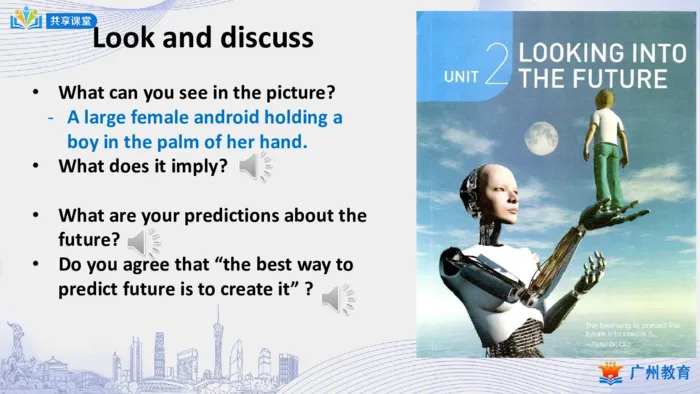
What can you see in the picture?
- A large female android holding a
boy in the palm of her hand.
•
What does it imply?
•
What are your predictions about the
future?
•
Do you agree that “the best way to
predict future is to create it” ?
Lead-in
•
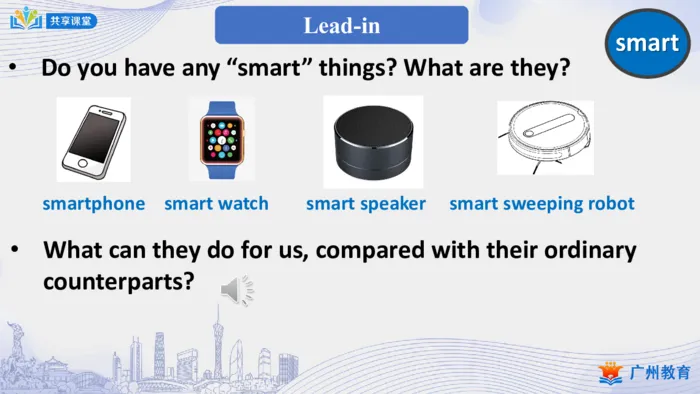
Do you have any “smart” things? What are they?
smartphone    smart watch        smart speaker     smart sweeping robot
•
What can they do for us, compared with their ordinary
counterparts?
Pre-reading
It means that it can make decisions on its own without a
human telling it what to do, and that it can also learn how to
do things itself.
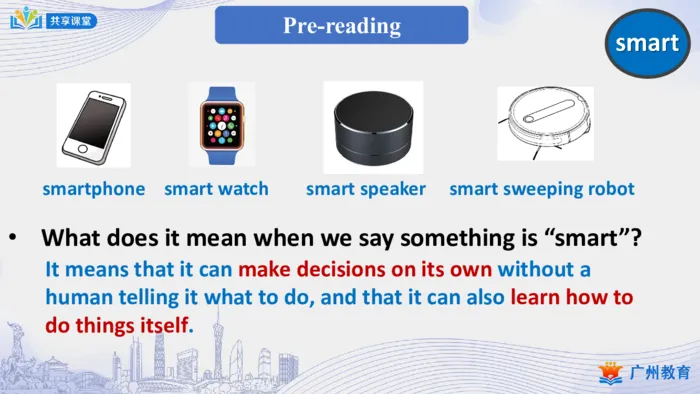
smartphone    smart watch        smart speaker     smart sweeping robot
•
What does it mean when we say something is “smart”?
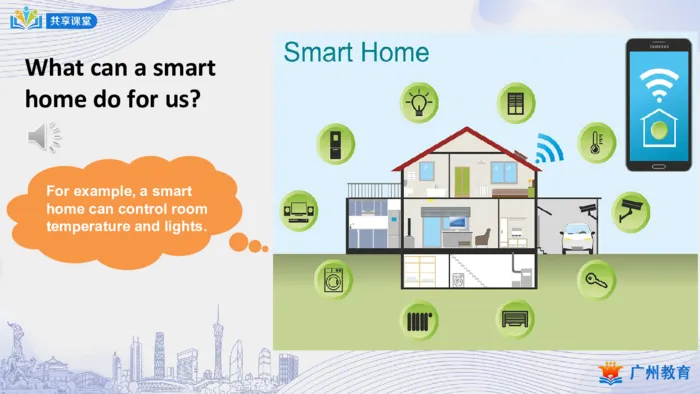
What can a smart
home do for us?
For example, a smart
home can control room
temperature and lights.
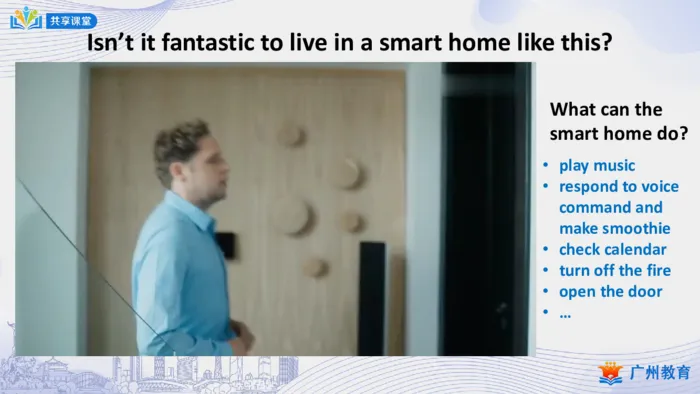
Isn’t it fantastic to live in a smart home like this?
• play music
• respond to voice
command and
make smoothie
• check calendar
• turn off the fire
• open the door
• …
What can the
smart home do?
After this lesson, you will
1. gain more knowledge about smart home’s functions, advantages
and possible future.
2. infer the writing purpose and intended audience according to its
text type and language features.
3. think critically about smart homes and form your own opinions.
Learning Objectives
P14 -15
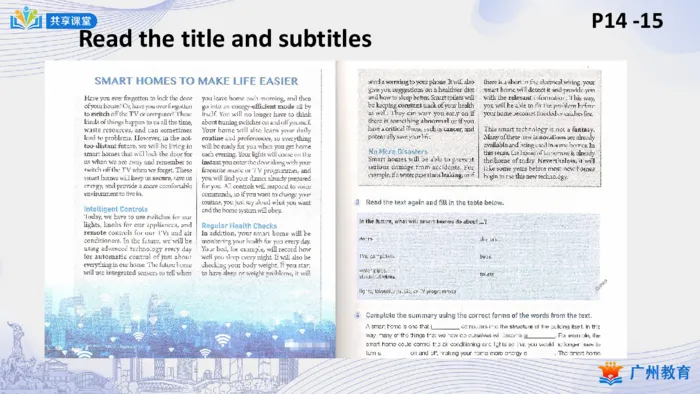
Read the title and subtitles
P14 -15
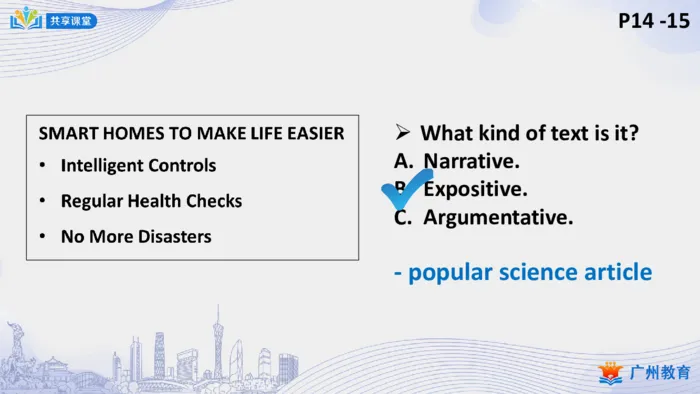
Ø What kind of text is it?
A. Narrative.
B. Expositive.
C. Argumentative.
- popular science article
P14 -15
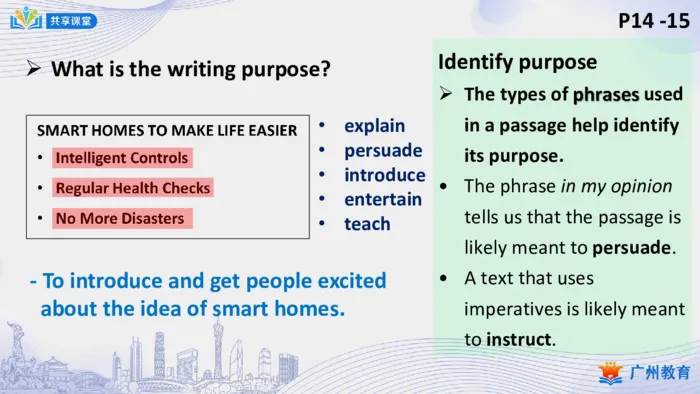
- To introduce and get people excited
about the idea of smart homes.
Identify purpose
Ø The types of
 used
in a passage help identify
its purpose.
• The phrase in my opinion
tells us that the passage is
likely meant to persuade.
• A text that uses
imperatives is likely meant
to instruct.
•
explain
•
persuade
•
introduce
•
entertain
•
teach
Ø What is the writing purpose?
P14 -15
- People who are interested in
smart homes or positive about
the life improved by technology.
Identify audience
Ø A passage’s content helps
identify its audience.
• A passage that gives tips
on looking after pets would
have pet owners as its
audience.
Ø Who is the intended audience?
Gist Reading (main idea & structure)
1. Can the title serve as the main idea of the text?
     Yes, it can.
1
2 3 4 5
1
2 3 4
5
2
1
3 4
5
A.                            B.                             C.
2. What is the structure of this text?
SMART HOMES TO MAKE LIFE EASIER
Pause the video for 2 minutes to read.
Intelligent
Controls
Regular
Health
Checks
No more
disasters
close-up
introduction
SMART HOMES TO MAKE LIFE EASIER
General
Structure
Part 1
Careful Reading
(detail, inference, writing technique)
introduction
1. Why does the writer start the
paragraph with two questions?
2. What does "these kinds of things”
refer to?
3. What will be a smart solution? In
what ways will such smart homes
be helpful?
Paragraph 1
Pause the video for 30 seconds to read.
1. Why does the writer start the paragraph with
two questions?
To arouse readers’ interest and get them to
think actively about the topic.
2. What does "these kinds of things” refer to?
Some inconvenient situations people may
have in ordinary homes such as…
3. What will be a smart solution? In what ways
will such smart homes be helpful?
     Smart homes will be a solution, and they can
keep us secure, save us energy and provide us
with a more comfortable environment to live
in.
Paragraph 1
Part 2
Intelligent
Controls
Regular
Health
Checks
No More
Disasters
Careful Reading
(detail, inference, writing technique)
1. In Paragraph 2, what makes all these
intelligent controls possible?
2. In Paragraph 3, why does the paragraph
start with “In addition"? What do you
think "Regular Health Checks” are?
3. In Paragraph 4, what does the writer want
to convey by describing how smart homes
prevent serious damage from accidents?
Paragraphs 2-4
Pause the video for 2 minutes to read.
•
In Paragraph 2, what makes all
these intelligent controls
possible?
      The integrated sensors.
Intelligent Controls
Paragraph
2
1. In Paragraph 3, why does the paragraph start
with “In addition”?
     Because both Para. 2 and Para. 3  introduce the
abilities of the smart home. They are parallel
paragraphs.
2. What do you think "Regular Health Checks” are?
     I think it means monitoring your health every
day, which might include the checks about your
body weight, sleep, diet, illnesses and so on.
Regular Health Checks
Paragraph 3
•
What message does Para. 4
convey by describing how smart
homes prevent serious damages
from accidents?
     It conveys that smart homes are
much safer than ordinary homes.

No More Disasters
Paragraph 4
• How does the writer develop
the paragraphs? What are
the benefits?
①Introducing detailed functions
②The 2nd person:
give readers a sense of real
experience
③Giving examples:
give further explanation about
those functions
Pause the video for 1 minute to read.
Part 3
Careful Reading
(detail, inference, writing technique)
close-up
In what way is the home of
tomorrow already the home of
today?
Many of the new innovations are
already used in some homes today.
It is true especially of automatic
controls for things such as lights
and air conditioners.
Paragraph 5
close-up
introduction
Intelligent
Controls
Regular
Health
Checks
No More
Disasters
• remote, automatic control
• energy-efficient mode
• learn routine, preferences
• voice command
Monitor your health
• bed: sleep, body, weight
• toilet: critical illnesses
Prevent serious damage:
detect leaking pipes, electric
wiring short
close-up
Draw a mind-map of the text in your preferred style
function
example
example
Post-reading
• What advantages do
smart homes have?
Bringing convenience,
saving energy and time,
monitoring health and
preventing diseases and
disasters.
• What is the writer’s
attitude towards smart
homes? How do you
know that?
SMART HOMES TO MAKE LIFE EASIER
positive   neutral    negative
Listen and read aloud
What might be some of the disadvantages of smart homes?
Discussion
What might be some of the disadvantages of smart homes?
Discussion
1. If the system breaks down,
2. If hackers hack into your system,
3. For older people,
you may find yourself locked out of
the house or unable to turn on your TV.
will be stolen for evil purposes.
it will be difficult to operate the system.
your personal information
①What is wrong?
②What will you consider to make it better?
①pulled out
teeth, change
in voice
②perhaps add
•
facial
recognition
•
fingerprint
code
•
traditional lock
and key
•
…
The smart home brings us not only benefits, but also challenges,
and some of the problems may be left to you.
advantages
disadvantages
ideas to make it better
read
think
popular
science
article
reading
strategy
identify purpose and audience
Summary
Homework
1. Read the text aloud and finish activities 3 and 4 on
page 15.
2. Design a smart home including its functions,
advantages, disadvantages and ideas to make it better.
Thank you!
高一—人教版—英语选择性必修一—第二单元
LOOKING INTO THE FUTURE
LESSON 1  READING AND THINKING I
答疑课
广州市第六中学 胡上
Practice Reading Technique
Identify writing purpose
Ø The types of
 used
in a passage help identify
its purpose.
e.g. The phrase in my opinion
tells us that the passage is
likely meant to persuade.
e.g. A text that uses
imperatives is likely meant
to instruct.
- To give advice on quitting smoking.
Identify audience
Ø A passage’s content helps
identify its audience.
• A passage that gives tips on
looking after pets would
have pet owners as its
audience.
- People who are interested in
the Winter Olympic Games
or winter sport events.
Identify purpose and audience
• Writing purpose:
   To teach readers how
to make Laba
porridge
• Intended audience:
    People interested in
making Laba porridge
or people interested
in Chinese traditional
food
Identify purpose and audience
• Writing purpose:
    To publicize travels in
the US.
• Intended audience:
    Tourists.
① descriptive and narrative :
② self-introducing:
③ story-telling:
④ dialogue:
Popular science article
                               vivid description and narration
              personification, 1st person
       introducing scientific knowledge in a story
 question and answer, communication with readers
2. Learn about the writing style
Which writing style
does it apply?
①descriptive &
narrative
②self-introducing
③story-telling
④dialogue
①descriptive and
narrative
②self-introducing
③story-telling
④dialogue
Which writing style
does it apply?
①descriptive and narrative
②self-introducing
③story-telling
④dialogue
Which writing style does it apply?
Thanks for watching!