高一—人教版—英语选择性必修一—第四单元
广州市第二中学 蓝钰珊
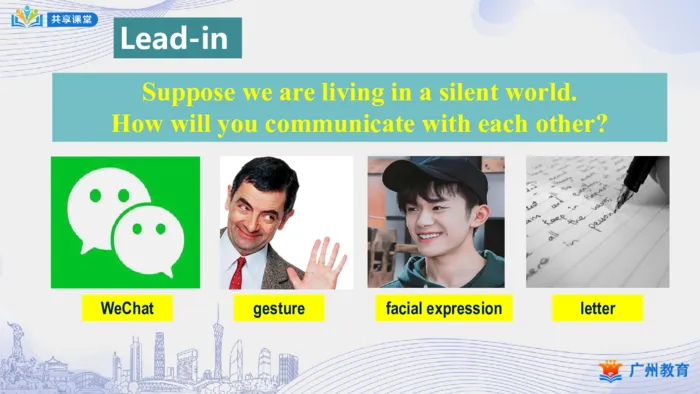
Suppose we are living in a silent world.
How will you communicate with each other?
Lead-in
gesture
facial expression
WeChat
letter
Pre-reading
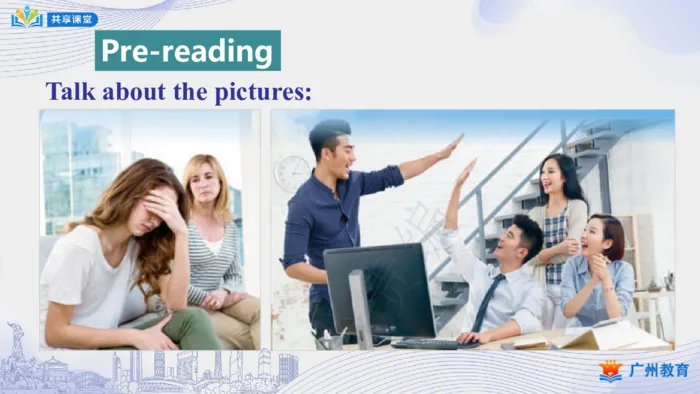
Talk about the pictures:
Talk about the pictures:
Pre-reading
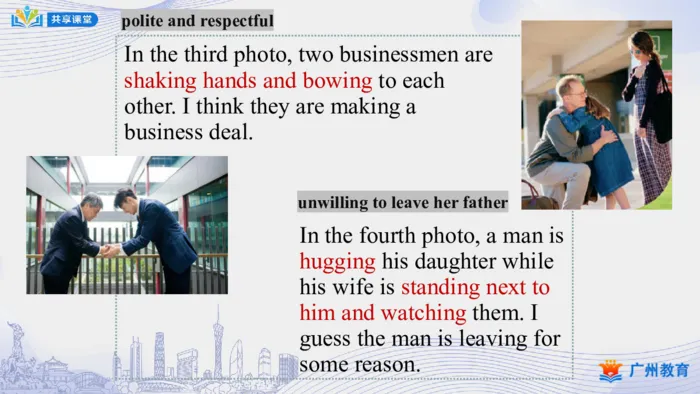
1  In the first photo,a girl is
    covering her face with her hand.
    A woman sitting next to her is
    looking at her. Maybe the first
    received bad news.

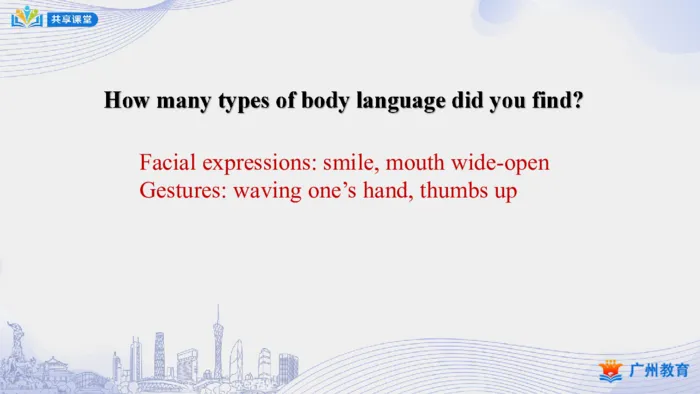
                           In the second photo, two men
                           are clapping hands and two
                           women are laughing. I think
                           they did well in a project
                           together.
 depressed and worried
happy and cheerful
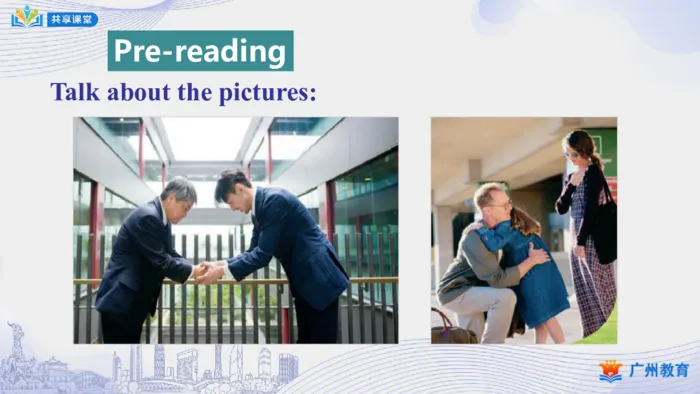
In the third photo, two businessmen are
shaking hands and bowing to each
other. I think they are making a
business deal.
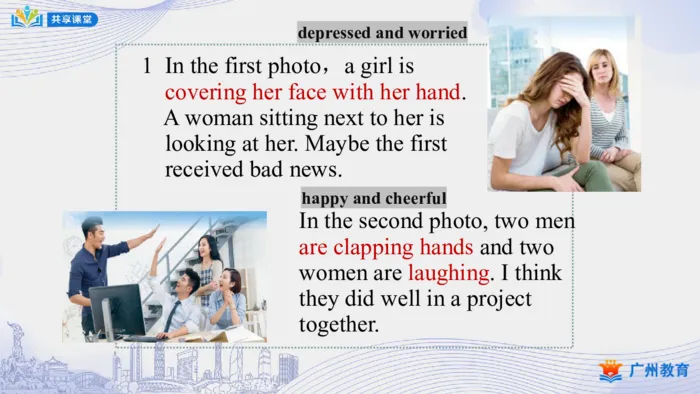
                              In the fourth photo, a man is
                              hugging his daughter while
                              his wife is standing next to
                              him and watching them. I
                              guess the man is leaving for
                              some reason.
unwilling to leave her father
polite and respectful
Facial expressions: smile, mouth wide-open
Gestures: waving one’s hand, thumbs up
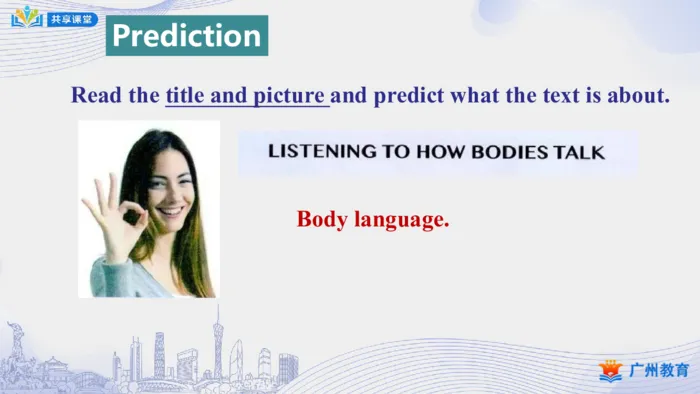
Read the title and picture and predict what the text is about.
Prediction
Body language.
While-reading
At the beginning
In the middle
At the end
While-reading
At the beginning
In the middle
At the end
√
While-reading
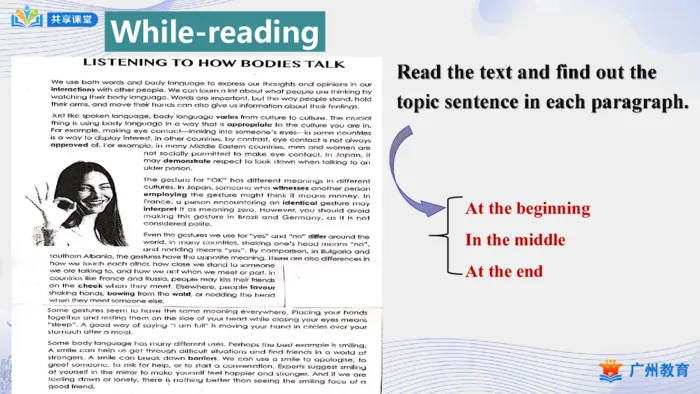
Para. 6 Some body language has many different uses.
Para. 1 We use both words and body language to express our thoughts and
opinions in our interactions with other people.
Para. 2 Just like spoken language, body language varies from culture to culture.
Para. 3 The gesture for “OK” has different meanings in different cultures.
Para. 4 Even the gesture we use for “yes” and “no” differ around the world.
Para. 5 Some gestures seem to have the same meaning everywhere.
               Read for structure
W e use both words and body language
to express our thoughts and opinions
in our interactions with other people.
body language
to express our thoughts and opinions
 The im portance
The gesture for "OK" has different
m eanings in different cultures.
There are also differences in how we
touch each other… when we m eet or part.
Just like spoken language, body
language varies from culture to culture.
Even the gestures we use for "yes
"and "no" differ around the world.
varies
differ
different
differences
also
 The im portance
               Read for structure
 The differences
Som e gestures seem to have the sam e
m eaning everywhere. .
the sam e
 The sim ilarities
 The im portance
               Read for structure
 The differences
Som e body language has m any different uses.
different uses
 The sim ilarities
Different uses
 The im portance
               Read for structure
①
②③④⑤   ⑥
A
B
C
①
  ②③④   ⑤⑥
①
②③④   ⑤  ⑥
               Read for structure
Part1(para. 1)
Body language
Part 2 (para. 2-4)
Varies across
cultures
Part 3 (para. 5)
Sim ilarities
between cultures
Part 4 (para 6)
Single gestures
for various uses
While-reading
Based on “to express our thoughts
and opinions” and “with other
people”, we can infer that it means
“communication”.
       Read for details
Make inferences
Sometimes a passage does
not say something directly.
However, you can figure it
out by looking at the clues
in the passage.
Body language/Gesture
M eaning
Country/Region
Eye contact between men
and women
Not polite
Middle East
Looking down when
talking to someone
OK sign
Kissing on the cheek
Placing your hands
together and resting them
on the side of your head
while closing your eyes
Moving your hand in
circles over your stomach
after a meal
A sign of
respect
Japan
Japan
France
Brazil & Germany
A greeting
Money
Zero
Not polite
France and Russia
I’m sleepy
I’m full
Most places
Most places
    Read
for details
① How is the body language mentioned in the text interpreted in China?
② Can you think of an example of body language that is appropriate in
China but might be misunderstood in another culture?
Some are the same in China. For example, the gesture for putting hands
together and resting them on the side of your head means sleeping.
Avoiding eye contact and lowering one’s head may mean respect and
being shy in China, whereas in some other countries this body language
may be interpreted as being rude.
       Read for details
       Read for details
What are the different uses of smiling?
Some body language has many different uses. Perhaps the best example
is smiling.  A smile can help us get through difficult situations and find
friends in a world of strangers. A smile can break down barriers. We can
use a smile to apologise, to greet someone, to ask for help, or to start a
conversation. Experts suggest smiling at yourself in the mirror to make
yourself feel happier and stronger. And if we are feeling down or lonely,
there is nothing better than seeing the smiling face of a good friend.
①
②
③
④
⑤
⑥
⑦
⑧
to be comforted
⑨
视频材料来自网络
Group discussion
Sometimes I smile when I am impatient, but I know I shouldn’t be.
For example, if I am riding a train and a baby starts crying, I may try
to smile, because even though the baby’s crying is annoying, I know
that it is not the baby’s fault and there is probably nothing that can be
done.
① Smiles can be used to hide feelings like anger, fear, or worry. Can
you describe a situation where you might smile when you don’t
mean it?
②Apart from fake smiles, is there any other kind of body
language that can sometimes be fake?
There are “crocodile tears”. This is when a person
fakes feeling sad or sympathetic for another person.
(The phrase comes from an old story that crocodiles
cry while they are eating, although they feel sad for
their victim.)
Group discussion
③ Which is a more reliable guide for understanding someone’s feelings,
their body language or the words they speak?
√ The body language is much more reliable than the words
they say, for the reason that the majority of people actually
have trouble hiding their feelings, such as anger,
disappointment, or irritation.
Group discussion
√ Normally, words are considered as something that has more
reliability than body language, which includes the way you
move or the expressions you show. By comparison, words are
more literal and easier to understand.
Group discussion
What advice on body language can you give a foreign friend on
his/her first trip to China?
It would be a good idea to pay attention to the social distance when
coming to China. As you can see here, the social distance is quite
different here than it is in the West.
Post-reading
Group discussion
What advice on body language can you give a foreign friend on
his/her first trip to China?
Post-reading
Group discussion
Post-reading
Within 0.5 meter: distance
between family members
0.5 ~ 1.5 meters: distance
between close friends
Group discussion
Post-reading
1.5 ~ 3 meters: distance
between acquaintances
More than 3 meters: distance
in public areas
Exercise:
        When we interact with other people, we use words as well as body language.
1.________(express) our thoughts and opinions. Important as words are, body language
can also give us 2. ________ (inform) about people’s feelings. However, body language
means 3. ________(different) in different countries. Take “making eye contact” as 4.
________ example. In some countries it is a way to display interest, 5.________ are in
many Middle Eastern countries, men and women are not socially permitted to make eye
contact. The gesture for “OK” 6.________ (vary) from culture to culture. In Japan,
people might think it means money while in France, people might interpret it as
meaning zero
        Some gestures seem to have the same 7.________(mean) everywhere. Placing your
hands together and resting them on the side of your head while 8.________ (close) your
eyes means “sleep”.
        Some body language has many different uses. A smile can help us get 9.________
difficult situations and find friends in a world of strangers. W can use a smile to
apologise, to greet, to ask for help, or to start a conversation. Experts suggest smiling at
10.________ (you) in the mirror to make yourself feel happier and stronger.
information
to express
differently
an
but
varies
closing
yourself
through
meaning
1. Finish Exercise 3 on Page 40
2. Read the whole article after class
3. Review the words in bold