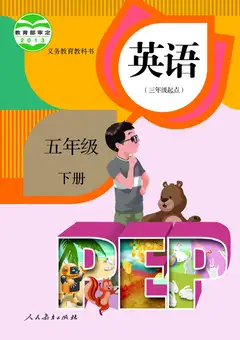
五年级 下册
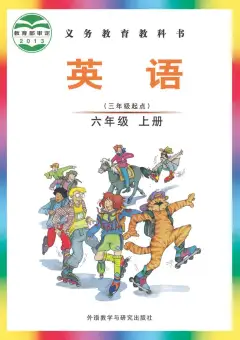
英 语
(三年级起点)
义
务
教
育
教
科
书
五年级 下册
英 语
(三年级起点)
义
务
教
育
教
科
书
主 编:刘兆义
编 者:朱腊梅 雷 军
致 同 学
致 同 学
小朋友好!很高兴能成为你们的“老”朋友!真羡慕你们这么小就可以学
习英语了!
每个小朋友都希望爸爸妈妈和老师夸自己学习好,是个聪明的孩子。那么
怎么才能学好英语呢?其实,“聪明”这两个字已经给了我们答案。你看“聪”
字的左边是个“耳”,右边上面的“
”就像一对眼睛,中间是个“口”,下
面是个“心”。这是告诉我们,学英语啊,一要用耳多听,听是攻克英语城堡
的突破口;二要用眼多看、多阅读,注意观察;三要用口多说、认真模仿、出
声朗读、大胆地说;四要特别注意用心用脑,学习中要多动脑筋思考、勤记忆。
这些学习的好习惯,一定要从小就养成。而由“日”和“月”组成的“明”是
告诉大家,学英语是个循序渐进的过程,需要日积月累的坚持和努力。小朋友
只要记住这些道理,跟随Toby 这位新朋友积极参与教材上的听、说、读、写、演、
唱、玩等各种活动,就一定能够学好英语。
衷心祝愿小朋友,好好学习,天天向上,都成为聪明的好孩子!
你们的“老”朋友
刘兆义
同学们好!我是托比,以后就叫我Toby 吧。
欢迎大家与我一起开始学习英语!
我们所学教材的英语名字是Join In,是“参与”
的意思。它里面有好多好多优美动听的英语歌曲、
易学易说的英语小韵文和诗歌、十分有趣的英语故
事和童话剧,还有非常好玩的英语动脑筋游戏。大
家一定会很喜欢!
让咱们参与到这些丰富多彩的听、说、读、写、
演、唱、玩的英语学习活动中去吧!我相信,大家
一定能在活动中体会到英语学习的乐趣,掌握一些
英语学习的方法,逐渐提高学英语和用英语的能力,
成为英语学习的主人!
致 同 学
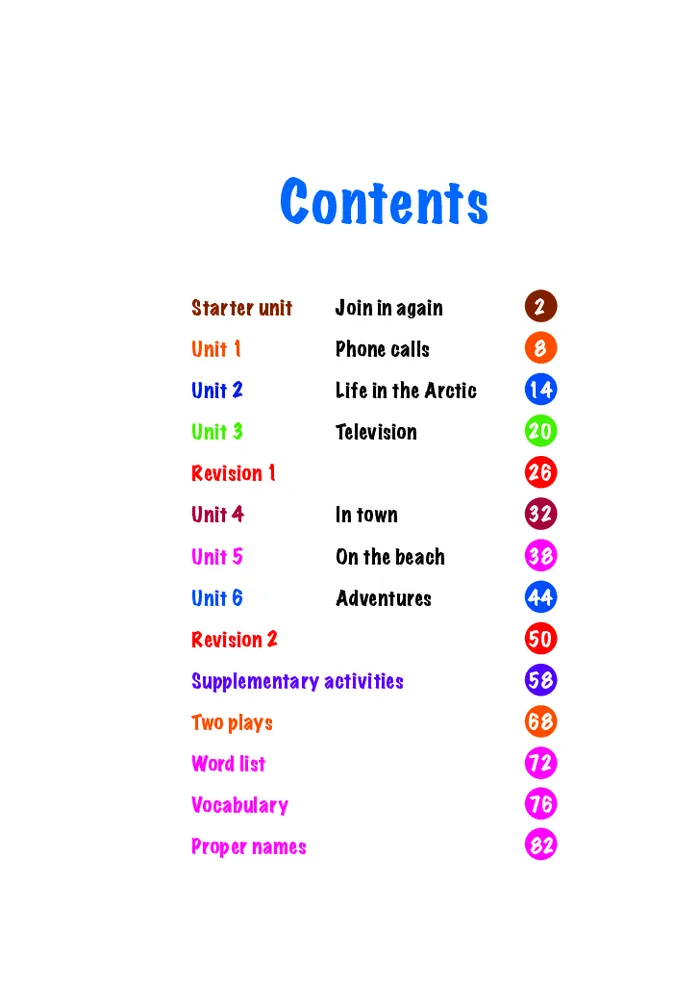
Contents
Starter unit
Join in again 2
Unit 1
Phone calls
8
Unit 2
Life in the Arctic 14
Unit 3
Television
20
Revision 1
26
Unit 4
In town
32
Unit 5
On the beach
38
Unit 6
Adventures
44
Revision 2
50
Supplementary activities
58
Two plays
68
Word list
72
Vocabulary 76
Proper names 82
2
Join in again
Starter
unit
1a
Listen and sing the song.
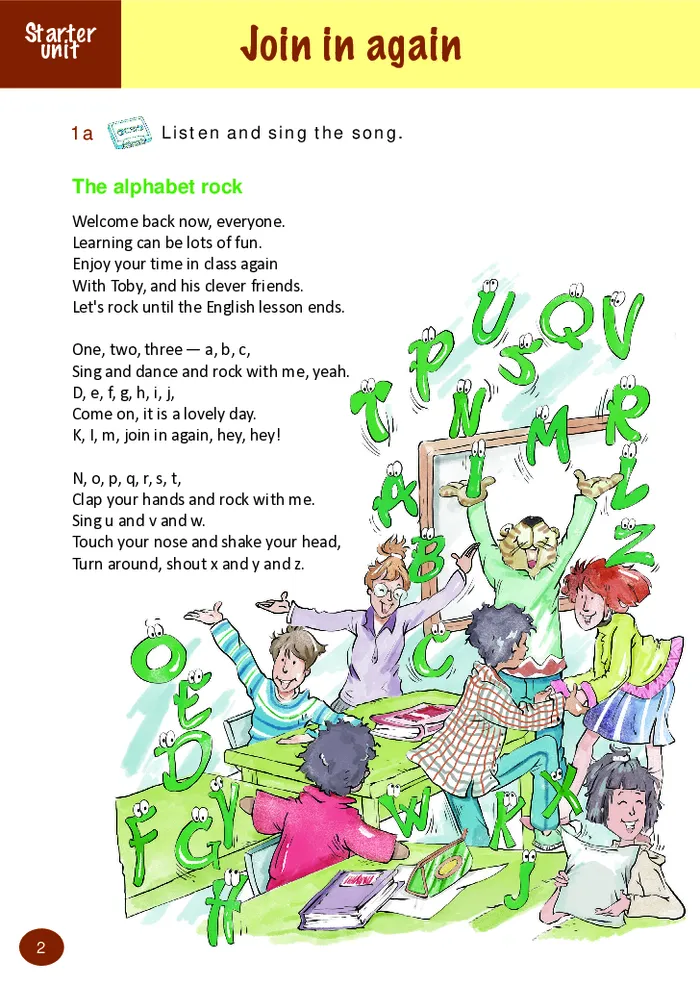
The alphabet rock
Welcome back now, everyone.
Learning can be lots of fun.
Enjoy your time in class again
With Toby, and his clever friends.
Let's rock until the English lesson ends.
One, two, three — a, b, c,
Sing and dance and rock with me, yeah.
D, e, f, g, h, i, j,
Come on, it is a lovely day.
K, I, m, join in again, hey, hey!
N, o, p, q, r, s, t,
Clap your hands and rock with me.
Sing u and v and w.
Touch your nose and shake your head,
Turn around, shout x and y and z.
3
Starter
unit
1b
Listen and number. Then read.
2
Listen and mime.
3
Read the text. Then answer the questions.
PAIRWORK
Tell your partner about your family.
Touch your nose and shake your head.
1 Welcome back now.
Come on, it is a lovely day.
Enjoy your time in class again.
Sing and dance and rock with me.
Clap your hands and rock with me.
Touch your nose.
Touch your hair.
Touch your ears.
Clap your hands.
Shake your head.
Shake hands with your partner.
Turn around.
Dance with me.
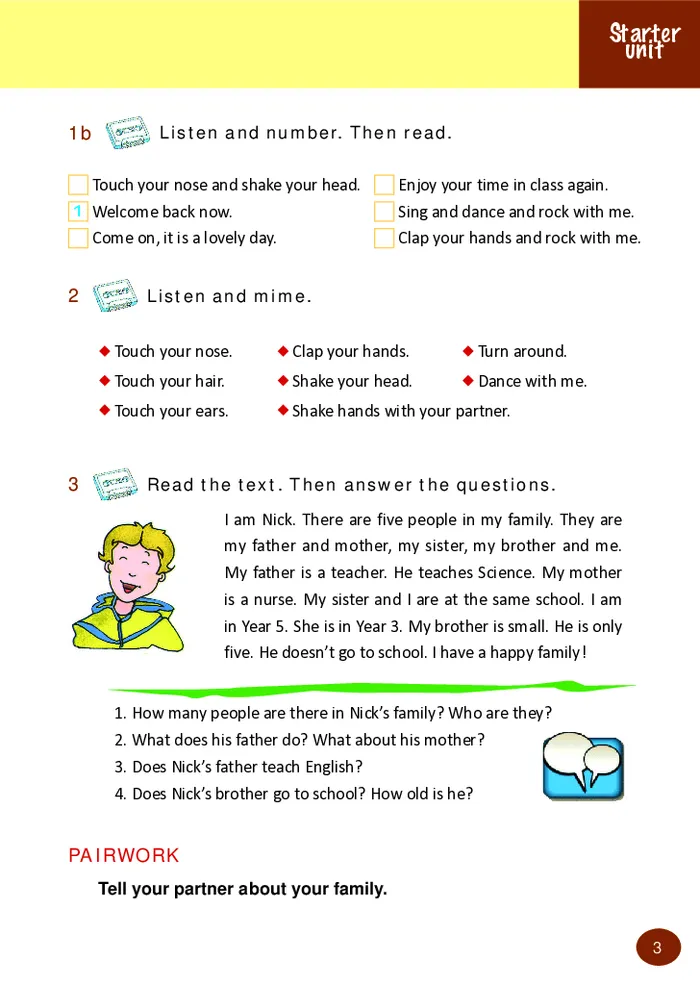
I am Nick. There are five people in my family. They are
my father and mother, my sister, my brother and me.
My father is a teacher. He teaches Science. My mother
is a nurse. My sister and I are at the same school. I am
in Year 5. She is in Year 3. My brother is small. He is only
five. He doesn’t go to school. I have a happy family!
1. How many people are there in Nick’s family? Who are they?
2. What does his father do? What about his mother?
3. Does Nick’s father teach English?
4. Does Nick’s brother go to school? How old is he?
4
Join in again
Starter
unit
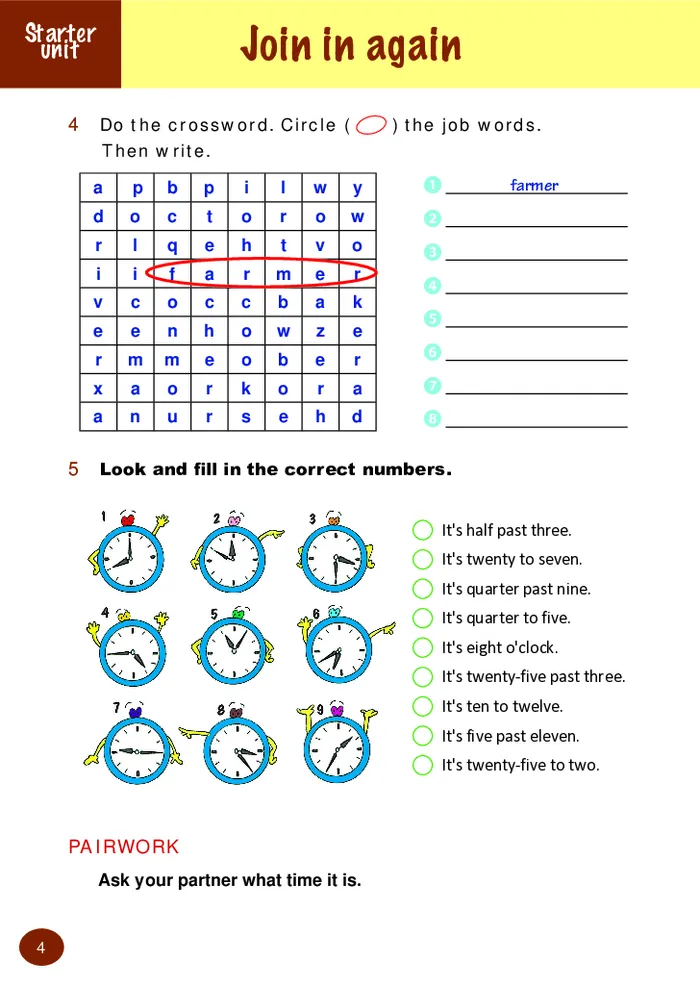
4 Do the crossword. Circle (
) the job words.
Then write.
5 Look and fill in the correct numbers.
A
B
C
D
E
F
G
H
farmer
a
p
b
p
i
l
w
y
d
o
c
t
o
r
o
w
r
l
q
e
h
t
v
o
i
i
f
a
r
m
e
r
v
c
o
c
c
b
a
k
e
e
n
h
o
w
z
e
r
m
m
e
o
b
e
r
x
a
o
r
k
o
r
a
a
n
u
r
s
e
h
d
It's half past three.
It's twenty to seven.
It's quarter past nine.
It's quarter to five.
It's eight o'clock.
It's twenty-five past three.
It's ten to twelve.
It's five past eleven.
It's twenty-five to two.
PAIRWORK
Ask your partner what time it is.
5
Starter
unit
= often
= sometimes
= never
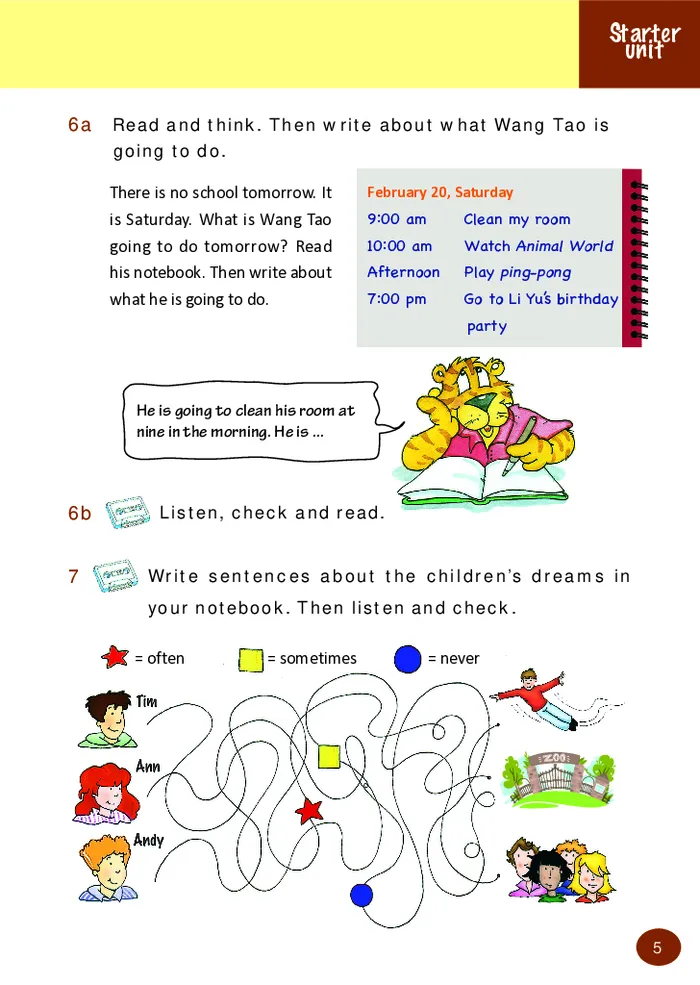
6a Read and think. Then write about what Wang Tao is
going to do.
6b
Listen, check and read.
7
Write sentences about the children’s dreams in
your notebook. Then listen and check.
There is no school tomorrow. It
is Saturday. What is Wang Tao
going to do tomorrow? Read
his notebook. Then write about
what he is going to do.
February 20, Saturday
9:00 am
Clean my room
10:00 am Watch Animal World
Afternoon Play ping-pong
7:00 pm
Go to Li Yu’s birthday
party
He is going to clean his room at
nine in the morning. He is ...
6
Join in again
Starter
unit
8a Look and think. Then talk about Steve.
PAIRWORK
Ask your partner about Steve.
The questions below will help you.
1. How old is Steve?
2. When is his birthday?
3. Where is he from?
4. What does he love?
5. What can he do?
6. When does he get up in the morning?
7. When does he go to school? 8. When do classes begin?
9. When does he go home?
10. What does he do then?
11. When does he go to bed?
7
Starter
unit
8b
Listen and complete the sentences.
9
Match questions and answers. Fill in the numbers.
Then listen and check.
PAIRWORK
Ask and answer the questions in 9.
Steve is
years old. His birthday is on
.
He is from
. He loves
. And he
can
.
Steve gets up at
in the morning. He goes to
school at
. Classes begin at
.
He goes home at
.
Then he does
or watches
.
He goes to bed at
.
1 Do you like English?
2 When do you come to school?
3 Is your mother a teacher?
4 How does she go to work?
5 Whose new car is it?
6 Has your father got a sister?
7 Can Mr Yue swim?
8 Where are you going?
9 What is Miss Ma going to do?
10 Is there a taxi near here?
No, she isn’t.
I’m going to the library.
No, he hasn’t.
1 Yes, I do.
It’s my uncle’s.
She’s going to swim.
Yes, let’s go by taxi.
She goes to work by bike.
At half past seven.
No, he can’t.
8
Phone calls
Unit
1
1a
Listen to the conversation.
Ken, Penny, Paula, Philip:
Paula:
Ken, Penny:
Paula:
Philip:
Paula:
Ken, Penny, Philip:
Ken:
Philip:
Penny:
Paula:
Penny:
Bye, see you tomorrow.
Hey, wait a moment.
I’ve got a new CD-ROM.
What is it about?
Arctic animals.
Super.
Can you come to my place?
Yes, great.
I have to ask Mum first.
Right, and I have to ask my grandmother.
Is there a phone box near here?
Yeah. There’s one over there.
Hurry up. Phone your mum and your grandma!
1b Read the conversation. Then answer the questions.
1. Who has got a new CD-ROM?
2. Who has to phone his mother?
3. Who has to phone his grandmother?
4. Where are they going to make the phone call?
5. Where do the children want to go?
Hello, is that Mum?
GROUPWORK
Act out the conversation in groups.
( The children are on their way home from school. )
9
Unit
1
2a
Read the sentences. Then listen and number.
2b Write down the telephone conversation in the correct
order. Then practise in pairs.
( Mrs Brown’s computer has something wrong.
She is phoning her grandson Mike for help. )
Yes, it’s Mike. Who’s speaking?
Oh sorry, Granny. I have to do my homework.
What about this evening?
Hello!
OK. See you this evening.
It’s your granny. Can you come to my place now?
My computer doesn’t work!
Hi, is that Mike?
Bye-bye.
1
Hello!
Mike:
Granny:
Mike:
Granny:
Mike:
Granny:
Mike:
Hello!
Hi, is that Mike?
Hi, is that Mike?
10
Phone calls
Unit
1
3
A story — Rabbit’s birthday.
It's my birthday
today! I'm very
excited!
Good morning, Squirrel!
It's my birthday today. Can
you come to my party?
Sorry, I can't.
I'm busy today.
Oh dear.
Hi, Sheep! Can you
come to my birthday
party today?
Sorry, Rabbit.
I can't come to your
birthday party.
Oh dear.
Oh dear.
Hello, Pig! Can you
come to my party? It's
my birthday today!
No, I can't.
Sorry.
Oh, no!
11
Unit
1
My friends can't
come to my party.
Hi, Rabbit. Can you come
to my house right now?
It's important.
OK.
Oh! Thank you!
Surprise! Happy
birthday!
12
Phone calls
Unit
1
4
Read the text. Then listen and repeat.
Mobile phones are very popular across the world.
You can use a mobile phone to write emails, listen
to music, watch TV programmes and play games.
You can use it to visit your favourite websites and
even do shopping.
PAIRWORK
Discuss what you can do with a mobile phone.
make phone calls visit websites see films
get messages
take photos
What can you do with
a mobile phone?
Can you visit websites?
I can send and get
messages.
Of course I can, but I don't
visit websites often.
13
Unit
1
5a Grammar puzzle.
5b Check your answers with your partner. Then read.
6 Complete the sentences with the correct form of the
words in the box.
My cousin Yanmei
hard at English.
She
English very much.
She
many English storybooks.
She often
her storybooks.
like
work
read
collect
2
3
4
5
My father
His parents
Philip
Their uncle
stamps.
music and art.
get up before 7:00.
many CD-ROMs.
collect
love
have to
have got
has to
collects
loves
has to
has got
1
I
ask Mum first.
have to
has to
1
2
3
4
14
Life in the Arctic
Unit
2
1a
Look, listen and learn.
2
Listen and say the sentences.
The Arctic
What do you know about the Arctic?
Where is the Arctic?
Look, the Arctic is here.
It is at the North Pole of our Earth.
1. The Arctic is very, very cold.
2. There is ice everywhere in the Arctic.
3. The sky is very, very blue.
4. The Arctic is very beautiful!
polar bears
It is very, very cold in the Arctic. Go
to the Arctic, and you will see a white
world. There is ice everywhere. The
sea is clean and blue, and the sky is
also very, very blue. The Arctic is very
beautiful!
1b Read the text again. Tell your partner what the Arctic
is like.
15
Unit
2
jump in the water
swim across the lake
walk through the snow
come to the top
look around
run up the hill
The polar bear
hare
What’s over there?
What’s over there?
A bear, a bear,
A big, big bear.
A big, big polar bear.
What’s he doing over there?
What’s he doing over there?
The bear, the bear,
The big, big bear,
The big, big polar bear.
He wants to catch a hare.
He wants to catch a hare.
The bear, the bear,
The big, big bear,
The big, big polar bear.
He jumps in the water,
He swims across the lake.
He walks through the snow
And he runs up the hill.
When he comes to the top,
He comes to a stop.
He looks around,
And what’s not there?
The hare, the hare, the arctic hare.
3
Listen and say the chant.
16
Life in the Arctic
Unit
2
4a
A story — Nicola’s holiday (1).
4b Answer the questions.
1. Is Nicola going to have her holiday in the Arctic?
2. Is Nicola happy to see her grandparents?
3. Does Nicola like it there?
4. Why does Nicola think it is boring there?
16
Nicola comes to the Arctic. She is going to have her holiday there.
Hi, Grandad.
Hi, Grandma.
Do you like it here?
No, it’s boring.
What can I do?
Yes. There are no
shopping malls,
no playground and
there’s no TV.
Boring?
Welcome,
Nicola.
This is our house.
17
Unit
2
5a
A story — Nicola’s holiday (2).
5b Complete the sentences with the words in the box.
Early the next morning, Grandpa wakes Nicola up ...
happy fish fishing no wakes playground
1. Nicola’s grandfather
her up early in the morning.
2. They go fishing and get some
for lunch.
3. Nicola says to Grandpa, “Can we go
again tomorrow?”
4. Grandpa says, “We are going to the
tomorrow.”
5. Nicola finds
playground at all. But she is very
!
wakes
Next morning
Wake up, Nicola. We’re
going to the shopping mall.
We need some fish.
I’ve got one.
Pull, Nicola. Pull!
This is
great fun,
Grandad.
Can we go fishing
again tomorrow?
No.
We’re going to the
playground.
18
Life in the Arctic
Unit
2
6a
A story — Nicola’s holiday (3).
Next Grandpa will show Nicola his TV. Do you know what’s on his TV?
And tomorrow
I’ll show you my TV.
Here you are,
Nicola.
Do you like them?
Yes, Grandad.
Can I come
again next year?
Yes, very boring!
Wasn’t
it boring?
6b Choose the right answers. A, B or C?
1. Grandpa
a TV for Nicola.
A. has got B. hasn’t got C. is going to buy
2. Nicola sees some
.
A. arctic hares B. seals C. polar bears
3. Nicola says, “Yes, very boring!” What does she really mean?
A. It’s great fun here! B. It’s too cold here! C. It’s boring here!
19
Unit
2
7
Listen to the whole story — Nicola’s holiday.
Then act out the story in groups.
9
Look and listen. Then role-play.
Tomorrow is Saturday. What will the children do?
8 Which two sentences have the same meaning?
Read and match. Then say all the sentences.
1. There are no playgrounds.
2. There are no shopping malls.
3. We are going to the playground.
4. I’ll show you my TV.
5. Can we go fishing again tomorrow?
Peter Jane Sue John Elena
I’ll go swimming.
What will you do
tomorrow, Peter?
There aren’t any shopping malls.
We’ll go to the playground.
Let’s go fishing again tomorrow.
I’m going to show you my TV.
There aren’t any playgrounds.
20
Television
Unit
3
1
Read the text. Then answer the questions.
2
Listen and point. Then tick (
) what you like to
watch on TV.
TV is short for television.
There are many different TV programmes.
Different people like different programmes.
Children usually like cartoons.
1. Do you often watch TV?
2. What programmes do you often watch?
cartoons
sports programmes
science fiction films
romantic films
nature programmes
detective films
21
Unit
3
cartoons
nature programmes
sports programmes
science fiction films
detective films
romantic films
cartoons
nature programmes
sports programmes
science fiction films
detective films
romantic films
3a
Listen and tick (
).
3b
Listen again and answer the questions.
PAIRWORK
Talk about what programmes the four children like and don’t like.
Talk about what programmes you like and don’t like.
1. Does Juliet like cartoons?
Does she like science fiction films?
3. Does Angela like science fiction films?
Does she like cartoons?
2. Does Fred like nature programmes?
Does he like sports programmes?
4. Does Frank like nature programmes?
What doesn't he like?
22
Television
Unit
3
4
When do the programmes begin?
Listen, draw and complete the sentences.
The sports programme
at
to
.
The nature programme begins at
.
The cartoon
at
.
The science fiction film
at
.
23
Unit
3
5
Listen and read.
6 Language puzzle. Fill in the numbers. Then read
the sentences.
never
like
sports programmes.
cartoons
brother
My
watches
often
doesn’t
nature
He
programmes.
like
and
I
nature programmes.
watch
football.
I
Mingming and his sister like watching TV. They always watch on
Saturday and Sunday.
Mingming likes cartoons. He thinks they are
interesting. This evening, there is a cartoon on called
Kung Fu Panda. It begins at twenty to eight.
Mingming will watch it.
His sister doesn’t like cartoons. She thinks they
are boring. She never watches them. She will watch
Man and Nature this afternoon. It begins at twenty
past four in the afternoon. “This programme is really
great!” she says.
24
Television
Unit
3
7 Can you read the texts?
I often
watch
TV. I like nature
programmes
. My dad often watches
football
. My mum doesn’t often watch
sports
programmes. She likes
romantic
films .
Jill
I often watch
. I
very much. My
and my
also
. I do not
.
I think they are stupid.
Peter
TV on Saturday and Sunday. I often watch sports
films are stupid, and I
My favourite programmes are cartoons
don't like science fiction very much.
programmes and nature films. Romantic
and detective films. I always watch
Barbara
Now write your own text.
25
Unit
3
8
Listen to the poem. Then read it out loud.
Kevin Dee
I’ve got a friend called Kevin Dee,
And he’s a star on TV.
Just switch on the telly
And watch for a while,
And there he is with a big, big smile.
He’s eating sweets,
First one, then two,
And then he stops and looks at you.
He smiles and says, "I love these sweets,"
And then he eats and eats and eats.
Thousands of children
Like you and me
Want to have what they see on TV.
They go and buy big bags of the sweets
That Kevin eats and eats and eats.
But what Kevin says on TV is not true.
He doesn’t like sweets like me and you.
He only eats them on TV.
I know, ’cause Kevin goes to school with me!
1
26
REVISION
CHECK YOUR ENGLISH
1
Read the phrases. Then listen and tick (
)
what you hear.
2
Read the conversation. Then listen and repeat.
1. make phone calls
2. send and get messages
3. visit websites
4. take notes
5. take photos
6. play games
7. listen to music
8. learn English
9. watch TV
10. watch the weather report
Paula: Have you got a mobile phone, Mike?
Mike: Yes, I have. I’ve got a mobile phone.
Paula: Great! What do you do with your mobile?
Mike: Make phone calls, of course. And send and get messages, too.
Paula: What about you, Rose? What can you do with your mobile?
Rose: I’ve got a mobile phone, too. I can do many things with it.
I often visit websites, listen to English and take photos.
GROUPWORK
Discuss what you usually do with a mobile phone.
I watch the weather
report, listen to music
and take photos.
What do you do
with your mobile phone?
1
27
REVISION
3 Ask your friends, family and teacher to find out
their favourite arctic animals. Then tell the class
the animals that got the most and least votes.
PAIRWORK
Ask about your partner’s favourite arctic animal.
What’s your favourite
arctic animal, Xiaohui?
Oh, it’s the arctic fox.
It’s so beautiful.
The seal
The polar bear
The arctic fox
The snowy owl
The arctic hare
1
28
REVISION
4
Match questions and answers. Then listen
and check.
1. Do you often watch TV?
2. Does Frank like sweets?
3. Has Bill got a 40 inch TV?
4. When does Man and Nature begin?
5. Does Mingming’s sister like cartoons?
6. What programmes does Joe often watch?
Yes, he has.
At twenty past four.
No, I don’t.
Films.
Yes, he does.
No, she doesn’t.
PAIRWORK
Ask and answer the questions.
1. Do you often watch TV?
2. Do you like cartoons?
3. What programmes do you often watch?
4. Does your father watch CCTV News every day?
5. Does he like sports programmes?
6. What programmes does your mother often watch?
1
29
REVISION
6 Read the sentences. Then write sentences with the
given words.
5 Complete the sentences with the given words.
1. In Wuhan, it is very
in summer.
2. I’m
. Can I have some water, please?
3. Tom is a
boy. He is good at his lessons.
4. It is
in Changchun in winter.
5. Oh, I’m
. I want to have a big hamburger.
6. It is
in Beijing’s autumn.
7. That film is
! Many people don’t like it.
8. Spring is coming. The weather is getting
.
cold
hot
cool
warm
clever
boring
thirsty
hungry
PAIRWORK
Read the words and the sentences in 5. Make your own
sentences with these words.
1. My cousin works hard at English.
(Tim, Science)
2. She never watches cartoons.
(Hans, eat fish)
Monkeys are
clever.
Our classroom
is very warm.
1
30
REVISION
7
Listen and fill in the numbers.
8
Read and match. Fill in the numbers. Then
listen and repeat.
A
Mrs Lee: Can you open the window, please?
Tom: OK.
B Mrs Lee: Can I open the window, Tom?
Tom: Yes, of course.
C Tom: Can you get the cake for Bill, please?
Connie: Sorry, I’m not going to his place.
D Tom: Can I have some more cake, Connie?
Connie: Yes. Here you are.
Tom wants to eat some more cake.
Tom asks Connie for help.
Mrs Lee wants to open the window.
Mrs Lee asks Tom to open the window.
1
31
REVISION
9
Listen to the conversation. Then read and talk
with your friends if you want to live on a farm.
Dick and Joe are on a farm for holiday. They live in a farmhouse.
It’s boring here! There are no computers. We
can’t use the Internet. There are no KTVs. We
can’t go singing. And the old TV doesn’t work
sometimes! And the food ...
Yeah, life is hard here, but the weather is
great! There’s a lake. The water is nice and
clean. We can often go swimming! At night,
we can see thousands of stars in the sky. It’s
lovely here, I think.
We can eat different fruits and vegetables on the
farm. That’s great!
Right, that's great. But, er ... there are no
hamburgers and no pizzas.
32
In town
Unit
4
1
Look, listen and fill in the numbers.
museum
park
church
police station
tourist office
train station
hospital
bus stop
post office
33
Unit
4
2
Listen and tick (
) the answers.
left
right
straight ahead
straight ahead
straight ahead
straight ahead
right
right
right
left
left
left
3 Act out the conversation in class.
Excuse me, where’s
the train station?
Go straight
ahead.
Thank you.
That’s OK.
34
In town
Unit
4
4
Listen and sing the song.
See you at Tony’s
At Tony’s, at Tony’s,
You get the best ice cream in town.
At Tony’s, at Tony’s,
You get the best ice cream in town.
It’s opposite the park
And next to the school.
Please don’t be late.
See you there at eight.
At Tony’s, at Tony’s,
You get the best ice cream in town.
At Tony’s, at Tony’s,
You get the best ice cream in town.
First you go left,
Then go straight ahead.
Then you turn right.
See you there tonight.
35
Unit
4
6
Listen to the chant. Then say in two groups.
Where’s the museum?
Excuse me, excuse me,
Where’s the museum?
Please tell me, please tell me,
Please tell me the way.
That’s easy. That’s easy.
First left, then right.
Then straight ahead,
Then right, then left again.
Go past the park
And past the pool.
Then you’re there,
Just past the school.
Oh, thank you. Oh, thank you.
That’s easy.
I know what I can do.
I think I’ll take a taxi.
5
Listen and role-play the conversations.
A: Excuse me. Where’s the police station?
B: It’s behind the park.
A: Where’s the park?
B: The park? That’s easy. Go straight ahead.
Then turn left.
A: Thank you.
B: That’s OK.
A: Excuse me. Where’s the post office?
B: The post office? Go straight. First turn right, then left.
A: Left, then right?
B: No, turn right. Then left. The post office is beside the school.
A: Thank you. Bye.
B: Bye.
35
36
In town
Unit
4
7
Listen and fill in the numbers.
You are
here.
school
post office
37
Unit
4
8
Listen, then read and colour.
Mr Black, Mr White, Mr Brown, Mr Green, Mr Grey and Mr Blue are
good friends. They live in the same street. They are neighbours, too.
Mr Green lives next to the bus stop.
Mr Black lives opposite Mr Green.
Mr Blue lives on Mr Black’s side of the street.
Mr Brown lives next to Mr Blue.
Mr White lives opposite Mr Blue.
Mr Grey does not live on Mr White’s side of the street.
38
On the beach
Unit
5
1
Look, listen and match. Then describe the picture
in pairs.
Today is Children’s Day. There is no school today. Lucy and her classmates
are on the beach. Look, they are having a great time!
1. Lucy, Kate and Betty are
2. Lily is
3. Bill is
4. Three boys and a girl are
5. Three pupils are
6. Jack is
7. Mary and Rose are
8. Carl is
flying a kite.
riding horses.
listening to music.
playing football.
collecting shells.
swimming in the sea.
fishing.
riding a jet-ski.
39
Unit
5
2
Listen and read. Then answer the questions.
3
Listen, number and say the words.
Peter: Hi, Nancy. This is Peter.
Nancy: Oh, Peter. Where are you now?
Peter: On Hainan Island with my cousin.
Nancy: In China? Super! What’s the weather like there?
Peter: It’s sunny. How’s the weather in London? Is it cold?
Nancy: Oh yes, very cold! It’s windy today.
Peter: It’s warm here. We’ll go to the beach tomorrow.
Nancy: Great. Have a good time!
Peter: Thank you. Bye.
1. Where is Peter? What’s the weather like there?
2. Where is Nancy? How’s the weather there?
PAIRWORK
Practise the conversations in 3.
What’s the weather like?/
How’s the weather?
It’s fine/sunny/cloudy.
FOCUS
cloudy windy sunny raining
40
On the beach
Unit
5
4a
A story — The seal.
Let’s go
snorkelling.
OK, I’ll get my
mask and flippers.
Look, Emma,
a seal.
Let’s swim
closer.
OK.
Stop,
Mike, a jet-ski.
Where’s
the seal?
Wow! It’s
a baby seal.
It’s over there.
Let’s get
closer.
What’s that in
the water?
I think it’s blood.
I think it’s
hurt.
Look, the seal
is over there,
on the rock.
41
Unit
5
Half an hour later
Two months later
Where can we
take it?
Hello,
Mr Jones. How
is our seal?
I’ll call
Ken Jones.
Come with me.
Who is he?
There it is. On the
rock. It’s fine again.
He knows a lot
about seals.
He can help.
Thank you,
Mr Jones.
It’s badly hurt.
I’ll take it with me.
Thank YOU.
Yes,
let’s get help.
Dad, there’s a seal
on the rock
over there.
It’s hurt.
Get into the boat.
We’ll go and get it.
Let’s go back.
Later
42
On the beach
Unit
5
4b
Listen to the story again. Then number the sentences.
5
Look, listen and learn.
1 Emma and Mike go to the beach with their father.
A boy is passing by on his jet-ski.
The children are going back for help.
They are getting closer. Then they find there’s blood in the water.
Their father helps get the seal to the beach by boat.
The seal is on the rock. It is badly hurt.
They are snorkelling in the sea. Then they see a baby seal nearby.
Hi, I’m Mary. I live on an island in Canada. There are lots of
beautiful starfish on the beach. You cannot swim there
very often. Most of the time, the water is too cold.
Hi, my name’s Qionghua. I live in Sanya. It’s a beautiful city
on Hainan Island in China. There are always many tourists
on the beach. You can swim here most of the year.
43
Unit
5
6
Listen and sing the song.
Come along to the beach, beach, beach.
Let’s play in the sand, sand, sand.
Let’s snorkel and swim, swim, swim.
Let’s play with the fish, fish, fish.
Everybody join in, in, in, in.
On the beach we’ll have fun, fun, fun.
We’ll play lots of games, games, games.
We’ll have fun in the sun, sun, sun.
Come along to the beach, beach, beach,
Where the weather is great, great, great,
Where the water is clear, clear, clear.
Come on, don’t be late, late, late.
Everybody join in, in, in, in.
On the beach we’ll have fun, fun, fun.
We’ll play lots of games, games, games.
We’ll have fun in the sun, sun, sun.
It’s great on the beach, beach, beach,
Where people have time, time, time,
To play and to sing, sing, sing,
The song that they like, like, like.
Everybody join in, in, in, in.
On the beach we’ll have fun, fun, fun.
We’ll play lots of games, games, games.
We’ll have fun in the sun, sun, sun.
Come along to the beach
44
Adventures
Unit
6
1a
Look and listen to the action story.
1b
Listen again and mime the actions.
Ouch!
45
Unit
6
1c
Listen and fill in the numbers.
2a
Read Bill’s story. Then listen and repeat.
2b
Listen again and say the words in bold.
Put on your boots and your cowboy hat.
Get on your horse.
Go for a ride.
1 You’re tired.
Stop your horse.
Get off.
Sit down on the ground.
Ouch!
You’ve sat on a cactus.
FOCUS
Put on your coat.
Take off your coat.
Get on your bike.
Get off your bike.
Ten years ago
Bill was born to a farmer’s family.
He was short and thin at your age.
He was often ill.
He was afraid of dogs.
He was afraid of getting into the water.
His parents were always worrying about him.
Now
Bill is very tall and strong.
He is good at swimming,
and he isn’t afraid of swimming in the sea.
He is a good swimmer in Australia.
His parents are proud of him!
46
Adventures
Unit
6
3a
Look, listen and draw lines.
3b
Listen again and say the sentences.
GROUPWORK
Tell your partners what you are afraid of and what you aren’t
afraid of.
I’m afraid of ...
I’m not afraid of ...
rats.
spiders.
big dogs.
the dark.
the cold.
hot food.
horror films.
sleeping alone.
47
Unit
6
4a
Listen and complete Sam’s poem.
5 Are you afraid of going to these places?
Talk with your friends.
I’m not afraid of
,
I’m not afraid of
,
And I’m not afraid of
.
But there’s one thing I’m afraid of:
Tomato soup for lunch.
I’m not afraid of
,
I’m not afraid of
,
And I’m not afraid of
.
But there’s one thing I’m afraid of:
.
4b Write your own poem. Then read it out loud.
1 spiders
2 the dark
3 horror films
2
the dark
48
Adventures
Unit
6
6
A story — The hero.
Stop the bank
robbers.
Money, money,
money, we love
money.
Hands up!
Ouch!
Bye-bye, Joe.
Can I sing a last
song, please?
Close your eyes
and dream ...
Where are you going,
Sarah?
I’m looking
for Joe.
OK.
OK, Sheriff.
I’ll catch them.
I’m not afraid.
Here you are.
Where are you going,
Joe?
I’m looking
for bank
robbers.
49
Unit
6
Ouch!
Hello, can I help you
with the pancakes?
Poor Joe.
Stop crying.
Thank you,
Sarah.
OK, Sarah.
Here you are.
Thank you.
Thanks, my hero.
Stop crying.
OK, Sarah.
Joe?
Well done, Joe. You’re a hero.
Here are a hundred dollars.
Watch this.
Yes, please.
Oh!
Bank
robbers.
Let’s make
some pancakes.
2
50
REVISION
CHECK YOUR ENGLISH
1 Complete the dialogues.
PAIRWORK
Practise the conversations in 1 in pairs.
Use: Go straight ahead, Turn left or Turn right
Use: next to or opposite
Excuse me, where's
the police station?
.
Excuse me, where's
the museum?
It's
the school.
Excuse me, where's
the post office?
here. It's not far.
Excuse me, where's
the church?
It's
the museum.
Excuse me, where's
the park?
here. It's not far.
Excuse me, where's
the swimming pool?
It's
the school.
police station
post office
post office
church
church
museum
museum
school
school
swimming pool
park
2
51
REVISION
m _ _ n
b _ _ ch
h _ _ _
s _ i _ m _ _ g
_ _ oes
c _ urc _
_ _ rse
_ oa _
m _ se _ m
h _ s _ ita _
2 Fill in the missing letters.
2
52
REVISION
3
Look at the picture and tick (
) True or False.
PAIRWORK
Ask your partner what the children are doing.
e.g.
A: What’s this boy doing?
B: He’s making a phone call.
1. A boy and a girl are flying their kites.
2. Two boys are playing football.
3. A girl is crying.
4. Two girls are reading books.
5. A girl and a boy are writing letters.
6. Two girls are making a phone call.
7. Three boys are listening to music.
8. A girl is eating ice cream.
T F
2
53
REVISION
5b Complete the sentences.
4 Number the sentences.
Hans
.
Mary
to music.
Bob
. Lily
a kite.
Jack
. Penny
.
Hans
Mary
Bob
Penny
Jack
Lily
A
B
C
F
E
D
5a Ask your partner what the children are doing.
Then change roles.
Sorry, but where's the post office?
Thank you. Bye-bye.
Excuse me, where's the museum?
Bye-bye.
The museum? That's easy. It's opposite the post office.
Turn left, then right.
2
54
REVISION
6
Listen and tick (
) or cross ( ).
7a
Listen and fill in the numbers.
7b
Listen again, point and say.
Mary
Chen Zihan
Ann
Tom
spiders
rats
big dogs
hot food
horror films
2
55
REVISION
8 Read the words. Then circle (
) in matching
colours.
9 Plan a visit to a famous city and share it with
your friends.
places
weather
television
feelings
directions
library
sunny
raining
next to
park
film
post office
news programme
cold
tired
cartoon
straight ahead
museum
hot
right
police station
happy
warm
bus stop
nature programme
cloudy
hospital
scared
supermarket
left
sad
windy
crayons
crayons
I am going to ...
I am travelling by ...
I am staying in ...
I am going
with ...
2
56
REVISION
10a
Read the text. Then complete the sentences.
10b The Earth is our home. Talk with your friends
what you can do to protect it.
1. The sky was
30 years ago, but now it is always
.
2. �There weren’t many
in my home town, but now there are.
And the hills are
.
3. My home town wasn’t
at all, but now it is.
30 years ago
Now
My name is Linda.
This was my home
town 30 years ago.
There were many
factories. The sky
was always grey. There weren’t
many trees. We had got no green
hills. It wasn’t beautiful at all!
This is my home town today.
The sky is always blue. There are
many trees. The hills are green.
The water is clean. It is very
beautiful!
2
57
REVISION
11
Complete the sentences with the given words
and phrases. Then listen and check.
1. _
is the Science Museum, please?
_ Go straight ahead. Then turn left.
2. _
are you going to Dick’s place?
_ This Sunday afternoon.
3. _
is your sister afraid of?
_ She’s afraid of big dogs.
4. _
TVs have you got in your family?
_ We’ve got three.
5. _
is that woman over there?
_ She’s Ms Wei, my Chinese teacher.
6. _ Hi, Carl.
is the weather in your town?
_ It’s often windy.
7. _
is this mobile phone?
_ It's 200 pounds.
8. _
is it on your watch?
_ It’s half past eleven.
PAIRWORK
Check your answers. Then ask and answer in pairs.
Who
What
How
When
What time
Where
How many
How much
58
Supplementary activities
Unit
2
1 Match and write the rhyming words.
letter
head
stop
buy
hare
go
much
sky
box
cow
rice
pair
clock
cake
yellow
bell
send
blue
hide
knee
fly now shell lock top
bed snake bear sweater touch
socks nice
tie friend
rainbow
know wear glue
key
ride
sky
59
Unit
2
2 Write the numbers.
I’ve got one.
Do you like it here?
No. We're going to
the playground.
Do you like them?
Wasn’t it boring?
Can we go fishing
again tomorrow?
Wake up, Nicola.
We’re going to the
shopping mall.
Can I come again
next year?
No, it’s boring.
What can I do?
Yes, Grandad.
Pull, Nicola, pull!
1
2
3
6
4
5
7
9
8
10
11
Supplementary activities
Unit
3
60
1 Complete the text.
2 Read and write.
don’t like
doesn’t like
like
like
watches
watches
watches
watch
My best friend and I ................. .................. romantic films very much.
We ............ cartoons best. My best friend always ......................... them.
I also ............ detective films. I always ......................... them.
My dad often ....................... sports programmes. My mum ...................
................. sports programmes. She never .................. them.
Jenny comes home from school at half past four. The nature
programme begins 15 minutes later. It ends at 5:30. The cartoons begin
10 minutes later. They end 20 minutes later. Then the sports programme
begins. It ends 50 minutes later. Then the science fiction film begins.
The nature ................................................................................
The ............................................................................................
The ............................................................................................
The ............................................................................................
When do the programmes begin?
Unit
3
61
3 TV programmes: Write about yourself, your best friend
and your mum and dad.
I like ................................ I often .................... them.
I don’t ................................................ I never ....................... them.
My best friend is ..................... He / She ..................................................
He / She always .................... them. He / She ..............................................
He / She never ...............................................
My mum / dad ........................................................
.............. always ........................ them.................. doesn’t like ........................
...............................................................................................
Supplementary activities
Unit
4
62
1 Write the numbers.
The police station 1 is next to the post office.
The church 2 is opposite the park.
The bus stop 3 is opposite the museum.
The tourist office 4 is in the park.
The hospital 5 is opposite the train station.
Unit
4
63
2 Where do they live? Read and colour the houses.
Where do the Pink family live?
The Green family live opposite the school.
The Blue family do not live on the Green family’s side of the street.
And they do not live next to the bus stop.
The Brown family live opposite the post office.
The Grey family live on the Brown family’s side of the street.
The Red family live opposite the Grey family’s house.
Supplementary activities
Unit
5
64
1 Match the pictures with the sentences.
2 Look at the pictures. Then match and fill in the numbers.
She is putting on her flippers.
She is buying a drink.
She is making a phone call.
She is collecting shells.
She is riding a jet-ski.
She is putting on a mask.
1 My favourite beach is not far away from my home. I often ride horses
on this beach.
2 My favourite beach is in Scotland. I like swimming in the warm water.
This is what I don't like: cars on the beach.
3 My favourite beach is on an island. I like to build sand castles with my
brothers and sisters there.
Unit
5
65
3 Write the girls’ names.
Ann, how many comics
have you got?
Yes, a pink mouse.
They are white,
brown and black.
Barbara, where are
my red socks?
It’s blue.
Sylvia, have you got
a mascot?
About 70.
Maria, what’s the time,
please?
Look under the bed.
Sandra, what colour
is your new bike?
It’s quarter to three.
Jane, when is your
birthday?
The Crazy Butterflies.
Aileen, what colour
are your rabbits?
In September.
It’s under your chair.
Diana, where’s
my pencil case?
Patricia, what’s your
favourite pop group?
Supplementary activities
Unit
6
66
1 Complete the text.
2 Write the sentences.
But there’s ....................... I am ..................................
............. ................ ............. .................. !
not afraid of
not afraid of
not afraid of
not afraid of
afraid of
one thing
I’m ............................................................................................. .
I’m ............................................................................................. .
I’m ............................................................................................. .
I’m ............................................................................................. .
of
Joe
I’m
afraid
catching
big dogs
bank robbers.
is
not
born
family.
Bill
farmer's
to
a
was
Australia.
swimmer
is
He
good
afraid of
under
my bed.
a
in
Unit
6
67
3 Write the numbers.
Oh!
Watch this.
Where are you
going, Joe?
I’m looking
for Joe.
Yes, please.
Joe?
Where are you
going, Sarah?
Hello, can I help you
with the pancakes?
OK, Sheriff.
I’ll catch them.
I’m not afraid.
I’m looking for
bank robbers.
Here you are.
OK, Sarah.
Here you are.
1
3
6
4
5
7
9
8
10
11
12
2
Two plays
68
Sandra
Roles:
Mrs Atkins
Sandra, her daughter
You need: a table with two chairs,
a tea pot, butter, toast, bread, etc.
(Mrs Atkins is in the kitchen.
She is making breakfast.
Sandra comes in in her pyjamas.)
Mrs Atkins: Good morning, Sandra.
Sandra: Good morning, Mum.
Hello to you.
And here I come.
Mrs Atkins: Oh, Sandra, come on. Tea?
Sandra: One, two, three,
Tea for me.
Mrs Atkins: Stop it, Sandra. Here's your tea. Some toast?
Sandra: Give me butter, give me bread,
My name's Sandra, and not Fred.
Mrs Atkins: Stop it, Sandra. Please!
Sandra: Stop it, Sandra, Sandra, stop,
I like to sing, I like to hop.
Mrs Atkins: Pleeease, Sandra, pleeeeeease.
Sandra: Please, please, please.
Give me some cheese.
Mrs Atkins: Hop, hop, hop,
Sandra, stop.
Stop it, please,
or there is no cheese!
Sandra: OK, Mum. Sorry.
Mrs Atkins: That's alright.
(Both laugh.)
69
A life of adventure
Roles:
Narrator 1, Woman, Xu Xiake (Xu Hongzu), Child 1, Man, Child 2, Mother,
Father, Narrator 2, Guide, Friend 1, Friend 2
You need:
Desks and chairs (the mountain), Cardboard boxes (rocks)
Narrator 1:
The Life of Adventure. Act 1 – Xu Xiake’s dream.
Woman:
What are you doing, Xu Hongzu?
Xu Xiake:
I’m reading.
Child 1:
What are you reading?
Xu Xiake:
The Classic of Mountains and Seas.
Man:
What’s it about?
Xu Xiake:
It’s about different plants, animals and so on.
Woman:
Why don’t you read your school books?
Child 2:
You’re not a good student.
(Xu Xiake looks very sad.)
Mother:
What’s the matter, my son?
Xu Xiake:
People say I’m not a good student.
Mother:
That’s not true!
Xu Xiake:
They think I should only read my school books.
Father:
You should read the books you enjoy, too.
Mother:
Just follow your dream.
Two plays
70
Xu Xiake:
(speaking to the audience) I want to see all the places I read in books. My
dream is to climb every mountain and sail every river in China!
Narrator 1:
Act 2 – A dream coming true. When Xu Xiake is 19 years old, his father dies.
Xu Xiake is very sad and stays with his mother at home for three years.
Mother:
My son, you can’t always stay at home. Leave and see the world. You
should follow your dream.
Xu Xiake:
Thank you for your support, Mother.
Narrator 2:
Xu Xiake is climbing Yandang Mountain with his guide.
Guide:
This is a very dangerous mountain.
Xu Xiake:
I want to see the wonderful lake
on the peak of the mountain.
Guide:
OK, but be careful.
(They climb up the mountain.)
Xu Xiake:
My legs ache. My whole body is
shaking!
Guide:
Let’s stop here!
Xu Xiake:
No, I must go on!
Guide:
Watch out!
(A big rock falls down the mountain.)
Xu Xiake:
I’m scared, but I want to go on!
Guide:
It’s too dangerous. I have to stop. Cross over three more peaks. Then you
will see the lake. Good luck!
Narrator 1:
The path gets steeper and steeper. Xu Xiake climbs over the first peak.
Then he climbs over the second peak.
(Xu Xiake climbs over the second peak.)
Xu Xiake:
But where’s the third peak?
(Xu Xiake scans the horizon.)
Narrator 2:
Xu Xiake is lost. Suddenly, he falls!
(Xu Xiake screams as he falls down the mountain, before stopping his fall by grabbing hold of
a rock.)
Narrator 2:
The rocks are as sharp as razors. But Xu Xiake climbs to safety.
Xu Xiake:
I can’t go on any more. But I will see the lake one day!
Narrator 2:
With regret, Xu Xiake goes back down the mountain.
Narrator 1:
Years later, Xu Xiake is talking with a friend.
Friend 1:
What is Yandang Mountain like, Xu Xiake?
Xu Xiake:
It’s very beautiful, but very dangerous.
71
Friend 1:
Did you see the lake at its peak?
Xu Xiake:
No, I didn’t. But I will return to Yandang Mountain soon.
Narrator 2:
This time, Xu Xiake chooses a different path. He pushes through bushes,
and climbs up and up the mountain. He climbs over the first peak. He
climbs over the second peak. And at last … he sees the lake!
Xu Xiake:
Ah, here it is! What a beautiful lake! I have no regrets anymore.
Narrator 1:
Act 3 – Thinking out-of-the-box.
Friend 2:
What’s the Changjiang River like, Xu Xiake?
Xu Xiake:
It’s a great river. In places, it’s nearly three times wider than the Yellow
River.
Friend 2:
I read from a book that the source of the Changjiang River is the Minjiang
River.
Xu Xiake:
I doubt it.
Friend 2:
But it’s in the book!
Xu Xiake:
I will prove I am right!
Narrator 2:
After a long-time discovery in Yunnan Province, Xu Xiake proves his idea.
Xu Xiake:
Finally, I’ve found it! The source of the Changjiang River is not the
Minjiang River. It is the Jinshajiang River!
Narrator 1:
Xu Xiake spent his life travelling and making notes. Read his journals to
find out more about Xu Xiake and the amazing things he saw in China.
72
Starter unit
alphabet 字母表
enjoy 享受……的乐趣
everyone 每个人
fun 乐趣
hey 嘿,喂
near
接近(地)
notebook 笔记本
ping-pong 乒乓球
school 〔在学校里〕上课
shake hands 握手
until 直到……为止
Unit 1
ask 问
before 在……以前
busy
忙碌的
call (一次)通话
CD-ROM 只读光盘
do shopping 购物
excited
兴奋的
get 收到,接到
important
重要的
mobile phone 移动电话,手机
moment
片刻
over there
在那边,在那儿
phone box 电话亭
phone call 电话
programme 〔电视或广播的〕节目
see you tomorrow 明天见
something 某物,某事
squirrel 松鼠
storybook 故事书
wait a moment 等一下
website 网站
work 运转
wrong 有问题的
Word list
(粗体单词是需要掌握的核心单词,标红星单词是超纲词)
73
Unit 3
call 名叫,叫做
detective 侦探
different 不同的
interesting 有趣的
Kung Fu Panda 《功夫熊猫》
nature 大自然,自然界
only 只有
romantic 关于爱情的
science fiction 科幻小说
star 明星
sweet 糖果
television 电视,电视机
telly 〔非正式〕电视机
thousand 一千
true 真实的
usually 通常地
want 想要
while 一段时间
Word list
Unit 2
Arctic 北极的
come to a stop 停止
early 早期的,初期的
earth 地球
fishing 钓鱼
go fishing 去钓鱼
grandad 〔非正式〕爷爷;外公
grandma 〔非正式〕奶奶;外婆
grandpa 〔非正式〕爷爷;外公
hare 野兔
hill 小山
ice 冰
lake
湖,湖泊
North Pole 北极
polar bear 北极熊
pull 拉
seal 海豹
shopping mall 大型购物中心
snow 雪
South Pole 南极
will 能〔表示可能性〕
74
Unit 5
baby 幼兽
badly 严重地
blood 血
boat 小船,小舟
call (给……)打电话
Children’s Day 儿童节
city
城市,都市
clear 清澈的
close 接近的
cloudy 多云的
come along 〔和某人〕一起去
fine 晴朗的
hurt 受伤的
island 岛屿
jet-ski 喷气式滑艇
most 大多数
nearby 附近的
pass by 经过(某人/某事物)
rain 下雨
rock 岩石
sand 沙子;沙滩
snorkel 徒手潜水
snorkelling 徒手潜水
starfish 海星
sun 太阳
sunny 阳光充足的
too 太,过分
tourist 游客
windy 风大的
Unit 4
ahead 向前
beside 在……旁边
bus stop 公共汽车站
church 教堂
excuse me 劳驾
hospital 医院
just 就,只
late 晚的,迟的
left 向左
museum 博物馆
neighbour 邻居
next 离得最近的
next to 紧挨着
on 在〔某位置〕
opposite 在……的对面
past 经过
police station 警察(分)局
post office 邮政局
right 向右
side 边,侧
straight 笔直地
tell 告诉
tourist office 旅游信息咨询处
town 城镇
train station 火车站
Word list
75
Unit 6
adventure 冒险(经历)
afraid 害怕的
age 年龄
ago 以前
alone 独自
bank 银行
be afraid of 害怕
boot 靴子
born to 出生于
cactus 仙人掌
coat 外套
cowboy hat 牛仔帽
dark 黑暗
good at 擅长
ground
地,地面
Hands up! 举起手来!
hero 英雄
horror film 恐怖片
hot 辛辣的
ill
有病的
last 最后的
pancake 薄煎饼
proud 自豪的
ride 骑
robber 强盗
sheriff 县治安官
short 矮的
soup 汤
strong 健壮的
swimmer 游泳运动员
thin 瘦的
worry 担心
Word list
build
建造
butter
黄油
by
通过
daughter
女儿
drink
饮料
plant
植物
river
江,河
sand castle
沙堡
woman
妇女
Supplementary activities & Two plays
76
Aa
adventure 冒险(经历)
afraid 害怕的
age 年龄
ago 以前
ahead 向前
alone 独自
alphabet 字母表
Arctic 北极的
ask 问
Bb
baby 幼兽
badly 严重地
bank 银行
be afraid of 害怕
before 在……以前
beside 在……旁边
blood 血
boat
小船, 小舟
boot 靴子
born to 出生于
build 建造
bus stop 公共汽车站
busy
忙碌的
butter 黄油
by
通过
Cc
cactus 仙人掌
call (一次)通话;
名叫,叫做;
(给……)打电话
CD-ROM 只读光盘
Children’s Day 儿童节
church 教堂
city
城市, 都市
clear 清澈的
close 接近的
cloudy 多云的
coat 外套
come along 〔和某人〕一起去
come to a stop 停止
cowboy hat 牛仔帽
Vocabulary
77
Dd
dark 黑暗
daughter 女儿
detective 侦探
different 不同的
do shopping 购物
drink 饮料
Ee
early 早期的,初期的
earth 地球
enjoy 享受……的乐趣
everyone 每个人
excited
兴奋的
excuse me 劳驾
Ff
fine 晴朗的
fishing 钓鱼
fun 乐趣
Gg
get 收到,接到
go fishing 去钓鱼
good at 擅长
grandad 〔非正式〕爷爷;外公
grandma 〔非正式〕奶奶;外婆
grandpa 〔非正式〕爷爷;外公
ground
地,地面
Vocabulary
78
Hh
Hands up! 举起手来!
hare 野兔
hero 英雄
hey 嘿,喂
hill
小山
horror film 恐怖片
hospital 医院
hot 辛辣的
hurt 受伤的
Ii
ice 冰
ill 有病的
important
重要的
interesting 有趣的
island 岛屿
Jj
jet-ski 喷气式滑艇
just 就,只
Kk
Kung Fu Panda 《功夫熊猫》
Ll
lake
湖, 湖泊
last 最后的
late 晚的,迟的
left 向左
Vocabulary
79
Vocabulary
Mm
mobile phone 移动电话,手机
moment 片刻
most 大多数
museum 博物馆
Nn
nature 大自然,自然界
near 接近(地)
nearby 附近的
neighbour 邻居
next 离得最近的
next to 紧挨着
North Pole 北极
notebook 笔记本
Pp
pancake 薄煎饼
pass by 经过(某人/ 某事物)
past 经过
phone box 电话亭
phone call 电话
ping-pong 乒乓球
plant
植物
polar bear 北极熊
police station 警察(分)局
post office 邮政局
programme 〔电视或广播的〕节目
proud 自豪的
pull 拉
Oo
on 在〔某位置〕
only 只有
opposite 在……的对面
over there 在那边,在那儿
80
Rr
rain 下雨
ride 骑
right 向右
river
江,河
robber 强盗
rock 岩石
romantic 关于爱情的
Ss
sand 沙子;沙滩
sand castle 沙堡
school 〔在学校里〕上课
science fiction 科幻小说
seal 海豹
see you tomorrow 明天见
shake hands 握手
sheriff 县治安官
shopping mall 大型购物中心
short 矮的
side 边,侧
snorkel 徒手潜水
snorkelling 徒手潜水
snow 雪
something 某物,某事
soup 汤
South Pole 南极
squirrel 松鼠
star 明星
starfish 海星
storybook 故事书
straight 笔直地
strong 健壮的
sun 太阳
sunny 阳光充足的
sweet 糖果
swimmer 游泳运动员
Vocabulary
81
Tt
television 电视,电视机
tell 告诉
telly 〔非正式〕电视机
thin 瘦的
thousand 一千
too 太,过分
tourist 游客
tourist office 旅游信息咨询处
town 城镇
train station 火车站
true 真实的
Ww
wait a moment 等一下
want 想要
website 网站
while 一段时间
will 能〔表示可能性〕
windy 风大的
woman
妇女
work 运转
worry 担心
wrong 有问题的
Uu
until 直到……为止
usually 通常地
Vocabulary
82
Aileen 艾琳
Connie 康妮
Dee 迪伊
Jill 吉尔
Jones 琼斯
Ken 肯
Lucy 露西
Mary 玛丽
Mr Blue 布卢先生
Mr Green 格林先生
Mr Grey 格雷先生
Mrs Atkins 阿特金斯夫人
Mrs Brown 布朗夫人
Mrs Lee 李夫人
Nancy 南希
Nicola 妮古拉
Patricia 帕特里夏
Paula 葆拉
Penny 彭妮
Philip 菲利普
Proper names
83
83
后 记
《英语》(Join In) 是依据教育部《义务教育 英语课程标准(2011
年版)》的教育理念和教学目标要求,吸纳现代外语教育在非英语
国家对少年儿童实施英语教学的研究成果,并根据我国小学英语教
育的实际,由外语教学与研究出版社开发的一套小学三年级起点的
英语教材。
本教材以国际教育心理学、认知心理学与语言教学理论的最新
成果——加德纳多元智能理论作为编写的主导思想。该理论认为,
每个人都具有八种智能特征,即语言、数学逻辑、音乐、空间、身
体运动、人际、自我认知和自然认知等智能。本教材特别注重少年
儿童认知系统与心理机制的开发,力图让小学生的各种智能特征在
英语学习过程中得以表现,使教材的教学成为对小学生各种外显的
语言学习活动与智能开发以及综合语言运用能力培养的优化整合过
程,从而实现小学英语教育人文性和工具性的统一。
教材三年级上册至四年级下册依据《义务教育 英语课程标准
(2011 年版)》一级教学目标要求设计;五年级上册至六年级下册
依据课程标准二级教学目标要求设计。教材编排关注学习过程,凸
现以听的方式导入,强调活动与实践,按“理解—识记—学习—掌
握—运用”的层次推进,注重复现,体现学习的渐进性和持续性。
北京师范大学程晓堂教授和北京外国语大学张连仲教授等为本
教材编写指导专家。