义 务 教 育 教 科 书
英 语
(三年 级起点)
六 年 级 上 册
Günter Gerngross(奥) Herbert Puchta(奥) 刘兆义 主编出 版 人:徐建忠
项目策划:张世钦
责任编辑:张世钦
装帧设计:北京至品广告有限责任公司
插图设计:炫木马时尚设计工作室
英语 (三年级起点)
六年级上册 学生用书
主编:Günter Gerngross(奥) Herbert Puchta(奥) 刘兆义
基础教育出版分社:
地 址:北京市西三环北路19号 外研社大厦 基础教育出版分社 (100089)
咨询电话:010-88819117/88819688
传 真:010-88819422
电子信箱:beed@fltrp.com
购书电话:010-88819928/9929/9930 (邮购部)
购书传真:010-88819428 (邮购部)致致 同同 学学
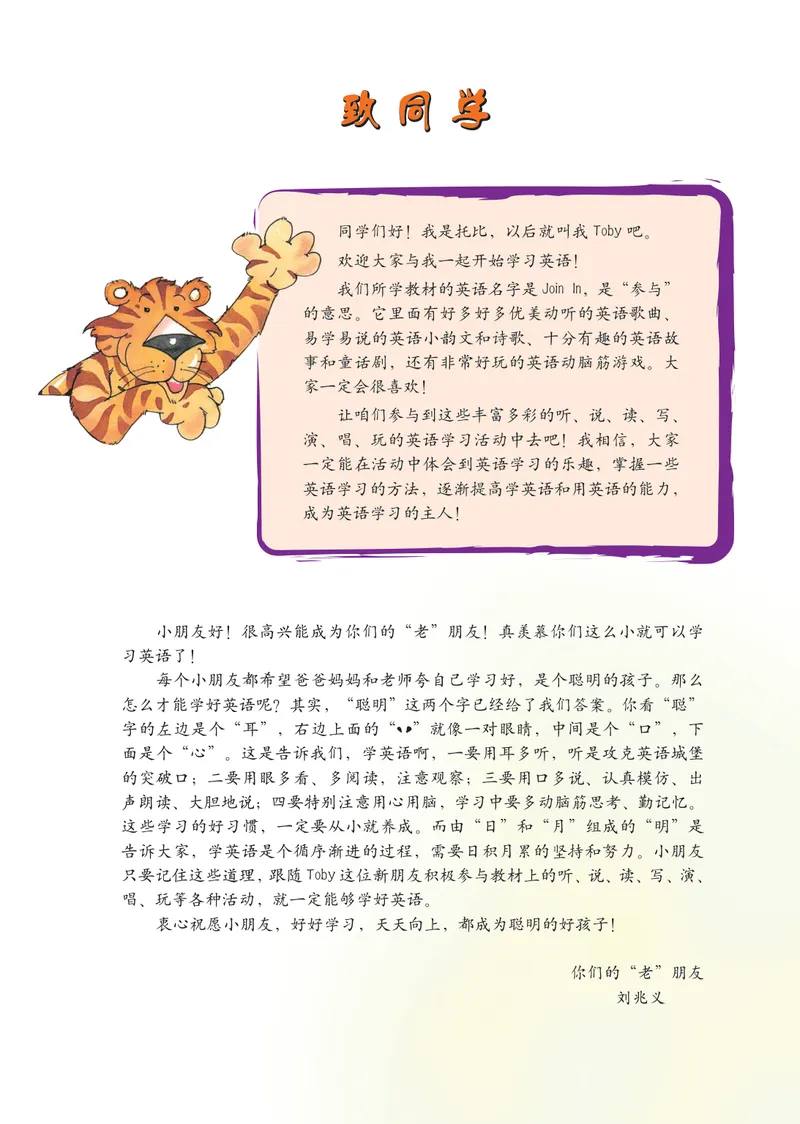
同学们好!我是托比,以后就叫我Toby吧。
欢迎大家与我一起开始学习英语!
我们所学教材的英语名字是Join In,是“参与”
的意思。它里面有好多好多优美动听的英语歌曲、
易学易说的英语小韵文和诗歌、十分有趣的英语故
事和童话剧,还有非常好玩的英语动脑筋游戏。大
家一定会很喜欢!
让咱们参与到这些丰富多彩的听、说、读、写、
演、唱、玩的英语学习活动中去吧!我相信,大家
一定能在活动中体会到英语学习的乐趣,掌握一些
英语学习的方法,逐渐提高学英语和用英语的能力,
成为英语学习的主人!
小朋友好!很高兴能成为你们的“老”朋友!真羡慕你们这么小就可以学
习英语了!
每个小朋友都希望爸爸妈妈和老师夸自己学习好,是个聪明的孩子。那么
怎么才能学好英语呢?其实,“聪明”这两个字已经给了我们答案。你看“聪”
字的左边是个“耳”,右边上面的“ ”就像一对眼睛,中间是个“口”,下
面是个“心”。这是告诉我们,学英语啊,一要用耳多听,听是攻克英语城堡
的突破口;二要用眼多看、多阅读,注意观察;三要用口多说、认真模仿、出
声朗读、大胆地说;四要特别注意用心用脑,学习中要多动脑筋思考、勤记忆。
这些学习的好习惯,一定要从小就养成。而由“日”和“月”组成的“明”是
告诉大家,学英语是个循序渐进的过程,需要日积月累的坚持和努力。小朋友
只要记住这些道理,跟随Toby这位新朋友积极参与教材上的听、说、读、写、演、
唱、玩等各种活动,就一定能够学好英语。
衷心祝愿小朋友,好好学习,天天向上,都成为聪明的好孩子!
你们的“老”朋友
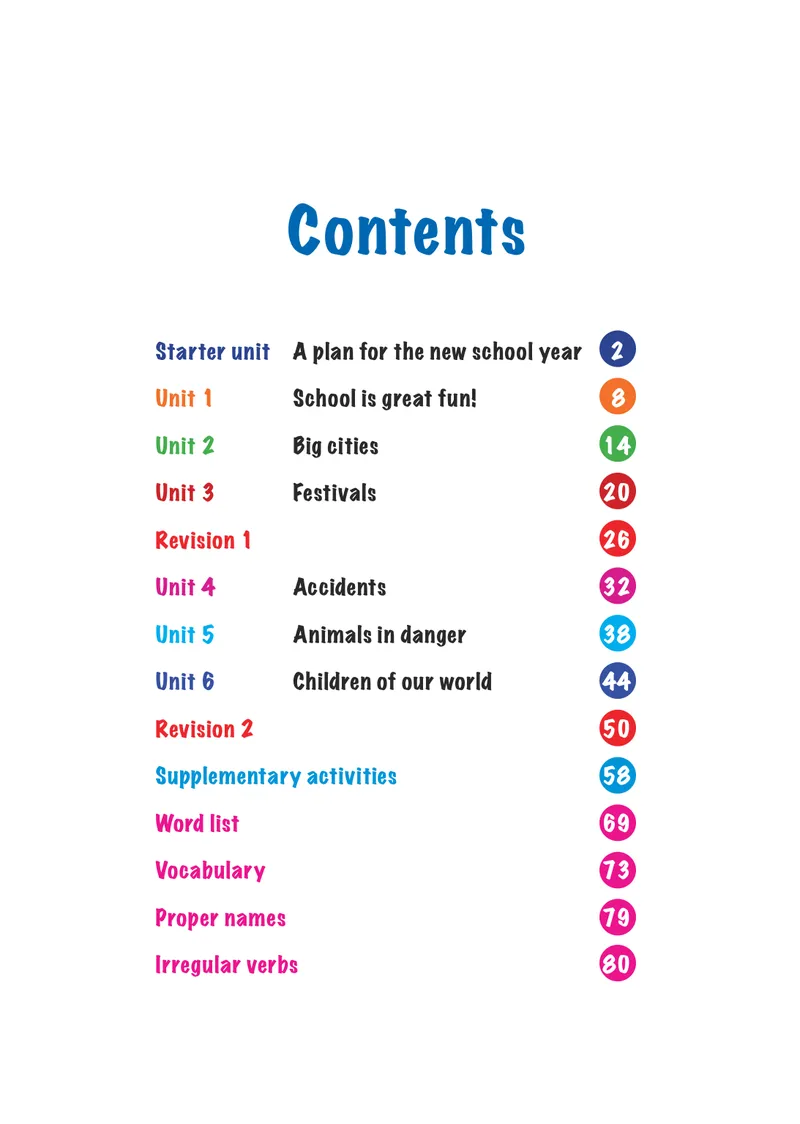
刘兆义Contents
Starter unit A plan for the new school year 2
Unit 1 School is great fun! 8
Unit 2 Big cities 14
Unit 3 Festivals 20
Revision 1 26
Unit 4 Accidents 32
Unit 5 Animals in danger 38
Unit 6 Children of our world 44
Revision 2 50
Supplementary activities 58
Word list 69
Vocabulary 73
Proper names 79
Irregular verbs 80Starter
A plan for the new school year
unit
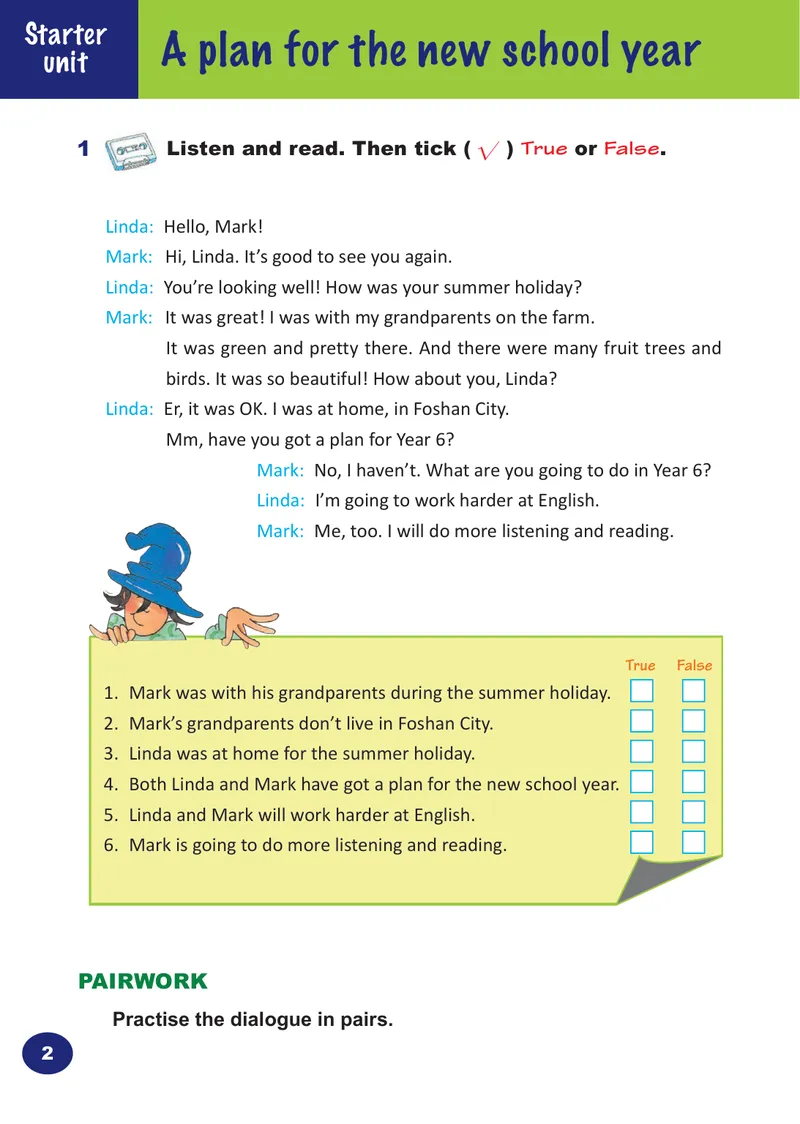
1 Listen and read. Then tick ( ) True or False.
Linda: Hello, Mark!
Mark: Hi, Linda. It’s good to see you again.
Linda: You’re looking well! How was your summer holiday?
Mark: It was great! I was with my grandparents on the farm.
It was green and pretty there. And there were many fruit trees and
birds. It was so beautiful! How about you, Linda?
Linda: Er, it was OK. I was at home, in Foshan City.
Mm, have you got a plan for Year 6?
Mark: No, I haven’t. What are you going to do in Year 6?
Linda: I’m going to work harder at English.
Mark: Me, too. I will do more listening and reading.
True False
1. Mark was with his grandparents during the summer holiday.
2. Mark’s grandparents don’t live in Foshan City.
3. Linda was at home for the summer holiday.
4. Both Linda and Mark have got a plan for the new school year.
5. Linda and Mark will work harder at English.
6. Mark is going to do more listening and reading.
PAIRWORK
Practise the dialogue in pairs.
2Starter
unit
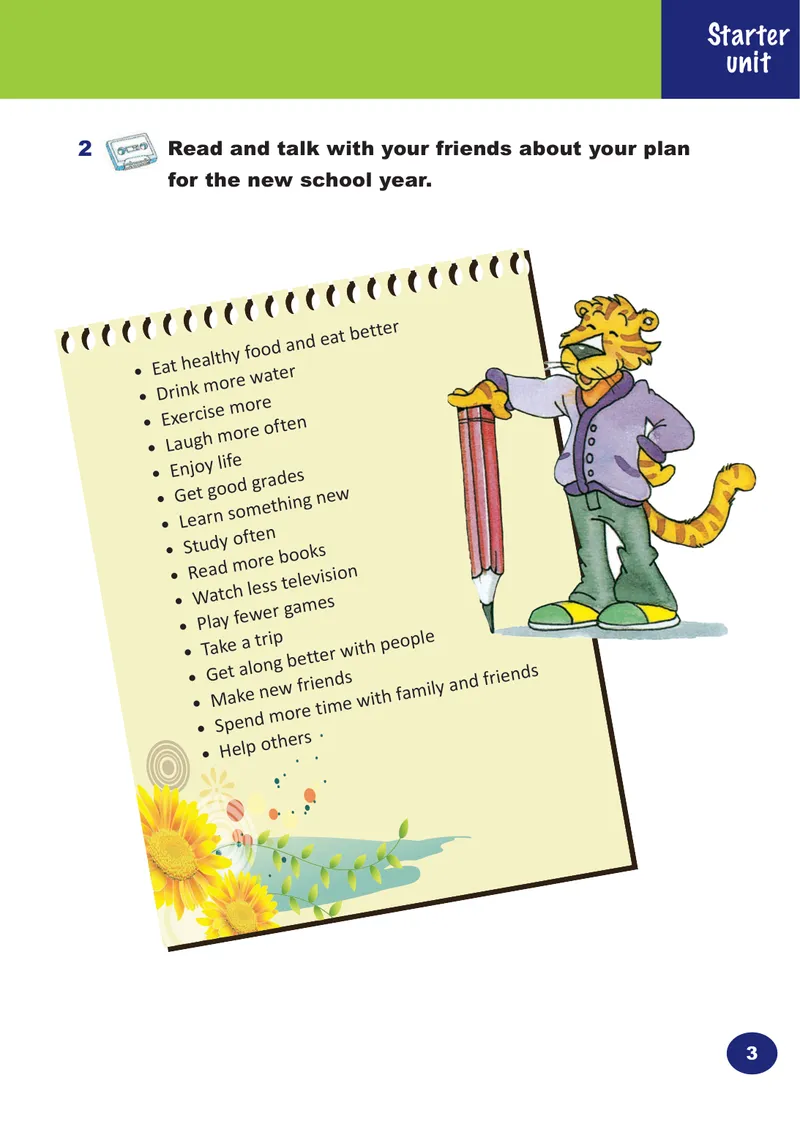
2 Read and talk with your friends about your plan
for the new school year.
• • • • E D E a L r t x a i e n h u r k e g c a h i m s l e t m o h m r y o e r o f e w o r o e a o d t f e t a e r n n d
eat
better
• • • E G L n e e jo t a y r g n o li o f s e o d m gr e a t d h e in s g new
• • • • S R t W P e u l a a d a d t y y c m o h fe f l o w t e e r s e e n s r b t g e o a l o m e k v e s is s ion
• • • • T G a M S e k p e a t e k a a n e l o d t n r n i m e p g w o b r e f e r t i t e t e i n m r d w e s i w th it p h e f o a p m le ily and friends
•
Help
others
3Starter
A plan for the new school year
unit
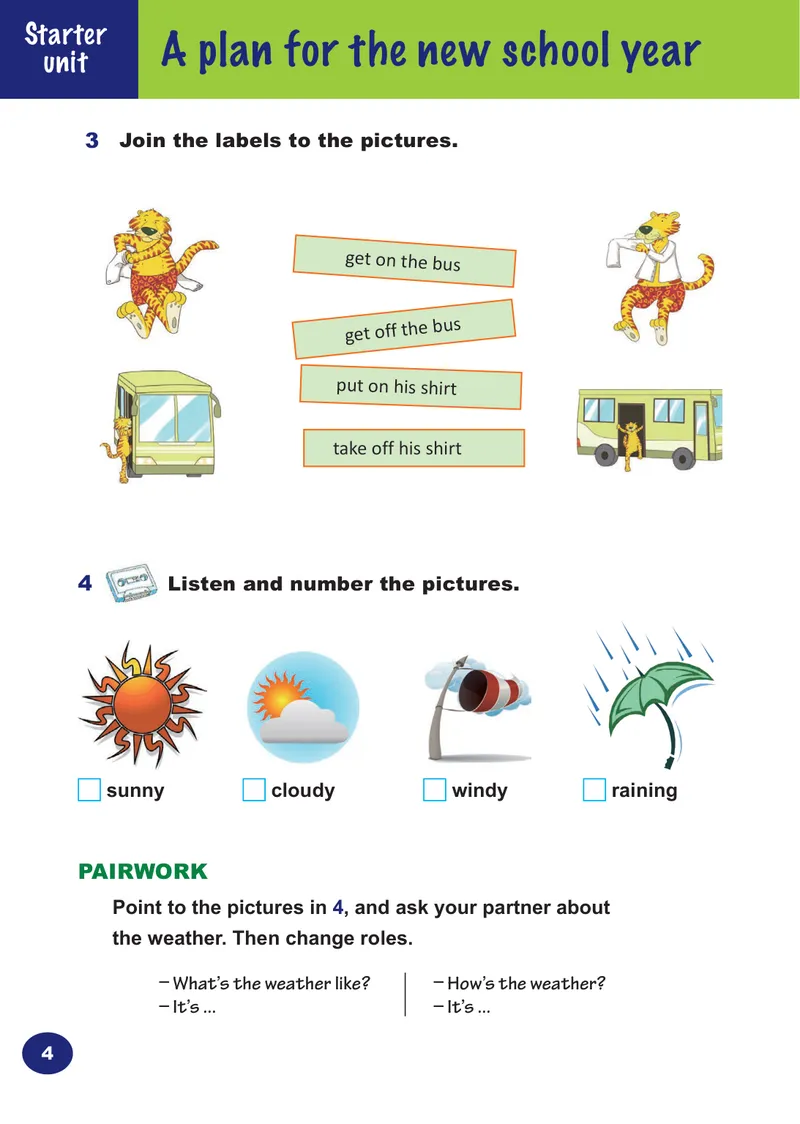
3 Join the labels to the pictures.
get on the bus
get off the bus
put on his shirt
take off his shirt
4 Listen and number the pictures.
sunny cloudy windy raining
PAIRWORK
Point to the pictures in 4, and ask your partner about
the weather. Then change roles.
_ _
What’s the weather like? How’s the weather?
_ _
It’s ... It’s ...
4Starter
unit
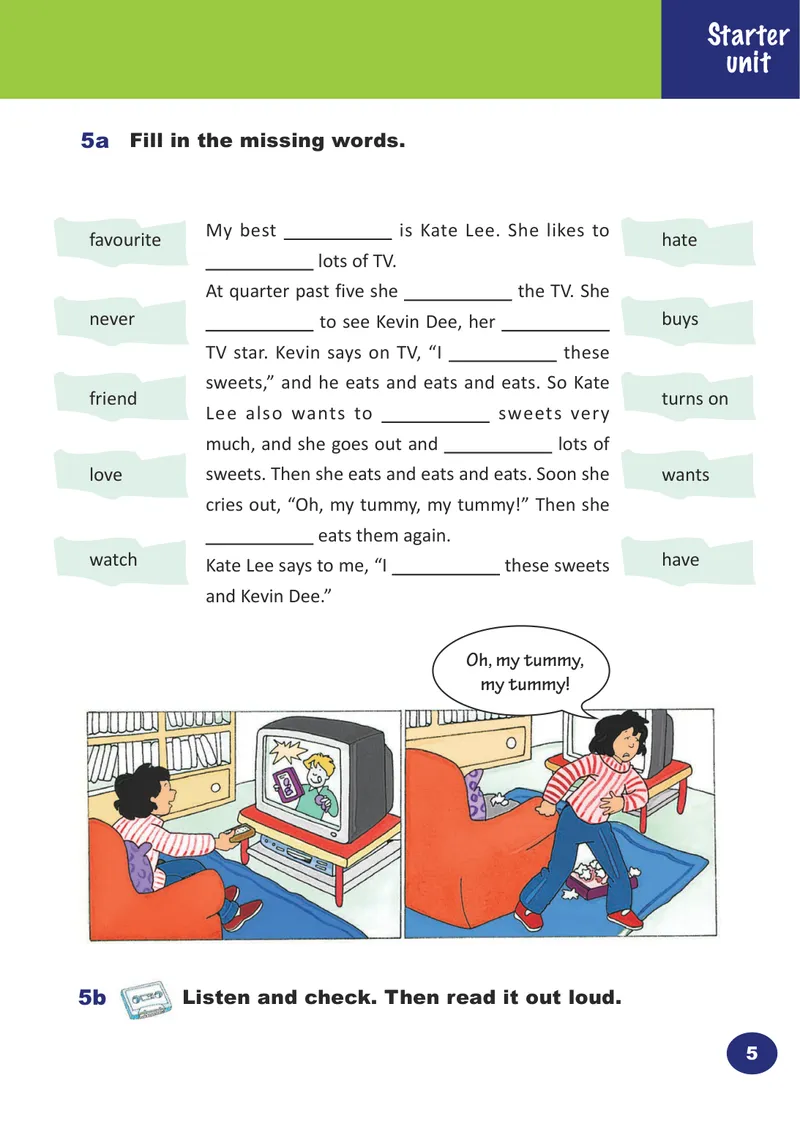
5a Fill in the missing words.
My best is Kate Lee. She likes to
favourite hate
lots of TV.
At quarter past five she the TV. She
never to see Kevin Dee, her buys
TV star. Kevin says on TV, “I these
sweets,” and he eats and eats and eats. So Kate
friend turns on
Lee also wants to sweets very
much, and she goes out and lots of
love sweets. Then she eats and eats and eats. Soon she wants
cries out, “Oh, my tummy, my tummy!” Then she
eats them again.
watch have
Kate Lee says to me, “I these sweets
and Kevin Dee.”
Oh, my tummy,
my tummy!
5b Listen and check. Then read it out loud.
5Starter
A plan for the new school year
unit
6 Read and fill in the numbers on the map.
1. The tourist office is in the park.
2. The police station is beside the post office.
3. The school is opposite the police station.
4. The phone box is beside the museum.
5. The church is opposite the park.
6. The bus stop is opposite the museum.
7. The fruit shop is beside the train station.
8. The hospital is opposite the train station.
6Starter
unit
7 Read and number. Then listen and check.
1. Excuse me, where’s the post office?
Go straight ahead. Then turn right.
Thank you.
That’s OK.
2. Excuse me, where’s the hospital?
Turn left and then left again.
It’s on the left side of the street.
Thank you.
3. Excuse me, where’s the museum?
Go straight ahead. It’s on the left, opposite the park.
Thank you.
That’s all right.
4. Excuse me, where’s the cinema?
Turn left and it's on the right. It’s next to the church.
Thank you.
That’s OK.
8 Make a dialogue. Put the sentences in the correct
order. Then listen and check.
Sorry, but where’s the supermarket?
Thank you. Bye-bye.
1 Excuse me, where’s the new cinema?
Bye-bye.
The new cinema? That’s easy. It’s opposite the supermarket.
Turn left, then right. You can see it.
PAIRWORK
Work in pairs. Practise the dialogues in 7 and 8.
7Unit
School is gre at fun!
1
1 Answer the questions.
1. Which school do you go to?
2. How many pupils are there in your class?
3. How many subjects do you have at school?
4. What is your favourite subject?
2a Read about Lake School.
SCHOOL IS GREAT FUN!
By Mary Chen
I come from China. I go to Lake School on North Island.
In our class there are 23 pupils: 12 girls and 11 boys.
This year we will have two new subjects, Drama and History.
Ms Howard will teach us Drama. I am her fan.
Mr Washington will teach us History.
We all love sports. Most pupils in our class like
pop music. Four boys and two girls have pets.
Our classroom is great. We like our teachers.
School is great fun!
8Unit
1
2b Listen and read again. Tick ( ) True or False.
True False
1. Mary is a Chinese girl, but she isn’t in China now.
2. There are 46 pupils in Mary’s class.
3. All the pupils in the class like sports.
4. Not many pupils in the class like pop music.
5. Half of the boys have got pets.
6. Mary has a great time at Lake School.
GROUPWORK
Ask and answer questions about Mary Chen.
1. Which school does Mary Chen go to?
2. How many pupils are there in Mary’s class?
3. What new subjects will she have this year?
4. What does she write about her Drama teacher?
5. Do the pupils like their teachers?
3 Listen and learn the words for school subjects.
Chinese Maths English Science Music Art
History PE Drama French Geography ICT
PE = Physical Education
*
* ICT = Information and Communication Technology
9Unit
School is gre at fun!
1
4a Listen and fill in the days.
Kevin and Christine are in the
same class in Hove, in the
south of England.
Monday
1st French 1st lesson 8:55 — 9:55 1st Maths
2nd Physical Education 2nd lesson 10:00 — 11:00 2nd History
3rd Music 3rd lesson 11:15 — 12:15 3rd Art
4th English 4th lesson 1:00 — 2:00 4th Drama
5th History 5th lesson 2:15 — 3:15 5th English
1st Physical Education 1st Geography 1st Geography
2nd French 2nd Science 2nd Information and
3rd Maths 3rd Art Communication Tech.
4th English 4th Music 3rd Drama
5th Science 5th Science 4th English
5th Maths
4b Play the game. Guess what day it is.
They’ve got French and History.
It’s Monday.
10Unit
1
5 Read and guess. What are their favourite subjects?
Then write out the words.
I often listen to
I love drawing pictures.
classical music.
I like working with
I love sports and games.
numbers.
I love China. I like I love working
learning its language. with my computer.
l often go to the I love plays.
Science Museum. They are great fun.
PAIRWORK
Ask and answer.
1. What subjects do the children in 5 love?
2. What do they often do?
3. What do they like doing?
Alison loves Music. She often listens to classical music.
11Unit
School is gre at fun!
1
6a Read. Then listen and repeat.
In my English class there are twelve
pupils: eight girls and four boys.
Our teacher's name is Mrs Blasco.
She is a very nice teacher.
English is my favourite subject.
I like reading stories and listening to
cassettes best.
Sandra
This year my favourite day at school is
Thursday. We have got History, English,
Maths and PE. I like History very much.
Our History teacher is very nice.
In English, I like singing songs and playing
games best. English is great fun!
Mario
6b Read again. Then complete the sentences.
1. Sandra got black hair. English is favourite subject.
She reading stories and listening to cassettes best.
2. Mario got brown eyes. Thursday is favourite day at school.
He History very much. History teacher is very nice.
In English, he singing songs and playing games best. He
English is great fun!
12Unit
1
7a Read and tell what Mario likes doing in English.
singing songs.
working in groups.
practising dialogues.
In English, I like learning new words.
saying chants.
reading stories.
watching cartoons.
acting in plays.
Practice makes
perfect.
7b Talk in class.
What do you like doing in English?
8 Write your own timetable in English.
Monday Tuesday Wednesday Thursday Friday
1st
2nd
3rd
4th
5th
6th
13Unit
Big cities
2
1a Listen and point.
the Great Wall the Palace Museum
Tower Bridge the London Eye
the White House the Smithsonian Castle
1b Listen and match.
1. Beijing is the capital of the UK.
2. London is 1 the capital of China.
3. Washington DC is the capital of the US.
14Unit
2
1c Listen and read.
Beijing is in the north of China. It is
the capital of the country. There are
many interesting places in Beijing.
The Great Wall and the Palace
Museum are the most popular.
London is the capital of the UK. The
city is full of history and culture.
The British Museum, Tower Bridge,
Big Ben and the London Eye are
great fun to visit!
Washington DC is the capital of
the US. It is home to the famous
White House and the Smithsonian
Museums. You can feel the history
and culture of the country here.
15Unit
Big cities
2
2 Emma is in London. Match the pictures with the
postcards.
Dear Mike,
Guess where we are today.
We are looking at the Palace. Mike Davis
The Queen lives there. 136 Sandyard Road
She's not at home today. Manchester
Tomorrow we'll be back in Ml6 ORA
Manchester.
Love,
Emma
Dear Mike,
It´s great!
There are so many big shops.
There are lots and lots of
Mike Davis
people. Guess where we are
at the moment.
136 Sandyard Road
Manchester
Love, M16 ORA
Emma
Dear Mike,
I like it here! Today we´re in
the middle of London. We´re Mike Davis
walking around Hyde Park. 136 Sandyard Road
It's so big. Next we are going Manchester
to Big Ben and Tower Bridge. M16 ORA
Love,
Emma
16Unit
2
3a Read and learn.
First look at the map. Emma and her parents are on Regent Street, where it
meets Oxford Circus. They want to walk to the National Gallery.
go straight ahead
take the third left take the third right
take the second left take the second right
take the first left take the first right
Emma, her dad and her mum ask for directions.
3b Who gets the correct answer? Listen and tick ( ).
correct answer wrong answer
Emma’s mum
Emma’s dad
Emma
N
W E
S
17Unit
Big cities
2
4a Look at the photo and do the New York quiz.
1. Is New York one of the biggest cities in the world?
2. Is it the capital of the US?
3. Is New York a city by the sea?
4. Are there many tall buildings in the city?
5. Do you think this photo of New York is new or old? Why?
4b Read and check.
New York City is a busy city by the sea in the
US. It is also one of the biggest cities in the
world. The twin towers in the photo were the
tallest buildings in the city. But they were hit
by two planes and fell down in 2001.
World
Trade
Centre
18Unit
Festi vals
3
1 Read the texts about festivals. Then listen and repeat.
Mid-Autumn Festival
The 15th day of the Chinese lunar August is a very important
festival in China. It’s Mid-Autumn Festival.
On this day, the moon is full and bright.
Families get together and eat moon cakes.
People far from home look up at the
moon and think about their families.
Thanksgiving
The fourth Thursday in November is a holiday
in the USA. It’s Thanksgiving.
On this day, families get together and have a
big dinner. People usually eat turkey, sweet
potatoes and other vegetables.
Many people will meet in
the streets and enjoy their
holiday together. Everybody
has fun!
20Unit
3
2 Read the story and find out more about Thanksgiving.
It is 1620.
The Mayflower lands in The people on the It is winter.
America. The ship comes Mayflower are looking The people from England
from England. for a new home. are cold and hungry.
Native Americans help They show them how to They show them how to
them to build houses. hunt for wild turkey. catch fish.
Later, when it's warm The people want to thank They invite the Native
again, they show them the Native Americans and Americans. They call
how to plant corn. have a big party. their party Thanksgiving.
21Unit
Festi vals
3
3a Listen and read the text.
Halloween
On 31st October, children in Britain and the USA dress up as witches,
monsters or ghosts. They go from house to house and ring the doorbell.
When the door opens, they call out, “Trick or treat.”
Most people give the children a treat, often chocolates or other sweets.
Some people don’t give the children anything. Then the children play a
trick. They come back, ring the doorbell again and run away.
3b Answer the questions.
1. When is Halloween?
2. How do the children dress up?
3. What do the children do then?
4. What do they say when the door opens?
5. What do people usually do?
3c Read the text again. Then put the sentences in the
correct order.
What do the children do on Halloween?
They ring the doorbell.
When the door opens, they call out, “Trick or treat.”
They get some chocolates or other sweets.
1 They dress up as witches or ghosts.
They go from house to house.
2222Unit
3
4 Listen and sing the song.
Halloween song
Give us a treat, (oh, yeah).
Give us a treat, (oh, yeah).
Give us a treat or Who’s there?
We’ll play a trick on you!
It’s trick or treat, (oh, yeah). Who’s that?
It’s trick or treat, (oh, yeah).
It’s trick or treat, or
We’ll get you, too!
It’s us. The
witches,
It’s us.
It’s the last night of October. monsters and
the ghosts.
We knock on every door.
But sometimes people lock us out
And then they can hear us shout:
Give us a treat, (oh, yeah).
Give us a treat, (oh, yeah).
Give us a treat or
We’ll play a trick on you!
It’s trick or treat, (oh, yeah).
It’s trick or treat, (oh, yeah).
It’s trick or treat, or
We’ll get you, too!
monster ghost witch
2233Unit
Festi vals
3
5 A story — A surprise.
Ring the doorbell,
Hi, Emma.
Mike.
Hi, Sarah. Trick or treat.
Hi, Mike and OK. Trick or treat.
Patrick.
Here you are, Half an hour later Five minutes later
children.
Let me see
what you've got. Chocolates,
sweets and lots
of peanuts.
Now let's go to It's dark.
Mr Pearson's house.
There's nobody
Oh, great! Thank you. at home.
Look! There's a light That's strange.
on upstairs. There's a ladder.
Come here!
And the window
upstairs is open.
2244Unit
3
We're at 29 Bridge Street.
Ten minutes
What can we do?
There's nobody at home,
later
but there's an open window
at the back.
And there's a ladder.
I've got Dad's
mobile phone!
OK, children.
Let's call
Your names and
the police.
OK. addresses, please.
We'll check it out.
Thank you.
Go home now, please.
Police!
Come down!
Look!
Good evening, officer! Hello, detectives.
I left my key Have a treat.
in the house and locked Well done,
myself out. children.
Oh, it's
Thank you,
Mr Pearson!
Mr Pearson.
22551
26
NOISIVER
GROUPWORK
1 Discuss questions about school in groups.
1. Which school do you go to? 6. Who teaches you Maths?
2. Which class are you in? 7. Who does best in Maths in your class?
3. How many pupils are there 8. Do you like reading?
in your class? 9. What do you often do in English?
4. What subjects do you have? 10. Do you think school is great fun?
5. What subject do you like best?
I like English best. We often listen
to recordings and read in English.
School is great fun!
2 Read the words. Then circle ( ) in matching colours.
subjects places festivals foods numbers
Art capital third potato
vegetable first Maths cinema
crayons
Christmas fish Science sweets
classroom museum corn train station
Halloween PE second Thanksgiving
fourth supermarket Music Spring Festival1
27
NOISIVER
3a Find their favourite days.
Science is my favourite
subject. I also like singing
and drawing.
I like working with
computers and I like
working with numbers.
I also like drawing.
I like sport.
I love the theatre.
Football is my
I also like reading.
favourite.
Monday Tuesday Wednesday
1st Chinese 1st Geography 1st Science
2nd English 2nd ICT 2nd Chinese
3rd Maths 3rd Drama 3rd Music
4th PE 4th Reading 4th Art
5th PE 5th Science 5th Maths
Thursday Friday
1st History 1st History
2nd Reading 2nd Maths
3rd Science 3rd Music
4th English 4th ICT
5th Chinese 5th Art
3b Answer the questions.
What lessons do they have on Wednesday?
What lessons do they have on Thursday?1
28
NOISIVER
4a Listen and read. Then number the pictures.
_ _
1 Excuse me, where’s the 2 Excuse me, where’s the
park, please? police station?
_ _
Go straight ahead. Take the first right.
_ _
3 Excuse me, where’s the 4 Excuse me, where’s the
supermarket? cinema?
_ _
Go ahead. Then take the Go straight ahead. Take the
second left. third right.
_
_ 6 Excuse me, where’s the
5 Excuse me, where’s the
museum?
No. 1 Hospital?
_
_ Go straight ahead. Then take
Take the first left.
the second right.
4b Fill in the place names.
park1
29
NOISIVER
5 What’s wrong? Correct the sentences and write
them in your notebook.
1. The Mid-Autumn Festival is always in August.
2. The moon is full and bright at Halloween.
3. Thanksgiving is the fourth Thursday in December.
4. People usually eat a very simple meal at Thanksgiving.
5. On 31st October, children in Britain and the USA dress up
as animals and go from house to house.
6. Most people give the children bananas at Halloween.
6 Read and tick ( ) True or False.
Sydney is not the capital of
Sydney Opera House
Australia, but it is the biggest
city of the country. It is also the
most beautiful city in Australia. It
has got lots of interesting places
to visit. Sydney Opera House
is the most popular. Sydney is
famous for this opera house and
the 2000 Summer Olympic Games.
True False
1. Sydney is the biggest city in Australia.
2. Sydney is the capital of Australia.
3. Sydney is a very beautiful city.
4. There aren’t many good places to visit in Sydney.
5. Sydney Opera House is famous around the world.1
30
NOISIVER
7a Listen to the six questions. Then number the
answers.
London is the capital of the UK.
They will go and visit Tower Bridge and the London Eye.
1 Shanghai is the biggest city in China.
They usually eat turkey, sweet potatoes and other vegetables.
It is in the south of England.
They are looking for a new home.
7b Listen and check. Then read.
PAIRWORK
Read the sentences to your partner. Then change roles.
8 Tick ( ) the words which go together. Then read
all the expressions.
milk the teacher music the bike potatoes
listen to
get on
get off
drink
eat1
31
NOISIVER
9a Listen and read Xiao Yu’s composition.
Today’s Shenzhen
I live in Shenzhen, a city by the sea.
It is clean and beautiful. It is also
a busy city. There are many tall
buildings in the city. Kingkey 100
is the tallest. It is over 440 metres
high. I love my home city!
Yesterday’s Shenzhen
But more than 30 years ago, it was
a very small town. There were only
some small shops in the streets.
There were not any tall buildings.
Most people were fishermen. Life
was hard at that time.
9b Read again and then answer the questions.
1. Is Shenzhen a beautiful city by the sea?
2. Are there many tall buildings in Shenzhen?
3. Was it a big city more than 30 years ago?
4. Were there any tall buildings at that time?Unit
Accidents
4
1 Look, listen and read.
When I was eight, I had an accident
with my bike. I broke my leg and my
right arm. I was in hospital for four
weeks.
Joel
Last year I was on holiday with my
parents. One day I went swimming.
I cut my foot on a broken bottle.
My mum put a bandage round it.
Joseph
2 Fill in he or his. Then read and check.
1. When Joel was eight, ____ had an accident with ____ bike.
____ broke ____ leg and ____ right arm. ____ was in hospital for four weeks.
2. Last year Joseph was on holiday with ____ parents. One day ____ went
swimming. ____ cut ____ foot on a broken bottle.
PAIRWORK
Ask and answer.
Did Joel have an accident Yes.
when he was eight?
Did he break his left arm? No. He broke his
right arm.
32Unit
4
3a Look at the pictures. Put the sentences in the correct
order.
The man broke his right leg.
They called the police.
The children went to Mr Snow’s house.
They put the ladder away.
The man wanted to get down the ladder.
They found a ladder in his garden.
The police came quickly.
The children and the police saw a man at the window.
He fell from the window.
3b Listen and check.
3c Listen again and read.
PAIRWORK
Point to the pictures and tell your partner the story. Then change
roles.
33Unit
Accidents
4
4 Listen and sing the song.
Take care
Listen, everybody
To what I have to say.
Listen well
And keep to these rules.
Hey, hey!
Take care when you ride your bike.
Wear your helmet so that you’re safe.
Take care when you rollerblade.
Don’t forget to put on your pads.
Listen, everybody
To what I have to say.
Listen well
And keep to these rules.
Hey, hey!
There’s another thing I want to say.
Please remember to put on your belt
When you ride in a car.
Oh, yeah!
And look left and right in the street.
Listen, everybody
To what I have to say.
Listen well
And keep to these rules.
Hey, hey!
34Unit
4
5 A story — Bad luck for Tony.
Welcome.
This is a lovely campsite.
Here's your key.
Let's stay here
for a while.
Yes, let's do that.
The beach looks great
for snorkelling.
Several days later Half an hour later Oh, no!
There's blood
I'm going on your foot.
down to the beach.
I cut my foot
down at the beach.
OK.
Let me see. Excuse me,
It's a deep cut. Here's a bandage. is there a doctor
You need a doctor. in the village?
Ouch, that
hurts!
The people in the village
didn't understand English.
3355Unit
Accidents
4
Excuse me,
is there a doctor
in the village? No, there isn't,
but there is one in
the next village.
I can come
Finally Tony's dad finds a boy
with you
and a girl who speak English. That's
and show you.
very kind.
Your cut needs That's all right.
five or six stitches. Was it bad?
It will hurt.
Thank you,
doctor.
No swimming
Well ...
for a week, OK?
OK.
Two weeks later
Don't forget
to write.
No, I won't.
Tony couldn't go snorkelling,
but he wasn't unhappy. The boy
and the girl from the village often came See you again
and played games with him. next year.
36Unit
4
6 Complete the dialogues. Then listen and check.
Doctor: What’s the matter with you? Doctor: What’s the matter with you?
Sue: My knee hurts. Peter:
Doctor: What’s the matter with you? Doctor: What’s the matter with you?
Liz: Tony:
7 Read the safety poster. Then design your own safety poster.
37Unit
Animals in danger
5
1 Listen, read and guess what animals they are.
It has got four legs. It has got four legs.
It has got a long nose. It eats grass.
It’s a very big animal. It lives on a farm.
It lives in Africa and Asia. It gives us milk.
It has got four legs. It has got four legs.
It eats other animals. It eats grass.
Its fur is white. It lives on a farm.
It lives in the Arctic. People ride it.
It has got four legs. It has got four legs.
It eats other animals. It eats grass.
It’s smaller than a tiger. It’s smaller than a sheep.
It lives in Africa and Asia. Foxes like to eat it.
GROUPWORK
Play the guessing game.
Has it got four legs? Yes.
Does it eat other animals? No.
Does it live on a farm? Yes.
Is it a cow? No.
Is it smaller than a horse? No.
Is it a horse? Yes.
38Unit
5
2 Listen and read. Then choose the best answer.
The kingfisher
Kingfishers are beautiful birds. They live in many
countries of the world. They eat small fish.
Kingfishers are in danger. The water in many
rivers is dirty. There are no fish in them, so there
is no food for the kingfishers. There is also
another problem. Kingfishers build their nests in
holes in riverbanks. When people change the
rivers and build new riverbanks, there is no quiet
place for birds to make holes for their nests.
1. The kingfisher is ________.
A. a very big fish B. a small fish C. a bird
2. The kingfisher eats ______.
A. small fish B. big fish C. small birds
3. Kingfishers _____ in holes in riverbanks.
A. catch fish B. build their nests C. eat their food
3 Look at the animals in danger below. Try to find out
why they are in danger.
39Unit
Animals in danger
5
4 A story — The kingfishers.
There are no Let's find out
about kingfishers
kingfishers this year.
on the web.
Why not?
I don't know.
The water is OK.
There are lots of fish. Good idea!
Ah, here it says how Where
we can help the kingfishers. are you going?
Right. They need To the river.
holes in riverbanks We want to help
to make nests. the kingfishers.
Why don't you come
Let's start
and help us?
digging here.
No, that's
boring.
OK.
See you.
40Unit
5
Let's make Five hours later
the hole for
That was
the nest here.
a lot of work.
Yeah.
All right.
Do you think Three months later
the kingfishers
Who is
I think so.
will come here,
that behind
It's a quiet place.
Emma? the bush?
I think it's
Emma
and Mike.
Let's not
tell anyone.
OK.
Wow,
baby birds.
Aren't they sweet?
What are you
doing here?
Be quiet and
have a look.
41Unit
Animals in danger
5
5 Listen and read the posters.
Let’s
help
pandas!
The
panda lives in
China.
It eats
bamboo.
It has
beautiful fur.
I
P
t
e
is
o p
b
l
l
e
ac
a
k
r o
a
u
n
n
d
d
w
t
h
h
i
e
te
w
.
orld love
pandas.
But they are in great
danger.
Let’s join in to help them.
Save China’s tigers!
We all know Toby the Tiger and love him.
But do you know the South China Tiger?
The South China Tiger lived in many parts of China.
But people can only see them in the zoo today.
Let’s help to save China’s tigers!
42Unit
5
6 Listen and read. Then tick ( ) True or False.
The black rhino lives in East Africa. It eats
The black rhino
fruit and leaves. The black rhino is not black.
It is grey. Why is it called black?
Black rhinos love mud and they often take
baths in the mud. When they come out, they
look black. People kill rhinos and sell their
horns. Then other people make medicine out
of the horns and get a lot of money for it.
They say this medicine helps when you are
ill, but that is not true.
True False
1. Black rhinos live in East Africa.
2. Black rhinos eat fruit and other animals.
3. The black rhino looks black, but it is not black.
4. The black rhino likes taking baths in mud.
5. Black rhinos are in danger.
7 Look at the pictures. Tell your partner what Li Ping did last
Saturday and what he didn’t do. Then change roles.
went to the went to the played played watched watched
zoo cinema basketball football cartoons sports
x x x
43Unit
Children of our world
6
1a Listen and read.
I’m Carlos. I live in Recife in Brazil.
I get up at half past seven every day.
Before I go to school, I feed my fish.
My fish are beautiful. They are very
precious to me.
I’m Ana. I’m from Tucuman, Argentina.
I love music. I have lots of CDs.
Sometimes some friends come to my place
and we listen to my CDs together. That’s great
fun! My CD player is my most precious thing.
1b Read again and match. Then read the sentences.
Carlos is listening to CDs.
Carlos enjoys precious to him.
Carlos’s fish are from Brazil.
Ana is feeding fish.
Ana enjoys precious to her.
Ana’s CD player is from Argentina.
44Unit
6
2 Read and match. Fill in the numbers. Then listen
and check.
1. Tom’s precious things are his books. It was his grandfather’s.
2. Sue’s precious things are her stamps. It is so cute!
3. Bill’s precious thing is his TV. He loves reading.
4. This old watch is precious to Carl. She often looks at them and thinks
5. Lily’s precious thing is her dog. back to the things in the past.
6. Granny’s precious things are her She has got more than 300.
old photos. He likes watching sports and cartoons.
3 Listen to the interviews. Then answer the questions.
Who ...?
Erica Jeff
loves playing the guitar.
is from London.
goes to the photo club.
wants to play in a band.
has a camera.
gets up at half past seven.
plays the guitar every afternoon.
loves taking photographs.
walks to school with a group of friends.
sometimes makes music.
45Unit
Children of our world
6
4a Listen and read. Then match the photos with
the texts.
S u h a t S a j p h o e l o a s m r e b o m a s r m s c t . w f s h Th h e s h o h a o i e a t x e a e d o h a n d r s l o d e e . s ' r t i c I i l h h s n s o l i e o n e v n t h c i w e o c s t e k s h h e o r b l e l i i l e o c c n v d a g o k l e e a r a t e k . r n s h r , n s S s d i e s h n s h o t e . o g h m e n A s p . e c o S l t b r o h i e h r v e e r o n e e h i a l o g i i s r i w n b l h n e i i r g t a d n s a f . n o i r v f t T t I y ' e t h c s n y r h n l e t d o y - e e o i t r c i i a w n a m k h r h . o s a S o p s S h v h a c o u h e e m h e r s e t a e i h s w a l . d g h g e n S a e a r o l t l p e h a t k o f s n d o s e s d . ' r s
home, so her books are precious things.
h t a s r h f u a w L t i a e r v d p t e e a e h e m n y e a s e h . t a t r o s i T e . n i . f n r s i A h S t v o e f o e o t e r y w o n m t . h o o m n L a L ' e w c e l l t e l f i G n n o i tt n m p a . c h l a a e S k e a h s i h s . s n t s a h e T a s o s v o e s h l i a e d n p e v r e d l . e e y n A l n r s r e u f s b m r L a n h i o m c e a h e y a n n a . s . s a g p O S t t a o p h a g r n s k y e e t e . e s a t i H s n s d w h o d t a e e h o n y r r b i r r f k s f a h t a r h n e i e u m n e e a r i g n n t i w b l . a a y w i S a s n k n n i h d e i t n t e h e . s e r S g t h u t d h h e o e n s e t e r s
4b Read and fill in the children’s names.
1. The child lives on a farm and has 2. The child’s family is very poor,
his lessons on TV in the morning. so the child cannot go to school.
NAME NAME
46Unit
6
Mark is from Western Australia. He is twelve. He lives
on a farm. The nearest town is 400 kilometres away, so
Mark cannot go to school. Every morning, he gets up
at eight o'clock. His lessons on TV start at nine. Mark
learns the same things as the children in town. Once a
month, his teacher comes to the farm and studies with
him. Mark helps his father a lot on the farm. Mark has
his own horse called Sprinter. In the afternoon he often
rides around the farm. He loves his horse very much.
J H C i H H m p o J h t e i w l e n e m i m a n a o g i y g t a m m y e l s o h u t f e s y o s i l t o u s o s h u u d n , t c e r t o p H r e c t w s e e e i s a d a a g e r e c t w m a n . n h l y h H v a a o y s . a i t e e o i H u e o l . . a f l r H f i r i e H b p s s s p i y a o i s m a e l s n a f g b p t y a o i o u t a s s i s . f h s n r e a t J . e e A v g i m I m p n e n m b i t r o n n m s e o t u . e h c c y t y S s r i e h a s o c A i w m ' e a c h u t m ft a a e A s e o s e a n e o t m t r b m h r o . l n i o e i c H s o H n r r a a t o n a g i t n e a c n r w i h a i t p n l s s n h i i a l s a v H a e i a n y i e s t f a a e f a c o s r n l w r t h w o o . i i i a o o n m t a n i b n o y e i . a s . a l . l l l
3. The child loves football and wants 4. The child loves books and learning,
to play in the national team. and dreams of a good job one day.
NAME NAME
47Unit
Children of our world
6
5a Listen and sing the song.
We are the children of this world
We're the children of this world.
We're the grown-ups of tomorrow.
Let's make the world a better place
Without poverty and sorrow.
Why don't you stop the wars
And build more schools?
How can we learn
To live together?
We want to listen
To each other.
We want to live
In peace forever.
We're the children of this world.
We're the grown-ups of tomorrow.
Let's make the world a better place
Without poverty and sorrow.
48Unit
6
5b Listen and repeat the sentences.
1. Why don’t you stop the wars and build more schools?
2. We want to listen to each other.
3. We want to live in peace forever.
GROUPWORK
Talk about yourself with each other.
My friends
My day
My good friend’s name is ... 4
I get up at ... 1
He / She is ... years old. 5
School starts at ... 2
We often ... together. 6
In the afternoon I often ... 3
My class
There are ... pupils in my class. 7 My hobbies
Most pupils like ... 8 I like / love ... 9
1 seven o’clock; half past seven; quarter to eight; quarter past eight ...
2 nine o’clock ...
3 play football; play with friends; read; listen to music ...
4 Tom; Mary; Yu Gang; Liu Yue ...
5 eleven; twelve; thirteen; fourteen ...
6 play table tennis; go swimming; go to the cinema; learn English ...
7 forty-eight; thirty-eight; fifty; fifty-two ...
8 English; pop songs; Art; PE ...
9 reading; singing; dancing; feeding fish; playing computer games;
collecting stamps ...
492
50
NOISIVER
GROUPWORK
1 Listen and tick ( ). Find the missing words.
hair head
eye
ear
nose
teeth
shoulder
arm
elbow finger
stomach
toe
leg
knee
feet
foot2
51
NOISIVER
2a Listen and tick ( ).
1. Where did the accident happen?
In Great Street. In Green Street.
2. What accident did Xiaogang have?
A car accident. A bike accident.
3. What problem did he have?
He broke his left leg. He broke his right arm.
4. Where is the hospital?
Behind our school. Beside our school.
2b Listen again and fill in the numbers. Then read.
He rode on the left of the street.
He fell off his bike and broke his right arm.
1 This morning Xiaogang went to work by bike.
The police took him to the hospital next to our school.
But he didn’t keep to the rules.
So he had an accident in Great Street.
3 Think and match. Then read and keep to the rules.
First look, on the right of the street.
Stop and wait then cross the street.
Ride your bike when the light is red.2
52
NOISIVER
4a Listen and read. Colour the frames.
cat panda rabbit
It’s black and white. It has got two long ears It has got bright eyes.
It eats bamboo. and a small mouth. It can see in the night.
It’s smaller than It eats grass, and it Its favourite food is fish.
the polar bear. eats vegetables, too. It likes eating mice, too.
It lives in China. It runs fast. Many people keep them
as pets.
4b Read and fill in the names of the animals.
1. The lives in China. It eats bamboo.
2. The likes eating fish. It likes eating mice, too.
3. The runs fast. It eats grass and vegetables.
4c Fill in bigger than or smaller than. Then read.
1. The panda is the polar bear.
2. The panda is the rabbit.
3. The rabbit is the polar bear.
4. The polar bear is much the rabbit.
It is the biggest of the three animals.2
53
NOISIVER
5 Can you find the two hidden animals? Write the first
letter of each word.
6 Listen and read.
A: Who’s the girl in the picture?
B: She’s Lena.
A: Lena looks lovely. Is she an American girl?
B: No, she isn’t. She’s from Africa. She’s thirteen.
A: Oh, she’s as old as me.
B: Yes, but she can’t go to school like you. Her family
is very poor, so she has to work every day.
A: She is only thirteen, and has to work? What does she do then?
B: She gets up at five o'clock in the morning and starts working with her father.
Then she rides into town and sells fruit in the streets.
A: Poor Lena! I think she wants to go to school very much!
B: Yes, she often dreams of studying at school! And she’s got another dream.
A: What is it?
B: She wants to have her own little shop one day.
PAIRWORK
Practise the dialogue with your partner.2
54
NOISIVER
7 Fill in the words in their correct forms. Then tell
your partner the reasons.
1. like or likes
Sam and I are music lovers. We often listen to music after school.
I _________ pop music, and he ________ country music.
2. go or goes
Mary and her parents all love travelling in the summer holiday.
Mary usually _______ to big cities, but her parents often _______
to small towns.
3. study or studies
Dick, Hill and Fanny are children from Canada. They are at the same
school. They _______ English and French at school. Fanny also
________ Chinese. She wants to work in China some day.
PAIRWORK
Ask and answer.
Does Mary usually go No, she doesn’t.
to small towns?
8a Listen and read the texts of 4a, Unit 6.
8b Read out the questions loud.
1. What’s your name? 2. How old are you?
3. Where are you from? 4. When do you get up?
5. What do you often do? 6. What is your dream?
PAIRWORK
Suppose you are Samshaad, Lena, Mark or Jimmy.
Ask each other the questions in 8b.2
55
NOISIVER
9 Match the sentences. Fill in the numbers.
1. Hakan’s most precious thing She loves his dark brown fur.
is a book.
2. Sergi’s most precious thing He has got two hundred.
is his TV.
3. Jakub’s most precious things She has got a new CD-ROM.
are his mask and his flippers.
4. Carmen’s most precious thing 1 He loves reading.
is her dog.
5. Pedro’s most precious things It’s made of gold.
are his stickers.
6. Christine’s most precious He loves watching sports and
thing is her necklace. cartoons.
7. Katya’s most precious thing is He loves the sea.
her computer.
10 Listen and read. Talk with your friends about
how you can help save the animal.
It is very difficult to see snow
leopards. They live up in the
mountains of the Himalayas.
The snow leopard has beautiful fur.
There is one big problem: people kill
snow leopards. They want to get the
beautiful fur and sell it.2
56
NOISIVER
11 Read the two posters. Then tick ( ) or cross ( ).
What do the posters want to say to people?
Poster 1 wants to say: Poster 2 wants to say:
X Super Bat can’t help the bats. Don’t keep wild animals as pets.
You can help Super Bat. Don’t keep pets in a cage.
Save the bats. The boy doesn’t want to live in a cage.
GROUPWORK
Make your own posters.
Protect
birds!
They need a home.
DON'T
KILL
WILD
ANIMALS!
Dogs are our friends.2
57
NOISIVER
12 Read the signs. Then match.
1. Don’t swim here.
2. Don’t turn left.
3. Don’t use your mobile phone here.
4. Don’t walk this way.
5. Don’t enter.
GROUPWORK
Discuss what we should say to them. Use: Don’t ...
He’s speaking on the phone They’re playing football
in the library. on the road.
She’s reading in the sun. They’re talking loud
on the bus.Unit
Supplementar y acti vities
1
1 Write the missing words.
Our English class
our class are
twenty-three : twelve girls
eleven boys.
year our is
Mrs Navarro. Most pupils in
class like .
Three collect stickers, four collect
and six football pictures.
pupils have .
Our classroom great and
like our teacher.
English In pupils This is pets pop music
Four
collect teacher there and our comics we
58Unit
1
2 My ideal timetable.
Look at the subjects on page 9 again. Then fill in your ideal timetable.
Monday Tuesday Wednesday Thursday Friday
st
1
nd
2
rd
3
th
4
th
5
th
6
3 Write sentences about the children.
likes doesn't like
using the computer
reading stories
Betty Bob
writing texts
listening to music
Jim
Ann
59Unit
Supplementar y acti vities
2
1 Write the missing words.
Mike,
are
!
It's
.
so many big
and lots of Mike Davis
There are
. Today we 136
Sandyard Road
where
Manchester
at the
lives.
M16 ORA
the
,
Emma
dear people queen great there palace
love lots shops are
2 Write the words.
turn left
take the second left
go straight ahead
take the first right
turn right
60Unit
2
3 Ask for directions. Write the dialogues.
Train Hotel
station
a
m Bus
e
Ci n stop
Post
office
Dialogue 1 Dialogue 2
Tourist: Excuse me, where is the Tourist: Excuse me, where is the
cinema? post office?
You: You:
Tourist: Thank you. Tourist: Thank you.
Dialogue 3 Dialogue 4
Tourist: Excuse me, where is the Tourist: Excuse me, where is the
hotel? train station?
You: You:
Tourist: Thank you. Tourist: Thank you.
61Unit
Supplementar y acti vities
3
1 Write the missing words.
The ...................... Thursday in November
is a ........................... in the United States.
It's .............................. . On this day,
all the ...................... of a family come
................................. and have a big dinner.
People usually eat .............................. ,
......................... ............................ and
other ............................. .
members together Thanksgiving holiday
sweet potatoes fourth turkey vegetables
2 Tick ( ) True or False.
True False
1. In 1720 the Mayflower lands in America.
2. The people on the Mayflower are looking for a new castle.
3. It is winter and the people from England are cold.
4. Native Americans help them to build houses.
5. They show them how to hunt for bears.
6. They show them how to catch birds.
7. When it is warm, they show them how to plant flowers.
8. The people want to thank the Native Americans.
9. They call their party Halloween.
62Unit
3
3 Write the numbers.
1 2 3
4 5 6
7 8 9
Here you are, That's strange.
Ring the doorbell.
children. There's a ladder.
Thank you.
There's nobody
Go home now. OK. We'll check
at home.
it out.
Hello, detectives. Police!
Have a treat. Oh, it's Mr Pearson. Come down!
63Unit
Supplementar y acti vities
4
1 Listen and tick ( ).
Situation 1 Situation 2
doctor doctor
hospital hospital
police police
in the park in Green Street
opposite the park next to the station
behind the station next to the police station
earache earache
problem with his knee problem with her arm
broken leg broken knee
plaster plaster
bandage bandage
medicine medicine
2 Write the missing words.
my I to on my holiday
the plaster in went put was
broke in doctor
When .................... .................. .................... ................... ..................... Spain,
I .................... ..................... arm. I ..................... ...................... ......................
hospital. The ............. ................... ................. arm ............... ............... .
64Unit
4
3 Write the numbers.
Several days later
Two weeks later
I can come
I'm going down
3
That's very kind.
with you and
1 to the beach. Excuse me,
show you.
2 is there a doctor 4
in the village?
Don't forget
OK. Yes, let's do that.
7
to write.
The beach looks great
5
OK. 8
for snorkelling.
6
Your cut needs
9
five or six stitches. See you again
10
It will hurt. next year.
No, there isn't, 11
but there is one in the
next village.
This is a lovely
campsite. Let's stay
No, I won't.
here for a while.
13
12
6655Unit
Supplementar y acti vities
5
1 Write the missing words.
Let's ............
There are ..............
about kingfishers
...................... this year.
on the ....... .
Why not?
.................. .
The water is OK.
1 2
There ...................... . Good idea!
Ah, here it .............. we can
help the kingfishers. ............... you going?
Right. ........... holes in
riverbanks to make
To the river.
nests.
We ............. help the
3 kingfishers. 4
Why ............ come and
............. the
help us?
hole for the nest
here.
All
No, that's
5 right. 6
............ .
Let's make find out I don't know. want to Where are
66
don't you boring are lots of fish web They need no kingfishers says howUnit
6
1 What do you remember? Write the sentence numbers
beside the pictures.
Mark Jimmy
Samshaad Lena
1. His lessons on TV start at nine.
2. He is American.
3. She lives in lndia.
4. She lives in Ghana.
5. She helps her mother in the garden.
6. She sells bananas in the streets.
7. Once a month, his teacher comes to the farm
and studies with him.
8. In the afternoon he always plays soccer.
9. He gets up at half past seven.
10. One day she wants to have her own little shop.
11. In her class there are fifty-two children.
12. His horse is called Sprinter. 67Unit
Supplementar y acti vities
6
2 Write about yourself.
My day
I get up at ...
School starts ...
In the afternoon I often ...
My friends
My best friend's name is ...
Glue your photo or
He / She is ... years old.
draw a picture of yourself here.
We sometimes ... together.
Precious things
My most precious thing is ...
I like my ...
I got it from ...
Hobbies
I like ...
I collect ...
68Word list
(粗体单词是需要掌握的核心单词,标红星单词是超纲词)
Starter unit
cinema 电 影院 spend 花〔时间〕
cry out 大声喊叫 supermarket 超市
exercise 运动,锻炼 That’s all right. 别客气。
get along 相处 That’s OK. 没关系。
grade 成绩,分数 trip 旅行
left 左边的;左侧 turn on 打开
plan 计划 will 将〔用于表示将来时〕
Unit 1
act 演出 history 历史
by 由……所做 ICT 信息和通信技术
dialogue 对话,对白 language 语言
drama 戏剧 nice 友好的
fan 狂热崇拜者,……迷 play 戏剧
French 法语 pop 流行音乐
geography 地理 south 南,南方
Unit 2
around 环绕 middle 中部
at the moment 此刻,目前 most 最
building 建筑(物) north 北,北方
busy 热闹的,忙碌的 palace 宫殿
by 靠近 Queen 女王
capital 首都,首府 right 右方,右侧
culture 文化 river 江,河
direction 方向 second 第二的
east 东,东方 third 第三的
famous 著名的 twin towers 双子塔
first 第一的 west 西,西面
map 地图
69Word list
Unit 3
anything 任何事物 Mid-Autumn Festival 中秋节
back 后面,后部 moon cake 月饼
call out 大声呼叫 myself 我自己
check 检查 Native American 北美土著居民,
check out 调查,核实 印第安人
corn 玉米 nobody 没有人
dark 黑暗的,昏暗的 officer 警官
doorbell 门铃 peanut 花生
down 向下,往下 plant 种植
dress up 装扮 ring 按铃
far 远 strange 奇怪的
festival 节日 surprise 意想不到的事
fourth 第四的 sweet potato 甘薯,红薯
full 满的,完整的 Thanksgiving 感恩节
get 抓住〔某人〕 the Mayflower 五月花号〔1620 年英
Halloween 万圣节前夕〔10月31日 国清教徒去北美殖民
之夜〕 地时所乘船名〕
hunt 猎取 treat 招待
important 重要的 trick 恶作剧
invite 邀请 trick or treat 不给糖就捣乱
land 登陆 turkey 火鸡
lock out 把〔某人〕锁在门外 upstairs 楼上
lunar 农历的 wild 野生的
70Word list
Unit 4
accident 事故,意外事件 pad 垫,护垫
bandage 绷带 put away 把〔某物〕收起来
belt 皮带;安全带 right 右边的,右侧的
bottle 瓶子 rule 规定,规则
campsite (野)营地 safe 安全的
cut 划伤;伤口 stay 停留
deep 深的 stitch 〔缝合伤口的〕一针
finally 最后,终于 swimming 游泳
helmet 头盔 take care 当心,小心
keep (使)保持 understand 懂;理解
keep to 遵守 unhappy 不快乐的
kind 体贴的 village 乡村,村庄
matter 事情,问题 well 唔,噢〔用于停顿片刻或使
自己在说话前有时间考虑〕
Unit 5
anyone 任何人 medicine 药,药物
bamboo 竹子 mud 泥,烂泥
black rhino 黑犀牛 nest 鸟巢,鸟窝
danger 危险 part 部分
dig 挖(土),掘(洞) rhino 〔非正式〕犀牛
dirty 肮脏的 riverbank 河岸
fur 毛皮 save 救,拯救
grass 草地 so 如此,如是;因此,所以
have a look 看,瞧 South China Tiger 华南虎
horn 〔牛、羊等头上的〕角 sweet 可爱的
kill 杀死 web 网络
kingfisher 翠鸟 work 工作;事情
leaf 叶子
71Word list
Unit 6
American 美国人 little 小的
band 〔尤指演奏流行音乐的〕 mango 芒果
乐队 national 国家的
bookshop 书店 near 〔距离〕近的
camera 照相机 once 一次
CD 激光唱片 own 拥有
CD player 激光唱机 peace 和平
chicken 鸡 photograph 照片
club 俱乐部 player 选手,球员
cute 漂亮的,逗人喜爱的 poor 贫穷的
dream 梦想,愿望 poverty 贫穷
each other 互相,彼此 precious 宝贵的,珍贵的
feed 喂养,饲养 signature 签字,签名
forever 永远 soccer 足球
grown-up 成年人 sorrow 悲伤,悲痛
hobby 业余爱好 war 战争
job 工作;职业 without 没有
Supplementary activities
hotel 宾馆 text 文字
plaster 石膏 yourself 你自己
72Vocabular y
Aa
accident 事故,意外事件 anything 任何事物
act 演出 around 环绕
American 美国人 at the moment 此刻,目前
anyone 任何人
Bb
back 后面,后部 black rhino 黑犀牛
bamboo 竹子 bookshop 书店
band 〔尤指演奏流行音乐的〕 bottle 瓶子
乐队 building 建筑(物)
bandage 绷带 busy 热闹的,忙碌的
belt 皮带;安全带 by 由……所做;靠近
Cc
call out 大声呼叫 chicken 鸡
camera 照相机 cinema 电影院
campsite (野)营地 club 俱乐部
capital 首都,首府 corn 玉米
CD 激光唱片 cry out 大声喊叫
CD player 激光唱机 culture 文化
check 检查 cut 划伤;伤口
check out 调查,核实 cute 漂亮的,逗人喜爱的
73Vocabular y
Dd
danger 危险 dirty 肮脏的
dark 黑暗的,昏暗的 doorbell 门铃
deep 深的 down 向下,往下
dialogue 对话,对白 drama 戏剧
dig 挖(土),掘(洞) dream 梦想,愿望
direction 方向 dress up 装扮
Ee
each other 互相,彼此 exercise 运动,锻炼
east 东,东方
Ff
famous 著名的 first 第一的
fan 狂热崇拜者,……迷 forever 永远
far 远 fourth 第四的
feed 喂养,饲养 French 法语
festival 节日 full 满的,完整的
finally 最后,终于 fur 毛皮
Gg
geography 地理 grade 成绩,分数
get 抓住〔某人〕 grass 草地
get along 相处 grown-up 成年人
74Vocabular y
Hh
Halloween 万圣节前夕〔10月31日 hobby 业余爱好
之夜〕 horn 〔牛、羊等头上的〕角
have a look 看,瞧 hotel 宾馆
helmet 头盔 hunt 猎取
history 历史
Ii
ICT 信息和通信技术 invite 邀请
important 重要的
Jj
job 工作;职业
Kk
keep (使)保持 kind 体贴的
keep to 遵守 kingfisher 翠鸟
kill 杀死
75Vocabular y
Ll
land 登陆 little 小的
language 语言 lock out 把〔某人〕锁在门外
leaf 叶子 lunar 农历的
left 左边的;左侧
Mm
mango 芒果 middle 中部
map 地图 moon cake 月饼
matter 事情,问题 most 最
medicine 药,药物 mud 泥,烂泥
Mid-Autumn Festival 中秋节 myself 我自己
Nn
national 国家的 nest 鸟巢,鸟窝
Native American 北美土著居民, nice 友好的
印第安人 nobody 没有人
near 〔距离〕近的 north 北,北方
Oo
officer 警官 own 拥有
once 一次
76Vocabular y
Pp
pad 垫,护垫 plaster 石膏
palace 宫殿 play 戏剧
part 部分 player 选手,球员
peace 和平 poor 贫穷的
peanut 花生 pop 流行音乐
photograph 照片 poverty 贫穷
plan 计划 precious 宝贵的,珍贵的
plant 种植 put away 把〔某物〕收起来
Qq
Queen 女王
Rr
rhino 〔非正式〕犀牛 ring 按铃
right 右方,右侧; riverbank 河岸
右边的,右侧的 rule 规定,规则
Ss
safe 安全的 spend 花〔时间〕
save 救,拯救 stay 停留
second 第二的 stitch 〔缝合伤口的〕一针
signature 签字,签名 strange 奇怪的
so 如此,如是;因此,所以 supermarket 超市
soccer 足球 surprise 意想不到的事
sorrow 悲伤,悲痛 sweet 可爱的
south 南,南方 sweet potato 甘薯,红薯
South China Tiger 华南虎 swimming 游 泳
77Vocabular y
Tt
take care 当心,小心 third 第三的
text 文字 treat 招待
Thanksgiving 感恩节 trick 恶作剧
That’s all right. 别客气。 trick or treat 不给糖就捣乱
That’s OK. 没关系。 trip 旅行
the Mayflower 五 月花号〔1620 年英 turkey 火鸡
国清教徒去北美殖民 turn on 打开
地时所乘船名〕 twin towers 双子塔
Uu
understand 懂;理解 upstairs 楼上
unhappy 不快乐的
Vv
village 乡村,村庄
Ww
war 战争 west 西,西面
web 网络 wild 野生的
well 唔,噢〔用于停顿片刻 will 将〔用于表示将来时〕
或使自己在说话前有 without 没有
时间考虑〕 work 工作;事情
Yy
yourself 你自己
78Proper name s
Names
Ana 安娜 Mr Pearson 皮尔逊先生
Christine 克里斯蒂娜 Mr Snow 斯诺先生
Davis 戴维斯 Mr Washington 华盛顿先生
Erica 埃丽卡 Mrs Blasco 布拉斯科夫人
Fanny 范妮 Mrs Navarro 纳瓦罗夫人
Hill 希尔 Ms Coward 科沃德女士
Joel 乔尔 Patrick 帕特里克
Joseph 约瑟夫 Sally 萨莉
Lena 莉娜 Samshaad 萨姆夏得
Mario 马里奥
Places
Asia 亚洲 Palace Museum 故宫博物院
Big Ben 大本钟 Recife 累西腓
British Museum 大英博物馆 Regent Street 摄政街
Changjiang River 长江 Smithsonian Castle 史密森城堡(史密
East Africa 东非 森博物馆总部)
England 英格兰 Smithsonian Museums 史密森博物馆
Ghana 加纳 Spain 西班牙
Honolulu 火奴鲁鲁(檀香山) Tangxun Lake 汤逊湖
Hove 霍夫 Tower Bridge 伦敦塔桥
Hyde Park 海德公园 Tucuman 图库曼省
India 印度 United States 美国
London Eye 伦敦眼 USA 美国
Manchester 曼彻斯特 Washington DC 华盛顿(哥伦比亚
National Gallery 英国国家美术馆 特区)
New York 纽约 Western Australia 西澳大利亚州
North Island 北岛 White House 白宫
Oxford Circus 牛津广场 World Trade Centre 世界贸易中心
79Ir regular verbs
Infinitive Past tense
be (am, is, are) was, were
become became
begin began
blow blew
break broke
bring brought
build built
buy bought
can could
catch caught
choose chose
come came
cut cut
dig dug
do did
draw drew
dream dreamt/dreamed
drink drank
drive drove
eat ate
fall fell
feed fed
feel felt
fight fought
find found
fly flew
get got
give gave
go went
80Ir regular verbs
Infinitive Past tense
hang(悬挂) hung
have (has) had
hear heard
hide hid
hold held
hurt hurt
keep kept
know knew
learn learnt/learned
leave left
let let
lie (躺) lay
light lit/lighted
make made
may might
meet met
must must
put put
read [ri:d] read [red]
ride rode
ring rang
run ran
say said
see saw
sell sold
send sent
set set
shake shook
shall should
81Ir regular verbs
Infinitive Past tense
sing sang
sit sat
sleep slept
speak spoke
spell spelt/spelled
stand stood
stick stuck
swim swam
take took
teach taught
tell told
think thought
throw threw
understand understood
wake woke
wear wore
will would
win won
write wrote
82后 记
《英语》(Join In) 是依据教育部《义务教育英语课程标准》的教
育理念和教学目标要求 , 吸纳现代外语教育在非英语国家对少年儿
童实施英语教学的研究成果,并根据我国小学英语教育的实际 , 由
外语教学与研究出版社和英国剑桥大学出版社合作开发的一套小学
三年级起点的英语教材。
本教材以 20 世纪末国际教育心理学、认知心理学与语言教学理
论的最新成果——加德纳多元智能理论作为编写的主导思想。该理
论认为 , 每个人都具有八种智能特征 , 即语言、数学逻辑、音乐、
空间、身体运动、人际、自我认知和自然认知等智能。本教材特别
注重少年儿童认知系统与心理机制的开发 , 力图让小学生的各种智
能特征在英语学习过程中得以表现 , 使教材的教学成为对小学生各
种外显的语言学习活动与智能开发以及综合语言运用能力培养的优
化整合过程 , 从而实现小学英语教育人文性和工具性的统一。
教材 1、2、3、4 册依据《义务教育英语课程标准》一级教学目
标要求设计 , 供小学三、四年级使用;5、6、7、8 册依据课程标
准二级教学目标要求设计 , 供小学五、六年级使用。教材编排关注
学习过程 , 凸现以听的方式导入 , 强调活动与实践 , 按“理解—识
记—学习—掌握—运用”的层次推进 , 注重复现 , 体现学习的渐进
性和持续性。
《英语》(Join In) 由冈特·根格罗斯、赫伯特·普赫塔和刘兆义
主编 , 编写组成员还有朱腊梅、雷军和克里斯廷·麦卡弗蒂等。北
京师范大学外国语言文学学院院长程晓堂教授和全国基础外语教育
研究培训中心常务副理事长张连仲教授等为本教材编写指导专家。
83